
Introduction
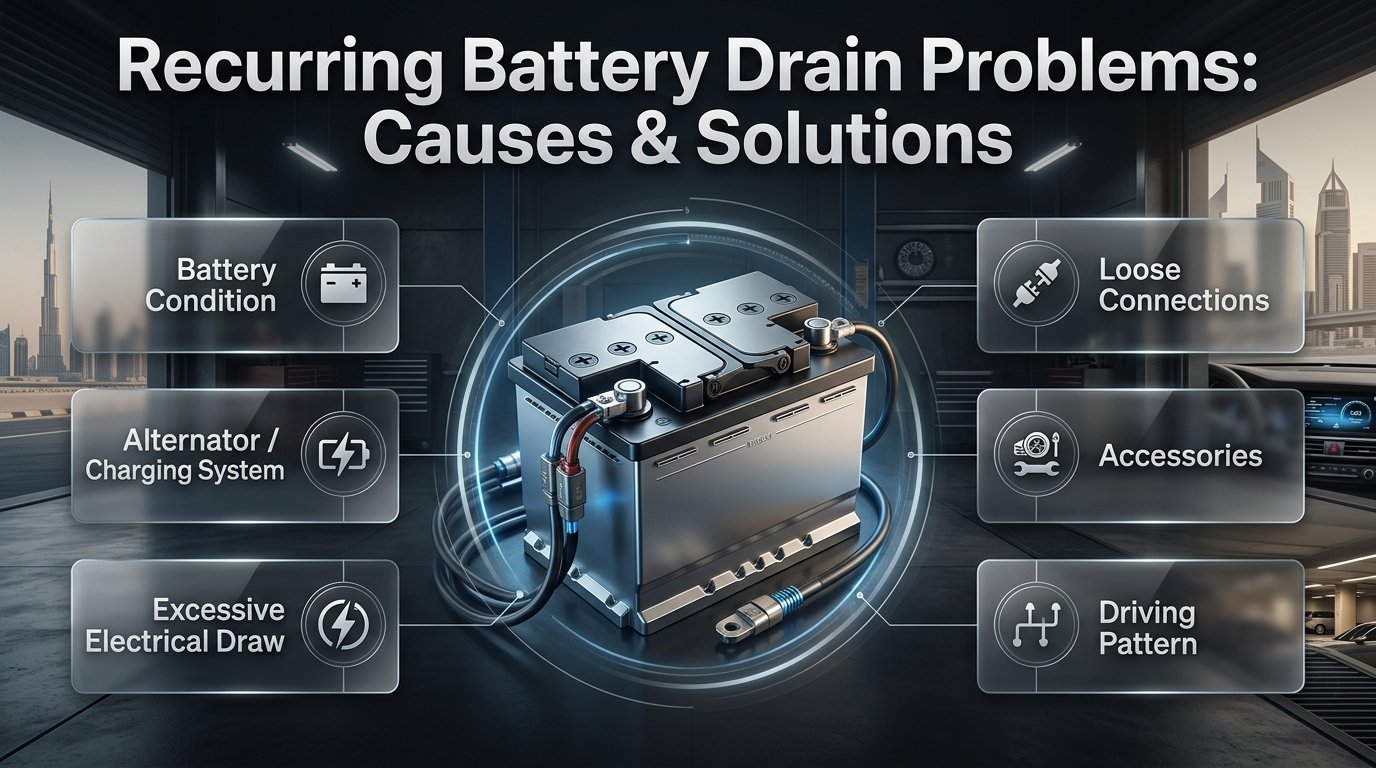
Recurring Battery Drain Problems | A car battery that keeps going flat is rarely a problem that should be solved by repeatedly replacing or jump-starting the battery. When recurring battery drain problems continue, the real issue may be hidden somewhere in the vehicle’s charging system, electrical components, wiring, accessories, or driving pattern.
For drivers in Dubai, repeated short journeys, heavy air-conditioning use, high temperatures, long periods of parking, and modern vehicles with numerous electronic systems can make battery-related problems more noticeable. If the battery loses charge again shortly after being recharged or replaced, it is important to identify why the vehicle is consuming or failing to restore electrical power.
For professional support, EuroSwift Auto Services provides automotive assistance covering battery-related problems, vehicle diagnostics, maintenance, and roadside situations.
The right approach is not simply to install another battery. A proper diagnosis should determine whether the problem comes from the battery itself, the alternator, excessive electrical draw, loose connections, an accessory, or another underlying fault.
What Are Recurring Battery Drain Problems?
Recurring battery drain occurs when a vehicle’s battery repeatedly loses enough charge that the engine becomes difficult or impossible to start, even after the battery has previously been charged or the vehicle has been jump-started.
A single discharged battery does not automatically mean the battery is defective. Leaving lights on, using electrical accessories while the engine is off, or leaving the vehicle parked for an extended period can temporarily discharge a healthy battery.
The concern becomes different when the same problem happens repeatedly without an obvious reason.
Common patterns include:
- The car starts normally one day but is completely flat the next morning.
- A recently replaced battery repeatedly becomes weak.
- The vehicle requires frequent jumpstarts.
- The battery works after driving but goes flat after parking.
- Electrical systems behave strangely before starting failure.
- The battery loses charge even when the vehicle is driven regularly.
- The vehicle starts normally after a long drive but struggles after several short trips.
Repeated symptoms should be treated as a diagnostic problem rather than simply a battery replacement issue.
Why Does a Car Battery Keep Draining?
There is no single cause behind recurring battery drain. The battery is part of a larger electrical system, and a fault anywhere in that system can affect starting reliability.
The most common causes include:
| Possible Cause | How It Can Affect the Battery |
|---|---|
| Parasitic electrical draw | An electrical component continues consuming power while the vehicle is parked |
| Weak alternator | Battery is not adequately recharged while driving |
| Aging battery | Battery loses its ability to hold sufficient charge |
| Loose battery terminals | Poor electrical connection can interfere with charging and starting |
| Corrosion | Resistance at electrical connections can reduce current flow |
| Short journeys | The battery may not recover energy used during starting |
| Aftermarket accessories | Improperly installed devices may continue drawing power |
| Faulty electronic module | A module may fail to enter its normal sleep state |
| Lights left on | Continuous electrical consumption can discharge the battery |
| Vehicle storage | Long periods without driving can gradually reduce battery charge |
The important point is that replacing the battery without identifying the underlying cause may only provide a temporary improvement.
Parasitic Drain: One of the Most Common Hidden Causes
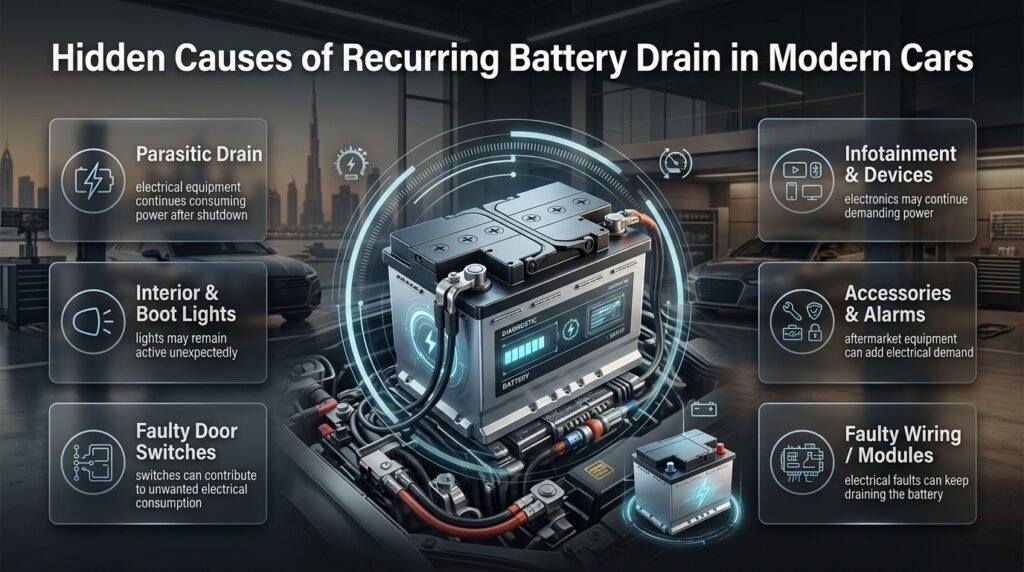
A parasitic drain occurs when electrical equipment continues consuming battery power after the vehicle has been switched off and should have entered its normal resting state.
Modern vehicles naturally use a small amount of electricity while parked. Security systems, memory functions, vehicle computers, and other systems may require standby power.
The problem occurs when electrical consumption remains significantly higher than the vehicle’s normal resting requirement.
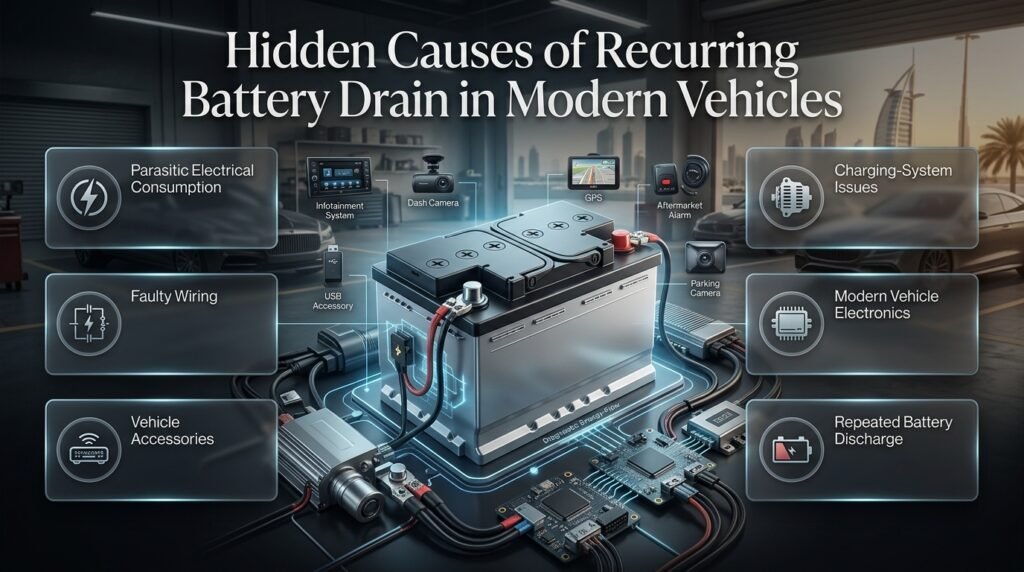
Potential sources can include:
- Interior or boot lights
- Faulty door switches
- Infotainment systems
- Dash cameras
- GPS devices
- Aftermarket alarms
- USB accessories
- Parking cameras
- Modified audio systems
- Faulty control modules
- Electrical wiring problems
A professional inspection can help isolate the circuit responsible instead of guessing which component is causing the drain.
Why a New Battery Can Still Keep Going Flat
One of the most frustrating situations for drivers is installing a new battery and experiencing the same problem again.
A new battery does not repair a faulty alternator, parasitic drain, damaged wiring, or an incorrectly installed accessory.
If the vehicle has an underlying electrical fault, the replacement battery may simply become the next battery affected by the same problem.
Before replacing another battery, it is sensible to consider:
- Battery condition
- Charging-system performance
- Electrical connections
- Resting electrical consumption
- Vehicle accessories
- Starting-system condition
- Driving pattern
- Vehicle storage habits
If testing confirms that the battery itself has failed, then professional Battery Replacement may be appropriate. EuroSwift’s dedicated Car Battery Replacement service in Dubai can be considered when replacement is actually required.
How Short Trips Can Contribute to Battery Drain
Short-distance driving is often overlooked.
Starting the engine requires a significant burst of electrical energy. Once the engine is running, the charging system must replenish that energy while also supporting the vehicle’s electrical loads.
If the vehicle is repeatedly used for very short journeys, there may be limited time for the charging system to restore the energy consumed during starting.
This does not necessarily mean short trips will damage a healthy battery immediately. However, a vehicle that spends most of its time making short journeys may be more vulnerable when combined with an aging battery, heavy electrical demand, or a charging-system problem.
A better maintenance approach is to investigate the overall pattern rather than blaming short trips alone.
Can Dubai Heat Make Recurring Battery Problems Worse?
Dubai’s climate creates demanding conditions for automotive components, particularly batteries.
High ambient temperatures can accelerate battery aging and increase the stress placed on electrical components. Vehicles also rely heavily on air conditioning, which increases electrical and mechanical demand during everyday driving.
Heat does not automatically mean that every battery will fail early, but it makes battery condition and charging-system health especially important.
Drivers should pay attention to:
- Slow engine cranking
- Repeated jumpstart requirements
- Battery warning indicators
- Unusual electrical behavior
- Visible terminal corrosion
- A battery that is approaching the end of its service life
If these signs appear together, arranging a proper inspection is more useful than waiting for complete starting failure.
Alternator Problems Can Look Like Battery Problems
The alternator is responsible for producing electrical power while the engine is running and helping maintain battery charge.
When the alternator is weak or its charging system is not operating correctly, the vehicle may gradually consume more battery energy than it can restore.
This can create a confusing cycle:
Battery becomes weak → vehicle is jump-started → vehicle runs temporarily → battery remains inadequately charged → vehicle struggles again later.
Possible charging-system concerns include:
- Alternator output problems
- Drive belt issues
- Wiring faults
- Poor electrical connections
- Charging-system control problems
- Battery terminal resistance
This is why battery testing and charging-system testing should be considered together when a battery repeatedly becomes discharged.
Battery Terminals and Connections Matter
Not every recurring battery problem is caused by the battery internally.
The terminals must provide a reliable electrical connection between the battery and the vehicle. Loose, contaminated, or corroded connections can create resistance and interfere with both starting and charging.
During inspection, attention should be given to:
- Positive terminal condition
- Negative terminal condition
- Terminal tightness
- Ground connections
- Visible corrosion
- Battery mounting
- Related wiring
A battery can be perfectly capable of holding charge but still perform poorly if the electrical connection between the battery and vehicle is compromised.
Aftermarket Accessories and Electrical Modifications
Modern vehicles often contain accessories that were not installed at the factory. These may include dash cameras, tracking systems, upgraded audio equipment, additional lighting, alarms, and other electronic devices.
Poor installation can create unwanted electrical consumption.
For example, an accessory may continue operating when the vehicle is parked instead of switching off with the ignition. A wiring modification may also connect a device to a circuit that was not designed for continuous operation.
If recurring drain began after installing an accessory, that timing is an important diagnostic clue.
Do not immediately remove components at random. A systematic electrical inspection can identify whether an accessory is actually responsible.
How Professionals Diagnose a Recurring Battery Drain
A proper diagnosis should follow a logical process instead of replacing parts based on symptoms alone.
Step 1: Check the Battery
The first step is to establish whether the battery can still hold an appropriate charge.
A technician may inspect:
- Battery condition
- Voltage
- Starting performance
- Physical condition
- Terminal condition
- Battery age and history
A battery that has repeatedly been deeply discharged may have suffered permanent loss of capacity.
Step 2: Test the Charging System
The charging system should then be checked to determine whether the battery receives adequate charging while the engine is running.
This helps distinguish between:
Battery unable to hold charge
and
Vehicle failing to recharge the battery correctly.
Step 3: Check for Excessive Electrical Draw
If the battery and charging system appear suitable, the next area of investigation is the vehicle’s electrical consumption while parked.
The vehicle may need time to enter its normal sleep state before measurements become meaningful.
The technician can then investigate abnormal consumption and isolate the relevant circuit or component.
Step 4: Inspect Wiring and Connections
Electrical testing should be supported by a physical inspection.
Technicians can look for:
- Loose terminals
- Corrosion
- Damaged wiring
- Poor grounding
- Aftermarket wiring
- Signs of previous electrical work
- Damaged connectors
Step 5: Verify the Repair
After the suspected cause has been addressed, the system should be checked again.
A repair is not fully successful simply because the engine starts once. The objective is to establish that the vehicle can start reliably and maintain appropriate battery charge during normal use.
Recurring Battery Drain Troubleshooting Guide
| Symptom | Possible Direction | Recommended Approach |
|---|---|---|
| Battery flat overnight | Parasitic drain or lights/accessory | Electrical draw inspection |
| Battery weak after short trips | Insufficient recovery or battery condition | Battery and charging-system test |
| New battery repeatedly fails | Underlying electrical fault | Full diagnostic inspection |
| Battery warning appears while driving | Charging-system issue | Alternator and charging inspection |
| Slow cranking in the morning | Weak battery or electrical issue | Battery and starting-system testing |
| Vehicle struggles after long parking | Battery self-discharge, aging, or drain | Battery condition and parked-current test |
| Electrical problems after accessory installation | Accessory wiring | Inspect installation and circuit |
| Battery terminals visibly corroded | Connection resistance | Terminal and cable inspection |
When Should You Stop Replacing the Battery?
Repeated battery replacement without diagnosis is usually the wrong strategy.
If the same vehicle has required multiple batteries within an unusually short period, the question should change from:
“Which battery should I buy?”
to:
“Why is this vehicle repeatedly losing battery capacity?”
That shift is important because the battery may only be the component showing the symptom.
Before another replacement, consider professional inspection of:
- Battery health
- Alternator performance
- Starter system
- Electrical draw
- Battery connections
- Grounding
- Accessories
- Wiring
- Vehicle control modules
If testing confirms a failed battery, choosing the correct replacement remains important. EuroSwift also provides brand-specific options such as Amaron Battery Replacement in Dubai and Bosch Battery Replacement in Dubai depending on vehicle requirements.
Choosing the Correct Battery After a Drain Problem
Once the actual cause has been identified and repaired, the replacement battery should match the vehicle’s requirements.
The correct choice can depend on:
- Vehicle model
- Engine configuration
- Battery dimensions
- Required capacity
- Cold-cranking requirements
- Electrical equipment
- Start-stop technology
- Manufacturer specifications
Some modern vehicles require specific battery technologies rather than a generic replacement.
For example, vehicles designed around start-stop systems may require an appropriate AGM or EFB battery rather than an unsuitable conventional battery.
EuroSwift’s AGM Battery Replacement service is relevant where AGM technology is specified by the vehicle.
Other available brand-specific options include Tuflong Battery Replacement, Exide Battery Replacement, Panasonic Battery Replacement, FIAMM Battery Replacement, and AC Delco Battery Replacement.
The correct battery should always be selected according to the vehicle’s specifications rather than choosing solely by brand or price.
How to Prevent Recurring Battery Drain Problems
Prevention starts with understanding how the vehicle is used.
A practical battery-maintenance routine should include:
- Inspecting the battery periodically.
- Checking terminals for corrosion or looseness.
- Paying attention to slow engine cranking.
- Testing the charging system when battery problems repeat.
- Avoiding unnecessary electrical accessories while parked.
- Checking aftermarket equipment for correct installation.
- Addressing warning lights promptly.
- Having recurring electrical problems professionally diagnosed.
- Maintaining the vehicle according to its service requirements.
- Avoiding repeated jumpstarts as a permanent solution.
Drivers who regularly leave their vehicles parked for extended periods should be especially attentive to battery condition.
Recurring Drain vs Normal Battery Discharge
Not every loss of battery charge indicates an electrical fault.
| Situation | More Likely Explanation |
|---|---|
| Vehicle parked for a very long period | Natural battery discharge may occur |
| Interior light left on | Preventable electrical consumption |
| Battery is several years old | Reduced battery capacity |
| Battery repeatedly dies after normal parking | Possible parasitic drain |
| Battery goes weak despite regular driving | Charging or battery issue should be investigated |
| New battery repeatedly becomes flat | Underlying fault should be diagnosed |
| Battery warning appears during driving | Charging-system inspection is important |
The difference is consistency. A one-time mistake may explain a single discharge. Repeated unexplained discharge deserves a proper diagnosis.
Common Mistakes That Make Battery Problems Worse
Replacing the Battery Without Testing
Installing another battery can temporarily hide the symptom while leaving the real fault untouched.
Assuming Every Flat Battery Is Defective
A discharged battery and a failed battery are not necessarily the same thing.
Ignoring the Alternator
A battery cannot remain healthy if the charging system is consistently failing to restore its charge.
Leaving Aftermarket Accessories Unchecked
A recently installed electronic device can be an important clue when recurring drain starts suddenly.
Depending on Jumpstarts
A jumpstart gets the vehicle running, but it does not diagnose or repair the reason the battery became discharged.
Ignoring Early Warning Signs
Slow cranking, intermittent electrical behavior, and repeated low-battery symptoms should be investigated before complete starting failure occurs.
Professional Recommendation for Dubai Drivers
When battery drain happens repeatedly, treat the pattern as a vehicle electrical diagnosis issue rather than simply a battery-shopping problem.
A professional inspection should establish three things:
Is the battery healthy?
Is the charging system working correctly?
Is the vehicle consuming abnormal electrical power while parked?
Once those questions are answered, the repair path becomes much clearer.
For drivers who experience a sudden no-start situation, professional Car Jumpstart or Roadside Assistance can provide immediate help. However, after the vehicle is running again, the underlying cause should still be investigated if the problem has occurred more than once.
If the battery issue is part of a wider mechanical or electrical problem, related Vehicle Inspection, Engine Diagnostics, Car Service, or Vehicle Maintenance may also be appropriate depending on the symptoms.
Battery Drain Maintenance Checklist
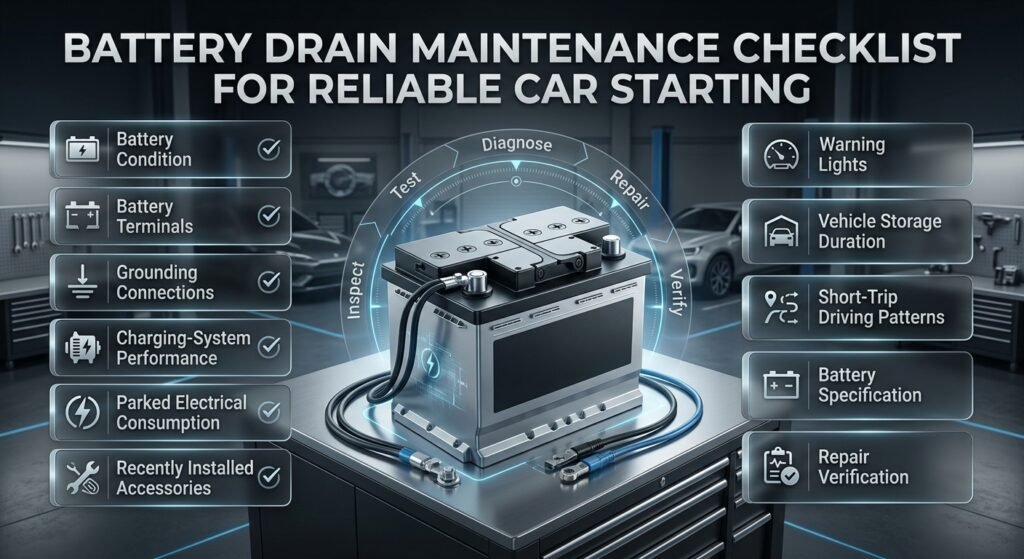
Use this checklist if your vehicle has experienced repeated battery problems:
✔ Check battery condition
✔ Inspect battery terminals
✔ Check grounding connections
✔ Test charging-system performance
✔ Investigate abnormal parked electrical consumption
✔ Review recently installed accessories
✔ Check for warning lights
✔ Consider vehicle storage duration
✔ Review short-trip driving patterns
✔ Confirm the battery specification
✔ Verify the repair after diagnosis
The goal is not merely to make the car start today. The goal is to restore dependable starting performance and prevent the same fault from returning.
Understanding the Cost of Recurring Battery Problems
The final cost depends heavily on the cause.
A straightforward battery replacement is different from diagnosing a persistent electrical drain, repairing damaged wiring, replacing an alternator, or correcting an incorrectly installed accessory.
Cost can be influenced by:
- Battery type
- Vehicle model
- Battery capacity
- Diagnostic time
- Electrical fault complexity
- Replacement components
- Installation requirements
- Charging-system repairs
For current battery pricing considerations, the EuroSwift Car Battery Prices in Dubai 2026 guide can help explain how battery choice and replacement requirements can affect the overall expense.
A useful principle is to diagnose first and replace second. Spending money on multiple batteries without finding the cause can ultimately cost more than a proper inspection.
Final Thoughts
Recurring Battery Drain Problems should never be treated as a simple cycle of “battery dies, jump-start, replace battery, repeat.” A healthy starting system depends on the battery, alternator, wiring, electrical connections, control modules, and the vehicle’s overall usage pattern working together.
For Dubai drivers, environmental conditions and demanding daily driving can make battery maintenance particularly important, but repeated discharge still requires proper diagnosis rather than assumptions.
The most reliable approach is straightforward: test the battery, verify the charging system, investigate abnormal electrical consumption, inspect connections and accessories, and only then decide whether repair or Battery Replacement is necessary.
When the underlying cause is correctly identified, the vehicle becomes easier to maintain, starting reliability improves, and unnecessary replacement costs can be avoided. Regular Vehicle Maintenance, timely Car Service, and professional diagnostics remain the best long-term strategy for preventing recurring electrical problems.
Why does my car battery keep dying even after I replace it?
If a newly installed battery keeps going flat, the battery itself may not be the real problem. A recurring drain can come from a weak charging system, excessive electrical consumption while the vehicle is parked, poor battery connections, wiring problems, or an aftermarket accessory that does not shut down correctly.
Replacing the battery can temporarily restore starting power, but it will not correct an underlying electrical fault. This is why repeated battery replacement without diagnosis can turn into an expensive cycle.
Professional points to check:
Test the battery’s ability to hold a charge.
Check alternator and charging-system performance.
Inspect battery terminals and ground connections.
Investigate abnormal electrical consumption while parked.
Review recently installed accessories or electrical modifications.
Check whether the vehicle’s electronic systems are entering their normal sleep state.
If the same problem continues with a replacement battery, the next step should normally be diagnosis rather than another battery replacement.
How can I tell if my car has a parasitic battery drain?
A parasitic drain is suspected when the battery repeatedly loses charge while the vehicle is switched off and there is no obvious reason for the discharge. Modern vehicles naturally use a small amount of standby power, but a faulty component or accessory can continue drawing excessive current after the car has been parked.
Common clues include a battery that is fine immediately after driving but becomes weak after sitting overnight or for several days. The problem may also appear after installing a dash camera, audio system, alarm, tracker, or another electronic accessory.
Potential sources include:
Interior or boot lights
Aftermarket stereos
Dash cameras
Alarm systems
USB or 12V accessories
Faulty switches
Electronic control modules
Wiring or grounding faults
A proper electrical inspection is more reliable than guessing which accessory is responsible. The goal is to identify the circuit creating the abnormal drain and then correct the actual fault.
Can short trips cause recurring battery drain problems?
Frequent short trips can contribute to battery problems because starting the engine consumes electrical energy, while the alternator needs operating time to replenish that energy. Repeated short journeys may therefore leave the battery at a lower state of charge, particularly when the battery is already aging or the vehicle has other electrical demands.
This does not mean every short trip automatically causes battery failure. The bigger concern is a combination of short-distance driving, an aging battery, extended parking, heavy electrical loads, or an inefficient charging system.
If your driving mostly consists of short journeys:
Pay attention to slow engine cranking.
Monitor repeated starting difficulties.
Have the battery tested periodically.
Check the charging system if discharge becomes frequent.
Avoid assuming that a jump-start has permanently solved the problem.
If the battery repeatedly becomes weak despite normal vehicle use, professional Vehicle Inspection and electrical diagnosis can determine whether driving habits are actually contributing to the issue.
Does a bad alternator cause the battery to keep dying?
A charging-system problem can cause repeated battery discharge because the alternator is responsible for supplying electrical power while the engine is running and helping recharge the battery. If charging performance is inadequate, the battery can gradually lose its reserve even though the vehicle may start normally after a jump-start or temporary recharge.
A battery warning or charging-system warning while driving should not be ignored. Possible causes can include alternator problems, wiring issues, a voltage-regulator fault, or problems with the belt driving the alternator.
A professional charging-system check should consider:
Alternator output
Charging voltage
Wiring and voltage drop
Battery terminals
Ground connections
Drive belt condition
Battery condition
This distinction matters because installing a new battery while leaving a charging-system fault unresolved can result in the replacement battery becoming discharged again.
Should I replace my battery if it keeps draining, or repair the electrical problem first?
The better decision depends on why the battery is draining. If testing shows that the battery has lost its ability to hold an adequate charge, replacement may be necessary. However, if the battery is being repeatedly discharged because of parasitic drain, poor charging, wiring problems, or an accessory, the underlying problem should be addressed as well.
A battery that has been repeatedly discharged may also be weakened by that history, so diagnosing the electrical problem does not automatically mean the existing battery will remain suitable.
A sensible professional sequence is:
Test the battery.
Check the charging system.
Inspect terminals and grounds.
Investigate excessive parked electrical consumption.
Identify and repair the underlying fault.
Replace the battery only if its condition requires it.
Verify that the charging and electrical systems are operating correctly afterward.
This approach is more effective than simply replacing batteries whenever the vehicle fails to start. The objective is to solve the cause of the recurring drain, not just restore power temporarily.
Expert Takeaway
When a car battery repeatedly goes flat, “bad battery” should not automatically be the final diagnosis. Battery condition, alternator performance, electrical draw, connections, accessories, and driving patterns can all play a role. For a recurring problem, proper testing is what separates a temporary fix from a reliable repair.
Conclusion
Recurring Battery Drain Problems are usually a sign that something in the vehicle needs closer attention. While an aging or damaged battery can certainly be responsible, repeated discharge may also point to a charging-system fault, parasitic electrical draw, poor connections, wiring issues, aftermarket accessories, or a driving pattern that does not allow the battery to recover properly.
The most effective solution is to diagnose the complete starting and charging system instead of repeatedly replacing the battery. Battery testing, alternator inspection, electrical-draw testing, terminal checks, and a review of accessories can help identify the actual source of the problem.
For Dubai drivers, regular Vehicle Maintenance, timely Car Service, and professional Vehicle Inspection can help reduce the risk of unexpected starting problems. When a battery repeatedly goes flat, professional Battery Replacement, Car Jumpstart, or Roadside Assistance may be necessary depending on the diagnosis and immediate situation.
Ultimately, reliable starting performance comes from fixing the cause—not simply treating the symptom. Identifying the underlying fault early can protect the battery, reduce unnecessary repair costs, and help keep the vehicle dependable for everyday driving.
Leave a Reply