
Introduction
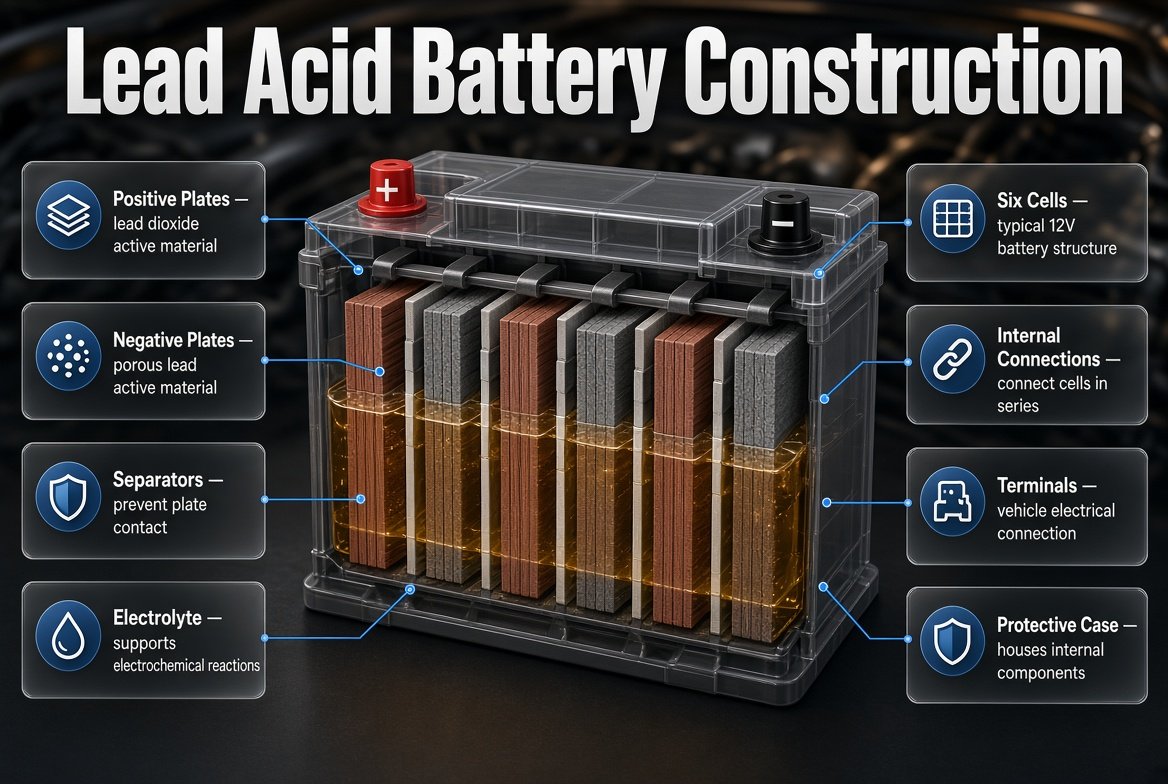
Lead Acid Battery Construction | A lead acid battery may look like a simple box under the hood, but its internal construction is carefully designed to deliver high current when a vehicle needs it most. From the outer polypropylene case to the positive and negative plates, separators, electrolyte, inter-cell connections, and terminals, every component has a specific role in storing and releasing electrical energy.
Understanding lead acid battery construction is useful for anyone who wants to understand how a conventional automotive battery works, why battery performance changes with age, and what can cause starting problems. It is also valuable when choosing a replacement because battery size alone does not tell the complete story. Plate design, capacity, starting performance, construction technology, and compatibility with the vehicle’s charging system all matter.
For Dubai drivers, battery construction is especially relevant because high ambient temperatures, engine-bay heat, frequent short trips, traffic congestion, and extended periods of vehicle inactivity can place additional demands on automotive batteries.
For broader guidance on vehicle batteries and professional automotive support, EuroSwift Auto Services provides a useful starting point for understanding available battery and vehicle-support services.
What Is a Lead Acid Battery?
A lead acid battery is a rechargeable electrochemical energy-storage device that converts chemical energy into electrical energy during discharge and converts electrical energy back into stored chemical energy during charging.
The traditional automotive version consists of multiple cells connected in series. A typical 12-volt automotive lead acid battery contains six cells, with each cell contributing roughly 2 volts of nominal voltage. Modern vehicle batteries are assembled from positive and negative plates, separators, electrolyte, a container, a lid, inter-cell connections, and external terminals.
The basic construction can be understood through several major groups:
- Battery container
- Cell partitions
- Positive plates
- Negative plates
- Plate grids
- Active material
- Separators
- Electrolyte
- Plate straps
- Inter-cell connectors
- Positive and negative terminals
- Cover and venting system
Although the technology is mature, automotive lead acid battery design has continued to evolve. Manufacturers have improved grid alloys, plate formulations, separators, internal connections, case design, and manufacturing processes to increase starting performance, durability, and resistance to vibration.
Main Components of Lead Acid Battery Construction
The best way to understand the battery is to examine it component by component.
Each part performs a different function, but the components must work together as one electrochemical system.
| Component | Main Function |
|---|---|
| Container | Houses and protects the internal components |
| Cell partitions | Separate individual battery cells |
| Positive plates | Contain lead dioxide active material when charged |
| Negative plates | Contain porous/spongy lead active material when charged |
| Grid | Supports active material and conducts current |
| Separators | Prevent positive and negative plates from touching |
| Electrolyte | Provides ionic medium for electrochemical reactions |
| Inter-cell connectors | Connect cells in series |
| Terminals | Connect battery to the vehicle electrical system |
| Cover | Seals and protects the upper part of the battery |
| Sediment space | Collects material that may shed from plates |
This basic arrangement is documented in technical battery-construction references, including GS Yuasa’s construction documentation.
1. Battery Container and Outer Case
The outer case is the foundation of the battery.
It protects the internal plates and electrolyte from mechanical damage while also maintaining the correct physical arrangement of the cells. Modern automotive battery containers are commonly manufactured from strong plastic materials such as polypropylene.
The case must perform several jobs at the same time.
It needs to:
- Resist vibration
- Tolerate temperature changes
- Resist chemical attack from electrolyte
- Hold the plates securely
- Prevent electrolyte leakage
- Maintain separation between cells
- Support the battery cover
- Provide space for sediment accumulation
Automotive batteries experience considerable vibration and temperature variation. The case therefore cannot simply be a container; it must be part of the structural design.
Why the Case Design Matters
A weak or damaged case can compromise the entire battery.
Cracks, deformation, leakage, or damage around the terminal area can create serious reliability problems. Even if the internal plates remain chemically active, a damaged housing can make the battery unsuitable for continued service.
This is why a professional Vehicle Inspection should include checking the battery housing, terminals, hold-down arrangement, visible leakage, and signs of corrosion.
2. Battery Cells
The internal case is divided into separate compartments known as cells.
A typical 12-volt automotive lead acid battery contains six cells connected in series. A 6-volt battery, by comparison, generally uses three cells.
Each cell contains its own group of positive and negative plates immersed in electrolyte.
The cells are electrically connected so that their individual voltages add together.
For example:
| Battery Type | Approximate Number of Cells | Nominal Voltage |
|---|---|---|
| 6V lead acid battery | 3 | 6V |
| 12V automotive battery | 6 | 12V |
| Individual cell | 1 | About 2V |
The exact measured voltage of a charged battery is higher than its nominal rating under appropriate conditions. A commonly referenced fully charged 12-volt lead acid battery can measure around 12.6 volts at rest, although actual readings vary with temperature, state of charge, battery condition, and measurement conditions.
3. Positive Plates
Positive plates are one of the most important parts of lead acid battery construction.
The positive plate consists of a supporting grid carrying active material. In a charged conventional lead acid battery, the positive active material is primarily lead dioxide, commonly represented as PbO₂.
The grid provides mechanical support while also providing an electrical pathway.
The active material needs to have sufficient surface area to interact effectively with the electrolyte. This is one reason automotive battery plate structures are designed with carefully controlled material distribution and geometry.
Why Positive Plate Design Matters
The positive plate must withstand repeated charge and discharge cycles.
During operation, the active material undergoes chemical changes. Over time, repeated cycling, vibration, temperature stress, corrosion, and material shedding can reduce the plate’s ability to perform efficiently.
Modern battery manufacturing therefore focuses heavily on:
- Grid composition
- Active-material formulation
- Paste adhesion
- Plate thickness
- Mechanical strength
- Corrosion resistance
- Surface area
- Manufacturing consistency
The exact formulation varies between battery manufacturers and product types.
4. Negative Plates
Negative plates are also constructed around a conductive grid, but their active material is different.
In the charged state, the negative active material is primarily porous or spongy lead. This porous structure provides substantial contact with the electrolyte.
The negative plate has to maintain its structural integrity while allowing electrochemical reactions to occur throughout the active material.
Special additives can be incorporated into negative-plate formulations to influence characteristics such as charge acceptance, durability, and performance.
The positive and negative plates therefore look similar from a structural perspective but perform different electrochemical roles.
5. Battery Grids
A plate is not simply a solid piece of lead.
Inside the plate is a grid structure that acts as a supporting framework and current collector.
The grid holds the active material in place and provides a conductive pathway between the active material and the battery’s external electrical connections.
Historically, lead-antimony alloys were widely used in battery grids. Modern designs can use different lead alloys, including calcium-based formulations, depending on battery technology and performance objectives.
The choice of grid material influences factors such as:
- Mechanical strength
- Corrosion resistance
- Water loss
- Manufacturing characteristics
- Electrical performance
- Service requirements
Modern automotive battery development has also focused on lighter grids and improved internal geometry to reduce resistance while maintaining adequate mechanical performance.
6. Active Material on the Plates
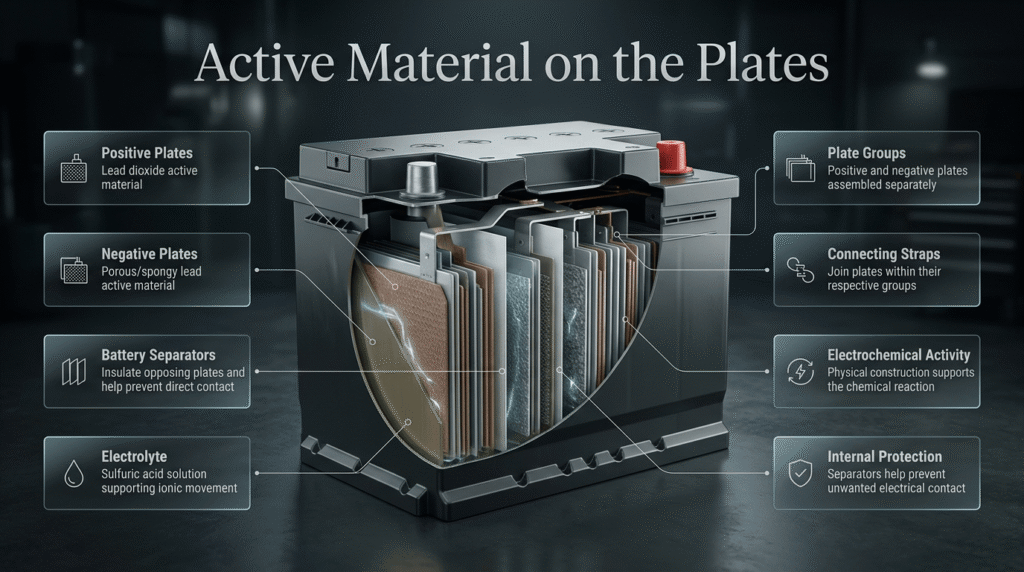
The active material is where much of the battery’s electrochemical activity occurs.
During manufacturing, a carefully formulated paste is applied to the grids. The plates are then cured and processed so the material develops the required structure and adhesion.
GS Yuasa describes the manufacturing process as involving grid production, application of active paste, curing, assembly, and subsequent formation.
The final electrochemically active materials in a conventional charged battery are broadly:
- Positive plate: lead dioxide
- Negative plate: porous/spongy lead
- Electrolyte: sulfuric acid solution
During discharge, both electrode materials participate in reactions that produce lead sulfate and alter the electrolyte composition.
This is why battery construction cannot be separated from battery chemistry. Physical design determines how effectively the chemical reactions can occur.
7. Battery Separators
Separators are thin, electrically insulating materials placed between positive and negative plates.
Their primary job is simple but critical:
Prevent the positive and negative plates from making direct electrical contact.
If opposing plates touch, an internal short circuit can occur.
At the same time, the separator cannot completely block the electrolyte. It must allow ionic movement between the plates so the electrochemical reaction can continue.
Modern separators can be manufactured from microporous polyethylene and other specialized materials. AGM batteries use absorbent glass mat technology, where the glass mat performs both separation and electrolyte-retention functions.
A good separator needs a combination of:
- Electrical insulation
- Porosity
- Chemical compatibility
- Mechanical strength
- Controlled pore structure
- Low electrical resistance
- Resistance to degradation
Separator Failure
Separator damage can contribute to internal short circuits.
Possible causes include:
- Excessive vibration
- Plate shedding
- Manufacturing defects
- Physical deformation
- Internal material growth
- Age-related deterioration
This is one reason a battery can sometimes fail internally even when its exterior looks normal.
8. Electrolyte
The electrolyte is another fundamental part of lead acid battery construction.
In conventional flooded lead acid batteries, the electrolyte is a solution of sulfuric acid and water.
It provides the ionic environment required for the electrochemical reaction between the positive and negative active materials.
The electrolyte is not simply “battery liquid.” Its concentration and condition are closely connected to the battery’s state of charge and operating condition.
During discharge, sulfuric acid participates in the reaction and the concentration of the electrolyte changes. During charging, the chemical process reverses.
This relationship is one reason electrolyte condition has historically been important in serviceable flooded batteries.
Important Safety Point
Battery electrolyte contains sulfuric acid and can cause serious chemical burns. Battery servicing should therefore be performed using appropriate protective equipment and professional procedures.
Do not open, modify, or attempt to reconstruct a battery yourself.
9. Plate Groups and Battery Elements
Individual plates are assembled into groups.
Positive plates are connected together electrically, while negative plates are connected together separately. Separators are positioned between opposing plates.
This arrangement creates a complete cell element.
The battery element includes:
- Positive plate group
- Negative plate group
- Separators
- Plate straps
- Internal connections
The element is then positioned inside its cell compartment.
Technical construction documentation describes the battery element as consisting of positive and negative plates, separators, and connecting straps.
This construction allows many plates to operate together within one cell.
10. Plate Straps and Internal Connections
The plates need a reliable electrical connection.
Plate groups are connected using conductive straps, which collect current from multiple plates and transfer it toward the inter-cell connections and external terminals.
In modern manufacturing, plate groups can be connected using specialized welding and cast-on-strap processes.
The quality of these connections matters because automotive batteries may need to deliver very high current during engine starting.
A connection with excessive resistance can create:
- Voltage drop
- Heat generation
- Reduced starting performance
- Uneven current distribution
- Premature failure
For this reason, internal connection quality is an important part of battery manufacturing.
11. Inter-Cell Connections
The six cells of a typical 12-volt automotive battery must be connected in series.
The positive side of one cell is connected to the negative side of the next cell.
This arrangement adds the voltage produced by each cell.
The internal connectors must carry substantial current while remaining mechanically secure and resistant to the operating environment inside the battery.
Some modern battery manufacturing systems use connections through or across cell partitions, depending on the design.
The objective remains the same: create a low-resistance, reliable electrical pathway between cells.
12. Battery Terminals
The external terminals provide the connection between the battery and the vehicle’s electrical system.
There are two primary terminals:
- Positive (+)
- Negative (−)
The positive terminal connects to the vehicle’s positive electrical circuit, while the negative terminal connects to the vehicle’s ground/return path.
Terminal design varies between vehicle applications.
Some batteries use traditional top posts, while others use side-terminal or application-specific arrangements.
Terminal condition is important because corrosion or poor connection can increase resistance and interfere with current flow.
A battery can be healthy internally but still produce starting problems if the external terminal connection is poor.
13. Battery Cover and Venting System
The battery cover closes the top of the container and provides the mounting structure for terminals and, depending on the battery design, venting or service features.
Traditional flooded batteries may have individual cell caps.
Many modern automotive batteries are maintenance-free designs with more controlled venting and reduced water-loss requirements.
The cover must provide:
- Structural sealing
- Terminal support
- Venting provisions
- Protection from contamination
- Resistance to electrolyte exposure
Battery venting is important because gas can be produced during charging under certain conditions.
14. Sediment Space at the Bottom of the Battery
Another interesting part of lead acid battery construction is the space below the plates.
During the life of a battery, some active material can shed from the plates.
If this material accumulated directly between positive and negative plates, it could contribute to an internal short circuit.
Battery cases therefore incorporate space or recesses beneath the plate groups to collect sediment away from the active plate area.
This small structural feature demonstrates how battery construction is designed around long-term reliability rather than simply initial performance.
How Lead Acid Battery Construction Produces Electricity
Understanding the physical components becomes much easier when connected to the battery’s operating principle.
When the battery is charged, the positive and negative plates are maintained in different chemical states.
During discharge, the vehicle’s electrical system creates a path between the negative and positive sides of the battery.
The chemical reaction then produces electrical energy.
At a simplified level:
Charged state
- Positive active material: lead dioxide
- Negative active material: porous lead
- Electrolyte: sulfuric acid solution
Discharged state
- Both electrode materials progressively form lead sulfate
- The electrolyte becomes less concentrated
The overall electrochemical reaction is commonly represented as:
PbO₂ + Pb + 2H₂SO₄ ⇌ 2PbSO₄ + 2H₂O
The exact behavior inside a real battery is more complex, but this equation helps explain the basic reversible chemistry.
Lead Acid Battery Construction for Automotive Starting
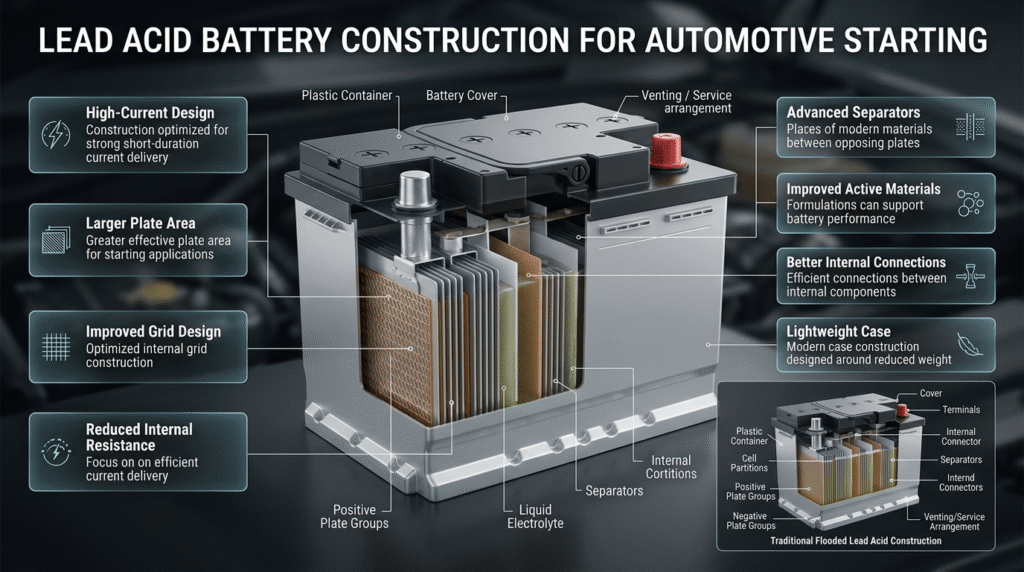
Automotive starting batteries are designed differently from batteries intended primarily for deep-cycle applications.
A starting battery needs to provide a large amount of current for a relatively short period.
This is why automotive SLI batteries—starting, lighting, and ignition batteries—use construction optimized for high-current delivery.
Design improvements have included:
- Larger effective plate area
- Improved grid designs
- Reduced internal resistance
- Advanced separator materials
- Improved active-material formulations
- Better internal connections
- Lightweight case construction
Technical literature notes that automotive starting batteries have evolved through thinner separators, optimized electrode geometry, lightweight grids, and improved case designs.
Flooded Lead Acid Battery Construction
Traditional flooded batteries contain liquid electrolyte surrounding the plates.
Their construction generally includes:
- Plastic container
- Cell partitions
- Positive plate groups
- Negative plate groups
- Separators
- Liquid electrolyte
- Internal connectors
- Terminals
- Cover
- Venting/service arrangement
Some flooded batteries are serviceable, while many modern versions are designed to reduce or eliminate routine electrolyte topping-up.
The exact maintenance requirements depend on the battery design.
A vehicle owner should therefore follow the manufacturer’s specifications rather than assuming every flooded battery should be serviced in the same way.
Maintenance-Free Lead Acid Battery Construction
Modern maintenance-free lead acid batteries are designed to reduce routine servicing.
Changes in grid alloys, plate formulations, separator design, case construction, and venting have helped reduce water loss and improve operational convenience.
However, maintenance-free does not mean failure-proof.
A maintenance-free battery can still suffer from:
- Internal plate degradation
- Sulfation
- Terminal corrosion
- Charging-system problems
- Excessive heat exposure
- Deep discharge
- Long periods without adequate charging
- Physical damage
When a battery is maintenance-free, the correct approach is generally to diagnose its condition rather than attempting to open it.
AGM Construction: How It Differs
Absorbent Glass Mat, or AGM, is an advanced lead acid battery construction.
Instead of having free-flowing electrolyte in the same way as a conventional flooded battery, the electrolyte is absorbed into a glass-mat separator.
This creates a different internal arrangement and allows the battery to provide characteristics useful for vehicles with higher electrical demands and certain start-stop applications.
For drivers who want to understand how AGM technology compares with conventional lead acid construction, the EuroSwift guide to AGM battery replacement in Dubai provides additional context.
The important point is that AGM is still based on lead acid chemistry, but its physical construction and electrolyte management are different.
Lead Acid Battery Construction vs AGM
| Feature | Conventional Flooded | AGM |
|---|---|---|
| Electrolyte | Liquid | Absorbed into glass mat |
| Separator | Microporous separator | Absorbent glass mat |
| Electrolyte movement | Free liquid | Immobilized/retained |
| Typical application | Conventional vehicles | Higher electrical demand/start-stop applications |
| Maintenance | Depends on design | Generally maintenance-free |
| Vibration resistance | Good depending on design | Generally strong |
| Construction complexity | Conventional | More advanced |
The correct replacement should always be based on the vehicle manufacturer’s requirements rather than simply choosing whichever technology appears more advanced.
What Can Go Wrong Inside a Lead Acid Battery?
Because a lead acid battery contains several interacting components, failure can originate from different areas.
Plate degradation
Repeated cycling and operating stress can gradually reduce active material effectiveness.
Sulfation
Lead sulfate naturally forms during discharge. Problems can occur when a battery remains deeply discharged or undercharged for extended periods, allowing difficult-to-reverse sulfate structures to develop.
Grid corrosion
The grid supports the active material and carries current. Over time, corrosion can weaken the grid structure.
Active-material shedding
Material can gradually detach from plates and settle into the sediment area.
Separator problems
Damaged or deteriorated separators can increase the possibility of internal electrical contact.
Electrolyte loss
Water loss or leakage can alter electrolyte condition and reduce battery performance.
Internal connection failure
A damaged internal connection can increase resistance or interrupt current flow.
Common Signs of Lead Acid Battery Problems
The construction of a battery explains many common symptoms.
| Vehicle Symptom | Possible Battery-Related Area |
|---|---|
| Slow engine cranking | Low state of charge, aging plates, high internal resistance |
| Clicking during starting | Insufficient available voltage/current |
| Battery warning symptoms | Charging system or battery condition |
| Repeated dead battery | Battery degradation or charging issue |
| Corroded terminals | Poor connection/environmental exposure |
| Swollen case | Excessive heat, charging problem, or internal failure |
| Battery leakage | Physical damage or serious internal problem |
| Short service life | Heat, charging issues, discharge, unsuitable battery |
These symptoms do not automatically prove that the battery itself is defective.
For example, repeated battery discharge can result from a charging-system fault, parasitic electrical load, poor terminal connection, or another vehicle problem.
That is why Engine Diagnostics, charging-system testing, and Vehicle Inspection can be important when a battery repeatedly fails.
How Heat Affects Lead Acid Battery Construction
Temperature has a major influence on lead acid battery behavior.
In hot environments, chemical reactions accelerate, but excessive heat can also accelerate battery aging and grid corrosion.
This is especially relevant in regions with very high ambient temperatures.
A battery installed inside a hot engine compartment may experience temperatures considerably above the surrounding outdoor temperature.
For Dubai vehicles, practical battery care includes:
- Checking battery condition periodically
- Keeping terminals clean
- Ensuring the battery is securely mounted
- Checking the charging system
- Avoiding unnecessary prolonged discharge
- Replacing an aging battery before repeated starting failures occur
- Using the correct battery specification
Heat does not mean every battery will fail quickly, but it is an important environmental factor when evaluating battery lifespan.
Lead Acid Battery Construction and Charging
Charging reverses much of the chemical process that occurs during discharge.
The vehicle’s alternator normally supplies electrical energy to recharge the battery while the engine is running.
However, the charging system must operate within the vehicle manufacturer’s specifications.
An incorrect charging voltage can contribute to battery problems.
Possible causes of abnormal charging include:
- Alternator problems
- Voltage-regulator issues
- Wiring resistance
- Poor ground connections
- Incorrect battery specification
- Electrical-system faults
A battery should therefore not automatically be blamed when charging-related symptoms appear.
A professional Car Service can include battery and charging-system checks as part of a broader diagnostic process.
Battery Construction and Internal Resistance
Internal resistance is an important performance characteristic.
A battery with low effective internal resistance can deliver high current more efficiently, which is particularly important during engine starting.
As the battery ages, internal changes can increase resistance.
The result may be:
- Greater voltage drop during starting
- Slower cranking
- Increased heat generation
- Reduced available starting power
This is why a battery may show a reasonable voltage reading while still failing a proper load or conductance test.
Voltage alone does not provide a complete picture of battery health.
How Professionals Inspect a Lead Acid Battery
A proper battery inspection should consider the complete electrical system rather than relying on one measurement.
A practical inspection can include:
Visual inspection
Check for:
- Cracks
- Leakage
- Swelling
- Corrosion
- Loose terminals
- Damaged cables
- Poor battery mounting
Resting-voltage check
This provides information about approximate state of charge but should not be treated as a complete health diagnosis.
Starting test
The battery’s behavior during engine cranking can reveal voltage-drop or starting-current problems.
Charging-system test
The alternator and vehicle charging system should be checked when battery problems are recurring.
Battery health test
Professional testers can evaluate characteristics such as available starting performance and internal condition.
Lead Acid Battery Construction and Battery Replacement
When a lead acid battery reaches the end of its useful service life, replacement should focus on compatibility rather than simply physical dimensions.
Important specifications can include:
- Battery size
- Terminal arrangement
- Voltage
- Capacity
- Cold cranking performance
- Reserve capacity
- Battery technology
- Manufacturer requirements
- Vehicle electrical-system requirements
EuroSwift’s car battery replacement service in Dubai is relevant when the issue has moved beyond diagnosis and the battery requires replacement.
For owners comparing replacement costs, the 2026 Dubai car battery price guide can provide useful context about the factors that influence battery pricing.
Why Battery Brand and Construction Both Matter
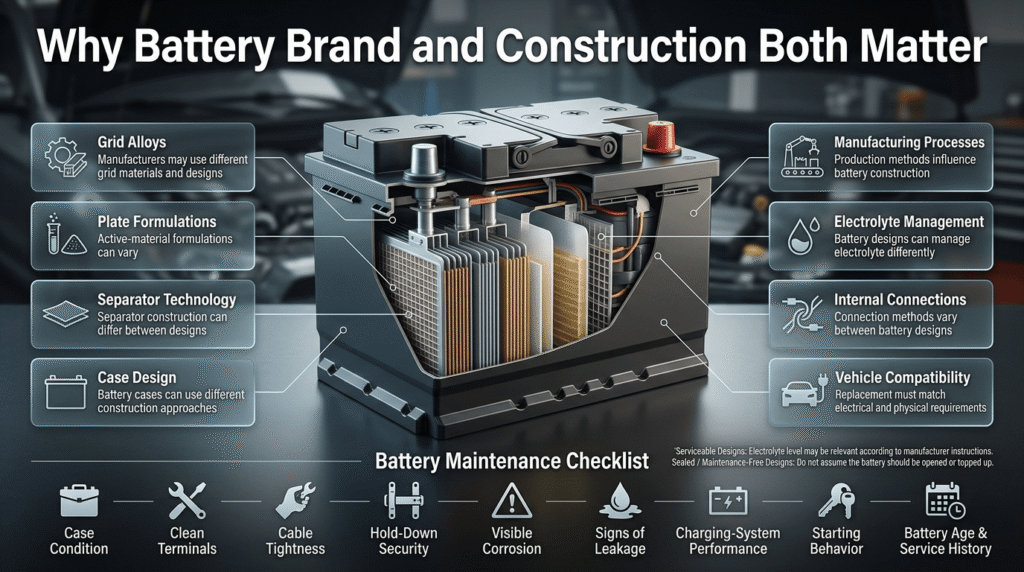
Battery branding alone does not determine suitability.
Different manufacturers can use different combinations of:
- Grid alloys
- Plate formulations
- Separator technology
- Case design
- Manufacturing processes
- Electrolyte management
- Internal connection methods
For example, drivers researching specific replacement options may encounter:
- Amaron car batteries
- Bosch car batteries
- Tuflong car batteries
- Exide car batteries
- Panasonic car batteries
- FIAMM car batteries
- ACDelco car batteries
The important consideration is not simply the name printed on the battery. The replacement should match the vehicle’s electrical and physical requirements.
Lead Acid Battery Construction Maintenance Checklist
A simple maintenance approach can help identify problems before the vehicle becomes difficult to start.
Regularly check:
✔ Battery case condition
✔ Terminal cleanliness
✔ Cable tightness
✔ Battery hold-down security
✔ Visible corrosion
✔ Signs of leakage
✔ Charging-system performance
✔ Starting behavior
✔ Battery age and service history
For conventional serviceable batteries, electrolyte level may also be relevant according to the manufacturer’s instructions.
For sealed or maintenance-free designs, do not assume the battery should be opened or topped up.
Common Mistakes That Reduce Battery Life
Several avoidable conditions can place unnecessary stress on a lead acid battery.
Leaving electrical accessories operating
Lights, entertainment systems, chargers, and other electrical loads can discharge a battery when the engine is not running.
Ignoring repeated slow starting
Slow cranking can be an early warning of battery deterioration or a broader starting-system problem.
Replacing the battery without checking the charging system
If an alternator or charging circuit is faulty, a new battery may also become discharged or damaged.
Choosing the wrong battery specification
Physical fit alone does not guarantee electrical compatibility.
Ignoring terminal corrosion
Poor terminal contact can increase electrical resistance and interfere with starting.
Allowing the vehicle to remain unused for long periods
A vehicle that sits for extended periods can experience battery discharge, especially when electrical systems continue drawing small amounts of current.
Lead Acid Battery Construction and Modern Automotive Technology
Lead acid batteries remain important in modern vehicles even as automotive electrical systems become more sophisticated.
Modern vehicles can have:
- Start-stop systems
- Advanced driver-assistance systems
- Larger infotainment systems
- Electronic control modules
- Remote connectivity
- Increased standby electrical loads
These technologies can increase the importance of correct battery selection.
Some vehicles require enhanced lead acid technologies such as EFB or AGM rather than a conventional flooded design.
The correct choice should therefore be based on vehicle specifications and battery-system requirements.
Lead Acid vs Other Automotive Battery Technologies
Lead acid technology is not the only battery chemistry used in vehicles.
| Technology | Common Automotive Role | General Characteristic |
|---|---|---|
| Conventional lead acid | Starting/standard electrical systems | Mature and widely used |
| EFB | Enhanced starting/start-stop applications | Improved cycling capability |
| AGM | Higher electrical demand/start-stop | Advanced absorbed-electrolyte construction |
| Lithium-ion | Certain modern/high-voltage applications | High energy density and different management requirements |
The construction of each technology is different.
For conventional 12V starting batteries, lead acid remains particularly important because its design provides high short-duration current at relatively low cost and with established manufacturing infrastructure.
Professional Recommendation for Battery Problems
A battery should be diagnosed as part of the vehicle’s complete electrical system.
If a vehicle repeatedly needs a jumpstart, replacing the battery immediately may not solve the underlying problem.
A professional approach can involve:
- Inspecting the battery
- Testing resting voltage
- Testing starting performance
- Checking charging voltage
- Inspecting terminals and cables
- Looking for parasitic electrical loads when appropriate
- Confirming the correct battery specification
- Replacing the battery if testing indicates end-of-life condition
When a battery fails while the vehicle is away from a workshop, Car Jumpstart and Roadside Assistance can provide immediate support, followed by proper diagnosis.
For broader mechanical problems, battery issues can sometimes occur alongside other vehicle faults requiring Car Repair, Mechanical Repair, or additional diagnostic work.
When Should a Lead Acid Battery Be Replaced?
There is no single universal replacement date that applies to every vehicle and every battery.
Service life depends on factors such as:
- Climate
- Vehicle usage
- Driving frequency
- Charging-system condition
- Battery technology
- Number of start cycles
- Discharge depth
- Maintenance
- Installation quality
Instead of waiting for complete failure, pay attention to changes in starting performance.
A battery that consistently struggles to crank the engine, repeatedly becomes discharged, or fails professional testing may be approaching the end of its service life.
What are the main components of a lead acid battery?
A lead acid battery is built from several components that work together to store and deliver electrical energy. The main parts include the battery case, individual cells, positive and negative plates, lead grids, separators, electrolyte, internal connectors, terminals, and the cover. In a typical 12-volt automotive battery, six cells are connected in series to produce the required nominal voltage.
The positive plates use lead dioxide as their charged-state active material, while the negative plates use porous or spongy lead. Separators keep the two plate types from touching while still allowing the electrolyte to support the electrochemical reaction. The case and internal structure then keep everything securely positioned during normal vehicle operation.
Key points:
Positive plates contain lead dioxide active material.
Negative plates contain porous/spongy lead.
Separators prevent internal short circuits.
Sulfuric-acid-based electrolyte enables the chemical reaction.
Six cells are commonly used in a 12V automotive battery.
The case protects the complete internal assembly.
How are positive and negative plates constructed in a lead acid battery?
The positive and negative plates are constructed around conductive lead-based grids that support the active material and provide a pathway for electrical current. Although the two plate types have a similar basic physical structure, their active materials perform different electrochemical functions.
During manufacturing, battery paste is applied to the grids and then processed through curing and formation stages. The resulting plate structure must provide sufficient active surface area while remaining mechanically strong enough to withstand vibration and repeated charging and discharging. Plate construction therefore has a direct relationship with starting performance, durability, and battery service life.
Key points:
Lead-based grids provide structural support and current collection.
Positive plates use lead dioxide in the charged state.
Negative plates use porous/spongy lead.
Active material needs effective contact with the electrolyte.
Plate strength helps resist vibration and material shedding.
Manufacturing quality strongly affects long-term battery performance.
What is the role of the electrolyte in lead acid battery construction?
The electrolyte is a sulfuric acid and water solution that provides the ionic environment required for the battery’s electrochemical reactions. It sits between the positive and negative plates and allows the chemical process responsible for producing electrical energy to take place.
As the battery discharges, sulfuric acid participates in the reaction and the electrolyte composition changes. During charging, the process is substantially reversed. This is why electrolyte condition is closely related to battery state of charge and overall operation. In modern maintenance-free and AGM designs, electrolyte management is handled differently from traditional serviceable flooded batteries.
Key points:
The electrolyte contains sulfuric acid and water.
It enables ion movement between the plates.
Its condition changes during charging and discharging.
Electrolyte problems can affect battery performance.
Modern battery designs use different methods of electrolyte management.
Because the electrolyte is corrosive, battery servicing requires appropriate safety procedures.
Why are separators important in a lead acid battery?
Separators are essential because they keep the positive and negative plates physically apart. Without this separation, the plates could come into direct contact and create an internal short circuit. At the same time, a separator cannot simply block the electrolyte; it needs a porous structure that permits the ionic processes required for normal battery operation.
Separator technology has also become an important part of modern battery development. Conventional flooded batteries use microporous separator materials, while AGM batteries use absorbent glass mat material that also helps retain the electrolyte. This difference is one of the major construction changes between conventional flooded and AGM lead acid batteries.
Key points:
Separators prevent positive and negative plates from touching.
They help reduce the risk of internal short circuits.
Their pores allow ionic movement through the battery.
Separator strength contributes to battery durability.
AGM batteries use absorbent glass mat technology.
Separator design influences resistance, reliability, and operating performance.
How does lead acid battery construction affect automotive battery performance?
Battery construction has a direct influence on how effectively the battery can deliver starting current, tolerate vibration, accept charging, and operate over repeated cycles. Plate surface area, grid design, separator characteristics, internal connections, electrolyte management, and case construction all contribute to the final performance of the battery.
This becomes particularly important in modern vehicles because the battery is not used only for starting the engine. It also supports lighting, electronic systems, security functions, control modules, and other electrical loads. In demanding environments such as Dubai, high temperatures can add another source of stress, making correct battery specification, charging-system condition, and regular inspection especially important.
Key points:
Plate design influences
Conclusion
Understanding Lead Acid Battery Construction gives vehicle owners a clearer picture of what is happening inside one of the most important components of a conventional automotive electrical system. A lead acid battery is not simply a container filled with acid; it is a carefully engineered assembly of cells, positive and negative plates, grids, separators, electrolyte, internal connections, terminals, and protective casing. Each component has a specific role, and the reliability of the complete battery depends on how effectively these parts work together.
The construction also explains why battery performance can change over time. Plate degradation, sulfation, grid corrosion, electrolyte-related problems, internal resistance, vibration, heat, and charging-system faults can all influence starting performance and service life. Modern technologies such as maintenance-free designs, EFB, and AGM have further developed the traditional lead acid platform to meet the electrical demands of newer vehicles.
For drivers, the practical priority is to use the correct battery specification, maintain reliable electrical connections, monitor charging-system performance, and investigate repeated starting problems instead of replacing batteries without proper diagnosis. In demanding climates such as Dubai, regular inspection becomes even more valuable because heat and vehicle operating conditions can contribute to battery aging.
Whether the vehicle requires routine Vehicle Maintenance, professional Battery Replacement, a Car Jumpstart, or broader Roadside Assistance, understanding the battery’s construction helps explain why proper testing and correct installation matter. A well-matched and properly maintained battery supports dependable starting, stable electrical performance, and greater confidence in everyday driving.
Leave a Reply