
Introduction
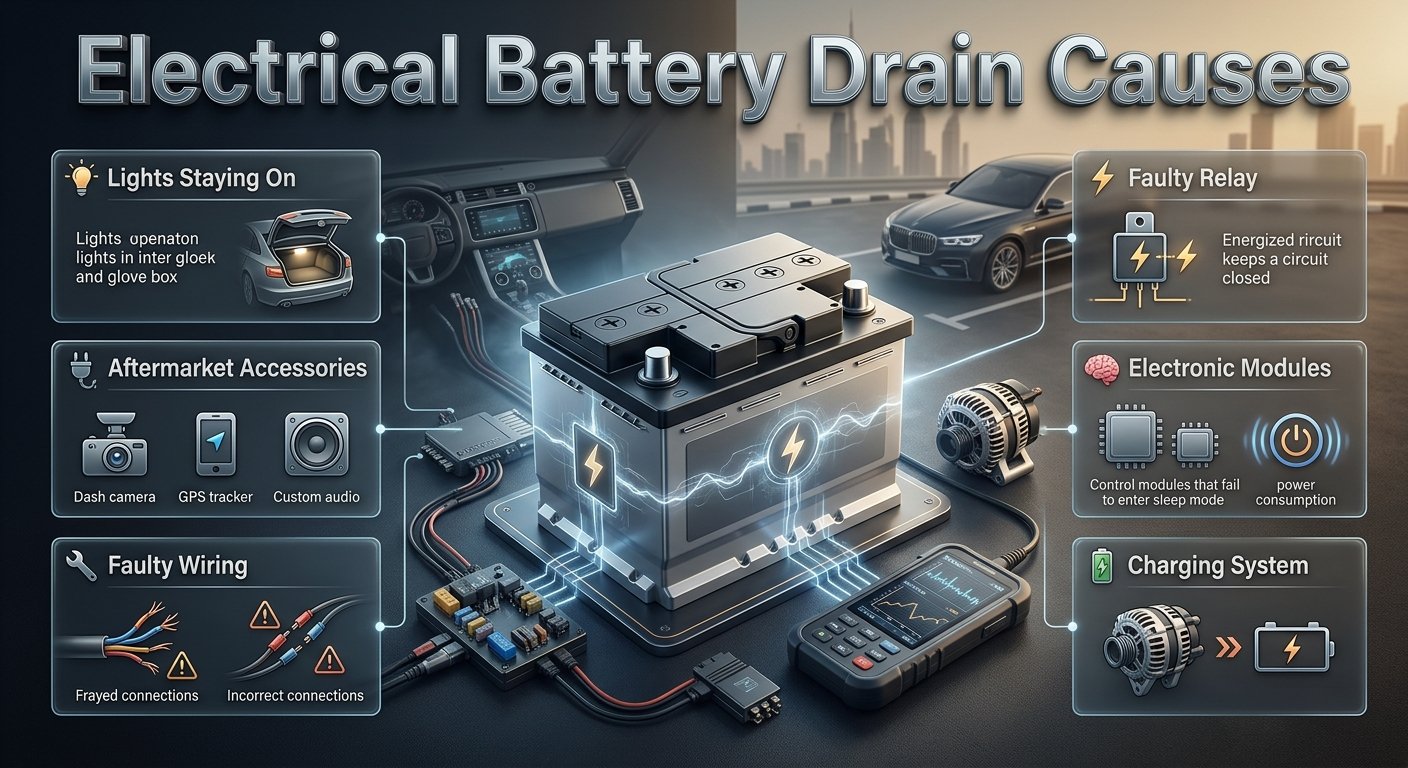
Electrical Battery Drain Causes | A car battery that repeatedly loses charge can be frustrating, especially when the vehicle starts normally one day and refuses to start after being parked overnight or for several days. While many drivers immediately assume that the battery needs replacing, the actual problem may be an electrical component that continues consuming power after the engine has been switched off. Understanding Electrical Battery Drain Causes is therefore an important part of diagnosing repeated battery failure.
For drivers in Dubai, battery problems can become even more noticeable because of high temperatures, heavy air-conditioning use, frequent traffic, short-distance driving, and extended periods of vehicle parking. Modern cars also contain far more electronic systems than older vehicles, creating additional possibilities for abnormal electrical consumption.
If your vehicle repeatedly loses battery power, a proper diagnosis should consider the battery, alternator, wiring, electrical accessories, control modules, relays, and vehicle sleep systems rather than automatically installing another battery. EuroSwift Auto Services provides a useful starting point for drivers looking for professional automotive support in Dubai, particularly when battery problems are accompanied by other vehicle symptoms.
The objective is not simply to get the vehicle started again. The real objective is to identify why the battery is losing power, correct the underlying fault, and prevent the same problem from returning.
1. What Does Electrical Battery Drain Actually Mean?
Electrical battery drain occurs when a vehicle consumes more electrical energy than expected, particularly when the engine is switched off.
Every modern vehicle uses a small amount of electricity even after it has been parked and locked. Security systems, memory functions, vehicle computers, keyless-entry systems, clocks, and other electronic components may continue operating at very low power levels.
That small amount of standby consumption is normal.
The problem begins when one or more components continue drawing excessive current or fail to enter their expected low-power state.
This condition is commonly described as:
- Parasitic battery drain
- Parasitic electrical draw
- Key-off battery drain
- Excessive standby current
- Electrical leakage
- Battery discharge while parked
The important point is that not every discharged battery has an electrical drain problem.
A battery can become weak because of age, internal deterioration, extreme temperatures, insufficient charging, or repeated short journeys. Similarly, a vehicle can have a perfectly healthy battery but still discharge it because an electrical component remains active.
A professional diagnosis therefore needs to establish which of these situations is actually occurring.
Normal Battery Consumption vs Excessive Drain
| Condition | What It Means | Possible Result |
|---|---|---|
| Normal standby consumption | Vehicle electronics use a small amount of power | Battery normally remains usable |
| Excessive parasitic draw | A component consumes abnormal current while parked | Battery gradually discharges |
| Weak battery | Battery has lost energy-storage capacity | Difficult starting |
| Charging-system fault | Battery is not adequately recharged | Repeated discharge |
| Short-trip usage | Battery receives limited charging time | Gradual loss of charge |
This distinction is especially important because replacing a battery does not repair an electrical circuit that is consuming power.
2. The Most Common Electrical Battery Drain Causes
There are numerous potential sources of excessive battery consumption. Some are simple and easy to identify, while others require professional electrical testing.
The most common causes include:
Interior Lights Staying On
A cabin light that remains illuminated after the vehicle is locked can gradually discharge the battery.
This can happen when a door switch, latch sensor, or control system incorrectly believes that a door is open.
The problem may be difficult to notice because the light may be inside the vehicle and hidden from view after the car is parked.
Trunk or Boot Light Problems
The trunk light is another commonly overlooked source.
A faulty trunk latch or switch can prevent the light from switching off completely. Because the trunk is closed, the driver may never realize that the lamp remains active.
Glove-Box Light
A glove-box light can create a similar problem.
If the switch does not recognize that the compartment has been closed, the lamp may continue operating while the vehicle is parked.
Faulty Relays
Relays control power to numerous electrical circuits.
If a relay becomes stuck in an energized position, the associated circuit may continue receiving power after the vehicle has been switched off.
Aftermarket Accessories
Accessories installed after the vehicle was manufactured are particularly important when investigating unexplained battery discharge.
These may include:
- Dash cameras
- GPS trackers
- Additional alarms
- Amplifiers
- Parking-monitoring systems
- LED lighting
- Remote-start equipment
- Aftermarket infotainment
- USB accessories
Incorrect wiring can cause an accessory to remain powered continuously.
Electronic Control Modules
Modern vehicles contain multiple electronic control units.
A malfunctioning module may fail to enter its expected sleep state, causing unwanted electrical consumption.
This type of problem is more difficult to identify because there may be no visible light, sound, or obvious accessory operating.
Alternator Diode Problems
The alternator charges the battery while the engine is running. However, an internal electrical fault can sometimes allow unwanted current flow when the engine is switched off.
This means the charging system should be tested when investigating repeated battery discharge.
Wiring Faults
Damaged insulation, incorrect connections, corrosion, or electrical modifications can create abnormal current paths.
Wiring problems can be particularly difficult to identify without vehicle-specific wiring diagrams and professional testing equipment.
3. How to Tell If Your Vehicle Has a Parasitic Electrical Drain
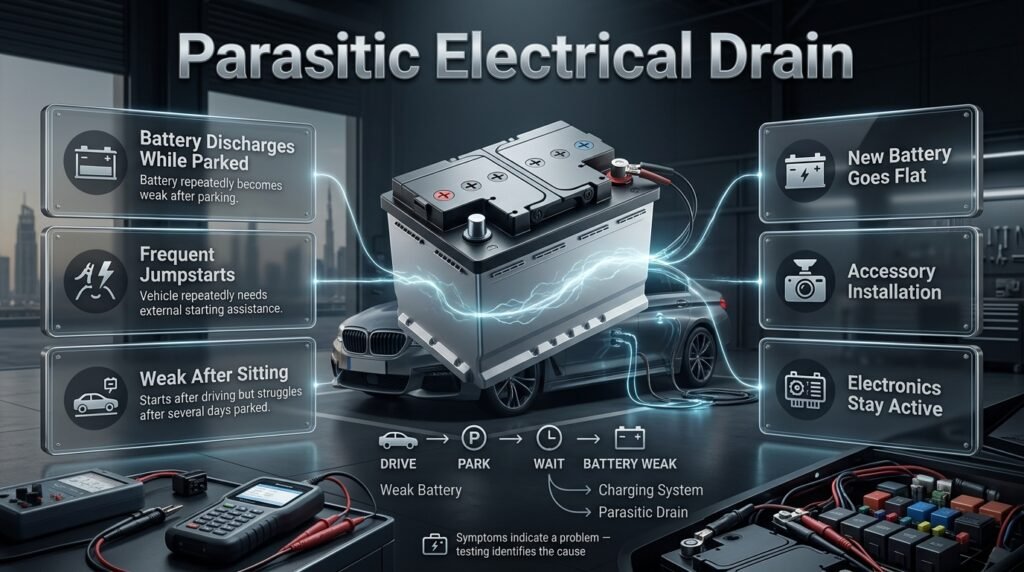
A parasitic drain does not always announce itself with a dashboard warning.
Instead, the most obvious symptom may simply be a battery that repeatedly becomes weak after the vehicle has been parked.
Watch for patterns rather than relying on one isolated incident.
Common signs include:
- Battery repeatedly becomes discharged while parked.
- Vehicle requires frequent jumpstarts.
- A relatively new battery repeatedly goes flat.
- Battery is strong immediately after charging but weak later.
- Vehicle starts normally after driving but struggles after sitting.
- Problem began after an accessory was installed.
- Interior electronics appear to remain active after locking.
- The vehicle becomes difficult to start after several days of parking.
- Battery replacement temporarily solves the problem before symptoms return.
- Charging-system testing does not explain the repeated discharge.
A Useful Diagnostic Pattern
Suppose a vehicle starts normally every morning after being driven regularly but becomes difficult to start after sitting for two or three days.
That pattern can point toward several possibilities:
- A weak battery may have insufficient reserve capacity.
- The charging system may not be restoring enough energy.
- A parasitic electrical drain may be consuming energy while parked.
The pattern is useful, but it does not prove the cause.
That is why professional testing is more reliable than simply replacing parts based on symptoms.
4. Battery Drain vs Battery Failure vs Alternator Failure
These three problems are frequently confused because they can produce similar starting symptoms.
A battery that cannot provide enough starting power may be defective.
An alternator problem can leave the battery undercharged.
An electrical drain can consume battery energy while the vehicle is switched off.
Comparison
| Problem | Main Issue | When Battery Loses Power |
|---|---|---|
| Weak battery | Reduced storage capacity | During starting or while parked |
| Charging fault | Battery not adequately recharged | During/after driving |
| Parasitic drain | Excessive electrical consumption | Mainly while parked |
| Poor connection | Electrical resistance/interruption | During starting or charging |
| Accessory drain | Additional continuous consumption | While parked or in standby |
The same vehicle can even have more than one problem.
For example, an aging battery may already have reduced capacity while an aftermarket accessory is also consuming power. In that situation, the electrical drain may expose the battery’s weakness much sooner.
This is why a professional Battery Replacement should normally be based on battery testing rather than the simple fact that the vehicle failed to start.
5. Why Modern Cars Are More Sensitive to Electrical Problems
Older vehicles generally had fewer electronic systems.
Modern cars may contain a large network of computers and electronic modules responsible for everything from engine management to security and infotainment.
These systems can include:
- Engine control modules
- Body control modules
- Security systems
- Keyless-entry systems
- Infotainment systems
- Climate-control electronics
- Parking sensors
- Driver-assistance systems
- Lighting controllers
- Battery-management systems
- Communication modules
Most of these systems are designed to reduce their electrical consumption when the vehicle is parked.
However, if one module remains awake or repeatedly wakes up, the battery may gradually discharge.
Vehicle Sleep Mode
A modern vehicle does not necessarily become completely inactive the instant the engine is switched off.
Some systems need time to complete shutdown procedures.
Electronic modules may communicate with one another before entering low-power operation.
This is why professional battery-drain diagnosis needs to account for the vehicle’s normal shutdown period.
Opening a door, unlocking the vehicle, pressing buttons, activating accessories, or reconnecting equipment during testing can wake electronic systems and affect the results.
6. Aftermarket Accessories as a Major Source of Battery Drain
When a battery problem begins after an accessory installation, the accessory and its wiring deserve careful attention.
A properly installed accessory should receive power through an appropriate circuit and should have a suitable shutdown strategy.
Problems can occur when an accessory is:
- Connected directly to constant battery power
- Wired to the wrong circuit
- Poorly grounded
- Installed without suitable power management
- Incorrectly configured
- Damaged internally
- Left active for extended periods
Dash cameras are a common example.
Some dash cameras are designed to monitor the vehicle while parked. That feature can be useful, but it means the camera intentionally consumes electrical energy when the engine is off.
The question is therefore not simply whether the dash camera uses power.
The important question is whether the power consumption is appropriate for the vehicle, battery condition, installation, and parking period.
Accessories Worth Investigating
✔ Dash cameras
✔ GPS trackers
✔ Alarm systems
✔ Audio amplifiers
✔ Parking surveillance equipment
✔ Additional lighting
✔ USB devices
✔ Remote-start systems
✔ Aftermarket screens
✔ Custom infotainment systems
If the battery problem appeared soon after an accessory was fitted, electrical diagnosis should include that installation.
7. Can a Dash Camera Drain Your Car Battery?
A dash camera can contribute to battery discharge when it continues operating while the vehicle is parked.
This is particularly relevant when parking mode is enabled.
Parking surveillance systems may monitor movement, impacts, or other events while the vehicle is unattended. Because they require electrical power, extended operation can gradually reduce battery charge.
A properly configured system may include power-management features intended to prevent excessive discharge.
However, battery condition also matters.
An older battery with reduced capacity may tolerate additional electrical loads less effectively than a healthy battery.
Therefore, if battery problems started after installing a dash camera, the correct response is not necessarily to remove the camera. The installation, power source, settings, and battery condition should be evaluated together.
8. Faulty Lights and Switches That Drivers Often Miss
Simple electrical faults can sometimes produce surprisingly persistent battery problems.
The most overlooked examples include lights inside areas that are not easily visible after the vehicle is closed.
Interior Lighting
Door-controlled interior lights should normally switch off after the appropriate shutdown period.
If a door sensor incorrectly reports that a door remains open, the vehicle may keep certain systems active.
Trunk Lighting
A trunk lamp can remain active because of a faulty latch or sensor.
Glove-Box Lighting
A misaligned switch can prevent the lamp from turning off.
Vanity-Mirror Lighting
Some vehicles contain lights inside sun visors or mirrors. A faulty switch or improperly closed cover can potentially leave them operating.
Door-Latch Sensors
Modern door latches often contain electronic sensing components.
A fault may cause the vehicle to believe that a door remains open even when it appears fully closed.
This can influence lighting and other body-control functions.
The lesson is simple: an electrical drain does not always come from a complicated computer. Sometimes the source is a small switch or light.
9. How Relays and Fuses Help Identify the Problem
Vehicle electrical systems are divided into multiple circuits.
Fuses protect circuits from excessive current, while relays allow certain electrical loads to be controlled safely.
If one circuit is consuming abnormal current, technicians can sometimes use circuit isolation to narrow down the source.
A fuse may help identify the affected circuit, but removing fuses randomly is not a reliable diagnostic method on a modern vehicle.
Some vehicles can react to power interruption by generating fault codes, resetting learned settings, or waking additional modules.
Professional diagnosis should therefore follow the manufacturer’s electrical architecture and appropriate testing procedures.
Circuit-Based Troubleshooting
A typical diagnostic approach may involve:
- Confirming the battery complaint.
- Checking battery condition.
- Checking charging performance.
- Allowing vehicle systems to enter sleep mode.
- Measuring key-off current.
- Identifying abnormal consumption.
- Isolating the affected circuit.
- Identifying the component responsible.
- Repairing the underlying fault.
- Rechecking the vehicle after repair.
This is far more reliable than replacing components until the symptom disappears.
10. How Professionals Test for Electrical Battery Drain
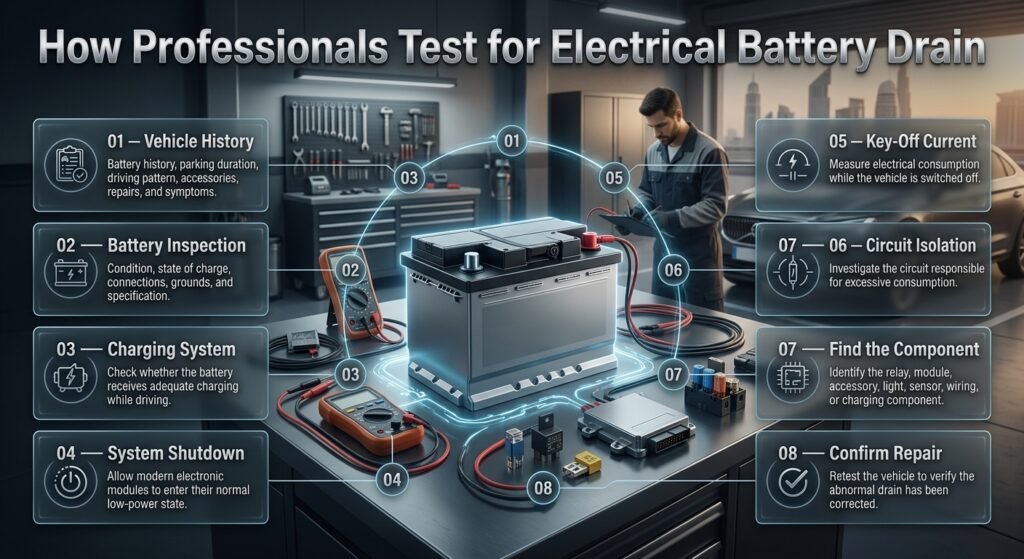
A proper electrical diagnosis is a process rather than a single measurement.
Step 1: Understand the Vehicle History
The technician should ask when the problem occurs and whether anything changed before it began.
Important information includes:
- Battery replacement history
- Parking duration
- Driving pattern
- Recent accessory installations
- Previous electrical repairs
- Jumpstart frequency
- Warning lights
- Vehicle modifications
Step 2: Inspect the Battery
The battery should be checked for its physical condition and performance.
Testing may consider:
- State of charge
- Starting capability
- Battery condition
- Terminal connections
- Ground connections
- Correct specification
Step 3: Test the Charging System
The charging system should be evaluated to determine whether the battery is being adequately replenished during vehicle operation.
Step 4: Allow Electronic Systems to Shut Down
Modern vehicles may need time before their electronic systems reach normal low-power operation.
Step 5: Measure Key-Off Current
Appropriate electrical testing can determine whether the vehicle is drawing excessive current while switched off.
Step 6: Isolate the Source
If excessive consumption is confirmed, the affected circuit can be investigated.
Step 7: Identify the Actual Component
Finding an affected circuit does not always identify the exact failed component.
Further testing may be necessary to determine whether the source is:
- A relay
- A module
- An accessory
- A light
- A sensor
- Wiring
- A charging component
Step 8: Confirm the Repair
After repair, the vehicle should be retested to ensure the abnormal consumption has been corrected.
11. Why Jumpstarting the Vehicle Does Not Fix Battery Drain
A Car Jumpstart can restore temporary starting ability when a battery is discharged.
It does not, however, explain why the battery became discharged.
This distinction is important.
Imagine the following cycle:
Battery discharges → vehicle is jumpstarted → battery is recharged → vehicle is parked → electrical drain continues → battery discharges again.
The vehicle may appear fixed for a short time, but the underlying electrical problem remains.
Repeated jumpstarts can therefore become a frustrating temporary solution.
If the battery repeatedly becomes discharged, the vehicle should be inspected rather than relying on another jumpstart.
For emergencies, Roadside Assistance can help restore mobility, but the vehicle should subsequently receive appropriate diagnostic attention.
12. Dubai Conditions That Can Make Battery Problems More Noticeable
Environmental conditions can influence vehicle battery performance.
Dubai’s high temperatures place additional stress on automotive batteries. Heat can accelerate battery aging, while frequent use of air conditioning and electrical equipment adds to the vehicle’s overall electrical workload.
Driving patterns also matter.
Short trips may not provide enough operating time for the charging system to fully restore energy consumed during starting and vehicle operation.
Extended parking can expose battery weaknesses even more clearly.
Common Local Driving Factors
| Driving Condition | Potential Effect |
|---|---|
| High ambient temperatures | Can accelerate battery aging |
| Heavy AC use | Higher electrical demand |
| Short trips | Limited recharge opportunity |
| Stop-and-go traffic | Frequent engine operation changes |
| Extended parking | Battery slowly loses standby energy |
| Heavy accessory use | Additional electrical consumption |
These factors do not automatically mean a vehicle has a parasitic drain.
A professional diagnosis should still determine whether the primary issue is battery condition, charging performance, electrical consumption, or a combination of factors.
13. Battery Type Matters, But It Does Not Cure Electrical Drain
Modern vehicles can use different battery technologies depending on their electrical requirements.
Common types include:
- Conventional flooded batteries
- EFB batteries
- AGM batteries
The correct replacement should match the vehicle manufacturer’s specifications.
For example, a vehicle designed around AGM technology may require an appropriate AGM battery rather than simply the cheapest available replacement.
However, installing a different battery technology does not solve a parasitic electrical drain.
Battery Technology and Drain
| Battery Type | Role | Eliminates Electrical Drain? |
|---|---|---|
| Conventional | Standard vehicle applications | No |
| EFB | Certain higher-demand applications | No |
| AGM | Higher electrical demands and specified systems | No |
| Correct replacement battery | Restores battery capacity when required | No, if drain remains |
When a battery genuinely needs replacement, vehicle owners can compare appropriate options such as Amaron Battery, Bosch Battery, or Tuflong Battery according to the vehicle’s actual requirements.
For vehicles that require AGM technology, AGM Battery may be the more appropriate category to investigate.
14. When a New Battery Is Actually the Correct Solution
Electrical diagnosis should not create the impression that batteries rarely need replacement.
Sometimes the battery genuinely has reached the end of its useful service life.
A battery may have:
- Reduced capacity
- Poor starting performance
- Internal deterioration
- Difficulty holding charge
- Physical damage
- Severe age-related degradation
If testing confirms that the battery has failed, replacement is appropriate.
Depending on the vehicle’s requirements, drivers may consider options such as Exide Battery, Panasonic Battery, FIAMM Battery, or AC Delco Battery where those specifications are suitable for the vehicle.
The important principle is that brand selection should come after confirming the correct battery specification, not before.
15. Common Mistakes That Make Battery Drain Problems Worse
Drivers often make reasonable assumptions that can delay the actual repair.
Mistake 1: Replacing the Battery Immediately
A dead battery does not automatically mean a failed battery.
Mistake 2: Ignoring the Charging System
A battery cannot remain properly charged if the charging system is not functioning correctly.
Mistake 3: Forgetting About Accessories
An aftermarket dash camera, tracker, alarm, or audio system may be relevant to the problem.
Mistake 4: Assuming No Visible Light Means No Electrical Drain
Electronic modules can consume power without producing an obvious visual sign.
Mistake 5: Repeatedly Jumpstarting the Vehicle
A jumpstart solves the immediate starting problem but does not repair the underlying cause.
Mistake 6: Installing an Incorrect Battery
A battery should match the vehicle’s required technology, size, capacity, and specifications.
Mistake 7: Testing Without Allowing Sleep Mode
Modern vehicle electronics may require time to shut down before meaningful key-off current measurements are made.
Mistake 8: Disconnecting Components Randomly
Unstructured troubleshooting can create additional fault codes or disrupt vehicle settings.
A systematic diagnostic approach is safer and more efficient.
16. Professional Battery Drain Troubleshooting Checklist
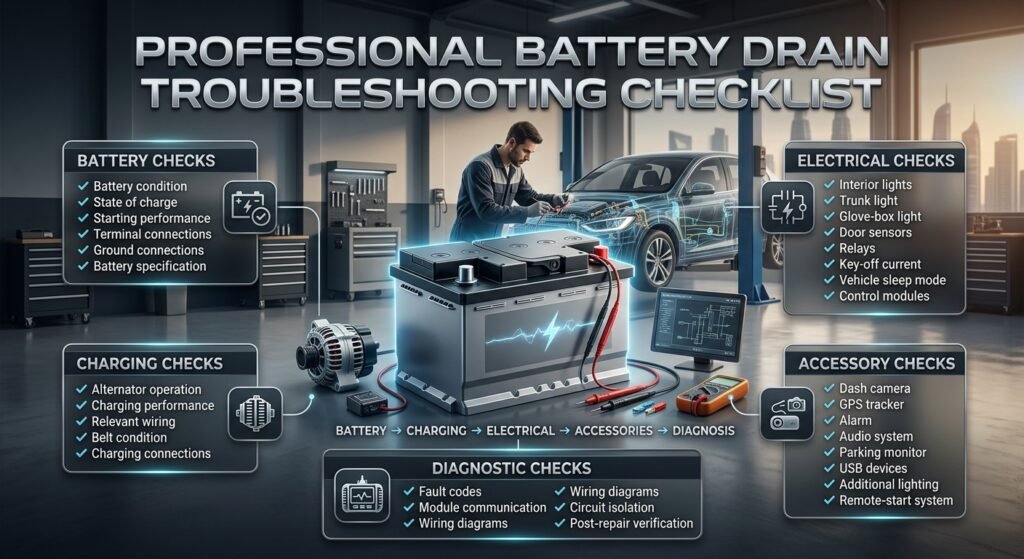
When a vehicle repeatedly loses charge, the following checklist provides a logical starting point.
Battery Checks
✔ Battery condition
✔ State of charge
✔ Starting performance
✔ Terminal connections
✔ Ground connections
✔ Battery specification
Charging Checks
✔ Alternator operation
✔ Charging performance
✔ Relevant wiring
✔ Belt condition
✔ Charging connections
Electrical Checks
✔ Interior lights
✔ Trunk light
✔ Glove-box light
✔ Door sensors
✔ Relays
✔ Key-off current
✔ Vehicle sleep mode
✔ Control modules
Accessory Checks
✔ Dash camera
✔ GPS tracker
✔ Alarm
✔ Audio system
✔ Parking monitor
✔ USB devices
✔ Additional lighting
✔ Remote-start system
Diagnostic Checks
✔ Fault codes
✔ Module communication
✔ Wiring diagrams
✔ Circuit isolation
✔ Post-repair verification
The exact process varies by vehicle make, model, electrical architecture, and equipment.
17. What Happens If You Ignore a Repeated Battery Drain?
A single discharged battery may not indicate a major vehicle problem.
Repeated discharge is different.
Every time a battery is deeply discharged, its available capacity and overall condition can be affected. If the underlying electrical problem remains unresolved, even a newly installed battery may eventually become unreliable.
Repeated starting failures can also create inconvenience when the vehicle is needed for:
- Work
- School or family travel
- Airport journeys
- Long-distance driving
- Emergency situations
- Daily commuting
The financial cost can also increase because drivers may repeatedly purchase batteries or request emergency starting assistance without repairing the actual source.
The better approach is to investigate repeated discharge early.
18. How Electrical Problems Connect With Wider Car Maintenance
Battery performance is closely connected to the vehicle’s broader electrical and mechanical condition.
A vehicle that experiences difficult starting may also have other issues involving:
- Engine operation
- Charging systems
- Starter motor
- Electrical grounds
- Sensors
- Vehicle control modules
- Climate-control systems
For this reason, a professional Car Service can sometimes identify related problems that would be missed by looking only at the battery.
If engine performance is also affected, Engine Diagnostics may be useful.
If other mechanical symptoms are present, a wider Car Repair inspection may be appropriate.
The purpose is not to turn every battery complaint into a major repair. It is to make sure the actual source of the problem is identified accurately.
19. Preventing Battery Drain Before Extended Vehicle Storage
Vehicles that remain parked for long periods deserve additional attention.
Before extended storage, consider having the following checked:
- Battery condition
- Charging-system condition
- Existing electrical faults
- Aftermarket accessories
- Battery terminals
- Vehicle electrical behavior
If the vehicle already has an unexplained discharge problem, extended parking can make the issue much more obvious.
A weak battery combined with excessive standby consumption can result in a vehicle that will not start when it is finally needed.
For longer storage periods, the appropriate battery-maintenance method should be selected according to the vehicle manufacturer’s recommendations and the vehicle’s electrical architecture.
20. How Professionals Decide Between Repair and Replacement
The correct repair depends on what testing reveals.
| Diagnostic Finding | Recommended Action |
|---|---|
| Battery fails testing | Replace battery |
| Battery healthy but excessive drain exists | Find and repair drain |
| Alternator problem | Repair charging system |
| Faulty relay | Replace relay |
| Defective light switch | Repair/replace switch |
| Incorrect accessory installation | Correct wiring |
| Faulty electronic module | Diagnose and repair as appropriate |
| Corroded connection | Clean/repair connection |
| Battery discharged but healthy | Recharge and investigate cause |
This approach prevents unnecessary parts replacement.
A professional technician should be able to explain what was tested, what was found, and why a particular repair is recommended.
21. Understanding Battery Replacement Costs in Dubai
The price of replacing a car battery depends on more than the battery’s brand.
Important factors can include:
- Battery technology
- Battery capacity
- Vehicle requirements
- Brand
- Installation requirements
- Battery-management system
- Vehicle coding or registration requirements where applicable
- Service location
- Emergency or roadside service requirements
For a broader understanding of the factors affecting replacement pricing, drivers can refer to the Car Battery Prices in Dubai 2026 guide.
However, price should not be the only consideration.
A cheaper battery that does not match the vehicle’s requirements may create more problems than it solves.
Likewise, purchasing an expensive battery does not fix a vehicle with an unresolved electrical drain.
22. Modern Diagnostic Technology for Battery Drain
Automotive electrical diagnosis has changed significantly as vehicles have become more computerized.
Modern technicians may combine traditional electrical measurements with scan-tool information and vehicle-specific diagnostic data.
Depending on the vehicle, diagnostics may provide information about:
- Battery state
- Charging system
- Electronic modules
- Communication faults
- Stored diagnostic codes
- Energy management
- Start-stop systems
- Module activity
Some faults cannot be identified reliably through visual inspection alone.
This is especially true when the problem involves an electronic module that intermittently wakes up or fails to enter sleep mode.
Modern Vehicle Inspection therefore increasingly combines physical inspection, electrical measurement, electronic diagnostics, and manufacturer-specific procedures.
23. Future Trends in Vehicle Electrical Diagnosis
Automotive electrical systems will continue becoming more sophisticated.
Connected vehicles, advanced driver-assistance systems, electrification, start-stop technology, intelligent energy management, and increasingly complex software architectures are changing how technicians approach electrical faults.
Future diagnostic systems are likely to place greater emphasis on:
- Predictive battery monitoring
- Remote diagnostics
- Energy-management data
- Connected vehicle information
- Battery health estimation
- Automated fault detection
- Software-based diagnostics
- Advanced electrical network analysis
This does not mean traditional electrical skills will become irrelevant.
Quite the opposite.
Technicians will increasingly need to understand both conventional electrical circuits and modern software-controlled vehicle networks.
For vehicle owners, the practical lesson is straightforward: repeated battery problems should be diagnosed using the correct tools and procedures rather than solved through trial-and-error parts replacement.
24. When Professional Electrical Diagnosis Is Recommended
Professional diagnosis is strongly worth considering when:
- The battery repeatedly dies while parked.
- A new battery develops the same problem.
- The vehicle needs frequent jumpstarts.
- Electrical accessories remain active.
- The problem started after an electrical modification.
- The vehicle has complex electronic systems.
- Battery testing appears normal but discharge continues.
- Charging-system testing does not explain the problem.
- The vehicle is being prepared for extended storage.
- The battery loses charge unusually quickly after parking.
At this stage, simply purchasing another battery may not be the most sensible next step.
A professional automotive technician can investigate the battery, charging system, electrical circuits, accessories, and electronic modules to determine the actual cause.
25. Quick Reference: Electrical Battery Drain Causes
| Possible Cause | Typical Situation | Diagnostic Importance |
|---|---|---|
| Interior light | Light remains active | High |
| Trunk light | Faulty latch/switch | High |
| Glove-box light | Faulty switch | Medium–High |
| Aftermarket dash camera | Parking mode/constant power | High |
| GPS tracker | Continuous power consumption | High |
| Alarm system | Fault or abnormal activity | Medium–High |
| Stuck relay | Circuit remains powered | High |
| Electronic module | Fails to sleep | High |
| Alternator diode fault | Unwanted current path | High |
| Wiring fault | Abnormal circuit path | High |
| Weak battery | Reduced capacity | High |
| Short trips | Limited recharge | Medium |
| Extreme heat | Accelerated battery aging | Medium–High |
The table is a diagnostic reference, not a replacement for vehicle-specific testing.
Why does my car battery keep dying even after I replace it?
When a newly replaced battery keeps going flat, the battery itself should not automatically be blamed. One of the strongest possibilities is that something in the vehicle is continuing to consume electrical power after the engine has been switched off. This can include an interior or trunk light, aftermarket dash camera, GPS tracker, alarm system, audio equipment, stuck relay, wiring fault, or an electronic module that does not properly enter its low-power state.
The charging system should also be considered. If the alternator is not adequately replenishing the battery while driving, the battery may repeatedly become undercharged and eventually appear to have a drain problem.
Important checks include:
Test the battery’s actual condition rather than judging it only by age.
Check charging-system performance.
Inspect recently installed electrical accessories.
Look for lights or switches that may remain active.
Test key-off electrical consumption.
Check whether electronic modules are entering their normal sleep state.
If the same symptom occurs with both the old and replacement battery, that pattern is a strong reason to investigate the vehicle’s electrical system instead of simply buying another battery.
What are the most common causes of a car battery draining while parked?
A battery can lose some charge naturally while a vehicle is parked because modern cars maintain small standby electrical loads. The concern is when something consumes substantially more power than the vehicle is designed to use after shutdown. Common causes include lights that remain on, accessories connected to constant power, aftermarket electronics, faulty alarms, stuck relays, and electronic modules that fail to sleep correctly.
One reason these faults are difficult to find is that the problem may not produce an obvious warning. You may lock the vehicle normally, see no lights, and still have an electronic system quietly consuming power.
Common areas worth investigating include:
Trunk and glove-box lighting
Interior lamps
Dash cameras
GPS trackers
Aftermarket stereos
Security systems
Remote-start equipment
Relays and switches
Vehicle control modules
Wiring and electrical connections
The important point is that there is no single universal cause. A proper diagnosis should measure the vehicle’s key-off electrical consumption and then isolate the circuit responsible rather than replacing components based only on symptoms.
Can a dash cam, GPS tracker, or other accessory drain a car battery?
Yes, an accessory can contribute to battery discharge if it continues drawing power while the vehicle is parked. This is particularly relevant to dash cameras with parking-monitoring functions, GPS trackers, aftermarket audio equipment, security systems, and devices connected to a 12-volt outlet that remains powered after the ignition is switched off.
That does not mean every dash cam or aftermarket accessory is incorrectly installed. Some are specifically designed to operate while the vehicle is parked. The important factors are how the device is wired, how much power it consumes, how long the vehicle remains parked, and the condition and capacity of the battery.
If the problem started after installing an accessory, check:
Whether the device uses constant or ignition-switched power.
Whether its parking mode is enabled.
Whether the installation includes appropriate power management.
Whether the battery was already aging or weakened.
Whether the accessory shuts down as intended.
A useful diagnostic clue is timing: if the battery was reliable before an accessory was installed and began repeatedly discharging afterward, that installation deserves attention. It should be tested rather than automatically assumed to be the fault.
How can I tell whether the problem is a bad battery, alternator, or electrical drain?
These three problems can produce very similar symptoms, so relying on the fact that the car will not start is not enough to identify the cause.
A bad battery has a problem with its ability to store and deliver energy. An alternator or charging-system fault means the battery may not be receiving adequate charging while the engine is running. An electrical or parasitic drain means excessive power is being consumed, particularly after the vehicle has been switched off.
Symptom
Possible Battery Problem
Possible Charging Problem
Possible Electrical Drain
Slow starting
✓
✓
✓
Battery repeatedly dies while parked
✓
Possible
✓
New battery also becomes flat
Possible
✓
✓
Problem follows long parking periods
✓
Possible
✓
Problem began after accessory installation
Unlikely
Unlikely
✓
Charging performance is abnormal
Possible
✓
Not necessarily
A professional diagnosis should therefore treat battery testing, charging-system testing, and key-off current testing as separate parts of the investigation.
This distinction matters because installing a new battery cannot correct an alternator fault, and a stronger battery does not eliminate an electrical circuit that continues consuming power. Current automotive guidance also emphasizes that repeated battery failure can have several causes, including extreme temperatures, infrequent driving, short trips, poor maintenance, and electrical drain.
How is parasitic battery drain diagnosed professionally?
Professional diagnosis starts by confirming that the battery is actually capable of holding a charge and that the charging system is functioning correctly. Once those areas are checked, the vehicle’s electrical system can be evaluated for abnormal key-off consumption.
Modern vehicles require particular care because electronic modules may remain active temporarily after the ignition is switched off. The technician needs to allow the vehicle to complete its normal shutdown process before judging whether the electrical draw is excessive. A methodical approach then isolates the circuit or component responsible.
A professional inspection may involve:
Battery condition testing
Charging-system testing
Inspection of battery terminals and grounds
Checking aftermarket accessories
Allowing modules to enter sleep mode
Measuring key-off electrical consumption
Isolating the affected electrical circuit
Checking relays, switches, and wiring
Using electronic diagnostic equipment where required
Confirming the repair with a follow-up test
The goal is not simply to prove that the battery is empty. The goal is to determine why it became empty.
That distinction is what prevents the common cycle of dead battery → replacement → temporary improvement → dead battery again. A systematic diagnosis is especially important on modern vehicles because a fault may involve an electronic module or communication system rather than an obvious light or accessory.
Professional Takeaway
If a vehicle repeatedly loses battery power while parked, do not treat battery replacement as the diagnosis. The battery, charging system, and key-off electrical consumption should be evaluated separately. That approach gives the technician a much better chance of finding the actual fault and gives the vehicle owner a more reliable long-term solution.
Conclusion
Electrical battery drain is rarely something that should be solved by repeatedly replacing the battery. When a vehicle loses power while parked, the real cause may be an interior light, aftermarket accessory, faulty relay, wiring problem, alternator issue, or electronic module that fails to shut down properly. Identifying that source is the key to preventing the same starting problem from returning.
For drivers in Dubai, high temperatures, frequent short journeys, heavy electrical usage, and long parking periods can place additional demands on an already weakened battery. Regular Vehicle Maintenance, timely Car Service, and professional electrical inspection can help identify battery and charging problems before they become unexpected roadside failures.
If your battery repeatedly becomes discharged, the most practical approach is to test the battery condition, charging system, and key-off electrical consumption separately. A Car Jumpstart may get you moving temporarily, but it does not repair the underlying fault.
Whether the final solution involves Battery Replacement, electrical repair, charging-system service, or correction of an aftermarket accessory, the repair should be based on proper diagnosis rather than guesswork. With the right inspection and preventive maintenance, drivers can improve starting reliability, reduce unnecessary repair costs, and keep their vehicles dependable on Dubai roads.

Leave a Reply