
Introduction
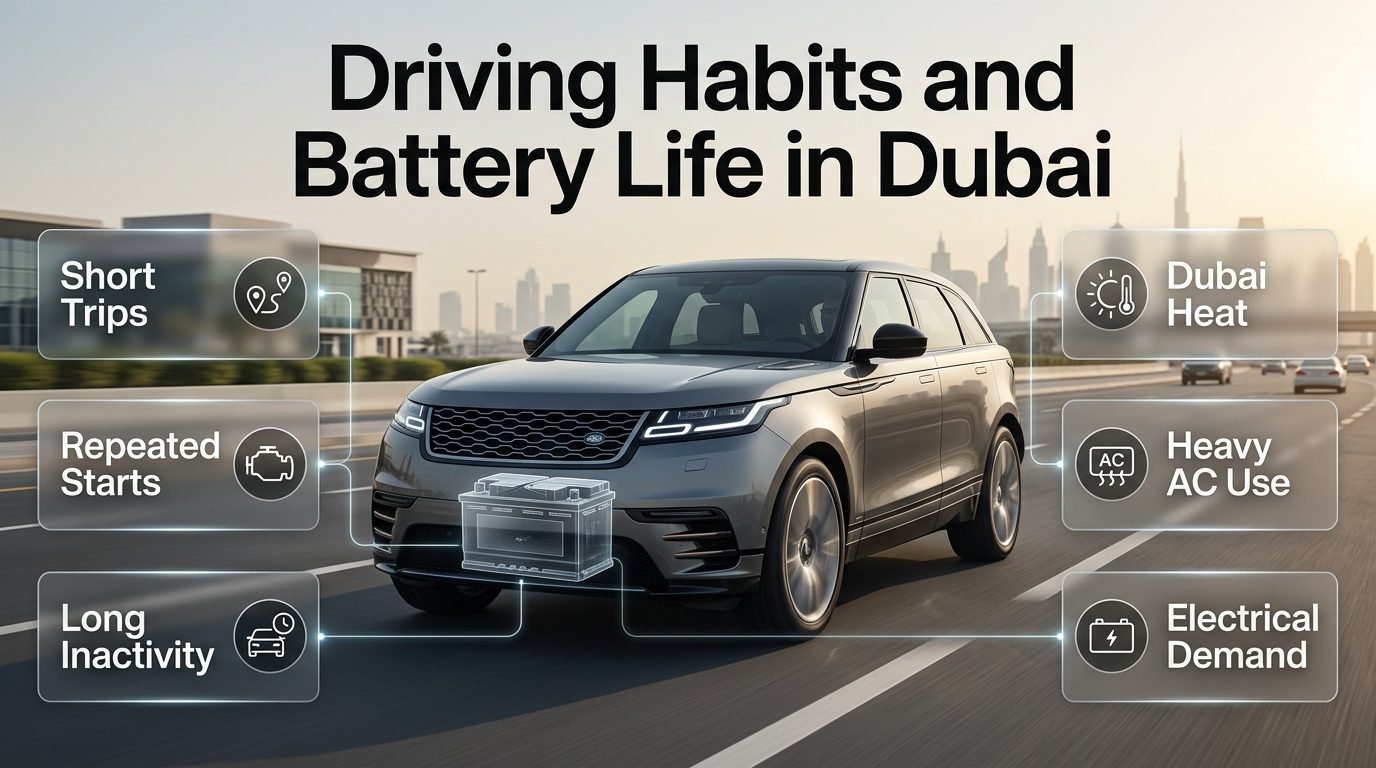
Driving Habits and Battery Life | Your daily driving pattern can have a surprising effect on your car battery. The battery does not operate independently; its performance is connected to engine starting, the alternator, electrical accessories, vehicle electronics, climate conditions, and the amount of time the charging system has to replenish energy after each start. For Dubai drivers, these factors can become especially important because frequent traffic, high temperatures, heavy air-conditioning use, and short urban journeys can create demanding operating conditions.
Understanding the relationship between Driving Habits and Battery Life can help you identify problems earlier, reduce unnecessary battery stress, and make better maintenance decisions. A driver who makes several short trips every day may place a different workload on the battery than someone who regularly drives longer distances. Similarly, a vehicle that remains parked for weeks can experience different battery-related problems from one used every day.
For professional automotive support in Dubai, EuroSwift Auto Services provides practical vehicle assistance and maintenance solutions for drivers dealing with battery, electrical, mechanical, and roadside problems.
This guide explains how different driving habits affect battery performance, why some patterns are harder on batteries than others, how Dubai conditions influence battery operation, which warning signs deserve attention, and how professional maintenance can help protect vehicle reliability.
1. Understanding the Relationship Between Driving Habits and Battery Life
A car battery provides the electrical power required to start the engine and supports the vehicle’s electrical system when necessary. Once the engine is running, the alternator generally supplies electrical power to the vehicle and replenishes energy used during starting.
This creates an important relationship between starting frequency and driving duration.
Every engine start consumes energy from the battery. The charging system then needs operating time to restore the battery’s state of charge. When a vehicle is driven for very short periods repeatedly, the charging system may have less opportunity to replenish the energy consumed during each start.
This does not mean that short journeys automatically damage a battery. A healthy battery can handle normal daily use. The concern develops when a demanding driving pattern continues for a long period, particularly when the battery is already aging or the charging system is not performing correctly.
Driving habits that can influence battery performance
- Frequent short journeys
- Repeated engine starts
- Heavy stop-and-go traffic
- Long periods of vehicle inactivity
- Extended accessory use while the engine is off
- Excessive idling
- Regular driving with a partially discharged battery
- Ignoring slow engine cranking
- Repeated jumpstarts
- Continuing to use a vehicle with charging-system warning signs
The important point is that battery life is influenced by the complete operating environment, not by mileage alone.
A vehicle driven 20 kilometers in several separate short trips may place a different workload on its battery than a vehicle driven the same distance in one continuous journey.
2. Why Frequent Short Trips Can Reduce Battery Reliability
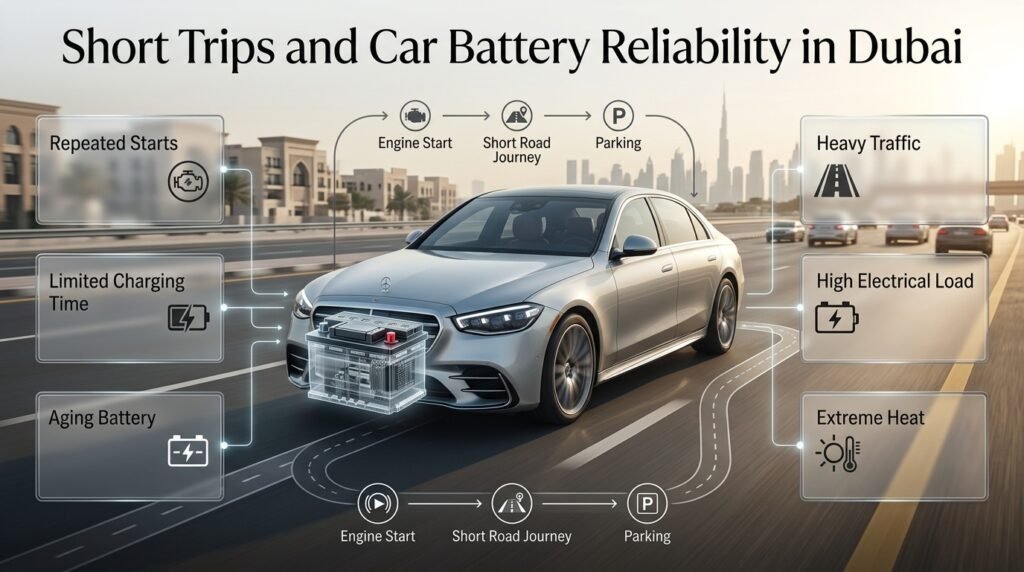
Short-distance driving is one of the most important habits to understand when discussing battery performance.
Starting the engine requires a significant electrical current for a short period. Once the engine starts, the alternator begins supplying electrical power and charging the battery. However, a journey lasting only a few minutes may not provide much time for the charging system to replace the energy consumed during startup.
Now imagine the same pattern repeated several times every day.
The driver starts the vehicle, drives a short distance, switches it off, and repeats the process later. The battery is repeatedly asked to provide starting power, while each journey may provide only limited charging time.
Example of a short-trip routine
A typical urban driver might:
- Start the vehicle for a short morning journey.
- Park after several minutes.
- Start again for a short afternoon trip.
- Drive to another location.
- Start again for an evening errand.
- Return home after another short journey.
Each individual trip may seem insignificant. However, the cumulative effect can become more relevant when this pattern continues for weeks or months.
What makes short trips more demanding?
Short journeys become more concerning when they are combined with:
- An aging battery
- High electrical loads
- Heavy traffic
- Frequent engine starts
- Poor charging-system performance
- Long periods of parking between trips
- Extreme operating temperatures
Drivers who regularly use their vehicle for very short journeys should therefore pay attention to changes in starting performance instead of waiting for complete battery failure.
3. Dubai Traffic and Its Effect on Battery Workload
Dubai’s road network includes busy urban routes, traffic signals, congestion, parking areas, and periods of slow-moving traffic. Stop-and-go driving can create a different operating environment from continuous highway driving.
The battery itself is not necessarily damaged simply because a vehicle is driven in traffic. However, traffic conditions can increase the overall workload placed on the vehicle’s systems.
During congested driving, the vehicle may simultaneously operate:
- Air conditioning
- Cooling fans
- Headlights
- Cabin blower
- Infotainment
- Navigation
- Electronic control systems
- Phone charging equipment
- Driver-assistance technology
- Other electrical accessories
A healthy charging system is designed to manage the vehicle’s electrical requirements. However, an aging battery or charging-system fault may become more noticeable when electrical demand is high.
Traffic is more significant when combined with other factors
Stop-and-go driving alone is not necessarily a battery problem.
The greater concern is a combination such as:
Heavy traffic + frequent starts + short journeys + high electrical demand + aging battery
When these factors occur together, battery performance may decline more noticeably.
This is one reason professional vehicle inspection should consider the driver’s actual usage pattern rather than simply checking the battery’s appearance.
4. Does Idling Charge Your Car Battery?
Many drivers assume that leaving a vehicle running while parked will automatically recharge the battery. The reality is more complicated.
The charging system can operate while the engine is idling, but the amount of electrical power available for charging depends on the vehicle, alternator, engine speed, battery condition, and electrical load.
Modern vehicles also manage electrical energy differently depending on operating conditions.
If the vehicle is running its air conditioning, cooling fans, lights, infotainment system, and other electronics while idling, much of the electrical output may be supporting those systems.
Why excessive idling is not a battery-maintenance strategy
If your battery is weak, repeatedly leaving the engine idling does not address the underlying cause.
A weak battery could be suffering from:
- Internal deterioration
- Low state of charge
- Charging-system problems
- Electrical drain
- Poor terminal connections
- Incorrect battery specification
- Excessive age
If the battery repeatedly becomes discharged, the correct response is diagnosis rather than relying on prolonged idling.
A professional Battery Replacement service should normally involve checking the battery and the charging system rather than simply installing a new battery without investigating the cause.
5. Repeated Engine Starts and Battery Stress
Every time you start the engine, the battery provides a high-current electrical supply to the starter system.
One or two starts during a normal day are generally not unusual. Problems become more likely when a vehicle is started repeatedly throughout the day, especially when each journey is very short.
This pattern is common among:
- Delivery drivers
- Sales representatives
- Service workers
- Drivers making frequent errands
- Parents making multiple short school runs
- Businesses using vehicles for repeated local trips
- Drivers who frequently move vehicles between parking locations
Frequent starts do not automatically mean the battery will fail prematurely. Battery technology, vehicle design, battery age, temperature, and charging performance all matter.
However, frequent starting increases the importance of keeping the battery properly charged and the charging system healthy.
Professional Recommendation
If your vehicle is started many times every day, do not judge battery health only by whether the engine currently starts. Pay attention to changes in cranking speed, electrical behavior, and repeated discharge.
A battery can continue starting a vehicle while its available reserve capacity is already declining.
6. Leaving Electrical Accessories On While Parked
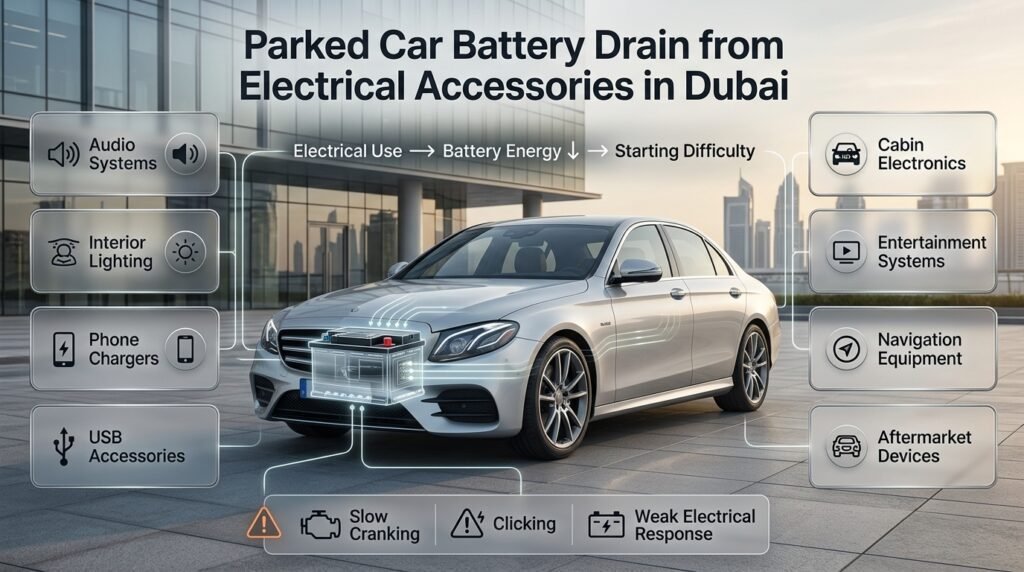
One of the simplest ways to discharge a car battery is to operate electrical accessories while the engine is switched off.
Modern vehicles contain many electrical devices, and drivers may spend time in their parked vehicles using:
- Audio systems
- Interior lighting
- Phone chargers
- USB accessories
- Cabin electronics
- Entertainment systems
- Navigation equipment
- Other aftermarket devices
A healthy battery can support electrical accessories for a period of time, but continued use gradually consumes stored energy.
If the battery is already partially discharged or aging, the vehicle may not have enough remaining power to start the engine afterward.
A common Dubai driving scenario
A driver parks outside a workplace, shopping center, residence, or school and remains inside the vehicle with the ignition or electrical system switched on.
The driver may not notice the battery losing energy because everything appears normal.
Later, when the engine is started, there may be:
- Slow cranking
- Clicking
- Weak electrical response
- Difficulty starting
The safest habit is to switch off unnecessary electrical equipment when the engine is not running.
7. Long Periods Without Driving Can Also Affect Battery Life
Some drivers believe that only heavy driving damages batteries. Extended inactivity can also create battery-related problems.
A modern vehicle may continue to consume small amounts of electrical energy while switched off. Electronic systems can remain active in low-power modes, allowing the vehicle to maintain security, memory, communication, and other functions.
When a vehicle remains parked for a long period, the battery can gradually lose charge.
This becomes more important when the battery is already older or partially discharged.
Vehicles commonly affected by extended inactivity
- Second household vehicles
- Luxury cars used occasionally
- Spare family vehicles
- Seasonal vehicles
- Vehicles kept at another property
- Cars left unused during extended travel
- Commercial vehicles used irregularly
The longer a vehicle remains inactive, the more important battery condition becomes.
If a vehicle is going to remain unused for an extended period, its storage and battery requirements should be considered as part of a broader Vehicle Maintenance plan.
8. Dubai Heat, Driving Habits, and Battery Aging
Dubai’s climate is another factor that should be considered when evaluating battery life.
High ambient temperatures can accelerate battery aging and influence the chemical processes occurring inside conventional lead-acid batteries. A battery that is already approaching the end of its useful service life may show problems sooner when operating under demanding conditions.
However, it would be inaccurate to blame every battery failure on temperature.
Battery performance is influenced by several factors:
| Factor | Possible Effect |
|---|---|
| High temperatures | Can accelerate battery aging |
| Short journeys | Limited charging opportunity |
| Frequent starts | Increased starting demand |
| Heavy traffic | Higher overall vehicle workload |
| Long inactivity | Gradual discharge |
| Electrical accessories | Additional electrical consumption |
| Poor charging system | Inadequate replenishment |
| Battery age | Reduced performance over time |
For this reason, Dubai drivers should think about climate + driving pattern + battery age + charging system rather than considering any single factor in isolation.
9. How Air Conditioning Relates to Battery Performance
Air conditioning is a major part of daily driving in Dubai.
It is important to understand that the vehicle’s battery is not simply powering the entire air-conditioning system by itself during normal engine operation. The engine and charging system play major roles in supplying the energy needed to operate the vehicle.
Nevertheless, air-conditioning operation can coincide with significant electrical demand from:
- Blower motors
- Cooling fans
- Climate-control electronics
- Cabin systems
- Vehicle control modules
When a battery or charging system is already weak, demanding operating conditions may expose the problem.
Warning signs worth investigating
- Slower starting after heavy vehicle use
- Electrical warning lights
- Dimming lights
- Repeated battery discharge
- Unusual electrical behavior
- Need for frequent jumpstarts
If you are experiencing AC-related vehicle problems as well, an inspection may need to consider both electrical and climate-control systems rather than treating the battery as the only possible cause.
10. Recognizing Battery Warning Signs Early
The most useful battery warning sign is often a change from the vehicle’s normal behavior.
Drivers become familiar with how their vehicle starts. If the engine normally starts immediately but suddenly takes longer to crank, that difference is valuable information.
Common signs include:
- Slower engine cranking
- Clicking during startup
- Delayed engine starting
- Battery warning light
- Repeated jumpstart requirement
- Weak interior lighting
- Electrical accessories behaving unusually
- Vehicle struggling after several days of inactivity
- Battery repeatedly becoming discharged
However, these symptoms do not automatically prove that the battery is defective.
For example, slow starting can also result from:
- Starter motor problems
- Poor battery terminals
- Electrical connection issues
- Charging-system faults
- Engine-related problems
That is why professional Engine Diagnostics and electrical testing can be useful when symptoms appear.
11. Driving Habits That Are Generally Easier on Batteries
No driving pattern can guarantee maximum battery life, but some habits are generally more favorable.
A vehicle that is driven regularly for reasonable distances gives the charging system more operating time than a vehicle that is repeatedly started and immediately switched off.
Better battery-use habits include:
Combine short errands where practical.
If several destinations are close together, combining them can reduce repeated cold starts.
Avoid unnecessary electrical use while parked.
Switch off lights and accessories when the engine is not running.
Respond to early symptoms.
Do not ignore noticeable changes in starting behavior.
Maintain the charging system.
A healthy alternator and good electrical connections are essential.
Keep the vehicle maintained.
Battery performance is part of overall vehicle reliability.
Inspect recurring problems.
A battery that repeatedly becomes discharged needs diagnosis rather than repeated jumpstarts.
12. Driving Pattern Comparison
Different drivers place different demands on their vehicle.
| Driving Pattern | Battery Consideration | Recommended Focus |
| Regular longer journeys | More charging opportunity | Routine maintenance |
| Frequent short trips | Less charging time per trip | Monitor battery condition |
| Multiple starts daily | Higher starting demand | Check battery health |
| Heavy urban traffic | Higher overall electrical workload | Charging-system inspection |
| Long-term parking | Gradual discharge possible | Battery monitoring |
| Repeated jumpstarts | Possible underlying fault | Complete electrical diagnosis |
| Accessories used while parked | Battery discharge risk | Reduce unnecessary use |
| Mixed driving | Balanced usage | Standard preventive maintenance |
This comparison demonstrates why a universal battery replacement schedule is not always appropriate.
Two vehicles of the same age may have very different battery conditions because they have experienced completely different operating environments.
13. How Your Driving Pattern Should Influence Maintenance
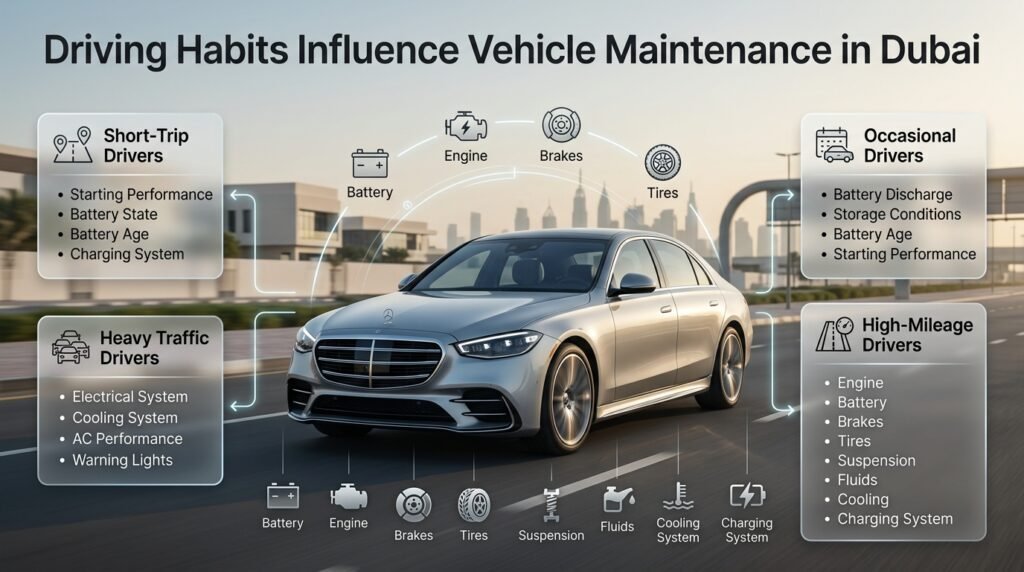
Maintenance should reflect how a vehicle is actually used.
A driver who travels long distances every day may have different maintenance priorities from a driver who uses the car mainly for short urban journeys.
Short-trip drivers
Short-trip drivers should pay particular attention to:
- Starting performance
- Battery state of charge
- Battery age
- Charging-system condition
- Repeated discharge
Heavy traffic drivers
Drivers who spend significant time in congestion should monitor:
- Electrical system behavior
- Cooling-system operation
- Air-conditioning performance
- Warning lights
- Battery condition
Occasional drivers
Drivers who leave their vehicles parked for long periods should consider:
- Battery discharge
- Vehicle storage conditions
- Battery age
- Starting performance after inactivity
High-mileage drivers
High-mileage drivers should maintain the entire vehicle, including:
- Engine
- Battery
- Brakes
- Tires
- Suspension
- Fluids
- Cooling system
- Charging system
This broader approach is more effective than focusing only on battery replacement.
14. Professional Battery Inspection Process
A professional battery inspection should be more comprehensive than simply looking at the battery casing.
Depending on the vehicle, a technician may evaluate:
Battery condition
Testing can help determine whether the battery has sufficient starting capability and whether its condition has deteriorated.
State of charge
A battery may be healthy but undercharged. This is different from a battery that has reached the end of its service life.
Charging-system performance
The alternator and associated charging system should be evaluated when battery discharge is recurring.
Battery terminals
Loose, contaminated, or corroded connections can interfere with electrical performance.
Electrical drain
If a vehicle loses charge while parked, an unwanted electrical load may need to be investigated.
Battery specification
The installed battery should match the vehicle’s requirements.
Vehicle-specific battery management
Some modern vehicles require specific procedures after battery replacement, depending on manufacturer design.
Professional inspection therefore helps answer a more important question:
Why is the battery performing poorly?
That question is often more useful than simply asking which battery should be installed.
15. Battery Replacement Should Address the Real Problem
Replacing a battery can restore reliability when the existing battery has genuinely reached the end of its service life.
However, battery replacement should not be used as a shortcut for diagnosing recurring electrical problems.
Suppose a driver installs a new battery and the vehicle becomes weak again shortly afterward.
Possible causes may include:
- Alternator problems
- Electrical drain
- Poor connections
- Incorrect battery specification
- Charging-system fault
- Another electrical issue
If the problem is not diagnosed, the new battery may also become discharged.
For drivers searching for professional car battery replacement in Dubai, the appropriate approach is to match the replacement battery to the vehicle and investigate recurring discharge problems.
Car Battery Replacement in Dubai can be considered when a vehicle requires professional battery replacement and installation.
16. Choosing a Battery According to Vehicle Requirements
A battery should never be selected solely because it is inexpensive or physically fits the battery tray.
Important considerations include:
- Battery dimensions
- Capacity
- Cold-cranking performance
- Terminal configuration
- Battery technology
- Vehicle electrical requirements
- Start-stop compatibility
- Manufacturer specifications
- Warranty
- Installation requirements
Modern vehicles can use different battery technologies depending on their electrical architecture.
Common battery technologies
Conventional maintenance-free batteries are used across many standard vehicles.
EFB batteries may be used in vehicles requiring enhanced cycling capability.
AGM batteries are common in applications with higher electrical demand and certain start-stop systems.
The correct battery depends on the specific vehicle.
17. Battery Brands and Driving Requirements
Drivers may encounter different battery brands in Dubai, including Amaron, Bosch, Tuflong, AGM, Exide, Panasonic, FIAMM, and AC Delco.
The important point is not simply choosing a recognizable brand. The battery should match the vehicle’s specifications and intended use.
For drivers researching options, EuroSwift Auto Services provides dedicated information for several battery categories and brands.
For example, drivers considering an Amaron Battery can review the dedicated Amaron battery replacement information from EuroSwift Auto Services.
Amaron Car Battery Replacement Dubai
Drivers looking for a Bosch Battery can also review the relevant Bosch battery service page.
Bosch Car Battery Replacement Dubai
For vehicles requiring Tuflong battery options, the dedicated service page provides additional information.
Tuflong Car Battery Replacement Dubai
For vehicles equipped for AGM technology, drivers can review the dedicated AGM Battery replacement service.
The correct battery should always be selected according to the vehicle’s actual specifications rather than simply choosing the most powerful option available.
18. Exide, Panasonic, FIAMM, and AC Delco Battery Options
Different vehicle owners may have different preferences based on vehicle requirements, manufacturer recommendations, availability, and battery technology.
EuroSwift Auto Services also provides dedicated pages covering several other battery brands.
For Exide Battery information:
Exide Car Battery Replacement Dubai
For Panasonic Battery information:
Panasonic Car Battery Replacement Dubai
For FIAMM Battery information:
FIAMM Car Battery Replacement Dubai
For AC Delco Battery information:
AC Delco Car Battery Replacement Dubai
These pages can be useful when researching battery options, but the final choice should remain vehicle-specific.
19. Why Battery Price Should Not Be the Only Consideration
Battery price can influence purchasing decisions, but choosing the cheapest option is not necessarily the most economical decision over the complete ownership period.
A battery’s suitability can depend on:
- Vehicle compatibility
- Battery technology
- Capacity
- Starting performance
- Warranty
- Expected operating conditions
- Installation
- Battery-management requirements
A battery that is unsuitable for the vehicle can create reliability problems even if its initial purchase price appears attractive.
For drivers researching the current market, a dedicated Car Battery Prices in Dubai guide can help explain the factors that influence battery pricing.
Complete Guide to Car Battery Prices in Dubai 2026
The better purchasing question is not simply:
“Which battery is cheapest?”
Instead, ask:
“Which battery correctly matches my vehicle and usage requirements?”
20. What to Do When Your Driving Habits Lead to a Dead Battery
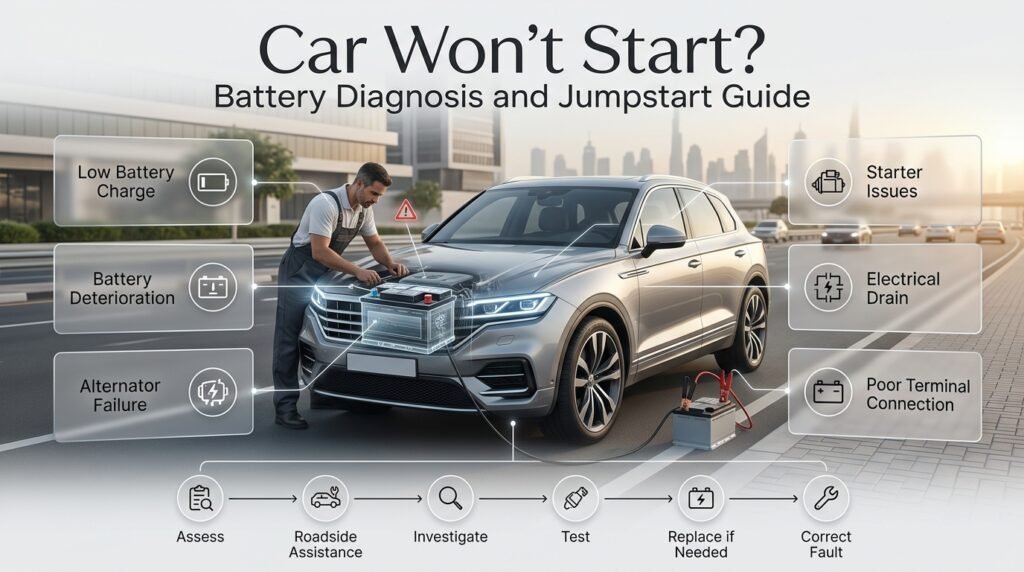
If your car does not start, avoid immediately assuming that the battery needs replacement.
The problem could involve:
- Low battery charge
- Battery deterioration
- Alternator failure
- Starter issues
- Electrical drain
- Poor terminal connection
- Another vehicle electrical fault
A professional Car Jumpstart may restore temporary mobility when appropriate.
However, if the same situation happens repeatedly, the vehicle needs diagnosis.
A practical response
Step 1: Determine whether the battery is completely discharged or whether another starting problem may exist.
Step 2: Use appropriate professional roadside assistance if the vehicle cannot be started safely.
Step 3: Once the vehicle is running, investigate why the battery became discharged.
Step 4: Test the battery and charging system.
Step 5: Replace the battery only when testing and vehicle condition justify replacement.
Step 6: Correct any underlying electrical fault.
Repeated jumpstarts without diagnosis can leave the original problem unresolved.
21. Roadside Assistance for Battery-Related Problems
Battery failures can happen at inconvenient times.
A vehicle may fail to start:
- At home
- At an office parking area
- At a shopping center
- During a commute
- Before an appointment
- After extended parking
- During an evening journey
When a vehicle cannot be started, Roadside Assistance can be valuable because the immediate priority is restoring mobility safely.
For a recurring battery problem, however, roadside assistance should be followed by proper diagnosis.
The objective should not simply be to restart the vehicle. The objective should be to understand why it failed.
22. Common Driving Mistakes That Shorten Battery Reliability
Several everyday habits can increase the likelihood of battery-related problems.
Mistake 1: Ignoring slow cranking
Drivers sometimes wait until the battery completely fails. A noticeable change in starting behavior should be treated as an early warning.
Mistake 2: Repeatedly relying on jumpstarts
A jumpstart can restore temporary operation, but repeated jumpstarts usually indicate that something requires investigation.
Mistake 3: Using accessories for long periods while parked
Electrical accessories can consume stored battery energy.
Mistake 4: Assuming a new battery solves everything
If the alternator or electrical system has a fault, another battery may also become discharged.
Mistake 5: Choosing a battery based only on price
Compatibility and specifications matter more than the lowest initial cost.
Mistake 6: Ignoring extended vehicle inactivity
A vehicle parked for a long time can gradually lose battery charge.
Mistake 7: Treating every battery issue as a heat problem
Climate matters, but battery condition and electrical-system health must also be checked.
23. Battery-Friendly Habits for Dubai Drivers
Dubai drivers can use several practical habits to reduce unnecessary battery stress.
Before leaving the vehicle
- Turn off unnecessary electrical equipment.
- Check that headlights are switched off when appropriate.
- Avoid leaving chargers connected unnecessarily.
- Make sure interior lights are not accidentally active.
During regular driving
- Pay attention to changes in engine starting.
- Avoid ignoring battery warning lights.
- Keep up with routine servicing.
- Address repeated battery discharge promptly.
During extended parking
- Consider the vehicle’s battery condition before leaving it unused for a long period.
- Arrange appropriate maintenance for vehicles that remain parked frequently.
- Do not assume a parked battery will remain fully charged indefinitely.
During vehicle breakdowns
- Avoid repeatedly attempting to start a severely weak vehicle.
- Use appropriate professional assistance.
- Have the underlying cause investigated after recovery.
24. How Driving Habits Connect With Complete Car Service
Battery performance is only one part of vehicle reliability.
A vehicle that is regularly maintained is easier to monitor because technicians can identify developing problems across multiple systems.
Depending on the vehicle, professional Car Service may include:
- Engine inspection
- Battery testing
- Charging-system testing
- Brake inspection
- Oil change
- Tire inspection
- Suspension inspection
- AC servicing
- Electrical diagnostics
- Fluid checks
- General vehicle inspection
This broader approach is especially useful for vehicles that experience demanding daily use.
For example, a driver may initially notice slow starting but later discover that the real problem involves a charging-system fault. Without a complete diagnostic approach, the battery may be replaced unnecessarily.
25. Battery Life and Preventive Vehicle Inspection
Preventive maintenance is about identifying problems before they become breakdowns.
A battery inspection can be incorporated into routine Vehicle Inspection, particularly when:
- The battery is aging
- The vehicle has frequent short-trip usage
- The vehicle has experienced repeated discharge
- The car has been unused for an extended period
- Starting performance has changed
- Electrical accessories behave unusually
Preventive inspection can also identify issues unrelated to the battery that could affect overall vehicle reliability.
This is why professional automotive maintenance should consider the entire vehicle rather than one component in isolation.
26. How Luxury Vehicles Can Be Different
Luxury and premium vehicles can have sophisticated electrical architectures with numerous control modules, comfort systems, safety systems, and electronic features.
As a result, battery-related problems may sometimes produce more complicated symptoms.
A battery replacement on a modern luxury vehicle may require consideration of:
- Correct battery technology
- Correct capacity
- Vehicle-specific installation
- Battery management
- Electronic registration or adaptation where applicable
- Diagnostic scanning
- Charging-system condition
Luxury vehicles should therefore receive maintenance based on manufacturer requirements and vehicle-specific specifications.
This is particularly important when selecting a replacement battery solely based on physical size.
27. Modern Automotive Battery Management Technology
Vehicle electrical systems have changed significantly over time.
Modern cars can monitor and control electrical energy more intelligently than many older vehicles.
Technology may include:
- Intelligent battery sensors
- Battery-management systems
- Variable charging strategies
- Start-stop systems
- Electronic energy management
- Diagnostic monitoring
- Advanced control modules
These systems can improve efficiency, but they also mean that battery replacement and diagnosis can be more vehicle-specific.
A professional technician should consider the vehicle’s electrical architecture rather than applying exactly the same procedure to every car.
28. Start-Stop Systems and Driving Habits
Start-stop technology automatically switches the engine off under certain conditions and restarts it when necessary.
This can increase the number of engine-start events compared with traditional vehicles.
Vehicles designed with start-stop systems therefore commonly require battery technologies capable of handling more demanding cycling requirements.
Depending on the vehicle, this may involve EFB or AGM technology.
Important consideration
A start-stop vehicle should not automatically receive a conventional battery simply because the battery physically fits.
The replacement battery should meet the manufacturer’s specifications and system requirements.
This is one reason professional battery selection matters more as vehicle technology becomes more advanced.
29. The Difference Between Battery Discharge and Battery Failure
A discharged battery and a failed battery are not necessarily the same thing.
Discharged battery
A healthy battery may become discharged because:
- Lights were left on
- Accessories were used while parked
- The vehicle remained unused for a long period
- The charging system did not replenish the battery adequately
The battery may recover after appropriate charging if it remains healthy.
Deteriorated battery
A battery that has reached the end of its useful service life may no longer hold or deliver sufficient charge reliably.
In that case, charging may provide only temporary improvement.
Why the distinction matters
Replacing a healthy battery that was simply discharged may be unnecessary.
Likewise, repeatedly charging a battery that has deteriorated internally may only delay the inevitable failure.
Professional testing helps distinguish these situations.
30. A Practical Battery Maintenance Strategy
There is no single rule that applies to every driver, but the following approach provides a useful framework.
If you drive mostly short distances
Monitor starting performance and consider periodic battery testing.
If you drive long distances regularly
Continue routine vehicle maintenance and watch for normal battery aging.
If you start the car many times each day
Pay closer attention to battery condition and charging performance.
If your car remains parked for weeks
Consider battery condition before extended storage.
If the battery repeatedly becomes discharged
Investigate the charging system and electrical system rather than simply replacing the battery.
If the vehicle is modern or equipped with start-stop technology
Follow the manufacturer’s battery technology and replacement requirements.
31. Battery Maintenance Schedule Based on Usage
| Usage Type | Recommended Attention |
| Daily mixed driving | Routine battery inspection during servicing |
| Mostly short journeys | Closer monitoring of battery condition |
| Heavy traffic usage | Monitor electrical and charging performance |
| Multiple starts daily | Watch for changes in cranking performance |
| Occasional driving | Monitor battery during long parking periods |
| Long-term vehicle storage | Plan appropriate battery maintenance |
| Repeated discharge | Professional electrical diagnosis |
| Older battery | More frequent condition checks |
This is not a substitute for the manufacturer’s maintenance schedule. Instead, it provides a practical way to think about battery care according to actual vehicle usage.
32. Professional Recommendations for Extending Battery Reliability
There is no driving trick that can make an old battery permanently reliable. However, good habits can reduce unnecessary stress and help drivers identify problems earlier.
Professional best practices
- Maintain the correct battery specification.
- Keep battery terminals and connections in good condition.
- Check the charging system when battery problems recur.
- Avoid unnecessary electrical accessory use while parked.
- Do not ignore slow cranking.
- Investigate repeated discharge.
- Follow manufacturer maintenance requirements.
- Consider driving pattern when evaluating battery condition.
- Use professional diagnostics for recurring electrical problems.
- Replace the battery when testing indicates that it can no longer reliably meet vehicle requirements.
The most important principle is simple:
Good battery maintenance is preventive, not reactive.
33. Future Outlook for Vehicle Battery Diagnostics
Battery diagnostics are becoming increasingly integrated with modern vehicle electronics.
As vehicles become more connected, technicians can increasingly use diagnostic information to understand battery condition, charging behavior, electrical loads, and system faults.
Future developments may improve the ability to detect declining battery performance before a vehicle becomes unable to start.
However, advanced technology does not remove the importance of basic maintenance.
A modern vehicle still needs:
- Correct battery selection
- Proper installation
- Healthy electrical connections
- Functional charging system
- Appropriate maintenance
- Accurate diagnostics
Technology works best when combined with professional automotive knowledge.
Do frequent short trips reduce car battery life?
Frequent short trips can contribute to faster battery deterioration because starting the engine requires a significant amount of electrical energy, while a very short journey may not give the alternator enough operating time to replenish that energy. The problem is usually not one short trip; it is the repeated pattern of starting the vehicle, driving briefly, switching it off, and repeating the cycle several times.
This becomes more important when the battery is already aging, the vehicle has high electrical demand, or the charging system is not performing properly. AAA specifically identifies frequent short trips as a factor that can leave a battery insufficiently charged over time.
For Dubai drivers, this can be relevant to vehicles mainly used for short office commutes, school runs, shopping trips, and repeated urban journeys.
Important points:
Frequent short journeys are more concerning than occasional short drives.
Repeated engine starts increase the battery’s workload.
An aging battery is less tolerant of repeated undercharging.
Heavy electrical use can increase the overall demand.
Slow engine cranking should be treated as an early warning.
If the battery repeatedly becomes weak, the battery and charging system should be tested.
The practical answer is not to avoid short trips completely. Instead, drivers with this type of routine should pay closer attention to battery condition and include battery checks within their regular Vehicle Maintenance schedule.
Does driving regularly help keep a car battery charged?
Regular driving generally helps because the vehicle’s charging system operates while the engine is running. However, simply starting the car for a few minutes is not the same as giving the charging system adequate operating time.
A vehicle that is driven regularly but only for very short journeys may still experience battery problems. On the other hand, a vehicle that remains parked for extended periods can gradually lose charge even when nothing appears to be wrong. AAA notes that both frequent short trips and prolonged inactivity can negatively affect battery condition.
This is particularly relevant for second cars, luxury vehicles that are driven occasionally, and vehicles that remain parked for long periods.
For better battery management:
Avoid leaving a vehicle unused for unnecessarily long periods.
Combine short errands when practical.
Do not repeatedly start the vehicle only to run it for a very brief period.
Pay attention to changes in starting performance.
Consider professional battery testing if the vehicle is used very infrequently.
If a vehicle will be stored for an extended period, follow the manufacturer’s recommended battery-storage procedure.
Regular use is helpful, but the quality and pattern of that use matter. A healthy charging system, suitable battery, and appropriate driving routine work together to maintain reliability.
How does Dubai’s hot climate affect car battery life?
Dubai’s high temperatures can accelerate battery aging, making climate an important consideration when evaluating battery performance. Heat increases the rate of chemical activity inside a battery and can contribute to deterioration over time. AAA identifies heat as one of the major environmental factors affecting battery lifespan.
However, it would be inaccurate to blame every battery failure simply on Dubai’s weather. In real driving conditions, several factors can work together. A vehicle may experience high temperatures, frequent short trips, heavy traffic, extensive electrical use, and long periods of parking. When an aging battery is exposed to several of these conditions, its weaknesses can become more noticeable.
Dubai drivers should pay attention to:
Slower-than-normal engine cranking.
Repeated battery discharge.
Frequent need for a jumpstart.
Battery or charging warning lights.
Unusual electrical behavior.
Visible corrosion or physical battery damage.
A battery approaching the later part of its service life.
The right approach is to inspect the battery rather than automatically replacing it because of the climate. A professional technician can determine whether the problem is battery deterioration, charging-system performance, an electrical drain, or another issue.
For Dubai vehicles, therefore, heat is one part of the battery-life equation—not the entire diagnosis.
Why does my car battery keep dying even after I replaced it?
If a replacement battery repeatedly becomes weak or discharged, there is a good possibility that the battery is not the underlying cause. A new battery cannot compensate for a vehicle that has a charging-system problem, an unwanted electrical drain, poor connections, or an incorrect battery specification.
This is one of the most important points in battery diagnosis. Replacing the battery without checking the rest of the electrical system can result in the same problem happening again. AAA also identifies charging-system faults and electrical issues as factors that can reduce battery life.
When a relatively new battery keeps going flat, a professional inspection should consider:
Battery state of charge and condition.
Alternator and charging-system performance.
Battery terminals and electrical connections.
Possible parasitic electrical drain.
Correct battery size and specification.
Vehicle-specific battery-management requirements.
Warning lights or unusual electrical symptoms.
The vehicle’s recent driving and parking pattern.
For example, if a driver mainly makes short journeys and the battery repeatedly becomes discharged, the solution may involve addressing the usage pattern as well as checking the charging system.
Likewise, if the vehicle loses power after sitting overnight, an electrical drain may need to be investigated.
The key principle is simple: when a replacement battery repeatedly fails, diagnose the vehicle rather than repeatedly replacing the battery.
What driving habits can help extend car battery life?
The most useful battery-friendly habits are practical rather than complicated. The objective is to avoid unnecessary battery discharge, reduce repeated stressful starting cycles, and identify developing problems before they become a roadside breakdown.
One of the most useful changes for drivers who mainly make short journeys is to combine errands when practical. This reduces the number of separate engine starts and can give the charging system more continuous operating time. It is also important to avoid leaving lights, chargers, audio systems, or other electrical equipment operating for extended periods while the engine is switched off. AAA recommends limiting short trips and avoiding unnecessary electrical use when the engine is not running.
Good battery-friendly habits include:
Combine nearby short trips when practical.
Avoid unnecessary repeated engine starts.
Switch off unnecessary electrical equipment when parked.
Do not leave lights or accessories operating accidentally.
Pay attention to slow engine cranking.
Keep battery connections properly maintained.
Investigate repeated battery discharge.
Check the charging system when battery problems return.
Use the battery type and specification recommended for your vehicle.
Include battery inspection within routine Car Service when appropriate.
For Dubai drivers, it is also sensible to consider the combination of climate and driving pattern. A vehicle regularly exposed to high temperatures and short urban journeys deserves closer attention than one operating under lighter conditions.
The goal is not to completely change your normal driving routine. It is to understand how your vehicle is being used and make sure the battery, charging system, and overall vehicle are being maintained accordingly.
Conclusion
Driving habits play an important role in how reliably a car battery performs over time. Frequent short trips, repeated engine starts, heavy traffic, extended use of electrical accessories, and long periods of vehicle inactivity can place additional demands on the battery and charging system. In Dubai, these factors can become more significant when combined with high temperatures and regular air-conditioning use.
The best approach is not to avoid certain types of driving completely, but to understand how your vehicle is being used and respond to early warning signs. Slow engine cranking, repeated battery discharge, frequent jumpstarts, or unusual electrical behavior should never be treated as normal. These symptoms can indicate a weak battery, charging-system problem, electrical drain, or another vehicle issue.
Regular Vehicle Maintenance, professional Car Service, timely Battery Replacement, and proper Vehicle Inspection can help identify battery-related problems before they result in an unexpected breakdown. When a battery repeatedly loses power, professional diagnosis is especially important because replacing the battery alone may not solve the underlying problem.
For Dubai drivers, combining sensible driving habits with correct battery selection, proper maintenance, and professional automotive support is the most practical way to maintain dependable starting performance and overall vehicle reliability.

Leave a Reply