
Introduction
In Dubai’s extreme climate, one of the most common yet underestimated vehicle issues is fast battery failure after hot weather parking. High ambient temperatures combined with engine bay heat can rapidly accelerate chemical degradation inside automotive batteries, leading to sudden breakdowns—even in relatively new units. This issue is especially critical for daily commuters, luxury vehicle owners, and long-term parked vehicles exposed to outdoor heat.
Modern automotive care in Dubai now focuses heavily on preventive diagnostics, thermal testing, and rapid roadside response systems. Workshops like EuroSwift Auto Services specialize in identifying root causes quickly to prevent unnecessary replacements and ensure reliable vehicle performance under extreme weather conditions.
Understanding Battery Failure After Hot Weather Parking in Dubai
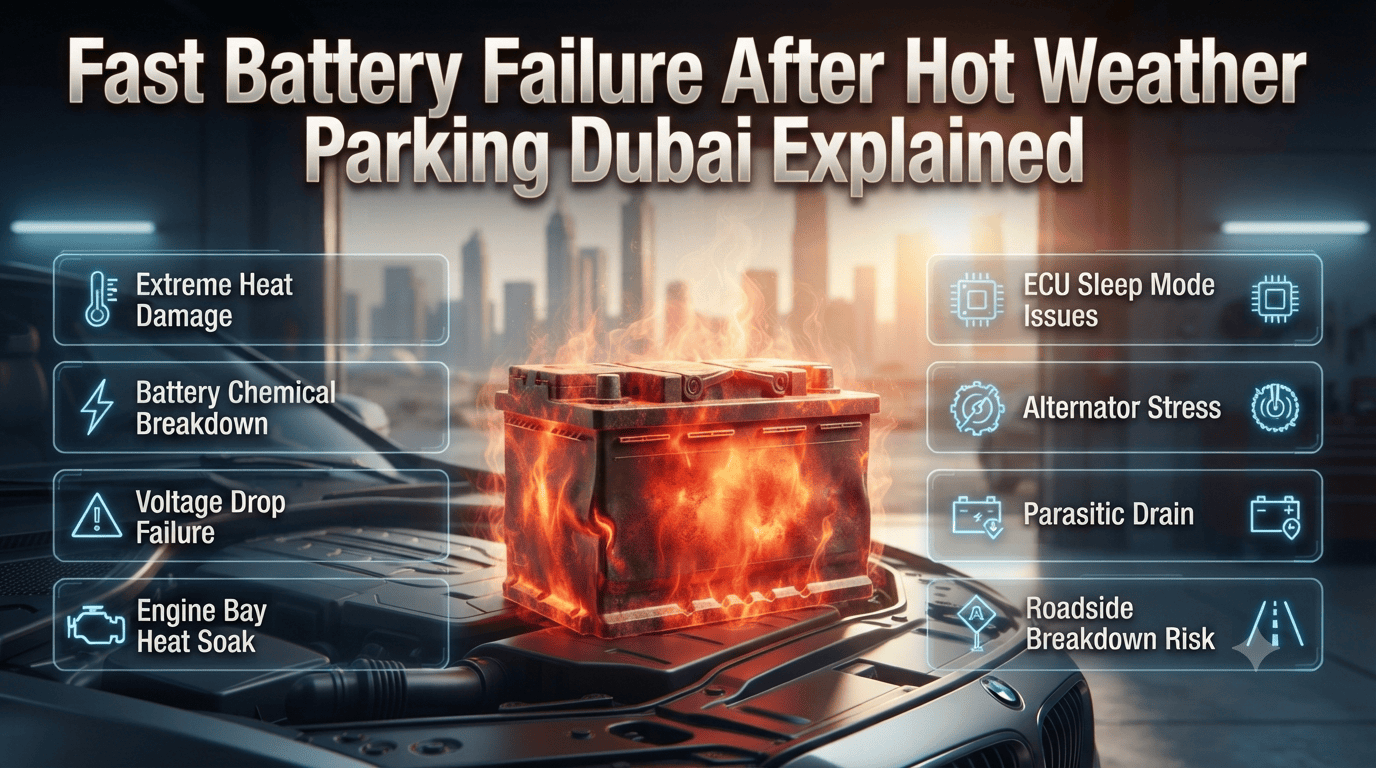
Battery failure after hot parking is not random. It is a predictable chemical and electrical reaction triggered by heat expansion, electrolyte evaporation, and internal resistance changes.
When a vehicle is parked under direct sunlight, cabin and engine bay temperatures can exceed safe operating limits. This causes internal battery plates to corrode faster and reduces charge-holding capacity.
Key understanding points:
✔ Heat accelerates sulfation
✔ Voltage drops during rest state
✔ Internal resistance increases
✔ Battery fluid evaporation in non-sealed units
Why Extreme Heat Damages Car Batteries So Quickly
Dubai’s climate creates a perfect storm for battery degradation. Unlike cold climates where batteries fail due to low chemical activity, heat causes overactive chemical breakdown.
Main Heat Damage Mechanisms
| Cause | Effect on Battery |
|---|---|
| High ambient temperature | Accelerated internal corrosion |
| Engine heat soak | Plate deformation |
| Overcharging in heat | Fluid loss |
| Extended parking | Deep discharge cycle stress |
Expert Insight: Heat does not just weaken batteries—it permanently shortens their lifecycle by up to 40–60% if unmanaged.
Common Symptoms of Heat-Related Battery Failure
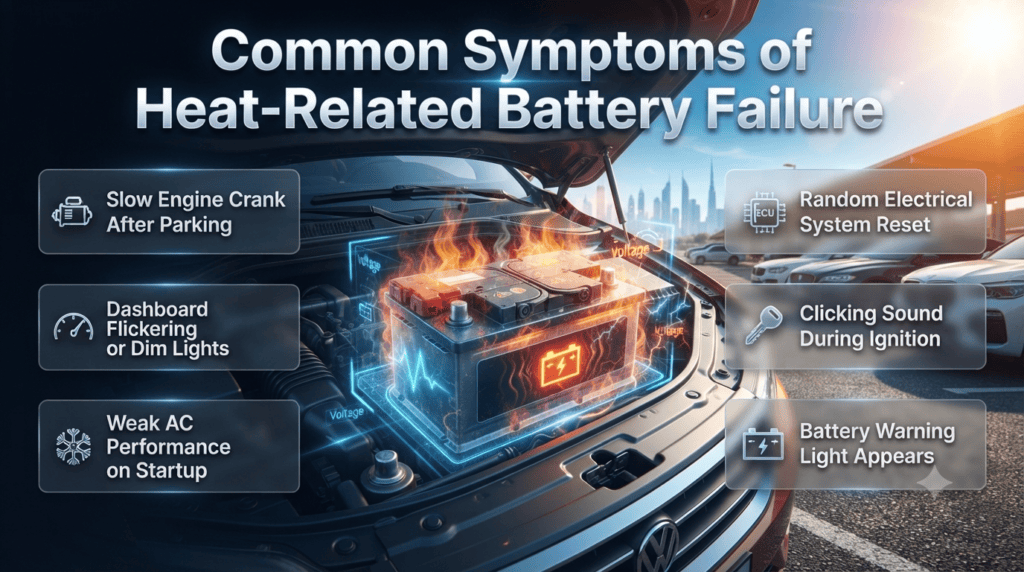
Recognizing early warning signs can prevent complete breakdown.
✔ Slow engine crank after parking
✔ Dashboard flickering or dim lights
✔ Random electrical system reset
✔ Weak AC performance on startup
✔ Clicking sound during ignition
✔ Battery warning light appears intermittently
These symptoms often overlap with alternator or wiring issues, making professional diagnosis essential.
Professional Diagnostic Process for Heat-Damaged Batteries
At advanced workshops like EuroSwift Auto Services, diagnostics go beyond basic voltage checks.
Standard Inspection Steps
✔ Alternator ripple voltage analysis
✔ Battery load capacity testing
✔ ECU sleep-mode verification
✔ Cable resistance inspection
✔ Thermal imaging of battery terminals
Diagnostic Comparison Table
| Test Type | Purpose | Result Indicator |
|---|---|---|
| Load Test | Measure real capacity | Battery health % |
| Ripple Test | Alternator stability | Charging consistency |
| Thermal Scan | Heat stress points | Hotspot detection |
| Voltage Drain Test | Parasitic drain | Overnight loss rate |
Field Testing Approach in Emergency Situations
In roadside scenarios, quick but accurate testing is essential.
✔ Portable digital battery analyzers
✔ Jumpstart response validation
✔ Alternator output verification
✔ ECU reset observation
Professional technicians avoid guesswork by combining real-time data with on-site physical inspection.
Repair vs Replacement Decision After Heat Failure
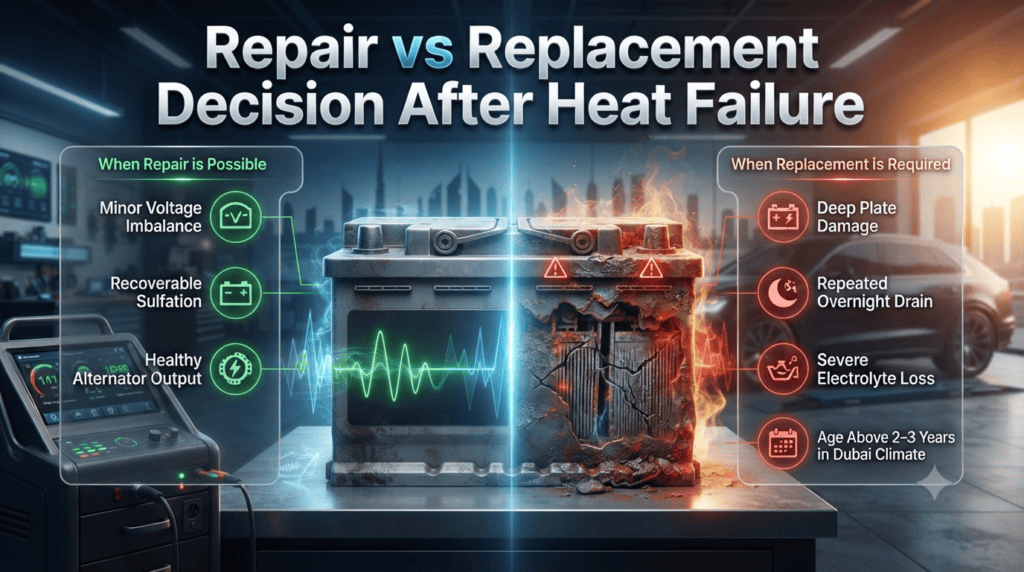
Not every heat-damaged battery requires replacement.
When Repair is Possible
✔ Minor voltage imbalance
✔ Recoverable sulfation
✔ Healthy alternator output
When Replacement is Required
✔ Deep plate damage
✔ Repeated overnight drain
✔ Severe electrolyte loss
✔ Age above 2–3 years in Dubai climate
Emergency Roadside Assistance in Dubai Heat Conditions
Extreme heat breakdowns require fast response systems due to safety risks.
✔ Immediate jumpstart service
✔ On-site battery replacement
✔ Mobile diagnostic scanning
✔ Electrical system validation
Services like Car Jumpstart and Roadside Assistance are critical during peak summer months when failure rates increase significantly.
Preventive Maintenance Strategies for Hot Weather Parking
Preventing battery failure is more effective than repairing it.
✔ Park in shaded or covered areas
✔ Start vehicle every 2–3 days
✔ Use smart battery chargers
✔ Avoid long idle periods
✔ Regular Car Service inspections
✔ Monitor voltage during AC-heavy usage
Role of Alternator and Electrical System in Battery Failure
A battery does not fail alone—alternator health plays a major role.
If the alternator overcharges in heat conditions, it can damage even premium batteries.
✔ Overcharging increases fluid evaporation
✔ Weak alternator causes undercharging
✔ Voltage instability reduces battery lifespan
Proper Engine Diagnostics ensures correct identification of root cause.
Battery Types and Heat Performance in Dubai Climate
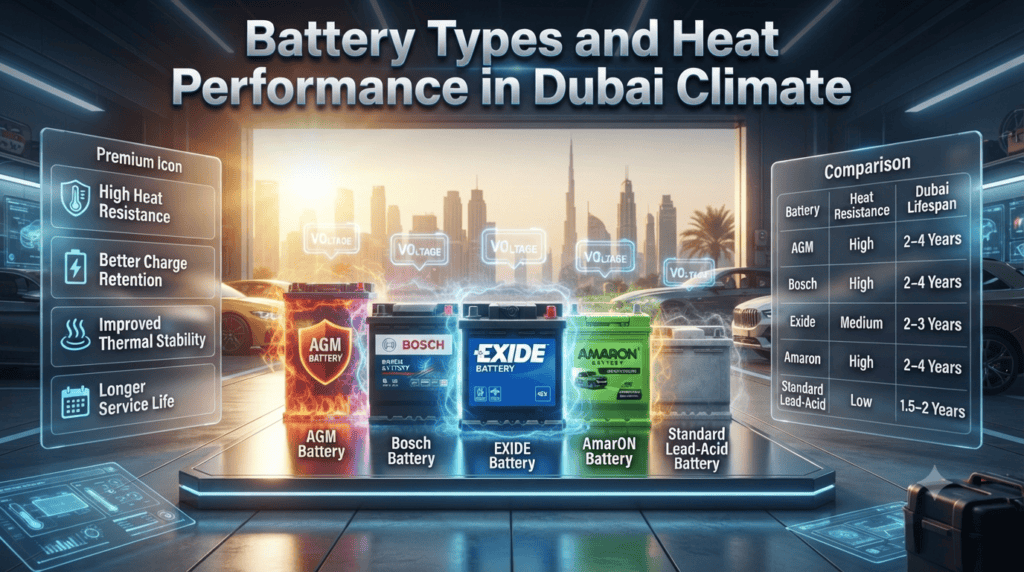
Different battery technologies react differently to heat stress.
Comparison Table
| Battery Type | Heat Resistance | Lifespan in Dubai |
|---|---|---|
| AGM Battery | High | 2–4 years |
| Exide Battery | Medium | 2–3 years |
| Bosch Battery | High | 2–4 years |
| Standard Lead-Acid | Low | 1.5–2 years |
Brands such as Amaron Battery, Bosch Battery, and Exide Battery are commonly used for better thermal stability.
Cost Factors for Battery Replacement in Dubai
Battery replacement costs depend on multiple technical and service-related factors.
✔ Battery brand and type
✔ Vehicle category (luxury vs standard)
✔ Emergency vs scheduled service
✔ Diagnostic requirements
✔ Installation complexity
For updated pricing insights, refer to:
Car Battery Price Guide Dubai
How EuroSwift Auto Services Handles Heat-Related Battery Failures
Modern service providers like EuroSwift Auto Services follow a structured approach:
✔ Rapid on-site diagnostics
✔ Genuine battery matching
✔ ECU-safe replacement process
✔ Free installation support
✔ Full electrical system check
Internal service pages:
- EuroSwift Auto Services Battery Replacement
- AGM Battery Service
- Tuflong Battery
- Panasonic Battery
- FIAMM Battery
- AC Delco Battery
Safety Risks of Heat-Damaged Batteries
Heat-affected batteries can become dangerous if ignored.
✔ Risk of sudden breakdown in traffic
✔ Electrical short circuits
✔ Battery swelling or leakage
✔ ECU system malfunction
Immediate inspection is recommended once symptoms appear.
Maintenance Schedule for Battery Health in Hot Climate
| Interval | Action |
|---|---|
| Weekly | Start vehicle & short drive |
| Monthly | Voltage check |
| Every 3 months | Full Car Inspection |
| Every 6 months | Battery load test |
| Yearly | Full electrical system diagnostics |
Future of Automotive Batteries in Hot Climates
Modern automotive technology is evolving rapidly.
✔ Heat-resistant lithium hybrid systems
✔ Smart battery monitoring sensors
✔ AI-based predictive failure alerts
✔ Improved thermal insulation systems
These innovations aim to reduce heat-related breakdowns significantly in regions like Dubai.
Understanding Deep Electrical Causes Behind Heat-Induced Battery Failure
Most drivers assume battery failure after hot weather parking is purely “battery aging,” but in real-world automotive diagnostics, the issue is far more layered. In Dubai’s high-temperature environment, the entire electrical ecosystem of the vehicle becomes unstable under heat stress, especially when vehicles are parked for long durations.
Heat does not only weaken the battery—it disrupts the interaction between alternator output, ECU sleep cycles, wiring resistance, and parasitic load behavior. This is why two identical batteries can behave completely differently in the same parking conditions.
Modern workshops like EuroSwift Auto Services focus on system-wide evaluation rather than isolated battery replacement, ensuring the root cause is correctly identified before any component is changed.
ECU Sleep Mode Failure and Overnight Drain After Heat Exposure
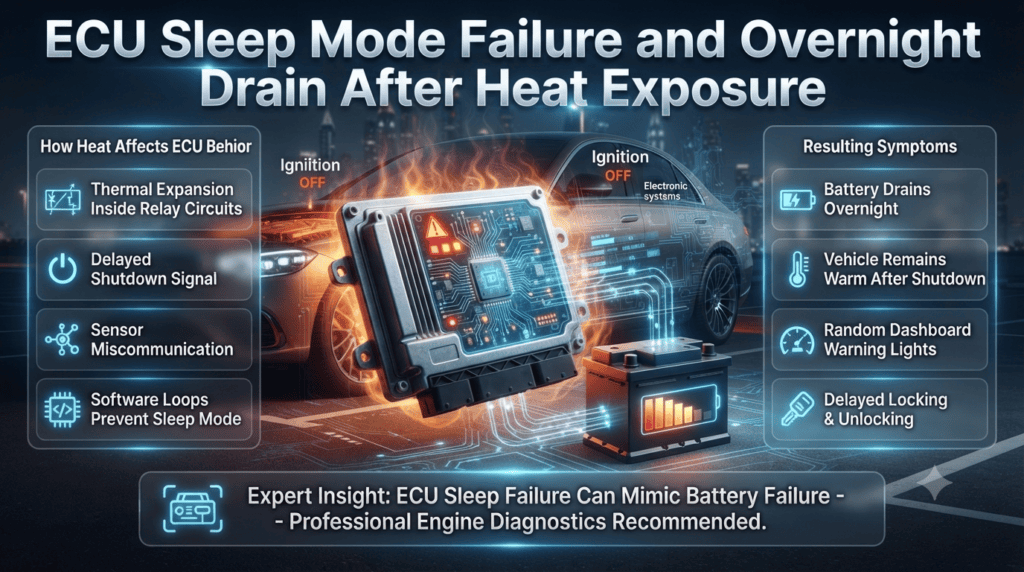
One of the most overlooked causes of “dead battery after parking in hot weather” is ECU sleep mode failure. When a vehicle is turned off, the ECU (Engine Control Unit) is supposed to enter a low-power state. However, excessive heat can disrupt this process.
How heat affects ECU behavior:
✔ Thermal expansion inside relay circuits
✔ Delayed shutdown signal from control modules
✔ Sensor miscommunication during cooldown phase
✔ Software loops preventing full sleep mode
Resulting symptoms:
✔ Battery drains overnight even if new
✔ Vehicle feels “warm” hours after shutdown
✔ Random warning lights on startup
✔ Delayed locking/unlocking response
Expert Insight: ECU sleep failure often mimics battery failure, leading to unnecessary replacements if not properly diagnosed through Engine Diagnostics.
Alternator Ripple Voltage Instability in High Heat Conditions
The alternator is the heart of the charging system, and in hot climates like Dubai, it is under constant thermal stress. Heat causes diode inefficiency and unstable voltage output known as ripple voltage distortion.
What happens during ripple instability:
✔ Uneven charging cycles
✔ Excess heat in battery plates
✔ Overcharging during short drives
✔ Voltage spikes during AC load usage
Diagnostic table:
| Alternator Condition | Effect on Battery | Vehicle Behavior |
|---|---|---|
| Stable output | Normal charging | No symptoms |
| High ripple | Battery overheating | Flickering lights |
| Undercharging | Deep discharge | Hard starting |
| Overcharging | Fluid loss | Battery swelling |
Proper Car Repair workflow includes ripple testing to prevent repeated battery replacements.
Cable Resistance Increase Due to Heat Expansion
Electrical wiring in vehicles is highly sensitive to temperature changes. In extreme heat, copper resistance increases, which reduces the efficiency of current flow between the alternator, ECU, and battery.
Common issues caused by heat-expanded wiring:
✔ Weak cranking despite charged battery
✔ Intermittent electrical failures
✔ Voltage drop under AC load
✔ Delayed ignition response
Key inspection points:
✔ Battery terminal corrosion
✔ Grounding point stability
✔ Starter motor wiring resistance
✔ Fuse box heat exposure
This is why advanced Vehicle Inspection includes resistance mapping, not just visual checks.
Parasitic Drain Amplified by Hot Weather Parking
Parasitic drain refers to electricity consumed by systems when the vehicle is off. In hot climates, this drain increases due to prolonged ECU activity and sensor recalibration cycles.
Major contributors:
✔ Smart key systems staying active
✔ Infotainment standby modes
✔ Cooling fan relay delays
✔ Faulty aftermarket accessories
Drain severity comparison:
| Drain Level | Battery Impact | Parking Outcome |
|---|---|---|
| Low | Minimal loss | Normal start |
| Medium | Gradual drain | Slow crank |
| High | Overnight failure | Dead battery |
Expert Recommendation: Parasitic drain testing should always be included in Car Service for vehicles regularly parked outdoors.
Heat Soak Effect After Engine Shutdown
Heat soak is a critical but often ignored phenomenon where engine temperature continues rising after shutdown instead of cooling immediately.
What heat soak does:
✔ Raises battery compartment temperature
✔ Affects ECU thermal sensors
✔ Weakens alternator diode insulation
✔ Increases chemical reaction speed in battery
This effect is particularly strong in SUV and luxury vehicles where engine bays are tightly packed.
Professional Diagnostic Workflow for Complex Heat Failures
Modern automotive diagnostics require multi-layer analysis instead of single-tool inspection.
At advanced service centers like EuroSwift Auto Services, technicians follow a structured workflow:
Step-by-step process:
✔ Initial voltage and load testing
✔ ECU sleep mode verification
✔ Alternator ripple voltage scan
✔ Thermal imaging of engine bay
✔ Wiring resistance mapping
✔ Parasitic drain isolation test
Diagnostic priority table:
| Priority Level | Test Type | Purpose |
|---|---|---|
| Level 1 | Battery load test | Immediate health check |
| Level 2 | Alternator scan | Charging stability |
| Level 3 | ECU sleep test | Drain detection |
| Level 4 | Wiring resistance | Hidden faults |
Common Misdiagnosis in Hot Weather Battery Failures
A major issue in Dubai automotive repairs is incorrect diagnosis leading to unnecessary battery replacements.
Frequently misdiagnosed issues:
✔ Alternator failure mistaken as battery fault
✔ ECU drain misidentified as weak battery
✔ Wiring resistance ignored
✔ Aftermarket devices overlooked
This leads to repeated breakdowns even after installing a “new battery.”
Professional Car Jumpstart teams often encounter vehicles where the battery was replaced multiple times without fixing the real issue.
Expert Recommendation: System-Based Diagnosis Approach
Instead of replacing parts blindly, modern automotive practice emphasizes system-level diagnosis.
✔ Always test alternator before battery replacement
✔ Check ECU sleep mode in idle vehicles
✔ Inspect wiring before confirming failure
✔ Use thermal scanning for hidden overheating points
This approach reduces repeat failures and improves long-term reliability, especially in high-temperature environments like Dubai.
Preventive Electrical Health Checklist for Hot Climate Vehicles
✔ Monthly voltage monitoring
✔ Regular alternator output testing
✔ Battery terminal cleaning every 60 days
✔ ECU diagnostic scan every service cycle
✔ Avoid long idle parking under direct sunlight
✔ Disable unnecessary aftermarket electronics when parked
Real-World Scenario: Why Batteries Fail Right After Parking in Dubai Heat
In real workshop situations, one of the most common complaints is:
“Car was fine in the morning, but after parking in the sun, it won’t start.”
This is not coincidence. It is a predictable heat-cycle failure pattern where internal battery chemistry collapses after thermal expansion and contraction cycles.
When vehicles sit under direct sunlight in Dubai:
✔ Engine bay temperature rises far beyond ambient levels
✔ Battery electrolyte becomes unstable
✔ Internal plate resistance increases suddenly
✔ Voltage drops below ECU-safe threshold
This creates a “silent failure” where the battery appears fine—but cannot deliver cranking power.
Premium vs Standard Battery Performance in Extreme Heat
Not all batteries respond the same way in hot weather. Premium batteries are designed with better plate density, heat-resistant separators, and improved electrolyte stability.
Performance comparison table
| Battery Type | Heat Tolerance | Recovery Ability | Lifespan in Dubai | Failure Pattern |
|---|---|---|---|---|
| Premium AGM Battery | Very High | Strong recovery | 2–4 years | Gradual decline |
| Mid-range Sealed Battery | Medium | Moderate recovery | 2–3 years | Sudden weak crank |
| Standard Lead-Acid | Low | Poor recovery | 1–2 years | Instant failure |
Brands commonly used in professional installations include:
Bosch Battery, Exide Battery, and AGM Battery.
Expert Insight: In Dubai heat conditions, battery quality is not optional—it directly determines breakdown frequency.
Heat-Triggered Failure Patterns in Luxury vs Standard Vehicles
Luxury vehicles behave differently under heat stress due to advanced electronics and constant background power consumption.
Luxury vehicle issues:
✔ Higher parasitic drain from smart modules
✔ Sensitive ECU sleep cycles
✔ More heat in compact engine bays
✔ Advanced sensors always active
Standard vehicle issues:
✔ Simpler electrical load
✔ Lower parasitic drain
✔ More predictable failure signs
✔ Easier jumpstart recovery
Even though luxury vehicles have premium components, they are often more vulnerable to overnight heat-related battery drain.
Emergency Breakdown Case Study Pattern (Dubai Roads)
Most roadside failures follow a consistent pattern in hot weather:
Typical breakdown timeline:
- Vehicle parked under sun (3–6 hours)
- Cabin temperature rises sharply
- ECU remains partially active
- Battery voltage slowly drops
- Driver returns → ignition failure
Common symptoms on arrival:
✔ No crank condition
✔ Dashboard resets
✔ Central locking delay
✔ Weak starter response
This is where fast Car Jumpstart and Roadside Assistance services become essential.
Emergency Recovery Process for Heat-Damaged Batteries
When technicians arrive on-site, recovery is not just jumpstarting—it is structured validation.
At professional service providers like EuroSwift Auto Services, emergency workflow includes:
Step-by-step response:
✔ Immediate voltage assessment
✔ Jumpstart with controlled current
✔ Alternator output validation
✔ ECU stability check
✔ Post-start battery load testing
Recovery decision matrix:
| Condition | Action | Outcome |
|---|---|---|
| Weak battery only | Jumpstart + recharge | Temporary recovery |
| Alternator issue | System repair required | No replacement yet |
| Deep discharge | Battery replacement | Permanent fix |
| ECU drain | Electrical diagnosis | System repair |
Why Jumpstarting Alone Does Not Solve Heat Failure Issues
A major misconception among drivers is that jumpstarting “fixes” the problem.
In reality:
✔ Jumpstart only restores temporary voltage
✔ It does not repair internal battery damage
✔ It does not stop ECU drain
✔ It does not fix alternator instability
If the root cause is not diagnosed properly, the vehicle will fail again within hours or days.
This is why structured Vehicle Inspection is critical after every emergency start.
Battery Heat Protection Techniques Used in Modern Workshops
Advanced automotive workshops now use preventive thermal protection methods to reduce failure rates.
Professional techniques:
✔ Heat shield battery wraps
✔ Engine bay airflow optimization
✔ ECU cooling path inspection
✔ Terminal anti-corrosion coating
✔ Voltage stabilization testing
These techniques significantly improve battery lifespan in extreme climates.
Long-Term Prevention Strategy for Dubai Drivers
To avoid repeated heat-related failures, long-term maintenance must be structured.
Recommended schedule:
✔ Weekly: Short engine runs (10–15 minutes)
✔ Monthly: Voltage and alternator check
✔ Quarterly: Full Car Service inspection
✔ Bi-annual: Battery load testing
✔ Annual: Complete electrical system scan
Common Driver Mistakes That Increase Heat Battery Failure
✔ Parking directly under sunlight for long hours
✔ Ignoring weak crank signs
✔ Delaying battery replacement after first failure
✔ Installing low-quality replacement batteries
✔ Skipping alternator diagnostics
✔ Overusing electronics while engine is off
These mistakes significantly shorten battery lifespan in Dubai conditions.
Future of Emergency Automotive Battery Support in Hot Climates
The automotive industry is rapidly evolving toward predictive and smart diagnostics.
Future systems include:
✔ AI-based battery failure prediction
✔ Real-time heat monitoring sensors
✔ Smart alternator regulation systems
✔ Remote ECU diagnostics via mobile apps
✔ Self-protecting battery thermal systems
These innovations aim to reduce sudden roadside breakdowns significantly.
Why does my car battery die after parking in hot weather?
Hot weather increases chemical activity inside the battery, causing internal fluid evaporation, plate corrosion, and voltage drop. When the vehicle is parked, heat soak continues damaging internal components, leading to sudden failure even if the battery seemed fine earlier.
Can extreme heat damage a new car battery?
Yes. Even a new battery can fail early in Dubai heat because:
✔ High engine bay temperature
✔ Continuous AC load usage
✔ Alternator overcharging in heat
✔ Poor ventilation during parking
In extreme climates, battery life can drop significantly compared to normal regions.
Why does my car start fine in the morning but fail after parking?
This is a classic heat soak failure pattern:
✔ Morning: battery is cool → normal voltage
✔ Afternoon parking: temperature rises → internal resistance increases
✔ Restart attempt: voltage drops → no crank condition
This is often misdiagnosed as a dead battery.
How long does a car battery last in Dubai heat?
On average:
✔ Standard battery: 1.5–2 years
✔ Premium battery: 2–4 years
✔ AGM battery: 2–5 years (better heat resistance)
Heat is the biggest factor reducing lifespan.
Conclusion
Fastest premium & genuine battery failure after hot weather parking in Dubai is not a random roadside problem—it is a predictable outcome of extreme thermal stress combined with modern vehicle electrical load behavior. High temperatures accelerate internal battery wear, disturb ECU sleep cycles, increase alternator strain, and amplify hidden parasitic drains. Together, these factors create sudden no-start situations even in vehicles that were performing normally just hours earlier.
For drivers in Dubai, the key takeaway is simple: battery failure is rarely just a battery issue. It is usually part of a wider electrical system imbalance that includes charging efficiency, wiring resistance, and thermal exposure. Ignoring early warning signs often leads to repeated breakdowns and unnecessary replacements.
A structured diagnostic approach using Car Service, Engine Diagnostics, Battery Replacement, and Electrical System Testing ensures the real cause is identified before any part is changed. This not only saves cost but also improves long-term vehicle reliability in extreme heat conditions.
With proper preventive care, quality battery selection, and professional inspection, vehicles can maintain stable performance even under harsh summer parking conditions. As automotive systems continue to evolve, smarter diagnostics and heat-resistant technologies will further reduce these failures—but proactive maintenance will always remain the most effective solution.

Leave a Reply