

Introduction
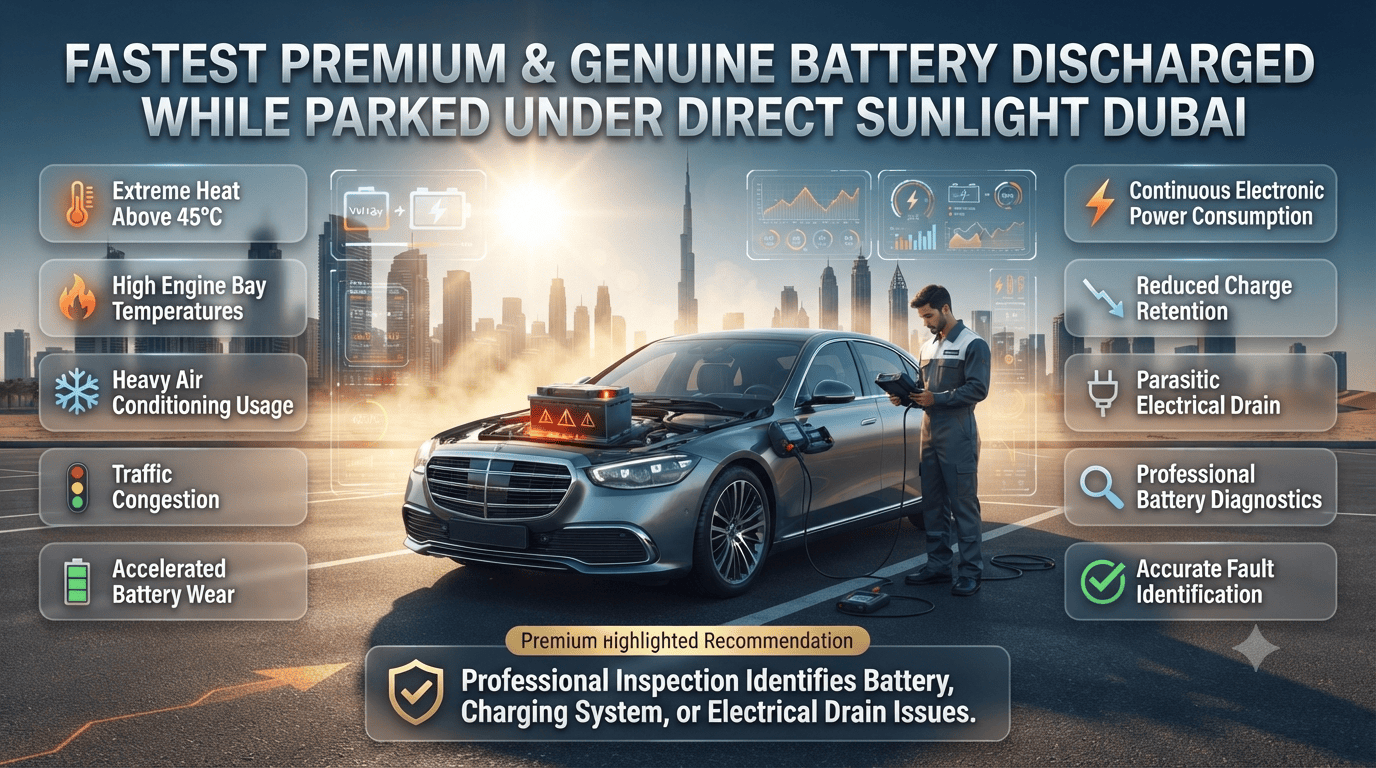
Fastest Premium & Genuine Battery Discharged While Parked Under Direct Sunlight Dubai | Returning to your car after it has been parked for several hours under Dubai’s intense sunlight only to discover that it won’t start is a common problem, especially during the summer months. Many drivers assume the battery suddenly failed, but in reality, prolonged exposure to extreme heat gradually weakens the battery long before complete failure occurs.
Dubai’s climate creates one of the toughest operating environments for vehicle batteries. Temperatures above 45°C, combined with high engine bay temperatures, heavy air conditioning usage, traffic congestion, and constant electronic power consumption, accelerate battery wear and reduce its ability to hold a full charge.
If your battery repeatedly discharges after being parked in direct sunlight, it should not be ignored. A professional inspection by EuroSwift Auto Services can determine whether the issue is caused by battery deterioration, charging system problems, or an excessive parasitic electrical drain.
Why Direct Sunlight Causes Car Batteries to Discharge Faster in Dubai
Direct sunlight does not drain a battery by itself. Instead, it dramatically increases the battery’s operating temperature, accelerating internal chemical reactions that permanently reduce battery life.
Unlike cooler climates where batteries mainly struggle during winter, Dubai’s extreme heat speeds up battery aging every day. After months of continuous exposure, even a few hours of parking under direct sunlight may leave an already weakened battery unable to start the engine.
Several local driving conditions contribute to faster battery deterioration:
- Continuous exposure to extreme temperatures
- High under-hood heat retention
- Heavy air conditioning usage
- Frequent stop-and-go traffic
- Long engine idling periods
- Modern vehicles with numerous electronic control modules
- Daily short-distance driving that limits proper battery charging
Environmental Factors That Affect Battery Performance
| Environmental Condition | Impact on Battery |
|---|---|
| Direct sunlight for several hours | Raises battery temperature significantly |
| Ambient temperatures above 45°C | Accelerates chemical aging |
| Hot asphalt parking areas | Reflects additional heat toward the engine bay |
| Heavy air-conditioning use | Increases electrical demand |
| Stop-and-go traffic | Reduces charging efficiency |
| Extended parking | Allows electronic systems to consume stored power |
What Happens Inside the Battery During Extreme Heat?
Extreme heat affects every internal component of a lead-acid battery.
Instead of aging gradually over several years, high temperatures accelerate chemical reactions, increasing internal resistance and reducing the battery’s ability to store electrical energy efficiently.
Faster Electrolyte Evaporation
The electrolyte inside the battery contains water and sulfuric acid. High temperatures increase water evaporation, changing the electrolyte concentration and reducing battery efficiency.
As electrolyte levels decrease:
- Charging becomes less efficient.
- Internal resistance increases.
- Cranking power declines.
- Battery lifespan shortens.
Although modern maintenance-free batteries are designed to minimize water loss, they are still affected by Dubai’s harsh climate.
Accelerated Plate Corrosion
Lead plates inside the battery naturally corrode over time. Continuous exposure to extreme temperatures speeds up this corrosion process.
Consequences include:
- Lower cold cranking performance
- Reduced reserve capacity
- Slower charging
- Permanent loss of battery capacity
- Increased risk of sudden failure
Once plate corrosion becomes severe, recharging the battery will not restore its original performance.
Heat Weakens Internal Battery Components
Extreme temperatures also affect battery separators and internal connections.
Over time, excessive heat may cause:
- Internal short circuits
- Voltage instability
- Uneven charging
- Reduced battery reliability
- Unexpected battery failure
This explains why a battery may appear healthy one day and completely fail after spending several hours parked in direct sunlight.
Why Your Battery Continues Losing Power Even While Parked
Many drivers believe a parked vehicle uses no electricity. Modern vehicles continue consuming small amounts of power even when the engine is switched off.
Common electrical consumers include:
- Alarm systems
- Smart key receivers
- Engine control modules
- GPS trackers
- Dash cameras
- Infotainment memory
- Remote locking systems
- Vehicle security electronics
A healthy battery easily supports these systems. However, a heat-weakened battery loses voltage much faster and may not have enough remaining power to start the engine.
Healthy Battery vs Heat-Damaged Battery
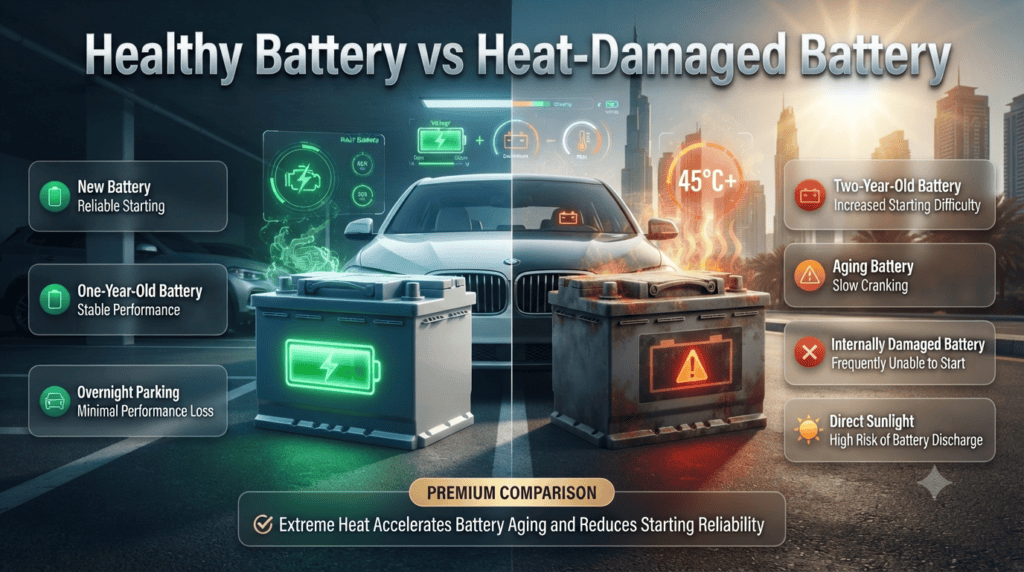
| Battery Condition | Overnight Parking | Parking in Direct Sunlight |
|---|---|---|
| New battery | Reliable starting | Minimal effect |
| One-year-old battery | Stable performance | Slight reduction in reserve |
| Two-year-old battery | Moderate performance loss | Increased starting difficulty |
| Aging battery | Slow cranking | High risk of discharge |
| Internally damaged battery | May fail unexpectedly | Frequently unable to start |
Warning Signs That Heat Has Damaged Your Battery
Battery problems rarely appear overnight. Most drivers experience several warning signs before complete failure.
Slow Engine Cranking
If the starter motor turns the engine more slowly than normal after your vehicle has been parked in the sun, the battery may no longer have sufficient reserve capacity.
Dashboard Battery Warning Light
The battery warning light does not always indicate a failed battery. It may also point to charging system faults involving the alternator or voltage regulator. A professional diagnostic inspection is recommended before replacing any components.
Dim Lights and Weak Electronics
Low battery voltage may result in:
- Dim headlights
- Flickering dashboard lights
- Slow power windows
- Weak infotainment performance
- Unstable electronic systems
Multiple Dashboard Error Messages
Modern vehicles depend on stable battery voltage.
A weak battery may trigger unexpected warnings such as:
- ABS warning
- Traction control warning
- Parking sensor faults
- Steering assistance alerts
- Transmission warning messages
These faults often disappear once proper battery voltage is restored.
Frequent Jump Starts
If your vehicle requires repeated jump starts within a short period, the battery should be professionally tested instead of repeatedly recharging it. Experienced technicians at EuroSwift Auto Services can perform a complete battery health assessment and determine whether replacement is necessary.
Quick Inspection Checklist
✔ Battery older than two years
✔ Vehicle parked outdoors daily
✔ Slow engine starting
✔ Battery warning light illuminated
✔ Dim headlights
✔ Electrical accessories operating slowly
✔ Battery terminals showing corrosion
✔ Battery case feels unusually hot
✔ Previous jump starts within recent weeks
✔ Battery repeatedly loses charge
Expert Recommendation
If testing confirms that heat has permanently reduced your battery’s capacity, replacing it with a high-quality battery designed for Dubai’s climate is the most reliable solution. Depending on your vehicle’s requirements, premium options such as AGM Battery, Amaron Battery, or Bosch Battery offer dependable performance in high-temperature conditions.
Why Professional Battery Diagnostics Matter Before Replacing the Battery
One of the biggest mistakes vehicle owners make is replacing the battery immediately after their car fails to start. Although a weak battery is the most common cause, it is not always the only reason. Problems such as a failing alternator, excessive parasitic battery drain, loose battery terminals, or a faulty charging system can produce nearly identical symptoms.
A comprehensive diagnostic inspection performed by EuroSwift Auto Services helps identify the actual cause before any components are replaced. This approach saves money, prevents repeat breakdowns, and ensures your vehicle receives the correct repair the first time.
Step-by-Step Battery Inspection Process Used by Professional Technicians
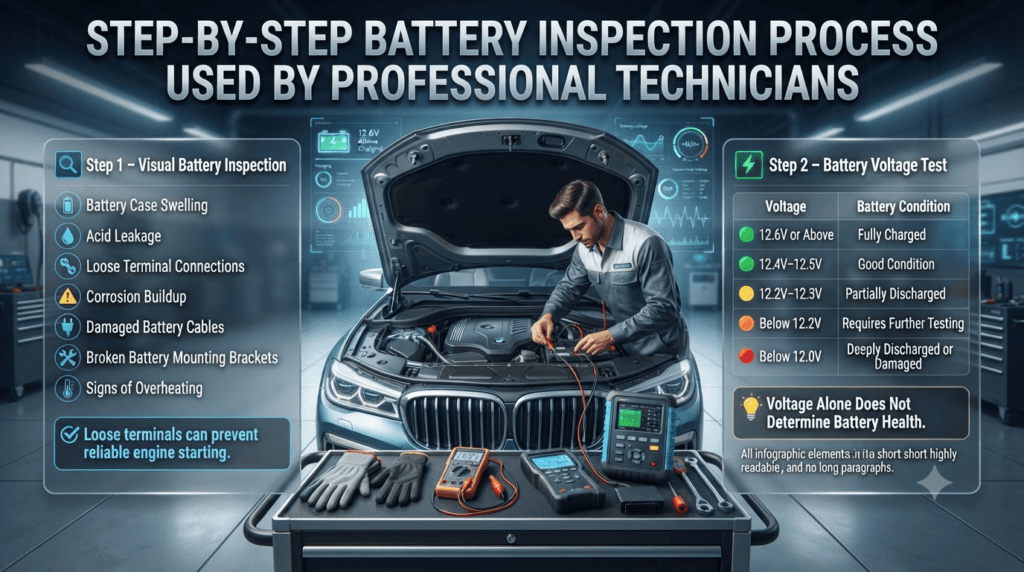
Modern battery diagnostics involve much more than checking battery voltage. Professional technicians evaluate the entire starting and charging system to ensure every component is functioning correctly.
Step 1 – Visual Battery Inspection
The first stage involves inspecting the battery and surrounding components for visible signs of damage.
Technicians typically check for:
- Battery case swelling
- Acid leakage
- Loose terminal connections
- Corrosion buildup
- Damaged battery cables
- Broken battery mounting brackets
- Signs of overheating
Even a loose terminal connection can create enough resistance to prevent the vehicle from starting properly.
Step 2 – Battery Voltage Test
A digital battery analyzer measures the battery’s resting voltage before the engine is started.
| Battery Voltage | Battery Condition |
|---|---|
| 12.6V or above | Fully charged |
| 12.4V–12.5V | Good condition |
| 12.2V–12.3V | Partially discharged |
| Below 12.2V | Requires further testing |
| Below 12.0V | Deeply discharged or damaged |
Voltage alone does not determine battery health, which is why additional testing is always recommended.
Step 3 – Battery Load Test
A load test measures how the battery performs under real starting conditions.
Instead of simply checking stored voltage, technicians apply a controlled electrical load to determine whether the battery can deliver sufficient current during engine cranking.
A battery may display acceptable voltage but still fail the load test due to internal deterioration caused by prolonged heat exposure.
Step 4 – Cold Cranking Amps (CCA) Evaluation
Cold Cranking Amps (CCA) indicate how much current a battery can provide during engine startup.
Although Dubai does not experience freezing temperatures, CCA remains an important indicator of battery health because reduced cranking power often signals internal plate deterioration.
Professional battery analyzers compare measured CCA against the manufacturer’s specifications to determine whether replacement is necessary.
Charging System Inspection
A healthy battery cannot compensate for a faulty charging system.
After confirming battery condition, technicians inspect the alternator, voltage regulator, and charging circuit.
Common checks include:
- Alternator output voltage
- Charging current
- Belt condition
- Voltage regulator performance
- Charging cable resistance
If the alternator is undercharging, even a brand-new battery will eventually discharge while parked or after short trips.
Battery vs Alternator Problems
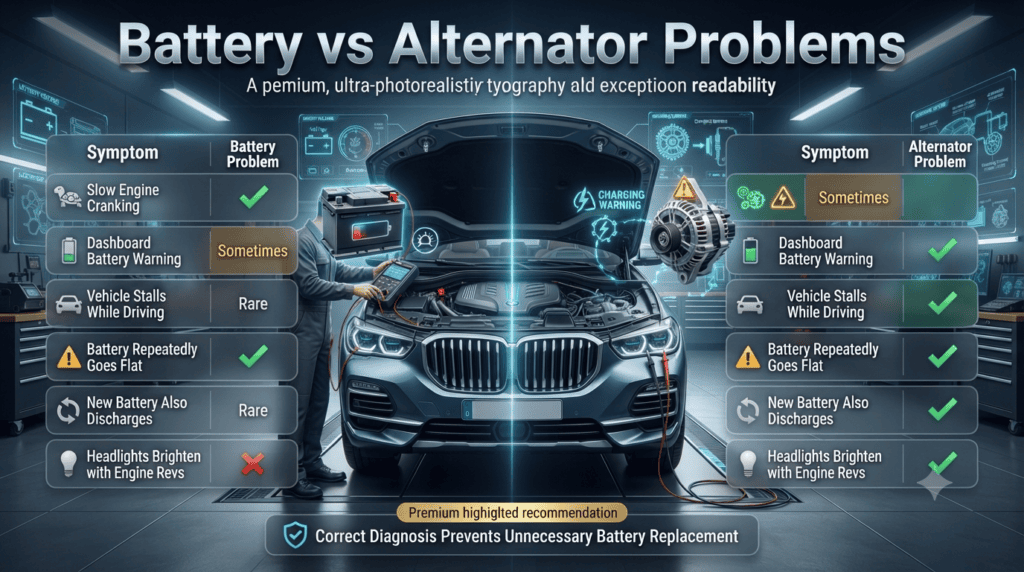
| Symptom | Battery Problem | Alternator Problem |
|---|---|---|
| Slow engine cranking | ✔ | Sometimes |
| Dashboard battery warning | Sometimes | ✔ |
| Vehicle stalls while driving | Rare | ✔ |
| Battery repeatedly goes flat | ✔ | ✔ |
| New battery also discharges | Rare | ✔ |
| Headlights brighten with engine revs | ✘ | ✔ |
Correct diagnosis prevents unnecessary battery replacement.
Checking for Parasitic Battery Drain
Even after the engine is switched off, every vehicle continues consuming a small amount of electrical power.
However, excessive parasitic drain can discharge a healthy battery overnight.
Professional technicians inspect systems such as:
- Alarm modules
- Dash cameras
- GPS trackers
- Interior lighting
- Faulty relays
- Infotainment systems
- Remote access modules
- Aftermarket accessories
Specialized testing equipment measures current draw and identifies which circuit is responsible for excessive power consumption.
Common Reasons Batteries Discharge While Parked
| Cause | Typical Severity | Professional Solution |
|---|---|---|
| Extreme heat exposure | High | Battery health inspection |
| Aging battery | High | Replace battery |
| Weak alternator | High | Charging system repair |
| Loose battery terminals | Medium | Clean and tighten connections |
| Corroded cables | Medium | Replace damaged cables |
| Parasitic electrical drain | High | Electrical diagnostics |
| Faulty voltage regulator | High | Charging system repair |
| Frequent short-distance driving | Medium | Battery charging and maintenance |
Repair or Replace? Making the Right Decision
Not every discharged battery needs replacement.
Professional diagnostics determine whether the battery can safely continue operating or whether internal damage has permanently reduced its capacity.
When Charging May Be Enough
A battery can often be recovered if:
- It was accidentally discharged.
- Electrical accessories were left on.
- Battery age is relatively low.
- Load test results remain acceptable.
- Internal resistance is normal.
When Replacement Is the Better Option
Battery replacement is generally recommended when:
- The battery repeatedly loses charge.
- Load test results fail.
- Capacity has dropped significantly.
- Internal plate corrosion is detected.
- Battery case is swollen.
- Electrolyte loss has occurred.
- Battery age exceeds its expected service life in Dubai.
For vehicles operating in extreme UAE temperatures, premium products such as Exide Battery, Panasonic Battery, and FIAMM Battery are designed to provide reliable performance under demanding conditions.
Professional Troubleshooting Guide
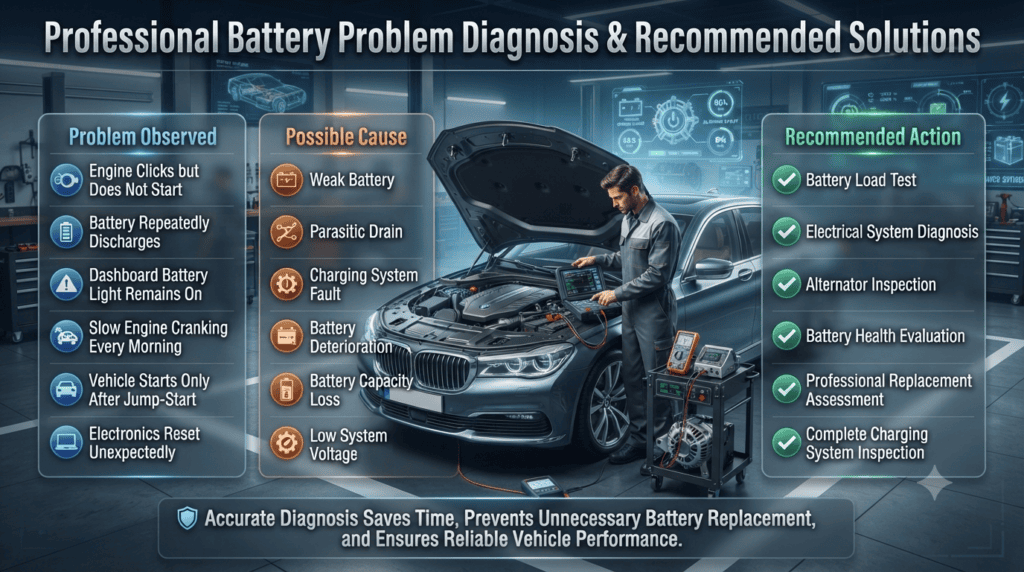
| Problem Observed | Possible Cause | Recommended Action |
|---|---|---|
| Engine clicks but does not start | Weak battery | Battery load test |
| Battery repeatedly discharges | Parasitic drain | Electrical system diagnosis |
| Dashboard battery light remains on | Charging system fault | Alternator inspection |
| Slow engine cranking every morning | Battery deterioration | Battery health evaluation |
| Vehicle starts only after jump-start | Battery capacity loss | Professional replacement assessment |
| Electronics reset unexpectedly | Low system voltage | Complete charging system inspection |
Expert Insight
Modern vehicles rely on dozens of electronic control modules that require stable voltage at all times. Installing a new battery without identifying the underlying cause of repeated discharge can result in the same problem returning within days or weeks. A complete inspection of the battery, alternator, starter system, and electrical circuits ensures the repair addresses the root cause rather than just the symptom.
If replacement is required, selecting the correct battery capacity and technology is equally important. High-performance options such as AC Delco Battery and Tuflong Battery can provide dependable starting power for vehicles operating in Dubai’s extreme climate.
How to Prevent Your Car Battery from Discharging While Parked in Direct Sunlight
Although Dubai’s climate cannot be changed, many battery failures can be prevented through proper maintenance and smart parking habits. Small adjustments to your daily routine reduce heat exposure, improve charging efficiency, and extend battery life.
Preventive maintenance is always more cost-effective than dealing with an unexpected roadside breakdown or emergency battery replacement.
Smart Parking Habits That Help Protect Your Battery
Where you park has a direct impact on battery temperature. Even a difference of a few degrees can influence how quickly the battery ages over time.
Whenever possible, try to park in:
- Covered parking structures
- Underground parking areas
- Building shade
- Multi-storey car parks
- Areas protected from direct afternoon sunlight
If shaded parking is unavailable, using a quality windshield sunshade can help reduce cabin temperatures, which indirectly lowers heat around electrical components.
Parking Comparison
| Parking Location | Heat Exposure | Battery Impact |
|---|---|---|
| Underground parking | Very Low | Best protection |
| Covered parking | Low | Helps extend battery life |
| Natural shade | Moderate | Good alternative |
| Open parking (morning) | Medium | Moderate heat buildup |
| Open parking (afternoon) | Very High | Accelerates battery aging |
| Asphalt parking without shade | Extreme | Highest risk of overheating |
Reduce Unnecessary Electrical Load
Modern vehicles continue consuming electricity even when the engine is turned off. Reducing unnecessary electrical demand helps preserve battery capacity, especially if the vehicle will remain parked for several hours.
Before leaving your vehicle, ensure that:
- Interior lights are switched off
- Phone chargers are unplugged
- Dash cameras are set to parking mode only if required
- Portable refrigerators are disconnected
- Aftermarket accessories are powered down
- USB devices are removed
- Doors, bonnet, and trunk are fully closed
These small checks can prevent avoidable battery drain.
Follow a Regular Battery Inspection Schedule
Many batteries fail without giving obvious warning signs. Routine inspections help detect early deterioration before it leads to a breakdown.
A professional inspection by EuroSwift Auto Services should include:
- Battery voltage testing
- Load testing
- Cold Cranking Amps (CCA) evaluation
- Alternator charging test
- Terminal inspection
- Cable resistance check
- Parasitic drain test
- Battery mounting inspection
Preventive inspections are especially valuable before the peak summer season.
Recommended Battery Maintenance Schedule
| Maintenance Task | Recommended Interval |
|---|---|
| Visual battery inspection | Monthly |
| Terminal cleaning | Every 3–6 months |
| Battery voltage check | Every 6 months |
| Load test | Every 12 months |
| Alternator charging test | Annually or if symptoms appear |
| Complete electrical inspection | Before summer travel |
| Battery replacement assessment | After 24–30 months in Dubai (depending on usage) |
Choosing the Right Battery for Dubai’s Climate
Not all batteries perform equally in extreme temperatures. Vehicles driven daily in Dubai benefit from batteries designed to withstand high heat, frequent starts, and heavy electrical loads.
The correct battery depends on:
- Vehicle manufacturer specifications
- Engine size
- Electrical equipment
- Driving habits
- Climate conditions
Selecting the wrong battery capacity may reduce performance and shorten service life.
Popular Battery Options for Dubai Drivers
Depending on your vehicle and driving requirements, reliable options include:
- AGM Battery – Ideal for luxury vehicles, start-stop systems, and cars with advanced electronics.
- Amaron Battery – Known for dependable performance and durability in hot climates.
- Bosch Battery – Suitable for premium vehicles requiring consistent starting power.
- Exide Battery – A practical option for many passenger vehicles.
- Panasonic Battery – Offers stable performance and reliable cranking.
- FIAMM Battery – Designed for dependable daily driving.
- AC Delco Battery – A trusted choice for a wide range of vehicle models.
- Tuflong Battery – Well suited for drivers seeking reliable everyday performance.
Common Mistakes That Shorten Battery Life
Many battery failures are caused by avoidable habits rather than manufacturing defects.
Frequently Observed Mistakes
- Ignoring slow engine cranking
- Delaying battery inspections
- Repeatedly jump-starting instead of diagnosing the problem
- Installing an incorrect battery size
- Leaving accessories connected overnight
- Parking in direct sunlight every day without considering shaded alternatives
- Skipping charging system inspections
- Continuing to use a battery after repeated discharge cycles
Correcting these habits can significantly improve battery reliability.
Battery Lifespan Comparison in Dubai
| Driving Pattern | Estimated Battery Lifespan |
|---|---|
| Mostly covered parking | Longer service life |
| Daily outdoor parking | Reduced lifespan |
| Frequent short trips | Faster capacity loss |
| Heavy stop-and-go traffic | Increased battery stress |
| Luxury vehicles with many electronics | Higher electrical demand |
| Well-maintained charging system | Improved battery longevity |
Battery life varies based on vehicle type, usage, maintenance, and environmental conditions rather than a fixed number of months.
Why Preventive Maintenance Saves Money
Waiting until a battery fails often leads to additional inconvenience, including towing costs, missed appointments, and emergency roadside assistance.
Preventive maintenance helps you:
- Reduce the likelihood of unexpected breakdowns
- Protect the alternator and starter motor
- Improve vehicle reliability
- Detect charging system issues early
- Avoid unnecessary emergency expenses
Drivers who replace aging batteries before complete failure typically experience fewer roadside emergencies and more dependable vehicle performance.
Understanding Battery Replacement Costs
Battery prices vary depending on:
- Battery technology
- Capacity
- Vehicle manufacturer requirements
- Warranty coverage
- Installation requirements
Instead of selecting a battery based on price alone, compare specifications, warranty, and compatibility. For a detailed overview of available options, battery types, and pricing considerations, refer to the Battery Price Guide before making a decision.
Why does my car battery discharge after being parked under direct sunlight in Dubai?
Many drivers assume that direct sunlight alone drains the battery, but the real issue is the extreme heat it creates inside the engine bay. When your car remains parked under Dubai’s intense sun, the battery temperature rises significantly above the outside air temperature. This accelerates internal chemical reactions, causes electrolyte evaporation, increases plate corrosion, and permanently reduces the battery’s ability to hold a charge. If the battery is already aging or partially weakened, the small amount of electricity consumed by the vehicle’s security system, keyless entry, GPS tracker, and onboard electronics while parked can be enough to leave it unable to start the engine.
Rather than repeatedly jump-starting the vehicle, it’s advisable to have the battery and charging system inspected by EuroSwift Auto Services to determine whether the battery can still be recovered or needs replacement.
Key Points
✔ Extreme heat accelerates battery aging.
✔ Electronic systems continue using power while the vehicle is parked.
✔ Older batteries are much more vulnerable to heat-related failure.
✔ Professional diagnostics identify the actual cause before replacing the battery.
Can a completely discharged battery be recharged, or should it be replaced?
A discharged battery does not always need replacement. If the battery has been accidentally drained—for example, by leaving the headlights on or parking for an extended period—it may simply require professional charging. However, if testing shows low reserve capacity, poor Cold Cranking Amps (CCA), internal plate corrosion, or repeated discharge cycles, replacing the battery is the more reliable option. Continuing to use a damaged battery often leads to recurring breakdowns and places additional strain on the starter motor and alternator.
Professional testing includes voltage measurement, load testing, and charging system inspection to determine whether the battery is still serviceable or has reached the end of its useful life.
Key Points
✔ Not every discharged battery requires replacement.
✔ Load testing is more accurate than checking voltage alone.
✔ Repeated discharge usually indicates internal battery deterioration.
✔ Replacing a failing battery early reduces the risk of roadside breakdowns.
How can I prevent my car battery from failing during Dubai’s summer?
Preventing battery failure starts with reducing heat exposure and maintaining a healthy charging system. Whenever possible, park in covered or shaded areas, especially during the hottest part of the day. Schedule regular battery inspections, keep the terminals clean, avoid unnecessary electrical loads while the engine is off, and replace batteries before they become unreliable. Drivers who use their vehicles mainly for short trips should also have the charging system checked because the battery may not receive enough time to recharge fully.
Choosing a battery specifically designed for high-temperature environments, such as an AGM Battery or another premium option that matches your vehicle’s specifications, can also improve long-term reliability.
Key Points
✔ Park in shaded or covered locations whenever possible.
✔ Inspect the battery before the summer season begins.
✔ Avoid leaving accessories running while parked.
✔ Use a battery suitable for Dubai’s extreme climate.
✔ Replace aging batteries before complete failure occurs.
How do I know if the problem is the battery, alternator, or another electrical fault?
The symptoms of a weak battery and a faulty charging system are often very similar, which is why guessing can lead to unnecessary repairs. If the engine cranks slowly after parking but starts normally after charging, the battery may be losing capacity. If the battery warning light remains illuminated while driving, headlights become brighter when the engine is revved, or a new battery also loses charge quickly, the alternator or voltage regulator may be responsible. In some cases, excessive parasitic battery drain caused by aftermarket accessories or faulty electrical components is the real issue.
A complete diagnostic inspection checks the battery, alternator, starter motor, charging voltage, and electrical circuits together to accurately identify the source of the problem.
Key Points
✔ Slow cranking often points to battery deterioration.
✔ A battery warning light may indicate charging system problems.
✔ Repeated battery failure can be caused by parasitic electrical drain.
✔ Professional diagnostics prevent replacing good parts unnecessarily.
When should I replace my car battery if I drive regularly in Dubai?
There is no fixed replacement date because battery lifespan depends on driving habits, parking conditions, vehicle electronics, and maintenance. In Dubai’s climate, batteries generally experience faster aging due to prolonged exposure to extreme heat. If you notice slow engine cranking, repeated jump-starts, dim lights, electrical warning messages, or the battery struggles after being parked in direct sunlight, it should be tested immediately rather than waiting for complete failure.
Replacing the battery before it becomes unreliable helps avoid emergency roadside breakdowns and ensures the charging system continues operating efficiently. Comparing battery specifications, warranty coverage, and compatibility through the Battery Price Guide can help you choose the right replacement for your vehicle.
Key Points
✔ Do not wait until the battery completely fails.
✔ Heat significantly shortens battery service life.
✔ Early testing helps prevent unexpected breakdowns.
✔ Select the correct battery based on your vehicle’s requirements, not price alone.
✔ Routine inspections improve long-term vehicle reliability.
Conclusion
A battery discharged while parked under direct sunlight in Dubai is more than just an inconvenience—it is often an early warning that your vehicle’s battery or charging system requires professional attention. Dubai’s extreme temperatures, combined with prolonged sun exposure, heavy air conditioning use, and the continuous power demand of modern vehicle electronics, place exceptional stress on automotive batteries. Over time, these conditions reduce battery capacity, shorten service life, and increase the likelihood of unexpected starting problems.
Rather than relying on repeated jump-starts or replacing the battery without proper testing, it is always best to identify the root cause through a complete diagnostic inspection. Checking battery health, alternator performance, charging voltage, and parasitic electrical drain ensures the correct repair is carried out and helps prevent recurring issues. If replacement is necessary, choosing a high-quality battery that matches your vehicle’s specifications and is designed for Dubai’s climate will provide better reliability and long-term performance.
Routine maintenance, smart parking habits, and periodic battery inspections remain the most effective ways to avoid heat-related battery failure. Whether you drive a compact sedan, family SUV, luxury vehicle, or high-performance car, proactive battery care reduces the risk of roadside breakdowns and protects other critical electrical components.
If your vehicle has recently experienced battery problems after being parked in direct sunlight, scheduling a professional inspection with EuroSwift Auto Services can help determine the exact cause and provide the most appropriate solution. From advanced diagnostics and emergency Battery Replacement to Car Jumpstart, Roadside Assistance, and complete Vehicle Maintenance, timely service ensures your car remains dependable throughout Dubai’s demanding climate.
Leave a Reply