
Introduction
Alternator Charging System Test | A car battery can be perfectly healthy and still leave you with a no-start situation if the alternator or charging circuit is not working correctly. The battery provides the electrical energy needed to start the engine, while the alternator supplies electrical power once the engine is running and restores energy to the battery.
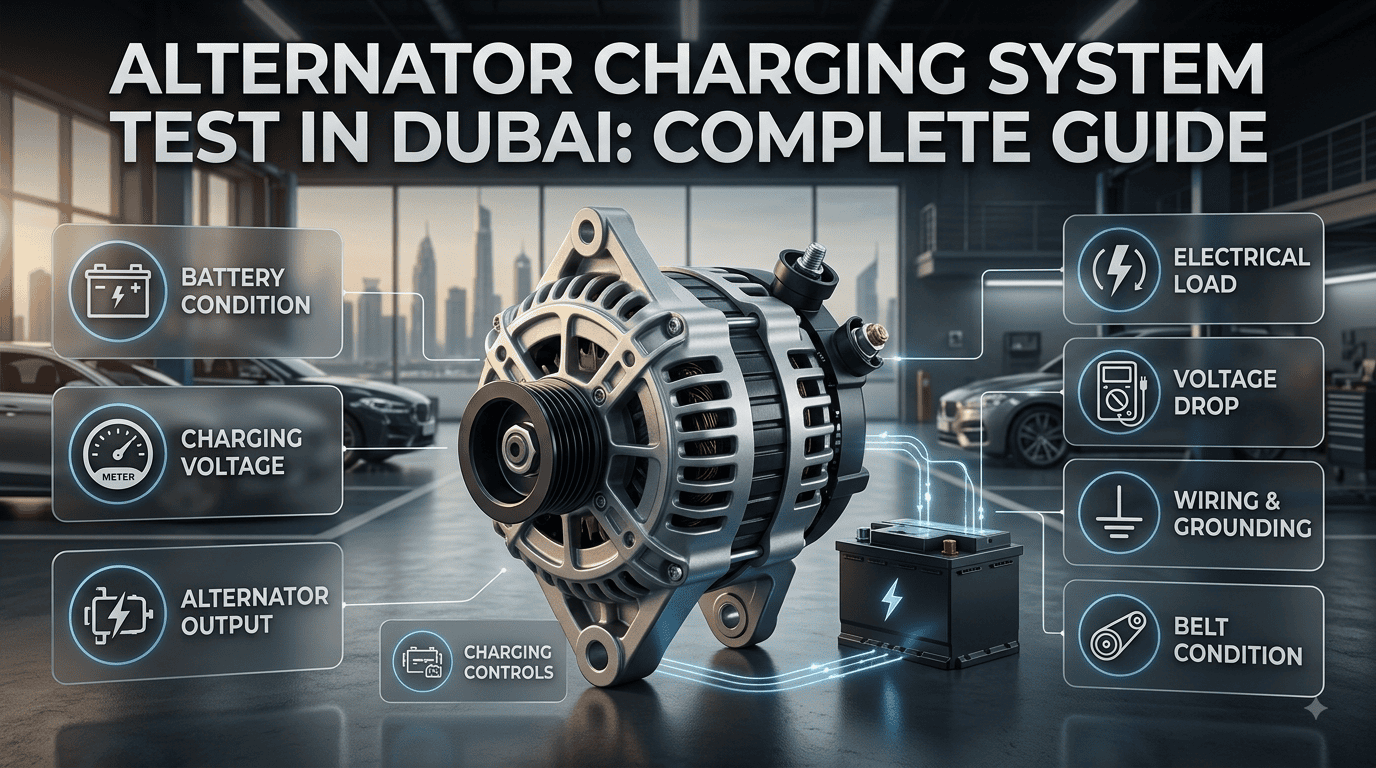
An Alternator Charging System Test checks whether this entire process is working properly. A professional test does not rely on one voltage reading. It can include battery condition, alternator output, charging voltage, electrical load, voltage drop, wiring, grounding, belt condition, and electronic charging controls.
This is particularly relevant in Dubai, where high temperatures, heavy traffic, frequent air-conditioning use, short journeys, and long periods of idling can place considerable demands on a vehicle’s electrical system.
If your battery repeatedly goes flat, the battery warning light appears, electrical accessories become inconsistent, or your vehicle requires frequent jumpstarts, testing the charging system can help identify the actual cause before unnecessary parts are replaced.
For complete automotive diagnostics and repair support, EuroSwift Auto Services provides professional automotive services in Dubai.
What Is an Alternator Charging System Test?
An alternator charging system test is a diagnostic procedure used to determine whether the alternator, battery, charging cables, grounding connections, and related electronic controls are functioning correctly.
The alternator converts mechanical energy from the running engine into electrical energy. That electrical power operates vehicle systems and replenishes energy used from the battery during starting and normal operation.
A complete charging-system inspection may evaluate:
- Battery resting voltage
- Battery state of charge
- Battery health
- Alternator charging voltage
- Alternator current output
- Voltage drop across charging cables
- Ground connections
- Battery terminals
- Alternator connections
- Drive belt condition
- Belt tension and pulley operation
- Electrical load response
- Charging-system warning signals
- Smart charging-system operation
- Related diagnostic fault codes
The important point is that battery testing and alternator testing are different procedures.
The battery stores electrical energy. The alternator generates electrical energy while the engine is operating. The charging circuit connects the two and allows the vehicle to manage electrical power.
Battery Test vs Alternator Test
| Test | Main Purpose | What It Can Reveal |
|---|---|---|
| Battery test | Checks battery condition | Weak, discharged or failing battery |
| Resting-voltage test | Estimates state of charge | Low or adequate charge |
| Alternator test | Checks charging performance | Undercharging or charging fault |
| Voltage-drop test | Checks circuit resistance | Cable or ground problems |
| Output test | Measures alternator performance | Insufficient or appropriate output |
| Load test | Checks charging under demand | System stability |
| Belt inspection | Checks mechanical drive | Slipping, worn or damaged belt |
A professional diagnosis considers the results together rather than declaring a component defective from one measurement.
Why Is the Charging System Important?
The battery supplies a large amount of electrical energy during engine starting. Once the engine starts, the alternator becomes the primary source of electrical power.
Modern vehicles have many electrical consumers, including:
- Engine control modules
- Headlights
- Air-conditioning systems
- Electric cooling fans
- Infotainment systems
- Sensors
- Safety systems
- Heated equipment
- Communication systems
- Driver-assistance electronics
If alternator output is inadequate, the battery may gradually compensate for the shortfall.
Eventually, the battery becomes discharged even though the battery itself may not have been the original problem.
This explains why some drivers install a new battery only to experience the same starting problem again shortly afterward.
How Does a Car Alternator Work?
An alternator is mechanically driven by the engine, normally through an accessory or serpentine belt.
Inside the alternator, electromagnetic principles generate electrical energy. The generated current is then rectified and regulated so that it can be used by the vehicle’s electrical system and battery.
The basic process is:
Engine rotation → Alternator rotation → Electrical generation → Rectification → Voltage regulation → Vehicle electrical system
Traditional charging systems were relatively straightforward, but modern vehicles can use electronically controlled charging strategies.
The vehicle may adjust alternator output according to battery condition, temperature, electrical demand, engine load, driving conditions, and signals from control modules.
That is why modern charging-system diagnosis should consider the vehicle’s specific design rather than relying on one universal voltage value.
Components Checked During an Alternator Charging System Test
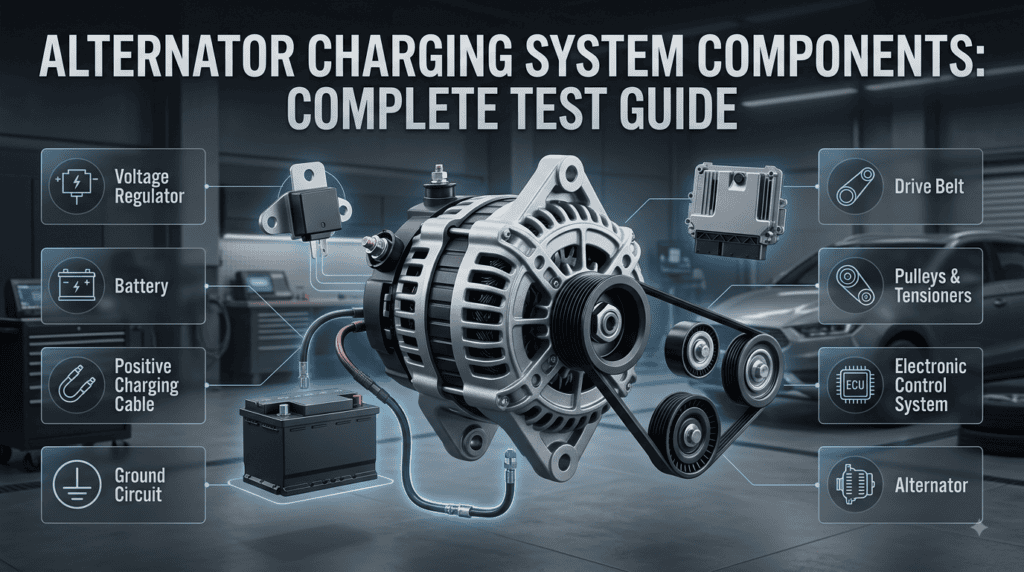
A professional technician should inspect the complete charging system rather than focusing exclusively on the alternator.
Alternator
The alternator is the main electrical generator. Depending on its design, faults may occur in the regulator, rectifier, rotor, stator, bearings, brushes, or internal electrical connections.
Voltage Regulator
The voltage regulator controls alternator output.
A regulator problem can cause insufficient charging or excessive charging, both of which require attention.
Battery
The battery needs to be tested independently. A defective battery can produce symptoms that resemble alternator problems.
If replacement is required after proper diagnosis, professional [Car Battery Replacement in Dubai] Car Battery Replacement in Dubai should be based on the correct vehicle specification rather than physical size alone.
Positive Charging Cable
The cable connecting the alternator with the battery and electrical distribution system must carry substantial current with minimal resistance.
Ground Circuit
A poor ground connection can cause voltage-drop problems and make a healthy alternator appear defective.
Drive Belt
A worn, loose, damaged, contaminated, or incorrectly tensioned belt can prevent the alternator from rotating correctly.
Pulleys and Tensioners
Modern vehicles can use specialized pulleys and automatic tensioners. Mechanical problems in these components can affect alternator operation.
Electronic Control System
Modern charging systems can involve battery-management modules, sensors, control units, and communication networks.
Electronic diagnosis may therefore be necessary on newer vehicles.
What Voltage Should an Alternator Produce?
There is no single charging voltage that applies to every vehicle under every condition.
Many conventional automotive charging systems operate somewhere around the mid-13 to mid-14-volt range while the engine is running, but modern vehicles can intentionally vary charging voltage.
The actual reading may depend on:
- Battery state of charge
- Battery temperature
- Ambient temperature
- Engine speed
- Electrical load
- Charging strategy
- Alternator design
- Manufacturer programming
- Smart battery-management system
Therefore, a technician should compare measurements with the vehicle’s correct specifications whenever possible.
A voltage that appears low under one operating condition does not automatically prove that the alternator has failed.
Likewise, a seemingly normal voltage reading does not guarantee that the complete charging system is healthy.
Professional Alternator Charging System Test Process
A professional inspection should follow a logical sequence.
1. Visual Inspection
The technician first checks the physical condition of the system.
This can include:
- Battery case
- Battery terminals
- Positive cable
- Ground cable
- Alternator housing
- Drive belt
- Belt tension
- Wiring
- Connectors
- Corrosion
- Signs of overheating
- Fluid contamination
A visual inspection can sometimes reveal an obvious fault before electrical testing begins.
2. Battery Condition Test
The battery should be assessed before charging measurements are interpreted.
A deeply discharged battery can influence charging behavior, while an internally damaged battery may continue producing symptoms even when the alternator is working correctly.
The technician may check:
- Resting voltage
- State of charge
- Starting performance
- Conductance
- Internal resistance
- Overall battery health
If the battery is severely discharged, it may need to be recharged before certain tests can be interpreted accurately.
3. Engine-Off Voltage Test
A resting-voltage measurement provides an initial indication of the battery’s state of charge.
However, voltage alone cannot prove battery health.
A battery can display a reasonable voltage while still having inadequate starting capability.
This is why a professional [Battery Replacement] Battery Replacement decision should be based on appropriate battery testing.
4. Engine-Running Charging Test
Once the engine is started, charging voltage is monitored.
The technician can observe charging behavior at idle and, when appropriate, at increased engine speed.
The system may also be monitored under electrical load.
The purpose is to determine whether charging remains stable and appropriate for the vehicle.
5. Electrical Load Test
Electrical demand can be increased using suitable vehicle loads.
Depending on the vehicle and test procedure, these can include:
- Headlights
- Climate-control blower
- Rear defogger
- Other electrical accessories
The technician then evaluates whether charging remains adequate.
This is important because an alternator can appear normal under light electrical demand but struggle when the system is heavily loaded.
6. Voltage-Drop Testing
Voltage-drop testing is an important method for identifying resistance in the charging circuit.
The technician measures the voltage difference across relevant portions of the positive and ground circuits while current is flowing.
Excessive voltage drop can indicate:
- Corroded terminals
- Damaged cables
- Loose connections
- Poor grounding
- Internal cable resistance
- Connection faults
In such cases, replacing the alternator may not solve the problem.
7. Alternator Output Testing
Alternator output can be evaluated using suitable diagnostic equipment.
The expected output depends on alternator design and operating conditions.
The result should therefore be compared against the vehicle’s specifications rather than an arbitrary universal number.
8. Electronic Scan
Many modern vehicles require scan-tool diagnosis.
A scan may identify:
- Charging-system fault codes
- Battery-management faults
- Alternator-control problems
- Sensor faults
- Communication errors
- Voltage-management issues
This becomes particularly important when the vehicle uses an intelligent charging strategy.
Common Alternator and Charging-System Symptoms
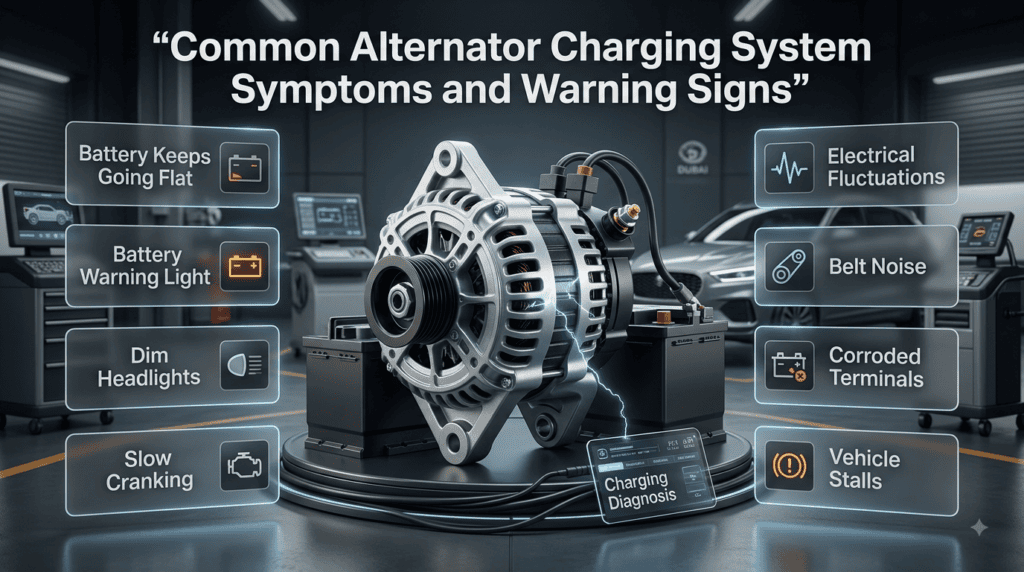
Charging-system problems do not always begin with a completely dead battery.
Drivers may notice subtle warning signs first.
| Symptom | Possible Cause | Diagnostic Direction |
|---|---|---|
| Battery repeatedly goes flat | Charging fault or electrical drain | Test charging and parasitic draw |
| Battery warning light | Charging-system fault | Perform charging diagnosis |
| Dim headlights | Low voltage or connection issue | Test charging under load |
| New battery discharges | Charging or electrical problem | Inspect complete system |
| Slow cranking | Weak battery or insufficient charging | Test battery and alternator |
| Electrical fluctuations | Regulator, wiring or control fault | Charging-system diagnosis |
| Belt noise | Belt, pulley or tensioner issue | Mechanical inspection |
| Vehicle stalls after electrical warnings | Charging failure possible | Immediate inspection |
| Corroded terminals | Electrical resistance | Clean and test voltage drop |
| Battery remains weak despite normal alternator | Battery fault or electrical drain | Battery and electrical testing |
Why a New Battery Can Still Go Flat
One of the most common automotive diagnostic mistakes is assuming that every dead battery needs to be replaced.
Suppose a vehicle has a charging problem. The owner installs a new battery, but the battery becomes discharged again.
The new battery may not be defective.
Possible causes include:
- Alternator undercharging.
- High resistance in the charging cable.
- Poor ground connection.
- Charging-control problem.
- Parasitic electrical drain.
- Belt or pulley problem.
- Battery-management fault.
- Battery not being properly recharged after installation.
This is why repeated battery replacement without diagnosing the charging system can become an expensive cycle.
Alternator Problems vs Battery Problems
There is significant symptom overlap between battery and alternator problems.
Battery-Related Problems
A weak or failing battery may produce:
- Slow engine cranking
- Clicking during starting
- Reduced starting performance
- Repeated discharge
- Poor battery-test results
- Reduced reserve capacity
Alternator-Related Problems
Charging-system faults may produce:
- Battery warning light
- Battery discharge while driving
- Dimming electrical systems
- Charging voltage outside expected behavior
- Repeated battery failure
- Electrical instability
- Belt-related noise
- Charging-system fault codes
Because symptoms overlap, testing remains more reliable than diagnosis based solely on what the driver notices.
What Causes Alternator Charging Failure?
Alternator failure can result from electrical, mechanical, thermal, or wiring-related problems.
Internal Electrical Failure
Internal components can deteriorate with age and use.
Potential faults include:
- Regulator failure
- Rectifier failure
- Winding problems
- Brush wear on applicable designs
- Internal connection faults
Bearing Wear
Alternator bearings operate whenever the engine is running. Excessive wear may create abnormal noise and eventually affect operation.
Drive-Belt Problems
A slipping or damaged belt can prevent the alternator from receiving consistent mechanical drive.
Heat
High temperatures can accelerate deterioration of electrical and mechanical components.
Dubai’s climate makes thermal conditions particularly relevant, especially when vehicles operate in traffic with heavy air-conditioning demand.
Poor Electrical Connections
Corroded or loose connections can create resistance and reduce effective charging performance.
Dubai Driving Conditions and Charging-System Stress
Dubai’s operating environment can expose vehicles to several conditions that influence electrical-system performance.
High ambient temperatures can accelerate battery aging and increase thermal stress.
At the same time, air conditioning, cooling fans, lighting, infotainment, and other electrical systems can create substantial electrical demand.
Traffic congestion can involve extended idling and frequent changes in engine speed.
Short journeys can create another challenge because energy consumed during engine starting may not always be fully restored before the vehicle is parked again.
However, climate should not automatically be blamed for every charging problem.
A proper inspection should still identify the actual fault.
Conditions Worth Monitoring
- Frequent short-distance driving
- Long periods of idling
- Heavy air-conditioning use
- Extended parking
- Repeated jumpstarts
- Older battery
- Previous charging-system faults
- Corroded terminals
- Heavy electrical accessories
- Extended vehicle storage
Smart Alternators and Modern Charging Systems
Modern charging systems are considerably more sophisticated than traditional fixed-output designs.
Some vehicles can change charging behavior according to:
- Battery condition
- Temperature
- Electrical demand
- Engine load
- Acceleration
- Deceleration
- Fuel-efficiency requirements
- Battery-management information
Because of this, the alternator may not maintain exactly the same voltage at every moment.
A technician diagnosing a modern vehicle should understand the manufacturer’s charging strategy before identifying a voltage reading as abnormal.
This may require both electrical measurements and electronic scan data.
Can a Bad Alternator Damage a Battery?
A charging-system fault can contribute to battery deterioration.
If an alternator consistently undercharges the battery, the battery may remain at a low state of charge. Repeated discharge can shorten its useful service life.
Excessive charging can also create problems because the battery and vehicle electrical system are not designed to operate continuously under uncontrolled overvoltage.
Therefore, whenever a battery fails unexpectedly, checking the charging system is an important part of determining why the failure occurred.
Alternator Repair or Replacement?
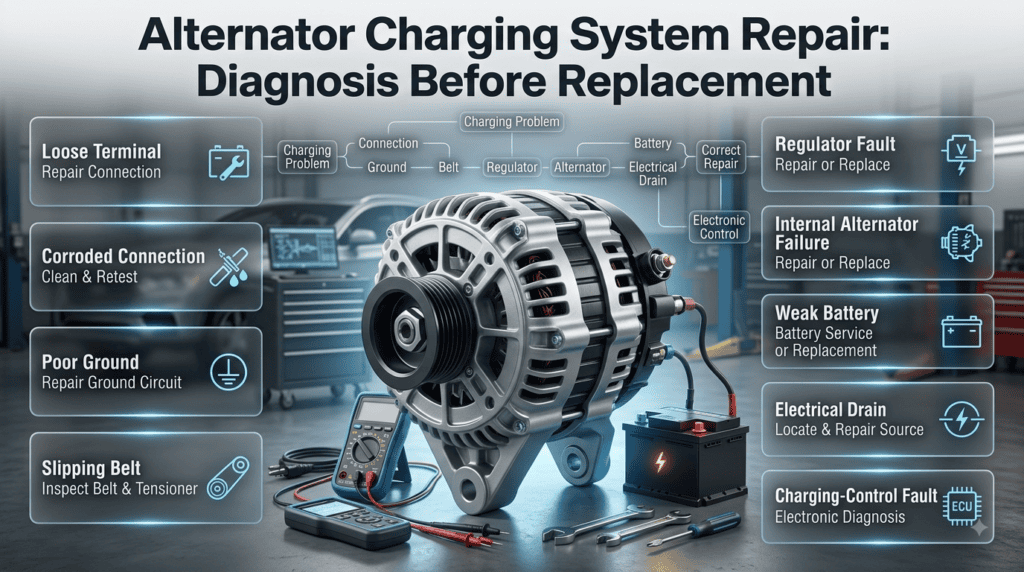
The correct repair depends on the specific diagnosis.
| Finding | Appropriate Direction |
|---|---|
| Loose terminal | Repair connection |
| Corroded connection | Clean or repair and retest |
| Poor ground | Repair ground circuit |
| Slipping belt | Inspect belt and tensioner |
| Regulator fault | Repair or replace according to design |
| Internal alternator failure | Repair or replace alternator |
| Weak battery | Battery service or replacement |
| Electrical drain | Locate and repair source |
| Charging-control fault | Electronic diagnosis |
A technician should avoid recommending alternator replacement simply because charging voltage is abnormal.
The objective should be to identify the failed component or circuit.
When Should You Have the Charging System Tested?
A charging-system test is particularly useful when a vehicle develops repeated electrical symptoms.
Consider having the system inspected when:
- The battery repeatedly goes flat.
- Your vehicle needs frequent jumpstarts.
- A battery warning light appears.
- Headlights become unusually dim.
- Electrical accessories behave strangely.
- Starting becomes progressively slower.
- A replacement battery loses charge quickly.
- You hear unusual belt or alternator noises.
- The vehicle recently experienced electrical repairs.
- You are preparing for extended travel.
- The vehicle has been stored for a long period.
If the vehicle is already showing serious electrical symptoms, professional [Roadside Assistance] Roadside Assistance may be preferable to continuing to drive until the battery becomes completely depleted.
Common Mistakes After Charging-System Problems
Replacing the Battery Immediately
A discharged battery may still be healthy.
The first step should be determining whether it is discharged or actually failing.
Testing Only the Battery
A battery cannot compensate indefinitely for an alternator that is not replenishing it correctly.
Ignoring Cable Connections
Corroded or loose connections can create resistance and reduce charging efficiency.
Assuming Every Low Voltage Reading Means Alternator Failure
Modern charging systems can deliberately vary voltage.
Ignoring the Drive Belt
The alternator needs mechanical drive to produce electricity.
Continuing to Drive With a Charging Warning
If the alternator stops charging, the vehicle can eventually depend entirely on stored battery energy.
Once that energy is depleted, the vehicle may stop operating.
Professional Charging-System Inspection Checklist
A comprehensive inspection should cover the entire system.
Electrical Checks
- Battery voltage
- Battery condition
- Charging voltage
- Alternator output
- Positive voltage drop
- Ground voltage drop
- Battery terminals
- Charging cables
- Alternator connections
Mechanical Checks
- Drive belt
- Belt tension
- Pulley
- Tensioner
- Alternator bearings
- Signs of overheating
Electronic Checks
- Charging-system codes
- Battery-management data
- Alternator-control signals
- Sensor information
- Control-module communication
Final Verification
After repairs, the system should be retested.
Replacing a component is not the final step. The technician should verify that charging performance has returned to the expected operating condition.
Battery Replacement After Charging-System Diagnosis
A charging-system test is especially important when a battery replacement is being considered.
Before installing a new battery, it is useful to establish:
- Why the previous battery failed
- Whether it was simply discharged
- Whether the alternator is charging correctly
- Whether terminals are clean
- Whether an electrical drain exists
- Whether the correct battery technology is being installed
Different vehicles may require conventional batteries, EFB batteries, AGM batteries, or other specifications.
For drivers considering [Amaron Battery] Amaron Battery or [Bosch Battery] Bosch Battery, the correct choice should be based on vehicle requirements rather than brand preference alone.
Likewise, [Tuflong Battery] Tuflong Battery can be considered when its specifications match the vehicle’s requirements.
AGM Batteries and Modern Electrical Systems
Vehicles with start-stop systems and substantial electrical demand may require specific battery technologies.
AGM batteries are used in many applications where higher cycling capability and electrical performance are required.
However, AGM should not automatically be installed simply because it is considered a premium battery.
The battery type must match the vehicle’s electrical architecture and manufacturer’s requirements.
For vehicles that specifically require this technology, drivers can explore the available [AGM Battery] AGM Battery options.
Exide, Panasonic and FIAMM Battery Options
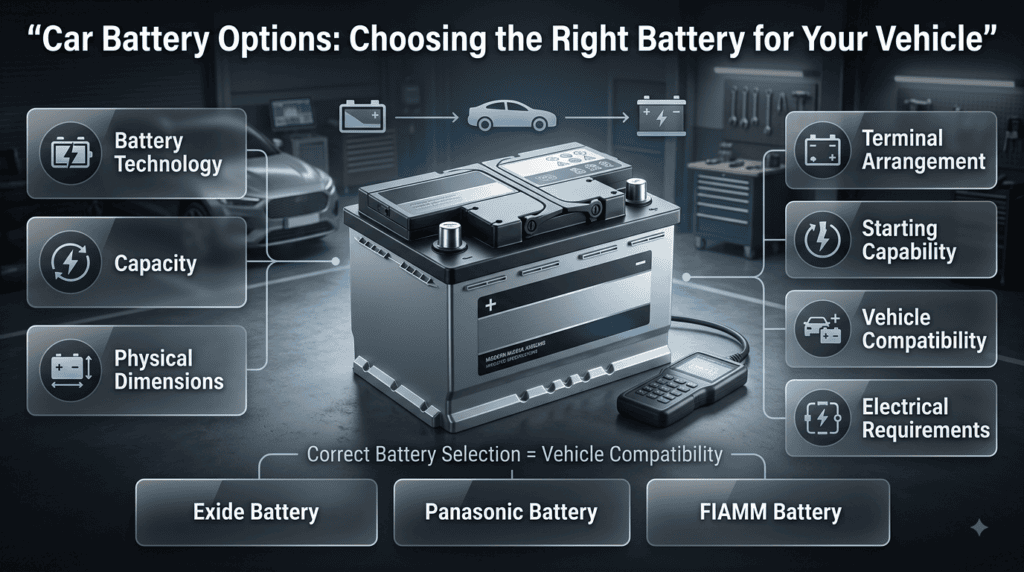
Battery replacement should involve more than selecting the cheapest available option.
The technician should confirm:
- Battery technology
- Capacity
- Physical dimensions
- Terminal arrangement
- Starting capability
- Vehicle compatibility
- Electrical requirements
Depending on the vehicle, [Exide Battery] Exide Battery, [Panasonic Battery] Panasonic Battery, or [FIAMM Battery] FIAMM Battery may be considered when the relevant specifications match the vehicle.
AC Delco Battery Considerations
Another option available for certain vehicle applications is [AC Delco Battery] AC Delco Battery.
The important consideration is not simply the brand.
A replacement battery should have the correct specification for the vehicle, including its electrical requirements and charging-system design.
Battery Price and Charging-System Diagnosis
Battery cost can vary considerably depending on vehicle requirements, battery technology, brand, capacity, and installation requirements.
However, price should not be considered separately from diagnosis.
If the charging system is defective, purchasing an expensive new battery without fixing the underlying fault may not solve the problem.
Drivers researching [Car Battery Prices in Dubai 2026] Car Battery Prices in Dubai 2026 can compare the factors that influence battery replacement costs before making a decision.
Relationship Between the Battery and Alternator
The relationship between the two components can be summarized simply:
Battery → Starts Engine → Alternator Begins Charging → Electrical System Operates → Battery Is Replenished
During starting, the battery provides substantial current to the starter motor.
Once the engine starts, the alternator begins generating electrical power.
If the alternator does not restore the energy consumed during starting and normal operation, the battery’s state of charge gradually decreases.
This is why a vehicle can start normally one morning and fail later even when the battery is relatively new.
What Happens If You Ignore a Charging-System Problem?
A small charging problem can eventually become a roadside breakdown.
Possible consequences include:
- Progressive battery deterioration
- Repeated jumpstarts
- Warning lights
- Electrical instability
- Reduced reliability
- Difficulty starting
- Loss of electrical accessories
- Vehicle shutdown in severe cases
Repeatedly jumpstarting the vehicle is not a substitute for diagnosis.
A [Car Jumpstart] Car Jumpstart may provide temporary starting power, but it does not repair an alternator, charging cable, battery, or electrical drain.
Charging-System Testing for Luxury Vehicles
Luxury vehicles can have complex electrical architectures and high electrical demand.
Some models use advanced battery-management systems, intelligent alternator controls, regenerative charging strategies, and manufacturer-specific diagnostic procedures.
For these vehicles, a generic voltage test may provide useful information but may not be sufficient for a complete diagnosis.
Professional [Luxury Car Service] Luxury Car Service should take the vehicle’s electronic architecture and manufacturer-specific charging strategy into account.
Preventive Charging-System Maintenance
Drivers do not have to wait until the battery completely fails before checking the charging system.
During routine [Car Service] Car Service, technicians can inspect:
- Battery terminals
- Charging cables
- Ground connections
- Drive belt
- Battery condition
- Charging performance
- Warning indicators
- Electrical symptoms
Preventive inspection can be particularly useful before:
- Long-distance journeys
- Summer driving
- Extended vehicle storage
- Road trips
- Selling a vehicle
- Buying a used vehicle
Early detection can prevent a minor electrical problem from becoming an inconvenient breakdown.
When Should Parasitic Drain Testing Be Performed?
Not every discharged battery is caused by the alternator.
A vehicle can have a perfectly healthy charging system and still lose battery energy while parked because an electrical component continues consuming power.
This is called parasitic electrical draw.
Possible sources include:
- Faulty electronic modules
- Aftermarket accessories
- Interior lighting
- Trunk or glovebox lights
- Alarm systems
- Infotainment equipment
- Devices that fail to enter sleep mode
If the battery charges normally while driving but repeatedly becomes discharged after parking, the technician should consider a parasitic-draw diagnosis.
Charging-System Troubleshooting Guide
| Situation | Primary Diagnostic Direction |
|---|---|
| Battery dead after parking | Battery + parasitic draw |
| Battery dies while driving | Alternator + charging circuit |
| Battery warning light | Charging-system diagnosis |
| New battery repeatedly goes flat | Alternator + electrical drain |
| Slow starting every morning | Battery + charging condition |
| Dimming lights while driving | Charging voltage + connections |
| Belt squeals with electrical symptoms | Belt + pulley + alternator |
| Normal battery but charging warning | Alternator/control circuit |
| Normal alternator but weak battery | Battery condition + electrical drain |
| Intermittent electrical faults | Wiring + electronic diagnosis |
How a Professional Workshop Diagnoses Charging Problems
A professional [Auto Workshop] Auto Workshop should use a logical diagnostic sequence instead of replacing components through trial and error.
The process generally follows:
Customer symptoms → Visual inspection → Battery test → Charging test → Voltage-drop testing → Electronic diagnosis → Repair → Verification
Each stage provides information for the next.
This approach reduces unnecessary replacement and increases the likelihood of finding the original cause.
Latest Developments in Charging-System Technology
Automotive electrical systems are becoming increasingly intelligent.
Modern vehicles are using:
- Smart alternator control
- Battery-management systems
- Advanced AGM and EFB applications
- Regenerative charging strategies
- Electronic energy management
- Real-time monitoring
- More sophisticated diagnostic software
As vehicles become more electronically controlled, charging-system diagnosis is moving beyond a simple voltage measurement.
Technicians increasingly need to understand how the battery, alternator, sensors, control modules, and electrical loads interact.
Future of Alternator Diagnostics
Future automotive diagnostics will likely rely even more heavily on real-time vehicle data.
Instead of testing isolated components, diagnostic systems can increasingly evaluate the interaction between the battery, alternator, control modules, sensors, and electrical loads.
This supports a shift toward predictive maintenance.
A vehicle may eventually detect abnormal charging behavior before the driver experiences a complete breakdown.
For workshops, knowledge of electronic diagnostics, battery-management systems, manufacturer-specific charging strategies, and advanced electrical testing will become increasingly important.
How do I know if my car has an alternator problem or a bad battery?
This is one of the most important questions because the symptoms of a weak battery and a failing alternator can look very similar. A slow start, repeated jumpstarts, a dead battery, or electrical problems do not automatically mean the battery itself needs replacement. The alternator may not be replenishing the battery correctly, or there may be a wiring, grounding, or charging-control problem.
A professional charging-system diagnosis should therefore test the battery and alternator together, rather than replacing whichever component appears suspicious first.
Important points:
A weak battery can cause slow or difficult starting.
A failing alternator can repeatedly discharge an otherwise healthy battery.
Corroded or loose battery cables can imitate both problems.
A charging-system warning light is not necessarily proof that the battery itself has failed.
A proper test can prevent unnecessary battery or alternator replacement.
For example, if a relatively new battery repeatedly becomes flat after driving, replacing it again may simply repeat the same problem. The charging system should be checked to determine whether the alternator is actually restoring the battery’s energy.
What are the warning signs that my alternator needs to be tested?
The most useful warning signs are changes in the vehicle’s electrical behavior. A battery or charging-system warning light, dimming or flickering lights, repeated battery discharge, electrical accessories behaving abnormally, starting problems, unusual alternator or belt noises, and unexplained stalling can all justify a charging-system inspection.
The important thing is to look at the combination of symptoms, not just one symptom in isolation. For example, dim headlights together with a charging warning light and a battery that repeatedly goes flat is much more concerning than a single isolated starting issue.
Warning signs worth taking seriously:
Battery/charging warning light stays illuminated.
Headlights or dashboard lights flicker or become unusually dim.
Battery repeatedly loses charge.
Car requires frequent jumpstarts.
Electrical accessories become slow or inconsistent.
Starting becomes increasingly difficult.
Unusual whining, growling, or belt-related noise appears.
The vehicle stalls after electrical symptoms develop.
If the charging warning light comes on while driving, it should not simply be ignored. The vehicle may eventually rely on the battery’s remaining stored energy if the alternator is no longer supplying sufficient power.
What does a professional alternator charging system test actually check?
A professional test is much more comprehensive than connecting a meter and looking at one voltage number. The technician normally evaluates the battery, alternator output, charging voltage, electrical connections, cable resistance, grounding, belt condition, and—on modern vehicles—electronic charging controls.
The objective is to determine where the electrical problem is actually coming from.
A professional inspection may include:
Battery state-of-charge and health testing
Alternator output testing
Charging-voltage measurement
Testing under electrical load
Positive-side voltage-drop testing
Ground-side voltage-drop testing
Battery terminal inspection
Alternator cable inspection
Drive-belt and pulley inspection
Charging-system fault-code scanning
Battery-management-system diagnosis where applicable
This matters because an alternator can be working correctly while a damaged cable or poor ground prevents the battery from receiving the expected electrical power. Similarly, a healthy charging system cannot compensate for a battery that has internally deteriorated.
Modern vehicles make this even more important because charging voltage can be electronically managed rather than remaining at one fixed value.
Why does my battery keep going flat even though I have already replaced it?
Repeated battery discharge after installing a new battery is a strong reason to investigate the underlying electrical system instead of purchasing another battery.
One possibility is that the alternator is undercharging. But it is not the only possibility. A high-resistance charging connection, poor ground, damaged belt, battery-management problem, or parasitic electrical drain can also leave the battery without enough stored energy.
Common possibilities include:
Alternator not producing sufficient output
Charging cable resistance
Poor battery or engine ground
Loose or corroded terminals
Drive-belt problem
Electrical component remaining active while parked
Battery-management fault
Battery not being properly recharged after installation
This distinction is especially important when a vehicle starts normally after the battery is replaced but develops the same problem again later.
A professional Alternator Charging System Test can determine whether the battery is actually failing or whether something is preventing it from maintaining its charge. If the battery itself has failed, then the correct replacement should be selected according to the vehicle’s specification rather than simply choosing the cheapest available option.
Can I keep driving if the battery or charging-system warning light comes on?
A charging-system warning light should be treated as a genuine warning rather than a routine maintenance reminder. The light can indicate a problem with the alternator or another part of the charging system, and the vehicle may eventually lose electrical power if the problem continues.
The situation becomes more concerning if the warning light is accompanied by dimming lights, electrical malfunctions, unusual noises, difficulty maintaining engine operation, or stalling.
What matters most:
Do not assume the warning light means only the battery is bad.
Avoid unnecessary electrical loads if the vehicle must be moved to a safe location.
If the vehicle begins losing electrical power or stalls, continuing to drive can leave you stranded.
Arrange professional charging-system diagnosis as soon as practical.
If the vehicle is unsafe to continue driving, use appropriate roadside assistance rather than taking unnecessary risks.
A charging-system fault can progress from a relatively minor electrical problem to a complete loss of vehicle operation. Early diagnosis is therefore usually far more sensible than waiting until the battery is completely discharged.
Conclusion
An Alternator Charging System Test is not simply a quick voltage check; it is a complete diagnostic process designed to determine whether the alternator, battery, wiring, grounding, belt drive, and charging controls are working together correctly. When a vehicle experiences repeated battery discharge, slow starting, dimming lights, warning indicators, or unexplained electrical problems, testing the complete charging system is more reliable than immediately replacing the battery or alternator.
For Dubai drivers, this becomes particularly important because high temperatures, heavy air-conditioning use, traffic congestion, frequent short journeys, and extended idling can place additional demands on the vehicle’s electrical system. However, these conditions should not automatically be blamed for a failure. A professional diagnosis should identify the actual cause.
The best approach is simple: test first, identify the fault, repair the cause, and then verify the charging system again. This can prevent unnecessary parts replacement, protect a new battery from premature failure, and improve overall vehicle reliability.
Whether the issue requires charging-system diagnosis, Battery Replacement, Car Repair, Vehicle Inspection, or broader Vehicle Maintenance, proper professional testing provides a much stronger solution than repeated jumpstarts or guesswork. As modern vehicles increasingly use smart charging and electronic battery-management systems, accurate charging-system diagnosis will become even more important for maintaining dependable vehicle performance.

Leave a Reply