

Introduction
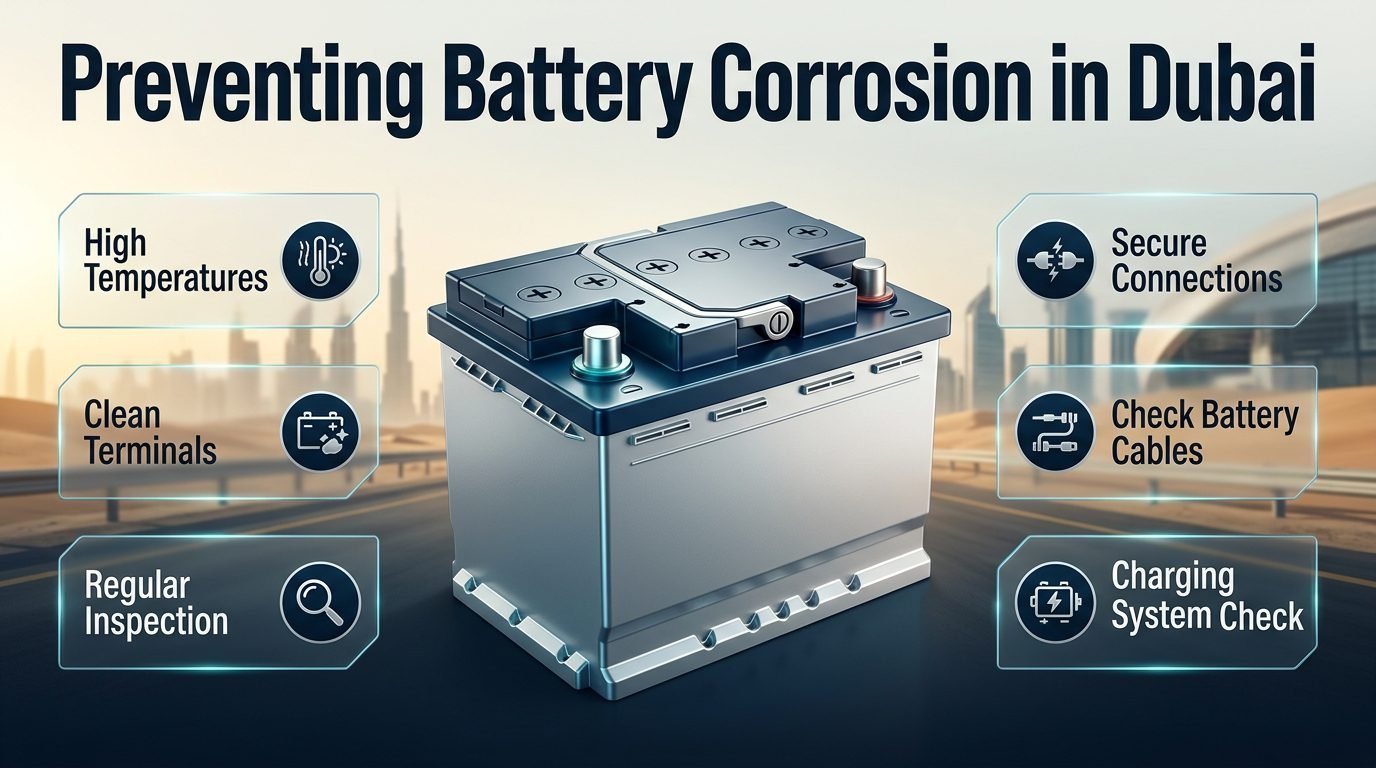
Preventing Battery Corrosion in Dubai is an important part of keeping a vehicle’s starting and electrical system reliable. Battery terminals provide the connection between the battery, starter motor, charging system, and the vehicle’s electrical components. When corrosion develops around these connections, electrical resistance can increase and the connection can gradually become less reliable. In severe cases, corrosion may contribute to slow cranking, intermittent electrical problems, or difficulty starting the vehicle.
For drivers in Dubai, battery care deserves particular attention. High temperatures, traffic congestion, frequent short journeys, extended parking, and demanding electrical loads can all increase the importance of regular battery inspection. A battery that appears acceptable during a quick visual check may still have deteriorating terminals, cables, or internal performance.
At EuroSwift Auto Services, battery maintenance can be approached as part of broader vehicle care rather than treating corrosion as an isolated cosmetic problem. The right solution depends on identifying why corrosion is occurring in the first place.
This guide explains the causes of battery corrosion, early warning signs, prevention methods, professional inspection procedures, battery types, common mistakes, replacement considerations, Dubai-specific factors, and modern battery-maintenance practices.
What Is Battery Corrosion?
Battery corrosion is the buildup of chemical deposits around battery posts, terminals, clamps, cable ends, or nearby metal surfaces.
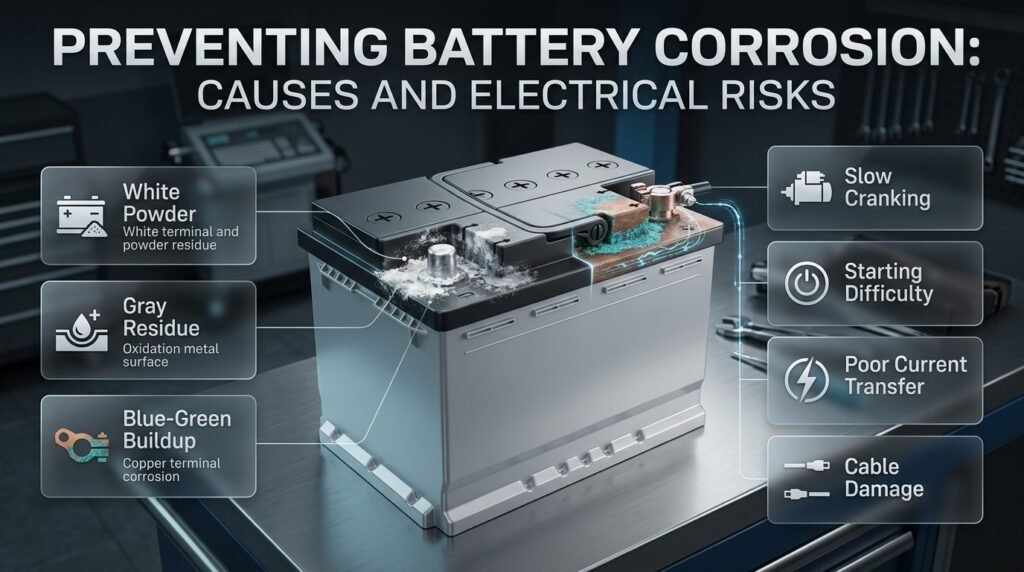
The deposits can vary in appearance. White or gray powder is common, while blue or green deposits may occur around copper-containing components.
Corrosion develops through chemical reactions involving the battery, terminal materials, moisture, contaminants, and environmental conditions. The exact cause can vary from one vehicle to another.
| Corrosion Appearance | Possible Condition |
|---|---|
| White powder | Common terminal corrosion |
| Gray or chalky residue | Oxidation or contamination |
| Blue-green buildup | Corrosion involving copper components |
| Wet residue | Moisture or possible electrolyte-related issue |
| Heavy deposits | Long-standing connection or battery problem |
The appearance provides a useful starting point, but it cannot determine battery health by itself.
A battery can have visible corrosion and still have acceptable internal performance. Likewise, a battery with clean terminals can be weak internally.
That is why professional battery inspection combines visual examination with electrical testing when required.
Why Preventing Battery Corrosion Matters
Battery terminals may look like simple mechanical connections, but they carry significant electrical current.
When the engine starts, the starter motor demands a high current from the battery. The connection between the battery post and terminal therefore needs to be clean, secure, and capable of carrying current efficiently.
Corrosion can increase resistance at this connection.
Depending on its severity, this may contribute to:
- Slow engine cranking
- Starting difficulties
- Intermittent electrical connections
- Poor current transfer
- Charging-related problems
- Terminal deterioration
- Cable damage
- Repeated battery symptoms
- Unexpected starting failures
This is why preventing battery corrosion is more than a matter of keeping the engine compartment looking clean.
The main objective is to maintain a reliable electrical connection.
What Causes Battery Corrosion?
Battery corrosion can develop for several different reasons. In some cases, one factor is responsible. In others, multiple conditions contribute to the problem.
Understanding the cause is important because repeatedly cleaning corrosion without correcting the underlying issue may only provide a temporary improvement.
Electrolyte-Related Problems
Automotive batteries contain electrolyte. If electrolyte reaches external metal components, it can contribute to corrosion.
Potential causes can include:
- Battery case damage
- Aging battery components
- Leakage
- Incorrect servicing
- Venting-related conditions
- Overfilling in applicable battery designs
Modern maintenance-free batteries are designed to minimize electrolyte loss, but no battery should be assumed to be completely immune to physical damage or chemical problems.
If wetness or suspected leakage is present around a battery, professional inspection is preferable to simply cleaning the terminals.
Charging-System Problems
The alternator supplies electrical power while the engine is running and helps recharge the battery after starting.
If the charging system is not operating correctly, battery performance and longevity can be affected.
Recurring corrosion accompanied by other symptoms may justify a charging-system inspection.
These symptoms can include:
- Repeated battery discharge
- Frequent jump-start requirements
- Battery warning-light activity
- Unusual electrical behavior
- Premature battery deterioration
- Starting problems despite recent charging
A weak battery and a faulty charging system can produce similar symptoms, so testing is important.
Loose Battery Connections
A battery terminal that is not properly secured can move because of normal vehicle vibration.
Movement may create unstable electrical contact and increase resistance.
However, over-tightening is not an appropriate solution. Excessive force can damage battery posts or terminal hardware.
The correct approach is to ensure the connection is secure according to the vehicle and battery manufacturer’s requirements.
Moisture Around the Battery
Moisture can contribute to corrosion, particularly when combined with dust, dirt, or other contaminants.
The battery area should therefore be kept reasonably clean and dry.
A wet battery compartment should be investigated if moisture repeatedly appears.
Dirt and Contamination
Dust and grime can accumulate around terminals and cable connections.
When contamination combines with moisture and electrical activity, it can encourage corrosion and reduce connection quality.
Routine inspection helps prevent excessive buildup from becoming a larger problem.
Battery Age
Battery aging can influence both internal performance and external condition.
As a battery becomes older, it may experience:
- Reduced starting capability
- Increased internal deterioration
- Greater susceptibility to discharge
- Terminal-related problems
- Electrolyte-related issues
- Reduced overall reliability
An older battery showing corrosion should therefore be evaluated as a complete unit.
Does Battery Corrosion Mean the Battery Is Bad?
Not necessarily.
This is one of the most important points in battery maintenance.
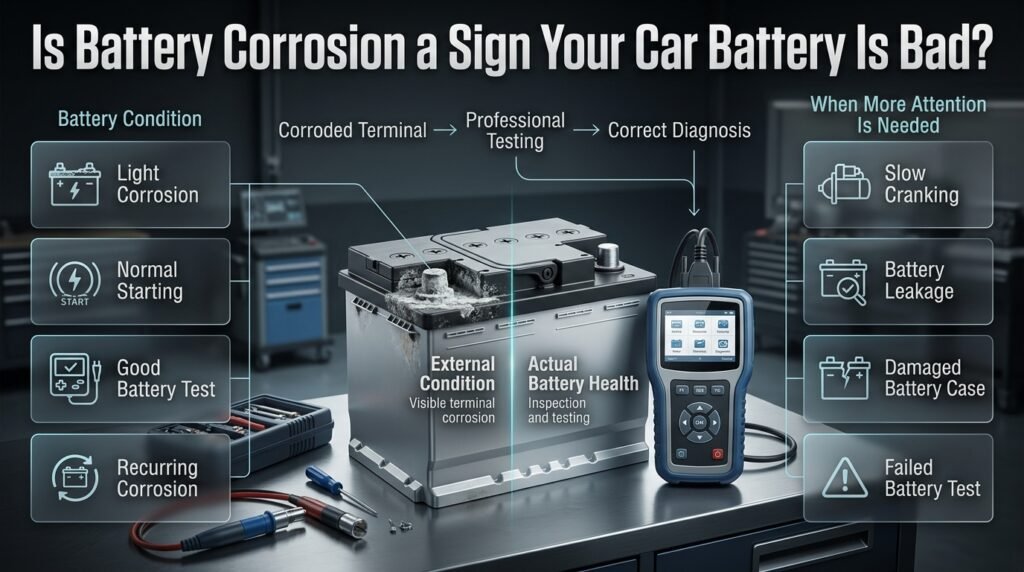
Corrosion is a visible condition, while battery failure is determined by electrical and chemical performance.
A battery may have light corrosion but still perform adequately.
Conversely, a battery may look completely clean but have insufficient capacity to start the vehicle reliably.
| Condition | Recommended Approach |
|---|---|
| Light corrosion and normal starting | Clean, inspect and monitor |
| Heavy corrosion but good battery test | Service connection and investigate cause |
| Corrosion with slow cranking | Test battery and connections |
| Corrosion returns quickly | Inspect battery and charging system |
| Corrosion with leakage | Professional battery assessment |
| Damaged battery case | Professional inspection |
| Failed battery test | Replacement may be appropriate |
Battery appearance should therefore be considered alongside test results and vehicle symptoms.
Early Signs of Battery Corrosion
Battery corrosion often develops gradually, giving drivers an opportunity to identify it before the connection becomes seriously compromised.
Visible Warning Signs
Check for:
- White powder around the terminal
- Blue or green deposits
- Gray residue
- Discolored clamps
- Corroded cable ends
- Moisture around the battery
- Damaged terminal hardware
- Corrosion spreading onto nearby metal
Performance Warning Signs
Battery-related problems may also appear as:
- Slower engine cranking
- Occasional starting difficulty
- Repeated jump-start requirements
- Battery discharge
- Electrical irregularities
- Battery warning-light activity
These symptoms do not prove that corrosion is the cause.
A weak battery, poor ground, alternator fault, starter problem, or electrical drain can produce similar symptoms.
How to Prevent Battery Corrosion
Preventing corrosion requires more than occasionally looking at the battery.
A combination of inspection, correct installation, clean connections, and proper electrical-system maintenance provides a stronger approach.
Inspect the Battery Regularly
During routine vehicle maintenance, inspect:
- Battery posts
- Terminal clamps
- Cable ends
- Battery housing
- Mounting arrangement
- Surrounding area
Early detection is valuable because minor terminal contamination is generally easier to address than severe corrosion.
Keep Battery Terminals Clean
Battery terminals should not be allowed to accumulate excessive deposits.
Cleaning should be carried out using appropriate automotive procedures and suitable equipment.
The goal is to restore a clean electrical connection without damaging the terminal, battery post, or surrounding components.
Aggressive scraping and unsuitable chemicals can create additional problems.
Keep Connections Secure
Battery terminals should fit properly and remain secure during normal vehicle operation.
If a terminal repeatedly becomes loose, the connection should be inspected rather than simply tightened again and again.
A worn terminal or connector may require repair or replacement.
Inspect Battery Cables
Battery cables are just as important as the terminal itself.
Check for:
- Damaged insulation
- Fraying
- Corroded cable ends
- Loose connections
- Heat discoloration
- Damaged connectors
Corrosion can sometimes affect a connection beyond the area that is immediately visible.
Battery Corrosion in Dubai’s Climate
Dubai’s environmental conditions make proactive battery maintenance particularly useful.
High temperatures can accelerate battery aging and influence chemical activity inside automotive batteries.
Driving patterns also matter.
Vehicles operating in Dubai may experience:
- High ambient temperatures
- Heavy traffic
- Stop-and-go driving
- Frequent air-conditioning use
- Short-distance journeys
- Long periods of parking
- Extended exposure to heat
These conditions do not mean every vehicle will develop corrosion. However, they make regular battery inspection a sensible part of preventive maintenance.
Drivers should pay particular attention when an older battery begins showing visible corrosion or starting symptoms.
Can Hot Weather Cause Battery Corrosion?
High temperatures can contribute to battery aging and may increase electrolyte loss or other battery stresses under certain conditions.
However, it would be inaccurate to say that heat alone causes every case of battery corrosion.
Corrosion can result from a combination of:
- Battery age
- Battery condition
- Moisture
- Contamination
- Terminal condition
- Charging-system operation
- Environmental exposure
For Dubai drivers, heat should therefore be considered one factor within the overall battery-maintenance picture.
Battery Corrosion and Air Conditioning
Air conditioning is essential for comfortable driving in Dubai.
When the engine is running, the alternator supplies electrical power to the vehicle’s electrical system and supports battery charging.
Normal air-conditioning use should not automatically be considered the cause of battery corrosion.
If a vehicle struggles electrically while operating normal accessories, the correct response is to inspect the battery and charging system.
Potential problems can include:
- Weak battery
- Poor battery connection
- Alternator problem
- Charging-system fault
- Poor grounding
- Aging electrical components
A healthy electrical system should be able to support the vehicle’s normal operating loads.
Professional Battery Corrosion Inspection Process
A professional inspection should focus on identifying the root cause rather than simply removing visible deposits.
Visual Battery Inspection
The technician examines:
- Battery housing
- Positive terminal
- Negative terminal
- Terminal clamps
- Battery cables
- Mounting hardware
- Surrounding area
The inspection looks for leakage, damage, corrosion, loose connections, and abnormal conditions.
Terminal Inspection
The terminal is examined for:
- Corrosion
- Looseness
- Physical damage
- Oxidation
- Heat discoloration
- Worn connection surfaces
A heavily deteriorated terminal may require replacement rather than cleaning alone.
Cable Inspection
Battery cables should be inspected for visible deterioration.
If corrosion has affected a cable connection, cleaning the battery post may not solve the problem.
Cable condition is particularly important when a vehicle experiences slow cranking despite a battery that appears healthy.
Battery Performance Testing
A suitable battery tester can provide information about the battery’s starting condition.
Testing can help determine whether the battery itself has deteriorated or whether the problem is more likely to involve the connection or charging system.
This is an important step before automatically recommending replacement.
Charging-System Testing
The alternator and charging system should be tested when symptoms suggest a charging problem.
This is especially useful when:
- The battery repeatedly goes flat.
- Corrosion returns quickly.
- A recently replaced battery becomes weak.
- The charging warning light appears.
- Electrical performance is inconsistent.
Battery Corrosion vs Battery Discharge
Battery corrosion and battery discharge are different problems.
Corrosion primarily affects the physical and electrical connection.
Discharge refers to the battery losing stored electrical energy.
The two can occur together, but one does not automatically mean the other.
A vehicle may have:
- Corrosion without significant discharge
- Discharge without visible corrosion
- Both corrosion and discharge
Battery discharge can result from:
- A weak battery
- Alternator failure
- Excessive parasitic draw
- Extended vehicle storage
- Frequent short trips
- Leaving electrical equipment operating
- Electrical faults
When a battery repeatedly discharges, the complete electrical system should be investigated.
Battery Corrosion and Ground Connections
The negative battery connection forms an important part of the vehicle’s grounding circuit.
A poor ground can create symptoms that appear to be battery-related.
During an electrical diagnosis, technicians may inspect:
- Negative battery terminal
- Negative cable
- Engine ground
- Chassis ground
- Ground straps
A battery can have sufficient voltage while a poor ground connection prevents the vehicle from receiving the current it needs.
This is why a complete starting-system diagnosis should consider both positive and negative connections.
Common Mistakes When Preventing Battery Corrosion
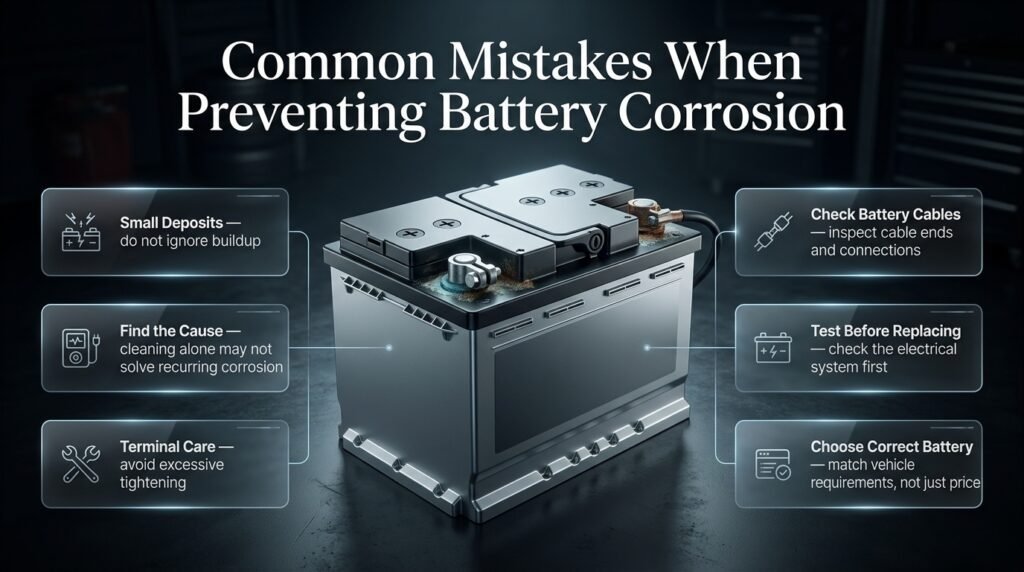
Ignoring Small Deposits
Small amounts of corrosion may not cause immediate failure, but allowing them to accumulate can eventually affect the connection.
Cleaning Without Finding the Cause
If corrosion quickly returns, the underlying problem may still exist.
Over-Tightening the Terminal
Excessive tightening can damage the battery post or terminal hardware.
Ignoring Battery Cables
Corrosion can affect cable ends and connection points.
Replacing the Battery Without Testing
A new battery will not fix a faulty alternator, poor ground, damaged cable, or excessive electrical drain.
Choosing a Battery Only by Price
The cheapest battery is not necessarily the correct battery for the vehicle.
Modern cars can require specific battery technology, capacity, starting characteristics, and physical configuration.
When Should a Corroded Battery Be Replaced?
Battery corrosion by itself does not automatically require replacement.
Replacement becomes more likely when corrosion occurs together with evidence of battery deterioration.
Possible indicators include:
- Failed battery testing
- Repeated starting problems
- Significant loss of starting performance
- Battery leakage
- Cracked battery housing
- Severe physical damage
- Repeated battery discharge
- Severe terminal deterioration
- Battery reaching the end of its useful service life
If testing confirms that replacement is required, the new battery should match the vehicle’s specifications.
EuroSwift’s Car Battery Replacement service provides a dedicated resource for battery replacement requirements in Dubai.
Choosing the Correct Replacement Battery
Battery selection should never be based only on physical size.
Several specifications need to be considered.
Battery Technology
Depending on the vehicle, the required technology may include:
- Conventional flooded
- Maintenance-free
- EFB
- AGM
Physical Dimensions
The replacement battery must fit correctly into the designated mounting location.
Terminal Position
Terminal placement must match the vehicle’s connection arrangement.
Starting Requirements
The battery should provide appropriate starting performance.
Electrical Requirements
Vehicles with start-stop technology or higher electrical loads may require batteries designed for greater cycling capability.
Manufacturer Specification
The vehicle manufacturer’s requirements should remain the primary reference.
A professional battery service can help verify compatibility before installation.
AGM Batteries and Corrosion Prevention
AGM, or Absorbent Glass Mat, batteries are used in many modern vehicles with demanding electrical systems and start-stop technology.
Their internal construction differs from conventional flooded batteries.
However, AGM batteries can still experience external terminal or connector corrosion.
They still require:
- Terminal inspection
- Cable inspection
- Correct installation
- Battery testing
- Charging-system checks
If the vehicle specifically requires AGM technology, installing a conventional battery simply because it physically fits can create compatibility problems.
For vehicles requiring this technology, the AGM Battery Replacement service provides a relevant battery-specific resource.
EFB Batteries and Battery Maintenance
Enhanced Flooded Battery, commonly known as EFB, technology is used in selected vehicles, especially those equipped with start-stop systems.
EFB batteries are designed for increased cycling compared with many conventional batteries.
Their maintenance still includes:
- Terminal inspection
- Cable inspection
- Battery testing
- Charging-system inspection
- Correct battery selection
The key principle is simple: the replacement battery must match the vehicle’s requirements.
Battery Brands and Corrosion Prevention
Battery brand is one factor in replacement selection, but brand alone does not determine whether corrosion will occur.
Battery condition can also be influenced by:
- Correct installation
- Vehicle charging performance
- Battery specification
- Environmental conditions
- Operating temperature
- Battery age
- Maintenance
For customers researching different battery options, these brand-specific resources can be used where relevant:
Amaron Battery, Bosch Battery, and Tuflong Battery cover different battery options.
Other available resources include Exide Battery, Panasonic Battery, FIAMM Battery, and AC Delco Battery.
The correct option should always be determined according to the vehicle’s specifications rather than selecting a battery based only on brand preference.
Battery Corrosion Before a Long Journey
Battery problems are especially inconvenient when they occur during a long journey.
Before extended travel, drivers should consider checking:
- Battery condition
- Terminal connections
- Cable condition
- Starting performance
- Battery age
- Charging-system operation
- Dashboard warning lights
If the vehicle has already shown slow starting or recurring corrosion, inspection before the journey is sensible.
Preventive maintenance can be much easier than dealing with a no-start situation away from home.
Battery Corrosion and Car Jumpstart Problems
A heavily corroded terminal can sometimes prevent sufficient current from reaching the starter.
However, a vehicle that will not start can have many possible causes.
| Symptom | Possible Cause |
|---|---|
| Slow cranking | Weak battery or poor connection |
| Clicking during start | Battery, starter or connection issue |
| No electrical power | Battery or main connection |
| Battery repeatedly goes flat | Battery, charging system or electrical drain |
| Starts after jump-start but fails later | Battery or charging-system issue |
| Battery tests healthy but no crank | Starter or electrical connection |
A Car Jumpstart can provide immediate assistance in an appropriate breakdown situation, but it should not be considered a permanent repair.
If the vehicle repeatedly needs a jump-start, the underlying problem should be diagnosed.
Battery Corrosion and Roadside Assistance
Battery problems can leave a vehicle stranded at home, work, a parking area, or roadside.
Roadside Assistance can be useful when a vehicle cannot be driven normally and requires assistance.
Depending on the diagnosis, the appropriate solution may involve:
- Battery replacement
- Terminal service
- Cable repair
- Charging-system repair
- Electrical diagnosis
Temporary assistance can restore mobility, but identifying the underlying cause is what helps prevent repeated breakdowns.
Battery Corrosion as Part of Vehicle Maintenance
Battery maintenance should form part of a wider preventive maintenance program.
A reliable vehicle depends on multiple systems.
Engine Diagnostics
Engine Diagnostics can help identify electrical or engine-related faults when warning symptoms go beyond a simple battery connection issue.
Brake Repair
Brake condition is unrelated to battery corrosion but remains an essential part of overall vehicle safety.
Oil Change
Regular oil service supports proper engine lubrication and operating performance.
AC Repair
In Dubai’s climate, proper air-conditioning operation is an important part of vehicle comfort and usability.
Suspension Repair
Suspension condition affects handling, ride quality, and tire wear.
Wheel Alignment
Correct alignment supports predictable handling and even tire wear.
Vehicle Inspection
A broader Vehicle Inspection can identify battery-related and other developing vehicle problems.
Battery corrosion should therefore be treated as one component of a complete vehicle-maintenance strategy.
Battery Maintenance for Luxury Vehicles
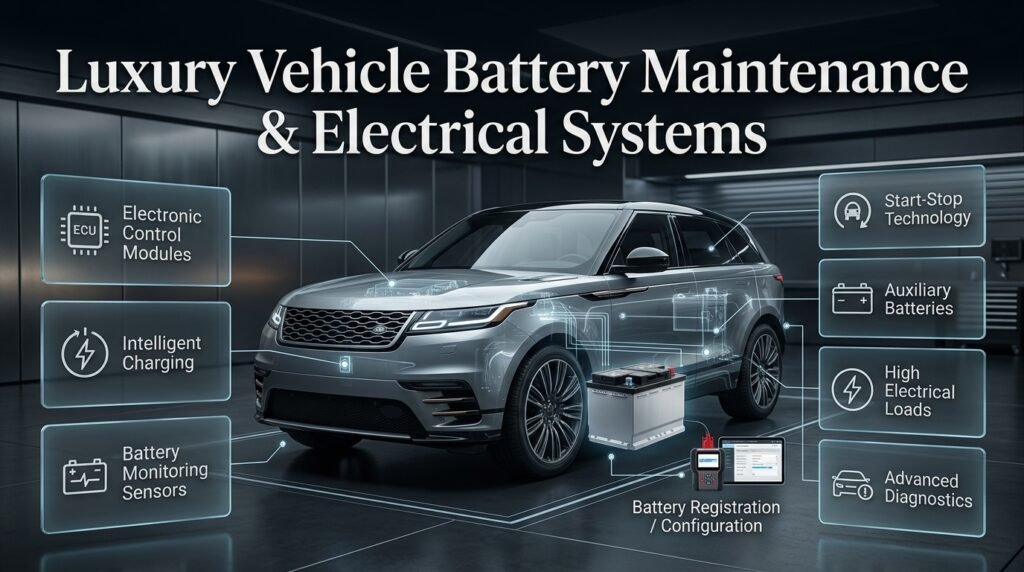
Modern luxury vehicles often have more sophisticated electrical systems than conventional vehicles.
Depending on the model, they may use:
- Multiple electronic control modules
- Intelligent charging systems
- Battery monitoring sensors
- Start-stop technology
- Auxiliary batteries
- High electrical loads
- Advanced diagnostic systems
Battery replacement on such vehicles may require more than physical installation.
Some vehicles require battery registration or electronic configuration after installation.
For these applications, professional Luxury Car Service can be useful when battery issues involve advanced electrical systems.
Battery Corrosion and Professional Vehicle Inspection
A professional Vehicle Inspection can evaluate the battery alongside other vehicle systems.
Depending on the service, inspection may consider:
- Battery condition
- Terminal connections
- Charging system
- Engine operation
- Brakes
- Suspension
- Tires
- Fluids
- Warning lights
- Electrical components
This approach is particularly useful when a vehicle is showing multiple symptoms.
A battery issue may be isolated, but it can also occur alongside other maintenance requirements.
How Battery Testing Prevents Unnecessary Replacement
Battery testing helps reduce guesswork.
Without testing, it is easy to assume:
“There is corrosion, so I need a new battery.”
That conclusion may be incorrect.
Testing can help distinguish between:
- Battery deterioration
- Terminal problems
- Cable problems
- Charging-system faults
- Electrical drains
- Grounding problems
If the battery tests healthy but the terminal connection is poor, replacing the entire battery may be unnecessary.
If the battery tests poorly and has significant deterioration, replacement may be the better long-term option.
The objective is to repair the actual problem rather than replace parts unnecessarily.
Battery Corrosion Maintenance Schedule
There is no universal inspection interval that applies to every vehicle.
The appropriate maintenance frequency depends on:
- Battery age
- Vehicle usage
- Climate
- Battery technology
- Electrical demand
- Previous corrosion
- Starting symptoms
| Maintenance Activity | When It Is Useful |
|---|---|
| Visual battery inspection | Regularly |
| Terminal inspection | During routine servicing |
| Battery performance test | When battery ages or symptoms appear |
| Charging-system test | When discharge or recurring corrosion occurs |
| Pre-trip battery check | Before extended travel |
| Full electrical diagnosis | When repeated problems occur |
Vehicles operating under demanding conditions may benefit from more frequent inspection.
Battery Corrosion and Extended Vehicle Storage
Long periods of vehicle storage can affect battery condition.
A parked vehicle can continue to consume a small amount of electrical energy through its electronic systems.
Over time, an aging or weak battery may lose enough charge to create a starting problem.
Before extended storage, owners should follow appropriate battery-maintenance procedures recommended for their vehicle.
After storage, inspect:
- Battery condition
- Terminal connections
- Visible corrosion
- Battery charge
- Charging-system operation
- Starting performance
A vehicle that has been stored for an extended period does not automatically require a new battery.
Testing should determine its condition.
How to Deal With Recurring Battery Corrosion
If corrosion keeps returning after cleaning, the problem deserves further investigation.
A logical diagnostic process is:
1. Inspect the battery
Look for leakage, physical damage, age-related deterioration, and abnormal conditions.
2. Inspect the terminals
Check whether the terminal is loose, damaged, worn, or excessively corroded.
3. Inspect the cables
Look for corrosion or deterioration around cable ends and connection points.
4. Test the battery
Determine whether it still has adequate starting performance.
5. Test the charging system
Confirm that the alternator and charging system are operating correctly.
6. Identify the root cause
Only after these checks should the correct maintenance or replacement decision be made.
This prevents the common cycle of repeatedly cleaning the same corrosion without resolving why it returns.
Battery Corrosion and Replacement Costs
The cost of resolving battery corrosion depends on what is actually wrong.
A simple terminal-cleaning requirement may be relatively straightforward.
A damaged cable, terminal, battery, or charging system may require additional work.
| Service | Possible Cost Factors |
|---|---|
| Terminal cleaning | Severity of corrosion |
| Terminal replacement | Connector design |
| Cable repair | Cable type and accessibility |
| Battery testing | Diagnostic requirements |
| Charging diagnosis | Vehicle and alternator design |
| Battery replacement | Battery type and specification |
| Electrical diagnosis | Vehicle electronics and fault complexity |
Drivers comparing replacement options can also review the Car Battery Prices in Dubai 2026 guide when evaluating battery replacement requirements.
The cheapest immediate solution is not always the most economical long-term solution if the actual cause remains unresolved.
Professional Recommendations for Preventing Battery Corrosion
Expert Insight
Recurring corrosion should be treated as a diagnostic clue rather than simply a cleaning requirement.
If deposits return soon after cleaning, the battery, terminals, cables, and charging system should be evaluated.
Industry Best Practice
Battery maintenance should combine visual inspection with electrical testing whenever starting or charging symptoms are present.
Dubai Maintenance Recommendation
Vehicles operating regularly in hot conditions should receive consistent battery inspections, particularly as the battery becomes older.
Long-Distance Travel Recommendation
Before an extended journey, inspect the battery if it has previously shown slow cranking, recurring corrosion, or repeated discharge.
Battery Replacement Recommendation
Never select a replacement battery only because it physically fits.
Battery technology, capacity, starting requirements, dimensions, terminal position, and vehicle specifications should all be considered.
Latest Developments in Battery Maintenance
Modern battery service is becoming increasingly diagnostic-driven.
Older maintenance approaches often relied heavily on visual inspection and basic voltage measurements.
Modern workshops can use electronic battery testers and diagnostic equipment to evaluate battery performance and charging behavior more accurately.
Start-stop systems have also increased the importance of choosing the correct battery technology.
AGM and EFB batteries are designed for different operating requirements and should not be treated as universally interchangeable.
Modern battery maintenance can include:
- Electronic battery testing
- Charging-system diagnostics
- Battery monitoring-system checks
- Vehicle diagnostic scanning
- Battery registration where required
- Correct battery technology selection
- Electrical-system inspection
As vehicles become more electronically controlled, battery condition is becoming increasingly connected to overall vehicle health.
Future Trends in Battery Maintenance
Automotive battery technology is continuing to evolve.
Future maintenance is likely to become more predictive, with vehicle systems increasingly capable of monitoring battery condition before a driver experiences a complete failure.
Potential developments include:
- Predictive battery-health monitoring
- More accurate battery-life estimation
- Intelligent charging management
- Vehicle-integrated electrical diagnostics
- Remote vehicle health monitoring
- Automated maintenance alerts
- Improved battery materials
- More sophisticated start-stop systems
- Condition-based battery servicing
The direction of the industry is moving toward identifying battery deterioration earlier rather than waiting for complete failure.
For vehicle owners, this means preventive maintenance and diagnostic information will become increasingly valuable.
What causes car battery corrosion, and why does it keep coming back?
Car battery corrosion usually develops when chemical vapors, electrolyte residue, moisture, and exposed metal around the battery terminals interact over time. Battery age, excessive heat, leakage, charging-system problems, and poor terminal connections can all contribute. A small amount of corrosion can occur naturally on lead-acid batteries, but heavy or recurring corrosion should not simply be treated as a cleaning issue.
If you clean the terminals and the same white, blue, or green deposits return shortly afterward, there may be an underlying issue that needs attention. The battery itself may be aging, the terminal connection may be deteriorating, or the charging system may not be operating correctly.
Important points:
Check the battery for leakage, cracks, swelling, or physical damage.
Inspect both battery terminals and cable connections.
Have the battery tested if corrosion is heavy or repeatedly returns.
Check the charging system when corrosion is accompanied by battery discharge or starting problems.
Cleaning the corrosion without finding its cause may only provide a temporary solution.
How can I prevent battery corrosion from forming on my car battery?
The most effective approach is regular inspection combined with clean, secure electrical connections and correct battery maintenance. Battery terminals should not be allowed to accumulate heavy deposits, and the battery should be checked for signs of leakage, damage, or abnormal buildup. Protective terminal products can also help reduce exposure to moisture and corrosive material when used appropriately.
Prevention is particularly important for vehicles operating in demanding environments. Instead of waiting until the car struggles to start, inspect the battery during routine Vehicle Maintenance and pay attention to any change in terminal condition.
Practical prevention checklist:
Inspect the terminals regularly.
Keep the battery area reasonably clean and dry.
Make sure terminal connections remain secure.
Check battery cables for deterioration.
Test an aging battery rather than relying only on appearance.
Investigate corrosion that repeatedly returns.
Check the charging system if battery problems continue.
Use the correct battery specification for the vehicle.
The objective is not to make corrosion impossible; rather, it is to minimize buildup and catch the underlying problem early. Minor corrosion can occur naturally, so regular monitoring is more realistic than expecting a battery to remain completely corrosion-free.
3. Can battery corrosion cause a car to have trouble starting?
Yes, significant corrosion can interfere with the electrical connection between the battery and the vehicle. The starter requires substantial current when the engine is cranked, so resistance at the battery terminals or cable connections can reduce the effectiveness of that connection. This may appear as slow cranking, intermittent starting, or other electrical symptoms.
However, corrosion should not automatically be blamed for every starting problem. A weak battery, damaged cable, poor ground connection, starter fault, or charging-system problem can produce similar symptoms.
When starting becomes slower, check:
Battery terminal condition
Battery cable connections
Battery health
Ground connections
Charging-system performance
Starter-system condition
If cleaning the terminals does not improve the problem, the next step should be diagnosis rather than repeatedly cleaning the same connection.
Does hot weather in Dubai make battery corrosion worse?
Dubai’s high temperatures make battery maintenance particularly important because heat can accelerate battery aging and contribute to conditions that promote corrosion. High under-hood temperatures can affect battery materials and increase stress on the battery, while moisture and chemical vapors can contribute to terminal corrosion.
This does not mean that every corroded battery in Dubai is caused by heat alone. Battery age, charging-system condition, electrolyte leakage, terminal condition, and environmental exposure can all play a role.
For Dubai vehicles, a sensible approach is to inspect the battery more carefully as it gets older and whenever starting performance changes.
Dubai-specific battery care points:
Check terminals during routine servicing.
Pay attention to recurring white or blue-green deposits.
Don’t ignore slow engine cranking.
Check an older battery before long-distance travel.
Investigate repeated battery discharge.
Have the charging system tested if corrosion keeps returning.
A battery that looks acceptable but has deteriorating performance should be tested rather than judged only by its appearance.
Should I clean battery corrosion or replace the battery?
The correct answer depends on the condition of the battery, not simply the amount of corrosion visible on the terminals. Light corrosion on an otherwise healthy battery may only require proper terminal service and inspection. Heavy corrosion, however, can sometimes indicate battery deterioration, leakage, charging problems, or damaged connections.
A battery should be professionally assessed when corrosion is severe, returns quickly, or appears alongside slow starting, repeated discharge, leakage, swelling, or other abnormal symptoms. A cracked, leaking, or swollen battery should not simply be cleaned and returned to service.
Use this as a practical guide:
Battery Condition
More Appropriate Approach
Light corrosion, normal starting
Inspect and clean connection
Moderate corrosion, battery tests healthy
Service terminals and investigate cause
Recurring corrosion
Battery and charging-system inspection
Corrosion with slow starting
Battery and connection testing
Leakage or physical damage
Professional assessment
Failed battery test
Battery replacement may be required
The important point is to avoid replacing a good battery unnecessarily while also avoiding continued use of a battery that has genuinely reached the end of its useful service life.
A professional Battery Replacement service can determine whether the vehicle needs terminal maintenance, further electrical diagnosis, or a correctly specified replacement battery.
Conclusion
Preventing battery corrosion is not simply about keeping the battery terminals clean. It is about maintaining a reliable electrical connection and identifying the reason corrosion is developing in the first place. Regular inspection of the battery, terminals, cables, and charging system can help catch small problems before they develop into starting or electrical failures.
For vehicles operating in Dubai, proactive battery care is especially valuable because high temperatures and demanding daily driving conditions can place additional stress on automotive batteries. Drivers should not ignore recurring corrosion, slow cranking, repeated battery discharge, or visible battery damage. These signs deserve proper inspection rather than repeated temporary cleaning.
A healthy battery should have clean and secure connections, appropriate charging-system performance, and the correct specification for the vehicle. When testing shows that the battery has deteriorated, replacing it with a compatible battery is generally more reliable than continuing to clean a failing unit.
Ultimately, preventing battery corrosion is part of preventive Vehicle Maintenance. Regular inspection, correct battery selection, professional testing, and timely maintenance can help improve starting reliability, reduce unexpected breakdowns, and extend the useful performance of the vehicle’s electrical system.
Leave a Reply