
Introduction
EFB Battery Performance Characteristics | Modern vehicles place much greater demands on their batteries than older cars did. A battery is no longer used only to start the engine in the morning. It may also support start-stop operation, electronic control modules, safety systems, lighting, climate-control functions, infotainment, and other electrical equipment while the engine is temporarily switched off.
This is where EFB Battery Performance Characteristics become particularly important. EFB stands for Enhanced Flooded Battery, a development of the conventional flooded lead-acid battery designed to provide improved cycling capability, stronger charge acceptance, and better durability under demanding operating conditions. EFB batteries are widely associated with vehicles using basic start-stop systems and are also suitable for some conventional vehicles with demanding electrical or urban-driving requirements.
For professional battery support, EuroSwift Auto Services approaches battery problems by considering the vehicle’s condition, battery specification, charging system, and actual operating requirements rather than simply recommending a replacement.
Understanding EFB performance helps vehicle owners make better decisions when a battery becomes weak, when a start-stop system stops functioning correctly, or when selecting the correct replacement technology.
What Is an EFB Battery?
An Enhanced Flooded Battery is an improved form of the conventional wet-cell lead-acid battery.
Like a traditional flooded battery, an EFB uses a liquid electrolyte. However, its internal construction is modified to provide better resistance to repeated charging and discharging. Manufacturers use different combinations of reinforced plate structures, active-material improvements, additives, separators, grid designs, and other technologies to improve cycling durability and charge acceptance.
The reason for this development is closely connected to modern vehicle operating conditions.
A conventional starter battery was primarily designed around a relatively simple pattern:
- Start the engine.
- Operate the vehicle.
- Receive charging from the alternator.
- Remain ready for the next start.
A start-stop vehicle changes this pattern considerably.
The engine may shut down while the vehicle is stationary, while electrical systems continue operating. When the driver releases the brake or prepares to move, the engine starts again. This cycle can happen repeatedly during urban driving.
EFB technology was developed to cope with these more demanding conditions.
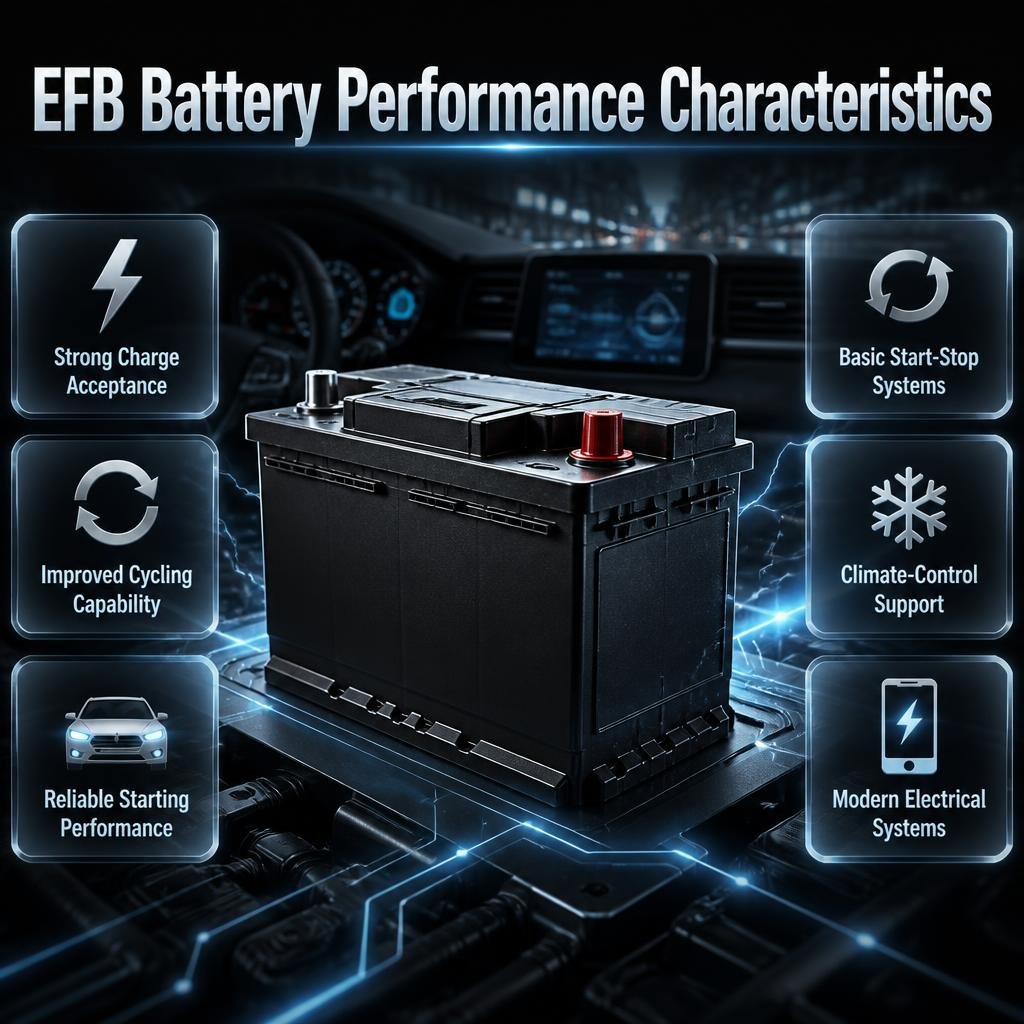
Basic EFB Characteristics
An EFB battery generally offers:
- Improved cycling capability compared with standard flooded batteries
- Better charge acceptance
- Strong starting performance
- Greater resistance to repeated start-stop operation
- Better suitability for frequent urban driving
- Improved performance under partial-state-of-charge conditions
- Practical compatibility with many basic start-stop systems
The exact performance depends on the battery design, vehicle specification, temperature, charging system, driving pattern, and maintenance condition.
Why EFB Battery Performance Matters
Battery performance should not be judged only by whether the engine starts.
A battery can still start an engine while gradually losing its ability to support the vehicle’s wider electrical requirements. This is especially relevant in modern vehicles where battery condition is monitored by energy-management systems.
For example, a vehicle may experience:
- Start-stop functionality becoming unavailable
- Increasingly slow engine cranking
- Electrical warnings
- Reduced battery reserve
- Frequent need for external starting assistance
- Poor recovery after short journeys
These symptoms do not always mean the battery has completely failed.
The battery may instead have reduced capacity, poor charge acceptance, or insufficient reserve performance.
This is why a professional Battery Replacement decision should normally follow testing rather than being based only on one symptom.
How EFB Batteries Improve Performance
The performance advantage of EFB technology comes from several internal improvements rather than one single component.
Research and technical references describe improvements such as reinforced positive plates, modified active materials, carbon additives, improved grid structures, and increased cycling capability. These changes help reduce active-material shedding and improve performance during repeated charge-discharge operation.
The basic principle is straightforward:
A battery designed for repeated cycling needs to tolerate repeated energy movement without losing performance too quickly.
This is particularly important when a vehicle operates for long periods in partial states of charge.
The Main Performance Areas
EFB technology is generally evaluated across several areas:
| Performance characteristic | Why it matters |
|---|---|
| Starting capability | Provides energy required to crank the engine |
| Cycling durability | Helps withstand repeated charge-discharge events |
| Charge acceptance | Allows the battery to recover energy efficiently |
| Partial-state-of-charge performance | Important during frequent stop-start driving |
| Electrical reserve | Supports vehicle systems when required |
| Temperature tolerance | Important for demanding engine-bay environments |
| Vibration resistance | Helps maintain durability during normal driving |
These characteristics work together.
A battery with excellent starting power but poor cycling durability would not necessarily be appropriate for a start-stop application.
EFB Battery Starting Performance
Starting the engine remains one of the battery’s most important responsibilities.
When the driver starts the vehicle, the battery must provide a high current for a short period to operate the starter motor and support the vehicle’s electronic systems during the starting event.
A healthy EFB battery is designed to provide reliable starting performance while also handling repeated cycling.
This combination is particularly useful in vehicles where the engine may be started many times during a journey.
However, starting performance depends on more than battery technology.
Factors Affecting Starting Performance
A professional assessment should consider:
- Battery state of charge
- Battery age and condition
- Engine oil viscosity
- Starter motor condition
- Electrical connections
- Terminal condition
- Ambient temperature
- Charging-system performance
- Correct battery specification
For example, a battery may appear weak when the real problem is excessive resistance at a terminal connection or a starter motor drawing abnormal current.
This is why simply installing a new battery without diagnosis may not solve a recurring starting problem.
EFB Battery Charge Acceptance
Charge acceptance is one of the most important EFB Battery Performance Characteristics.
It refers to the battery’s ability to accept electrical energy from the vehicle’s charging system.
This matters because modern vehicles do not always provide long periods of uninterrupted charging.
During urban driving, a vehicle may accelerate, stop, restart, slow down, and stop again within a short period.
The battery therefore needs to recover energy efficiently between demanding events.
Technical literature identifies improved dynamic charge acceptance as an important advantage of EFB technology compared with standard flooded batteries.
Why Charge Acceptance Matters
Imagine a vehicle that repeatedly performs this cycle:
Engine starts → driving → stop → engine switches off → electrical load continues → engine restarts → battery receives charging
If the battery cannot accept energy efficiently, it may gradually remain at a lower state of charge.
Over time, this can contribute to reduced performance.
An EFB battery is designed to handle this type of operating environment more effectively than a conventional flooded starter battery.
Dynamic Charge Acceptance and Modern Vehicles
Dynamic charge acceptance becomes particularly important when the vehicle’s energy-management system controls charging according to driving conditions.
Some modern systems intentionally operate the battery below a completely full state of charge so that additional electrical energy can be accepted when appropriate, including energy associated with braking or deceleration in vehicles designed for energy recuperation.
The exact strategy varies between manufacturers and vehicle systems.
This means the battery must be compatible with the vehicle’s charging strategy.
An EFB battery is not simply a larger conventional battery. Its internal design is intended to tolerate the charging and cycling behavior associated with its application.
Exide, for example, describes EFB technology as providing high dynamic charge acceptance and improved energy recovery in appropriate start-stop applications.
EFB Battery Cycling Performance
Cycling performance describes how effectively a battery can tolerate repeated charging and discharging.
This is one of the biggest differences between an ordinary starter battery and an EFB battery.
A conventional battery may experience relatively limited cycling during normal use. A start-stop vehicle can create considerably more frequent energy movement.
During every stop:
- The engine may switch off.
- The alternator may stop charging.
- Electrical systems continue consuming energy.
- The battery supports the vehicle’s electrical network.
- The engine then restarts.
- The battery receives charging again.
Repeating this process puts additional stress on the battery.
EFB technology uses enhanced construction to improve resistance to this type of cycling. VARTA describes EFB batteries as more cycle-resistant than conventional flooded batteries and suitable for vehicles with basic automatic start-stop systems.
EFB Battery Performance During Partial State of Charge
One of the most important operating conditions for modern batteries is partial state of charge, often abbreviated as PSoC.
A battery operating at partial state of charge is neither completely full nor deeply discharged. Modern vehicle energy-management systems may intentionally operate batteries within such ranges.
The challenge is that repeated operation without sufficient recovery can gradually reduce battery performance.
EFB batteries are designed with greater resistance to these conditions than conventional flooded starter batteries.
This does not mean an EFB battery should be allowed to remain severely discharged.
Instead, it means the battery is engineered to tolerate the normal cycling conditions associated with its intended vehicle application.
Professional Recommendation
If a vehicle is repeatedly showing low-voltage warnings or start-stop problems, do not assume that the battery simply needs to be driven for a longer distance.
The correct approach is to test:
- Battery condition
- State of charge
- Starting performance
- Charging voltage and behavior
- Electrical load
- Vehicle energy-management operation
This helps identify whether the battery itself is deteriorating or whether another problem is preventing proper recovery.
EFB Batteries and Start-Stop Systems
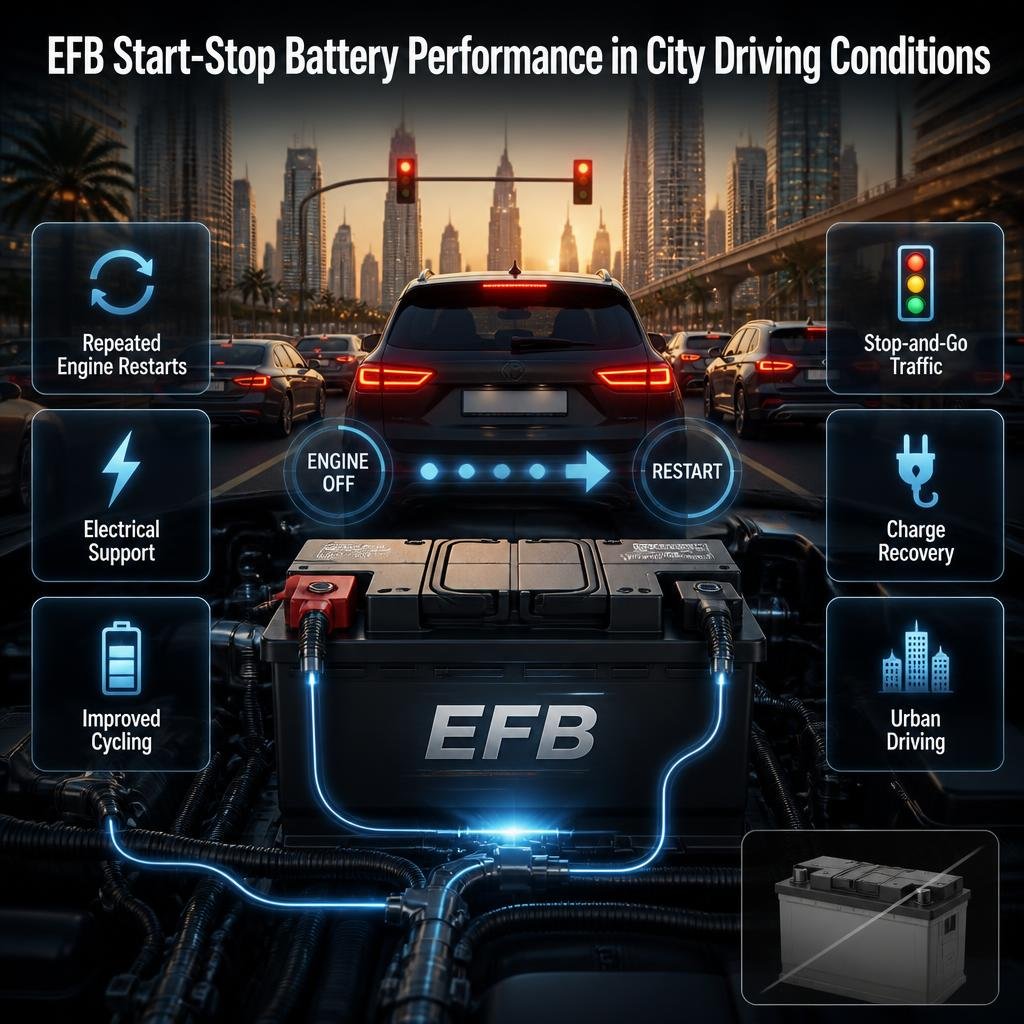
EFB technology is strongly associated with vehicles using basic automatic start-stop systems.
Start-stop technology is designed to reduce unnecessary engine idling. When the vehicle stops under suitable conditions, the engine can temporarily shut down. The system then restarts it when driving conditions require.
This can improve efficiency in situations where the engine would otherwise remain running while stationary.
However, the battery becomes more important because it must support electrical equipment while the engine is off and then provide energy for another engine start.
VARTA identifies EFB and AGM batteries as technologies designed for the increased demands of automatic start-stop systems.
Why a Conventional Battery May Not Be Suitable
A conventional flooded starter battery is not necessarily designed for the same level of repeated cycling.
Using the wrong battery technology can result in:
- Reduced battery life
- Start-stop system problems
- Poor charge recovery
- Frequent battery warnings
- Unreliable starting
The correct battery type should therefore be determined according to the vehicle manufacturer’s specification.
EFB Performance in City Driving
Urban driving is one of the operating conditions where EFB technology can provide a practical advantage.
City traffic can involve:
- Frequent traffic lights
- Stop-and-go movement
- Short journeys
- Repeated engine restarts
- Heavy accessory use
- Long periods of low-speed driving
- Frequent engine-off periods
These conditions can create a demanding battery workload.
Technical sources identify EFB batteries as particularly suitable for vehicles with basic start-stop systems and demanding urban driving requirements.
For drivers in Dubai, traffic congestion and high electrical demand from climate-control systems can make battery condition especially important.
However, climate and traffic conditions do not eliminate the need for correct battery selection. They simply make proper battery performance more valuable.
EFB Battery Performance in Hot Climates
Temperature has a significant influence on lead-acid battery behavior and aging.
Hot environments can accelerate chemical reactions and contribute to faster battery aging. This is especially relevant in vehicles where the battery is exposed to elevated engine-compartment temperatures.
EFB technology is designed for automotive environments and is used in many applications where durability under engine-compartment conditions is required.
Still, an EFB battery is not immune to heat-related aging.
For vehicles operating in hot climates, owners should pay attention to:
- Battery age
- Terminal condition
- Charging-system performance
- Starting behavior
- Battery test results
- Signs of swelling or physical damage
- Electrical warnings
Regular inspection is particularly useful because heat-related deterioration may progress before the driver notices a major starting problem.
EFB Battery Construction and Its Effect on Performance
The internal construction of an EFB battery explains much of its performance.
Compared with a conventional flooded battery, EFB designs may incorporate reinforced grids, improved active materials, carbon additives, and plate-support structures.
One example described by VARTA is the use of a polyfleece scrim on the positive plate to stabilize active material during repeated cycling.
These design changes are intended to improve durability and maintain electrical performance over repeated cycles.
Key Construction Improvements
| Internal improvement | Performance purpose |
|---|---|
| Reinforced plate structure | Supports durability |
| Improved active material | Helps maintain electrical performance |
| Carbon additives | Can improve charge acceptance |
| Optimized grid design | Supports current flow and durability |
| Enhanced separators | Help manage internal battery behavior |
| Improved vibration resistance | Supports automotive durability |
Different manufacturers use different technologies, so specifications should always be checked for the individual battery.
EFB vs Conventional Flooded Battery
The easiest way to understand EFB technology is to compare it with the conventional flooded battery.
| Feature | Conventional Flooded | EFB |
|---|---|---|
| Basic engine starting | Yes | Yes |
| Repeated cycling | Moderate | Improved |
| Basic start-stop suitability | Limited/application dependent | Designed for suitable systems |
| Charge acceptance | Standard | Enhanced |
| Urban stop-start use | Less suitable | Better suited |
| Partial-state-of-charge cycling | More demanding | Improved capability |
| Technology level | Traditional | Enhanced flooded |
The important point is that EFB technology is an evolution of flooded battery technology rather than a completely different battery chemistry.
It retains the fundamental flooded lead-acid architecture while adding features intended to improve performance.
EFB vs AGM Battery Performance
EFB and AGM are often discussed together because both can be used in modern start-stop vehicles.
However, they are not identical.
An AGM battery uses an absorbed electrolyte structure and is designed for demanding applications. EFB remains a flooded technology but includes improvements intended to provide greater cycling capability than conventional flooded batteries.
VARTA notes that EFB batteries are commonly used for basic start-stop systems, while AGM technology is used for applications with greater battery demands.
EFB vs AGM
| Characteristic | EFB | AGM |
|---|---|---|
| Battery construction | Enhanced flooded | Absorbent glass mat |
| Electrolyte | Liquid | Absorbed |
| Cycling capability | Enhanced | Very high |
| Start-stop suitability | Basic systems | More demanding systems |
| Electrical demand | Moderate to high | High |
| Typical cost | Generally lower | Generally higher |
| Replacement choice | Vehicle dependent | Vehicle dependent |
The correct replacement should always follow the vehicle’s specification.
A more expensive battery is not automatically the correct battery.
Can an EFB Battery Replace a Standard Battery?
The answer depends on the vehicle.
If a vehicle is designed for an EFB battery, replacing it with a conventional flooded battery may reduce the system’s ability to handle the intended cycling demands.
The battery specification should therefore be treated as part of the vehicle’s engineering requirements.
Before replacement, check:
- Battery technology
- Capacity
- Cold-cranking rating
- Physical dimensions
- Terminal layout
- Polarity
- Vehicle energy-management requirements
A professional battery supplier should also consider whether battery registration or adaptation is required after installation.
Can an EFB Battery Replace an AGM Battery?
This is an even more important compatibility question.
An EFB battery should not automatically be substituted for an AGM battery simply because both are 12-volt automotive batteries.
Vehicles designed around AGM technology may have higher electrical demands, more sophisticated energy management, or charging strategies that require AGM performance.
If the vehicle originally requires AGM, the correct replacement should normally follow the manufacturer’s specification.
If you are comparing technologies before replacement, the relevant service is not simply “install the cheapest battery.” It is a proper battery and vehicle compatibility assessment.
For drivers specifically looking for an AGM solution, EuroSwift’s AGM battery replacement service in Dubai can be considered when AGM technology is appropriate for the vehicle.
EFB Battery Performance and Short Trips
Short-distance driving can be surprisingly demanding on a vehicle battery.
Every engine start consumes energy. If the journey is very short, the charging system may not have enough opportunity to restore all the energy used during starting and electrical operation.
Repeated short trips can therefore leave the battery at a lower state of charge.
EFB technology provides improved cycling performance, but it does not eliminate the basic need for adequate charging.
If a vehicle is mainly used for short journeys, battery condition should be monitored more carefully.
Short-Trip Battery Checklist
- Monitor starting speed.
- Pay attention to battery warnings.
- Check start-stop behavior.
- Test the battery periodically.
- Check the charging system.
- Avoid unnecessary electrical loads when the engine is off.
- Investigate repeated low-voltage symptoms.
EFB Battery Performance and Electrical Accessories
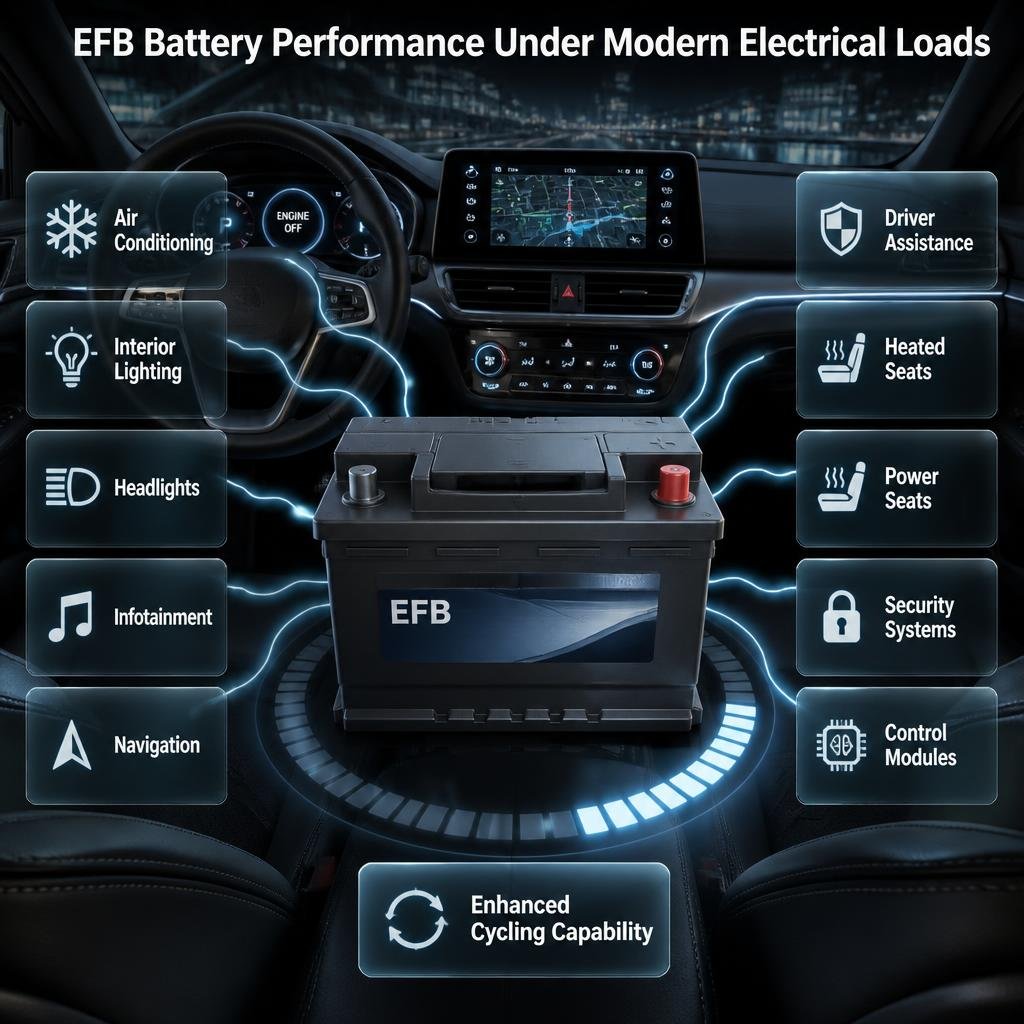
Modern vehicles contain many electrical consumers.
Depending on the vehicle, these may include:
- Air conditioning
- Interior lighting
- Headlights
- Infotainment
- Navigation
- Driver-assistance systems
- Heated seats
- Power seats
- Electronic steering systems
- Security systems
- Control modules
When the engine is stopped, many of these systems may continue drawing energy.
This creates additional demands on the battery.
EFB technology is designed to provide greater cycling capability for appropriate applications, but the battery still has a finite energy reserve.
If electrical systems remain active for extended periods while the engine is off, the battery can become discharged regardless of whether it is conventional, EFB, or AGM.
Signs That an EFB Battery Is Losing Performance
Battery deterioration can happen gradually.
Some drivers wait until the vehicle refuses to start, but several warning signs may appear earlier.
Common Warning Signs
1. Slow engine cranking
The starter motor may sound slower than usual.
2. Start-stop unavailable
The vehicle may disable its start-stop function because the battery does not meet the system’s current requirements.
3. Battery warning
A dashboard warning may indicate a battery or charging-system problem.
4. Repeated jumpstarts
If a vehicle frequently requires external starting assistance, the underlying cause should be diagnosed.
5. Electrical irregularities
Unusual electrical behavior can sometimes accompany low battery voltage.
6. Poor recovery
The battery may repeatedly become weak after relatively normal driving.
None of these symptoms alone proves that an EFB battery needs replacement.
Professional testing is more reliable than guessing.
EFB Battery Diagnostic Process
A proper diagnostic process should look at the complete electrical system.
Step 1: Visual Inspection
The technician checks the battery case, terminals, cables, mounting, and visible signs of damage.
Step 2: Battery Testing
The battery is tested to determine its current condition and starting capability.
Step 3: State-of-Charge Assessment
The technician checks whether the battery is sufficiently charged.
Step 4: Charging-System Test
The alternator and charging system are evaluated.
Step 5: Electrical Load Assessment
Unusual electrical consumption may need to be investigated.
Step 6: Vehicle Compatibility Check
The technician confirms the required battery technology and specification.
Step 7: Replacement or Repair Decision
Only after the results are reviewed should a replacement be recommended.
This approach helps prevent unnecessary battery replacement.
EFB Battery Performance Problems and Possible Causes
| Symptom | Possible cause |
|---|---|
| Slow starting | Weak battery, starter problem, poor connection |
| Battery repeatedly discharged | Charging issue, parasitic draw, short-trip use |
| Start-stop disabled | Low battery state, battery aging, system conditions |
| Battery warning | Charging-system or battery problem |
| Poor charging recovery | Battery condition or charging-system issue |
| Repeated jumpstart requirement | Battery deterioration or electrical fault |
| Premature battery failure | Incorrect battery, heat, charging issue, excessive cycling |
The table is a diagnostic starting point rather than a final diagnosis.
A trained technician should test the vehicle before deciding what component needs attention.
EFB Battery Maintenance Practices
Although EFB batteries are designed for demanding conditions, maintenance still matters.
Keep Battery Connections Clean
Dirty or corroded terminals can create resistance and interfere with electrical performance.
Monitor Starting Behavior
Changes in starting speed can provide an early indication that battery performance is declining.
Check the Charging System
A healthy battery cannot compensate for a defective alternator or charging system.
Avoid Repeated Deep Discharge
Repeatedly allowing the battery to become heavily discharged can reduce its useful service life.
Test Before Replacement
A battery test can provide useful information about whether replacement is actually necessary.
Use the Correct Battery Technology
If the vehicle requires EFB, use a compatible EFB replacement unless the manufacturer specifically allows another technology.
EFB Battery Performance in Emergency Situations
Battery failure often happens at inconvenient times.
A vehicle may fail to start outside a home, workplace, shopping area, or roadside location.
When this happens, forcing repeated starting attempts can further reduce the available battery energy.
A professional Car Jumpstart can provide temporary assistance, but jumpstarting should not automatically be treated as a permanent repair.
If the battery repeatedly needs a jumpstart, the underlying issue should be investigated.
Similarly, Roadside Assistance can be useful when a battery problem occurs away from a workshop and the driver needs safe vehicle support.
If a replacement is required, the technician should verify the correct battery type before installation.
Choosing the Right EFB Battery
Battery selection should never be based solely on physical size or price.
Two batteries may appear similar but have different electrical characteristics.
Important Selection Factors
Battery technology:
Confirm whether the vehicle requires EFB.
Capacity:
The replacement should meet the vehicle’s required capacity.
Cold-cranking performance:
The battery must provide appropriate starting power.
Dimensions:
The battery must physically fit the vehicle.
Terminal arrangement:
Correct terminal positioning is essential.
Manufacturer specification:
The battery should meet the vehicle’s required specification.
Energy-management compatibility:
Modern vehicles may require battery registration or adaptation.
A professional battery supplier can check these details before installation.
EFB Battery Brands and Application Matching
Battery brand is important, but application matching is even more important.
A premium battery that does not match the vehicle’s required technology is not automatically a better choice.
EuroSwift’s battery support includes several established battery options depending on vehicle requirements.
For example, drivers researching Amaron car battery replacement in Dubai can evaluate whether the available specification is suitable for their particular vehicle.
Similarly, Bosch car battery replacement in Dubai may be relevant for vehicles requiring a compatible Bosch battery specification.
For other applications, Tuflong car battery replacement in Dubai provides another battery option to consider according to vehicle requirements.
The important point is to match the battery to the car rather than choosing purely by brand recognition.
EFB Battery Performance and Battery Replacement Cost
The cost of an EFB battery can vary according to several factors.
These may include:
- Battery capacity
- Battery size
- Brand
- Technology
- Vehicle requirements
- Warranty
- Installation
- Emergency service
- Battery registration
- Location
- Availability
For drivers comparing battery prices in Dubai, a useful starting point is the complete car battery price guide for Dubai.
However, price should never be considered independently from specification.
A cheaper battery that is unsuitable for the vehicle can become more expensive if it causes repeated problems or requires premature replacement.
EFB Battery Replacement in Dubai
Dubai’s driving environment can make reliable battery performance particularly important.
Traffic congestion, frequent stopping, high temperatures, air-conditioning use, and short urban journeys can all increase the importance of maintaining a healthy battery and charging system.
When replacement becomes necessary, the technician should confirm:
- Existing battery technology
- Battery condition
- Correct capacity
- Correct dimensions
- Starting specification
- Charging-system condition
- Vehicle compatibility
EuroSwift’s car battery replacement service in Dubai is relevant for drivers who need professional battery support rather than simply purchasing a battery without vehicle assessment.
EFB vs Different Battery Applications
Not every vehicle needs the same battery technology.
A basic conventional vehicle may work correctly with a standard flooded battery.
A vehicle with a basic start-stop system may require EFB.
A vehicle with more demanding start-stop, energy-management, or recuperation requirements may require AGM.
The vehicle manufacturer’s specification should therefore be the starting point.
Application Comparison
| Vehicle requirement | Common battery consideration |
|---|---|
| Conventional starting system | Standard flooded or specified alternative |
| Basic start-stop | EFB often used |
| Higher electrical demand | EFB or AGM depending on vehicle |
| Advanced start-stop | AGM often specified |
| Energy recuperation | Battery technology must match system |
| Luxury/high-electrical-load vehicle | Follow OEM specification carefully |
This is why battery technology should be considered part of the vehicle’s electrical architecture.
EFB Battery Performance and Preventive Maintenance
Preventive maintenance is generally easier than dealing with an unexpected no-start situation.
A practical battery maintenance routine includes:
Every Routine Service
Check:
- Battery condition
- Terminals
- Charging performance
- Starting behavior
- Warning lights
When Starting Behavior Changes
Arrange a battery and charging-system test.
Before Long Trips
If the battery is already showing weakness, have it tested before travelling.
During Extreme Weather
Pay closer attention to battery behavior and charging performance.
When Replacing the Battery
Confirm that the replacement matches the vehicle’s required technology and specifications.
Common EFB Battery Mistakes
Several mistakes can reduce battery reliability.
Mistake 1: Choosing Only by Price
The cheapest battery is not necessarily the correct battery.
Mistake 2: Choosing Only by Physical Size
A battery can fit physically while having an unsuitable electrical specification.
Mistake 3: Replacing EFB With a Conventional Battery
If the vehicle requires EFB technology, downgrading to a conventional battery can reduce suitability for repeated cycling.
Mistake 4: Ignoring the Charging System
A new battery can become weak quickly if the alternator or charging system is defective.
Mistake 5: Waiting Until Complete Failure
Testing a battery after warning signs appear is generally better than waiting for a complete no-start condition.
Mistake 6: Assuming Every Start-Stop Problem Is a Battery Failure
Start-stop systems can be disabled for multiple reasons, including system conditions and vehicle faults.
Mistake 7: Ignoring Vehicle-Specific Requirements
Some vehicles require battery registration or adaptation after replacement.
EFB Battery Testing: What Professionals Look For
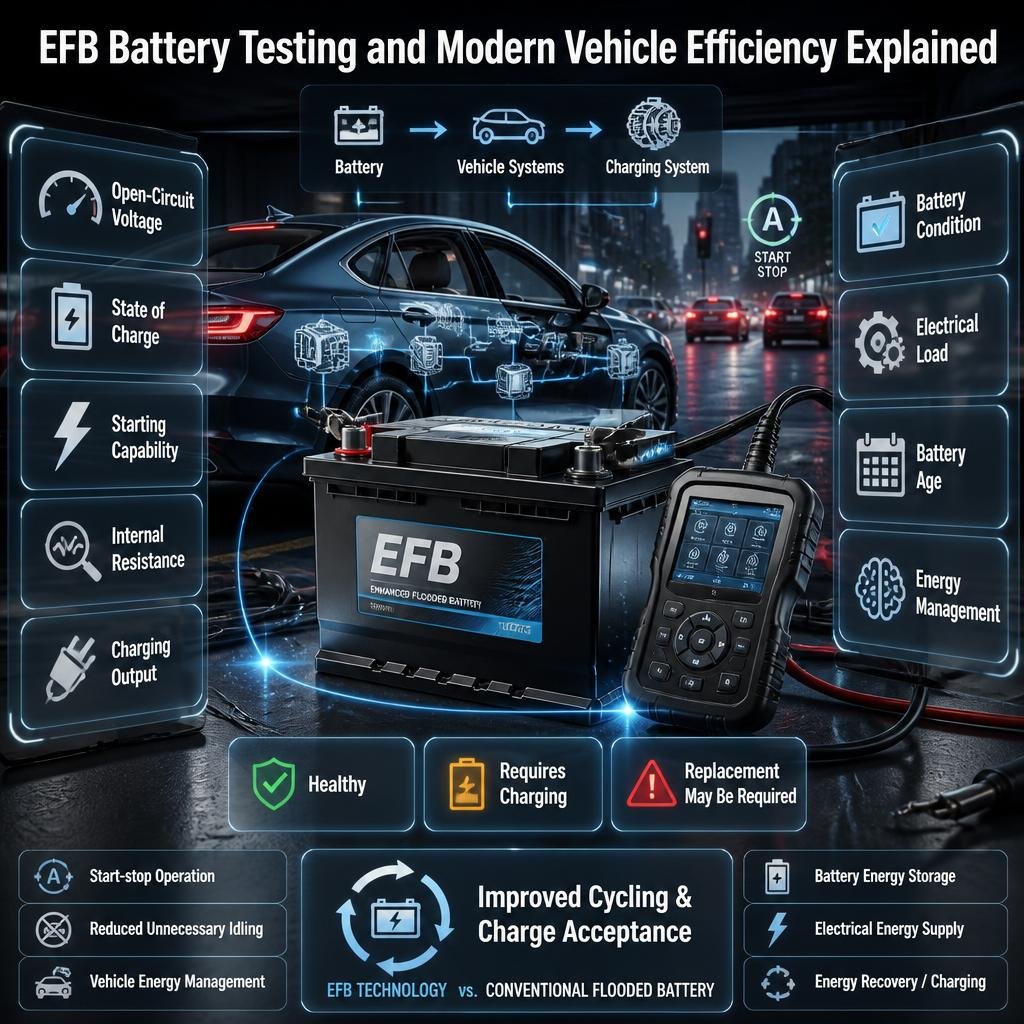
A professional battery inspection should provide more information than a simple voltage reading.
Voltage alone does not tell the complete story of battery health.
A comprehensive assessment may consider:
- Open-circuit voltage
- State of charge
- Starting capability
- Internal resistance or conductance
- Charging-system output
- Battery condition
- Electrical load
- Battery age
- Vehicle energy-management behavior
The exact testing method depends on the equipment and vehicle.
A professional technician can use the results to determine whether the battery is healthy, requires charging, is approaching the end of its service life, or needs replacement.
How EFB Technology Supports Modern Automotive Efficiency
Modern vehicle efficiency is influenced by more than the engine itself.
Start-stop technology and energy-management systems are designed to reduce unnecessary energy consumption and engine idling under suitable conditions.
The battery is an important part of this system because it stores and supplies electrical energy when the engine is not running.
EFB technology supports this approach by providing improved cycling and charge acceptance compared with conventional flooded batteries.
Exide describes modern EFB technology as supporting high dynamic charge acceptance and energy recovery in suitable start-stop vehicles.
This demonstrates why battery technology has become increasingly integrated with vehicle efficiency strategies.
EFB Battery Performance and Future Vehicle Technology
Automotive electrical systems continue to become more sophisticated.
Vehicles increasingly use:
- Advanced energy management
- Electrified accessories
- More electronic control modules
- Driver-assistance technology
- Start-stop functionality
- Regenerative energy systems
- Higher electrical loads
As these systems develop, batteries will continue to play an important role in vehicle reliability.
EFB technology represents one stage in the development of automotive lead-acid batteries. AGM technology provides another solution for applications requiring greater performance.
Future automotive battery systems will continue to evolve, but the fundamental requirement will remain the same:
The battery must match the vehicle’s electrical architecture and operating conditions.
Professional EFB Battery Performance Checklist
Before approving an EFB battery replacement, consider this checklist:
Battery
✔ Correct EFB technology
✔ Correct capacity
✔ Correct starting specification
✔ Correct dimensions
✔ Correct terminal configuration
Vehicle
✔ Start-stop requirements checked
✔ Energy-management system considered
✔ Charging system tested
✔ Electrical load considered
✔ Battery registration requirements checked
Installation
✔ Battery securely mounted
✔ Terminals properly connected
✔ Connections inspected
✔ Old battery handled correctly
✔ Vehicle systems checked after installation
This process is more reliable than simply replacing a battery because it looks old.
When Should You Consider Professional Battery Replacement?
Professional replacement becomes more appropriate when testing confirms that the battery can no longer provide reliable performance.
Typical reasons may include:
- Significantly reduced starting capability
- Repeated discharge
- Poor test results
- Physical battery damage
- Advanced battery aging
- Inability to maintain an appropriate state of charge
- Repeated start-stop system problems caused by battery condition
If the battery is still healthy, replacement may not be necessary.
If the battery is genuinely deteriorated, delaying replacement can increase the risk of an unexpected no-start situation.
EFB Battery Performance Characteristics: Quick Reference
| Characteristic | EFB Performance |
|---|---|
| Starting capability | Strong starting performance when correctly specified |
| Cycling | Better than conventional flooded batteries |
| Charge acceptance | Improved |
| Start-stop suitability | Well suited to many basic systems |
| Urban driving | Suitable for demanding stop-and-go conditions |
| Partial-state-of-charge operation | Improved compared with standard flooded technology |
| Electrical support | Designed for higher cycling demands |
| Heat exposure | Suitable for automotive applications, but heat still affects aging |
| Maintenance | Requires appropriate testing and charging-system checks |
| Replacement | Must match vehicle specification |
What Are the Main Performance Characteristics of an EFB Battery?
An EFB (Enhanced Flooded Battery) is designed to deliver stronger cycling performance and better charge acceptance than a conventional flooded starter battery. This makes it particularly useful for vehicles that experience frequent engine starts, stop-and-go traffic, and basic start-stop operation. The battery still provides the strong starting current required to crank the engine, but it is also built to handle more frequent charging and discharging without losing performance as quickly as a standard flooded battery.
For everyday driving, the most important advantage is the balance between starting power, cycling durability, and charge recovery. However, actual performance depends on the battery’s specification, age, temperature, charging system, and how the vehicle is driven.
Key characteristics include:
Improved resistance to repeated charge-discharge cycles
Better dynamic charge acceptance
Reliable engine-starting capability
Greater suitability for basic start-stop systems
Improved performance during frequent urban driving
Better tolerance of partial-state-of-charge operation
Is an EFB Battery Better Than a Standard Flooded Car Battery?
For vehicles that require greater cycling capability, an EFB battery is generally a more suitable choice than a conventional flooded starter battery. The main difference is not simply that an EFB produces more starting power; its major advantage is that it is designed to cope with a more demanding operating pattern.
A conventional battery may perform well in a vehicle with a straightforward starting and charging cycle. An EFB, however, is better suited to situations where the engine starts repeatedly, the battery temporarily supplies electrical equipment while the engine is stopped, and the charging system needs to restore energy efficiently during relatively short periods of driving.
An EFB can be particularly useful for:
Vehicles equipped with basic start-stop systems
Frequent stop-and-go city driving
Vehicles with higher electrical demands
Applications involving repeated battery cycling
Drivers who regularly make short urban journeys
The important point is application matching. An EFB should not be selected simply because it sounds more advanced. The vehicle manufacturer’s required battery technology should always be checked first.
How Does an EFB Battery Perform in Start-Stop and City Driving?
Start-stop and urban driving can place considerably more demand on a battery than steady highway driving. During a traffic stop, the engine may switch off while systems such as climate control, lighting, infotainment, safety electronics, and control modules continue operating. When the vehicle is ready to move, the battery must then support another engine restart.
EFB technology is designed to handle this repeated cycling more effectively than a conventional flooded starter battery. Its improved charge acceptance also helps the battery recover energy during the periods when the vehicle’s charging system is active. This is one reason EFB batteries are commonly associated with basic start-stop applications.
City driving can involve:
Frequent engine restarts
Repeated stops at traffic signals
Heavy electrical-system usage
Short journeys with limited charging time
More frequent battery discharge and recovery
Extended periods of partial state of charge
For this reason, drivers who spend most of their time in congested urban traffic should pay attention to battery condition rather than waiting for a complete no-start situation.
How Long Does an EFB Battery Last, and What Affects Its Performance?
There is no single service-life figure that applies to every EFB battery. Battery lifespan depends heavily on the vehicle, climate, driving pattern, charging system, electrical load, battery quality, and maintenance. An EFB battery operating correctly in a suitable vehicle can provide reliable service, but repeated deep discharge, excessive heat, charging problems, or frequent short trips can accelerate deterioration.
This is particularly relevant in hot climates such as Dubai, where high ambient and engine-compartment temperatures can contribute to faster battery aging. A battery may therefore lose performance gradually even when the vehicle still starts normally.
Factors that can affect EFB battery life include:
High operating temperatures
Frequent short-distance journeys
Repeated deep discharge
Heavy electrical loads
Faulty or inefficient charging systems
Poor terminal or cable connections
Incorrect battery specification
Advanced battery age
Signs such as slower cranking, repeated jump-start requirements, start-stop becoming unavailable, or recurring battery warnings are reasons to have the battery and charging system tested.
Can You Replace an EFB Battery With a Normal Battery or AGM Battery?
Battery replacement should be based on the vehicle manufacturer’s specification rather than simply choosing whichever battery is available. If a vehicle is designed for EFB technology, replacing it with a conventional flooded battery may reduce its ability to handle the repeated cycling required by the vehicle’s electrical system.
An AGM battery is different again. AGM generally offers higher cycling capability and is commonly used in vehicles with more demanding start-stop systems, higher electrical loads, or specific energy-management requirements. However, installing AGM purely because it is considered a higher-performance technology is not automatically necessary or appropriate.
Before replacing an EFB battery, check:
Required battery technology
Battery capacity and size
Cold-cranking specification
Physical dimensions
Terminal position and polarity
Start-stop requirements
Vehicle energy-management system
Whether battery registration or adaptation is required
The best replacement is not necessarily the cheapest or the most expensive battery. It is the battery that correctly matches the vehicle’s electrical architecture, operating conditions, and manufacturer requirements.
Conclusion
Understanding EFB Battery Performance Characteristics is increasingly important as modern vehicles place greater demands on their electrical systems. An EFB battery is not simply an upgraded starting battery; it is designed to provide a better balance of starting power, cycling durability, and charge acceptance for vehicles that experience repeated engine starts and demanding everyday driving conditions.
For drivers who regularly deal with stop-and-go traffic, short journeys, basic start-stop operation, or higher electrical loads, the battery’s ability to recover energy and withstand repeated cycling can make a significant difference to overall reliability. At the same time, even the best EFB battery cannot compensate for an incorrect battery specification, a faulty charging system, excessive electrical drain, or prolonged deep discharge.
Before replacing an EFB battery, it is therefore worth looking beyond the battery itself. A proper assessment should consider the battery’s condition, charging system, vehicle requirements, electrical load, and manufacturer-specified technology. This helps prevent unnecessary replacement and reduces the risk of installing a battery that is not suitable for the vehicle.
The most practical approach is simple: test the battery, identify the real cause of the problem, confirm the correct specification, and choose the appropriate technology for the vehicle. With the right battery and proper electrical-system care, drivers can support dependable starting performance and more consistent operation in demanding everyday conditions.
Leave a Reply