
Introduction
Car Battery Maintenance Checklist | A reliable car battery is one of the most important parts of a modern vehicle. Although its primary job is to provide the electrical power required to start the engine, the battery also supports numerous electronic systems before, during, and after the engine is running. When battery condition gradually deteriorates, the first signs may be easy to overlook: slightly slower cranking, dimming lights during startup, intermittent electrical behavior, or a vehicle that needs occasional jumpstarting.
A proper Car Battery Maintenance Checklist helps drivers identify these warning signs before a battery failure leaves the vehicle stranded. This is particularly relevant in Dubai, where high temperatures, heavy air-conditioning use, traffic congestion, frequent short journeys, and long periods of outdoor parking can place additional demands on vehicle batteries and charging systems.
For drivers who want a structured approach to vehicle maintenance, EuroSwift Auto Services provides a broader automotive service environment in which battery inspection can be considered alongside other mechanical and electrical maintenance requirements.
Battery maintenance should not be limited to asking whether the vehicle starts. A professional assessment considers battery condition, terminals, charging performance, electrical consumption, battery technology, vehicle usage, and the manufacturer’s specifications.
This guide explains how to maintain a car battery, what to inspect, how often testing should be considered, what problems commonly cause battery discharge, how Dubai conditions influence battery performance, and when professional battery replacement becomes the better option.
1. Why Car Battery Maintenance Is Important
A car battery can deteriorate internally without producing an obvious visual warning. In many cases, the vehicle continues starting normally until the battery’s available performance falls below the level required for reliable engine cranking.
This is why preventive battery maintenance is more useful than waiting for complete failure.
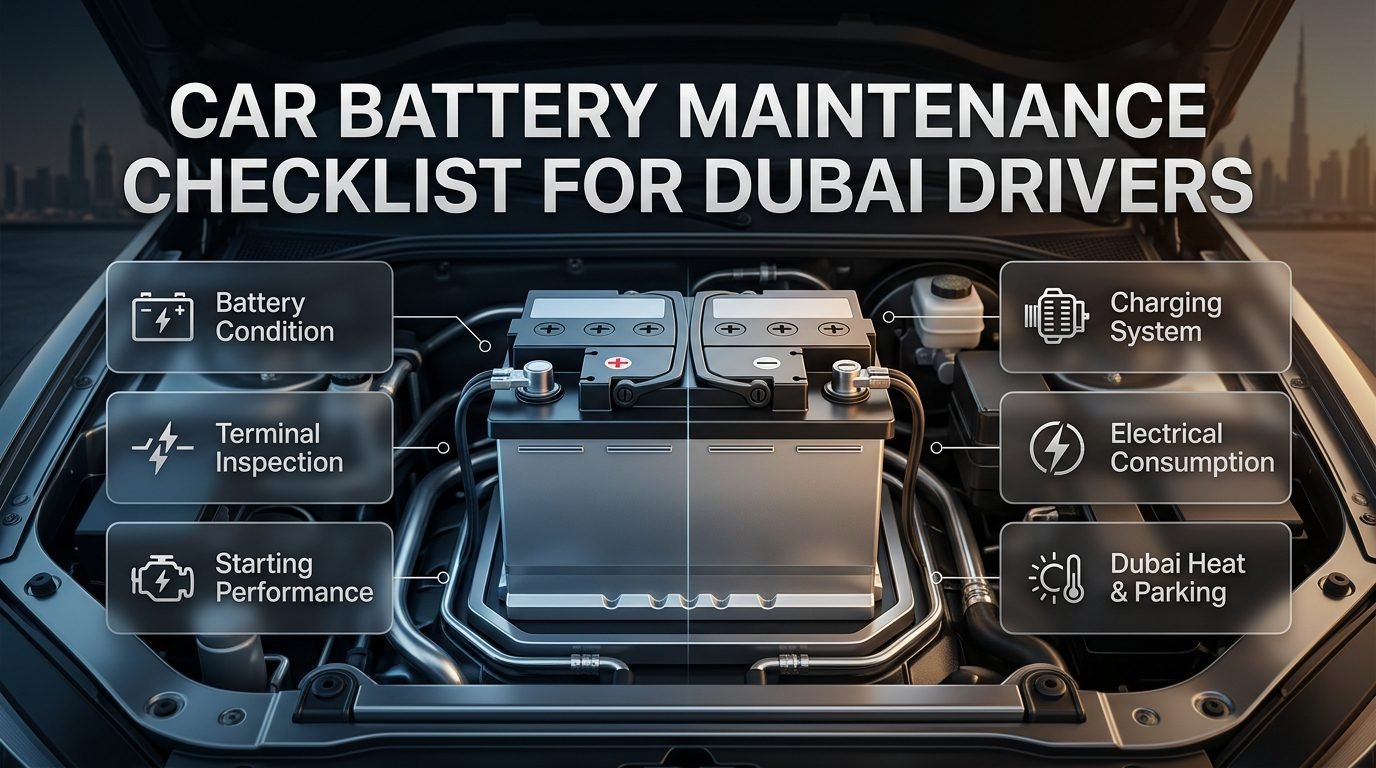
A battery inspection can help identify problems involving:
- Battery condition
- Terminal connections
- Battery mounting
- Charging-system performance
- Electrical consumption
- Battery age
- Starting performance
- Incorrect battery specification
- Excessive discharge
- Vehicle-specific battery-management systems
The battery also works closely with the alternator and starter motor. If one of these systems develops a problem, the symptoms may appear to be a battery failure even when the battery itself is not the primary cause.
Battery maintenance versus battery replacement
Maintenance aims to preserve reliability and identify deterioration.
Replacement becomes necessary when the battery has reached the end of its useful service life, fails an appropriate test, suffers physical damage, or no longer meets the vehicle’s starting requirements.
| Situation | Appropriate response |
|---|---|
| Battery starts normally | Continue routine monitoring |
| Minor terminal corrosion | Inspect and address the connection |
| Slow cranking | Arrange battery and starting-system testing |
| Repeated discharge | Investigate battery, charging system, and electrical drain |
| Battery fails testing | Replace with correct specification |
| Physical battery damage | Professional inspection recommended |
| New battery repeatedly discharges | Diagnose underlying vehicle problem |
The key principle is simple: do not assume every starting problem means the battery needs replacing.
2. Complete Monthly Car Battery Maintenance Checklist
A monthly inspection does not need to be complicated. The purpose is to identify visible changes and notice symptoms that could justify professional testing.
Monthly checklist
- Inspect the battery casing.
- Look for cracks, swelling, or deformation.
- Check for visible leakage or unusual residue.
- Inspect battery terminals.
- Look for excessive corrosion.
- Confirm that the battery is securely mounted.
- Check for obvious cable damage.
- Pay attention to engine-cranking speed.
- Notice any unusual clicking during startup.
- Monitor repeated battery discharge.
- Check whether electrical systems behave abnormally.
- Review the approximate battery age.
- Consider professional testing if performance has changed.
A visual inspection is useful, but it cannot determine the complete internal condition of a battery. A battery may look perfectly clean and still have reduced starting capability.
Professional testing becomes particularly valuable when the vehicle begins displaying symptoms.
3. Inspect Battery Terminals and Electrical Connections
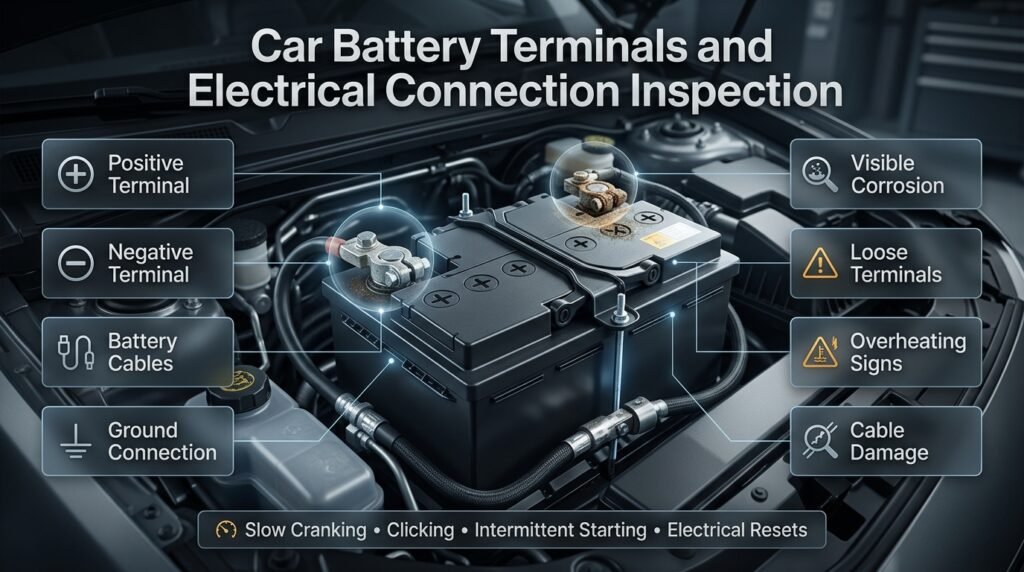
Battery terminals are among the most overlooked components during routine vehicle care.
The battery can only deliver electrical power effectively when the connection between the battery, cables, vehicle ground, starter, and electrical system is in good condition.
Corrosion or a loose terminal can increase electrical resistance. This may produce symptoms that resemble a weak battery.
Inspect these areas
During an appropriate inspection, attention should be given to:
- Positive battery terminal
- Negative battery terminal
- Terminal clamps
- Battery cables
- Ground connections
- Visible corrosion
- Signs of overheating
- Physical cable damage
- Battery mounting
A connection problem can become especially noticeable during engine starting because the starter requires substantial electrical current.
Why loose terminals matter
A battery may have sufficient stored energy but fail to transfer that energy efficiently if the connection is poor.
This can result in:
- Slow cranking
- Intermittent starting
- Clicking sounds
- Electrical resets
- Unusual dashboard behavior
Therefore, a proper Vehicle Inspection should consider both the battery and its connections.
4. Check the Battery Case for Physical Damage
The physical condition of the battery should never be ignored.
Inspect the battery casing for:
- Cracks
- Swelling
- Deformation
- Leakage
- Damaged terminals
- Burn marks
- Severe corrosion
- Loose mounting
A battery that is physically damaged should receive professional attention.
Modern maintenance-free batteries are designed differently from older serviceable battery designs. Drivers should not automatically apply old battery-maintenance practices such as opening sealed batteries or adding fluids unless the specific battery design and manufacturer instructions permit it.
Battery mounting is also important
A battery should remain securely positioned in its tray.
Excessive movement can place stress on:
- Battery casing
- Terminals
- Electrical cables
- Internal components
Battery installation is therefore part of proper Car Service, rather than simply an installation detail.
5. Monitor Engine Starting Performance
One of the most useful practical battery indicators is a noticeable change in how the engine starts.
If the engine previously cranked quickly but now turns over more slowly, this change deserves attention.
Common starting warning signs
Look for:
- Slow engine cranking
- Repeated clicking
- Delayed startup
- Dashboard lights dimming noticeably during startup
- Electrical systems resetting
- Starting problems after parking
- Increasing reliance on jumpstarts
These symptoms do not automatically prove battery failure.
The cause could involve:
- Battery deterioration
- Poor terminal connection
- Starter motor
- Charging system
- Ground connection
- Electrical drain
A technician can use appropriate testing to distinguish between these possibilities.
Why waiting for complete failure is a mistake
Many drivers ignore gradual changes because the vehicle still starts.
However, a battery that has been cranking more slowly for several weeks may already be approaching the point where normal starting becomes unreliable.
Preventive testing is usually more convenient than dealing with an unexpected no-start condition at an inconvenient location.
6. Test Battery Health Instead of Guessing
Battery voltage is useful information, but it does not provide the complete picture of battery condition.
A professional battery assessment may evaluate several characteristics depending on the vehicle and battery technology.
These can include:
- Resting voltage
- Starting performance
- Cranking capability
- Battery condition
- Charging voltage
- Electrical connections
- Charging-system behavior
Why voltage alone is not enough
A battery may show an apparently reasonable voltage while still having inadequate starting performance.
This is why professional testing can be more informative than relying on a single voltage measurement.
| Inspection | Main purpose |
|---|---|
| Visual inspection | Identify physical problems |
| Terminal inspection | Check connection quality |
| Voltage assessment | Evaluate electrical state |
| Starting test | Assess performance under demand |
| Charging test | Evaluate charging system |
| Electrical-drain test | Identify unwanted consumption |
If testing confirms that the battery has reached the end of its serviceable condition, replacement should be based on the vehicle’s actual requirements.
7. Check the Alternator and Charging System
A battery does not operate independently.
Once the engine is running, the vehicle’s charging system supplies electrical power and replenishes energy used during starting and other electrical operations.
The alternator and related charging components therefore deserve attention when battery discharge becomes repetitive.
Possible charging-system problems
A technician may inspect:
- Alternator performance
- Charging voltage
- Electrical connections
- Grounding
- Drive-belt condition where applicable
- Battery-management system
- Charging-control electronics
A new battery that keeps going flat is a warning
Suppose a driver installs a new battery and the vehicle begins losing charge again shortly afterward.
Replacing another battery without diagnosing the vehicle may not solve the problem.
Possible causes include:
- Alternator fault
- Electrical drain
- Poor connection
- Grounding problem
- Vehicle electronics remaining active
- Incorrect battery specification
This is why professional Engine Diagnostics can be important when battery failures become repetitive.
8. How Dubai Heat Can Affect Battery Maintenance
Dubai’s climate deserves special consideration when planning vehicle maintenance.
High temperatures can accelerate battery aging and increase thermal stress on automotive components. A battery exposed to prolonged heat may deteriorate differently from a battery operating in a milder environment.
This does not mean that every battery will fail quickly simply because the vehicle operates in Dubai. Battery life depends on multiple factors.
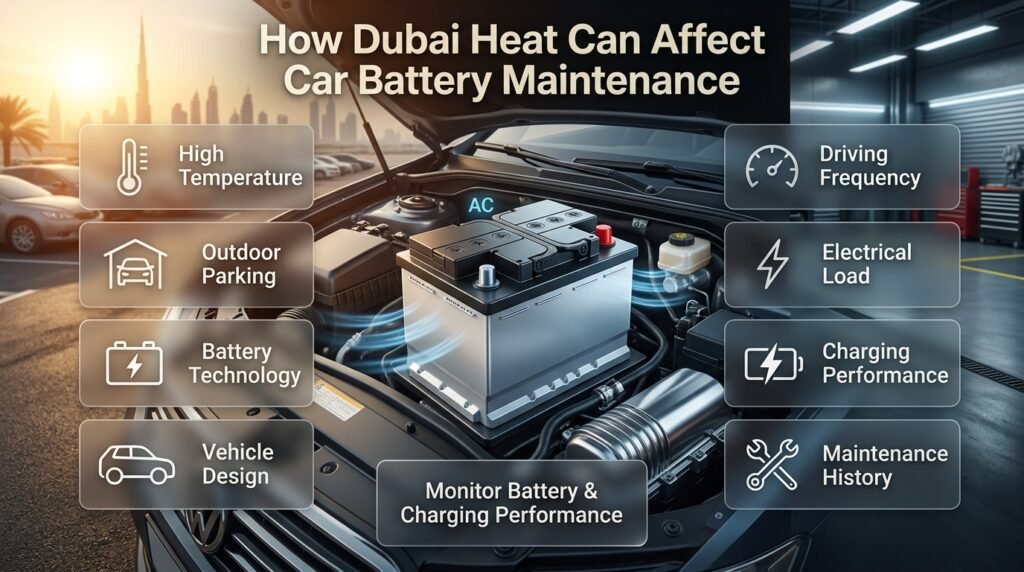
These include:
- Battery technology
- Vehicle design
- Parking conditions
- Driving frequency
- Electrical load
- Charging performance
- Battery quality
- Maintenance history
Outdoor parking
Vehicles parked outside for long periods may experience greater heat exposure than vehicles regularly parked in shaded or enclosed environments.
For such vehicles, monitoring battery condition becomes especially useful.
Air-conditioning and electrical loads
Dubai drivers often rely heavily on air conditioning. Modern vehicle electrical systems are designed to handle normal operating loads, but a battery or charging system that is already deteriorating may become more noticeable under demanding conditions.
The correct response is not to blame air conditioning automatically. Instead, battery and charging performance should be tested when symptoms appear.
9. Battery Maintenance for Short Trips
Short-distance driving can create a different type of battery challenge.
Every engine start consumes electrical energy. If a vehicle is repeatedly used for very short trips, the charging system may have limited time to replenish the energy consumed during starting.
The effect varies considerably between vehicles.
Factors include:
- Trip length
- Number of daily starts
- Battery condition
- Alternator performance
- Electrical accessories
- Vehicle technology
- Ambient temperature
Short-trip drivers should monitor
- Slow cranking
- Repeated discharge
- Battery warning lights
- Starting inconsistencies
- Battery age
- Electrical behavior
If the vehicle regularly becomes weak despite normal use, the cause should be diagnosed rather than assuming the driving pattern is entirely responsible.
10. Battery Maintenance for Vehicles Parked for Long Periods
Modern vehicles can continue consuming small amounts of electrical energy even when the engine is switched off.
Depending on the vehicle, these loads may support:
- Security systems
- Alarm functions
- Vehicle computers
- Keyless systems
- Memory functions
- Connected electronics
When a vehicle remains unused for an extended period, the battery can gradually lose charge.
Extended parking checklist
- Check battery condition before long-term parking.
- Ensure lights and unnecessary accessories are switched off.
- Follow manufacturer storage instructions.
- Avoid leaving unnecessary devices connected.
- Test the battery if the vehicle has been unused for a long period.
- Investigate repeated discharge.
- Check the charging system if the battery does not recover normally.
A vehicle that repeatedly loses charge while parked may have an electrical drain that requires professional diagnosis.
11. Battery Age and Replacement Timing
Battery age is important, but it should not be treated as the only replacement criterion.
Battery service life varies according to:
- Climate
- Battery technology
- Vehicle usage
- Charging system
- Electrical load
- Parking conditions
- Maintenance
- Battery quality
A battery approaching the end of its expected service period deserves closer monitoring, particularly before long journeys.
Practical approach
| Battery situation | Recommended approach |
|---|---|
| Healthy and tested | Continue monitoring |
| Older but performing normally | Test periodically |
| Slow cranking | Test soon |
| Repeated discharge | Diagnose cause |
| Failed battery test | Replace |
| Physically damaged | Professional assessment |
The objective is not to replace a battery prematurely.
The objective is to avoid depending on a battery that no longer provides reliable starting performance.
12. Selecting the Correct Replacement Battery
When replacement becomes necessary, choosing a battery simply because it fits physically is not enough.
The battery should match the vehicle’s electrical and mechanical requirements.
Important considerations may include:
- Physical dimensions
- Terminal arrangement
- Capacity
- Starting capability
- Battery technology
- Electrical requirements
- Vehicle manufacturer specifications
- Start-stop compatibility
- Battery-management requirements
For drivers researching different options, Amaron Battery is one available battery-specific option, while Bosch Battery provides information for drivers considering Bosch applications.
Another option is Tuflong Battery, which can be evaluated according to vehicle compatibility and requirements.
The important point is that the correct battery should be selected for the vehicle rather than choosing purely according to brand popularity.
13. AGM and Advanced Battery Technology
Modern vehicles can use battery technologies designed for higher electrical demands and specific operating conditions.
AGM batteries are commonly associated with vehicles that have demanding electrical systems or start-stop applications where the vehicle manufacturer specifies AGM technology.
Drivers should not assume that an AGM battery is automatically better for every car.
The correct technology depends on the vehicle.
For vehicles specifically requiring this technology, AGM Battery Replacement Dubai provides a dedicated resource.
Why battery technology matters
Different battery technologies can have different:
- Charging characteristics
- Cycling capabilities
- Electrical performance
- Application requirements
- Installation considerations
A vehicle’s original specifications should therefore guide replacement decisions.
14. Brand-Specific Battery Maintenance Considerations
Brand selection is only one part of battery selection, but drivers may still want to understand available options.
For example, Exide Battery is another battery option that can be considered according to vehicle requirements.
Drivers may also research Panasonic Battery when comparing available battery solutions.
For other vehicle applications, FIAMM Battery may also be relevant.
Similarly, AC Delco Battery can be evaluated where the battery specification is appropriate.
The professional approach is to start with the vehicle’s requirements and then identify suitable battery options.
15. Car Battery Maintenance Before a Long Journey
Battery failure before a long trip can be particularly inconvenient.
A vehicle may start normally every morning while still having a battery that is gradually losing its ability to provide reliable starting power.
Before a long journey, especially when traveling between emirates, drivers should consider a broader preventive inspection.
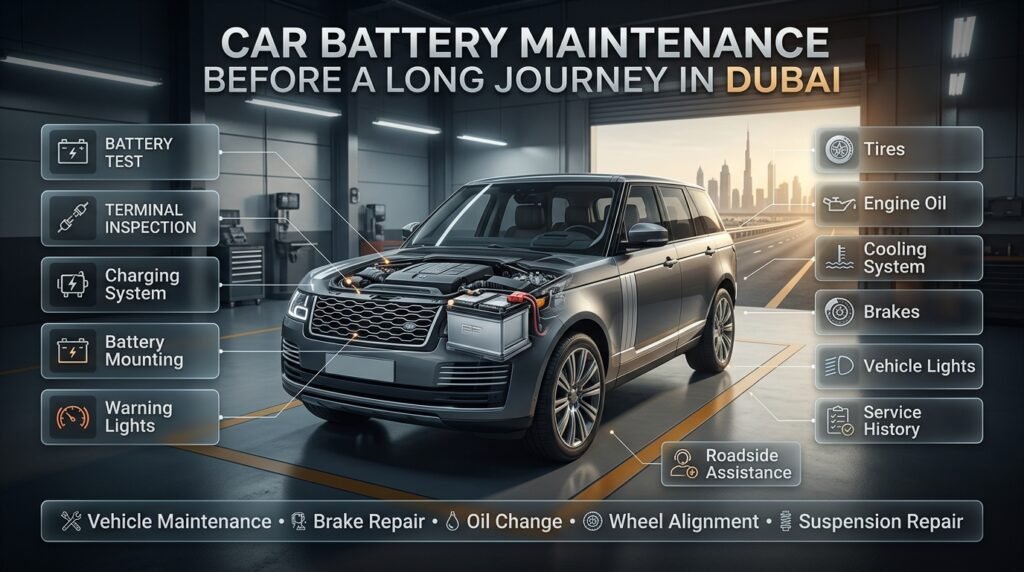
Pre-trip checklist
- Test the battery if it is older or showing symptoms.
- Inspect terminals.
- Check charging-system performance.
- Confirm secure battery mounting.
- Check warning lights.
- Inspect tires.
- Check engine oil.
- Check cooling-system condition.
- Check brakes.
- Check lights.
- Review service history.
- Make sure roadside assistance arrangements are available.
Battery preparation should form part of complete Vehicle Maintenance.
A pre-trip inspection can also identify overdue Brake Repair, Oil Change, Wheel Alignment, Suspension Repair, or other maintenance requirements.
16. Warning Signs That Should Not Be Ignored
Some symptoms should move a battery from routine monitoring to professional inspection.
Important warning signs
- Engine cranks more slowly than usual.
- Vehicle requires repeated jumpstarts.
- Battery repeatedly becomes discharged.
- Battery warning light appears.
- Electrical systems reset unexpectedly.
- Dashboard lights behave unusually.
- Battery casing appears swollen.
- Battery terminals show severe corrosion.
- New battery becomes weak unexpectedly quickly.
- Vehicle loses electrical power while operating.
These signs do not all indicate the same problem.
For example, a charging-system fault can produce repeated battery discharge, while a starter problem can produce starting symptoms even when the battery is healthy.
This is why diagnosis should precede unnecessary component replacement.
17. Common Car Battery Maintenance Mistakes
Good battery maintenance is not only about knowing what to do. It is also about knowing what not to do.
Replacing the battery without diagnosis
A discharged battery may still be recoverable.
Testing should determine whether the battery is actually defective.
Ignoring the alternator
A new battery cannot compensate for a charging-system problem indefinitely.
Repeatedly jumpstarting
A jumpstart is a temporary solution.
If the vehicle repeatedly requires one, the underlying issue should be investigated.
Choosing the cheapest battery
The cheapest option may not be appropriate for the vehicle’s technology or electrical requirements.
Ignoring slow cranking
Slow starting is useful warning information.
Waiting for complete failure removes the opportunity for convenient preventive action.
Assuming all batteries are interchangeable
Battery dimensions alone do not determine compatibility.
Ignoring vehicle electronics
Modern vehicles can have sophisticated battery-management systems that influence replacement procedures.
18. Professional Battery Inspection Process
A professional inspection should follow a logical sequence.
Step 1: Discuss vehicle symptoms
The technician should understand:
- When the issue started
- How frequently it occurs
- Whether it happens after parking
- Whether jumpstarting has been necessary
- How frequently the vehicle is driven
- Whether the battery was recently replaced
Step 2: Visual inspection
The battery casing, terminals, cables, and mounting system are inspected.
Step 3: Battery testing
Appropriate diagnostic equipment assesses battery condition.
Step 4: Charging-system testing
The technician evaluates alternator and charging performance.
Step 5: Electrical-drain investigation
If the vehicle loses charge while parked, unnecessary electrical consumption may need investigation.
Step 6: Replacement decision
If the battery has failed, the correct replacement specification is identified.
Step 7: Installation verification
The technician confirms that the new battery is properly installed and that the vehicle’s electrical system operates correctly.
This process connects battery service with wider Car Repair and electrical diagnostics.
19. Battery Maintenance for Luxury Cars
Luxury vehicles can have substantially more electronic equipment than basic vehicles.
These systems may include:
- Advanced infotainment
- Keyless entry
- Driver-assistance systems
- Electronic seat systems
- Multiple control modules
- Start-stop technology
- Advanced security systems
- Battery-management systems
As a result, battery selection and replacement procedures may require greater attention to manufacturer specifications.
A luxury vehicle should not automatically be serviced using generic assumptions.
Professional Luxury Car Service should take the specific vehicle’s electrical architecture into account.
For some modern vehicles, battery replacement may also require electronic registration, adaptation, or battery-management procedures depending on manufacturer design.
20. Battery Maintenance and Overall Vehicle Reliability
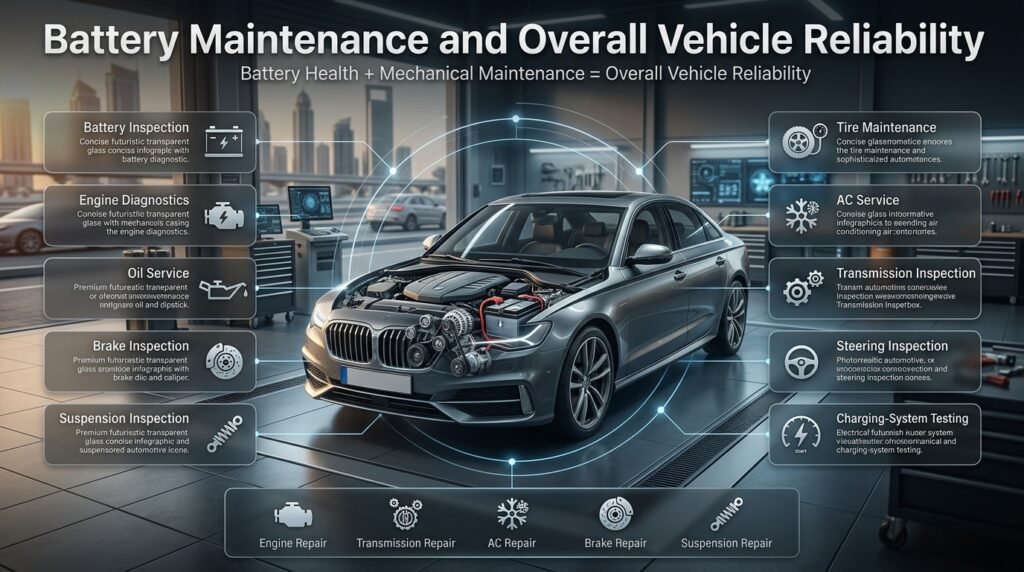
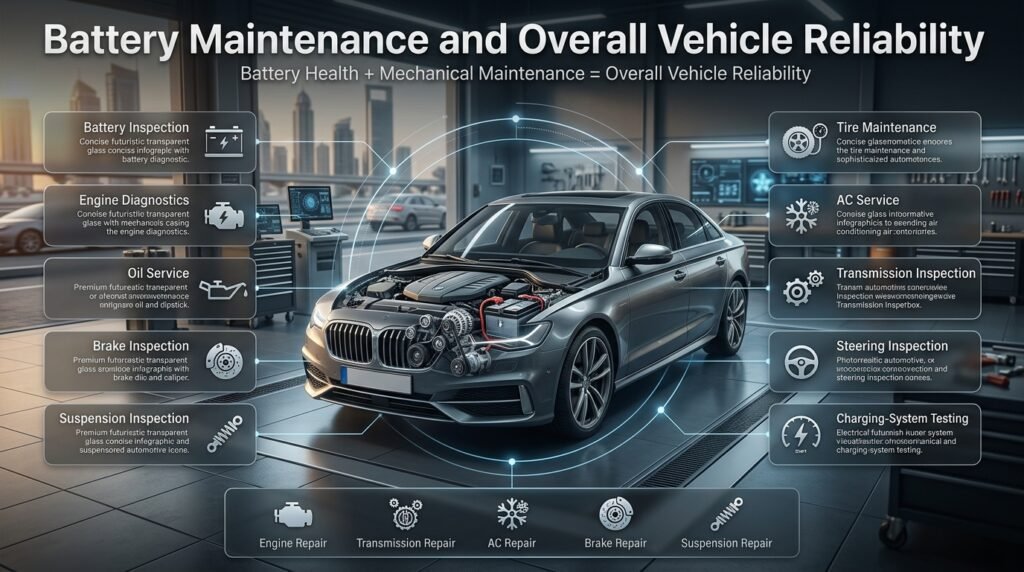
Battery health is closely connected to the overall condition of the vehicle.
A car with a healthy battery but poor brakes, worn tires, weak suspension, or overdue engine maintenance is not truly reliable.
A comprehensive maintenance approach can include:
- Battery inspection
- Engine diagnostics
- Oil service
- Brake inspection
- Suspension inspection
- Tire maintenance
- Air-conditioning service
- Transmission inspection
- Steering inspection
- Charging-system testing
For drivers looking beyond battery care, professional Engine Repair, Transmission Repair, AC Repair, Brake Repair, and Suspension Repair can address other systems that influence vehicle reliability.
This broader approach is particularly useful for high-mileage vehicles and vehicles used extensively in Dubai traffic.
21. Battery Problems and Roadside Assistance
Battery failures often occur at the worst possible moment.
Examples include:
- Before work
- At a shopping location
- Outside a residence
- After leaving the vehicle parked
- Before an important journey
- During an evening commute
- After extended inactivity
In these situations, Car Jumpstart can provide immediate starting assistance.
However, jumpstarting should not be considered a permanent battery repair.
If the battery repeatedly becomes discharged, the vehicle should receive a proper inspection.
Professional Roadside Assistance can help drivers deal with immediate vehicle immobilization while allowing the underlying mechanical or electrical problem to be investigated afterward.
22. Battery Maintenance and Cost Considerations in Dubai
Battery replacement costs can vary significantly depending on the vehicle and battery specification.
Important factors can include:
- Battery brand
- Battery technology
- Battery capacity
- Vehicle model
- Installation requirements
- Diagnostic requirements
- Battery-management procedures
- Service location
- Emergency call-out requirements
A driver should therefore compare the complete service rather than focusing solely on the battery price.
For a more detailed understanding of market pricing factors, the Car Battery Price Guide for Dubai can be used as a supporting resource.
The final price should always be evaluated in relation to compatibility, installation, warranty, service quality, and vehicle requirements.
23. A Seasonal Battery Maintenance Approach for Dubai
Dubai does not have the same seasonal battery challenges as colder climates, but vehicle usage and environmental exposure still change throughout the year.
During periods of intense heat, drivers should pay attention to:
- Battery age
- Starting performance
- Outdoor parking
- Air-conditioning use
- Electrical behavior
- Battery casing condition
During periods when the vehicle is used less frequently, extended parking and discharge become more relevant.
Practical seasonal approach
| Condition | Maintenance focus |
|---|---|
| Very high temperatures | Monitor battery condition |
| Heavy commuting | Check charging and starting performance |
| Frequent short trips | Monitor discharge |
| Extended parking | Check battery state before and after storage |
| Long-distance travel | Test older or symptomatic batteries |
| Older battery | Increase monitoring frequency |
The best maintenance strategy adapts to actual vehicle use.
24. Fleet and Business Vehicle Battery Maintenance
Fleet vehicles deserve a more structured battery maintenance system because one failed vehicle can affect schedules, deliveries, staff transportation, or customer service.
A fleet maintenance program can record:
- Battery installation date
- Battery brand
- Battery specification
- Test results
- Vehicle mileage
- Starting complaints
- Replacement history
- Charging-system problems
- Repeated discharge events
Fleet battery checklist
- Maintain battery service records.
- Track battery replacement dates.
- Record repeated discharge incidents.
- Test vehicles showing slow starting.
- Investigate charging-system problems.
- Avoid unnecessary emergency replacements.
- Standardize inspection procedures where appropriate.
This turns battery maintenance from reactive repair into condition-based vehicle management.
25. How Battery Maintenance Supports Preventive Car Service
Battery maintenance should not be viewed separately from the rest of the vehicle.
During a professional Car Service, technicians can identify other issues that may eventually affect reliability.
For example:
A vehicle may arrive with a battery complaint, but inspection could also reveal an overdue oil service, worn brake components, tire problems, or suspension deterioration.
Likewise, a vehicle with repeated battery problems may require charging-system diagnostics rather than simply another battery.
This is where preventive maintenance becomes more valuable than isolated component replacement.
The goal is to maintain the complete vehicle rather than repeatedly responding to individual failures.
26. Modern Automotive Battery Technology
Battery maintenance is becoming increasingly connected with vehicle electronics.
Modern vehicles can include systems that monitor:
- Battery voltage
- Charging behavior
- Electrical consumption
- Energy management
- Start-stop operation
- Battery state
- Electronic control systems
As vehicles become more sophisticated, technicians increasingly need diagnostic equipment capable of communicating with vehicle systems.
Traditional battery testing remains important, but it is increasingly combined with electronic diagnostics.
Start-stop systems
Start-stop vehicles can place different demands on batteries because the engine may restart repeatedly during normal driving.
This is one reason manufacturers specify particular battery technologies for certain applications.
Replacing a specified battery with an unsuitable alternative can affect system performance.
27. Future Trends in Car Battery Maintenance
Automotive maintenance is gradually moving toward predictive rather than purely reactive servicing.
Future battery-management systems are likely to make greater use of:
- Connected vehicle data
- Predictive battery-health monitoring
- Remote diagnostics
- Automated service alerts
- Electronic maintenance records
- More advanced battery analytics
Instead of waiting for a battery to fail, future systems may increasingly provide early warnings based on measured battery performance.
This development is particularly relevant for modern vehicles with extensive electronic architecture.
For drivers, the underlying principle remains unchanged: identifying deterioration early is better than discovering a failed battery when the vehicle cannot start.
28. Complete Professional Car Battery Maintenance Checklist
The following checklist can be used as a practical reference.
Battery condition
- Battery casing inspected.
- No visible cracks.
- No unusual swelling.
- No obvious leakage.
- Battery securely mounted.
- Battery age recorded.
Terminals and cables
- Positive terminal secure.
- Negative terminal secure.
- Excessive corrosion checked.
- Cables visually inspected.
- Ground connection considered.
Starting system
- Engine cranks normally.
- No repeated clicking.
- No unexplained starting delays.
- No repeated jumpstart requirement.
Charging system
- Charging performance checked where necessary.
- Alternator investigated when battery repeatedly discharges.
- Charging connections inspected.
- Electrical drain considered.
Vehicle usage
- Short-trip driving considered.
- Long parking periods considered.
- Outdoor heat exposure considered.
- Electrical load considered.
Replacement
- Correct battery size confirmed.
- Correct technology confirmed.
- Correct capacity confirmed.
- Vehicle specifications checked.
- Battery-management requirements considered.
29. When Professional Battery Service Is Recommended
Drivers should consider professional battery inspection when:
- The engine cranks slowly.
- The battery repeatedly goes flat.
- A jumpstart is needed more than once.
- The battery warning light appears.
- Electrical systems behave unusually.
- The battery is approaching the end of its expected service period.
- A new battery becomes weak unexpectedly.
- The vehicle remains parked for long periods.
- The vehicle is preparing for an important long-distance journey.
- There is visible battery damage.
Professional diagnosis is especially important when the same problem continues after battery replacement.
A reliable workshop should determine whether the issue is actually the battery or another component.
30. Where Battery Maintenance Fits Into a Complete Dubai Vehicle Maintenance Strategy
Battery maintenance is one component of a larger preventive maintenance program.
A complete vehicle strategy can include:
Electrical system
- Battery testing
- Charging-system inspection
- Starting-system diagnostics
- Electrical-drain investigation
Engine system
- Engine diagnostics
- Oil service
- Cooling-system inspection
- Engine repair where required
Braking system
- Brake inspection
- Brake pad monitoring
- Brake repair
Suspension and steering
- Suspension inspection
- Wheel alignment
- Steering checks
Climate control
- Air-conditioning inspection
- AC repair
- Cabin cooling performance
Emergency support
- Car jumpstart
- Roadside assistance
- Emergency car repair
For Dubai drivers who want to manage these requirements through one automotive service provider, EuroSwift Auto Services can be considered as part of a broader vehicle maintenance strategy.
How often should you check your car battery in Dubai?
There is no single interval that works perfectly for every vehicle. A driver who uses the car every day in heavy Dubai traffic has a different battery-maintenance requirement from someone whose vehicle sits parked for several days at a time. A practical approach is to include a basic visual inspection during regular maintenance and arrange a proper battery test when the battery is getting older, starting performance changes, or the vehicle has experienced repeated discharge.
Dubai’s heat makes this more important because battery deterioration can develop gradually and then become obvious when the battery is placed under a high starting load. Current UAE maintenance guidance commonly recommends closer monitoring of older batteries, particularly around the two-to-three-year range, although actual service life depends on battery type, vehicle use, charging condition, and environmental exposure.
What to include in the check:
Inspect the battery casing for swelling, cracks, or damage.
Look for corrosion around the terminals.
Check whether the battery is securely mounted.
Pay attention to slower engine cranking.
Check for repeated discharge or jump-start requirements.
Test the charging system when symptoms appear.
Have an older or questionable battery professionally tested.
The important point is that battery maintenance should be condition-based rather than simply calendar-based. If the vehicle starts normally and the battery tests healthy, there is usually no reason to replace it merely because a particular month has arrived. On the other hand, a battery showing warning signs deserves attention even if it has not yet reached a particular age.
What are the warning signs that a car battery needs attention?
The most useful warning sign is usually a change in normal vehicle behavior. If the engine previously started quickly and suddenly begins cranking more slowly, that is worth investigating. Other common signs include dimming lights during starting, repeated jump-starts, unusual electrical behavior, and a battery warning light on the dashboard.
The important thing is not to treat every symptom as proof that the battery itself has failed. A weak alternator, poor terminal connection, damaged cable, starter problem, or electrical drain can create similar symptoms.
Watch for these signs:
Slow or labored engine cranking.
Clicking when attempting to start the vehicle.
Dashboard or interior lights becoming unusually weak during startup.
Infotainment or electronic systems resetting.
Needing repeated jump-starts.
Battery warning light appearing.
Battery repeatedly losing charge while parked.
Visible swelling, leakage, or serious corrosion.
A replacement battery becoming weak unusually quickly.
A particularly important distinction is between “the battery is discharged” and “the battery has failed.” A discharged battery may still be serviceable, while a battery that has lost significant internal capacity may require replacement.
That is why a professional battery test combined with a charging-system check is much more useful than simply installing another battery and hoping the problem disappears.
Does Dubai heat affect car battery life, and how can you protect it?
Dubai’s high temperatures are an important factor in battery maintenance. Heat accelerates the chemical processes inside conventional lead-acid batteries and contributes to internal deterioration over time. UAE automotive guidance consistently identifies heat as a major reason batteries require closer monitoring than they might in cooler climates.
The damage is not necessarily something a driver notices immediately. A battery can continue working normally while gradually losing its ability to handle demanding starting conditions. This is one reason a battery may appear fine for months and then suddenly struggle during a particularly hot period.
For better battery care in Dubai:
Monitor an older battery more closely.
Avoid ignoring slow engine cranking.
Inspect terminals for corrosion.
Keep the battery properly secured.
Check charging-system performance when symptoms occur.
Consider testing the battery before a long journey.
Pay particular attention to vehicles parked outdoors for extended periods.
Investigate repeated discharge instead of repeatedly jump-starting.
There is also an important misconception to avoid: air conditioning does not automatically mean your battery is defective. A properly functioning vehicle is designed to operate its electrical systems under normal conditions. If electrical problems appear when the AC and other systems are being used, the correct response is to investigate battery and charging-system health rather than blaming the AC alone.
For Dubai drivers, preventive testing is especially sensible when the battery is approaching the later part of its service life or has already shown signs of weakness.
How do you know whether the problem is the battery or the alternator?
This is one of the most important questions because replacing a battery will not permanently solve a charging-system problem.
The battery stores electrical energy and provides the high current required for starting. The alternator, together with the vehicle’s charging system, replenishes electrical energy while the engine is running. If the alternator or charging system is not working correctly, the battery can repeatedly become discharged even when the battery itself is relatively new.
A common example is a driver who replaces an old battery, gets normal starting for a short period, and then discovers that the replacement battery is weak again. That situation should trigger a charging-system investigation rather than another automatic battery replacement.
A professional diagnosis can examine:
Battery condition.
Battery voltage and starting performance.
Alternator charging performance.
Battery terminals and cables.
Ground connections.
Electrical consumption while parked.
Vehicle battery-management systems.
Starter-system performance where appropriate.
Some symptoms can provide clues, but they cannot reliably identify the failed component on their own. A battery warning light, for example, may indicate a charging-system problem rather than simply a bad battery.
The professional approach is therefore:
Test the battery → check the charging system → inspect connections → investigate electrical drain if necessary → then decide whether replacement is required.
That approach prevents unnecessary parts replacement and gives the driver a much clearer explanation of why the vehicle is losing starting power.
Should you replace a car battery based on age or wait until it fails?
Waiting for complete failure is usually the least convenient approach, particularly in Dubai. However, replacing every battery simply because it has reached a particular age is not necessarily the best maintenance strategy either.
Battery age should be treated as one factor in a broader condition assessment. Recent UAE automotive guidance commonly places many conventional batteries around the two-to-three-year range, with some AGM or premium applications potentially lasting longer, but actual life varies considerably with climate, driving pattern, battery technology, charging performance, and maintenance.
Consider professional testing when:
The battery is getting older.
Starting performance has changed.
The vehicle has required jump-starts.
The battery has discharged repeatedly.
The vehicle is going on a long trip.
The car has been parked for an extended period.
The battery has been exposed to demanding conditions.
A previous battery failed unexpectedly.
If testing shows that the battery is still healthy, continuing to use it with sensible monitoring may be appropriate. If testing shows significantly reduced performance, proactive replacement can be preferable to waiting for the vehicle to become immobilized.
The better question is therefore not “How old is my battery?” but:
“Is my battery still capable of reliably meeting my vehicle’s starting and electrical requirements?”
That is the mindset behind professional preventive Car Battery Maintenance. It reduces unnecessary replacement while also reducing the chance of an avoidable roadside breakdown.
Conclusion
A well-maintained car battery is not simply about making sure the engine starts every morning. It is about maintaining the complete starting and electrical system before a small warning becomes an unexpected breakdown. Regular inspection of the battery casing, terminals, connections, starting performance, and charging system gives drivers a much better understanding of the vehicle’s actual condition.
For Dubai drivers, preventive battery care deserves particular attention because high temperatures, frequent short journeys, heavy traffic, extensive air-conditioning use, and prolonged outdoor parking can place additional demands on the vehicle. These conditions do not mean every battery will fail early, but they make it more important to notice changes in performance and test the battery when warning signs appear.
A practical maintenance routine should include:
- Inspecting the battery and terminals regularly.
- Monitoring slow or unusual engine cranking.
- Checking for repeated battery discharge.
- Testing older or symptomatic batteries.
- Inspecting the charging system when necessary.
- Investigating repeated jump-start requirements.
- Selecting the correct replacement battery for the vehicle.
- Following manufacturer-specific battery-management procedures.
The most important principle is not to wait for complete battery failure. A battery that is showing reduced performance can often be identified before it leaves the driver stranded. At the same time, replacing a battery without diagnosing the cause of repeated discharge can result in unnecessary expense if the real problem is the alternator, electrical connection, starter system, or parasitic drain.
For modern vehicles, battery maintenance is becoming increasingly connected with electronic diagnostics and preventive Vehicle Maintenance. Taking a professional approach helps protect reliability, reduce unexpected starting problems, and keep the vehicle ready for everyday Dubai driving.

Leave a Reply