
Introduction: Understanding Battery Failure After Vehicle Storage in Dubai
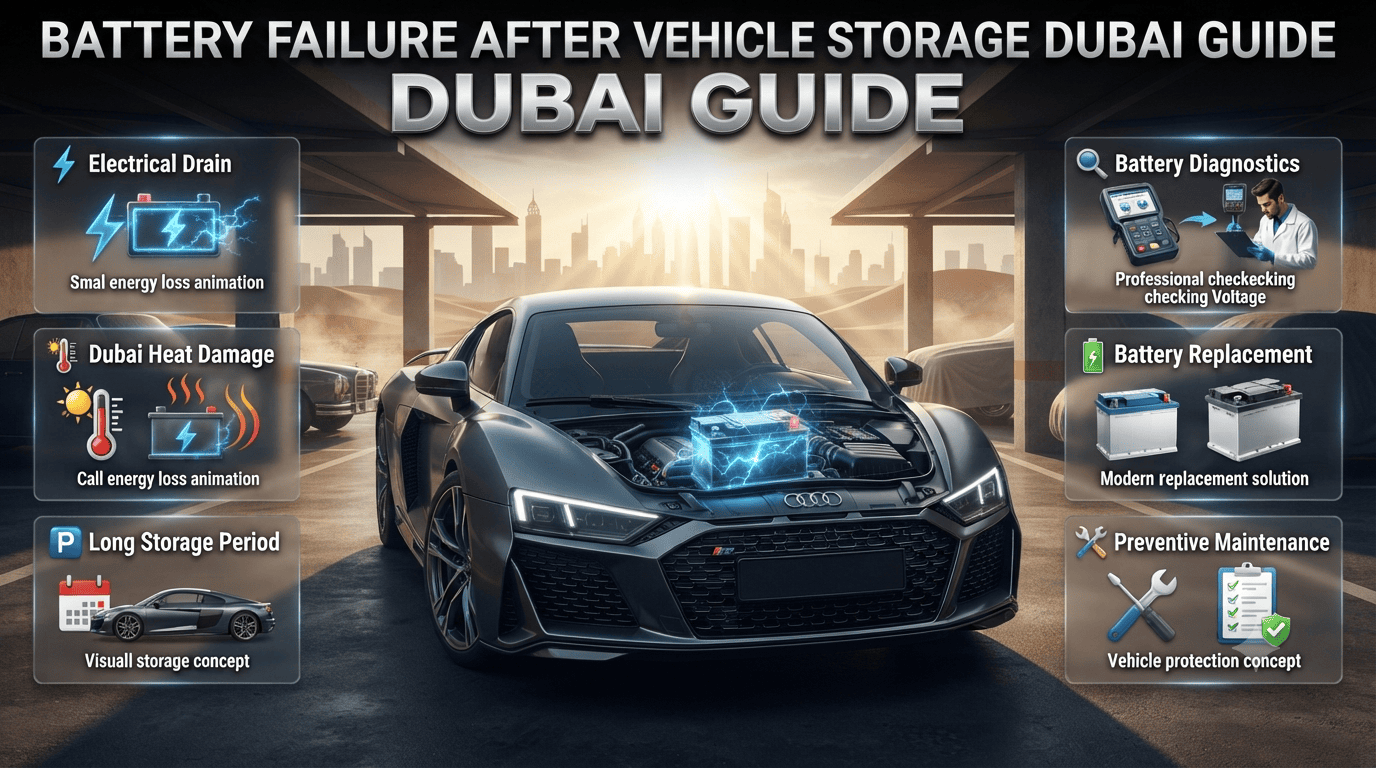
Battery Failure After Vehicle Storage Dubai A vehicle that remains parked for an extended period can develop several mechanical and electrical issues, but battery failure after vehicle storage in Dubai is one of the most common problems faced by car owners. Many drivers assume that a parked vehicle is not consuming power, yet modern cars continue using electrical energy even when the engine is switched off. Security systems, electronic control modules, keyless entry systems, alarms, tracking devices, and memory functions constantly require a small amount of electricity.
Dubai’s extreme climate makes this situation more challenging. High temperatures, intense sunlight exposure, and long parking periods can accelerate battery deterioration. A battery that may perform normally before storage can become completely discharged or permanently damaged after only a few weeks or months of inactivity.
Whether you own a daily commuter, luxury vehicle, SUV, sports car, or company fleet vehicle, proper storage preparation is essential for avoiding unexpected breakdowns. Professional services such as EuroSwift Auto Services help vehicle owners identify battery issues through proper diagnostics, safe jumpstart procedures, and professional Battery Replacement solutions when recovery is no longer possible.
Modern vehicle maintenance is moving toward preventive care rather than emergency repairs. Checking battery health, monitoring voltage levels, inspecting electrical systems, and following correct storage procedures can significantly improve vehicle reliability.
This guide explains why batteries fail during storage, the warning signs, professional diagnosis methods, and the best solutions for Dubai drivers.
Why Does Battery Failure Happen After Vehicle Storage in Dubai?
A car battery does not fail only because a vehicle is being driven. In many cases, extended parking creates conditions where the battery slowly loses charge until it can no longer start the engine.
When a vehicle is stored, the alternator is not operating because the engine is inactive. Therefore, the battery depends entirely on its stored energy capacity. If electrical consumption continues for weeks or months, the battery voltage gradually drops.
Dubai conditions create additional stress because heat affects the chemical reactions inside the battery. Higher temperatures increase internal corrosion, accelerate fluid evaporation in traditional batteries, and shorten overall battery lifespan.
Several factors contribute to storage-related battery failure:
| Cause | How It Affects The Battery | Risk Level |
|---|---|---|
| Long parking duration | Battery slowly loses charge through natural discharge | High |
| Extreme Dubai heat | Accelerates chemical deterioration | Very High |
| Security systems | Creates continuous electrical drain | Medium |
| Dash cameras and accessories | Causes parasitic battery drain | High |
| Old battery condition | Reduced ability to hold charge | Very High |
| Short trips before storage | Battery may not be fully charged | Medium |
| Poor terminal condition | Creates resistance and charging problems | Medium |
How Dubai Climate Accelerates Battery Problems During Storage
Dubai’s environment creates unique challenges for automotive batteries. Unlike colder regions where batteries often fail because of freezing temperatures, UAE vehicles commonly experience heat-related battery degradation.
Temperatures inside parked vehicles can become significantly higher than outside temperatures. When a vehicle remains exposed to direct sunlight for extended periods, the battery experiences additional thermal stress.
High temperatures affect batteries in several ways:
1. Faster Internal Chemical Breakdown
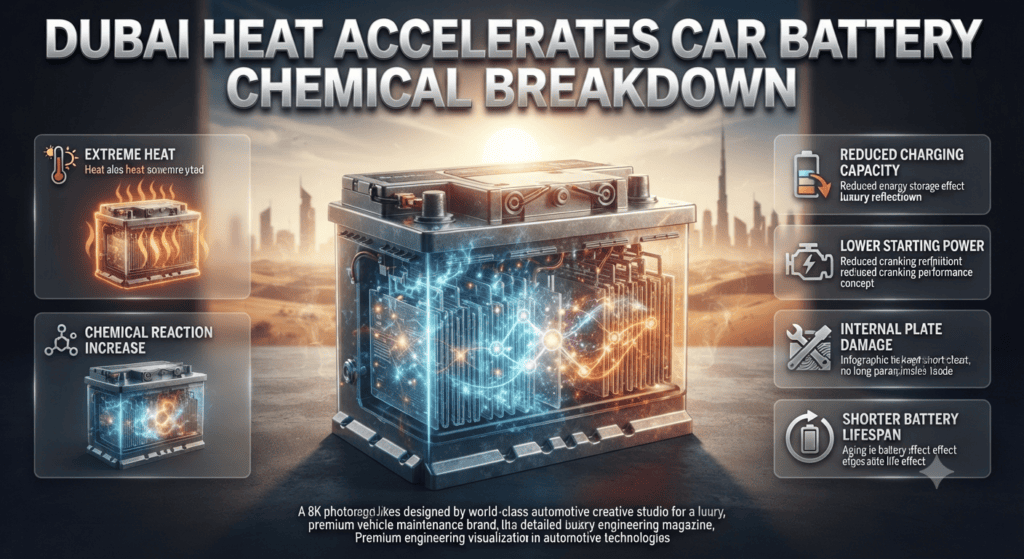
A battery relies on chemical reactions between lead plates and electrolyte fluid. Excessive heat increases these reactions, causing faster aging of internal components.
Over time, this can result in:
- Reduced charging capacity
- Lower cold cranking power
- Internal plate damage
- Shorter battery lifespan
2. Increased Electrolyte Loss
Traditional flooded batteries may lose electrolyte through evaporation during extreme heat conditions. Reduced fluid levels expose internal plates, causing permanent damage.
3. Faster Self-Discharge
Every battery naturally loses charge over time. Heat increases this self-discharge rate, meaning a parked vehicle in Dubai can lose usable battery power faster compared with a vehicle stored in a cooler environment.
Professional Recommendation
For vehicles stored in Dubai for extended periods, battery selection matters. Premium options such as AGM Battery technology provide improved resistance against vibration, heat stress, and electrical demands compared with conventional batteries.
Vehicle owners with luxury cars and high-electronic-load vehicles often benefit from advanced battery solutions because modern systems require stable voltage even when parked.
How Long Can a Car Sit Before the Battery Dies in Dubai?
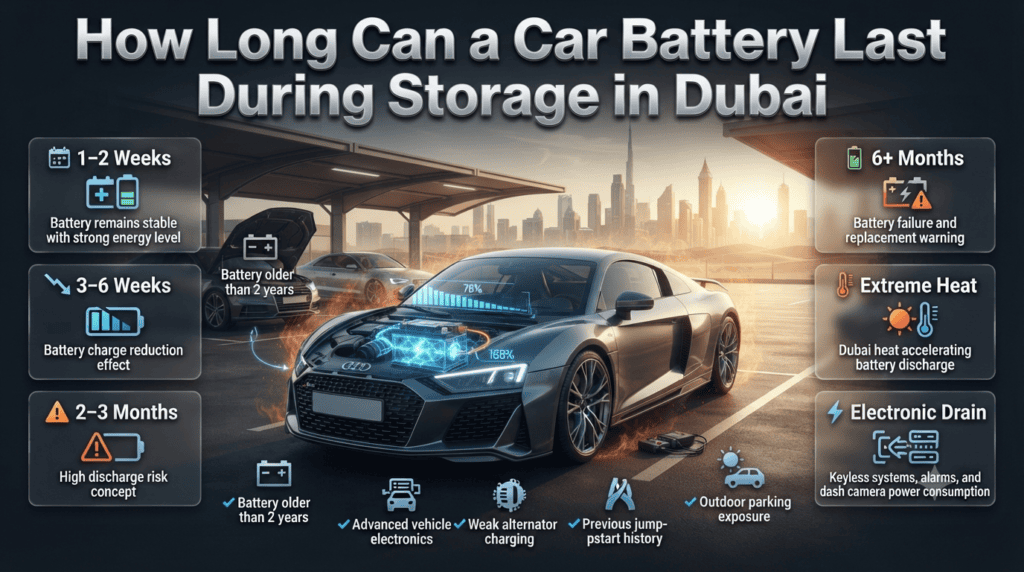
The exact duration depends on battery age, vehicle electronics, weather conditions, and battery condition before storage.
A healthy battery may start a vehicle after several weeks of inactivity, while an older battery may fail within days.
| Storage Period | Possible Battery Condition |
|---|---|
| 1–2 weeks | Usually safe if battery is healthy |
| 3–6 weeks | Battery charge may reduce significantly |
| 2–3 months | High chance of complete discharge |
| 6+ months | Battery damage is highly possible |
Factors that reduce storage survival time include:
✔ Battery older than two years
✔ Vehicle equipped with advanced electronics
✔ Dash cameras connected permanently
✔ Weak alternator charging before storage
✔ Previous jumpstart history
✔ Extreme outdoor parking conditions
A vehicle that already had a weak battery before storage will usually experience complete failure much sooner.
Common Vehicles Affected by Battery Failure After Storage
Although any vehicle can experience battery discharge, some categories are more vulnerable.
Luxury Vehicles
Premium vehicles contain advanced electronic systems, including:
- Multiple control modules
- Keyless entry systems
- Security systems
- Comfort electronics
- Electronic suspension systems
- Memory functions
These features improve driving experience but increase standby electrical consumption.
Luxury owners often require specialized Luxury Car Service because incorrect battery installation can create electronic faults.
Modern SUVs and Family Vehicles
Large SUVs typically have:
- Bigger engines
- More electronic equipment
- Automatic tailgates
- Advanced infotainment systems
- Driver assistance technology
These systems require reliable battery performance.
Rental and Fleet Vehicles
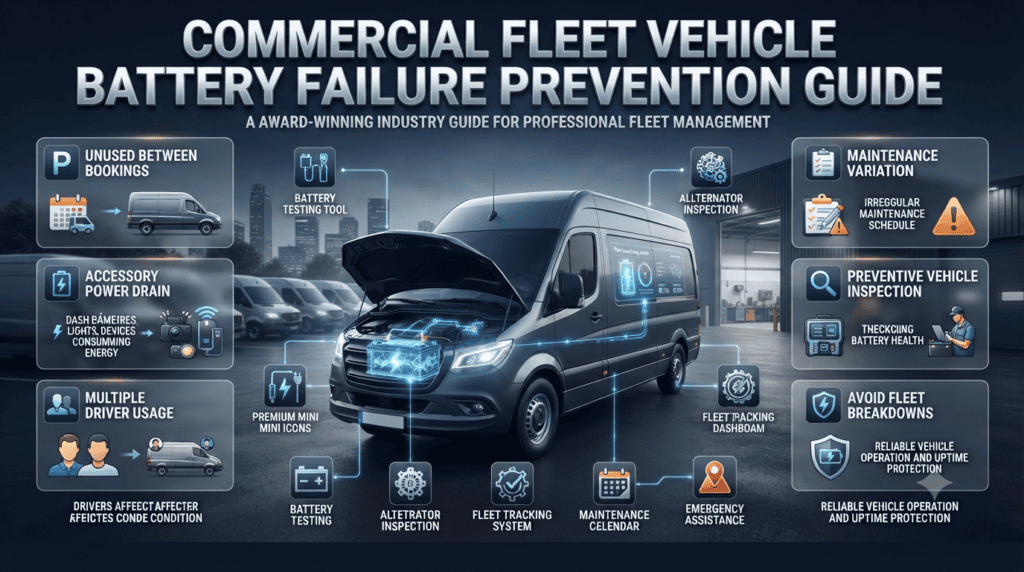
Commercial vehicles often experience battery problems because:
- Vehicles may sit unused between bookings
- Multiple drivers may leave accessories running
- Maintenance schedules can vary
Fleet operators commonly use preventive Vehicle Inspection programs to detect weak batteries before breakdowns occur.
Signs Your Vehicle Battery Has Failed After Storage
A completely dead battery is not always the first warning sign. Many vehicles show symptoms before complete failure occurs.
Recognizing early signs can prevent emergency situations.
| Warning Sign | Possible Battery Issue |
|---|---|
| Slow engine cranking | Reduced battery power |
| Clicking sound during startup | Insufficient voltage |
| Dashboard warning lights | Low system voltage |
| Remote key not working | Weak battery output |
| Interior lights dimming | Battery discharge |
| Electronic features malfunctioning | Voltage instability |
| Complete electrical failure | Fully discharged battery |
Professional Battery Diagnosis After Long-Term Vehicle Storage
Jumpstarting a vehicle may restore temporary operation, but it does not identify the actual cause of failure.
A professional diagnosis checks whether the battery can still hold charge or whether replacement is required.
At EuroSwift Auto Services, a proper battery inspection generally involves multiple testing stages:
Battery Voltage Test
Technicians measure resting voltage to determine the current charge condition.
Typical readings:
| Voltage Reading | Battery Condition |
|---|---|
| 12.6V–12.8V | Healthy fully charged battery |
| 12.4V | Partially discharged |
| 12.0V–12.2V | Weak battery condition |
| Below 12V | Deep discharge risk |
Battery Load Test
A load test evaluates whether the battery can deliver sufficient starting power under realistic conditions.
This helps identify:
- Weak internal cells
- Reduced capacity
- Starting failure risks
Alternator Output Check
Sometimes the battery is not the only problem. A weak alternator may fail to recharge the battery after the vehicle starts.
Professional technicians inspect:
- Charging voltage
- Alternator performance
- Electrical connections
Parasitic Drain Testing
If a new battery repeatedly dies after storage, hidden electrical consumption may be responsible.
Common sources include:
- Aftermarket alarms
- Dash cameras
- Tracking systems
- Faulty control modules
- Interior lights remaining active
Expert Insight: Why Jumpstarting Alone Is Not Always The Solution
Many drivers assume that a jumpstart completely fixes a storage-related battery problem. In reality, jumpstarting only provides enough power to start the engine.
If the battery has suffered deep discharge, internal damage may already exist.
After a jumpstart, the vehicle should undergo:
✔ Battery health testing
✔ Alternator inspection
✔ Charging system evaluation
✔ Terminal inspection
✔ Electrical drain testing
For emergency situations, professional Car Jumpstart and Roadside Assistance services provide safer solutions compared with repeated DIY attempts.
Recovery, Replacement, Prevention & Expert Solutions
Can a Stored Car Battery Be Recovered or Does It Need Replacement?
After a vehicle has been parked for several weeks or months, the first question most owners ask is whether the battery can be recharged or if a complete replacement is required.
The answer depends on the battery’s condition before storage, how deeply it discharged, its age, and whether internal damage has occurred.
A battery that has only lost charge may recover through controlled charging. However, a battery that has experienced deep discharge, sulphation, plate damage, or internal failure usually cannot provide reliable performance even after charging.
Professional evaluation from EuroSwift Auto Services helps determine whether recovery is practical or whether a new Battery Replacement is the safer long-term solution.
Battery Recovery vs Battery Replacement After Storage
Understanding the difference between charging and replacement prevents unnecessary expenses and repeated breakdowns.
| Situation | Recommended Solution | Expected Result |
|---|---|---|
| Battery discharged but recently purchased | Professional charging | Battery may recover |
| Battery below 2 years with good test results | Recharge and monitor | Possible continued use |
| Battery older than 2–3 years | Replacement recommended | Better reliability |
| Battery has swelling or leakage | Immediate replacement | Safety improvement |
| Battery repeatedly fails after charging | Replace battery | Prevent future breakdown |
| Internal cell damage detected | Replacement required | Permanent solution |
Professional Battery Inspection Process After Vehicle Storage
A professional technician does not immediately replace a battery without diagnosis. A complete inspection identifies the actual cause of failure.
A proper storage recovery inspection includes several stages.
Step 1: Visual Battery Inspection
The first step is checking the physical condition of the battery.
Technicians inspect:
✔ Battery case condition
✔ Swelling or cracks
✔ Terminal corrosion
✔ Loose connections
✔ Leakage signs
✔ Manufacturing date
Physical damage usually indicates that charging alone will not restore reliable operation.
Step 2: Battery Voltage and Capacity Testing
Voltage testing shows the current charge level, but capacity testing provides a clearer picture of battery health.
A battery may display acceptable voltage but still fail when starting the engine because it cannot deliver sufficient current.
Professional testing evaluates:
- State of charge
- State of health
- Cold Cranking Amps (CCA)
- Internal resistance
Step 3: Charging System Diagnosis
A healthy battery requires a healthy charging system.
After storage, technicians inspect the alternator because a failing alternator can create repeated battery failures.
A complete Engine Diagnostics check can identify:
- Alternator output problems
- Electrical faults
- Charging irregularities
- Control module errors
Why Deep Discharge Damages Car Batteries
Many drivers believe a dead battery can always be restored with a charger. This is not always true.
When a lead-acid battery remains discharged for a long time, chemical changes occur inside the battery.
Sulphation Problem
During discharge, sulphate crystals form on battery plates. If the battery remains empty for an extended period, these crystals become harder and reduce battery efficiency.
Effects include:
- Lower charging capacity
- Reduced starting power
- Shorter battery lifespan
- Repeated failures
Internal Plate Damage
Long-term discharge can damage the internal plates, preventing the battery from storing energy properly.
At this stage, replacement becomes more economical than repeated charging attempts.
Choosing the Right Battery After Storage Failure in Dubai
Replacing a failed battery is not simply about selecting the cheapest option. The correct battery must match:
- Vehicle specifications
- Engine size
- Electrical demand
- Climate conditions
- Driving habits
Dubai vehicles often require batteries designed for high-temperature environments.
Best Battery Technologies for Dubai Vehicles
AGM Batteries
Absorbent Glass Mat (AGM) batteries are commonly used in premium vehicles because they provide:
✔ Better vibration resistance
✔ Higher electrical stability
✔ Improved performance for start-stop systems
✔ Strong support for modern electronics
For luxury vehicles and high-electrical-demand cars, an AGM Battery is often the preferred option.
Amaron Battery
Amaron Battery options are popular among Dubai drivers because they are designed for durability and strong starting performance.
They are commonly selected for:
- Daily commuter vehicles
- SUVs
- Family cars
- Vehicles operating in hot climates
Bosch Battery
Bosch Battery solutions are widely used for vehicles requiring dependable performance and advanced engineering standards.
Suitable applications include:
- European vehicles
- Premium sedans
- High-performance cars
Exide Battery
Exide Battery products provide reliable starting power and are available for various vehicle categories.
They are commonly considered for:
- Passenger cars
- SUVs
- Commercial vehicles
Battery Installation After Long-Term Vehicle Storage
Battery installation requires more than simply disconnecting the old unit and connecting a new one.
Modern vehicles contain sensitive electronic systems that require careful handling.
Professional installation includes:
Safe Battery Removal
Technicians carefully disconnect terminals to prevent:
- Electrical spikes
- ECU issues
- Memory loss problems
Correct Battery Matching
The replacement battery must match:
| Requirement | Importance |
|---|---|
| Battery size | Ensures correct installation |
| CCA rating | Provides starting power |
| Amp-hour capacity | Supports electrical systems |
| Battery technology | Matches vehicle requirements |
Battery Registration and ECU Reset
Many modern luxury vehicles require battery registration after replacement.
This allows the vehicle computer system to correctly manage:
- Charging cycles
- Battery condition monitoring
- Energy management
Incorrect installation can cause premature battery wear.
Common Mistakes Vehicle Owners Make After Storage
Many battery failures happen because owners follow incorrect recovery methods.
Mistake 1: Repeated Jumpstarting
Repeated jumpstarts may temporarily start the vehicle but can hide a failing battery.
Better approach:
✔ Test battery health
✔ Check charging system
✔ Replace weak batteries early
Mistake 2: Driving Only Short Distances After Jumpstart
A short drive may not fully recharge a deeply discharged battery.
The alternator is designed mainly to maintain battery charge, not always restore a completely empty battery.
Mistake 3: Ignoring Battery Age
A battery close to the end of its lifespan has a higher failure risk after storage.
Professional recommendation:
Replace aging batteries proactively instead of waiting for complete failure.
Battery Replacement Cost Factors After Storage in Dubai
The final cost depends on multiple factors:
| Cost Factor | Impact |
|---|---|
| Vehicle model | Luxury vehicles usually require specialized batteries |
| Battery technology | AGM costs more than standard batteries |
| Battery brand | Premium brands have higher pricing |
| Installation requirements | Coding or registration may affect cost |
| Emergency service location | Mobile assistance may vary |
For updated information about battery pricing, vehicle owners can review the detailed Battery Price Guide.
Professional Recommendation: Preparing a Vehicle Before Storage
The best battery repair is prevention. Before leaving a vehicle unused, owners should prepare the electrical system properly.
Storage Preparation Checklist
✔ Fully charge the battery before parking
✔ Clean battery terminals
✔ Inspect battery age
✔ Disconnect unnecessary accessories
✔ Avoid leaving dash cameras connected
✔ Park in covered areas when possible
✔ Check tire pressure
✔ Perform basic vehicle inspection
A complete Vehicle Inspection before long-term parking helps identify existing problems before they become expensive repairs.
Future Automotive Battery Trends for Stored Vehicles
Automotive battery technology is changing rapidly. New vehicles increasingly use smarter energy management systems that monitor battery condition automatically.
Future improvements include:
- Advanced lithium auxiliary batteries
- Smart battery monitoring systems
- Remote vehicle health tracking
- Improved thermal management
- AI-based maintenance predictions
These technologies will help reduce unexpected battery failures and improve vehicle reliability.
How long can a car battery be kept in storage?
A car battery can typically remain stored for several weeks to a few months, but the exact duration depends on the battery condition, storage temperature, vehicle electronics, and whether the battery is disconnected or maintained.
For a normal vehicle parked without a battery maintainer:
Storage Period
Expected Battery Condition
1–3 weeks
Usually safe if the battery is healthy
1–2 months
Battery charge may reduce significantly
3–6 months
High possibility of deep discharge
6+ months
Risk of permanent battery damage increases
In Dubai, storage periods can be shorter because high temperatures accelerate battery self-discharge and internal degradation. A battery that survives several months in a mild climate may fail sooner when exposed to extreme heat.
For long-term storage, professional recommendations include:
✔ Fully charge the battery before parking
✔ Disconnect unnecessary electrical accessories
✔ Use a battery maintainer when possible
✔ Inspect battery terminals before storage
✔ Perform a battery health check before returning the vehicle to service
A weak battery before storage is unlikely to recover after months of inactivity. In many cases, professional Battery Replacement becomes the more reliable solution.
What happens if a smart storage battery fails?
A smart storage battery system usually refers to vehicles equipped with advanced battery monitoring, intelligent charging systems, or smart storage features that manage electrical consumption during parking.
When this type of battery fails, several problems can occur:
1. Vehicle Electronics May Stop Working
Modern vehicles depend on stable battery voltage for:
Keyless entry
Alarm systems
Electronic control modules
Infotainment memory
Remote connectivity features
A weak battery can cause unusual electrical behavior before complete failure.
2. The Vehicle May Enter Power-Saving Mode
Some smart vehicles automatically reduce electrical activity when battery voltage becomes low. Owners may notice:
Disabled comfort features
Warning messages
Reduced electronic functions
3. Battery Management System Errors
Advanced vehicles may require battery testing, coding, or registration after replacement. Installing the wrong battery without proper configuration can affect charging performance.
For luxury and modern vehicles, professional Engine Diagnostics and Vehicle Inspection are recommended before replacing components.
Is it okay to keep a 12V battery in a storage container if outside temperatures are in the 90s?
A 12V battery can be stored in a container when outside temperatures are around 90°F (approximately 32°C), but proper conditions are important.
Heat is one of the biggest causes of battery aging. Even when the outside temperature is 90°F, a closed storage container exposed to sunlight can become significantly hotter.
A hot storage environment can cause:
Faster self-discharge
Electrolyte evaporation in traditional batteries
Increased internal corrosion
Reduced battery lifespan
Best Storage Conditions for a 12V Battery
Condition
Recommendation
Temperature
Cool, stable environment preferred
Location
Shaded and ventilated area
Battery charge
Fully charged before storage
Terminals
Clean and protected
Maintenance
Periodic voltage checks
For Dubai conditions, avoid leaving batteries inside enclosed areas that trap heat, especially during summer months.
How to fix car battery failure?
The correct solution depends on why the battery failed. A dead battery is not always a simple charging issue.
Step 1: Check Battery Condition
Inspect:
✔ Battery age
✔ Physical damage
✔ Corrosion on terminals
✔ Swelling or leakage
✔ Loose connections
If the battery case is damaged, replacement is usually required.
Step 2: Perform a Battery Test
A professional battery test checks:
Voltage level
Charging capacity
Cold Cranking Amps (CCA)
Internal resistance
A battery may show voltage but still fail when starting the engine.
Step 3: Recharge If Battery Is Recoverable
A recently discharged battery may recover through controlled charging.
However, batteries that remain completely discharged for a long period may suffer permanent internal damage.
Step 4: Check the Charging System
If a battery repeatedly fails, the problem may not be the battery itself.
Technicians should inspect:
Alternator output
Electrical connections
Parasitic drain
Vehicle control modules
Step 5: Replace the Battery When Necessary
Battery replacement is recommended when:
Battery is older than its expected service life
It fails load testing
It cannot hold charge
It repeatedly requires jumpstarts
For Dubai vehicles, selecting the correct battery type is important because extreme heat and high electrical loads require reliable performance.
Options may include:
AGM Battery for luxury and high-electrical-demand vehicles
Amaron Battery for reliable daily-use vehicles
Bosch Battery for premium European applications
Professional services such as EuroSwift Auto Services can diagnose whether the issue requires charging, repair, or complete battery replacement.
Conclusion: Preventing Battery Failure After Vehicle Storage in Dubai
Battery failure after vehicle storage in Dubai is a common issue, but it is largely preventable with proper preparation, regular inspection, and the right maintenance approach. A parked vehicle does not stop consuming electrical power. Modern security systems, electronic modules, and smart vehicle features continue drawing energy, while Dubai’s extreme heat accelerates battery aging and charge loss.
Before storing any vehicle for an extended period, owners should ensure the battery is fully charged, terminals are clean, electrical accessories are disconnected, and the vehicle is stored in the safest possible environment. Regular battery testing, alternator checks, and professional Vehicle Inspection can identify weaknesses before they become unexpected breakdowns.
When a battery fails after storage, the correct solution depends on its condition. Some batteries can be recovered through controlled charging, while deeply discharged or damaged batteries require professional Battery Replacement. Choosing the correct battery technology, such as AGM solutions for high-performance vehicles or premium batteries designed for hot climates, improves reliability and long-term performance.
Professional automotive support from EuroSwift Auto Services helps vehicle owners receive accurate diagnostics, safe installation, and dependable roadside solutions when problems occur.
As automotive technology continues advancing, smart battery monitoring systems, improved energy management, and next-generation battery designs will make vehicle storage safer and more predictable. However, preventive maintenance will remain the most effective way to protect your vehicle, avoid emergency breakdowns, and maintain reliable performance in Dubai’s demanding driving environment.

Leave a Reply