
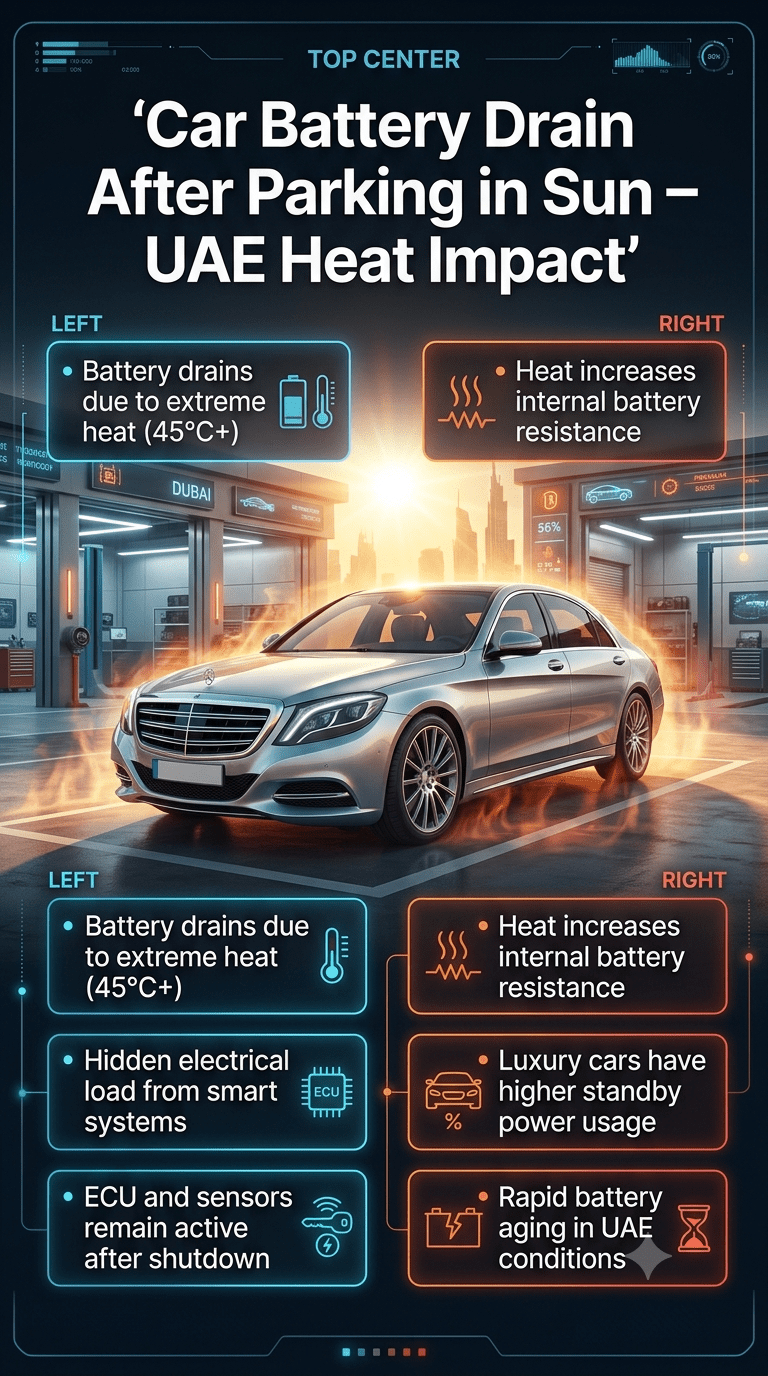
A vehicle battery draining after being parked under direct sunlight is one of the most frequent breakdown complaints in UAE conditions, especially in Dubai’s extreme heat environment. What looks like a sudden failure is usually a combination of thermal stress, hidden electrical load, and accelerated battery aging caused by high ambient temperatures often exceeding 45°C in summer parking situations.
Luxury vehicles like BMW, Mercedes-Benz, Audi, Porsche, Lexus, Range Rover, and even Toyota or Nissan models are equally affected because modern electrical systems continuously draw power even when the ignition is off.
Dubai Heat Impact on Battery Drain After Parking
In UAE workshop environments, technicians consistently observe a pattern: vehicles parked for just a few hours in open sun often return with weak cranking or complete battery failure.
The core issue is not just heat exposure—it is heat soak combined with electrical parasitic consumption.
Key real-world effects seen in Dubai garages:
- Battery electrolyte evaporation in non-sealed units
- Rapid voltage drop after heat soak
- ECU and telematics modules staying partially active
- Cabin heat increasing under-hood temperature further
- Alternator recovery delay after restart attempts
Luxury SUVs like Range Rover and Mercedes GLE show faster degradation because of high standby electronics load.
Why Battery Drains After Parking in Sun
The failure mechanism typically follows a predictable chain seen in UAE workshop diagnostics:
- Heat accelerates chemical reaction inside the battery
- Internal resistance increases sharply
- Voltage drops even when vehicle is off
- Control modules remain partially active (keyless entry, tracking, sensors)
- Battery cannot recover after restart cycle
In vehicles like Tesla and other EV-related hybrid systems, battery management systems (BMS) actively protect components, but prolonged heat exposure still reduces efficiency over time.
Common Symptoms Observed in UAE Workshops
Technicians in Dubai mobile service units report these frequent symptoms:
- Slow engine crank after parking in sun
- Dashboard warning lights after ignition
- Central locking delay or malfunction
- Infotainment system rebooting randomly
- Complete no-start after 2–4 hours parking
- Clicking sound when turning ignition
These symptoms are more severe in vehicles with AGM or EFB batteries when they are already near end-of-life.
Diagnostic Process Used by Technicians
Professional roadside units and garages in Dubai typically follow this diagnostic workflow:
- Battery voltage test (resting and under load)
- Alternator output check after restart
- Parasitic drain measurement using ammeter
- ECU sleep mode verification
- Heat stress inspection of battery casing
- Terminal corrosion and grounding check
In premium vehicles like BMW 5 Series and Audi Q7, diagnostic scanners are also used to check control module wake cycles that may prevent full sleep mode.
Battery Types and Heat Sensitivity in UAE
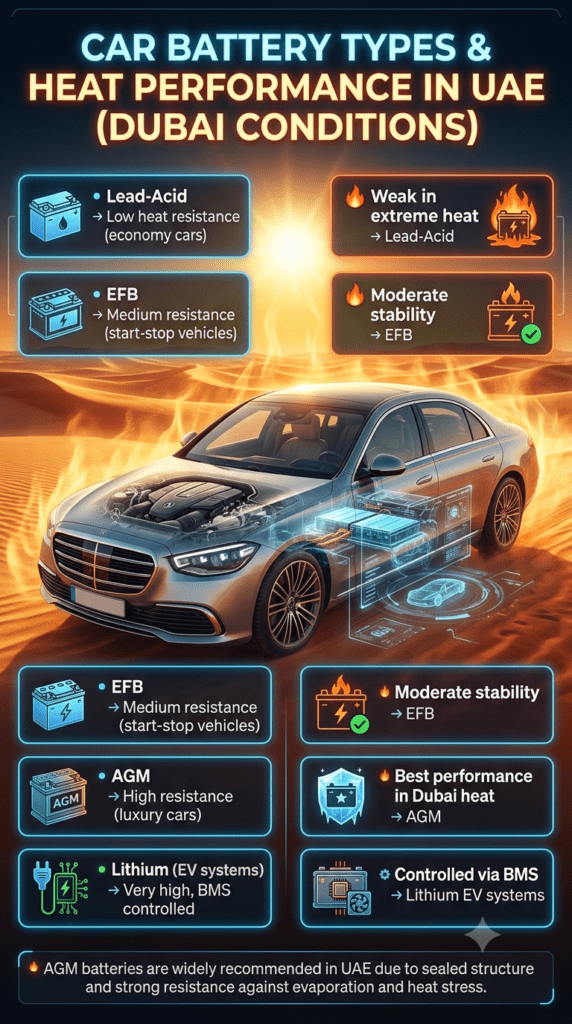
| Battery Type | Heat Resistance | Common Use | UAE Performance |
|---|---|---|---|
| Lead-Acid | Low | Economy cars | Weak in extreme heat |
| EFB | Medium | Start-stop vehicles | Moderate stability |
| AGM | High | Luxury vehicles | Best performance in Dubai heat |
| Lithium (EV systems) | Very High | EVs / hybrids | Controlled via BMS |
AGM batteries are widely recommended in UAE conditions due to their sealed structure and resistance to evaporation.
Pricing & Replacement Packages in Dubai
Battery replacement costs vary depending on vehicle class and battery technology.
| Battery Type | Price Range (AED) | Vehicle Segment | Warranty |
|---|---|---|---|
| Lead-Acid | 250 – 450 | Economy cars | 6–12 months |
| EFB | 400 – 650 | Mid-range vehicles | 12–18 months |
| AGM | 600 – 1200 | Luxury vehicles | 18–24 months |
| Premium Brands | 500 – 1300 | All segments | 12–24 months |
For fast mobile service, customers often rely on premium installation providers such as EuroSwift Auto Services offering doorstep replacement across Dubai and nearby Emirates.
Battery Failure Scenarios in UAE Parking Conditions
Mall Parking Scenario
Vehicles parked for shopping trips often face rapid battery drain due to:
- Interior heat buildup under closed parking zones
- Continuous alarm and sensor standby
- Frequent short trips without full recharge cycle
Airport Long-Term Parking
Long-term parking at Dubai Airport often results in:
- Deep discharge due to inactivity
- ECU memory drain
- Battery sulfation in lead-acid units
Residential Outdoor Parking
Common issues include:
- Direct sun exposure throughout the day
- Alternator not compensating for repeated short drives
- Accelerated AGM degradation
Maintenance Practices for Heat-Related Battery Drain
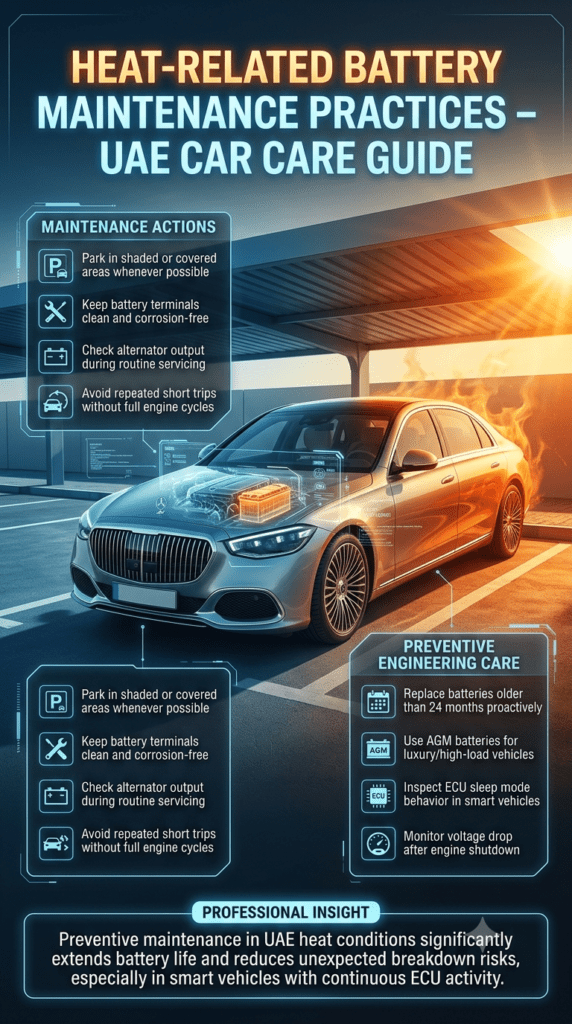
- Park in shaded or covered areas whenever possible
- Ensure battery terminals remain clean and corrosion-free
- Check alternator output during routine servicing
- Avoid repeated short trips without full engine cycles
- Replace batteries older than 24 months proactively
- Use AGM batteries for luxury and high-load vehicles
- Inspect ECU sleep mode behavior in smart vehicles
- Monitor voltage drop after engine shutdown
Expert Workshop Recommendations (UAE Conditions)
Experienced technicians in Dubai consistently recommend:
- Upgrade to AGM battery for BMW, Mercedes, Audi, Porsche
- Avoid low-quality imported batteries without heat rating certification
- Perform parasitic drain test before replacing battery
- Check software updates in smart vehicles affecting power management
- Inspect grounding points during every replacement service
Brands commonly used in UAE workshop installations include:
Service Ecosystem for Fast Battery Replacement in Dubai
Modern UAE roadside service networks prioritize:
- 15–30 minute mobile installation response
- On-site battery testing before replacement
- ECU memory support during swap
- Warranty-backed installation
- Heat-rated battery selection based on vehicle profile
For full service coverage, drivers rely on EuroSwift Auto Services Dubai for immediate battery diagnosis and replacement at home, office, or roadside.
Final Expert Insight
Battery drain after parking in sun is not a random failure—it is a predictable heat-induced electrical and chemical imbalance accelerated by UAE climate conditions. Vehicles operating in Dubai require higher-grade battery technology, proper diagnostic handling, and preventive maintenance discipline to avoid sudden no-start situations in extreme heat environments.
ECU Power Drain and Smart Vehicle Standby Consumption in UAE Heat
Modern vehicles in Dubai are no longer “fully off” when parked. In workshop diagnostics, one of the most overlooked causes of battery drain after sun exposure is ECU standby consumption that increases in high-temperature environments.
When ambient heat rises, control modules behave differently:
- Keyless entry systems remain in frequent wake cycles
- Telematics modules maintain network connectivity
- Security systems increase sensor polling frequency
- Comfort control units delay full sleep mode
- Infotainment memory retention stays partially active
In vehicles like Mercedes S-Class, BMW 7 Series, and Audi A8, technicians often measure higher parasitic draw during hot afternoons compared to nighttime readings. The system does not fail instantly—it slowly pulls the battery below safe cranking voltage while the car is parked.
EV-adjacent platforms like Tesla and hybrid Lexus models manage this better through battery management systems, but even they show increased energy buffering during extreme heat soak conditions.
Alternator Recovery Issues After Heat Soak
A major real-world observation in UAE workshops is delayed alternator stabilization after heat-soaked restarts.
When a vehicle is restarted after being parked in sun:
- Alternator initially struggles to stabilize output voltage
- Heat-expanded internal components reduce charging efficiency
- Belt resistance increases due to thermal expansion
- Battery demands higher immediate current than alternator can supply
This is especially visible in turbocharged vehicles like Porsche Cayenne and Range Rover Sport, where electrical load spikes occur at startup due to fuel systems, cooling fans, and ECU initialization.
Technicians often mistake this as “battery failure,” but in many cases the battery is already weakened and the alternator is temporarily unable to recover it fast enough.
Real Workshop Observations from Dubai Service Vans
Mobile battery technicians in Dubai report consistent patterns during summer months:
- 60–70% of “dead battery” calls occur after midday sun exposure
- Vehicles parked in uncovered residential zones fail faster than mall parking
- German luxury vehicles show higher parasitic drain sensitivity
- Start-stop systems degrade faster in stop-and-go traffic + heat combination
- Batteries under 18 months old can still fail prematurely if heat cycling is severe
One important trend observed is that customers often replace batteries without diagnosing parasitic drain, leading to repeat failures within weeks.
Common Misdiagnosis Cases in UAE Conditions
Many battery failures after sun exposure are incorrectly diagnosed. In reality, technicians frequently find:
- Faulty door control modules staying awake
- Aftermarket alarm systems causing continuous drain
- Dashcams hardwired without cutoff relay
- Weak grounding points increasing resistance under heat
- Software bugs in infotainment systems preventing sleep mode
This is why experienced garages in Dubai always perform a full parasitic drain test before confirming battery replacement.
Heat-Affected Vehicle Categories in Dubai
Certain vehicle categories are more vulnerable due to electrical architecture complexity:
Luxury Sedans (BMW, Mercedes, Audi)
- High module count increases standby load
- Comfort systems remain active longer
- Soft-close doors and sensors consume standby current
SUVs (Range Rover, Lexus, Porsche Cayenne)
- Dual battery loads in some configurations
- Higher cooling system activation cycles
- Larger infotainment and air suspension systems
Economy Vehicles (Toyota, Nissan)
- Lower battery capacity makes them sensitive to heat loss
- Older models lack advanced sleep management systems
Charging System Stress in Extreme Temperatures
UAE heat does not only affect the battery—it also stresses the entire charging system:
- Voltage regulators operate at higher thermal load
- Wiring resistance increases with engine bay heat
- Ground connections weaken due to expansion and contraction cycles
- Fuse box temperature affects current stability
Over time, this creates a mismatch between energy generation and consumption, especially in vehicles used for short daily commutes in hot conditions.
Preventive Engineering Adjustments Used in UAE Workshops
Experienced technicians in Dubai often recommend practical upgrades based on vehicle usage:
- Heat-resistant AGM battery upgrade for premium vehicles
- ECU sleep mode recalibration (when supported by manufacturer tools)
- Installation of intelligent cutoff relays for aftermarket devices
- Thermal insulation wraps for battery compartments in select SUVs
- Periodic alternator load testing every 6–12 months
For premium-grade replacements, users often choose trusted installations through Bosch Battery Dubai Service or upgrade to heavy-duty systems via AGM Battery Solutions UAE depending on vehicle load requirements.
Heat Cycle Damage Pattern (UAE Driving Reality)
A typical failure pattern seen in Dubai follows this cycle:
- Morning start in cool condition
- Midday parking under direct sun
- Interior and engine bay heat accumulation
- ECU enters unstable standby behavior
- Battery voltage slowly drops
- Evening restart failure or weak crank
Repeated daily exposure accelerates sulfation in lead-acid batteries and reduces AGM lifecycle even under normal usage mileage.
Technical Insight from Field Diagnostics
Technicians often summarize the issue in one line:
“Heat doesn’t kill the battery instantly—it breaks its ability to recover charge after every parking cycle.”
This is why vehicles that are driven frequently but parked in extreme heat still experience sudden failure, even when the alternator and battery appear healthy during routine checks.
What happens if you leave a battery out in the sun?
Leaving a car battery exposed to direct sunlight—especially in UAE conditions—accelerates internal chemical breakdown. The real damage comes from sustained heat, not just sunlight itself.
In workshop conditions across Dubai, technicians commonly observe:
Electrolyte evaporation in non-sealed lead-acid batteries
Internal plate corrosion speeding up
Plastic casing expansion and micro-cracks over time
Increased internal resistance leading to weak cranking
Permanent capacity loss after repeated heat exposure
In extreme cases, a battery that would normally last 2–3 years can degrade in under 12–18 months if the vehicle is regularly parked in open sun without protection or proper battery grade selection.
How long does a premium battery last?
Battery life in UAE is significantly shorter than in temperate climates due to constant heat stress and high electrical load.
Typical real-world lifespan in Dubai conditions:
Economy lead-acid batteries: 1.5 – 2.5 years
EFB batteries: 2 – 3 years
Premium AGM batteries: 2.5 – 4 years (under proper usage)
High-end OEM-grade batteries (BMW/Mercedes spec AGM): up to 4–5 years in controlled conditions
However, workshop data shows that driving style matters as much as brand:
Short trips + sun parking = faster degradation
Long highway usage = better charging recovery
Stop-start traffic + heat = maximum stress cycle
Premium batteries last longer, but they are still highly sensitive to repeated heat soak cycles.
Why does the sun drain my battery?
Sunlight itself does not directly “drain” a battery—but heat created by sun exposure triggers multiple electrical and chemical effects that reduce usable charge.
In Dubai conditions, the process works like this:
Cabin and engine bay temperatures rise rapidly after parking
Battery temperature increases beyond optimal operating range
Internal resistance inside the battery increases
Voltage stability drops even when the car is off
Modern ECUs and sensors remain partially active
Small parasitic loads continuously pull energy
This combination creates the illusion of “sun draining the battery,” but the real issue is heat-driven self-discharge combined with standby electrical consumption.
Luxury vehicles like BMW, Mercedes-Benz, and Range Rover are more affected due to high electronic standby loads.
Does parking your car in sun give you a battery warning?
Yes—frequent parking in direct sun can trigger battery warnings, especially in modern smart vehicles.
In UAE workshop diagnostics, common warning patterns include:
“Battery Charge Low” warning after ignition
Start-stop system disabled message
Electrical system malfunction alerts
Infotainment reset or lag on startup
Keyless entry reduced range warnings
This usually happens when:
Battery voltage drops below ECU threshold after heat soak
Battery cannot recover fast enough after short drives
Alternator output is temporarily insufficient after restart
Parasitic drain is higher than normal due to heat-affected modules
In premium cars like Audi A6, BMW 5 Series, and Mercedes E-Class, even a healthy battery can trigger a warning if it is exposed to extreme heat parking repeatedly.
A single warning is not always battery failure—but repeated warnings after sun exposure are a strong indicator that the battery is losing capacity and needs testing or replacement.
Conclusion
Battery drain after parking in the sun is a direct outcome of UAE’s extreme heat environment combined with modern vehicle electrical demand. It is not a random failure but a predictable condition where high temperatures accelerate internal battery wear, increase electrical resistance, and expose hidden parasitic loads inside smart vehicle systems.
In real Dubai workshop scenarios, the pattern is consistent: vehicles parked under direct sunlight repeatedly show reduced cranking power, delayed starts, and sudden warning messages—even when the battery appears “fine” during casual inspection. Premium vehicles such as BMW, Mercedes-Benz, Audi, Porsche, and Range Rover are especially sensitive because of their continuous electronic standby systems.
The key takeaway from field diagnostics is simple: heat does not instantly kill a battery—it shortens its recovery life cycle after every parking event. Once that recovery ability weakens, warnings, slow starts, and breakdowns become inevitable.
Reliable prevention comes down to three practical decisions: using heat-rated AGM or premium batteries, reducing direct sun exposure where possible, and ensuring proper diagnostic testing before replacement. In UAE conditions, these steps are the difference between a stable daily drive and unexpected roadside failure.
Leave a Reply