
Introduction
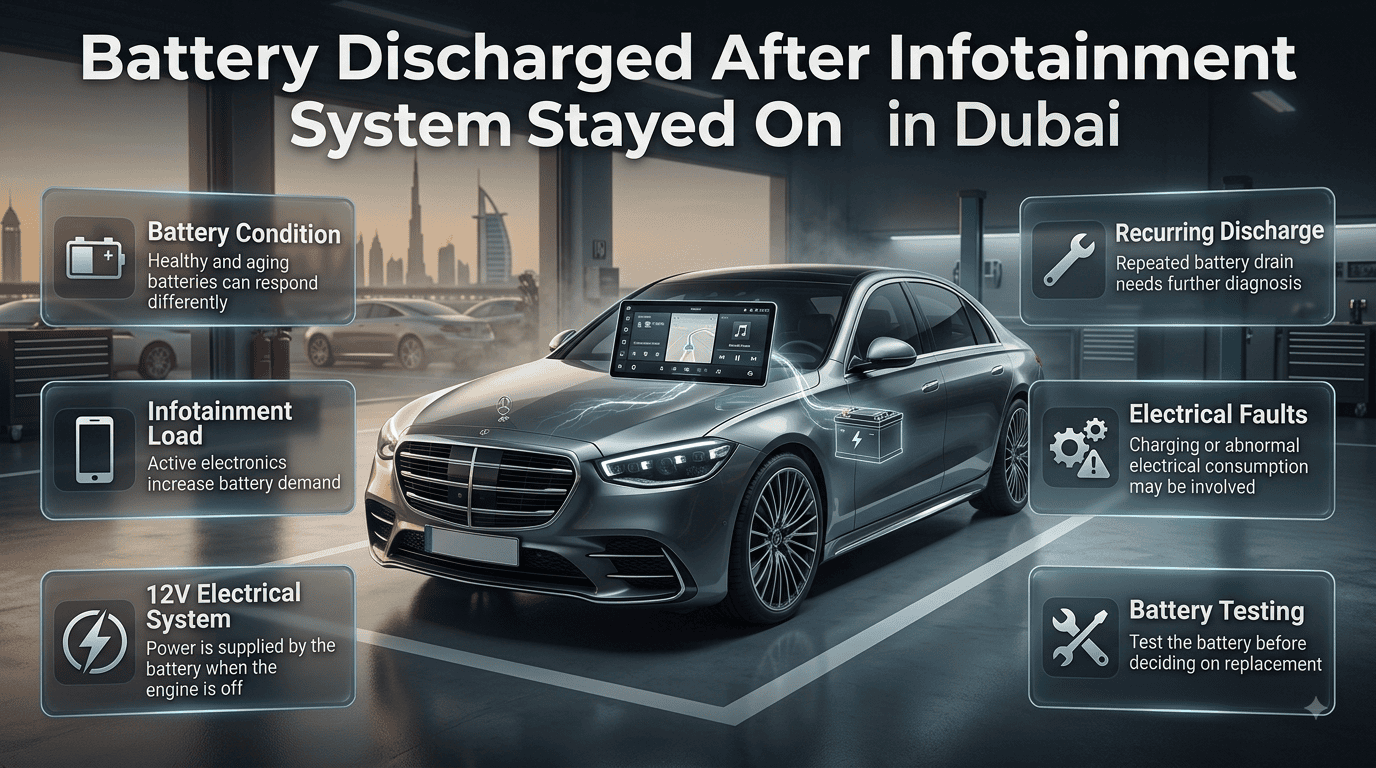
Battery Discharged After Infotainment System Stayed On in Dubai | A battery discharged after the infotainment system stayed on in Dubai can happen when the radio, central display, navigation, Bluetooth system, USB accessories, or other electronics continue operating after the engine has been switched off. Modern vehicles contain considerably more electronics than older cars, so an accessory that remains active can place additional demand on the 12V battery.
The outcome depends heavily on the battery’s condition. A healthy battery may tolerate an accidental discharge better than an older battery with reduced capacity. If the vehicle repeatedly becomes difficult to start after being parked, however, the infotainment system may only be part of the story. A charging-system fault, abnormal electrical consumption, aftermarket equipment, or a module that fails to enter its normal low-power state may also be involved.
For Dubai drivers, understanding the difference between a one-time accidental discharge and a recurring electrical problem is important. The right response may be recharging and testing the battery, investigating electrical consumption, or arranging professional Car Battery Replacement when testing shows that the battery is no longer reliable.
1. Can an Infotainment System Drain a Car Battery?
Yes, an infotainment system can contribute to battery discharge when it continues operating while the engine is off.
The system may include much more than a radio. Depending on the vehicle, it can involve a touchscreen, amplifier, navigation, Bluetooth connectivity, USB ports, cameras, communication functions, and other electronic modules.
When the engine is running, the alternator supplies electrical energy and helps maintain battery charge. Once the engine is switched off, the battery becomes the available source for electrical equipment that remains active.
The important distinction is that infotainment-related battery discharge does not automatically mean the battery is defective.
A useful way to look at the situation is:
| Situation | What It Can Mean |
|---|---|
| Infotainment left on once | Battery may simply be discharged |
| Old battery + infotainment left on | Higher chance of a no-start |
| Infotainment repeatedly stays active | Possible electrical or software issue |
| Battery repeatedly dies after parking | Possible abnormal electrical consumption |
| Battery fails after proper testing | Replacement may be required |
The vehicle’s design also matters because different manufacturers use different power-management strategies.
2. Why Does the Battery Discharge Faster When the Engine Is Off?
The alternator normally provides much of the vehicle’s electrical power while the engine is operating.
When the engine stops, the alternator stops producing its normal charging output. Electrical systems that remain active then draw energy from the battery.
This is why using electrical accessories while parked can eventually leave insufficient energy for the starter motor.
The situation becomes more significant when several loads operate together. For example, the infotainment system may remain active while a phone is connected, an amplifier is operating, a dashcam is recording, and other vehicle modules remain awake.
That combined demand can be much more significant than the driver realizes.
3. Why Dubai Conditions Matter
Dubai’s hot environment can make battery condition especially important.
High temperatures can accelerate battery aging, meaning a battery that has already spent considerable time operating in a hot environment may have less reserve capacity than a newer battery.
This creates an important difference between two otherwise identical vehicles.
A relatively healthy battery may recover from an accidental accessory discharge without developing an obvious problem.
An aging battery may become too weak to provide dependable starting power after the same event.
This is one reason professional Battery Replacement in Dubai should be based on testing and vehicle requirements rather than simply assuming that every discharged battery needs replacement. EuroSwift’s battery service information also emphasizes checking the battery and alternator before deciding whether replacement is actually necessary.
4. Why Did the Infotainment System Stay On?
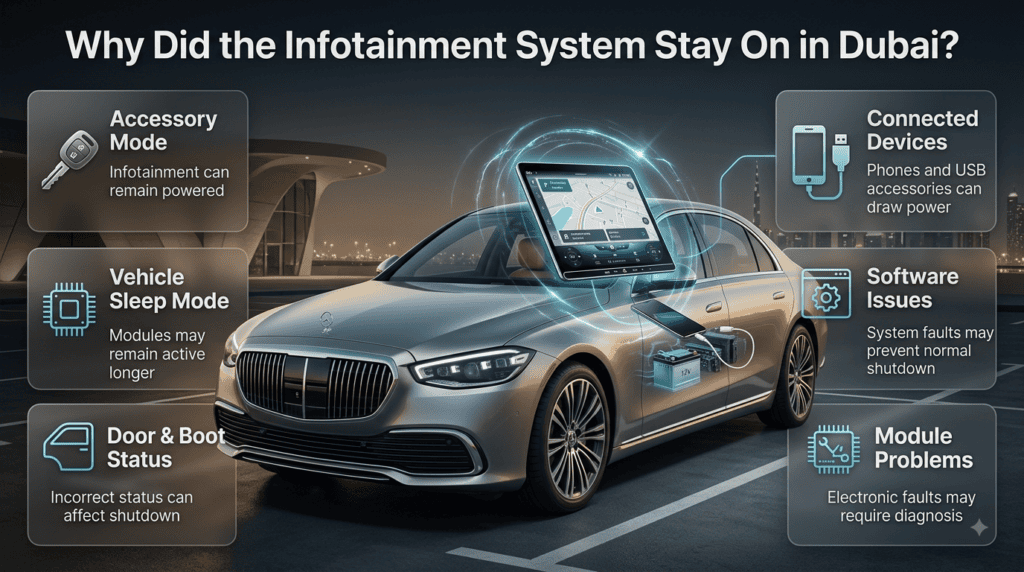
There are several possible explanations, and the cause can vary by vehicle.
Accessory Mode Remained Active
Some vehicles allow the driver to use infotainment functions without running the engine.
If the vehicle remains in an accessory or ignition mode, the infotainment system may continue receiving power.
The Vehicle Did Not Fully Shut Down
Modern cars contain numerous electronic control units. After the vehicle is switched off, some systems remain active temporarily before entering a low-power state.
If a module remains awake longer than expected, electrical consumption can continue.
Door or Boot Status
Vehicle electronics use switches and sensors to determine whether doors and other access points are closed.
An incorrect status signal can sometimes prevent normal shutdown behavior.
Connected Devices
Phones, USB accessories, dashcams, and aftermarket electronics can contribute to battery consumption while parked.
Software or Module Problems
If the infotainment system repeatedly refuses to shut down correctly, the issue may involve software, wiring, communication between modules, or another electronic component.
At that point, repeatedly replacing batteries is unlikely to be the best solution.
5. What Is Normal Electrical Consumption After Parking?
A modern vehicle does not necessarily consume absolutely zero electricity after it is locked.
Some systems need limited power for functions such as security, memory, communication, alarms, and other vehicle features.
The concern is excessive or prolonged electrical consumption.
The vehicle should normally transition toward a much lower-power state after shutdown. Research into automotive electronic networks also shows why modern vehicles have sleep and wake-up states for electronic control units.
If a vehicle repeatedly remains electrically active and the battery becomes discharged, professional diagnosis is more appropriate than assuming the infotainment system is simply “using too much power.”
6. Signs That the Battery Is Already Weak
An infotainment-related discharge can expose a battery that was already approaching the end of its useful service life.
Pay attention to warning signs such as:
- Slower engine cranking
- Difficulty starting after short parking periods
- Repeated jumpstart requirements
- Flickering or unusual electrical behavior
- Battery warning indications
- Battery becoming discharged again soon after charging
- Noticeable decline in starting performance
A battery that repeatedly fails after being recharged deserves proper testing.
The question is not simply “Did the infotainment system drain it?”
The more useful question is:
“Why did the battery have insufficient reserve capacity to recover from the event?”
7. Battery Discharged Overnight: What Should You Check?
If you return to the vehicle and discover that the battery is discharged, start by identifying what happened before immediately purchasing another battery.
Consider:
- Was the infotainment system left running?
- Were USB devices connected?
- Was a dashcam operating?
- Were interior lights left on?
- Was the vehicle properly closed and locked?
- Was the battery already showing slow-starting symptoms?
- Has the vehicle experienced a similar problem before?
These questions help separate a one-time user mistake from a recurring electrical problem.
If this is the first occurrence and the battery previously performed normally, the battery may simply require proper recharging and testing.
If it happens repeatedly, further diagnosis becomes much more important.
8. What to Do If the Car Will Not Start
When the battery is too weak to start the engine, a professional Car Jumpstart can provide temporary assistance.
However, a jumpstart should not automatically be treated as the final repair.
Once the vehicle starts, the battery and charging system should be evaluated if there is any reason to suspect a recurring problem.
A jumpstart can restore temporary starting ability, but it cannot by itself tell you whether:
- The battery has lost capacity
- The alternator is charging correctly
- An electrical system is consuming excessive power
- The infotainment system is failing to shut down
- An aftermarket accessory is contributing to the drain
This distinction is particularly important when the same problem happens more than once.
9. Jumpstart vs Battery Replacement
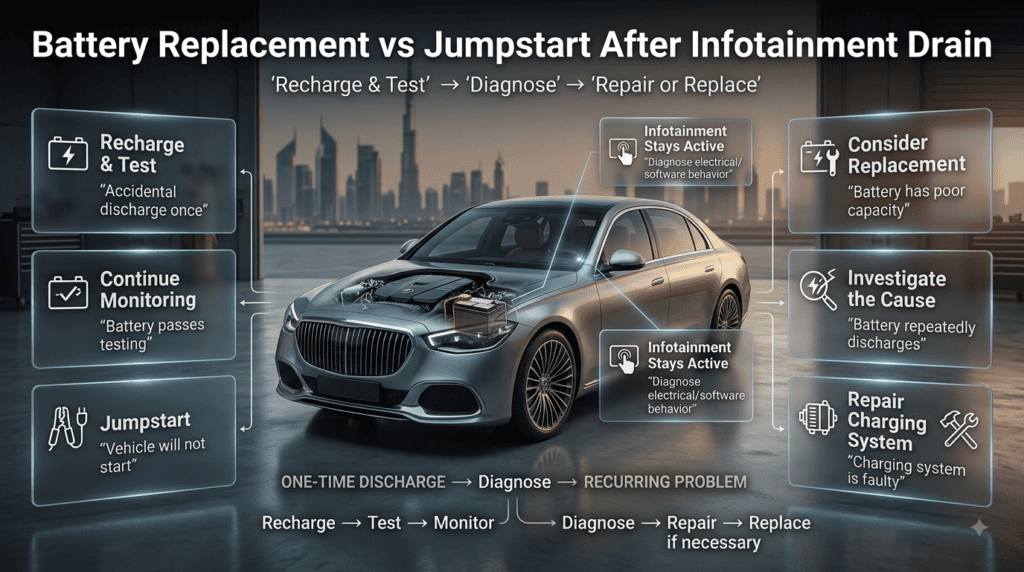
The two services solve different problems.
| Situation | Appropriate Direction |
|---|---|
| Battery accidentally discharged once | Recharge and test |
| Battery passes testing | Continue monitoring |
| Battery has poor capacity | Consider replacement |
| Battery repeatedly discharges | Investigate the cause |
| Infotainment remains active | Diagnose electrical/software behavior |
| Charging system is faulty | Repair charging system |
| Vehicle will not start | Jumpstart or roadside assistance |
Replacing the battery can be appropriate when testing confirms deterioration.
It is not necessarily appropriate simply because the battery became flat once.
10. How Professionals Diagnose the Problem
A proper inspection should consider the complete electrical system rather than focusing exclusively on the infotainment screen.
Battery Testing
The battery should be evaluated for its condition and starting capability.
Charging-System Testing
The alternator and charging system should be checked to determine whether the battery is being properly replenished while driving.
Electrical Consumption
If the battery repeatedly loses charge while parked, the vehicle may need testing for abnormal electrical consumption.
Sleep-State Assessment
The technician can determine whether the vehicle’s electronic systems eventually transition into their expected low-power condition.
Infotainment Inspection
If the infotainment system remains active when it should not, the system itself and its related components may need further diagnosis.
This approach helps avoid replacing a perfectly serviceable battery while leaving the actual cause unresolved.
11. Parasitic Drain: When the Infotainment Is Not the Only Problem
A parasitic drain occurs when electrical equipment continues consuming more power than expected while the vehicle is parked.
A small amount of standby consumption can be normal in modern vehicles. Excessive consumption is the concern.
Possible sources include:
- Infotainment modules
- Audio amplifiers
- Dashcams
- GPS equipment
- Aftermarket stereos
- USB accessories
- Alarm systems
- Lighting circuits
- Faulty switches
- Electronic control modules
A hardwired dashcam, for example, can continue drawing power while parked depending on how it is installed and configured.
Therefore, if your battery keeps dying even when you remember to switch the infotainment system off, the investigation should expand beyond the infotainment system.
12. Why Repeated Battery Discharge Should Not Be Ignored
A battery that becomes discharged repeatedly can indicate a deeper problem.
Consider the difference between these two situations:
Situation A:
The radio was accidentally left on once, the battery was recharged, and the vehicle has operated normally since.
Situation B:
The vehicle was fully switched off, yet the battery continues becoming weak after parking.
Situation A may be an isolated incident.
Situation B deserves investigation.
Repeated battery failure can point toward battery deterioration, charging-system problems, excessive electrical consumption, or electronic modules that are not entering their normal low-power state.
13. How to Prevent Infotainment-Related Battery Drain
A simple shutdown routine can reduce the risk.
Before Leaving the Vehicle
✔ Switch the ignition completely off.
✔ Confirm the infotainment display shuts down.
✔ Disconnect unnecessary USB accessories.
✔ Check that interior lights are off.
✔ Make sure the doors and boot are properly closed.
✔ Lock the vehicle normally.
✔ Look for unusual lights or electronic activity after locking.
For vehicles with different accessory modes, follow the manufacturer’s shutdown procedure rather than assuming every model operates in exactly the same way.
14. Battery Maintenance for Dubai Drivers
Battery reliability depends on more than avoiding accidental infotainment use.
Drivers should periodically pay attention to starting performance and investigate changes before the vehicle becomes completely immobilized.
A practical maintenance approach includes:
| Area | What to Monitor |
|---|---|
| Starting | Slower cranking |
| Battery | Condition and capacity |
| Terminals | Corrosion or poor connections |
| Alternator | Proper charging |
| Infotainment | Normal shutdown |
| Accessories | Unnecessary parked loads |
| Parking | Long periods without driving |
| Warning lights | Electrical or battery warnings |
When replacement is genuinely required, the correct battery specification should be selected for the vehicle.
15. Choosing the Correct Replacement Battery
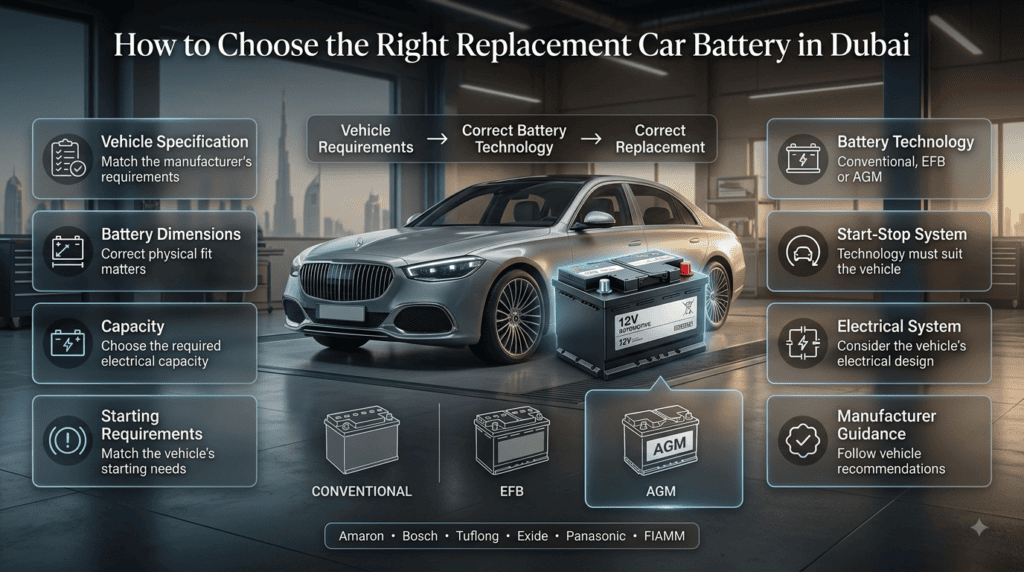
A discharged battery does not automatically require the same replacement battery that another vehicle uses.
Battery selection should consider:
- Vehicle manufacturer specification
- Battery dimensions
- Capacity
- Starting requirements
- Battery technology
- Start-stop requirements
- Electrical system design
- Manufacturer recommendations
Depending on the vehicle, drivers may need conventional, EFB, or AGM technology.
If a replacement is necessary, options such as Amaron Battery, Bosch Battery, Tuflong Battery, Exide Battery, Panasonic Battery, and FIAMM Battery may be considered where they match the vehicle’s requirements.
For vehicles that specifically require AGM technology, an appropriate AGM Battery should be selected rather than choosing a battery based only on brand or price.
16. Does a Discharged Battery Need to Be Replaced?
Not necessarily.
A battery can become discharged without being permanently unusable.
The decision should depend on its condition after proper charging and testing.
Replacement becomes more likely when:
- The battery has poor capacity.
- Starting performance remains weak.
- The battery repeatedly loses charge.
- Testing indicates deterioration.
- The battery is already significantly aged.
- The vehicle requires more reliable starting performance.
Replacement may not be necessary when:
- The battery is relatively healthy.
- The discharge was clearly caused by an isolated event.
- The battery performs normally after proper charging.
- Testing confirms adequate condition.
This is why professional testing is more useful than replacing a battery based solely on one discharge event.
17. How Much Does Battery Replacement Cost in Dubai?
There is no single price for every vehicle.
The final cost can depend on battery technology, capacity, brand, vehicle requirements, installation, warranty, and whether additional diagnosis is required.
| Cost Factor | Why It Matters |
|---|---|
| Battery technology | AGM/EFB and conventional batteries differ |
| Capacity | Larger requirements can increase cost |
| Brand | Different manufacturers have different pricing |
| Vehicle | Some vehicles require specialized batteries |
| Installation | Professional installation adds service value |
| Diagnostics | Recurring drain may require additional testing |
| Warranty | Longer coverage can affect the overall package |
Drivers comparing replacement costs can review the Car Battery Prices in Dubai 2026 guide to understand the major factors affecting battery pricing.
18. Common Mistakes After an Infotainment-Related Discharge
Repeatedly Jumpstarting the Car
A jumpstart can restore temporary mobility, but repeatedly relying on it without diagnosis can leave the original problem unresolved.
Immediately Buying a New Battery
A battery that was simply discharged may still be serviceable.
Ignoring Slow Starting
If the vehicle had been starting slowly before the infotainment incident, the battery may already have been deteriorating.
Forgetting Connected Accessories
USB equipment, dashcams, chargers, and aftermarket electronics can contribute to parked electrical consumption.
Assuming Every Vehicle Shuts Down the Same Way
Different vehicles have different power-management systems.
Ignoring a Recurring Pattern
If the battery repeatedly becomes discharged, the pattern itself is evidence that further investigation is needed.
19. Professional Recommendation for Dubai Drivers
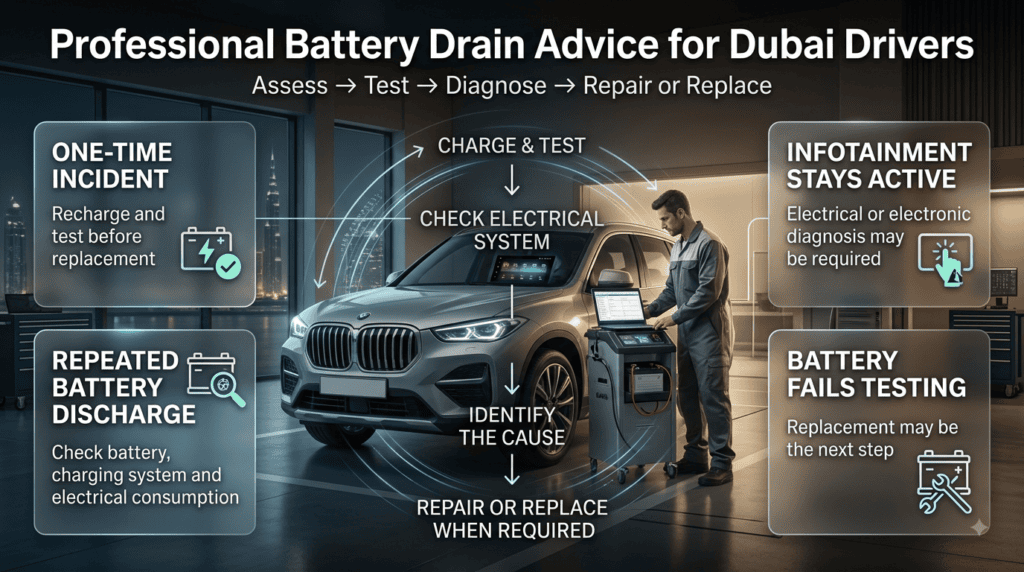
The most sensible approach is to classify the incident.
One-time incident
If the infotainment system was accidentally left on once and the vehicle has otherwise behaved normally, recharge and test the battery before deciding on replacement.
Repeated battery discharge
If the vehicle keeps losing battery power after parking, investigate the battery, charging system, and electrical consumption.
Infotainment repeatedly stays active
If the screen, audio system, or related electronics repeatedly remain active after shutdown, the vehicle may require electrical or electronic diagnosis.
Battery fails testing
If the battery cannot maintain adequate starting performance after proper charging, replacement becomes the logical next step.
EuroSwift’s published battery service information describes a process that includes checking the existing battery and alternator before replacement, helping distinguish a battery problem from another electrical issue.
20. Practical Prevention Checklist
Before Parking
✔ Turn off the engine completely.
✔ Confirm the infotainment system has shut down.
✔ Disconnect unnecessary USB accessories.
✔ Check interior lighting.
✔ Close doors and boot properly.
✔ Lock the vehicle normally.
Battery Maintenance
✔ Monitor starting performance.
✔ Check the battery when symptoms appear.
✔ Inspect battery terminals during routine maintenance.
✔ Check the charging system when repeated discharge occurs.
If the Problem Returns
✔ Do not assume the battery is automatically defective.
✔ Have the battery tested.
✔ Check charging-system performance.
✔ Investigate abnormal parked electrical consumption.
✔ Inspect infotainment shutdown behavior.
✔ Review aftermarket electronic accessories.
21. Modern Infotainment and Vehicle Electrical Systems
Today’s vehicles increasingly depend on interconnected electronic systems. Infotainment is no longer simply a radio; it can be integrated with navigation, communications, cameras, smartphone connectivity, voice controls, and vehicle information.
This increased integration makes electrical diagnosis more important.
A problem that appears to be “the battery died because the screen stayed on” may actually involve the interaction between the infotainment system, body-control electronics, connected devices, and battery-management strategy.
Modern automotive service therefore requires more than basic mechanical inspection. A capable Auto Workshop should be able to consider both mechanical and electrical causes when diagnosing repeated battery discharge.
Can leaving the infotainment system on drain a car battery overnight?
Yes, leaving the infotainment system operating while the engine is off can gradually use the battery’s stored electrical energy. Modern infotainment systems may power a touchscreen, audio equipment, navigation, Bluetooth connectivity, USB functions, amplifiers, and other electronics. The actual impact depends on the vehicle and the battery’s condition. AAA notes that modern vehicle accessories can draw battery power when the engine is not running, while the alternator normally provides charging power when the engine is operating.
A healthy battery and an aging battery can therefore react very differently to the same situation. If the battery was already weak, leaving the infotainment system active may simply be the event that finally leaves insufficient power for starting.
Key points:
The engine-off battery has limited stored energy.
Older or weakened batteries are more vulnerable.
Amplifiers and connected devices can increase electrical demand.
Modern vehicles may shut some systems down automatically, but behavior varies by model.
If the problem happens repeatedly, investigate the vehicle rather than blaming the infotainment system every time.
Why did my car battery die after the infotainment system stayed on in Dubai?
The infotainment system may have been the immediate reason for the discharge, but it may not be the complete explanation. Battery condition, the amount of electrical equipment operating, the time the vehicle remained parked, and the vehicle’s power-management system all influence the result.
Dubai’s demanding climate also makes battery condition important. A battery that has already deteriorated may have considerably less reserve capacity than a newer, healthy battery. In that situation, an extended period of accessory use can expose an existing weakness.
If the vehicle normally starts strongly and this happened only once after the infotainment system was accidentally left active, the battery may simply need proper charging and testing. If it continues happening when the infotainment is switched off, the diagnosis should expand to possible electrical drain, charging problems, or battery deterioration.
What to look for:
Slow engine cranking before the incident
Battery becoming weak again soon after charging
Infotainment remaining active after the vehicle is locked
USB devices or aftermarket electronics staying powered
Repeated no-start situations after parking
Does a jumpstart fix a battery discharged by the infotainment system?
A jumpstart can get the vehicle running again when the battery does not have enough power to start the engine, but it should not automatically be considered the complete solution.
If the infotainment system was accidentally left on and the battery was otherwise healthy, the incident may be isolated. However, if the battery is old or repeatedly becomes discharged, simply jumpstarting it each time can leave the underlying problem unresolved.
The better approach after a recurring incident is to check the battery’s condition and the vehicle’s charging system. If the vehicle loses charge while parked even when everything appears switched off, an electrical-consumption problem may also need investigation. AAA identifies persistent accessory loads and other parasitic drains as possible causes of battery discharge.
Professional approach:
Use a jumpstart only to restore immediate starting ability.
Check battery condition afterward.
Check charging-system performance if necessary.
Investigate repeated parked battery drain.
Do not assume every discharged battery automatically needs replacement.
Should I replace my car battery after the infotainment system drained it?
Not necessarily. A battery becoming discharged does not automatically mean it has permanently failed.
The important question is whether the battery can still hold an appropriate charge and provide dependable starting performance after being properly recharged. If it passes testing and the incident was clearly caused by an isolated event, replacement may not be necessary.
Replacement becomes more reasonable when the battery has poor capacity, repeatedly loses charge, struggles to start the vehicle, or fails appropriate testing. This distinction is important because installing a new battery will not solve an underlying electrical drain if the vehicle continues consuming excessive power while parked.
Before replacing the battery, consider:
Battery condition
Starting performance
Charging-system operation
Battery age and service history
Whether the infotainment system shuts down normally
Any aftermarket electrical accessories
Whether the same discharge has happened before
This is why professional Battery Replacement should follow proper assessment rather than being based solely on one accidental discharge.
Why does my car battery keep dying even when the infotainment system is turned off?
If the battery continues becoming discharged after the infotainment system is switched off, there may be another source of electrical consumption. Modern vehicles normally continue using small amounts of power for systems such as security, memory, communications, and other electronic functions, but excessive consumption while parked can indicate a problem.
Possible causes can include aftermarket accessories, dashcams, USB equipment, lighting circuits, electronic modules, or a system that fails to enter its normal low-power state. A weak battery or charging-system problem can also produce repeated no-start symptoms.
This is the point where replacing batteries repeatedly becomes an expensive way of treating the symptom. A proper electrical diagnosis should identify whether the battery itself is weak or whether something in the vehicle is continuously consuming more power than expected.
Important checks include:
Battery health and capacity
Alternator and charging performance
Parked electrical consumption
Infotainment shutdown behavior
Aftermarket accessories
Interior and boot lighting
Electronic modules that may remain awake
Bottom line
For a battery discharged after the infotainment system stayed on in Dubai, the smartest approach is to distinguish between a one-time accidental discharge and a recurring electrical problem. One incident may only require proper charging and monitoring. Repeated discharge calls for battery, charging-system, and electrical diagnosis rather than repeated jumpstarts or automatic battery replacement.
Conclusion
A battery discharged after the infotainment system stayed on in Dubai is not always a sign that the battery needs immediate replacement. In many cases, leaving the radio, display, navigation, amplifier, or connected devices operating while the engine is off can consume enough stored power to leave the vehicle unable to start. However, the battery’s existing condition plays an equally important role. An older or weakened battery may be far less capable of recovering from prolonged electrical use.
For Dubai drivers, the right response is to look beyond the immediate no-start problem. If the incident happened once, proper charging and battery testing may be enough. If the battery repeatedly becomes discharged, the vehicle should also be checked for charging-system problems, excessive parked electrical consumption, aftermarket accessories, or an infotainment system that is failing to enter its normal low-power state.
Professional Battery Replacement, Car Jumpstart, Vehicle Inspection, and electrical diagnostics should therefore be based on the actual cause rather than guesswork. A reliable battery is important, but so is a properly functioning vehicle electrical system. By paying attention to unusual starting behavior and addressing repeated battery discharge early, Dubai drivers can reduce unexpected breakdowns and maintain better day-to-day vehicle reliability.
Leave a Reply