
Introduction
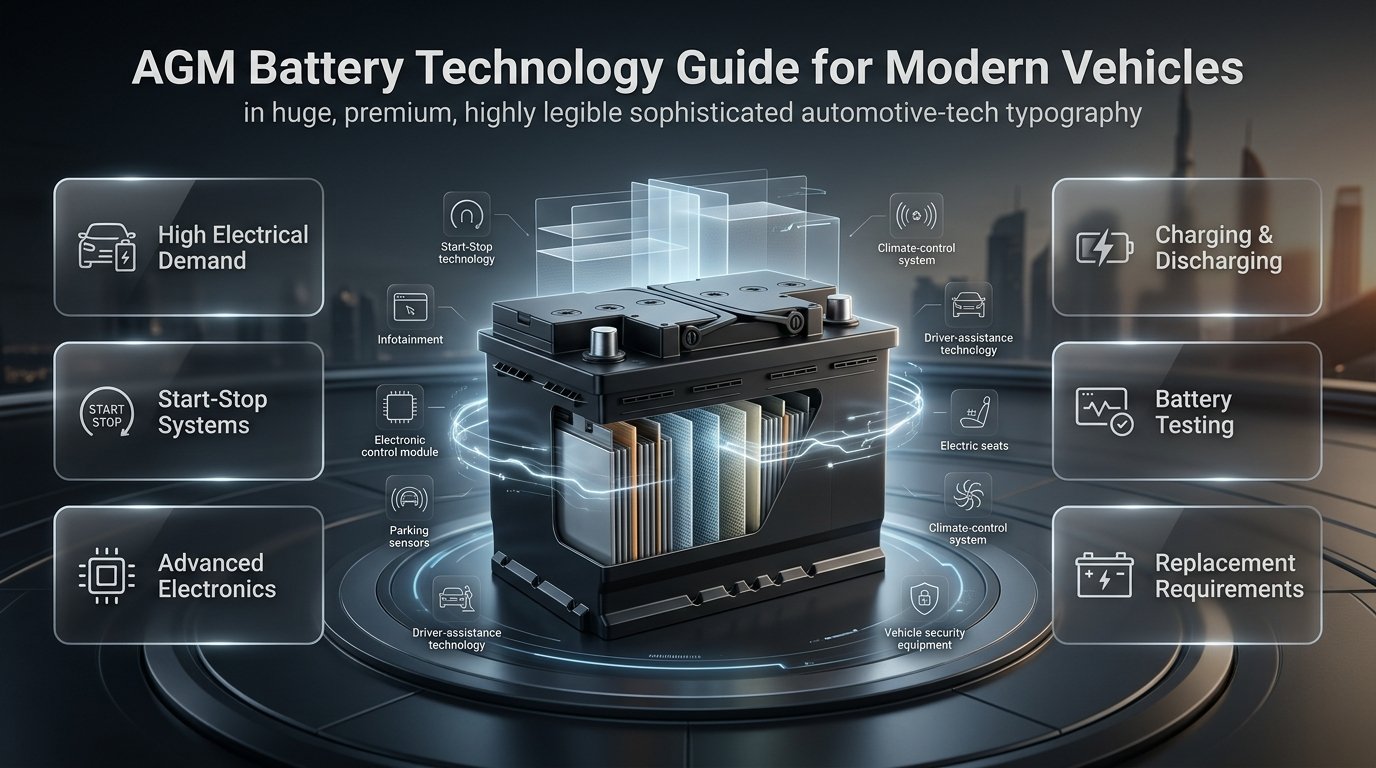
Modern vehicles depend on their batteries for far more than simply starting the engine. Today’s cars can contain start-stop systems, advanced infotainment, electronic control modules, parking sensors, driver-assistance technology, electric seats, powerful climate-control systems, security equipment, and dozens of other electronic components. All of these systems require a dependable electrical supply.
This is one reason AGM battery technology has become increasingly important in modern automotive applications.
AGM stands for Absorbent Glass Mat, a type of valve-regulated lead-acid battery technology in which the electrolyte is absorbed into specialized glass-fiber separators. Instead of allowing the electrolyte to move freely around the battery, the AGM structure keeps it closely associated with the plates. This design provides several advantages for vehicles that experience high electrical demand and frequent charging and discharging.
For drivers looking for professional battery and automotive support in Dubai, EuroSwift Auto Services provides access to automotive maintenance and battery-related services designed around modern vehicle requirements. Understanding how AGM batteries work can help you make better decisions about battery testing, charging, replacement, and preventive maintenance.
An AGM battery is not automatically the correct battery for every vehicle. The correct choice depends on the manufacturer’s specifications, electrical architecture, battery capacity, starting requirements, charging system, and energy-management technology.
This guide explains how AGM battery technology works, why manufacturers use it, how it differs from conventional batteries, how Dubai’s climate can affect battery performance, what happens during charging and starting, how AGM batteries are tested, when replacement may be necessary, and what drivers should know before installing a new battery.
What Is an AGM Battery?
An AGM battery is an advanced form of lead-acid automotive battery.
The letters AGM stand for Absorbent Glass Mat, referring to the special glass-fiber material positioned between the positive and negative plates.
The glass mat absorbs and retains the electrolyte, keeping the electrolyte closely connected with the active plate material.
This is different from a traditional flooded lead-acid battery, where liquid electrolyte is able to move more freely around the plates.
AGM batteries are also generally classified as VRLA batteries, or valve-regulated lead-acid batteries. Their internal construction allows gases produced during normal operation to be managed within a controlled system.
The basic AGM structure includes:
- Positive lead plates
- Negative lead plates
- Absorbent glass-fiber separators
- Electrolyte
- Battery terminals
- Pressure-regulating valves
- Protective battery casing
- Internal connections
The combination of these components allows an AGM battery to deliver high electrical current while also tolerating repeated cycling.
This makes the technology particularly useful in vehicles where battery demands go beyond a traditional engine-starting application.
How AGM Battery Technology Works
The fundamental chemistry of an AGM battery is still based on lead-acid electrochemistry.
The major difference is the way the electrolyte is contained and how the battery is physically constructed.
During discharge, the chemical energy stored inside the battery is converted into electrical energy. This electrical energy travels through the vehicle’s electrical system to power the starter, lights, control modules, accessories, and other electrical components.
When the vehicle’s charging system supplies electrical energy back to the battery, the electrochemical reaction is reversed and the battery stores energy again.
The AGM glass mat plays an important role because it keeps the electrolyte distributed throughout the separator material and closely associated with the plates.
A simplified operating cycle
Battery charged → engine starts → battery supplies electrical current → charging system restores energy → battery returns toward a higher state of charge.
The process happens continuously during normal vehicle operation.
However, modern vehicles make this process more complicated because the charging system may not operate at one fixed voltage all the time.
Intelligent charging systems can adjust charging behavior according to battery condition, electrical load, engine operation, temperature, and energy-management requirements.
What Is Inside an AGM Battery?
Understanding the internal components helps explain why AGM batteries behave differently from conventional flooded batteries.
Positive and Negative Plates
The plates are the main electrochemical components of the battery.
Their construction, surface area, thickness, and active materials influence the battery’s ability to deliver current and withstand repeated cycling.
Automotive AGM batteries are generally engineered to provide strong starting performance while also handling more demanding cycling conditions than a basic starter battery.
Absorbent Glass Mat Separators
The glass mat is the defining feature of AGM technology.
The separator is made from extremely fine glass fibers that can absorb and retain the battery’s electrolyte.
This arrangement keeps the electrolyte in close contact with the plates while leaving microscopic spaces that support controlled gas movement within the battery.
The electrolyte is therefore not simply sitting as a pool of free liquid.
Valve-Regulated Construction
AGM batteries use pressure-regulating valves.
These valves help maintain controlled internal pressure. Under normal operating conditions, the battery is designed to retain gases rather than continuously venting them like a conventional flooded battery.
This is one reason AGM batteries can be installed in applications where vibration resistance and controlled electrolyte retention are important.
Why AGM Technology Is Different From a Conventional Battery
A conventional flooded lead-acid battery uses free-flowing liquid electrolyte.
An AGM battery uses glass mats to absorb and retain that electrolyte.
This physical difference changes several characteristics of the battery.
| Feature | AGM Battery | Conventional Flooded Battery |
|---|---|---|
| Electrolyte | Absorbed into glass mat | Free liquid |
| Internal construction | Sealed/regulated design | Conventional flooded design |
| Vibration resistance | Generally high | Generally lower |
| Cycling ability | Strong for demanding applications | More limited depending on design |
| Starting capability | Strong | Depends on battery specification |
| Spill resistance | High under normal operation | Lower |
| Start-stop suitability | Commonly used | Application dependent |
| Charging requirements | More specific | Generally simpler |
| Maintenance | Low routine maintenance | Design dependent |
| Typical use | Modern/high-demand vehicles | Traditional applications |
This does not mean AGM is universally superior.
A vehicle should always use the battery technology specified or approved by the manufacturer.
Installing a battery with the wrong chemistry can create charging, performance, or durability problems.
Why Modern Cars Use AGM Batteries
Modern cars have changed dramatically.
A vehicle that once needed a battery primarily to start the engine may now need that battery to support multiple electronic systems during driving and stationary periods.
Consider what can happen when a modern vehicle is stopped at a traffic signal.
The engine may switch off automatically.
The infotainment system remains active.
The climate-control system continues operating.
Lighting and safety systems remain powered.
Electronic control modules continue monitoring the vehicle.
Then the engine must restart when the driver releases the brake or presses the accelerator.
This cycle can happen repeatedly.
A battery designed only for occasional starting may not be suitable for such an operating environment.
AGM batteries are therefore commonly selected for vehicles that require strong starting capability combined with greater cycling capability.
AGM Batteries and Start-Stop Technology
Start-stop systems are one of the most important applications for AGM batteries.
The purpose of an automatic start-stop system is to shut down the engine when the vehicle is stationary under appropriate conditions and restart it when movement is required.
This can increase the number of engine-start events substantially.
A conventional battery may experience relatively few starting cycles during a normal journey.
A start-stop vehicle can experience many more.
The battery must support:
- Frequent engine restarts
- Electrical loads while the engine is stopped
- Repeated partial discharge
- Rapid recharge
- High starting-current demand
- Intelligent charging
- Continuous electrical monitoring
AGM technology is well suited to many of these requirements.
However, not every start-stop vehicle uses exactly the same battery technology. Some vehicles use EFB batteries, while others use AGM depending on the design.
The vehicle manufacturer’s specification should always be the final reference.
What Happens When an AGM Battery Starts the Engine?
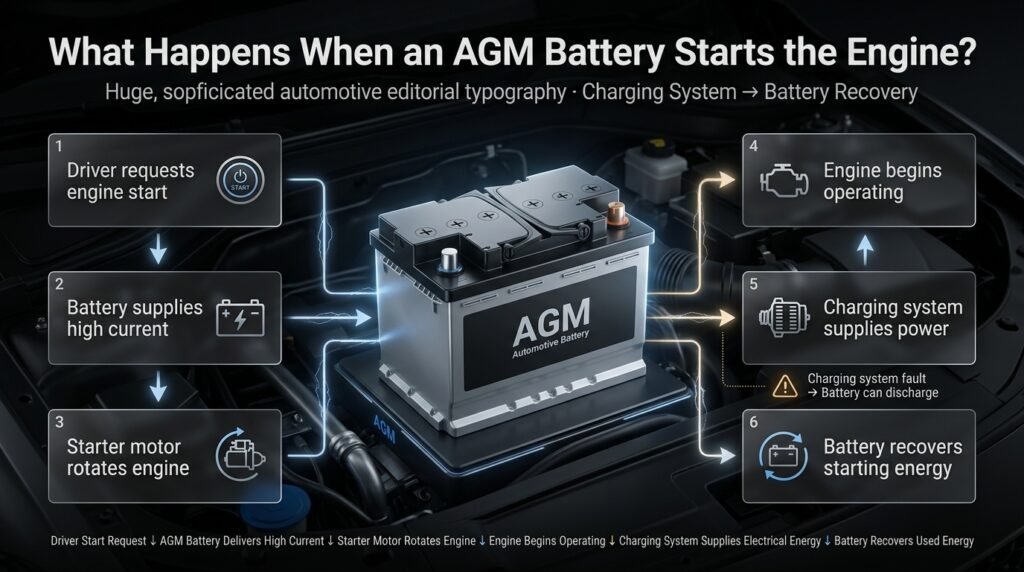
Starting an engine requires a large amount of electrical current for a short period.
When the driver activates the ignition or start button, the battery supplies current to the starter system.
The starter motor uses this energy to rotate the engine.
Once the engine begins operating independently, the charging system starts supplying electrical energy to the vehicle and replenishing the battery.
A simplified sequence is:
- Driver requests engine start.
- Battery supplies high current.
- Starter motor rotates the engine.
- Engine begins operating.
- Charging system supplies electrical power.
- Battery begins recovering energy used during starting.
If the charging system is functioning correctly, the battery can continue supporting the vehicle during normal operation.
If the alternator or charging system is faulty, however, even a brand-new AGM battery can eventually become discharged.
That is why battery replacement should not be performed without considering the complete electrical system when repeated failures occur.
Why AGM Batteries Can Deliver Strong Starting Performance
AGM batteries are engineered to provide substantial current when required.
Their internal construction contributes to low internal resistance and efficient electrical transfer.
The electrolyte remains closely associated with the active material, while the battery plates and separators are designed to provide effective electrochemical performance.
Several characteristics can contribute to strong starting performance:
- Low internal resistance
- Efficient plate design
- Good electrolyte contact
- Robust internal construction
- High current capability
- Strong vibration resistance
- Ability to tolerate repeated cycling
However, starting performance depends on more than battery technology.
Battery temperature, state of charge, age, condition, cable connections, starter condition, engine condition, and charging-system health can all affect the actual starting experience.
AGM Battery Charging Explained
Charging is one of the most important aspects of AGM battery operation.
An AGM battery should be charged using a charging strategy appropriate for AGM technology.
This is especially important because modern charging systems may vary their output rather than simply maintaining a constant charging voltage.
The vehicle may monitor:
- Battery state of charge
- Battery temperature
- Electrical demand
- Driving conditions
- Charging history
- Energy consumption
- Regenerative braking activity
The charging system may then adjust its behavior.
This means a single voltage measurement does not necessarily provide a complete picture of battery health.
A professional battery diagnosis should consider the battery’s condition, charging system, electrical demand, and vehicle-specific energy-management strategy.
Can You Charge an AGM Battery With a Normal Charger?
An AGM battery can generally be charged using a charger that specifically supports AGM batteries.
The charger should have an appropriate AGM charging mode or charging profile.
Using unsuitable charging equipment can cause problems if the charging behavior does not match the battery’s requirements.
Before charging an AGM battery, confirm:
✔ The charger supports AGM technology
✔ The charger voltage matches the battery
✔ The correct charging mode is selected
✔ The battery is physically undamaged
✔ Manufacturer instructions are followed
✔ The battery is not showing signs of severe internal failure
If the battery repeatedly becomes discharged, charging it again and again may not solve the underlying problem.
There may be an alternator fault, parasitic drain, poor connection, or battery-management issue that needs diagnosis.
AGM Battery State of Charge vs Battery Health
This distinction is often misunderstood.
A battery can show a reasonable voltage reading and still have reduced capacity.
State of charge describes how much energy is currently stored.
Battery health refers more broadly to the battery’s ability to deliver and retain that energy under operating conditions.
For example, a battery may appear adequately charged but fail to deliver the required starting current.
This is why professional battery testing can use more than simple voltage measurement.
Depending on the vehicle and equipment available, technicians may use electronic conductance testing, load testing, starting-system testing, charging-system testing, and diagnostic scans.
AGM Battery Testing: What a Professional Inspection Involves
A professional inspection should evaluate the battery and the systems that depend on it.
1. Visual Inspection
The technician examines:
- Battery casing
- Terminals
- Cable connections
- Mounting
- Signs of physical damage
- Corrosion
- Venting arrangement
2. Electrical Testing
Battery voltage and other electrical characteristics can be measured.
3. Battery Health Testing
Electronic testing equipment can estimate whether the battery retains adequate starting capacity.
4. Charging-System Testing
The alternator and vehicle charging system are checked.
5. Starting-System Testing
The starter and cranking behavior may be evaluated if starting is slow.
6. Parasitic-Drain Diagnosis
If the battery becomes discharged while parked, technicians can investigate unwanted electrical consumption.
7. Vehicle Diagnostics
Modern vehicles can store electrical faults that may provide additional information about the problem.
A complete Vehicle Inspection is particularly useful when the battery has been replaced recently but the same symptoms continue.
Signs Your AGM Battery May Be Getting Weak
AGM batteries do not always fail without warning.
Drivers may notice gradual changes before a complete no-start situation occurs.
Common warning signs include:
- Slower engine cranking
- Repeated low-voltage warnings
- Start-stop system becoming unavailable
- Electrical accessories behaving unusually
- Battery warning messages
- Difficulty starting after parking
- Repeated need for jumpstarts
- Vehicle electronics showing intermittent faults
These symptoms should not automatically be blamed on the battery.
For example, a weak alternator can produce similar symptoms.
A poor battery connection can also create starting problems.
A parasitic electrical drain may discharge a perfectly healthy battery overnight or over several days.
Proper diagnosis is therefore more reliable than replacing components based only on symptoms.
AGM Battery Troubleshooting Guide
| Symptom | Possible cause | Recommended approach |
|---|---|---|
| Slow engine cranking | Weak battery, starter issue, poor connection | Battery and starting-system test |
| Battery repeatedly discharges | Parasitic drain or charging problem | Electrical diagnosis |
| Battery warning light | Charging-system issue | Charging-system inspection |
| Start-stop unavailable | Battery condition or system strategy | Battery and diagnostic testing |
| New battery fails quickly | Wrong specification or underlying fault | Complete inspection |
| Car needs frequent jumpstarts | Battery or charging problem | Battery and alternator test |
| Electrical warnings appear | Low system voltage or electrical fault | Diagnostic scan and electrical testing |
The key principle is simple: diagnose before replacing.
AGM Batteries in Dubai’s Climate
Dubai’s climate creates several conditions that can influence battery performance.
High temperatures can accelerate chemical processes inside lead-acid batteries and contribute to faster aging.
The issue becomes more important when high temperatures are combined with heavy electrical demand.
Air conditioning can operate for long periods.
Traffic can result in extended periods of low-speed driving and idling.
Short journeys may not provide enough operating time to fully restore the energy used during starting.
Long periods of parking can also allow electrical systems to gradually consume battery energy.
Dubai driving conditions and potential battery effects
| Driving condition | Potential impact |
|---|---|
| High ambient temperature | Accelerated battery aging |
| Heavy traffic | Increased electrical demand |
| Long AC operation | Higher electrical load |
| Frequent short trips | Less opportunity for recharge |
| Extended parking | Possible battery discharge |
| Frequent restarts | Increased cycling |
| Weak alternator | Undercharging |
| Electrical drain | Battery discharge while parked |
This is why battery testing can be especially useful for drivers who use their cars heavily in Dubai.
AGM Battery Life: How Long Can It Last?
There is no universal lifespan for an AGM battery.
Battery life depends on operating conditions rather than age alone.
Important factors include:
- Temperature
- Driving distance
- Number of starts
- Charging-system condition
- Electrical load
- Battery quality
- Vehicle design
- Parking duration
- Start-stop operation
- Maintenance history
A car that is driven regularly on longer journeys may have a different battery life from one used primarily for short trips.
Likewise, an electrical fault can shorten the useful life of a battery that would otherwise have continued working normally.
Factors affecting AGM battery longevity
| Factor | Potential effect |
|---|---|
| Excessive heat | Faster aging |
| Undercharging | Reduced long-term capacity |
| Overcharging | Battery deterioration |
| Frequent short journeys | Incomplete recharge |
| Long-term discharge | Capacity loss |
| Parasitic drain | Repeated discharge |
| Incorrect charging | Premature degradation |
| Wrong battery specification | Poor performance |
Condition-based testing is therefore more useful than relying on a fixed replacement date.
AGM Battery Maintenance Tips
AGM batteries require little routine maintenance compared with traditional serviceable flooded batteries, but they should not be completely ignored.
Recommended maintenance practices
✔ Keep battery terminals clean and secure.
✔ Check for physical damage.
✔ Make sure the battery is securely mounted.
✔ Monitor changes in starting performance.
✔ Investigate repeated battery discharge.
✔ Test the charging system if battery problems occur.
✔ Follow correct AGM charging procedures.
✔ Test the battery before long-distance travel if its condition is uncertain.
✔ Follow the manufacturer’s storage recommendations during long periods of inactivity.
One of the most important maintenance principles is to investigate repeated battery problems instead of simply installing another battery.
AGM Battery Replacement: What Should Be Checked?
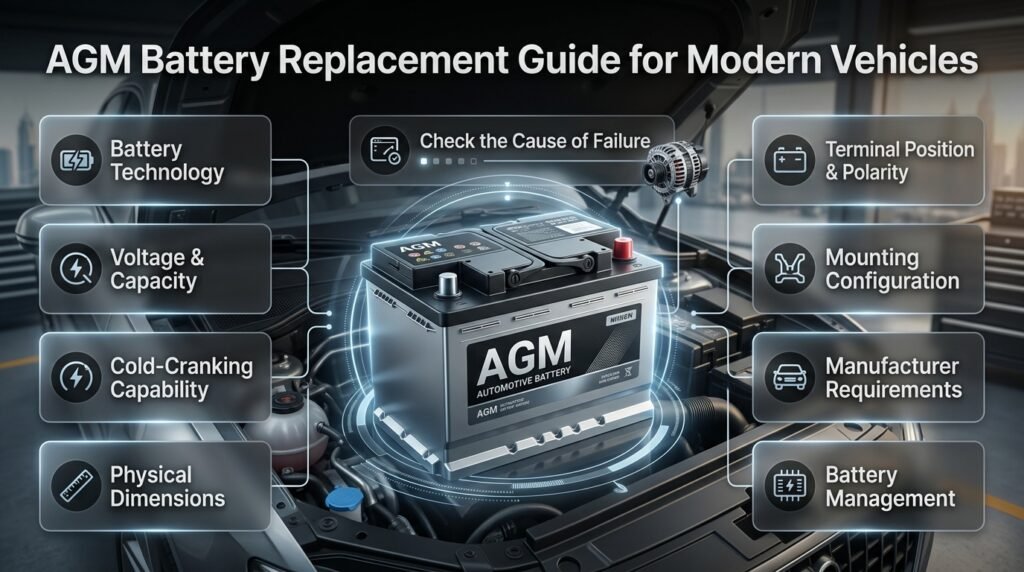
Replacing an AGM battery involves more than selecting a battery that physically fits into the engine compartment.
A replacement battery should match the vehicle’s requirements.
Important specifications include:
- Battery technology
- Voltage
- Amp-hour capacity
- Cold-cranking capability
- Physical dimensions
- Terminal position
- Polarity
- Mounting configuration
- Manufacturer requirements
- Battery-management requirements
A professional Battery Replacement service should also examine the reason the original battery failed.
For example, if an alternator is undercharging the battery, installing a replacement battery without fixing the alternator problem may result in another failure.
Drivers looking for battery replacement support can also explore EuroSwift Auto Services battery replacement service for a broader understanding of battery service options in Dubai.
Choosing the Correct AGM Battery Brand
Battery brand matters, but compatibility comes first.
Different vehicles may require different battery capacities, dimensions, terminal configurations, and performance characteristics.
For example, drivers researching individual battery options may consider:
Amaron Battery when comparing battery availability and replacement options.
Similarly, Bosch Battery can be considered when a Bosch battery matches the vehicle’s required specification.
Another option is Tuflong Battery, depending on vehicle compatibility and available specifications.
The important point is that a brand should never be selected solely because it has a strong reputation.
The battery must match the vehicle.
AGM Battery vs Other Battery Options
Different automotive batteries are designed around different requirements.
| Battery type | Typical strength | Common consideration |
|---|---|---|
| Conventional flooded | Traditional applications | Less suited to some high-demand systems |
| EFB | Moderate start-stop applications | Depends on vehicle design |
| AGM | High electrical demand and cycling | Requires correct charging strategy |
| Lithium-ion | Advanced applications | More complex and application-specific |
AGM remains a highly relevant technology because many modern vehicles continue to rely on lead-acid batteries for their low-voltage electrical systems.
AGM Batteries and Battery Management Systems
Modern vehicles increasingly use battery-management systems to monitor electrical energy.
The system can monitor battery condition and influence how charging is managed.
When a battery is replaced, some vehicles require a registration or adaptation procedure.
This can tell the vehicle that:
- A new battery has been installed.
- Battery capacity has changed.
- Battery type has changed.
- Charging strategy needs to be updated.
The exact procedure varies significantly between manufacturers.
Some vehicles require simple registration, while others may require additional coding or adaptation.
A technician should therefore consult the appropriate vehicle-specific procedure instead of applying one universal method.
Why Battery Registration Can Matter
Imagine that a vehicle has an energy-management system calibrated around an older battery.
The system may have learned that the battery has reduced capacity due to age.
If a new battery is installed but the vehicle is not informed where required, the energy-management system may continue operating according to outdated battery information.
This does not mean every vehicle needs battery registration.
It means the procedure should be checked for the specific vehicle.
This is particularly important for modern European and premium vehicles with sophisticated electronic energy management.
AGM Battery and Parasitic Drain
A parasitic drain occurs when electrical equipment continues consuming power while the vehicle is parked.
Some electrical consumption is normal.
Modern vehicles need to maintain security systems, memory functions, communication modules, and other systems.
The problem occurs when the vehicle consumes more electricity than expected after entering its normal sleep state.
Possible causes can include:
- Faulty electronic modules
- Aftermarket accessories
- Dash cameras
- Tracking equipment
- Interior lights
- Malfunctioning switches
- Incorrectly installed electronics
- Communication modules that fail to enter sleep mode
If an AGM battery repeatedly becomes flat while the vehicle is parked, parasitic-drain testing should be considered.
AGM Battery and Alternator Problems
The battery stores electrical energy, but the charging system is responsible for restoring that energy while the engine is running.
If the alternator or charging system is not operating correctly, the battery may gradually lose its state of charge.
Possible charging-system problems include:
- Low charging output
- Charging-system wiring problems
- Poor electrical connections
- Faulty voltage-control components
- Alternator failure
- Charging-management problems
This is why a battery replacement should often include charging-system verification.
A vehicle with a faulty alternator can make a healthy AGM battery appear defective.
Can an AGM Battery Be Repaired?
A discharged AGM battery is not necessarily a failed AGM battery.
If the battery has simply lost charge because the vehicle was parked or experienced an electrical drain, appropriate charging may restore usable performance.
However, if the battery has suffered substantial capacity loss, internal damage, or advanced deterioration, replacement is generally the practical solution.
Testing should determine which situation applies.
Possible situations
| Battery condition | Typical response |
|---|---|
| Discharged but healthy | Correct charging and diagnosis |
| Reduced capacity | Replacement may be appropriate |
| Internal damage | Replacement |
| Repeated discharge from vehicle fault | Repair underlying electrical problem |
| Healthy battery with alternator fault | Repair charging system |
Replacing every discharged battery without diagnosis can become unnecessarily expensive.
AGM Battery and Car Jumpstart
A Car Jumpstart can be useful when a vehicle cannot start because its battery is discharged.
However, jumpstarting should be viewed as an emergency starting solution rather than proof that the battery needs replacement.
After the vehicle starts, determine why the battery became discharged.
Possible causes include:
- Battery aging
- Lights left on
- Extended parking
- Parasitic drain
- Alternator problem
- Frequent short trips
If the battery continues to discharge, repeated jumpstarts are not a long-term solution.
For drivers stranded with a non-starting vehicle, professional Roadside Assistance can help provide emergency support while the underlying battery or electrical issue is assessed.
AGM Batteries and Long-Term Vehicle Parking
Vehicles that remain unused for extended periods can experience battery discharge.
Even when the engine is switched off, modern vehicles can consume small amounts of electrical energy.
Over time, that consumption can reduce battery state of charge.
Before storing a vehicle for an extended period:
- Follow the manufacturer’s storage instructions.
- Make sure the battery is adequately charged.
- Consider an approved battery-maintenance charger where appropriate.
- Remove or manage unnecessary aftermarket electrical accessories.
- Check the battery after extended inactivity.
- Inspect for abnormal electrical drain if discharge occurs repeatedly.
Proper storage practices can reduce unnecessary battery stress.
AGM Battery Preparation Before a Long Dubai Drive
A long journey is not the ideal time to discover that the battery is approaching failure.
Before a major trip, consider checking:
✔ Battery condition
✔ Engine starting performance
✔ Charging-system operation
✔ Battery terminals
✔ Tire condition
✔ Engine oil
✔ Coolant
✔ Brake condition
✔ AC operation
✔ Warning lights
A battery inspection is especially worthwhile if the vehicle has already shown slow starting or electrical warnings.
For broader preventive maintenance, a professional Car Service can identify problems that may otherwise appear during a long journey.
AGM Battery and Other Vehicle Maintenance
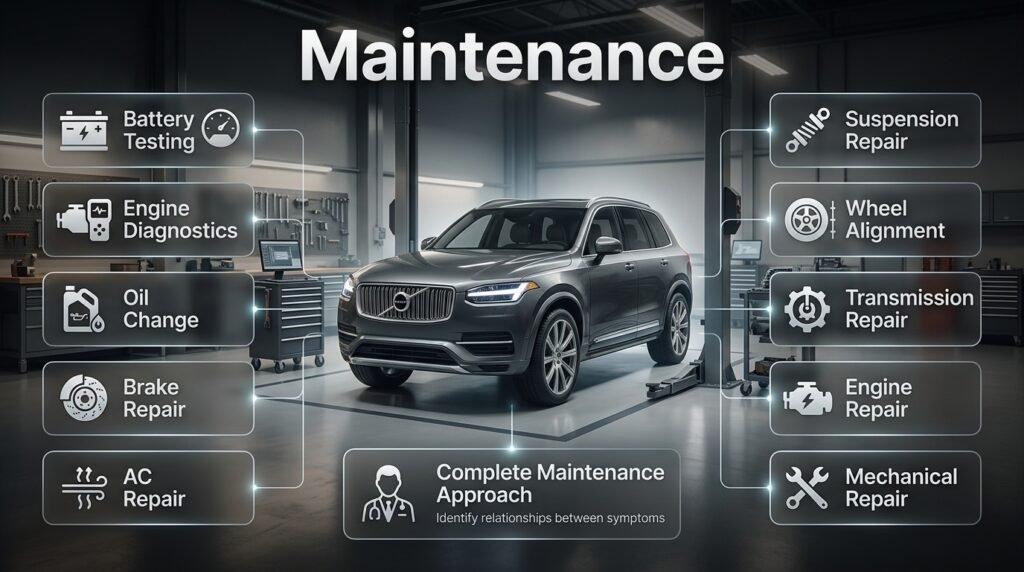
Although the battery is the focus of this article, it should be considered part of the vehicle’s complete maintenance system.
Electrical reliability can be affected by mechanical and electronic problems elsewhere in the vehicle.
A comprehensive Vehicle Maintenance program can include:
- Battery testing
- Engine Diagnostics
- Oil Change
- Brake Repair
- AC Repair
- Suspension Repair
- Wheel Alignment
- Transmission Repair
- Engine Repair
- Mechanical Repair
The advantage of a complete maintenance approach is that technicians can identify relationships between symptoms rather than treating every problem as an isolated component failure.
AGM Battery Requirements in Luxury Vehicles
Luxury vehicles often contain more electrical equipment than basic vehicles.
Depending on the model, the vehicle may include:
- Electric seats
- Heated seats
- Ventilated seats
- Advanced infotainment
- High-powered audio
- Security systems
- Driver-assistance technology
- Multiple control modules
- Electronic suspension
- Start-stop systems
This makes correct battery specification particularly important.
A luxury vehicle may also require additional diagnostic procedures after battery replacement.
For these vehicles, professional Luxury Car Service can be valuable because battery replacement may interact with several electronic systems.
Common AGM Battery Replacement Mistakes
Installing a Cheaper Battery With the Wrong Specification
Lower price does not automatically mean better value.
A battery that does not meet the manufacturer’s requirements may perform poorly even if it physically fits.
Ignoring Battery Registration
If the vehicle requires registration or adaptation, skipping that process can affect energy-management operation.
Replacing the Battery Without Testing the Alternator
A charging fault can destroy the usefulness of a new battery.
Repeatedly Charging a Severely Damaged Battery
Charging is not a permanent solution for a battery with significant internal deterioration.
Ignoring Electrical Drain
If something is draining the battery while parked, a replacement battery may eventually experience the same problem.
Choosing a Battery Based Only on Size
Physical dimensions are only one part of compatibility.
AGM Battery Cost in Dubai
The cost of an AGM battery depends on several factors.
There is no single price that applies to every vehicle.
Important cost factors include:
- Battery capacity
- Cold-cranking rating
- Brand
- Vehicle model
- Battery dimensions
- AGM technology
- Warranty
- Installation
- Availability
- Diagnostic requirements
- Battery registration or coding
Drivers comparing replacement options should therefore consider the complete service rather than just the battery’s purchase price.
For a broader understanding of the factors affecting local replacement costs, you can refer naturally to the Car Battery Prices in Dubai 2026 guide.
This can help when comparing different battery specifications and understanding why prices vary between vehicles.
Other Battery Brands and Replacement Options
AGM technology is available across multiple manufacturers and vehicle applications.
When researching replacement options, drivers may also encounter brands such as Exide, Panasonic, FIAMM, and AC Delco.
For example, Exide Battery replacement in Dubai can be considered when the vehicle’s required specifications match the available Exide battery.
Similarly, Panasonic Battery replacement provides another brand-specific option for vehicles requiring a compatible battery.
Drivers comparing European and other battery applications can also research FIAMM Battery replacement.
Another available option is AC Delco Battery replacement, subject to the vehicle’s correct specification.
These pages should be treated as supporting resources when researching battery options rather than as a reason to select a particular brand without checking compatibility.
AGM Battery Replacement Process
A professional replacement can involve several stages.
Step 1: Confirm Vehicle Specification
The technician identifies the correct battery technology and specification.
Step 2: Inspect the Existing Battery
The existing battery is tested rather than replaced blindly.
Step 3: Check Charging System
The alternator and charging system are evaluated.
Step 4: Confirm Physical Compatibility
Dimensions, terminals, polarity, and mounting are checked.
Step 5: Install the Replacement
The new battery is securely installed according to manufacturer requirements.
Step 6: Perform Required Registration
If the vehicle requires battery registration or adaptation, the appropriate diagnostic procedure is performed.
Step 7: Verify Operation
Starting performance and charging behavior are checked after installation.
This process is more reliable than simply removing the old battery and installing another one.
Professional AGM Battery Inspection Checklist
| Inspection area | Professional check |
|---|---|
| Battery technology | Confirm AGM requirement |
| Capacity | Match manufacturer specification |
| Starting rating | Verify required performance |
| Physical dimensions | Confirm fit |
| Terminals | Check polarity and connections |
| Battery mounting | Ensure secure installation |
| Charging system | Test alternator/system |
| Starting system | Evaluate cranking |
| Parasitic drain | Investigate repeated discharge |
| Battery management | Register/adapt if required |
| Diagnostic faults | Scan vehicle systems |
| Final test | Confirm correct operation |
This approach creates a more complete picture of the vehicle’s electrical health.
When Should You Consider AGM Battery Replacement?
Replacement may be appropriate when testing confirms that the battery can no longer provide adequate performance.
Common situations include:
- Significantly reduced starting capability
- Repeated unexplained discharge after other faults are eliminated
- Confirmed loss of battery capacity
- Internal battery damage
- Persistent low-voltage problems caused by battery deterioration
- Battery reaching the end of its useful service life
However, age alone should not be treated as the only replacement criterion.
The actual condition of the battery and vehicle should determine the decision.
AGM Battery Technology and the Future of Vehicles
Automotive electrical systems continue to evolve.
Hybrid vehicles, mild-hybrid systems, 48-volt architectures, regenerative braking, and fully electric vehicles are changing how manufacturers manage electrical energy.
AGM batteries remain relevant because many modern vehicles still require dependable low-voltage electrical power even when propulsion systems become increasingly electrified.
Future vehicles may combine different battery technologies.
For example:
- Traditional lead-acid systems
- EFB batteries
- AGM batteries
- 48-volt systems
- Lithium-ion auxiliary batteries
- High-voltage lithium-ion propulsion batteries
The result is likely to be a more sophisticated automotive energy ecosystem rather than the disappearance of AGM technology.
AGM vs Lithium-Ion: A Simple Comparison
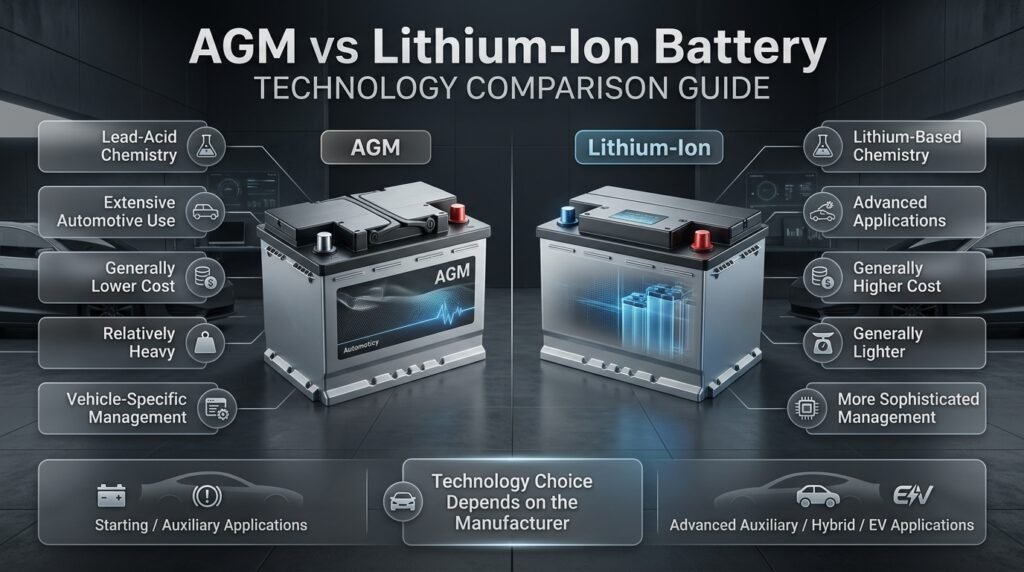
AGM and lithium-ion batteries are based on different technologies and serve different applications.
| Characteristic | AGM | Lithium-ion |
|---|---|---|
| Chemistry | Lead-acid | Lithium-based |
| Automotive use | Starting/auxiliary applications | Advanced auxiliary/hybrid/EV applications |
| Cost | Generally lower | Generally higher |
| Established automotive use | Extensive | Rapidly expanding |
| Weight | Relatively heavy | Generally lighter |
| Management requirements | Vehicle-specific | Often more sophisticated |
| Application | Depends on manufacturer | Highly application-specific |
It is not appropriate to replace one technology with another simply because one appears newer.
The vehicle manufacturer determines the appropriate technology.
Professional Recommendations for AGM Battery Owners
Expert Insight
Do not evaluate an AGM battery using one measurement alone. Battery voltage can be useful, but battery health, starting performance, charging behavior, and electrical demand should also be considered.
Professional Recommendation
If a replacement AGM battery fails prematurely, investigate the vehicle before purchasing another battery.
Industry Best Practice
Use a charger designed for AGM batteries when external charging is required.
Dubai Maintenance Advice
Drivers operating vehicles regularly in high temperatures should pay attention to battery condition, especially when combined with short journeys and heavy electrical loads.
Diagnostic Recommendation
When repeated starting problems occur, evaluate the battery, starter, charging system, electrical connections, and possible parasitic drain together.
When to Contact a Professional Auto Workshop
Professional assistance is recommended when:
- The vehicle repeatedly fails to start.
- A new battery repeatedly becomes discharged.
- Battery warning lights appear.
- Start-stop functions stop working unexpectedly.
- Electrical faults appear after battery replacement.
- The battery requires frequent jumpstarts.
- Charging-system problems are suspected.
- You are unsure which battery specification the vehicle requires.
A professional Auto Workshop can diagnose the battery and the broader vehicle system rather than treating the battery as an isolated component.
If the vehicle has stopped operating unexpectedly, Emergency Car Repair and roadside support may be more appropriate than attempting repeated starts without understanding the problem.
AGM Battery Safety Considerations
Although AGM batteries are designed with controlled electrolyte retention, they still contain lead-acid chemistry and should be handled correctly.
Important precautions include:
✔ Use appropriate charging equipment.
✔ Avoid physical damage to the battery casing.
✔ Follow manufacturer installation instructions.
✔ Ensure the battery is correctly secured.
✔ Use the correct replacement specification.
✔ Avoid incorrect polarity.
✔ Follow vehicle-specific battery disconnection procedures.
✔ Allow qualified technicians to perform complex electrical diagnosis when necessary.
Modern vehicles can also contain sensitive electronic systems, so incorrect battery disconnection or installation procedures can create additional problems.
AGM Battery: Repair or Replacement Decision Guide
| Situation | Repair/inspection approach |
|---|---|
| Battery simply discharged | Test and recharge if appropriate |
| Battery has good capacity | Continue using after identifying discharge cause |
| Battery has reduced capacity | Consider replacement |
| Internal damage confirmed | Replace |
| Alternator fault | Repair charging system |
| Parasitic drain | Diagnose and repair electrical fault |
| Wrong battery installed | Replace with correct specification |
| Registration required | Perform manufacturer-specific procedure |
This approach prevents unnecessary replacement and focuses attention on the actual cause.
Final AGM Battery Inspection Before a Long Trip
Before traveling long distances, particularly across emirates, consider a basic vehicle readiness check.
Battery
Check starting performance and battery condition.
Charging System
Verify that the vehicle is charging correctly.
Tires
Inspect pressure, tread, and visible damage.
Brakes
Check for warning signs and unusual braking behavior.
Engine Fluids
Check oil and coolant according to manufacturer recommendations.
Air Conditioning
Confirm that the AC system is functioning correctly, particularly in Dubai’s climate.
Warning Lights
Do not ignore dashboard warnings before a long journey.
Emergency Equipment
Make sure appropriate roadside support is available if needed.
Preventive checks can reduce the likelihood of a simple battery or mechanical issue disrupting a long trip.
How Does AGM Battery Technology Work?
AGM battery technology works by using Absorbent Glass Mat separators to hold the battery’s electrolyte closely against the lead plates. Unlike a conventional flooded battery, where the electrolyte remains as free-flowing liquid, an AGM battery absorbs the electrolyte into a fine glass-fiber material positioned between the plates. This construction helps the battery deliver strong starting power while handling repeated charge and discharge cycles.
The basic electrochemical process remains a lead-acid system. When the vehicle needs electrical power, chemical energy stored in the battery is converted into electrical energy. When the alternator or approved charging system supplies energy back to the battery, the process is reversed and the battery stores energy again.
The AGM design becomes particularly useful when a vehicle has frequent engine restarts or significant electrical demand. Manufacturers use AGM technology in many vehicles equipped with start-stop systems because the battery needs to support repeated starting events while also powering electrical equipment when the engine is temporarily switched off.
Key points to understand:
AGM means Absorbent Glass Mat.
The electrolyte is absorbed into glass-fiber separators rather than freely circulating.
AGM batteries are designed for strong starting performance and repeated cycling.
They are commonly used in vehicles with start-stop and high electrical demands.
The battery still depends on a healthy charging system to remain properly charged.
AGM technology does not eliminate the need for correct battery selection and maintenance.
The important distinction is that AGM is not simply a “stronger normal battery.” It is a different battery construction designed around different operating requirements. That is why replacing an AGM battery with another technology should always be based on the vehicle manufacturer’s specification rather than appearance, physical size, or price alone.
Why Are AGM Batteries Used in Start-Stop Vehicles?
AGM batteries are widely used in demanding start-stop applications because these vehicles place substantially different demands on the battery than a conventional vehicle.
In a traditional driving cycle, the engine starts and then remains running for most of the journey. In a start-stop vehicle, the engine may shut down at traffic lights or during other stationary periods and restart when the vehicle needs to move again. During the engine-off period, the battery may continue supporting systems such as lighting, infotainment, climate-related electrical functions, and control electronics.
That creates a much more demanding battery workload.
The battery must repeatedly provide starting current while also accepting charge efficiently when the charging system becomes available. Bosch describes AGM technology as being designed for frequent starts and stops and for vehicles using brake-energy recuperation, while also supporting electrical consumers during the engine-off phase.
Why start-stop systems put extra demand on the battery:
More engine-start cycles
Repeated charge and discharge activity
Electrical loads while the engine is stopped
Rapid recovery of battery charge
Greater dependence on battery condition
More sophisticated energy-management systems
This is why a standard flooded battery is not automatically an appropriate replacement for an AGM battery.
Some vehicles use EFB technology rather than AGM, so the correct approach is to identify the battery technology specified for the particular vehicle. Industry battery guidance also warns that not every start-stop vehicle should automatically be converted between EFB and AGM.
Professional recommendation:
Before replacing a battery in a start-stop vehicle, check:
Original battery technology
Battery capacity
Cold-cranking specification
Physical dimensions
Terminal configuration
Vehicle charging strategy
Battery-management requirements
For a modern vehicle, battery compatibility is more important than simply choosing a battery with a higher advertised rating.
Can You Replace a Regular Car Battery With an AGM Battery?
An AGM battery can be an excellent choice for a vehicle that is specifically designed or approved to use AGM technology, but it should not be treated as a universal upgrade for every car.
This is one of the most common misunderstandings surrounding AGM batteries. Because AGM batteries offer strong performance and are used in many modern vehicles, some drivers assume that installing an AGM battery in any vehicle will automatically improve reliability. In reality, the vehicle’s charging system, battery-management system, battery capacity, and original specifications all need to be considered.
For some vehicles, an AGM replacement is appropriate. For others, the manufacturer may specify a conventional flooded battery or EFB battery.
The correct battery therefore depends on the complete electrical architecture of the vehicle.
Before changing battery technology, check:
Original battery type
Vehicle manufacturer’s recommendation
Required battery capacity
Cold-cranking performance
Charging-system compatibility
Battery-management system
Physical battery dimensions
Terminal location and polarity
Whether battery registration or adaptation is required
Interstate’s current battery guidance similarly notes that AGM is appropriate when the vehicle came equipped with AGM or when AGM is specifically specified for the application, while some start-stop vehicles use EFB instead.
The professional way to approach an upgrade
Rather than asking, “Is AGM better?”, the better question is:
“Is AGM the correct technology for my vehicle?”
If the answer is yes, AGM can provide the characteristics the vehicle was designed around. If the answer is no, installing a different battery technology simply because it appears more advanced may not deliver the expected result.
This is particularly important in modern European and luxury vehicles, where battery-management systems can actively monitor battery condition and influence charging behavior.
How Should an AGM Battery Be Charged and Maintained?
AGM batteries are maintenance-free in normal use, but that does not mean they can be ignored. Like other automotive batteries, an AGM battery gradually loses charge and can become weak if the vehicle is frequently used for short trips, left parked for long periods, or has an electrical drain while switched off.
Charging an AGM battery also requires the correct charging method. AGM batteries have different charging requirements from conventional flooded batteries, so a charger with an AGM-compatible setting is preferable when external charging is required.
For vehicles in Dubai, battery condition should also be considered alongside the vehicle’s overall electrical system. Extreme operating temperatures, heavy electrical usage, repeated short journeys, and air-conditioning demand can all make battery health more important.
Good maintenance practices include:
Use an AGM-compatible smart charger when external charging is needed.
Avoid allowing the battery to remain deeply discharged.
Check the battery if the vehicle has been parked for an extended period.
Test the battery before long-distance travel if it is showing weakness.
Inspect the alternator and charging system if the battery repeatedly loses charge.
Investigate parasitic electrical drain rather than repeatedly replacing the battery.
A professional battery test is often more useful than judging battery health from appearance alone.
How Do You Know When an AGM Battery Needs Replacement?
An AGM battery does not always fail suddenly. In many cases, its declining condition appears through changes in vehicle starting performance or electrical behavior. A slower engine start, repeated low-voltage warnings, start-stop system deactivation, or difficulty maintaining charge can indicate that the battery should be tested.
However, these symptoms do not automatically prove that the battery itself is defective. Similar problems can be caused by an alternator that is not charging correctly, excessive parasitic drain, poor electrical connections, or another vehicle electrical fault. That is why professional diagnosis is important before purchasing a replacement.
A proper battery inspection can include battery voltage testing, state-of-charge evaluation, starting-performance testing, and inspection of the vehicle’s charging system. If the battery fails the appropriate test or can no longer maintain adequate performance, replacement becomes the sensible solution.
Watch for signs such as:
Slower-than-normal engine cranking.
Frequent battery or electrical warnings.
Start-stop functionality becoming unavailable.
Battery repeatedly losing charge.
Electrical accessories behaving unusually.
The vehicle requiring repeated jumpstarts.
A battery test showing poor remaining performance.
If an AGM battery is approaching the end of its useful service life, replacing it before a complete failure can be especially valuable before a long trip or during periods when reliable starting is critical. For Dubai drivers, professional Car Battery Replacement and testing can help identify whether the battery itself needs replacement or whether another electrical problem is responsible.
Conclusion
AGM battery technology is more than simply an upgraded version of a conventional car battery. Its absorbent glass mat construction, strong starting capability, improved cycling performance, and efficient charge acceptance make it well suited to modern vehicles with start-stop systems, regenerative braking, and high electrical demands. Understanding how AGM technology works also makes it easier to recognize why the correct battery specification matters when servicing or replacing a vehicle battery.
For drivers in Dubai, battery reliability is especially important because daily traffic, frequent short journeys, extensive air-conditioning use, and demanding electrical systems can place additional stress on the vehicle’s starting and charging system. A weak AGM battery should not automatically be blamed for every electrical problem, however. Professional testing should also consider the alternator, charging system, battery connections, and possible parasitic drain.
The most important approach is simple: use the battery technology recommended for your vehicle, maintain the charging system properly, and test the battery when warning signs appear. Choosing the right AGM battery and having it professionally installed can help maintain dependable starting performance and protect the vehicle’s wider electrical system.
When battery performance becomes questionable, professional diagnosis is a better first step than replacing parts based on guesswork. A proper inspection can determine whether you need a new AGM battery, charging-system repair, or another form of electrical service.

Leave a Reply