
Introduction
Causes of Sudden Battery Failure | A car battery can sometimes fail with little or no obvious warning. The vehicle may start normally one day and then struggle to start or become completely unresponsive the next. Understanding the causes of sudden battery failure is important because a dead battery is not always caused by the battery itself. Problems with charging, electrical connections, vehicle electronics, driving habits, temperature, or an aging battery can all contribute.
For drivers in Dubai, reliable battery performance is especially important because daily traffic, high ambient temperatures, frequent air-conditioning use, and repeated short journeys can place additional demands on a vehicle’s electrical system. If you need professional automotive assistance, EuroSwift Auto Services provides battery-related and wider vehicle maintenance services designed to help drivers identify problems rather than simply replace parts without diagnosis.
This guide explains why a car battery can fail suddenly, how to distinguish battery problems from charging-system faults, what professional technicians check, and how drivers can reduce the likelihood of unexpected battery failure.
What Causes Sudden Battery Failure?
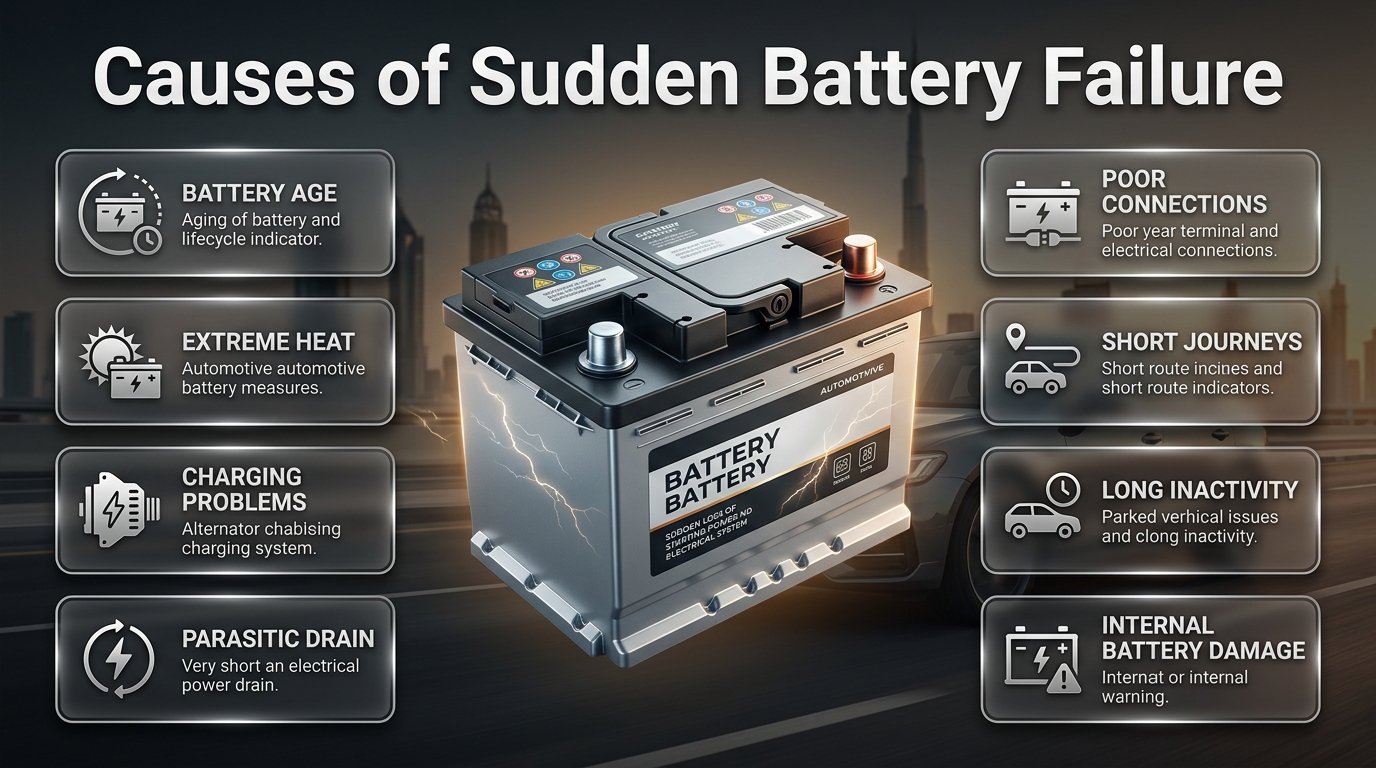
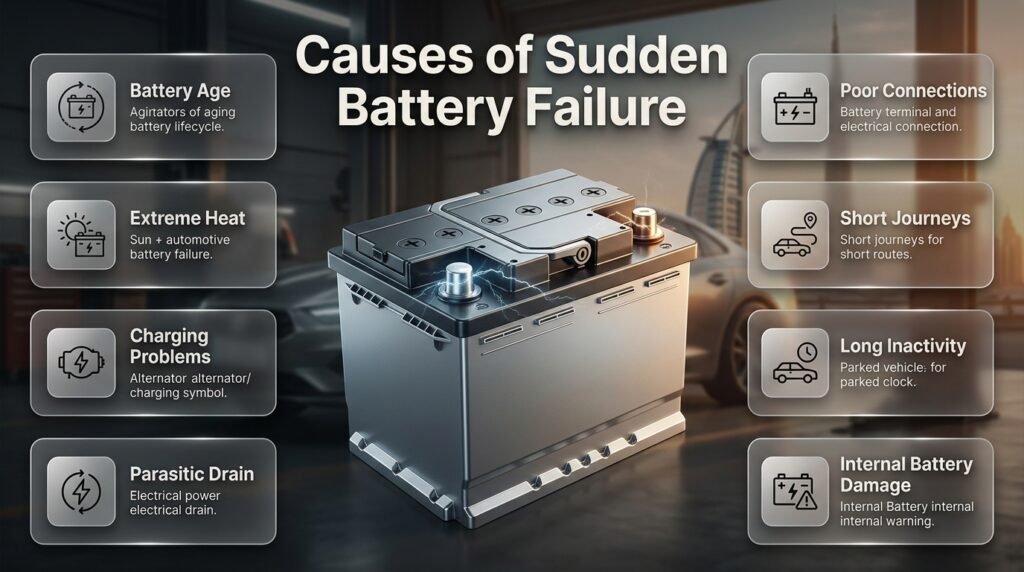
Sudden battery failure usually results from one of several underlying conditions. Some problems develop gradually inside the battery but only become noticeable when the battery can no longer provide enough starting power. Other failures happen because the battery has been discharged by an electrical problem or because the charging system is not restoring the energy used during driving.
Common causes include:
- An aging or internally damaged battery
- Extreme operating temperatures
- Alternator or charging-system problems
- Loose or corroded battery terminals
- Poor ground connections
- Parasitic electrical drain
- Lights or accessories being left active
- Repeated short journeys
- Incorrect battery specification
- Poor installation
- Long periods of vehicle inactivity
- Electrical faults elsewhere in the vehicle
The important point is that a suddenly dead battery does not automatically mean the battery needs replacement. A proper diagnosis should identify why the battery lost its ability to start the vehicle.
Battery Age and Internal Deterioration
A battery can appear healthy while its internal performance is gradually declining. Over time, repeated charging and discharging cycles can reduce the battery’s ability to store and deliver electrical energy.
This deterioration may remain unnoticed because the battery can still start the engine under normal conditions. However, when the vehicle experiences a demanding situation—such as extended parking, colder conditions, heavy electrical use, or repeated starting—the remaining reserve may no longer be sufficient.
An aging battery may therefore appear to fail suddenly even though its performance has been declining for some time.
Why Battery Failure Can Seem Unexpected
Drivers often assume that a battery will provide obvious warning signs before failure. That is not always the case.
A battery may continue working until its available starting capacity falls below the level required by the starter motor. Once that threshold is reached, the change from apparently normal operation to a no-start condition can happen quickly.
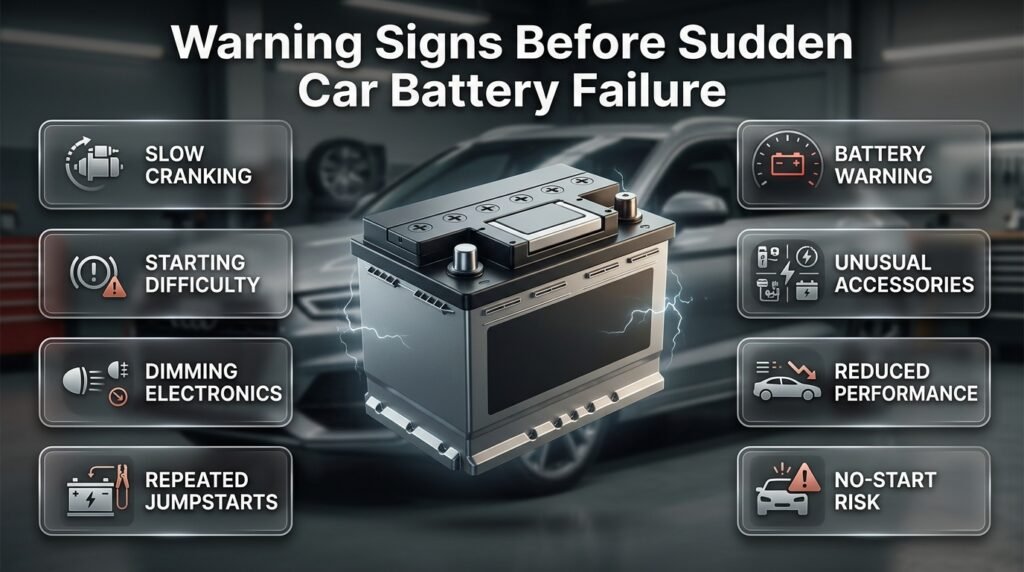
Warning signs may include:
- Slower engine cranking
- Intermittent starting difficulty
- Dimming electrical equipment during startup
- Repeated need for jumpstarts
- Battery warning indications
- Electrical accessories behaving unusually
- Reduced performance after the vehicle has been parked
These symptoms should be investigated rather than ignored.
Extreme Heat and Battery Reliability in Dubai
Temperature is an important factor in automotive battery performance. Dubai’s hot climate can place considerable thermal stress on battery components and the vehicle’s wider electrical system.
High temperatures can accelerate internal battery deterioration and can contribute to the loss of usable battery performance over time. The effect may not always be immediately visible. A battery that has been weakened by prolonged heat exposure can continue starting the vehicle until one day its available capacity is no longer sufficient.
Heat is particularly relevant when combined with:
- Frequent stop-and-go traffic
- Long periods of vehicle parking outdoors
- Heavy air-conditioning use
- Repeated engine starts
- Short journeys
- An already aging battery
Professional Recommendation
Do not wait for a complete no-start condition before checking an older battery. Periodic inspection can identify reduced starting performance before the vehicle becomes stranded.
This is particularly useful before long journeys, extended parking, or periods when roadside assistance may be inconvenient.
Alternator and Charging-System Problems
The battery does not operate independently. Once the engine is running, the charging system is responsible for replenishing electrical energy used during starting and supporting the vehicle’s electrical demands.
If the alternator, charging circuit, wiring, belt system, or related components develop a problem, the battery may gradually lose charge.
This can create a misleading situation: the driver may replace the battery, only to discover that the new battery also becomes discharged.
Battery Problem or Charging Problem?
| Situation | Possible Cause | Recommended Action |
|---|---|---|
| Battery repeatedly becomes weak | Charging or electrical issue | Test battery and charging system |
| Battery is discharged after driving | Alternator or charging fault possible | Check charging performance |
| New battery repeatedly loses charge | Underlying vehicle fault | Perform electrical diagnosis |
| Starting is slow after several days | Battery condition or drain | Check battery and parked-current draw |
| Battery warning appears while driving | Charging-system concern | Arrange professional inspection |
A proper diagnosis should therefore include both battery testing and charging-system testing when the battery repeatedly loses charge.
Loose or Corroded Battery Connections
The battery may be capable of producing sufficient power but still fail to deliver it effectively if its connections are poor.
Battery terminals should make secure electrical contact. Corrosion, looseness, damaged connectors, or poor cable connections can increase electrical resistance and interfere with starting performance.
A poor connection can produce symptoms such as:
- Intermittent starting
- Clicking during startup
- Electrical fluctuations
- Difficulty starting despite a reasonably charged battery
- Apparent battery failure after vibration or movement
Ground connections are equally important. A weak engine or chassis ground can create electrical symptoms that appear to originate from the battery.
For this reason, visual inspection should be combined with appropriate electrical testing.
Parasitic Electrical Drain
One of the more difficult causes of repeated battery discharge is a parasitic drain.
A vehicle normally consumes a small amount of electrical energy while parked to maintain systems such as security functions, memory settings, and electronic modules. The problem occurs when an electrical component remains active when it should have entered its normal sleep state.
Potential sources can include:
- Interior lighting
- Trunk or boot lighting
- Glove-box lighting
- Aftermarket electronics
- Faulty control modules
- Alarm systems
- Dash cameras
- USB accessories
- Other permanently connected electrical equipment
A parasitic drain can gradually discharge a battery while the vehicle appears to be completely switched off.
Why This Problem Is Often Misdiagnosed
Replacing the battery may temporarily solve the starting problem because the new battery has more available charge. However, if the electrical drain remains, the replacement battery can eventually experience the same problem.
That is why repeated battery failure deserves electrical diagnosis rather than repeated battery replacement.
Leaving Lights or Accessories On
A simpler cause of sudden battery discharge is accidentally leaving an electrical load active.
Modern vehicles often have automatic systems designed to switch lights or accessories off after a certain period. However, drivers should not assume that every electrical device will always shut down automatically.
Examples include:
- Interior lights
- Boot lights
- Glove-box lights
- Exterior lights
- Aftermarket entertainment equipment
- Portable electronics
- Plugged-in accessories
A single incident may discharge a battery significantly, particularly when the battery is already aging or partially charged.
If the vehicle repeatedly becomes discharged without an obvious reason, however, the situation should not automatically be blamed on driver error.
Repeated Short Trips and Undercharging
Frequent short journeys can make it difficult for the vehicle to fully recover the electrical energy consumed during starting.
This becomes more important when the vehicle is regularly used for short-distance trips involving multiple engine starts, traffic delays, and heavy electrical loads.
A typical pattern might involve:
- Starting the engine.
- Driving only a short distance.
- Using air conditioning and electrical equipment.
- Switching the engine off.
- Repeating the process several times throughout the day.
Over time, the battery may operate below its preferred state of charge.
Professional Insight
Short journeys are not automatically harmful to a healthy battery. The concern is the overall balance between electrical energy consumed and energy restored by the charging system.
If a vehicle is mainly used for short trips, periodic battery and charging-system checks become more valuable.
Incorrect Battery Specification or Installation
Modern vehicles are not necessarily compatible with any battery that physically fits the battery tray.
Battery selection may involve factors such as:
- Battery technology
- Capacity
- Cold-cranking performance
- Physical dimensions
- Terminal arrangement
- Vehicle electrical requirements
- Start-stop system requirements
Some vehicles are designed for advanced battery technologies such as AGM or EFB. Installing an unsuitable specification can affect battery performance and service life.
A professional replacement should therefore verify the manufacturer’s required battery specification rather than selecting a battery based only on physical size.
For drivers comparing suitable battery options, EuroSwift’s car battery replacement service can be used as the relevant service reference.
Battery Brand and Technology Considerations
Battery brand alone does not determine whether a battery is suitable. The correct specification for the vehicle remains the priority.
Depending on vehicle requirements, drivers may encounter different battery technologies and manufacturers. Relevant battery options covered by EuroSwift include:
- Amaron Car Battery Replacement Dubai
- Bosch Car Battery Replacement Dubai
- Tuflong Car Battery Replacement Dubai
- AGM Battery Replacement Dubai
- Exide Battery Replacement Dubai
- Panasonic Battery Replacement Dubai
- FIAMM Battery Replacement Dubai
- AC Delco Battery Replacement Dubai
The correct choice should always be based on the vehicle’s required specification rather than choosing a battery simply because it is familiar or inexpensive.
Battery Failure After Extended Parking
A vehicle that remains parked for an extended period can gradually lose battery charge.
Even when the engine is switched off, modern vehicles continue to consume small amounts of electricity. If the vehicle remains unused long enough, this background consumption can reduce the battery’s state of charge.
The risk can be greater when:
- The battery is already aging.
- The vehicle was not fully charged before parking.
- An electrical accessory remains active.
- The vehicle has a parasitic drain.
- The battery has reduced reserve capacity.
For vehicles that are regularly stored for long periods, an appropriate battery-maintenance strategy can help reduce unexpected starting problems.
Signs That Battery Failure May Be Imminent
Sudden battery failure may not always provide clear warning, but several symptoms deserve attention.
Starting Symptoms
- Engine cranks more slowly than usual
- Starting becomes inconsistent
- The vehicle requires repeated attempts
- Jumpstarting becomes necessary
Electrical Symptoms
- Lights appear weaker than normal
- Electronics behave inconsistently
- Dashboard warnings appear unexpectedly
- Electrical equipment loses power during starting
Maintenance Symptoms
- Battery repeatedly becomes discharged
- Battery requires frequent charging
- The vehicle has needed several jumpstarts
- A replacement battery has developed the same problem
None of these signs should be interpreted in isolation. A weak alternator, poor connection, or electrical drain can produce similar symptoms.
Battery Failure vs Charging-System Failure
A common diagnostic mistake is assuming that every no-start condition is a battery problem.
| Symptom | Battery | Alternator/Charging | Electrical Drain |
|---|---|---|---|
| Slow starting | Possible | Possible | Possible |
| Battery repeatedly goes flat | Possible | Very possible | Very possible |
| Vehicle loses electrical power while driving | Possible | More concerning | Less typical |
| Battery fails after parking | Possible | Indirectly possible | Very possible |
| New battery also becomes discharged | Less likely | Possible | Very possible |
| Battery warning while engine runs | Less likely | Strong possibility | Less typical |
Testing is the best way to separate these possibilities.
How Professionals Diagnose Sudden Battery Failure
A professional inspection should look beyond the battery label.
A logical diagnostic process can include:
1. Visual Inspection
The technician checks the battery case, terminals, cables, mounting, and surrounding components for visible problems.
2. Battery Condition Testing
The battery’s state of charge and starting performance can be assessed using appropriate testing equipment.
3. Charging-System Testing
The charging system is checked to determine whether the battery is receiving appropriate charging support while the engine is running.
4. Connection Inspection
Battery terminals, cables, and relevant ground connections are examined for looseness, corrosion, damage, or resistance-related problems.
5. Electrical Drain Testing
If the battery repeatedly discharges while parked, electrical current consumption may need to be evaluated after the vehicle’s systems have entered their normal resting state.
6. Vehicle-Specific Diagnosis
Modern vehicles may contain multiple electronic control modules. A professional diagnosis may therefore need to consider warning messages, electronic faults, accessories, and vehicle-specific electrical behavior.
When Battery Replacement Is Actually Necessary
Replacement becomes more appropriate when testing shows that the battery can no longer provide reliable starting performance or has suffered significant internal deterioration.
Replacement may be considered when:
- The battery has failed a suitable performance test.
- Starting performance remains poor despite proper charging.
- The battery has significant internal deterioration.
- The battery repeatedly fails after the vehicle’s charging and electrical systems have been verified.
- The battery is unsuitable for the vehicle’s required specification.
A new battery should not be treated as the automatic solution to every discharge problem.
Battery Replacement Cost Factors in Dubai
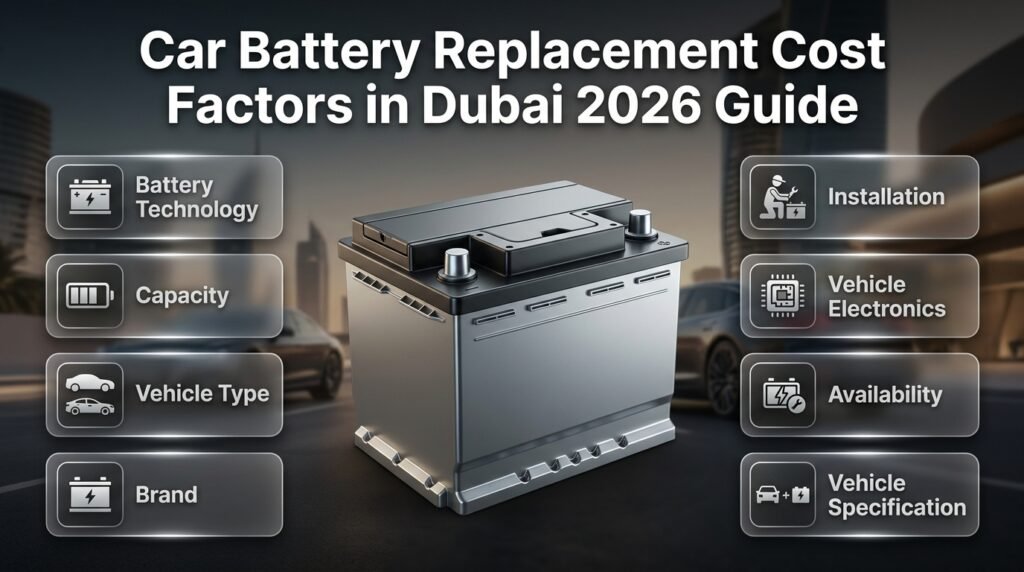
The cost of replacing a car battery can vary depending on the vehicle and battery specification.
Important factors include:
| Cost Factor | Why It Matters |
|---|---|
| Battery technology | AGM and other advanced technologies may cost more |
| Capacity | Larger battery specifications can affect pricing |
| Vehicle type | Some vehicles require specialized batteries |
| Brand | Manufacturer and product range influence cost |
| Installation | Professional fitting can add to the service |
| Vehicle electronics | Some vehicles may require additional procedures |
| Availability | Battery availability can affect service options |
For a broader overview of pricing considerations, the Car Battery Prices in Dubai 2026 guide provides a dedicated reference.
What to Do When Your Battery Fails Suddenly
If your vehicle suddenly will not start, avoid immediately assuming that the battery is permanently damaged.
Start with basic observations:
✔ Check whether the dashboard receives power.
✔ Observe whether the starter motor cranks normally.
✔ Check for obvious lighting or accessory issues.
✔ Inspect the battery area for visible connection problems if it is safe to do so.
✔ Avoid repeatedly attempting to start the vehicle for long periods.
✔ If a jumpstart is required, investigate why the battery became discharged afterward.
If the vehicle repeatedly needs assistance, the underlying cause should be diagnosed.
For drivers who require a replacement battery rather than diagnosis alone, choosing the correct specification and having the installation performed properly can help prevent another starting problem.
Common Mistakes Drivers Make
Replacing the Battery Without Diagnosis
A new battery can temporarily restore starting performance while leaving an alternator fault or parasitic drain unresolved.
Assuming Voltage Tells the Whole Story
A voltage reading provides useful information, but battery health cannot always be determined from voltage alone.
Ignoring Repeated Jumpstarts
Frequent jumpstarts are a symptom that something needs investigation. They should not become a long-term substitute for diagnosis.
Choosing the Cheapest Battery Automatically
Price is only one consideration. Vehicle compatibility, battery technology, capacity, quality, and installation all matter.
Ignoring Electrical Accessories
Aftermarket equipment can sometimes contribute to unexpected battery discharge. Any recent electrical modification should be considered during diagnosis.
Preventive Maintenance for Battery Reliability
Sudden failure cannot always be prevented, but good maintenance can reduce avoidable problems.
Regular Battery Inspection
Have the battery condition checked periodically, especially if the vehicle experiences slow starting or has a history of discharge.
Check Charging Performance
A healthy charging system is essential for maintaining battery charge during normal vehicle operation.
Keep Connections Secure
Battery terminals and relevant ground connections should remain clean, secure, and in good condition.
Investigate Repeated Discharge
If the battery repeatedly loses charge, look for an underlying electrical cause instead of repeatedly replacing or charging the battery.
Consider Driving Patterns
Vehicles used mainly for very short journeys may benefit from closer attention to battery condition and charging performance.
Prepare Before Long Trips
A battery that is already marginal may become a significant problem during long-distance travel. A pre-trip inspection can identify obvious concerns before departure.
Professional Battery Inspection Checklist
A useful inspection should cover more than a simple battery voltage reading.
Battery
✔ Physical condition
✔ State of charge
✔ Starting performance
✔ Correct specification
✔ Terminal condition
✔ Mounting security
Charging System
✔ Alternator performance
✔ Charging connections
✔ Relevant wiring
✔ Belt condition where applicable
Electrical System
✔ Interior lights
✔ Trunk or boot light
✔ Glove-box light
✔ Aftermarket accessories
✔ Vehicle modules
✔ Possible parasitic drain
Vehicle Condition
✔ Starting behavior
✔ Dashboard warnings
✔ Recent electrical work
✔ Driving pattern
✔ Previous jumpstarts
✔ History of battery replacement
This approach provides a much clearer picture of why the battery failed.
How Sudden Battery Failure Connects With Wider Vehicle Maintenance
Battery reliability is only one part of overall vehicle reliability.
An electrical complaint can sometimes overlap with wider vehicle problems involving charging, starting, electronic systems, or general mechanical condition. Depending on the symptoms, professional attention may also involve Car Service, Engine Diagnostics, Vehicle Inspection, Mechanical Repair, or broader Vehicle Maintenance.
This is particularly important when the battery complaint occurs alongside warning lights, unusual starting behavior, electrical faults, or other vehicle symptoms.
A reliable maintenance strategy should therefore look at the vehicle as a complete system rather than treating every battery-related complaint as an isolated part failure.
Expert Recommendations for Dubai Drivers
For vehicles operating in Dubai, battery maintenance should be approached proactively rather than only after a complete failure.
High temperatures, frequent traffic, air-conditioning demand, short journeys, and long periods of parking can all influence vehicle operating conditions. These factors do not guarantee battery failure, but they make regular inspection particularly useful for vehicles showing early warning signs.
The most practical approach is simple:
- Monitor starting performance.
- Investigate repeated discharge.
- Check charging performance when problems occur.
- Keep battery connections in good condition.
- Use the correct battery specification.
- Consider the vehicle’s driving pattern.
- Inspect the battery before important long-distance journeys.
- Diagnose recurring problems instead of repeatedly replacing the battery.
Why Does My Car Battery Suddenly Die Without Warning?
A car battery can seem to die suddenly even when the underlying problem has been developing for months. As a battery ages, its ability to store energy and provide sufficient starting power gradually declines. Eventually, it reaches a point where a normal engine start requires more power than the battery can deliver. That is why a vehicle may start normally one evening but fail the following morning.
However, battery age is not the only possibility. A charging-system fault, parasitic electrical drain, loose connection, repeated short journeys, long periods of inactivity, or excessive heat can also leave the battery too weak to start the engine. Modern vehicles can be particularly sensitive because they continue to use small amounts of electrical power even when parked.
Important points to consider:
An older battery can reach the end of its usable life with relatively little warning.
Extreme heat can accelerate internal battery deterioration.
Short journeys may not give the alternator enough time to restore the energy used during starting.
A vehicle that sits unused for long periods can gradually lose battery charge.
A battery that repeatedly goes flat should be tested rather than simply jumpstarted again.
For Dubai drivers, heat deserves particular attention. High temperatures can accelerate battery degradation, meaning a battery that might still appear acceptable during a basic check may have significantly reduced reserve capacity.
Can a Bad Alternator Cause a Car Battery to Suddenly Fail?
The alternator can be responsible for what looks like a sudden battery failure because it is responsible for supplying electrical power while the engine is running and replenishing the battery after starting. If the charging system is not working correctly, the battery can gradually become undercharged until there is not enough stored energy for the next start.
This is an important distinction because replacing the battery alone will not correct an alternator or charging-system problem. A new battery may initially work normally, but if it is not being charged correctly, the same starting problem can return.
Look for these related clues:
The battery repeatedly becomes discharged.
The battery or charging warning light appears.
Electrical equipment behaves unusually.
Starting becomes progressively weaker.
A recently installed battery develops the same problem.
The vehicle experiences electrical problems while running.
A proper diagnosis should therefore evaluate both the battery and charging system. Wiring, grounds, connections, the alternator, and related charging components may need to be checked before deciding that battery replacement is the correct solution.
Why Does My Car Battery Keep Dying Even After I Replace It?
When a replacement battery repeatedly goes flat, it is a strong reason to look beyond the battery itself. A healthy new battery should not continually become discharged under normal operating conditions, so repeated failure suggests that something may be preventing it from maintaining its charge.
One possibility is an alternator that is not replenishing the battery correctly. Another is parasitic drain, where an electrical component continues consuming power while the vehicle is parked. Poor battery terminals, damaged wiring, grounding problems, or an unsuitable battery specification can also contribute to recurring electrical problems.
The most important areas to investigate are:
Charging-system performance
Parasitic electrical drain
Battery terminals and cable connections
Ground connections
Aftermarket electrical accessories
Battery type and vehicle specification
Driving and parking habits
This is where simply installing another battery can become an expensive cycle. The better approach is to identify why the previous battery discharged or failed before fitting another replacement. AAA also recommends testing the battery and considering other electrical-system components when repeated jumpstarts or battery failures occur.
Can Extreme Heat Cause Sudden Car Battery Failure in Dubai?
Dubai’s high temperatures can have a significant effect on automotive battery life. Heat does not necessarily make a battery fail instantly; instead, repeated exposure to high temperatures can accelerate internal deterioration and reduce the battery’s ability to hold and deliver energy. The eventual failure may therefore appear sudden even though the battery has been weakening for some time.
Under-hood temperatures can become particularly demanding because the battery is exposed not only to the outside temperature but also to heat generated by the engine compartment. Long outdoor parking periods and frequent driving in heavy traffic can add to the thermal stress.
For vehicles operating in hot conditions, pay attention to:
Battery age and previous service history
Visible terminal corrosion
Slow or unusual engine cranking
Repeated battery discharge
Battery casing damage or deformation
Correct battery installation and secure mounting
Proper charging-system performance
Heat is therefore one reason battery condition should be included in regular Vehicle Maintenance rather than waiting until the vehicle refuses to start.
Should I Replace My Car Battery After a Jumpstart?
A jumpstart gets the vehicle running again, but it does not automatically mean that the battery needs to be replaced. The jumpstart only provides enough electrical power to overcome the immediate starting problem. The reason the battery became discharged still needs to be determined.
For example, an aging battery may genuinely need replacement, while a relatively healthy battery could have been discharged because of an electrical drain, extended inactivity, short-trip driving, or a charging-system problem. Replacing the battery without identifying the cause could allow the same problem to return.
After a jumpstart, consider checking:
Battery age and overall condition
Battery starting performance
Charging-system operation
Battery terminals and ground connections
Possible parasitic electrical drain
Recent driving and parking patterns
Any warning lights or unusual electrical behavior
A jumpstart should therefore be viewed as temporary assistance, not a diagnosis. If the vehicle has needed repeated jumpstarts, or the battery goes flat again soon afterward, a professional battery and electrical-system inspection is the more reliable next step.
SEO Expert Recommendation
For your article, these five FAQs are stronger than adding many generic questions because they cover the main search-intent paths:
Sudden failure → Alternator → Repeated failure after replacement → Dubai heat → Jumpstart vs replacement
That gives the FAQ section useful topical coverage without unnecessarily repeating the same battery-failure keyword across multiple questions.
Conclusion
Sudden battery failure may seem unexpected, but in many cases it is the final result of a problem that has been developing gradually. Battery age, Dubai’s high temperatures, charging-system faults, parasitic electrical drain, poor connections, short journeys, long periods of inactivity, and internal battery deterioration can all reduce starting reliability over time.
The important step is not to assume that every no-start situation means the battery needs replacing. A proper diagnosis should consider the battery, alternator, electrical connections, vehicle usage, and possible sources of electrical drain. This helps identify the actual cause and prevents unnecessary battery replacement when another vehicle system is responsible.
For drivers in Dubai, regular battery checks should be part of wider Vehicle Maintenance and Car Service. Addressing slow starting, repeated discharge, or unusual electrical behavior early can reduce the risk of an unexpected breakdown and help maintain dependable vehicle performance.
When a battery does fail, professional Battery Replacement, Car Jumpstart, Roadside Assistance, or Vehicle Inspection can provide the appropriate solution depending on the underlying cause. The goal should always be to restore reliable starting performance while fixing the reason the battery failed in the first place.
Leave a Reply