
Introduction
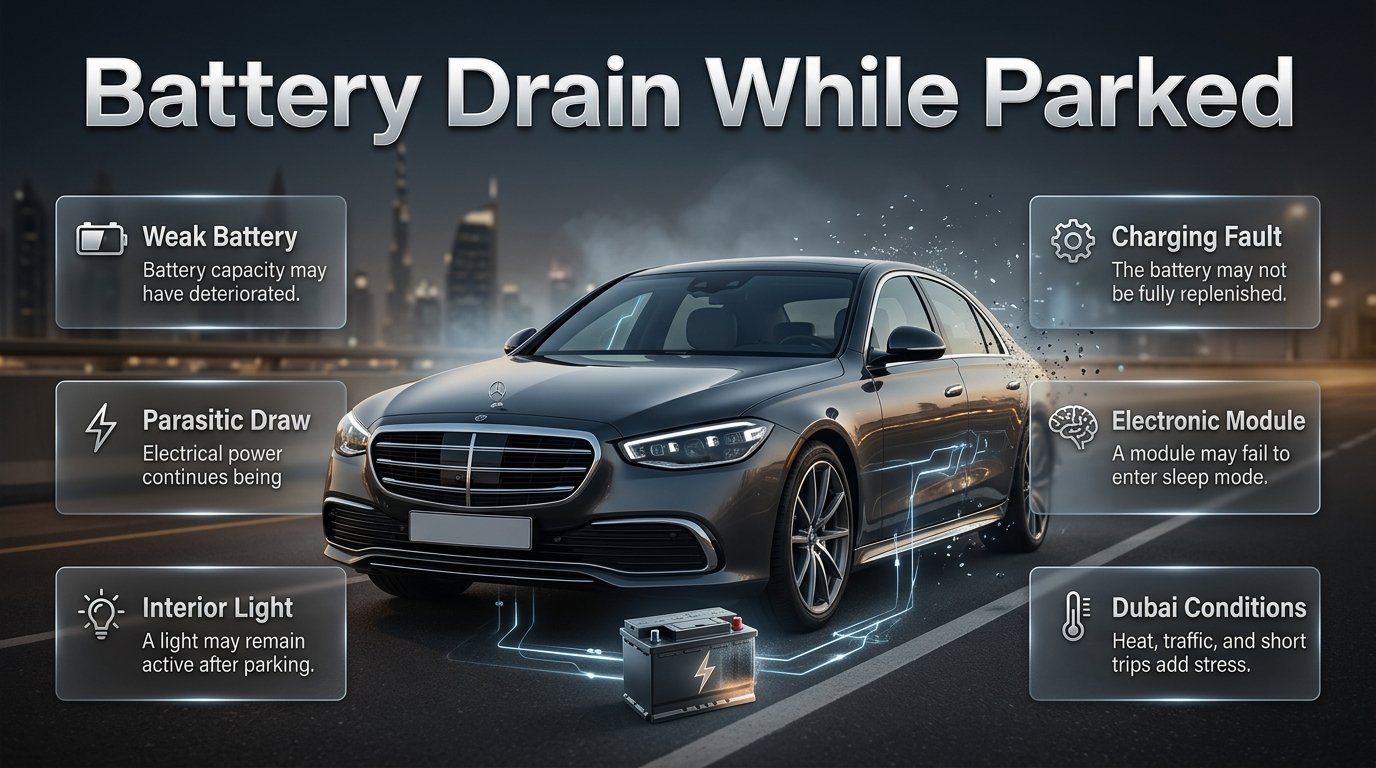
Battery Drain While Parked | A car battery that goes flat while the vehicle is parked can be frustrating, especially when the battery seemed perfectly normal the last time you drove. Battery drain while parked usually means that electrical power is being consumed when the vehicle should be in its normal resting state. Sometimes the cause is simple, such as an interior light being left on. In other cases, the problem may involve a parasitic electrical draw, a weak battery, a charging-system fault, or a modern electronic module that fails to enter sleep mode.
This issue matters because repeatedly discharging a battery can reduce its service life and leave you unable to start the vehicle when you need it. In Dubai, frequent air-conditioning use, high temperatures, heavy traffic, short journeys, and extensive electronic equipment can add further stress to a vehicle’s electrical system.
Understanding why a battery loses charge while parked helps prevent unnecessary battery replacement. A proper diagnosis should determine whether the battery itself is failing or whether another component is continuously consuming electricity.
For drivers dealing with repeated electrical problems, professional Vehicle Inspection, battery testing, and electrical diagnosis can identify the actual source instead of simply treating the symptom. EuroSwift Auto Services
What Does Battery Drain While Parked Mean?
A vehicle normally continues to use a small amount of electricity after the engine is switched off. Modern cars have electronic control units, security systems, clocks, keyless-entry systems, alarm systems, memory functions, and other modules that require a limited amount of standby power.
The important distinction is between normal standby consumption and excessive electrical drain.
After the vehicle has been parked for an appropriate period, many electronic systems should enter a low-power sleep state. If a component remains active or repeatedly wakes up, it can consume enough electricity to discharge the battery.
A simplified way to understand the problem is:
Battery discharge = electrical consumption over time exceeding the battery’s available capacity.
A healthy battery may tolerate normal standby consumption for a reasonable period. A weak or partially discharged battery, however, may lose its ability to provide sufficient starting power much sooner.
This is why two apparently identical vehicles can behave differently after sitting overnight.
One may start normally while another struggles or produces only clicking sounds.
How a Car Battery Should Behave When the Vehicle Is Parked
When you switch off the engine, the vehicle does not necessarily become completely electrically inactive.
Several systems may remain operational, including:
- Security and alarm systems
- Remote locking receivers
- Vehicle computers
- Clock and memory functions
- Keyless-entry systems
- Telematics equipment
- Certain monitoring systems
- Factory-installed tracking features
These systems are designed to consume very little power.
The problem begins when something prevents the vehicle from entering its normal sleep condition or when an electrical component continues drawing more current than intended.
Normal standby activity vs excessive drain
| Condition | Typical situation | Concern |
|---|---|---|
| Normal standby | Vehicle electronics enter sleep mode | Usually no issue |
| Door or boot left open | Interior systems remain active | Can discharge battery |
| Accessory left connected | Device continues consuming power | Possible drain |
| Faulty electronic module | Module fails to sleep | Significant concern |
| Wiring problem | Current leaks through unintended path | Requires diagnosis |
| Weak battery | Reduced usable capacity | May fail quickly |
| Charging fault | Battery was not fully replenished | Can appear like parked drain |
The important point is that a dead battery does not automatically prove that the battery itself is defective.
Common Causes of Battery Drain While Parked
There are several possible causes, and the most efficient diagnosis starts by separating battery condition from electrical consumption.
1. Interior or Boot Lights Remaining On
One of the simplest causes is also one of the easiest to overlook.
A glovebox light, boot light, vanity mirror light, or interior lamp may remain illuminated because a switch, latch, or sensor is not operating correctly.
The vehicle may appear completely switched off from the driver’s perspective while a small light continues consuming electricity.
A faulty boot latch sensor can be particularly difficult to notice because the problem may not be visible from outside the vehicle.
2. Aftermarket Accessories
Modern vehicles often receive aftermarket electrical equipment such as:
- Dash cameras
- GPS trackers
- Additional alarms
- Audio equipment
- Parking-monitoring devices
- USB accessories
- Bluetooth adapters
- Lighting equipment
Poor installation can create a continuous electrical load.
Some accessories are designed to remain active while parked, particularly dash cameras with parking-monitoring functions. If configured incorrectly, they can consume more battery power than expected.
The correct approach is not automatically to remove the accessory. A technician should determine whether it is operating within an appropriate electrical configuration.
3. Faulty Electronic Control Module
Modern vehicles contain numerous control modules.
A module that fails to enter sleep mode may repeatedly communicate with other systems or remain active after the vehicle has been locked.
This can create an intermittent drain that is difficult to identify because the vehicle may behave normally while driving.
Advanced Engine Diagnostics and electrical diagnostic equipment can help identify abnormal module activity.
4. Weak or Aging Battery
Sometimes the vehicle has no abnormal electrical drain at all.
The battery itself may have lost capacity.
Battery aging can reduce the amount of energy available for starting and shorten the amount of time the vehicle can remain parked before voltage falls too low.
This becomes especially noticeable when:
- The battery is several years old.
- The vehicle is driven mostly on short journeys.
- The battery has been deeply discharged previously.
- The vehicle operates in demanding temperatures.
- The charging system has not been functioning correctly.
A battery that repeatedly goes flat should therefore be tested rather than immediately replaced.
5. Alternator or Charging-System Problems
The alternator is responsible for replenishing the battery while the engine is running.
If charging performance is inadequate, the battery may never become fully charged.
The driver may then park the car believing the battery is healthy, only to find that it does not have enough reserve capacity the following day.
This creates a situation that can look like battery drain while parked, even though the original problem happened while driving.
6. Faulty Wiring or Electrical Leakage
Damaged wiring, incorrect connections, corrosion, or electrical modifications can create unintended current paths.
These problems can be particularly challenging because they may not produce an obvious warning light.
A professional technician may need to inspect wiring, connectors, fuses, relays, and individual circuits to isolate the source.
Symptoms That Suggest Your Battery Is Draining While Parked
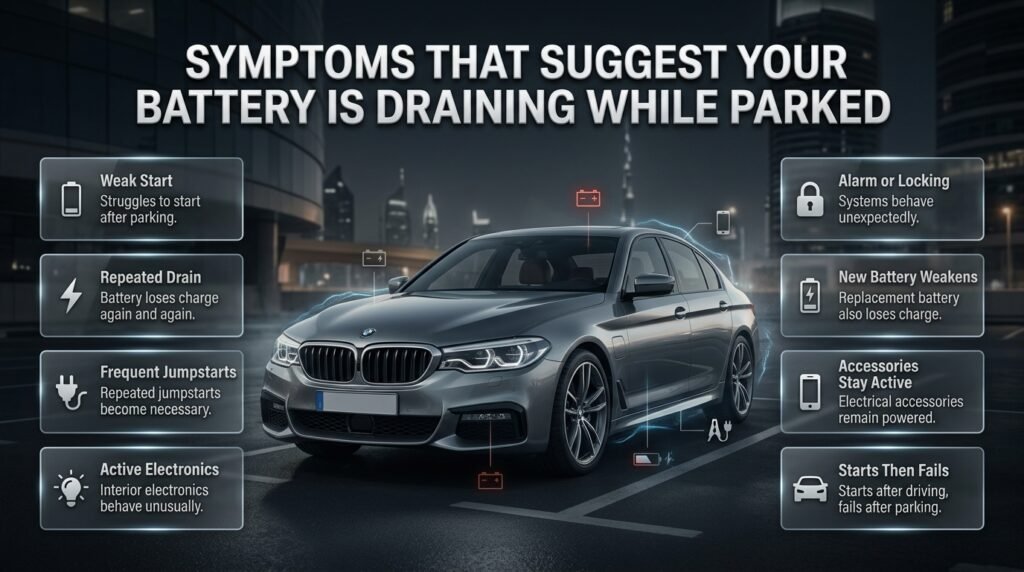
A completely dead battery is the most obvious symptom, but it is not the only warning sign.
Drivers should pay attention to repeated patterns.
Common warning signs
✔ Vehicle struggles to start after sitting overnight
✔ Battery is weak after several days of parking
✔ You need frequent jumpstarts
✔ Interior electronics behave unusually after parking
✔ Alarm or locking systems operate unexpectedly
✔ Battery repeatedly loses charge despite replacement
✔ New battery develops the same problem
✔ Electrical accessories remain active after the car is locked
✔ Vehicle starts normally after driving but fails after sitting
✔ Battery voltage drops significantly after the vehicle has been parked
One failed start does not necessarily mean there is a parasitic drain. The vehicle may simply have an aging battery or charging-system problem.
Repeated failure is what makes professional diagnosis increasingly important.
Battery Drain Overnight: Why Does It Happen?
When a vehicle starts normally in the evening but struggles or fails the next morning, drivers often assume the battery suddenly failed.
That is not always the case.
An overnight discharge can occur when an electrical system remains active for several hours.
For example, an accessory that draws electricity continuously may not cause an immediate problem. Over a longer period, however, the cumulative energy consumption can become significant.
The battery’s starting performance can also be affected by its existing state of charge.
If the battery was already partially discharged because of short trips or insufficient charging, only a relatively small additional electrical load may be enough to cause a starting problem.
Overnight troubleshooting checklist
Before arranging a battery replacement, consider:
- Was the vehicle fully locked?
- Was the boot completely closed?
- Could a glovebox or interior light remain active?
- Was a dash camera connected?
- Were USB accessories left plugged in?
- Was an aftermarket tracker installed?
- Did the problem begin after electrical modifications?
- Has the battery recently been replaced?
- Has the alternator been tested?
- Has the vehicle required jumpstarting recently?
These questions help narrow the diagnostic path.
Parasitic Battery Drain: What It Actually Means
The term parasitic drain describes electrical consumption that continues when the vehicle is switched off and the relevant systems should have entered their normal low-power state.
Some standby consumption is expected.
The concern is excessive or abnormal current draw.
A professional diagnostic process generally involves allowing the vehicle to reach its appropriate resting condition and then measuring electrical current consumption. If the measured draw is higher than expected, the technician can investigate individual circuits.
This may involve checking:
- Fuse circuits
- Relays
- Control modules
- Lighting systems
- Infotainment equipment
- Security systems
- Accessories
- Charging-system components
- Wiring
Because modern vehicles can take time to enter sleep mode, immediately measuring the vehicle after switching the ignition off may produce misleading results.
How Professionals Diagnose Battery Drain While Parked
A proper electrical diagnosis is more than checking whether the battery has voltage.
The technician generally needs to establish three separate facts:
1. Is the battery healthy?
2. Is the charging system functioning properly?
3. Is excessive electrical current being consumed while parked?
Professional inspection sequence
| Diagnostic stage | What is checked | Why it matters |
|---|---|---|
| Battery inspection | Condition and physical state | Identifies obvious battery problems |
| Voltage testing | Resting voltage | Shows state of charge |
| Load/conductance testing | Battery performance | Helps assess usable starting capability |
| Charging test | Alternator output | Confirms battery is being replenished |
| Sleep-state evaluation | Electronic shutdown | Identifies modules staying active |
| Current measurement | Key-off electrical draw | Detects abnormal consumption |
| Circuit isolation | Fuses/modules/accessories | Locates the source |
| Repair verification | Re-test after correction | Confirms the problem is resolved |
This approach prevents unnecessary parts replacement.
Why Replacing the Battery May Not Fix the Problem
One of the most common mistakes is replacing the battery without identifying why the previous battery discharged.
A new battery may temporarily solve the starting problem because it has greater reserve capacity.
But if the vehicle still has an excessive electrical draw, the replacement battery can eventually become discharged as well.
The same applies to charging-system problems.
If an alternator is not adequately replenishing the battery, installing another battery does not correct the underlying fault.
Battery replacement makes sense when:
- The battery fails testing.
- Capacity has significantly deteriorated.
- The battery has reached the end of its useful service life.
- Internal damage has occurred.
- The correct battery specification is required after diagnosis.
Electrical repair makes more sense when:
- A module remains active.
- An accessory is drawing excessive power.
- A light stays on.
- Wiring has a fault.
- A relay remains energized.
- Charging-system problems are present.
The right repair depends on the evidence obtained during testing.
AGM, EFB and Conventional Batteries: Does Battery Type Matter?
Battery technology matters, particularly in modern vehicles equipped with start-stop systems and higher electrical loads.
Conventional flooded batteries, EFB batteries, and AGM batteries have different designs and operating characteristics.
An AGM-equipped vehicle should generally receive the correct AGM specification rather than an unsuitable substitute.
If your vehicle requires AGM technology, professional Battery Replacement should consider the manufacturer’s specifications, battery dimensions, terminal configuration, capacity, starting performance, and vehicle charging requirements.
EuroSwift Auto Services also provides dedicated information for different battery technologies and brands, including its AGM battery replacement service.
For drivers comparing different replacement options, understanding the difference between battery technology and battery brand is important. The most expensive battery is not automatically the correct battery for every vehicle.
Battery Drain in Dubai: Why Local Driving Conditions Matter
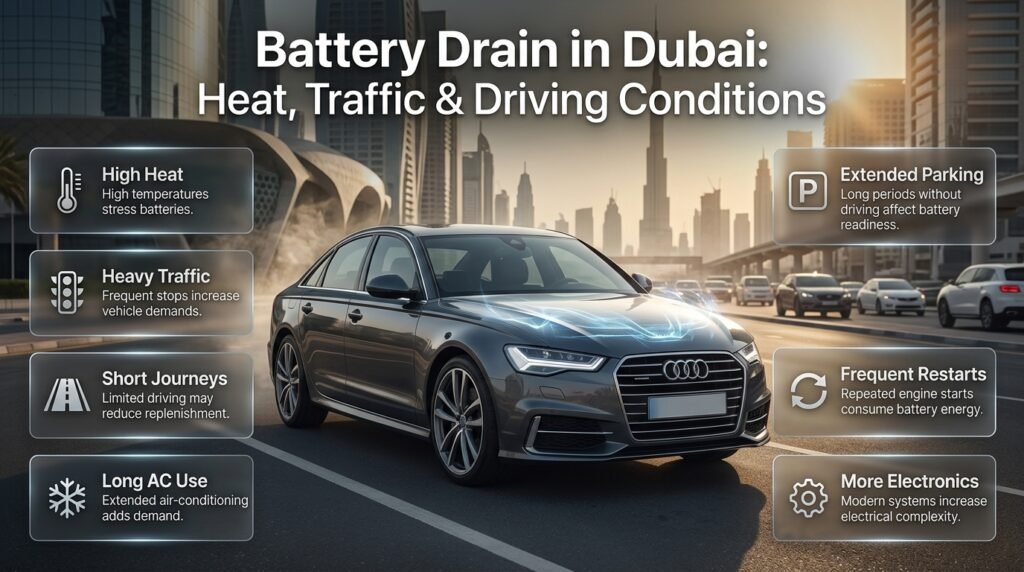
Dubai’s operating environment can place significant demands on vehicle electrical systems.
High ambient temperatures can accelerate battery aging, while extensive air-conditioning use increases the overall electrical and mechanical demands placed on the vehicle.
Urban driving can also involve frequent stops, short journeys, traffic congestion, and repeated engine restarts.
These conditions matter because a vehicle that is driven only for short periods may not fully replenish the energy consumed during starting and accessory operation.
Dubai driving patterns that deserve attention
✔ Frequent short-distance journeys
✔ Heavy traffic
✔ Long periods of air-conditioning use
✔ Extended parking periods
✔ High ambient temperatures
✔ Frequent stop-start operation
✔ Vehicles equipped with numerous electronic systems
A vehicle used differently from the way it was designed to operate may need more frequent inspection and preventive maintenance.
How Short Trips Can Contribute to Battery Problems
A common misconception is that driving automatically recharges the battery sufficiently.
The reality depends on the duration and conditions of the drive.
Starting the engine requires substantial electrical energy. The alternator then replenishes the battery while also supporting the vehicle’s electrical systems.
If a vehicle is repeatedly driven for very short distances, the charging period may be insufficient to fully recover the energy used during starting.
This does not necessarily create a parasitic drain.
Instead, it can leave the battery operating at a lower state of charge, making it more vulnerable to failure after the vehicle is parked.
That distinction is important during diagnosis.
Can a Dash Cam Drain a Car Battery While Parked?
Yes, depending on how it is installed and configured.
A dash camera with parking surveillance can continue operating after the ignition is switched off.
Some systems use a dedicated hardwire kit with voltage protection or another battery-protection strategy. Others may be connected to a power source that allows continued operation without appropriate battery protection.
The key issue is not simply whether a dash cam exists.
The technician needs to determine:
- How it receives power
- Whether it remains active after shutdown
- How much current it consumes
- Whether low-voltage protection works correctly
- Whether installation has affected another circuit
If the battery problem started after a dash cam or other accessory was installed, that timeline is an important diagnostic clue.
Can a Car Alarm Cause Battery Drain?
A properly functioning factory alarm system normally operates within the vehicle’s intended electrical design.
However, a faulty alarm, aftermarket security system, sensor, siren, or control module can potentially contribute to excessive electrical consumption.
An alarm system that repeatedly wakes the vehicle or remains active when it should not may gradually discharge the battery.
This is another reason why simply replacing the battery may not provide a lasting solution.
The electrical system should be evaluated if the battery continues going flat after replacement.
What Happens When a Battery Is Repeatedly Discharged?
Repeated deep discharge can be harmful to a lead-acid automotive battery.
A battery is designed to provide starting power and then be replenished by the vehicle’s charging system.
When it is repeatedly discharged too deeply, its ability to deliver reliable starting performance can deteriorate.
This creates a frustrating cycle:
Electrical fault → battery discharge → reduced battery condition → more frequent starting problems → replacement battery → unresolved electrical fault.
The best way to break that cycle is to identify the original cause.
If the battery has already been damaged by repeated discharge, correcting the electrical drain may still leave the vehicle needing a battery replacement.
What Should You Do If Your Car Battery Is Dead?
If the vehicle will not start because the battery is discharged, avoid repeatedly attempting to start it.
Repeated attempts may further reduce the available charge.
A professional Car Jumpstart can restore enough electrical power to start the vehicle when appropriate, but a jumpstart should be viewed as a recovery measure rather than a diagnosis.
After the vehicle starts, the underlying cause should still be investigated if the discharge was unexpected.
Professional Roadside Assistance can be especially useful when the vehicle is stranded away from home, at work, or in a parking facility.
After recovery, battery condition and charging performance should be checked before assuming that normal driving has solved the problem.
Battery Drain Troubleshooting Guide
Use the following guide to understand what different situations may indicate.
| Symptom | Possible cause | Recommended direction |
|---|---|---|
| Dead after one night | Light, accessory, severe battery weakness | Inspect battery and key-off draw |
| Dead after several days | Excessive standby draw or weak battery | Electrical diagnosis |
| Starts after jumpstart but fails next day | Drain or battery/charging issue | Test all three systems |
| New battery repeatedly goes flat | Underlying electrical fault | Investigate parasitic draw |
| Battery weak after short trips | Insufficient charging time or aging battery | Test battery and charging system |
| Problem began after accessory installation | Accessory or wiring | Inspect installation |
| Battery warning light while driving | Charging-system concern | Charging-system inspection |
| Battery voltage appears normal but vehicle fails | Capacity/start performance issue | Load or conductance testing |
The table is only a diagnostic starting point. Electrical symptoms can overlap, which is why professional testing is more reliable than guessing.
Preventing Battery Drain While Parked
Prevention starts with understanding how the vehicle is used.
Before leaving the vehicle
✔ Check that doors, boot, and glovebox are fully closed.
✔ Confirm that interior lights have switched off.
✔ Remove unnecessary accessories from power sockets.
✔ Check dash-camera parking-mode settings.
✔ Avoid leaving electronic devices connected unnecessarily.
✔ Lock the vehicle normally so its systems can enter their intended sleep state.
As part of regular maintenance
✔ Have the battery tested periodically.
✔ Check charging-system performance.
✔ Inspect battery terminals for corrosion or poor connections.
✔ Address repeated starting problems promptly.
✔ Investigate repeated jumpstart requirements.
✔ Inspect aftermarket electrical installations.
✔ Follow the correct battery specification for the vehicle.
Preventive Vehicle Maintenance is generally less disruptive than dealing with a vehicle that will not start unexpectedly.
How Long Can a Car Sit Before the Battery Goes Flat?
There is no single number that applies to every vehicle.
The result depends on:
- Battery age
- Battery capacity
- State of charge
- Vehicle electrical consumption
- Ambient temperature
- Vehicle electronics
- Installed accessories
- Battery condition
- Charging history
A healthy vehicle with a healthy battery and normal standby consumption can generally tolerate periods of parking better than a vehicle with a weak battery or excessive electrical draw.
If you regularly leave a vehicle parked for extended periods, it is worth discussing appropriate battery-maintenance practices with a qualified technician rather than relying on assumptions.
Battery Drain vs Battery Failure: How to Tell the Difference
These two problems can produce almost identical symptoms.
The distinction is important because the repair is completely different.
| Battery drain | Battery failure |
|---|---|
| Electrical system consumes excessive power | Battery itself has deteriorated |
| Vehicle may repeatedly discharge battery | Battery cannot provide adequate performance |
| New battery may also discharge | New correct battery may solve problem |
| Key-off current may be abnormal | Battery testing may show poor condition |
| Electrical fault needs investigation | Replacement may be appropriate |
There can also be a third scenario: charging-system failure.
In that case, the battery may be healthy enough to start the vehicle initially but is not being properly replenished during driving.
Professional diagnosis should therefore evaluate the complete electrical system.
When Professional Battery and Electrical Diagnosis Is Recommended
Professional inspection becomes particularly important when the problem is recurring.
You should consider professional diagnosis when:
- The battery repeatedly dies while parked.
- A recently installed battery becomes discharged.
- The vehicle needs frequent jumpstarts.
- Electrical accessories remain active.
- The issue started after an electrical modification.
- The car has complex electronic systems.
- Charging-system testing does not explain the problem.
- Battery voltage alone does not explain the starting failure.
- The vehicle is regularly parked for long periods.
- You are preparing a vehicle for extended storage.
A qualified technician can use systematic testing rather than replacing parts based on symptoms alone.
For drivers who need a broader Car Service, the battery issue can also be assessed alongside other maintenance requirements rather than treated as an isolated problem.
Battery Replacement: Choosing the Correct Battery
If testing confirms that the battery itself needs replacement, selecting the correct specification is more important than simply choosing a battery with the largest available capacity.
Important considerations include:
- Battery technology
- Physical dimensions
- Terminal arrangement
- Capacity
- Cold-cranking performance
- Start-stop compatibility
- Manufacturer specifications
- Vehicle electrical architecture
Brand selection can then be considered within the correct specification.
EuroSwift Auto Services offers dedicated battery replacement information for several major brands, including Amaron Battery replacement, Bosch Battery replacement and Tuflong Battery replacement.
Other available options include Exide Battery replacement, Panasonic Battery replacement and FIAMM Battery replacement.
For vehicles using other battery specifications, AC Delco Battery replacement is another dedicated option.
The correct choice should always be based on the vehicle’s requirements rather than brand popularity alone.
Understanding Battery Replacement Cost in Dubai
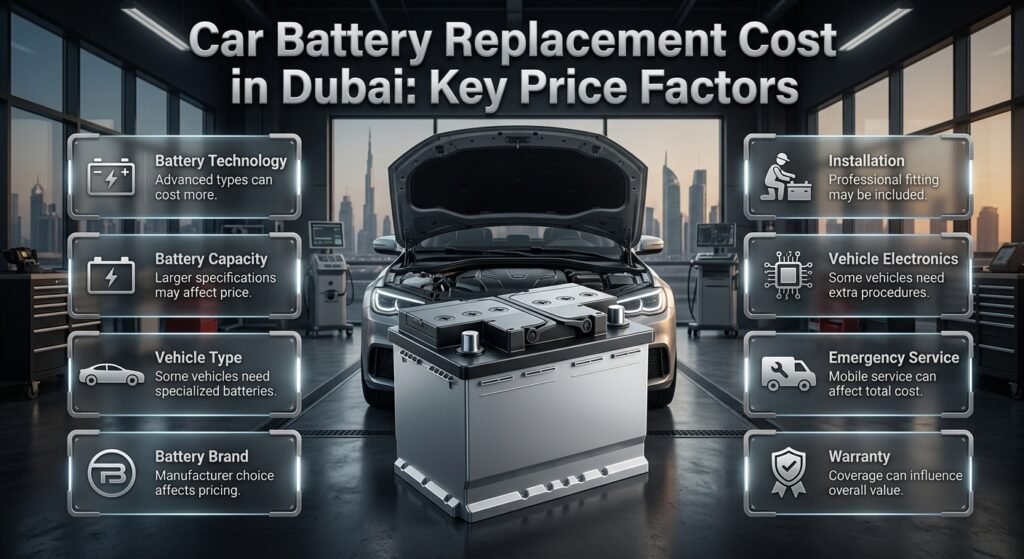
Battery replacement pricing can vary considerably depending on the vehicle and battery specification.
Factors can include:
| Cost factor | Why it affects price |
|---|---|
| Battery technology | AGM and other advanced types can cost more |
| Battery capacity | Larger specifications may increase cost |
| Vehicle type | Some vehicles require specialized batteries |
| Brand | Pricing differs between manufacturers |
| Installation | Professional fitting may be included |
| Vehicle electronics | Some vehicles require additional procedures |
| Emergency service | Mobile or roadside assistance can affect pricing |
| Warranty | Longer or broader coverage can influence total value |
Drivers comparing prices should therefore compare the complete service rather than looking only at the battery’s purchase price.
EuroSwift Auto Services also provides a dedicated Car Battery Prices in Dubai 2026 guide for drivers researching replacement costs and specifications.
What Modern Vehicles Are Changing About Battery Diagnosis
Vehicle electrical systems are becoming increasingly sophisticated.
Modern cars may include:
- Start-stop technology
- Intelligent battery sensors
- Multiple control modules
- Advanced driver-assistance systems
- Keyless entry
- Connected vehicle services
- Remote communication
- Electrically controlled accessories
This means battery diagnosis increasingly involves communication between electronic systems rather than simply measuring voltage.
A battery can show an apparently reasonable voltage reading while still having insufficient starting capability.
Likewise, a vehicle can have a healthy battery while an electronic module creates excessive current consumption.
Modern Vehicle Diagnostics therefore needs to consider both electrical measurements and vehicle communication data.
The Importance of Battery Monitoring Systems
Many newer vehicles use battery monitoring technology to track battery condition and electrical usage.
These systems can monitor factors such as:
- Battery voltage
- Current flow
- Charging behavior
- Battery temperature
- Electrical demand
- State of charge
Depending on the vehicle, battery replacement procedures may also involve electronic registration or configuration.
This is one reason why professional battery replacement can be preferable to treating every vehicle as if it had a simple conventional electrical system.
Common Mistakes That Make Battery Problems Worse
Some habits can turn a manageable electrical problem into repeated breakdowns.
Mistake 1: Replacing the battery immediately
A replacement battery may hide the problem temporarily without fixing the underlying cause.
Mistake 2: Assuming the alternator is automatically healthy
The fact that the engine runs does not prove that the charging system is functioning correctly.
Mistake 3: Ignoring aftermarket accessories
Dash cams, trackers, alarms, and audio systems can change the vehicle’s electrical behavior.
Mistake 4: Using only a voltage reading
Voltage provides useful information, but it does not tell the complete story about battery capacity or key-off electrical consumption.
Mistake 5: Repeatedly relying on jumpstarts
A jumpstart gets the vehicle running but does not identify why the battery became discharged.
Mistake 6: Ignoring intermittent symptoms
Electrical problems can disappear temporarily and return later. Intermittent behavior should not automatically be dismissed.
Professional Battery Drain Inspection Checklist
A comprehensive inspection should consider the vehicle as a complete system.
Battery
- Physical condition
- Terminal condition
- State of charge
- Starting performance
- Battery technology
- Age and service history
Charging system
- Alternator operation
- Charging voltage
- Charging behavior under load
- Related wiring and connections
Electrical system
- Key-off current
- Sleep-mode behavior
- Fuse circuits
- Relays
- Control modules
- Interior lighting
- Security systems
Accessories
- Dash cameras
- GPS trackers
- Audio systems
- Aftermarket alarms
- USB devices
- Additional lighting
- Other modifications
Final verification
After the suspected fault is corrected, the vehicle should be tested again to confirm that the abnormal drain has actually been eliminated.
This final step is important because finding a possible cause is not the same as proving the repair worked.
Battery Drain While Parked: When Repair Is Better Than Replacement
Not every electrical problem requires a new battery.
If a light is staying on, repairing the switch may solve the problem.
If an aftermarket accessory is incorrectly installed, correcting its wiring may be enough.
If a module remains awake, diagnosing or replacing that component may be necessary.
If the alternator is undercharging the battery, charging-system repair is more appropriate.
Replacement becomes necessary when testing demonstrates that the battery itself can no longer provide reliable performance.
This repair-first approach helps prevent unnecessary expenses and gives the vehicle a better chance of remaining reliable.
Preventive Maintenance Plan for Drivers
A practical maintenance approach can reduce unexpected battery problems.
| Maintenance action | Recommended purpose |
|---|---|
| Battery condition check | Identify deterioration early |
| Charging-system inspection | Confirm proper replenishment |
| Terminal inspection | Prevent poor electrical connections |
| Accessory review | Identify unnecessary electrical load |
| Periodic vehicle inspection | Catch related mechanical/electrical issues |
| Prompt diagnosis of starting problems | Prevent repeated discharge |
| Correct battery specification | Maintain electrical-system compatibility |
Battery care should also be considered part of broader Car Repair and preventive maintenance rather than a completely separate concern.
A vehicle that receives regular Oil Change, Brake Repair, Suspension Repair, AC Repair, Wheel Alignment, and general maintenance may be less likely to develop neglected problems that eventually affect reliability.
Battery Drain and Long-Term Vehicle Storage
Extended parking requires additional consideration.
A vehicle sitting unused for weeks can gradually lose battery charge even when its electrical systems are functioning normally.
The situation becomes more difficult when the battery is already aged or partially discharged.
Before extended storage, owners should consider the vehicle manufacturer’s recommendations and, where appropriate, professional advice about battery maintenance.
Luxury vehicles and electronically complex vehicles may require additional consideration because they can contain more systems that remain active while parked.
This is where specialist Luxury Car Service and electronic diagnostic experience can be valuable.
Industry Best Practice: Diagnose the Cause, Not the Symptom
The strongest approach to battery drain diagnosis is straightforward:
Test first. Replace or repair based on evidence.
A professional technician should not automatically assume:
Dead battery = bad battery.
Instead, the diagnostic question should be:
Why did the battery become discharged?
That question leads to a more reliable process.
If the battery is healthy but an electrical module is consuming excessive power, the battery is not the root cause.
If the battery is failing but electrical consumption is normal, replacement may be appropriate.
If charging performance is inadequate, the alternator or charging system needs attention.
This diagnostic mindset is especially important in modern vehicles where electrical systems are increasingly interconnected.
Future Outlook for Automotive Battery Management
Vehicle electrical systems are expected to become even more sophisticated as connected-car technology, electrification, advanced driver-assistance systems, and intelligent energy management continue developing.
Battery monitoring is increasingly moving toward more detailed electronic assessment rather than simple voltage measurement.
Vehicles may become better at identifying abnormal energy consumption and warning drivers before a complete starting failure occurs.
For technicians, this means modern Mechanical Repair is increasingly connected with electronic diagnostics, battery management, software communication, and system-level troubleshooting.
The future of automotive maintenance is therefore not simply about replacing worn components. It is about understanding how mechanical, electrical, and electronic systems interact.
Why Does My Car Battery Keep Dying While Parked Overnight?
A battery that repeatedly dies while the car is parked usually means there is a problem that needs to be identified rather than simply assuming the battery is bad. The main possibilities are an excessive parasitic electrical draw, a battery that has lost its ability to hold a charge, or a charging system that is not fully replenishing the battery during driving. Modern vehicles continue using a small amount of electricity after shutdown for security systems, memory functions, clocks, keyless-entry systems, and electronic modules. That small standby demand is normal; the concern is when a component stays active or the battery has insufficient capacity.
Common causes worth investigating include:
A glovebox, boot, or interior light staying on
An aftermarket dash camera or tracker
An alarm or audio system that is incorrectly installed
A control module that fails to enter sleep mode
A stuck relay
A battery that has deteriorated
An alternator or charging-system fault
Professional recommendation: If the same problem occurs repeatedly, don’t keep replacing batteries without diagnosis. A proper inspection should evaluate the battery condition, charging system, and key-off electrical consumption so the actual cause can be identified.
What Is Draining My Car Battery When the Engine Is Off?
When the engine is off, a vehicle is not necessarily using zero electricity. Modern cars maintain certain functions even when parked, including security systems, computer memory, remote-entry receivers, clocks, and other electronic systems. The vehicle should eventually enter a low-power state, but a faulty component or accessory can prevent that from happening.
The most common areas to investigate are:
Interior lighting: A faulty door, boot, or glovebox switch can leave a light operating.
Aftermarket accessories: Dash cams, trackers, alarms, amplifiers, and other equipment can continue consuming power.
Electronic modules: A module that does not enter sleep mode can keep part of the vehicle network awake.
Relays: A stuck relay can leave a circuit energized after the vehicle is switched off.
Alternator: A failed diode can allow unwanted current flow through the charging system while parked.
The important point is that the source cannot reliably be identified from the dead-battery symptom alone. Professional electrical diagnosis is useful because the same symptom can come from completely different components.
Can a Bad Alternator Cause a Battery to Drain While the Car Is Parked?
Yes, but there are two different alternator-related problems that should not be confused.
The first is undercharging. If the alternator is not properly replenishing the battery while the engine is running, the battery may gradually become undercharged. The driver then parks the car with less available energy, and the vehicle may fail to start later. This can look like a parked battery drain even though the battery was not actually being drained excessively while parked.
The second possibility is an alternator diode fault. A damaged diode can allow current to flow in an unintended direction when the engine is off, contributing to a parasitic electrical draw.
A professional diagnosis should therefore separate:
Possible problem
What happens
Weak battery
Battery cannot retain or deliver sufficient energy
Undercharging alternator
Battery is not properly replenished while driving
Alternator diode fault
Unwanted electrical consumption may occur while parked
Parasitic draw elsewhere
Another circuit continues consuming power
Best practice: Test the battery and charging system before concluding that the alternator is responsible. This avoids replacing an expensive component based only on the symptom.
Why Does My New Car Battery Keep Dying After the Car Is Parked?
When a new battery keeps going flat, the battery itself should not automatically be blamed. In fact, repeated failure of a replacement battery is an important clue that something else may be wrong.
A parasitic electrical draw can discharge a new battery just as it discharged the previous one. Similarly, an alternator that is not charging correctly can leave the new battery continually undercharged. Aftermarket electrical equipment is another common area to investigate, particularly if the problem began after a dash camera, alarm, tracker, sound system, or other accessory was installed.
Look for this pattern:
Old battery repeatedly became weak.
Battery was replaced.
Vehicle initially operated normally.
New battery also became discharged after parking.
Jumpstarting temporarily restored the vehicle.
The problem returned after another period of parking.
That pattern strongly suggests the vehicle needs diagnostic testing rather than another battery replacement.
A professional technician should verify the replacement battery’s condition, confirm charging performance, and investigate excessive key-off current if appropriate. This approach protects the new battery from repeated deep discharge and prevents unnecessary spending.
How Can I Stop My Car Battery From Draining While Parked?
Preventing battery drain starts with finding out whether the problem is caused by the battery, charging system, or an abnormal electrical load. There is no single maintenance trick that fixes every case.
For everyday prevention, pay attention to anything that could remain electrically active after you leave the vehicle. Make sure doors, the boot, and glovebox are properly closed, and review the installation and settings of aftermarket equipment such as dash cameras or trackers. If the vehicle has repeatedly required jumpstarts, arrange a battery and electrical-system inspection rather than continuing to recharge it and hoping the problem disappears.
A practical prevention checklist
Have the battery condition checked periodically.
Check the charging system if the battery is repeatedly weak.
Inspect battery terminals and connections.
Review aftermarket electrical accessories.
Don’t ignore repeated overnight starting problems.
Investigate unusual electrical behavior promptly.
Use the correct battery specification for the vehicle.
Consider the manufacturer’s recommendations when storing the vehicle for extended periods.
For Dubai drivers, regular battery inspection can be particularly worthwhile because high ambient temperatures, frequent short trips, heavy traffic, extensive air-conditioning use, and long parking periods can all make battery reliability more important.
The biggest professional takeaway is simple: if your car repeatedly loses battery power while parked, diagnose the cause instead of treating every dead battery as a battery-replacement problem.
Conclusion
Battery drain while parked is more than an inconvenience—it can be a warning that something in the vehicle’s electrical system needs attention. A weak battery, excessive parasitic draw, faulty wiring, aftermarket accessories, an electronic module that fails to enter sleep mode, or a charging-system problem can all leave a vehicle unable to start after sitting.
The right solution is to identify the cause before replacing parts. Battery condition testing, charging-system checks, and professional electrical diagnosis can determine whether the vehicle actually needs Battery Replacement or whether another component is responsible for the repeated discharge.
For Dubai drivers, regular Vehicle Maintenance is particularly important because high temperatures, short journeys, traffic congestion, and extensive electrical and AC use can place additional demands on the vehicle. Addressing warning signs early can help prevent repeated jumpstarts and unexpected roadside breakdowns.
If your battery continues to lose charge while the vehicle is parked, professional Car Service, Vehicle Inspection, and electrical diagnosis can help restore dependable starting performance. Proper diagnosis today can save you from repeated battery replacements and help keep your vehicle reliable for everyday driving.

Leave a Reply