
Introduction
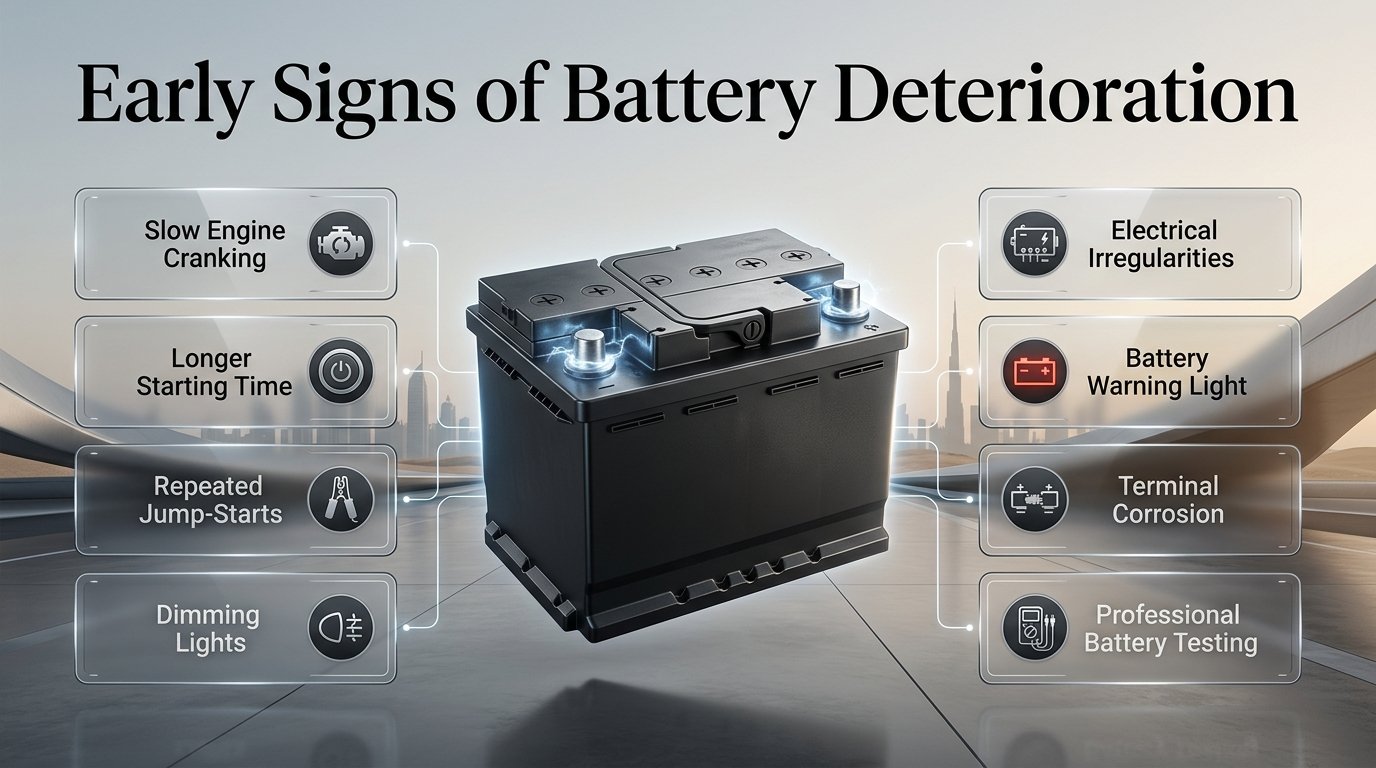
Early Signs of Battery Deterioration | A car battery can appear perfectly normal right up until the moment it struggles to start the engine. That is why understanding the early signs of battery deterioration is much more useful than waiting for a complete battery failure. As a battery ages, its ability to store energy and provide the high electrical current required during engine startup gradually decreases. The vehicle may continue to operate normally for some time, but subtle changes in starting performance, electrical behavior, and battery condition can indicate that its reliability is declining.
For drivers in Dubai, battery condition deserves particular attention. High ambient temperatures, frequent air-conditioning use, traffic congestion, short journeys, and long periods of parking can all place additional demands on the vehicle’s electrical system. A battery that appears acceptable during a basic visual inspection may still have reduced starting capacity.
EuroSwift Auto Services provides automotive support for drivers who need professional diagnosis, maintenance, and battery-related assistance in Dubai. Recognizing deterioration early gives you an opportunity to investigate the actual cause before a minor warning develops into an inconvenient starting problem.
This guide explains the most important early symptoms of battery deterioration, why they occur, how Dubai’s driving environment can affect battery performance, how professionals test battery condition, and when inspection or replacement becomes the sensible option.
What Does Battery Deterioration Actually Mean?
Battery deterioration is the gradual loss of a battery’s ability to store electrical energy and deliver sufficient current when the vehicle needs it. A battery does not necessarily become completely unusable as soon as deterioration begins. Instead, its performance can decline progressively.
A healthy starting battery needs to deliver substantial electrical current for a short period while the starter motor turns the engine. It also needs to recover its charge through the vehicle’s charging system and supply electrical power when required.
As the battery ages, its internal ability to perform these tasks decreases. The result can be a vehicle that still starts successfully but requires more effort from the battery during startup.
This distinction is important because many drivers consider a battery healthy simply because the engine starts. In reality, successful starting does not necessarily mean the battery has plenty of reserve capacity remaining.
A deteriorating battery may still start the vehicle today and struggle tomorrow.
The early stage is therefore the ideal time for diagnosis. Instead of waiting for a complete failure, drivers can investigate changes in starting behavior and determine whether the battery remains suitable for continued use.
The First Sign: Slower Engine Cranking
One of the most noticeable early symptoms is slow engine cranking.
When you turn the key or press the start button, the starter motor should rotate the engine with consistent strength. If the engine suddenly sounds as though it is turning more slowly than usual, the battery deserves attention.
The change can be subtle. You may notice that the engine takes slightly longer to turn over in the morning. You may hear a weaker cranking sound compared with previous weeks. In some cases, the vehicle starts normally after sitting for a shorter period but struggles after being parked overnight.
A single slow start does not automatically prove that the battery is failing. Temperature, electrical connections, starter condition, charging performance, and other factors can influence cranking speed.
However, repeated changes should not be ignored.
If slow cranking becomes a pattern, professional battery testing can determine whether the battery has lost starting capability or whether another part of the starting system is responsible.
2. The Engine Takes Longer to Start
A second warning sign is an increase in the amount of time required to start the engine.
The difference may initially be only a fraction of a second. Over time, however, the driver may notice that the engine needs several additional moments before it starts.
This symptom should be evaluated in context.
A vehicle that consistently takes longer to start may have a battery problem, but other causes can include fuel delivery issues, ignition faults, sensor problems, starter problems, or charging-system concerns. That is why replacing the battery immediately based on one symptom is not always the correct approach.
A professional Engine Diagnostics check can help determine whether the starting problem is electrical or related to another vehicle system.
When the battery is deteriorating, the starter motor may not receive the same level of electrical power it previously received. The engine can therefore take longer to reach the required cranking speed.
The important point is consistency. If your vehicle has gradually developed a starting hesitation that was not present previously, consider having the battery and starting system inspected.
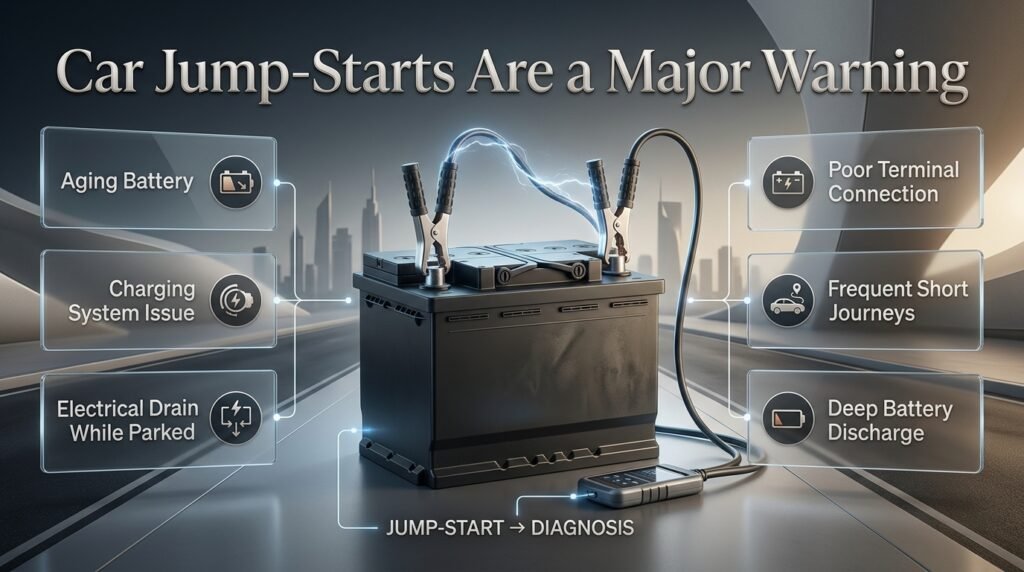
3. Repeated Jump-Starts Are a Major Warning
Occasionally needing a jump-start does not automatically mean that the battery must be replaced.
However, if a vehicle repeatedly requires external assistance to start, the situation deserves proper diagnosis.
A jump-start temporarily provides the electrical energy necessary to start the vehicle. It does not determine why the battery became unable to start the engine independently.
There are several possibilities:
- The battery may have reached the later stage of its usable life.
- The charging system may not be replenishing the battery properly.
- An electrical component may be consuming power while the vehicle is parked.
- Battery terminals may have a poor connection.
- The vehicle may be used primarily for short journeys.
- The battery may have been deeply discharged.
Simply continuing to jump-start the vehicle without identifying the underlying cause can leave the original problem unresolved.
If you need assistance because the vehicle will not start, professional Car Jumpstart support can get the vehicle moving, but the next step should be diagnosis rather than assuming the jump-start solved the problem.
4. Headlights and Interior Lights Become Noticeably Weaker
Changes in lighting can sometimes provide another clue.
If headlights appear noticeably dimmer than normal, particularly when the engine is not running, the electrical system should be checked. Interior lights and dashboard illumination may also appear weaker when the battery is under strain.
However, lighting performance must be interpreted carefully.
Once the engine is running, the alternator normally contributes to the vehicle’s electrical supply. Therefore, dimming lights while driving may involve the charging system rather than the battery alone.
This is why a battery inspection should not be isolated from the wider electrical system.
A professional technician can assess the battery, charging voltage, terminals, and related components to establish whether the battery itself is deteriorating.
5. Electrical Features Behave Differently During Startup
Modern vehicles rely on many electronic systems, and a weak electrical supply can sometimes become noticeable during startup.
You may notice that certain electrical functions behave differently when starting the engine. Dashboard electronics may restart, infotainment equipment may briefly switch off, or other systems may respond differently than they normally do.
These symptoms do not automatically mean the battery is defective.
Modern vehicles have complex electrical architecture, and electronic irregularities can have several possible causes. Software faults, poor electrical connections, charging-system problems, and other issues can produce similar symptoms.
Nevertheless, if electrical irregularities appear at the same time as slow cranking or difficult starting, the battery should be included in the diagnostic process.
This is where proper Vehicle Inspection becomes more valuable than replacing parts based on assumptions.
6. Battery Terminal Corrosion Should Not Be Ignored
Physical inspection can reveal useful clues about battery condition.
Corrosion around the battery terminals can interfere with electrical conductivity. Even when the battery itself still contains usable capacity, a poor connection can restrict the current available to the starter.
A technician should therefore examine:
- Battery terminals
- Cable connections
- Terminal tightness
- Visible corrosion
- Battery casing
- Signs of leakage
- Physical swelling or distortion
- General battery condition
Terminal corrosion does not always mean the battery itself has failed. Sometimes cleaning and correcting the connection resolves the electrical problem.
That distinction matters.
Replacing a battery without addressing a poor connection can leave the vehicle with the same starting issue. A professional inspection should identify the actual cause rather than treating every battery-related symptom as proof that replacement is necessary.
7. A Swollen or Damaged Battery Case Is a Serious Physical Warning
A battery’s physical condition should always be considered during inspection.
If the battery casing appears swollen, distorted, cracked, or otherwise damaged, it should not be treated as a normal aging symptom that can simply be ignored.
Physical deterioration can indicate internal problems and may compromise the battery’s reliability.
The safest approach is professional assessment rather than attempting to continue using a visibly damaged battery.
Drivers should also avoid making assumptions based purely on external appearance. A battery can look clean and intact while its internal performance has already declined.
That is one reason electrical testing remains an important part of battery diagnosis.
8. The Battery Warning Light Requires Attention
A dashboard battery or charging-system warning indicator should not be dismissed.
Many drivers assume that this light simply means the battery needs replacing. That is not necessarily the case.
The warning can relate to the vehicle’s charging system, including the alternator and associated electrical components. If the charging system is not maintaining the correct electrical supply, the battery may gradually become discharged even if the battery itself is relatively new.
This is an important diagnostic distinction.
Replacing the battery without checking the charging system can result in another discharged battery because the original charging problem remains.
When the battery warning indicator appears, professional Car Service or Engine Diagnostics can help identify the actual source of the problem.
9. Starting Problems After the Vehicle Has Been Parked
Another useful clue is when the problem occurs.
If the vehicle starts normally after a short stop but struggles after being parked overnight, battery condition may deserve investigation.
A healthy battery should retain enough charge during normal parking periods to provide reliable engine starting. If the battery has reduced capacity, or if an electrical component is drawing excessive power while the vehicle is switched off, the available energy can fall below the level required for reliable starting.
Long parking periods can therefore expose an existing weakness.
The key is not simply how long the car was parked but whether the starting behavior has changed from normal.
If the same vehicle previously started easily after several days of parking and now struggles after a single night, that change deserves attention.
10. Short Trips Can Gradually Expose Battery Weakness
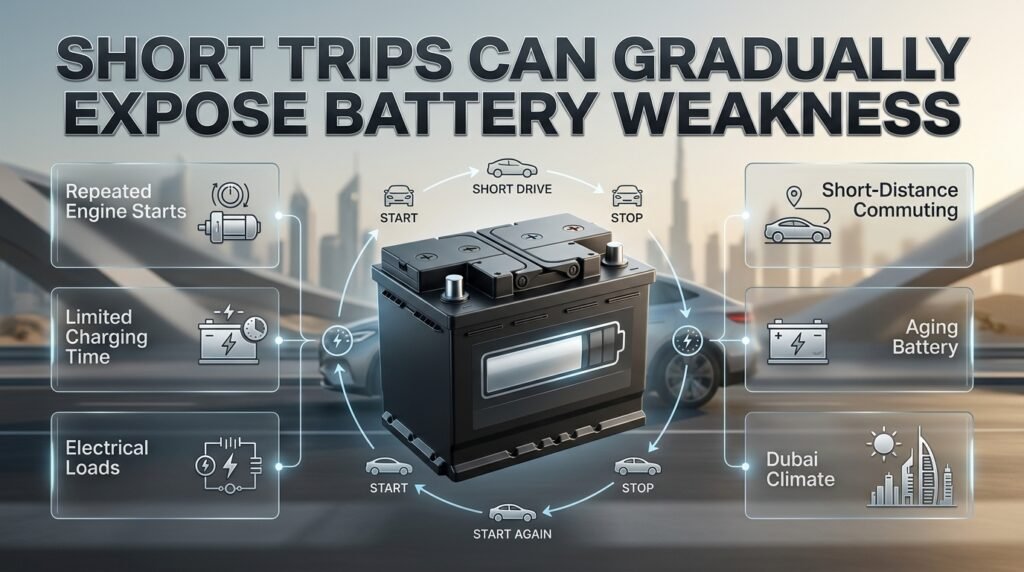
Vehicles used primarily for very short journeys can place a different demand on the battery and charging system than vehicles regularly driven for longer periods.
Starting the engine requires significant electrical energy. The vehicle’s charging system then needs sufficient operating time to restore the energy used during startup while also supporting other electrical loads.
If the vehicle is repeatedly started, driven for only a short distance, switched off, and started again later, the battery may not always receive the same opportunity to recover its charge.
This does not mean that every short trip damages a healthy battery. It means that driving patterns should be considered when diagnosing repeated low-charge symptoms.
If short-distance commuting is combined with an aging battery, frequent electrical use, and Dubai’s demanding climate, early warning signs can become more noticeable.
11. Frequent Use of Air Conditioning Adds Electrical Demand
Air conditioning is an essential part of everyday driving in Dubai, especially during hotter periods.
The vehicle’s air-conditioning system itself is mechanically driven in many conventional configurations, but the overall electrical system still supports numerous related components and controls. At the same time, drivers commonly use headlights, infotainment systems, charging ports, cooling fans, and other electrical equipment.
A battery that is already deteriorating may therefore have less reserve capacity when the vehicle is operating under a heavier electrical load.
It is important not to blame air conditioning for battery failure by itself. A healthy charging system and correctly specified battery are designed to support normal vehicle operation.
The concern arises when an already weak battery is combined with demanding operating conditions.
That is why battery condition should be considered as part of wider Vehicle Maintenance rather than treated as an isolated component.
12. Dubai Heat Can Accelerate Battery Aging
Climate is another factor that deserves attention.
Dubai’s high temperatures can be particularly demanding on automotive batteries. Heat can accelerate chemical processes inside a battery and contribute to faster aging over time.
The result is that a battery may lose reliability earlier than a driver expects based purely on the calendar.
This is one reason a battery that has performed adequately for years should not be judged only by whether it still starts the vehicle.
Drivers should pay attention to changes in performance, particularly during periods of high temperature.
A battery approaching the later stage of its service life may have less reserve capacity, making early symptoms more important.
13. Why Battery Age Matters
Battery age is not a perfect measurement of battery health, but it is an important part of the diagnostic picture.
Two batteries of the same age can have very different conditions because their operating environments are different.
Factors that influence battery aging include:
- Climate
- Driving frequency
- Journey length
- Electrical demand
- Parking duration
- Charging-system condition
- Battery technology
- Vehicle electrical architecture
- Previous deep discharges
- Maintenance and connection quality
This means there is no universal date at which every battery must be replaced.
Instead, age should be considered alongside actual test results and observed symptoms.
A battery that is older and showing repeated slow-cranking symptoms deserves more attention than a battery of the same age that continues to test within the manufacturer’s required performance range.
14. Battery Voltage Alone Does Not Tell the Whole Story
One common mistake is checking voltage and assuming that one number completely represents battery health.
Voltage is useful, but it is only part of the assessment.
A battery can show an acceptable resting voltage while still having insufficient starting performance under load. Conversely, an unusual voltage reading can be influenced by recent driving, charging activity, temperature, or electrical conditions.
Professional testing can evaluate the battery’s condition more comprehensively.
Depending on the vehicle and battery technology, technicians may assess resting voltage, starting performance, charging voltage, and other relevant characteristics.
The goal is not simply to obtain a number. The goal is to understand whether the battery can reliably perform the job required by the vehicle.
15. Battery Problems and Alternator Problems Can Look Similar
This is one of the most important distinctions in battery diagnosis.
The battery stores electrical energy. The alternator and charging system help replenish that energy while the engine is operating.
If the alternator is not charging correctly, the battery can become discharged even when the battery itself is relatively new.
Similarly, a weak battery can cause starting problems even when the charging system is functioning correctly.
Because symptoms can overlap, a professional inspection should consider both systems.
A useful diagnostic approach includes examining:
- Battery condition
- Charging-system performance
- Terminal connections
- Starter behavior
- Electrical consumption
- Relevant dashboard warnings
This prevents unnecessary parts replacement and helps ensure that the actual cause of the starting problem is addressed.
16. Parasitic Electrical Drain Can Mimic Battery Failure
Another possibility is an electrical component continuing to consume power while the vehicle is parked.
This is commonly described as parasitic drain.
Modern vehicles contain numerous electronic modules and systems that continue to perform limited functions after the vehicle is switched off. Normal standby consumption is expected, but excessive electrical draw can gradually discharge a battery.
Possible sources can vary considerably depending on the vehicle.
For example, an aftermarket accessory, malfunctioning module, lighting issue, or another electrical component could potentially contribute to excessive drain.
If a relatively new battery repeatedly becomes discharged after parking, replacing it again may not solve the underlying issue.
Electrical diagnosis is therefore important when repeated discharge cannot be explained by battery age or driving conditions.
17. Battery Technology Also Affects Diagnosis
Not every modern vehicle uses the same battery technology.
Conventional flooded batteries, EFB batteries, and AGM batteries have different designs and are not automatically interchangeable in every application.
Vehicles equipped with start-stop systems or higher electrical demands may require a specific battery technology and specification.
This means the correct replacement decision is not simply:
“Which battery has the highest capacity?”
The better question is:
“Which battery specification is appropriate for this vehicle’s electrical system and manufacturer requirements?”
For vehicles designed around AGM technology, for example, using the correct AGM specification can be particularly important.
If testing confirms that replacement is required, drivers can review the relevant AGM Battery service information before choosing a replacement.
18. When a Battery Test Is Better Than Guesswork
Battery symptoms can overlap with several other vehicle problems, which is why testing is valuable.
A professional inspection can help answer several practical questions:
Is the battery still capable of starting the vehicle reliably?
Is the battery holding charge correctly?
Is the charging system working as expected?
Are the electrical connections sound?
Is there evidence of excessive electrical drain?
Does the vehicle require battery replacement, or is another repair more appropriate?
This diagnostic approach reduces unnecessary replacement and gives the owner a clearer understanding of what is happening.
A battery should be replaced because testing and vehicle requirements indicate that replacement is appropriate—not simply because one symptom appeared.
19. When Battery Replacement Becomes the Better Option
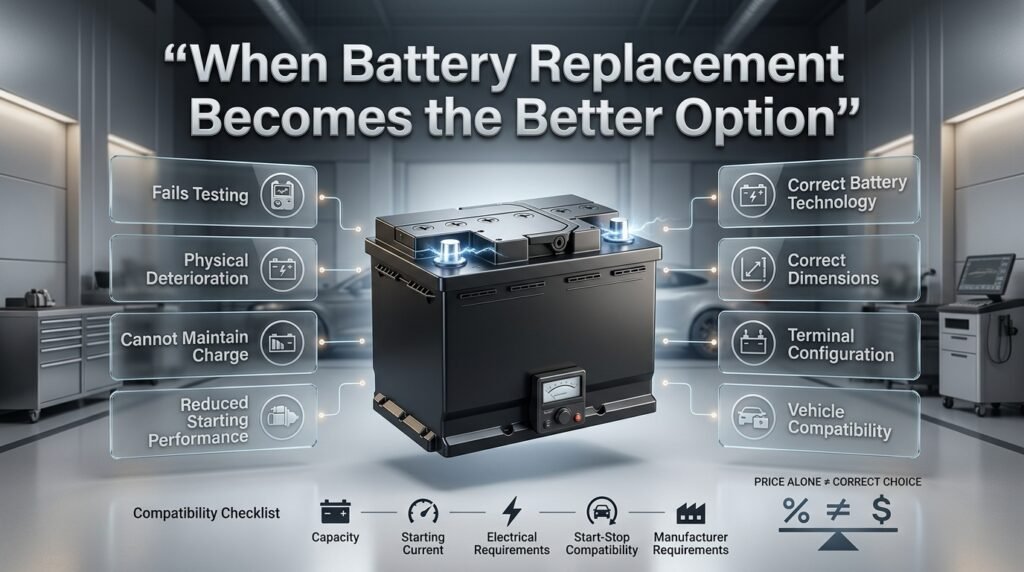
Replacement becomes more reasonable when the battery consistently fails testing, has significant physical deterioration, cannot maintain sufficient charge, or no longer provides the required starting performance.
The replacement must also match the vehicle’s requirements.
Important considerations can include:
- Correct battery technology
- Appropriate physical dimensions
- Correct terminal configuration
- Required capacity
- Starting-current specification
- Vehicle electrical requirements
- Start-stop compatibility
- Manufacturer requirements
A replacement battery should not be selected solely on price.
A cheaper battery that does not suit the vehicle can create reliability problems and potentially result in another replacement sooner than expected.
For drivers researching replacement options, the dedicated Battery Replacement service page provides a useful starting point for understanding the service.
20. Choosing the Correct Battery Brand
Once testing confirms that replacement is required, the next decision is selecting an appropriate battery.
Brand can matter, but compatibility should come first.
EuroSwift Auto Services provides information for several battery brands and technologies, allowing drivers to investigate options according to their vehicle requirements.
For example, drivers considering an Amaron battery can review the dedicated Amaron Car Battery Replacement Dubai service page.
For Bosch applications, the Bosch Car Battery Replacement Dubai service page can be used as a reference.
Drivers looking at Tuflong batteries can also review Trusted Tuflong Car Battery Replacement Dubai for relevant service information.
The important principle is to match the battery to the vehicle rather than selecting a brand simply because it is familiar.
21. Exide, Panasonic, FIAMM and AC Delco Options
Different vehicles and owners may have different battery requirements, so it is useful to consider several compatible options rather than treating one brand as universally suitable.
For drivers researching Exide applications, the Exide Car Battery Replacement Dubai service page provides dedicated information.
For Panasonic battery requirements, see Panasonic Car Battery Replacement Dubai service.
For FIAMM applications, the FIAMM Car Battery Replacement Dubai service page can be reviewed.
Drivers considering AC Delco can also refer to AC Delco Car Battery Replacement Dubai service.
These pages should be treated as brand-specific service resources rather than a reason to choose one manufacturer without first confirming compatibility.
22. AGM Batteries Require Particular Attention
AGM technology is used in many vehicles with higher electrical requirements and certain start-stop configurations.
An AGM battery uses a different construction from a conventional flooded battery and is designed for particular vehicle applications.
If your vehicle was originally equipped with AGM technology, replacing it with an unsuitable battery type simply because it is cheaper can be a poor decision.
The correct approach is to confirm the vehicle’s battery specification first.
This becomes particularly relevant for newer vehicles containing extensive electronic systems, start-stop technology, energy-management systems, and other electrical features.
Battery replacement should therefore be treated as a compatibility decision rather than a simple purchase.
23. Battery Replacement Before a Long Journey
A battery showing early deterioration deserves additional attention before a long road trip.
A vehicle that starts reliably around town may become inconvenient if the battery fails after being parked at a hotel, shopping center, roadside location, or another unfamiliar area.
Before extended travel, consider checking:
- Battery starting performance
- Battery age and condition
- Charging-system performance
- Battery terminals
- Tire condition
- Engine fluids
- Cooling system
- Lights
- Emergency equipment
Preventive inspection is particularly valuable before long-distance or cross-emirate travel because identifying a weak battery at home is considerably easier than dealing with an unexpected no-start situation away from your normal service area.
24. Why Preventive Battery Checks Make Sense
Preventive maintenance is not about replacing every component before it fails.
It is about identifying developing problems early enough to make an informed decision.
A battery check can be useful when:
- The vehicle begins cranking more slowly.
- Starting becomes inconsistent.
- The battery has reached an advanced stage of service life.
- The vehicle is frequently jump-started.
- The car is used mainly for short trips.
- The vehicle has experienced a deep discharge.
- The charging system has recently required repair.
- The vehicle is preparing for extended travel.
Early inspection can reveal whether the battery remains healthy, requires monitoring, or should be replaced.
That gives the driver control over the timing of maintenance rather than forcing a decision during an emergency.
25. Common Mistakes Drivers Make With Weak Batteries
One of the most common mistakes is repeatedly jump-starting the vehicle without finding the cause.
Another is replacing the battery without testing the charging system.
Some drivers also select a replacement based entirely on price or choose a battery that appears physically similar without confirming the correct specification.
Other avoidable mistakes include ignoring terminal corrosion, overlooking repeated slow cranking, and assuming that a battery is healthy because it has not completely failed yet.
A better maintenance approach is straightforward:
✔ Pay attention to changes in starting performance.
✔ Investigate repeated electrical symptoms.
✔ Test the battery instead of relying only on appearance.
✔ Check the charging system when appropriate.
✔ Confirm battery compatibility before replacement.
✔ Address recurring discharge rather than repeatedly jump-starting the vehicle.
26. Early Deterioration vs Complete Battery Failure
There is a major practical difference between a deteriorating battery and a completely failed battery.
During early deterioration, the vehicle may still start, but starting performance can become gradually weaker.
During complete failure, the battery may no longer provide enough power for the starter system to operate effectively.
Early-stage symptoms therefore provide an opportunity.
Once the battery has completely failed, the driver’s options may become more urgent, particularly if the vehicle is parked somewhere inconvenient.
This is why recognizing subtle changes is useful. The goal is not to create unnecessary concern every time the vehicle behaves differently. The goal is to distinguish a developing pattern from a one-time event.
27. A Practical Battery Warning Checklist
If you are unsure whether your battery is beginning to deteriorate, consider the following checklist.
Has the engine recently started cranking more slowly?
Does the vehicle take longer to start than it used to?
Have you needed a jump-start more than once?
Have the headlights or interior lights become noticeably weaker?
Has the battery warning light appeared?
Are there visible signs of corrosion around the terminals?
Does the battery casing appear damaged or swollen?
Does the vehicle repeatedly lose charge while parked?
Has the battery been subjected to a deep discharge?
Is the battery older and now showing new symptoms?
If several of these observations apply, a professional battery and charging-system inspection is sensible.
The checklist does not diagnose the vehicle by itself. It simply identifies situations where further investigation is worthwhile.
28. How Professional Inspection Helps
A professional inspection should begin with the actual symptoms rather than immediately assuming that the battery is defective.
The technician can review the vehicle’s starting behavior, inspect the battery and connections, and perform appropriate electrical testing.
Depending on the results, the diagnostic process may then move toward the charging system, starter circuit, or electrical system.
This approach matters because modern vehicles can have several interconnected electrical systems.
A battery problem can be caused by the battery itself, but it can also be the consequence of another fault.
Proper diagnosis therefore protects the owner from unnecessary parts replacement and helps restore reliable vehicle operation.
29. Battery Replacement Is Not the Only Possible Solution
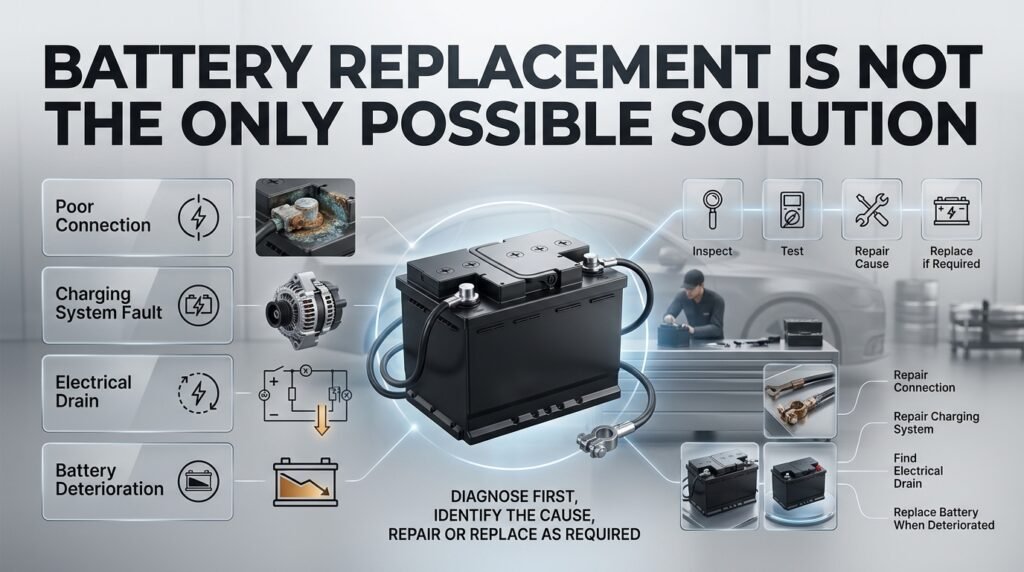
It is important to understand that not every battery-related symptom requires a new battery.
If corrosion is causing a poor connection, correcting the connection may resolve the problem.
If the charging system is malfunctioning, repairing that system may be the appropriate solution.
If excessive electrical drain is discharging the battery while parked, identifying and correcting the source of the drain is more important than repeatedly installing batteries.
If the battery itself has genuinely deteriorated beyond reliable service, replacement becomes appropriate.
This diagnostic mindset is a major part of professional Mechanical Repair and preventive maintenance.
30. Battery Condition and Overall Vehicle Reliability
A battery is only one component of vehicle reliability, but it has an important role because so many vehicle functions depend on stable electrical power.
A weak battery can make starting unpredictable. Electrical problems can also create secondary diagnostic challenges, particularly in vehicles with numerous electronic control systems.
For this reason, battery health should be considered alongside broader Car Service, Vehicle Inspection, and preventive maintenance.
Drivers who maintain the battery while also keeping the charging system, engine, brakes, tires, fluids, and other major components in proper condition are better positioned to identify developing problems before they become disruptive.
31. What Drivers Should Do When Symptoms Appear
The correct response depends on the severity and frequency of the symptoms.
If you notice one unusual start but the vehicle subsequently behaves normally, monitoring may be reasonable.
If slow cranking becomes frequent, arrange a battery test.
If the vehicle repeatedly needs jump-starting, investigate the battery and charging system rather than continuing to rely on external starting assistance.
If the battery warning light appears, seek professional diagnosis.
If the battery casing is visibly damaged or swollen, professional attention should not be delayed.
And if the vehicle will not start at all, roadside assistance or professional Emergency Car Repair support may be required before the underlying fault can be diagnosed.
32. Battery Price Should Not Be the Only Consideration
Drivers often begin the replacement process by asking how much a new battery costs.
Price is obviously relevant, but it should not be the only factor.
The final cost can depend on:
- Battery technology
- Vehicle requirements
- Battery capacity
- Starting-current specification
- Brand
- Installation requirements
- Battery registration or adaptation requirements on certain vehicles
- Diagnostic work
- Emergency or roadside service
- Location and timing of service
For a broader understanding of battery pricing considerations, the dedicated Car Battery Prices in Dubai 2026 guide can be used as a supporting resource.
The important point is to compare like-for-like batteries. A lower advertised price does not necessarily represent better value if the specification, technology, warranty, or installation requirements differ.
33. How to Reduce the Risk of Unexpected Battery Problems
There is no method that guarantees a battery will never fail unexpectedly, but sensible maintenance can reduce avoidable problems.
Pay attention to starting behavior instead of waiting for complete failure.
Keep battery terminals and connections in good condition.
Have the charging system checked when battery discharge is recurring.
Avoid ignoring dashboard charging warnings.
If the vehicle is stored for extended periods, consider professional advice about maintaining its electrical system.
Before long-distance travel, inspect the battery if it is already showing warning signs.
Most importantly, treat repeated symptoms as a pattern that deserves diagnosis.
34. When You Should Seek Professional Help
Professional assistance is particularly appropriate when the problem is recurring or when the vehicle’s symptoms cannot be explained by a simple discharged battery.
Seek diagnosis when:
- Slow cranking repeatedly occurs.
- The battery repeatedly loses charge.
- Jump-starts are becoming common.
- A battery warning light appears.
- Electrical systems behave unusually.
- The vehicle struggles after normal parking periods.
- The battery shows physical damage.
- A new battery becomes discharged unexpectedly.
- Starting problems continue after a battery replacement.
These situations can indicate that the battery is only part of the problem.
A proper Auto Workshop diagnosis can help determine whether the vehicle requires battery replacement, electrical repair, charging-system work, or another form of Car Repair.
35. The Importance of Correct Installation
Installing the correct battery is only part of the replacement process.
The battery must also be installed correctly, with secure electrical connections and appropriate consideration of the vehicle’s electrical architecture.
Some modern vehicles may require battery-management procedures or registration after replacement, depending on the vehicle design.
This is another reason professional installation can be preferable to selecting and fitting a battery based solely on physical appearance.
Correct installation helps ensure that the replacement battery can perform as intended and that the vehicle’s electrical management system operates appropriately.
36. A Professional Approach to Battery Deterioration
The best approach to battery deterioration is neither to ignore every warning nor to replace the battery at the first unusual symptom.
Instead, follow a logical process.
First, identify whether the symptom is recurring.
Second, inspect the battery and electrical connections.
Third, test the battery’s actual condition.
Fourth, evaluate the charging system if required.
Fifth, investigate possible electrical drain when repeated discharge occurs.
Finally, replace the battery only when testing and vehicle requirements indicate that replacement is appropriate.
This process is more reliable than guessing and replacing components one by one.
37. Why Early Detection Saves More Than Time
The biggest advantage of recognizing battery deterioration early is predictability.
A driver who identifies a weak battery while the vehicle is still operational can arrange inspection and replacement at a convenient time.
A driver who waits until the battery fails completely may need emergency assistance at an inconvenient location.
The difference is not simply financial. It is also about reliability, planning, and avoiding unnecessary disruption.
For Dubai drivers who depend on their vehicles for commuting, family travel, business, or daily activities, predictable maintenance is often preferable to emergency repair.
What are the earliest signs of car battery deterioration?
The earliest signs are usually changes in starting performance and electrical behavior rather than a completely dead battery. A driver may notice that the engine takes slightly longer to crank, the starter sounds weaker than it used to, or the vehicle needs more effort to start after sitting overnight. These changes can develop gradually, which is why they are easy to dismiss.
Other clues can include dimmer lights, unusual electrical behavior, repeated jump-starts, or visible corrosion around the battery terminals. However, none of these symptoms alone proves that the battery is defective because starter, connection, and charging-system problems can produce similar symptoms.
Important points to watch:
Slower-than-normal engine cranking
Longer starting time
Repeated need for jump-starting
Dimming or flickering lights
Electrical accessories behaving unusually
Corrosion or physical deterioration around the battery
Battery or charging-system warning light
The most useful approach is to look for a repeated pattern, rather than reacting to one unusual start. If several symptoms appear together, a professional battery and charging-system test can establish whether the battery is actually deteriorating.
How can I tell if my battery is weak or the alternator is failing?
This is one of the most important questions because a weak battery and a failing alternator can produce very similar symptoms. A battery primarily provides the electrical power needed to start the vehicle, while the alternator supplies electrical power while the engine is running and recharges the battery.
If the vehicle consistently struggles to crank, particularly after being parked, the battery may be losing starting capacity. On the other hand, if the battery repeatedly becomes discharged, electrical systems behave strangely while driving, or the battery warning light appears, the charging system deserves attention as well.
A professional diagnosis should consider:
Battery condition and starting performance
Charging-system output
Battery terminals and cables
Possible electrical drain
Starter-system condition
Vehicle-specific electrical requirements
Replacing the battery without checking the charging system can be a costly mistake. If the alternator is not charging correctly, even a new battery can eventually become discharged. Current automotive guidance specifically recommends testing rather than assuming that every battery-related symptom means the battery itself has failed.
Can a car battery be deteriorating even if the car still starts normally?
Yes, and this is one of the reasons battery deterioration can go unnoticed.
A battery does not have to completely fail before its performance becomes weaker. It may still start the engine on normal days while having considerably less reserve capacity than when it was healthy. A driver may therefore believe everything is fine simply because the engine continues to start.
The more useful question is whether the starting performance has changed.
For example, if the engine used to crank immediately but now takes noticeably longer, that change is worth investigating. A resting voltage reading can also provide useful information, but voltage alone does not always tell the complete story. A battery can show an acceptable resting voltage while still performing poorly under starting load.
Pay particular attention when:
Starting becomes progressively slower
The vehicle struggles after sitting for longer periods
Jump-starting becomes necessary
Electrical symptoms appear alongside starting problems
The battery is older and performance is changing
A professional battery test can determine whether the battery still provides adequate starting performance or whether replacement should be planned.
Why does my car battery keep going flat after the car is parked?
A battery that repeatedly goes flat should not automatically be replaced without investigating the cause.
There are several possibilities. The battery itself may have deteriorated and no longer hold sufficient charge. Alternatively, the charging system may not be replenishing it correctly, or an electrical component may continue drawing excessive power while the vehicle is parked. Loose or corroded connections can also contribute to starting and charging problems.
This distinction is particularly important when a relatively new battery repeatedly becomes discharged. Installing another battery may temporarily improve the situation while leaving the underlying electrical problem unresolved.
Common areas that should be investigated include:
Battery condition
Alternator and charging system
Battery terminals and cables
Possible parasitic electrical drain
Vehicle usage pattern
Previous deep discharge
Aftermarket electrical equipment
If the vehicle starts after a jump but the same problem returns repeatedly, treat the jump-start as a temporary recovery—not as proof that the underlying problem has been fixed. Repeated jump-starts are a strong reason to have the battery and charging system properly tested.
When should I replace my car battery instead of waiting for it to fail completely?
Battery replacement becomes appropriate when testing shows that the battery can no longer provide reliable starting performance, cannot maintain its required charge, or has significant physical deterioration. Waiting until complete failure is not always the best strategy, particularly when the battery has already developed several warning signs.
A battery that is showing slow cranking, repeated discharge, or frequent jump-start requirements may be approaching the point where reliability becomes unpredictable. Physical problems such as a swollen or damaged casing are also serious warning signs and require professional attention rather than continued use.
Before replacing the battery, check:
Whether the battery actually fails its performance test
Whether the charging system is working correctly
Whether the terminals and cables are in good condition
Whether an electrical drain is present
Which battery technology the vehicle requires
The correct battery size and specification
Whether the vehicle has start-stop or other battery-management requirements
The goal should not be to replace a battery simply because it is old. The better approach is to combine battery age, symptoms, test results, vehicle requirements, and operating conditions. That gives the driver a much more reliable basis for deciding whether replacement is necessary.
Conclusion
Recognizing the early signs of battery deterioration can prevent a minor electrical issue from turning into an unexpected no-start situation. Slow engine cranking, longer starting times, repeated jump-starts, dimming lights, electrical irregularities, corrosion, and charging warnings are all signs that deserve attention—especially when they begin occurring repeatedly.
For Dubai drivers, battery condition is particularly important because high temperatures and demanding daily driving conditions can accelerate battery aging. However, symptoms should never be used as the only reason to replace a battery. A proper inspection should determine whether the actual problem is the battery, alternator, charging system, electrical connection, or excessive electrical drain.
The smartest approach is early diagnosis rather than emergency replacement. Testing the battery before complete failure gives you a clearer idea of its remaining condition and allows you to choose the correct replacement specification when necessary. Keeping the battery, charging system, and wider electrical system properly maintained also supports dependable vehicle starting and overall reliability.
Whether the vehicle needs Battery Replacement, Car Jumpstart, Vehicle Inspection, Car Service, or further Mechanical Repair, addressing warning signs early can save time, reduce unnecessary repairs, and help keep your vehicle reliable on Dubai roads.

Leave a Reply