
Introduction
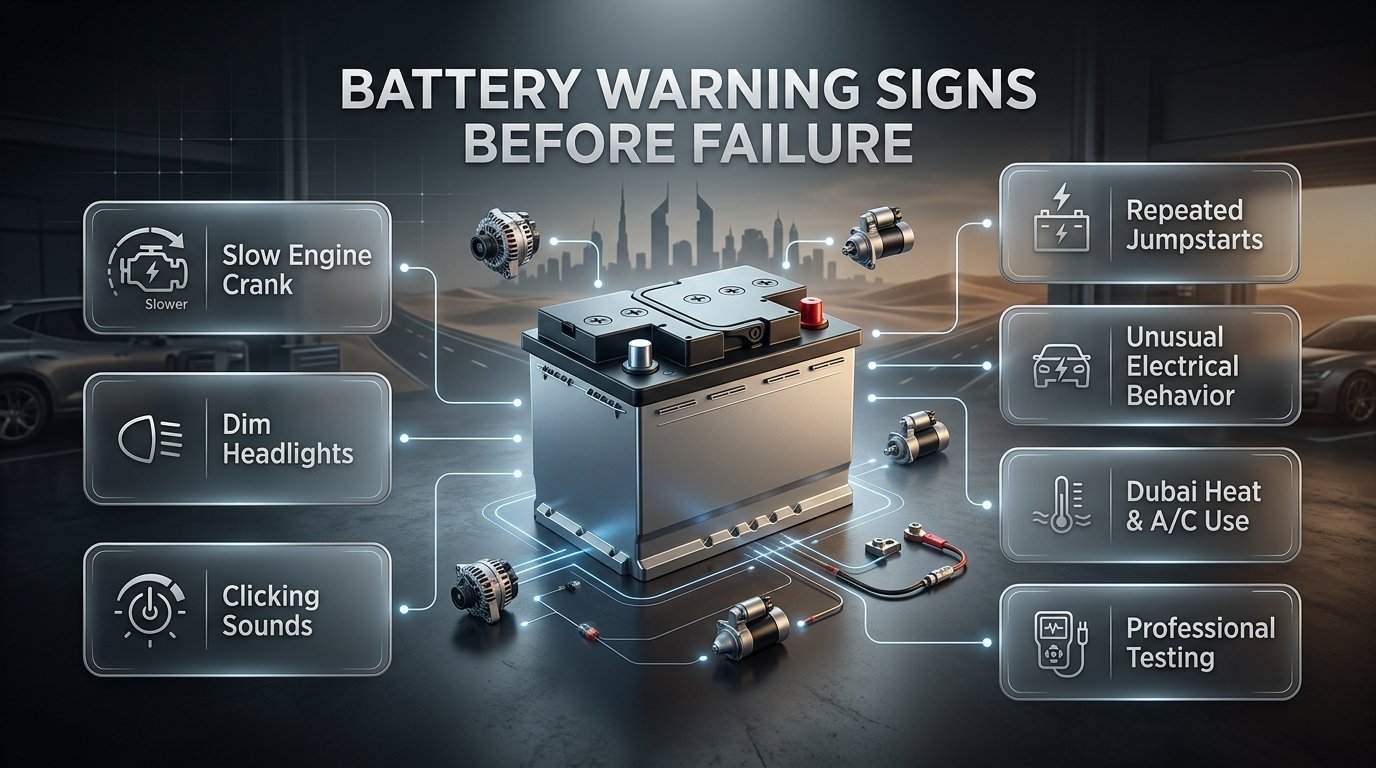
Battery Warning Signs Before Failure | A car battery can give several warning signs before it finally loses enough power to start the engine. The problem is that many drivers ignore these early symptoms because the vehicle still starts and appears to be working normally. A slightly slower engine crank, dim headlights, clicking sounds, repeated jumpstarts, or unusual electrical behavior can all indicate that the battery or charging system needs attention.
Understanding these Battery Warning Signs Before Failure can help you take action before a minor electrical problem becomes an unexpected roadside breakdown. Instead of waiting until the vehicle refuses to start, drivers can use early symptoms as an opportunity to arrange professional testing and determine whether the battery is still reliable.
For Dubai drivers, battery condition deserves particular attention because vehicles operate in a demanding environment. High temperatures, extensive air-conditioning use, traffic congestion, short journeys, and long periods of parking can place additional demands on the vehicle’s electrical system.
If you are already experiencing battery-related symptoms and want professional automotive assistance, EuroSwift Auto Services provides a relevant starting point for battery and vehicle services in Dubai.
However, an important point should be understood from the beginning: not every battery symptom proves that the battery itself has failed. The alternator, starter motor, battery terminals, wiring, or another electrical component can create similar symptoms. A proper diagnosis therefore looks at the complete starting and charging system rather than replacing parts based on one symptom.
This guide explains the most important warning signs, what they can indicate, how battery problems differ from alternator problems, when testing is recommended, and how preventive maintenance can reduce the risk of unexpected failure.
What Are Battery Warning Signs Before Failure?
A battery rarely becomes unreliable at exactly the same moment that a driver first notices a problem. In many cases, deterioration happens gradually.
The battery may continue starting the vehicle while its available capacity is declining. This creates a period where the car appears functional but is less tolerant of heat, repeated starts, electrical loads, or extended parking.
The most common battery warning signs include:
- Slow engine cranking
- Longer starting time
- Clicking when attempting to start
- Dim headlights
- Weak interior lights
- Repeated jumpstart requirements
- Battery warning light
- Electrical accessories behaving unusually
- Battery terminals showing corrosion
- Swollen or damaged battery casing
- Unusual odor around the battery
- Battery repeatedly losing charge
- Start-stop system problems
- Multiple electrical warning messages
- Starting problems after the vehicle has been parked
One symptom by itself does not always identify the exact problem.
For example, slow engine cranking can be caused by a weak battery, but it can also result from poor battery connections or a starter-system problem.
The most useful approach is to look for changes in normal vehicle behavior and consider whether several symptoms are occurring together.
1. Slow Engine Cranking
One of the earliest and most noticeable signs of battery deterioration is slow engine cranking.
When you start your vehicle, the starter motor requires a substantial amount of electrical power. A healthy battery should deliver that power quickly enough for the engine to crank at its normal speed.
When battery performance declines, the starter may turn the engine more slowly.
You may hear a heavier or slower cranking sound before the engine eventually starts.
What should you look for?
Pay attention if:
- The engine takes longer to start than before.
- The starter sounds slower.
- Starting performance changes from one day to another.
- The problem is worse after overnight parking.
- The vehicle needs several attempts before starting.
- The engine starts more easily after a recent drive.
A driver who uses the same car every day can often recognize this change simply because the normal starting sound is familiar.
Slow cranking should not automatically lead to battery replacement. A technician should also check the battery terminals, starter system, and charging system.
2. The Engine Takes Longer to Start
A longer-than-normal starting process can be an early indication that the vehicle’s available starting power is declining.
Sometimes the difference is very small. The engine may still start, but instead of starting immediately, it takes an extra moment.
Drivers often dismiss this because the car eventually starts.
That can be a mistake if the change becomes increasingly frequent.
A battery that is beginning to lose capacity may perform adequately under one set of conditions but struggle after the vehicle has been parked for several hours or exposed to demanding temperatures.
Why starting behavior matters
Starting the engine is one of the most demanding electrical events a vehicle performs.
If the battery is becoming weaker, starting performance can reveal the problem before other electrical symptoms become obvious.
When a previously reliable vehicle begins starting differently, it is worth paying attention.
3. Clicking Sounds When Starting
A clicking noise when pressing the start button or turning the key is another warning sign that should not be ignored.
The starter system needs sufficient electrical power to operate. If available voltage drops significantly when the starter is engaged, you may hear clicking instead of normal engine cranking.
A weak battery is one possible cause.
However, clicking can also result from:
- Poor battery-terminal connections
- Corroded terminals
- Starter-system problems
- Electrical connection faults
- Relay-related problems
This is why the sound alone should not be used as a diagnosis.
If clicking occurs together with slow cranking, dim lights, or repeated starting difficulties, battery testing becomes particularly worthwhile.
4. Headlights Become Dim
Headlights can provide another clue about the vehicle’s electrical condition.
If headlights become noticeably dimmer than normal, especially during starting or while the engine is idling, there may be an issue with available electrical power.
Possible causes include:
- Weak battery
- Alternator problem
- Poor electrical connection
- Voltage instability
- Wiring issue
The timing of the dimming is useful.
If the lights become noticeably weaker when the engine is being started, battery condition deserves attention.
If the headlights fluctuate while the engine is already running, the charging system should also be investigated.
A lighting symptom therefore provides a reason for inspection rather than a reason to immediately replace the battery.
5. Interior Lights Become Weaker
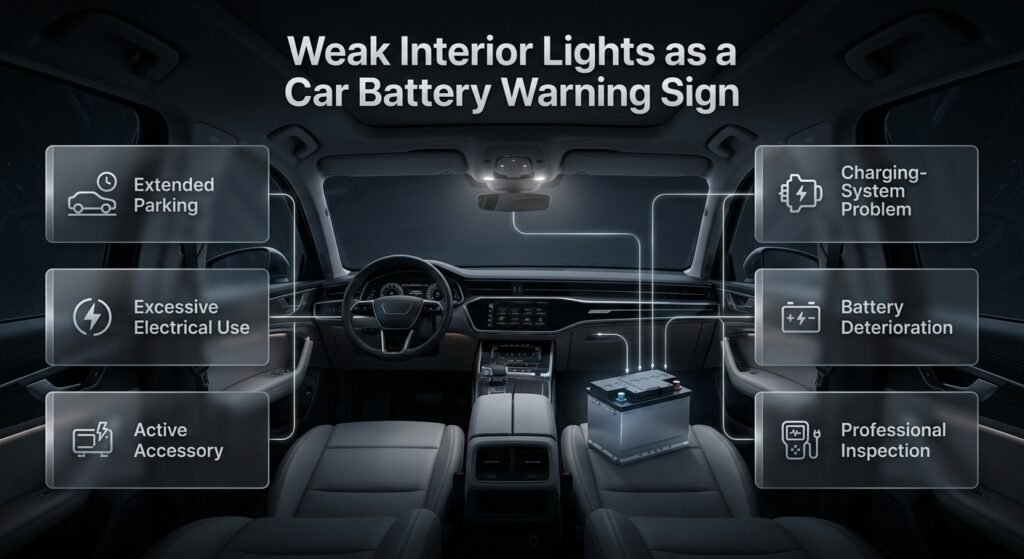
Interior lighting is another small detail that drivers may notice before a starting problem becomes obvious.
If cabin lights appear weaker when the engine is switched off, especially after the vehicle has been sitting for an extended period, the battery may have a low state of charge.
This does not automatically mean the battery has reached the end of its service life.
The vehicle could have experienced:
- Extended parking
- Excessive electrical use
- An accessory remaining active
- A charging-system problem
- Battery deterioration
If weak interior lighting keeps returning, the vehicle should be inspected rather than repeatedly recharged without investigating the underlying reason.
6. Battery Warning Light Appears
The battery warning light is one of the most misunderstood dashboard warnings.
Many drivers assume that a battery-shaped warning light automatically means the battery needs replacement.
That is not necessarily the case.
In many vehicles, this warning relates to the charging system.
Potential causes can include:
- Alternator malfunction
- Charging-system fault
- Drive-belt issue
- Electrical connection problem
- Battery-related electrical fault
If the warning light remains illuminated while the engine is running, professional diagnosis is recommended.
The battery may still have usable capacity while the alternator is failing to recharge it properly.
Why replacing the battery immediately can be a mistake
Suppose the alternator is not charging correctly.
Replacing the battery may temporarily restore starting performance, but the new battery can also become discharged if the charging problem remains unresolved.
This is why battery and charging-system testing should be considered together.
7. Your Car Needs Repeated Jumpstarts
A single jumpstart does not necessarily mean your battery has failed.
For example, accidentally leaving an interior light on can discharge a battery.
The concern begins when jumpstarts become a repeated event.
If the vehicle needs external starting assistance multiple times, one of several problems may exist.
Possible causes
Battery deterioration:
The battery may no longer have enough starting capacity.
Alternator problem:
The charging system may not be replenishing the battery properly.
Parasitic electrical drain:
An electrical component may continue consuming power while the vehicle is parked.
Poor connections:
Corroded or loose terminals can interfere with charging and starting.
Driving pattern:
Frequent short journeys may provide limited opportunity for the charging system to restore energy used during starting.
If the vehicle repeatedly needs assistance, a jumpstart should be treated as a temporary solution rather than the final repair.
For immediate no-start situations, Car Jumpstart or Roadside Assistance may be appropriate, but the underlying cause should still be investigated afterward.
8. Electrical Accessories Behave Unusually
Modern vehicles depend heavily on stable electrical power.
A developing low-voltage condition can sometimes affect systems that do not appear directly related to the battery.
You may notice:
- Power windows operating differently
- Central locking behaving inconsistently
- Infotainment systems restarting
- Interior lights becoming weak
- Electronic seats responding slowly
- Dashboard displays behaving unusually
- Start-stop systems becoming unavailable
- Multiple warning messages appearing
One isolated electrical issue does not automatically indicate battery failure.
However, several unrelated electrical symptoms appearing around the same time deserve investigation.
Modern vehicles contain multiple control modules, and unstable voltage can sometimes create temporary or secondary warnings.
9. Heavy Battery Terminal Corrosion
The battery terminals provide the electrical connection between the battery and vehicle.
Corrosion can interfere with this connection and increase resistance.
That can contribute to:
- Difficult starting
- Voltage drops
- Intermittent electrical behavior
- Poor charging
- Starter problems
Terminal corrosion should therefore be treated as a maintenance issue rather than something to ignore.
However, corrosion does not automatically mean the battery itself has failed.
A technician should determine whether:
- The battery remains healthy.
- The terminals require attention.
- The cables are in good condition.
- The charging system is operating correctly.
- The battery should actually be replaced.
This distinction can prevent unnecessary replacement.
10. Battery Casing Looks Swollen
Physical battery damage is a more serious warning sign.
If the battery casing appears swollen, distorted, cracked, or otherwise abnormal, it should receive professional attention.
Drivers should periodically inspect the visible battery area for:
- Swelling
- Cracks
- Leakage
- Severe corrosion
- Physical damage
- Loose mounting
- Damaged connections
A visibly damaged battery should not be treated as a normal aging symptom.
Professional inspection can determine whether replacement is necessary and whether another vehicle-system issue may have contributed to the battery’s condition.
11. Unusual Odor Around the Battery
An unusual smell coming from the battery area is another reason to arrange an inspection.
Drivers should not attempt to investigate the internal condition of a battery themselves.
Instead, professional diagnosis can determine whether the odor is related to the battery or another component in the engine compartment.
An unusual odor becomes particularly important when it appears together with:
- Physical battery damage
- Swelling
- Corrosion
- Electrical problems
- Charging-system warnings
The combination of physical and electrical symptoms provides more useful diagnostic information than either symptom alone.
12. Battery Keeps Losing Charge
A battery that repeatedly loses its charge requires investigation.
There is no single explanation for repeated discharge.
Battery deterioration
An aging battery may no longer retain electrical energy effectively.
Alternator or charging problem
The battery may not receive sufficient charging while the engine is operating.
Parasitic drain
Another electrical component may continue consuming power while the vehicle is parked.
Driving pattern
Repeated short journeys can mean the battery has limited opportunity to recover energy used during starting.
This is why repeatedly charging the battery may not solve the underlying problem.
The correct diagnostic question is:
Why is the battery repeatedly losing charge?
Once that is understood, the appropriate repair can be selected.
13. Start-Stop System Stops Working
Vehicles equipped with automatic start-stop technology may disable the feature when battery conditions are not suitable.
The system can consider factors such as:
- Battery state of charge
- Battery condition
- Temperature
- Electrical demand
- Vehicle operating conditions
Therefore, a non-functioning start-stop feature does not automatically prove that the battery has failed.
However, if start-stop problems appear together with slow starting or other electrical symptoms, battery testing becomes worthwhile.
Vehicles using start-stop technology may require specific battery types, including EFB or AGM depending on the manufacturer’s design.
If your vehicle specifically requires AGM technology, the dedicated AGM Car Battery Replacement Dubai page is more relevant when researching the replacement stage.
14. Multiple Electrical Warning Messages Appear
A low-voltage condition can sometimes trigger several warning messages.
This can be confusing because the dashboard may appear to indicate problems with multiple vehicle systems.
Before assuming that several expensive components have failed, the electrical supply should be checked.
A technician can determine whether the warnings represent:
- Independent faults
- Low-voltage consequences
- Charging-system problems
- Battery deterioration
- Communication-related electrical faults
Modern vehicles often require electronic diagnostics in addition to traditional physical inspection.
15. Starting Problems Become Worse in Extreme Conditions
A marginal battery may appear acceptable during normal conditions but struggle when the vehicle faces more demanding circumstances.
For Dubai drivers, high temperatures are particularly relevant.
Heat can accelerate battery aging, while heavy air-conditioning use and frequent traffic operation can increase electrical demand.
A battery that is already deteriorating may therefore become less reliable during periods of extreme heat.
This does not mean every battery problem is caused by weather.
Instead, temperature can expose weaknesses that already exist.
If starting performance becomes noticeably worse during demanding conditions, battery testing can help determine whether capacity has declined.
How Dubai Heat Can Affect Battery Reliability
Dubai presents a challenging environment for vehicle batteries.
High temperatures can accelerate the aging process of automotive batteries. Vehicles may also spend long periods parked in hot conditions, while air conditioning and other electrical systems are used heavily during daily driving.
Several factors can overlap:
- High ambient temperatures
- Extended parking
- Frequent engine starts
- Heavy air-conditioning use
- Stop-and-go traffic
- Short journeys
- High electrical demand
The combination does not guarantee premature failure, but it makes preventive inspection valuable.
Drivers should be particularly attentive when a battery begins showing changes in starting behavior.
Waiting until complete failure is rarely the most convenient strategy.
Battery Problems vs Alternator Problems
One of the most important parts of battery diagnosis is distinguishing battery problems from charging-system problems.
The battery stores electrical energy and supplies high current during starting.
The alternator generates electrical power while the engine is running and helps replenish the battery.
Because these components work together, a problem with one can affect the other.
| Symptom | Battery possibility | Alternator possibility |
|---|---|---|
| Slow engine cranking | High | Possible |
| Clicking during startup | Possible | Possible |
| Repeated jumpstarts | High | High |
| Battery warning light | Possible | High |
| Electrical fluctuation while driving | Possible | High |
| Battery repeatedly loses charge | High | High |
| Poor charging voltage | Low by itself | High |
| Starts after jumpstart but later loses power | Possible | Possible |
The table demonstrates why symptom-based diagnosis has limits.
A proper inspection should test the battery and charging system together when appropriate.
Can a Bad Alternator Make a Good Battery Appear Bad?
Yes.
If the alternator does not provide adequate charging power, the battery can gradually lose its available charge.
Eventually, the vehicle may become difficult to start.
The driver may assume that the battery has failed because it is the component that appears unable to provide enough power.
However, installing another battery without correcting the alternator problem can lead to the same situation again.
That is why repeated battery discharge should always raise the question of whether the charging system has been checked.
Professional Battery Testing Before Failure
Professional testing is more reliable than guessing from symptoms.
A proper battery inspection can involve several stages.
Visual inspection
The technician examines:
- Battery casing
- Terminals
- Cables
- Mounting
- Corrosion
- Visible damage
This identifies obvious physical concerns before electrical testing begins.
Resting voltage testing
Voltage measurement can provide information about the battery’s state of charge.
However, voltage alone does not provide a complete picture of battery health.
A battery may display an acceptable voltage while still having reduced starting capability.
Starting-capacity testing
Depending on the battery and equipment available, a technician may use load or conductance testing to evaluate starting capability.
This can provide more useful information about the battery’s ability to deliver the power required during engine starting.
Charging-system testing
The alternator and charging circuit should be evaluated when symptoms suggest that the battery may not be receiving sufficient charging power.
Terminal and cable inspection
Poor electrical connections can produce symptoms that look like battery failure.
Checking these connections can prevent unnecessary battery replacement.
Electronic diagnostics
Modern vehicles may store low-voltage or electrical-related fault information.
Diagnostic scanning can provide additional information where appropriate.
Battery Warning Signs and What They May Mean
| Warning sign | Possible explanation | Best next step |
|---|---|---|
| Slow cranking | Reduced battery capacity | Battery test |
| Clicking | Low voltage or starter issue | Starting-system inspection |
| Dim headlights | Battery or charging issue | Electrical test |
| Battery warning light | Charging-system problem | Charging inspection |
| Repeated jumpstarts | Battery, alternator, or drain | Full diagnosis |
| Terminal corrosion | Poor electrical connection | Terminal inspection |
| Swollen battery | Physical battery problem | Professional assessment |
| Repeated discharge | Battery, charging, or electrical drain | Diagnostic testing |
| Start-stop unavailable | Battery condition or operating conditions | Battery/system check |
| Multiple electrical warnings | Voltage or electronic fault | Diagnostic inspection |
These symptoms should be treated as diagnostic clues rather than automatic proof of battery failure.
When Should You Replace a Car Battery?
Battery replacement should ideally be based on condition, testing, symptoms, and vehicle requirements.
Age is useful information, but it should not be the only deciding factor.
A battery that still performs reliably may not require immediate replacement simply because it has reached a certain age.
On the other hand, a battery showing poor test results and repeated starting problems may need replacement even if it has not reached an expected service interval.
Replacement becomes more appropriate when:
- Testing shows significantly reduced capacity.
- Starting performance is consistently poor.
- The battery repeatedly loses charge.
- The battery has physical damage.
- Repeated jumpstarts are required.
- The battery cannot reliably retain sufficient charge.
- The battery no longer meets the vehicle’s required specifications.
When replacement is confirmed, the next step is choosing the correct battery rather than simply selecting the cheapest option.
Drivers who specifically need a replacement service can use Car Battery Replacement Dubai for the replacement-focused search intent.
Choosing the Correct Battery for Your Vehicle
Battery replacement is not simply about finding a battery that fits physically.
Important factors can include:
- Battery technology
- Capacity
- Starting requirements
- Physical dimensions
- Terminal configuration
- Vehicle electrical requirements
- Start-stop compatibility
- Manufacturer specifications
Some modern vehicles require AGM or EFB batteries because of their electrical architecture and start-stop systems.
Installing an unsuitable battery can affect vehicle performance and battery life.
The correct approach is to identify what the vehicle manufacturer specifies and then select a compatible replacement.
AGM Battery vs Conventional Battery
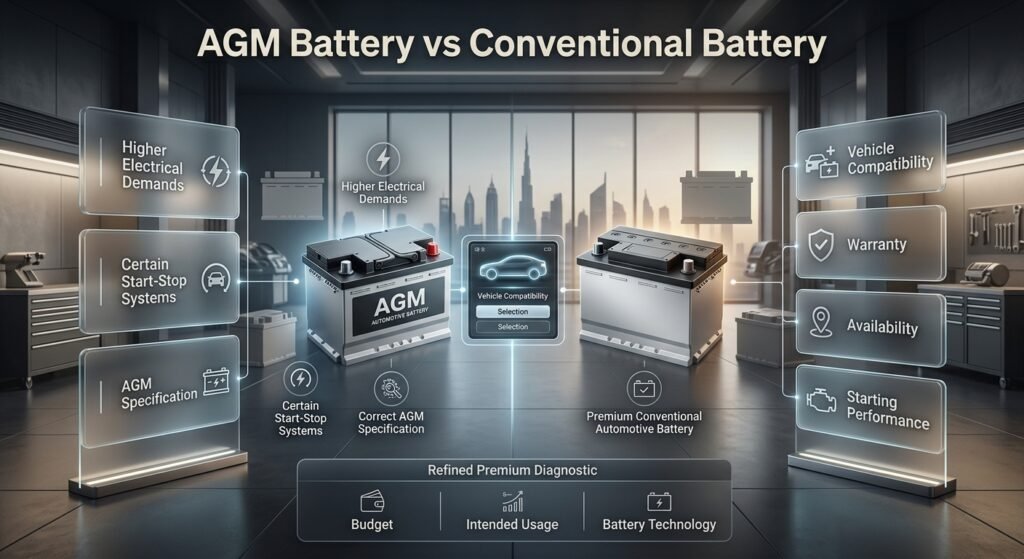
AGM technology is used in many vehicles with higher electrical demands and certain start-stop systems.
However, AGM is not automatically the correct choice for every car.
The vehicle’s requirements should determine the appropriate battery technology.
If a vehicle is designed for AGM, selecting the correct AGM specification becomes important.
This is why battery replacement should be treated as a compatibility decision rather than a simple price comparison.
Choosing Between Battery Brands
Once a battery has been confirmed for replacement, brand selection becomes another consideration.
Different drivers may prioritize:
- Vehicle compatibility
- Battery technology
- Warranty
- Availability
- Starting performance
- Budget
- Intended usage
If you are researching specific brands, the relevant dedicated pages can be used instead of turning this warning-sign article into a brand comparison page.
For example, information about Amaron Car Battery Replacement Dubai is more relevant when a driver is specifically researching Amaron options.
Similarly, drivers researching Bosch can use Bosch Car Battery Replacement Dubai.
For Tuflong battery information, the dedicated Tuflong Car Battery Replacement Dubai page serves that more specific search intent.
Drivers researching other available battery brands can also explore Exide Car Battery Replacement Dubai, Panasonic Car Battery Replacement Dubai, and FIAMM Car Battery Replacement Dubai.
For AC Delco-specific replacement information, AC Delco Car Battery Replacement Dubai provides a more focused resource.
These pages should support the replacement stage rather than distract from the primary purpose of this article: identifying battery warning signs before failure.
Common Mistakes Drivers Make
Waiting for complete failure
The most common mistake is assuming that the battery is fine because the vehicle still starts.
A battery can already have reduced capacity while remaining operational.
Assuming a jumpstart solved the problem
A jumpstart provides temporary starting assistance.
It does not automatically repair a weak battery, alternator, or electrical drain.
Replacing the battery without checking the alternator
If the alternator is not charging correctly, the replacement battery may eventually become discharged as well.
Ignoring terminal corrosion
Poor connections can create starting and charging problems.
Choosing a battery based only on price
The lowest price does not necessarily represent the correct battery for the vehicle.
Compatibility should come first.
Ignoring intermittent symptoms
A problem that occurs only occasionally can still represent developing battery deterioration.
Intermittent symptoms deserve attention when they are different from the vehicle’s normal behavior.
Battery Inspection Before a Long Journey
Long-distance travel is one situation where preventive battery inspection makes particular sense.
A vehicle that starts reliably during normal commuting may still have a marginal battery.
Before a long trip, consider inspection if you have recently noticed:
- Slow engine cranking
- Clicking during startup
- Dimming lights
- Repeated jumpstarts
- Battery warning messages
- Significant terminal corrosion
- Previous charging problems
- Inconsistent starting
A pre-trip Vehicle Inspection can help identify potential battery and charging-system problems before departure.
This can be particularly useful before highway travel, where an unexpected breakdown can create greater inconvenience.
How to Reduce the Risk of Battery Failure
Preventive maintenance cannot guarantee that a battery will never fail, but it can help identify deterioration before it becomes an emergency.
Practical battery-maintenance habits
✔ Pay attention to changes in starting speed.
✔ Do not ignore repeated starting difficulties.
✔ Check battery terminals periodically.
✔ Investigate repeated battery discharge.
✔ Have the charging system checked when appropriate.
✔ Avoid unnecessary electrical loads when the engine is switched off.
✔ Test an aging battery before long-distance travel.
✔ Follow manufacturer battery specifications.
✔ Address repeated jumpstart requirements.
✔ Consider the effects of Dubai’s climate on battery condition.
The objective is simple: identify deterioration while there is still time to act.
How Short Trips Can Affect Battery Recovery
Starting the engine consumes electrical energy.
The charging system replenishes that energy while the vehicle is operating.
When journeys are extremely short and the vehicle is repeatedly started and stopped, there may be limited opportunity for the charging system to restore the energy consumed during starting.
Short trips do not automatically mean the battery will fail.
However, a vehicle used primarily for short journeys may benefit from closer monitoring, particularly if starting performance begins changing.
If short journeys are combined with high temperatures, heavy air-conditioning use, and an aging battery, early symptoms should not be ignored.
Battery Warning Signs Before a Roadside Breakdown
A complete no-start condition is often more disruptive than an early warning symptom.
Consider two situations.
In the first, the driver notices slower starting and arranges a battery test while the vehicle is still operational.
In the second, the driver ignores the symptoms until the vehicle will no longer start at home, at work, or in a parking area.
The second situation creates greater inconvenience because immediate assistance may become necessary.
This is why early battery diagnosis has practical value.
The goal is not to replace every battery at the first unusual symptom.
The goal is to determine whether the symptom represents a developing fault and act appropriately.
What a Professional Battery Inspection Should Include
A comprehensive inspection should look beyond the simple question of whether the engine starts.
| Inspection area | What it evaluates |
|---|---|
| Battery casing | Physical condition |
| Battery terminals | Electrical connection |
| Battery cables | Connection and condition |
| Resting voltage | State of charge information |
| Starting test | Available starting capability |
| Charging voltage | Alternator/charging performance |
| Electrical system | Related voltage issues |
| Diagnostic scan | Relevant electronic faults |
| Battery specification | Compatibility requirements |
This approach provides a clearer picture of the vehicle’s electrical condition.
It also reduces the risk of replacing the wrong component.
What If the Battery Is Healthy?
This is an important possibility.
Not every battery warning symptom requires battery replacement.
If testing shows that the battery is healthy, the technician can investigate other possible causes.
These may include:
- Starter motor
- Alternator
- Battery terminals
- Wiring
- Electrical drain
- Charging circuit
- Other vehicle electronics
This is why diagnosis should come before replacement whenever the cause is uncertain.
A professional Car Service or Vehicle Inspection can help determine which part of the vehicle actually needs attention.
Battery Failure Prevention for Daily Dubai Driving
Drivers who use their vehicles every day can benefit from a simple preventive routine.
Before driving
Notice whether the engine starts at its normal speed.
During driving
Pay attention to dashboard battery warnings and unusual electrical behavior.
After parking
Consider whether the vehicle has experienced repeated electrical problems or unusual discharge.
During routine maintenance
Have battery condition checked if the vehicle is experiencing symptoms.
Before long journeys
Test the battery if there has been any recent deterioration in starting performance.
This does not require constant battery replacement.
It requires awareness.
Battery Warning Signs Checklist
Use this checklist if you are unsure whether your vehicle’s battery needs professional attention:
- ☐ Engine cranks slower than normal
- ☐ Vehicle takes longer to start
- ☐ Clicking occurs during startup
- ☐ Headlights become dim
- ☐ Interior lights appear weak
- ☐ Battery warning light appears
- ☐ Vehicle requires repeated jumpstarts
- ☐ Power windows or electronics behave unusually
- ☐ Battery terminals have heavy corrosion
- ☐ Battery casing appears swollen
- ☐ Battery area has an unusual odor
- ☐ Battery repeatedly loses charge
- ☐ Start-stop function becomes unavailable
- ☐ Multiple electrical warnings appear
- ☐ Starting problems become worse after parking
If several symptoms are present, professional testing is a sensible next step.
When Battery Replacement Becomes the Right Solution
If testing confirms that the battery no longer provides adequate starting capacity, replacement becomes the appropriate solution.
At that stage, the focus changes from “What is causing the warning sign?” to “Which replacement battery is correct for this vehicle?”
This is an important distinction for SEO and for the driver.
The warning-sign stage is about recognizing symptoms and identifying the cause.
The replacement stage is about:
- Correct battery technology
- Correct size
- Correct capacity
- Starting requirements
- Vehicle compatibility
- Installation
- Battery registration or system procedures where required
Drivers researching current battery costs can use the dedicated Car Battery Prices in Dubai 2026 price guide rather than relying on general estimates from a warning-sign article.
Expert Recommendation: Do Not Wait for the Final Warning
The most useful battery warning sign is often a simple change in normal vehicle behavior.
If a car that previously started immediately now cranks slowly, requires occasional assistance, produces clicking sounds, or develops electrical irregularities, those changes should not be dismissed.
At the same time, drivers should avoid assuming that every symptom means they need a new battery.
The better approach is:
Notice the symptom → test the system → identify the cause → choose the correct service.
This prevents unnecessary replacement and gives the vehicle a better chance of remaining reliable.
For Dubai drivers, this approach is particularly practical because high temperatures and demanding urban driving can expose weaknesses in an aging electrical system.
What are the most common warning signs that a car battery is about to fail?
A battery that is approaching the end of its useful life often becomes less consistent before it stops working completely. The most noticeable change is usually slower engine cranking, where the starter sounds weaker or the engine takes longer to turn over. Drivers may also notice dim headlights, clicking during startup, repeated jumpstarts, or electrical accessories behaving differently. These symptoms become more meaningful when they appear repeatedly rather than as a one-time event.
The important thing is not to wait for the battery to become completely dead. Early symptoms give you an opportunity to have the battery and charging system tested while the vehicle is still usable.
Key signs to watch:
Slow or hesitant engine cranking
Clicking when attempting to start
Dim headlights or dashboard illumination
Repeated need for jumpstarts
Electrical accessories behaving unusually
Battery or charging warning light
Corrosion or physical changes around the battery
If several of these signs are appearing together, professional testing is more useful than simply guessing that the battery needs replacement.
How can I tell if my car battery is failing or the alternator is the problem?
This is one of the most important questions because battery and alternator problems can produce very similar symptoms. A weak battery commonly causes slow cranking, clicking and difficulty starting. An alternator or charging-system problem can also leave the battery discharged because the battery is not being properly replenished while the engine is running.
The biggest mistake is replacing the battery without checking the charging system. If the alternator is the real problem, a new battery may eventually become discharged as well.
A useful diagnostic pattern is to consider what happens after the vehicle has been properly recharged or jumpstarted. If the car repeatedly loses power again, the charging system or an electrical drain deserves investigation.
Professional checks should include:
Battery condition and starting capacity
Battery voltage
Charging-system performance
Alternator operation
Battery terminals and cable connections
Possible electrical drain
Starter-system condition when symptoms point in that direction
The safest conclusion is not “slow starting equals bad battery.” The correct conclusion is “slow starting means the starting and electrical system should be checked.”
Can a car battery suddenly fail even if there were no warning signs?
Yes, a battery can sometimes fail with very little noticeable warning, which is why relying only on symptoms is not enough. However, many batteries do show smaller changes beforehand—such as slower cranking, intermittent starting difficulty, dim lighting, or repeated discharge—that drivers may simply overlook. AAA also notes that not every failing battery provides obvious warning signs.
This is particularly important when a vehicle is used in demanding conditions. A battery that appears acceptable during normal driving may have limited reserve capacity and become unreliable when conditions place greater demands on the electrical system.
For that reason, preventive testing makes sense when a battery is aging, the vehicle has experienced previous starting problems, or the driver notices a clear change from the car’s normal behavior.
Situations where testing is especially worthwhile:
The engine has recently started more slowly
The vehicle has needed a jumpstart
The battery has repeatedly discharged
Electrical behavior has changed
The battery has visible corrosion or damage
You are preparing for a long journey
The vehicle operates regularly in very hot conditions
A professional battery test is a much better way to assess remaining reliability than waiting to see whether the car starts tomorrow morning.
Why does my car keep needing jumpstarts if the battery was recently charged?
Repeated jumpstarts usually mean the underlying problem has not been resolved. A battery can be temporarily recharged and still have reduced capacity, while an alternator problem or parasitic electrical drain can cause the battery to lose its charge again. Automotive guidance consistently recommends investigating repeated jumpstarts rather than treating them as a permanent solution.
The key question is why the battery keeps becoming discharged.
For example, one isolated jumpstart after accidentally leaving lights on is very different from needing another jumpstart several times within a short period without an obvious reason.
Repeated jumpstarts can point toward:
A deteriorating battery
Alternator or charging-system problems
Electrical drain while parked
Loose or corroded battery connections
Frequent short-trip driving
Another starting or electrical fault
If the vehicle starts after a jump but later struggles again, don’t assume the battery simply needs another charge. Have the battery and charging system checked together so the actual cause can be identified.
How does Dubai’s heat affect car battery failure and warning signs?
Dubai’s high temperatures make battery condition particularly important because heat can accelerate battery aging. The effect becomes more significant when high temperatures are combined with heavy air-conditioning use, traffic, repeated engine starts, short journeys, and extended parking.
Heat does not mean that every battery will suddenly fail, but it can make an already weakened battery less tolerant of demanding conditions. AAA identifies heat, along with time and vibration, as factors that influence battery life.
For Dubai drivers, the practical approach is to pay attention to changes rather than waiting for complete failure.
Watch more carefully for:
Slower starting than usual
Repeated jumpstarts
Dimming lights
Battery or charging warnings
Unusual electrical behavior
Repeated discharge after parking
Visible battery deterioration
If these symptoms appear, testing the battery and charging system before a long journey or continued daily use can help identify whether the vehicle needs monitoring, battery replacement, or another electrical repair.
Conclusion
Recognizing Battery Warning Signs Before Failure can save drivers from an unexpected no-start situation and the inconvenience of a roadside breakdown. Symptoms such as slow engine cranking, clicking during startup, dim lights, repeated jumpstarts, unusual electrical behavior, and recurring battery discharge should not simply be ignored.
At the same time, these warning signs do not always mean that the battery itself needs replacement. An alternator, starter, battery terminals, wiring, or another electrical issue can create similar symptoms. That is why proper battery and charging-system testing is important before making a replacement decision.
For drivers in Dubai, paying attention to battery condition is especially important because high temperatures, heavy air-conditioning use, traffic, frequent short journeys, and extended parking can place additional demands on the vehicle’s electrical system.
The best approach is simple: notice the warning signs early, diagnose the actual cause, and replace the battery only when testing confirms it is no longer reliable or suitable for your vehicle. Taking action before complete failure can help keep your vehicle dependable and reduce the risk of being unexpectedly stranded.

Leave a Reply