
Introduction
Car battery heat protection is an important part of vehicle maintenance, particularly in hot climates such as Dubai. High temperatures do not simply make a vehicle uncomfortable to drive; prolonged heat exposure can accelerate battery aging, increase fluid evaporation in applicable battery designs, damage internal components, and reduce starting performance.
Modern vehicles place even greater demands on their batteries. Infotainment systems, electronic control modules, advanced safety systems, keyless entry, start-stop technology, electric seats, powerful air conditioning, and other electrical equipment all depend on a reliable 12-volt electrical system.
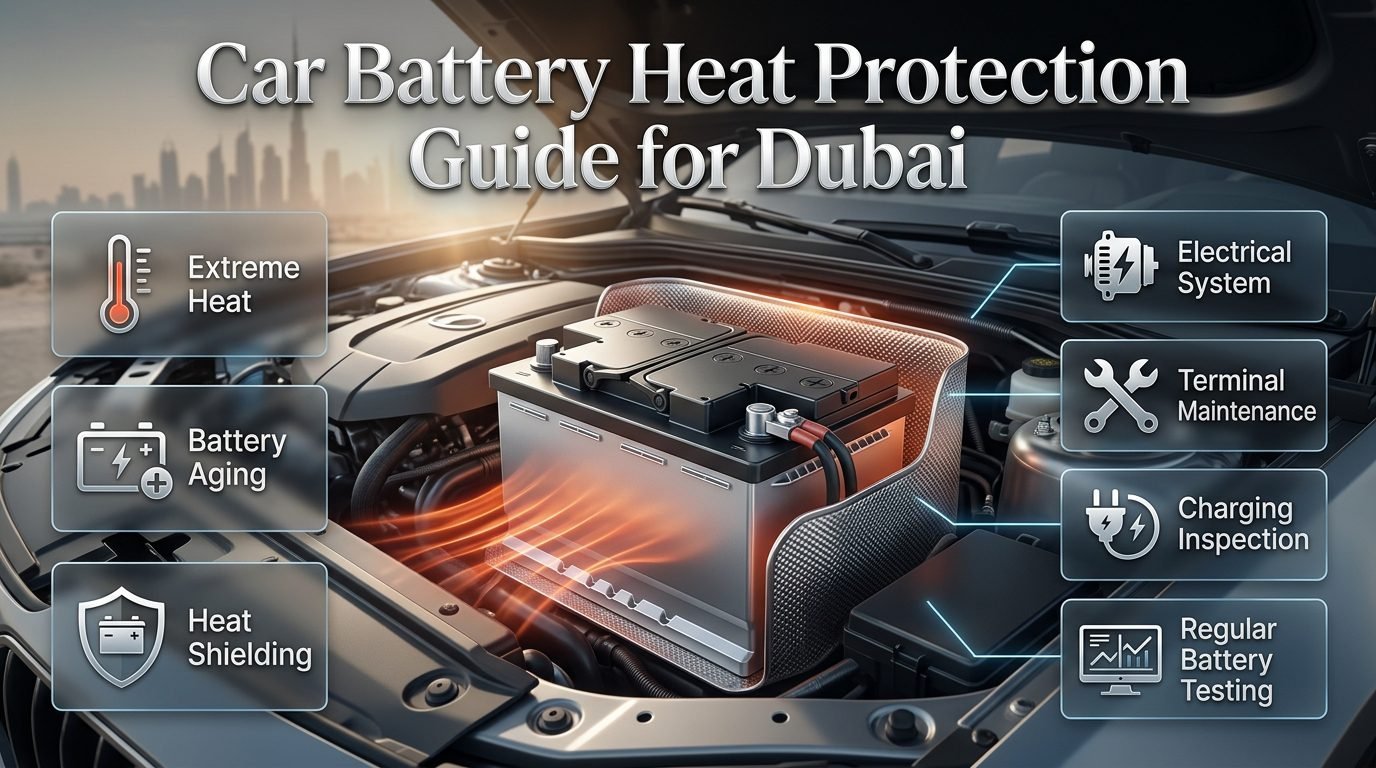
A battery that appears normal during cooler conditions may become unreliable after extended exposure to engine-bay heat or extreme outdoor temperatures. Proper battery heat protection therefore involves more than installing insulation. It includes correct battery selection, secure mounting, terminal maintenance, charging-system inspection, heat shielding where appropriate, and regular battery testing.
For Dubai drivers looking for professional automotive support, EuroSwift Auto Services provides battery-related assistance alongside broader vehicle maintenance and roadside automotive services.
1. Why Car Battery Heat Protection Matters
Automotive batteries operate through chemical reactions. Temperature affects the speed of those reactions, and excessive heat can accelerate unwanted chemical and physical changes inside the battery.
Heat exposure can contribute to:
- Faster battery aging
- Reduced battery service life
- Electrolyte evaporation in applicable battery designs
- Increased corrosion
- Internal component deterioration
- Reduced starting reliability
- Greater risk of sudden battery failure
- Stress on the vehicle charging system
The important point is that heat damage is often cumulative. A battery does not necessarily fail immediately after one extremely hot day. Instead, repeated exposure to elevated temperatures can gradually reduce its ability to deliver the current required during engine starting.
| Factor | Normal Aging | Excessive Heat Exposure |
|---|---|---|
| Chemical degradation | Gradual | Accelerated |
| Internal corrosion | Progressive | Can increase faster |
| Starting performance | Slowly decreases | May decline prematurely |
| Electrolyte loss | Depends on battery design | Can increase in applicable batteries |
| Failure risk | Usually progressive | Can become unexpectedly high |
2. How High Temperature Affects a Car Battery
The battery is affected by both ambient temperature and the temperature surrounding it inside the vehicle.
The engine compartment can become significantly hotter than the outside environment. When a battery is located close to heat-producing components, repeated thermal exposure can place additional stress on its internal materials.
Chemical Reaction Rate
Higher temperatures can accelerate electrochemical reactions. While a battery may temporarily appear to perform strongly in warm conditions, accelerated chemical activity can also contribute to faster long-term degradation.
Internal Corrosion
Heat can contribute to conditions that accelerate corrosion of internal battery components. As corrosion progresses, electrical performance can deteriorate.
Electrolyte Evaporation
For battery designs where electrolyte loss is possible, excessive heat can increase evaporation. Reduced electrolyte levels can affect internal battery performance and may eventually contribute to damage.
Battery Case and Material Stress
Repeated heating and cooling cycles can place physical stress on battery materials. Over a long period, thermal cycling may contribute to deterioration.
3. Dubai Heat Creates Additional Battery Challenges
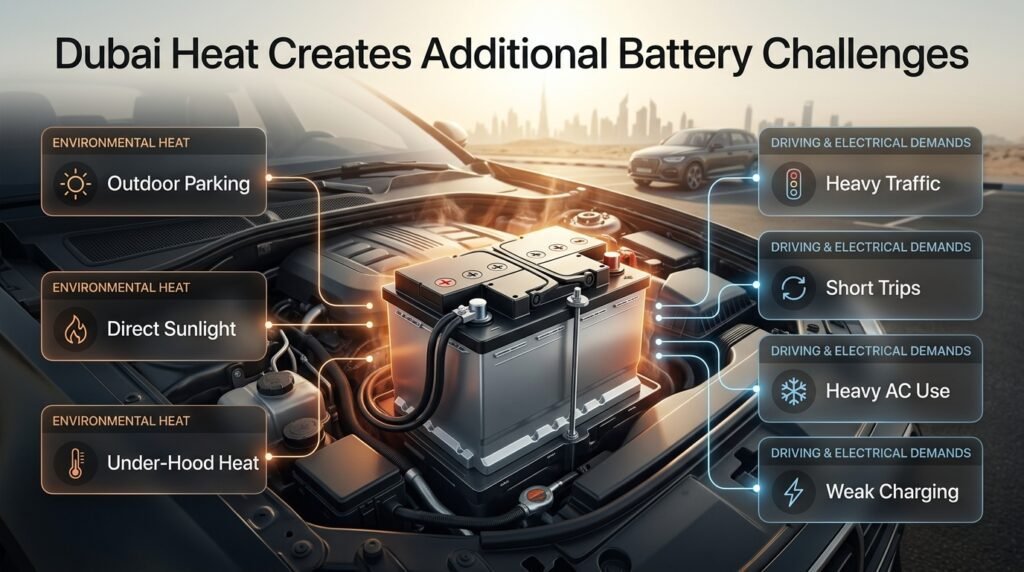
Dubai’s climate makes battery temperature management particularly relevant.
A vehicle parked outdoors can experience prolonged exposure to high ambient temperatures. A car parked in direct sunlight can become considerably hotter internally, while engine-bay temperatures can rise further during and after driving.
Traffic conditions can make the situation more demanding.
During slow urban driving, the engine and surrounding components continue producing heat while airflow through the engine compartment may be lower than during highway driving.
At the same time, drivers may depend heavily on air conditioning and other electrical equipment.
| Driving Condition | Potential Battery Impact |
| Outdoor parking | Prolonged heat exposure |
| Direct sunlight | Higher vehicle temperatures |
| Heavy traffic | Increased under-hood heat |
| Frequent short trips | Limited battery recharge time |
| Heavy AC use | Greater electrical demand |
| Long periods without driving | Risk of discharge |
| Weak charging system | Battery may remain undercharged |
4. Where Does Battery Heat Come From?
Many drivers assume the outside temperature is the only source of battery heat. It is not.
A vehicle battery can be affected by several heat sources.
External Heat
Direct sunlight and high ambient temperatures can increase battery temperature, especially when a vehicle is parked outside for extended periods.
Engine-Bay Heat
The engine, exhaust components, radiator, turbocharger, and other systems generate significant heat.
A battery positioned close to these components can experience elevated temperatures.
Post-Drive Heat Soak
After the engine is switched off, airflow decreases dramatically while many components remain extremely hot. Heat can migrate through the engine compartment and surrounding materials.
This means a battery can continue experiencing high temperatures even after the vehicle has stopped.
5. Signs That Heat May Be Affecting Your Battery
Heat-related battery deterioration does not always produce a dedicated warning message.
Drivers should pay attention to changes in starting performance and electrical behavior.
Common warning signs include:
- Engine cranks more slowly than usual
- Vehicle occasionally requires a jumpstart
- Battery repeatedly becomes discharged
- Interior or exterior lights appear weaker
- Electrical systems behave inconsistently
- Battery warning messages appear
- Battery casing shows physical deterioration
- Corrosion develops around terminals
- Battery fails unexpectedly despite appearing relatively new
A single symptom does not automatically prove that heat is responsible.
A weak alternator, parasitic electrical drain, loose connection, poor grounding, or an aging battery can produce similar symptoms.
That is why professional testing is more reliable than guessing.
6. Battery Heat Protection Should Start With Correct Battery Selection
Heat protection begins before the battery is installed.
A replacement battery should match the vehicle’s electrical requirements and manufacturer specifications.
Important factors can include:
- Battery technology
- Physical dimensions
- Terminal arrangement
- Cold cranking capability
- Capacity
- Reserve capacity
- Vehicle electrical requirements
- Start-stop compatibility
- AGM or EFB requirements
- Manufacturer-specific battery specifications
If the existing battery has reached the end of its service life, professional car battery replacement in Dubai should include checking the correct battery specification rather than simply fitting a battery of the same physical size.
For vehicles requiring advanced battery technology, an AGM battery may be necessary, particularly where start-stop systems and high electrical loads are involved.
7. Battery Insulation and Heat Shields: Do They Really Help?
Battery insulation can help reduce direct exposure to external heat, but it must be installed correctly.
A battery heat shield or thermal protection sleeve is designed to reduce the transfer of excessive heat to the battery. However, the goal is not to trap heat around the battery.
A poorly designed or incorrectly installed cover can interfere with ventilation, inspection, terminal access, or battery maintenance.
Good Heat Protection Should
- Reduce direct radiant heat exposure
- Maintain appropriate ventilation
- Avoid contact with moving components
- Avoid interfering with terminals
- Allow battery inspection
- Remain securely positioned
- Be compatible with the vehicle’s original battery compartment
Do not wrap a battery with random household insulation or install improvised materials around the engine compartment.
8. Battery Location and Engine-Bay Heat Management
Some vehicles place batteries in relatively cool areas such as the trunk or under-seat compartments. Others locate them inside the engine bay.
Battery location can significantly influence thermal exposure.
If a battery is positioned close to a major heat source, the surrounding thermal environment should be considered when diagnosing premature battery deterioration.
A professional inspection can identify:
- Battery position
- Heat-source proximity
- Original heat shielding
- Ventilation arrangements
- Cable routing
- Mounting condition
- Evidence of excessive heat exposure
9. Battery Terminals and Cables Need Heat Protection Too
Protecting the battery itself is only part of the electrical-system equation.
Battery terminals, cables, connectors, and grounds also operate under demanding conditions.
High temperatures can contribute to deterioration of electrical connections over time. Corrosion or loose connections can increase electrical resistance and make starting more difficult.
During inspection, technicians should check:
- Positive terminal condition
- Negative terminal condition
- Cable connections
- Ground connections
- Terminal corrosion
- Cable insulation
- Battery hold-down
- Signs of overheating
- Electrical connection security
A battery can test reasonably well while a poor connection creates starting problems.
This is why professional battery replacement should include inspection of the surrounding electrical connections rather than simply removing the old battery and installing a new one.
10. How to Protect a Car Battery From Dubai Heat
Drivers cannot control the outdoor temperature, but they can reduce unnecessary thermal exposure.
Practical Heat-Protection Measures
Park in shade whenever practical.
Covered parking can reduce direct solar exposure and help reduce overall vehicle temperature.
Use covered parking for long-term parking.
If a vehicle remains parked for several hours, reducing direct sunlight can be beneficial.
Keep the engine compartment properly maintained.
Cooling-system problems can contribute to excessive under-hood temperatures.
Inspect the battery regularly.
Early detection of corrosion, physical damage, loose mounting, or deterioration can prevent bigger problems.
Keep electrical connections clean and secure.
Poor connections can increase resistance and electrical stress.
Test an aging battery before demanding journeys.
A battery that is already weakened may fail when subjected to additional heat and electrical demand.
Maintain the charging system.
A healthy alternator and properly functioning charging system are essential for battery reliability.
11. Air Conditioning, Electrical Loads, and Battery Stress
Dubai drivers rely heavily on air conditioning, particularly during the hottest months.
The air-conditioning system involves electrical components, cooling fans, control systems, blower motors, and other electrical loads.
A healthy charging system should support these demands.
However, when a battery is already weak or the alternator is not functioning correctly, heavy electrical use can expose the problem more quickly.
Electrical Systems That Can Increase Demand
- Air-conditioning blower
- Cooling fans
- Headlights
- Infotainment
- Heated or ventilated seats
- Electronic control modules
- Security systems
- USB and accessory devices
- Driver-assistance systems
- Start-stop systems
12. Why Short Trips Can Make Heat Problems Worse
Short-distance driving can create a difficult combination for automotive batteries.
The engine starts using a large amount of electrical energy. The alternator then needs time to replenish the battery.
When a vehicle is repeatedly driven for very short periods, the battery may not receive enough charging time to fully recover.
If the same vehicle is exposed to high temperatures, the combination of:
heat + frequent starting + short trips + electrical demand
can accelerate battery deterioration.
13. Professional Battery Heat Protection Inspection
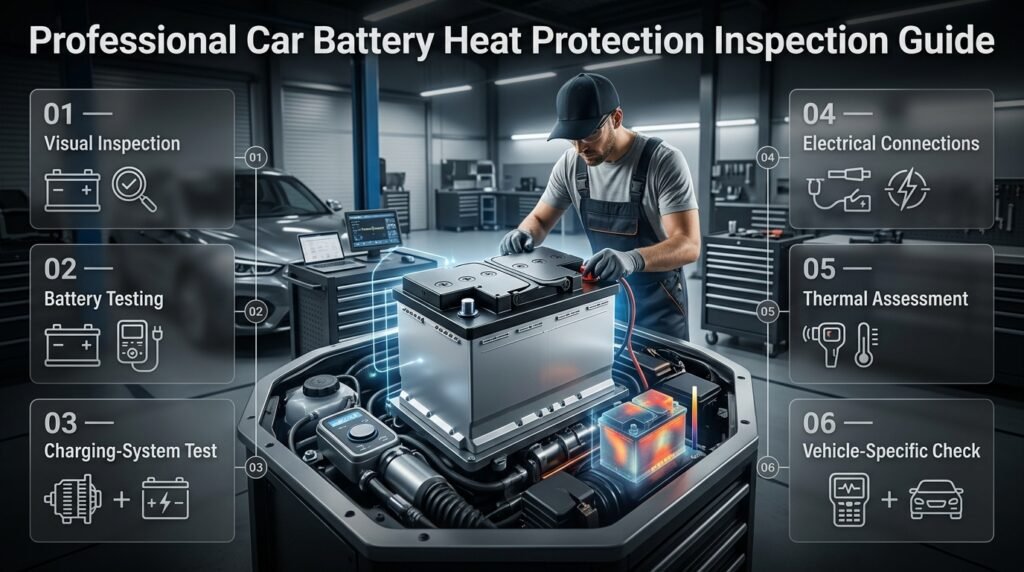
A professional inspection should not focus exclusively on battery voltage.
A comprehensive inspection can include several stages.
Step 1: Visual Inspection
The technician checks the battery casing, terminals, mounting, cables, and surrounding area.
Step 2: Battery Condition Testing
Appropriate battery-testing equipment can assess the battery’s condition and starting capability.
Step 3: Charging-System Testing
The alternator and charging system are evaluated to determine whether the battery is receiving appropriate charging.
Step 4: Electrical Connection Inspection
Terminals, grounds, cables, and connections are checked for corrosion, looseness, or deterioration.
Step 5: Thermal Environment Assessment
The technician can inspect the battery’s location and surrounding components for obvious excessive heat exposure or missing protective components.
Step 6: Vehicle-Specific Assessment
Modern vehicles may require additional procedures such as battery registration or electronic-system adaptation after battery replacement, depending on the vehicle.
14. Battery Voltage Alone Does Not Tell the Whole Story
One of the most common mistakes is judging battery health solely from voltage.
A battery can show an acceptable resting voltage and still have reduced starting capability.
Battery condition can involve:
- State of charge
- Starting capability
- Internal resistance
- Capacity
- Charging performance
- Age
- Temperature exposure
- Electrical-system condition
For this reason, professional battery testing is more informative than relying on a basic voltage reading alone.
| Symptom | Possible Cause | Recommended Action |
| Slow cranking | Weak battery | Battery test |
| Repeated discharge | Battery, drain, or charging issue | Electrical diagnosis |
| Battery warning light | Charging-system fault | Check alternator |
| Corroded terminal | Connection issue | Inspect and clean connection |
| New battery failing early | Incorrect specification or vehicle fault | Full inspection |
| Battery overheating | Excessive thermal exposure or system issue | Inspect battery location and surroundings |
15. Battery Heat Protection for Luxury and Modern Vehicles
Luxury vehicles often contain substantially more electronic equipment than basic vehicles.
Depending on the model, the electrical system may support:
- Advanced infotainment
- Multiple control modules
- Driver-assistance systems
- Electronic seat functions
- Advanced climate controls
- Security systems
- Connectivity features
- Start-stop systems
These systems do not necessarily mean a battery will fail quickly, but they make correct battery specification and electrical-system management increasingly important.
For premium vehicles, Luxury Car Service should therefore include attention to the electrical system rather than treating the battery as an isolated component.
16. Battery Heat Protection and Start-Stop Technology
Start-stop systems can place additional demands on the battery because the engine may restart frequently during normal driving.
Vehicles equipped with start-stop technology commonly use battery technologies designed for repeated cycling, such as AGM or EFB, depending on the manufacturer’s specification.
For vehicles that require this technology, an AGM battery replacement in Dubai may be appropriate when it matches the manufacturer’s requirements.
Installing a conventional battery where a start-stop-compatible battery is required can result in reduced performance and premature deterioration.
17. Common Mistakes That Reduce Battery Life in Hot Weather
Many battery problems are preventable.
Mistake 1: Waiting Until the Battery Dies
A battery can provide warning signs before complete failure.
Mistake 2: Installing an Incorrect Battery
Physical fit does not guarantee electrical compatibility.
Mistake 3: Ignoring the Alternator
Replacing a battery without checking the charging system can leave the underlying problem unresolved.
Mistake 4: Using Improvised Heat Insulation
Materials not designed for automotive environments can create clearance, ventilation, or heat-retention problems.
Mistake 5: Ignoring Corrosion
Corroded terminals can interfere with electrical conductivity.
Mistake 6: Assuming a New Battery Cannot Fail
A new battery can discharge because of a charging problem, parasitic drain, incorrect installation, or prolonged vehicle inactivity.
18. Battery Heat Protection Maintenance Schedule
There is no single inspection interval that applies to every vehicle, but a practical preventive approach is useful.
| Maintenance Task | Recommended Approach |
| Visual battery inspection | Check periodically |
| Terminal inspection | Check during routine maintenance |
| Battery performance test | Before demanding travel and when symptoms appear |
| Charging-system test | When battery problems occur or during electrical diagnosis |
| Battery mounting inspection | During service |
| Heat-shield inspection | During battery-area inspection |
| Battery replacement assessment | Based on test results, age, specification, and condition |
19. What to Do Before Long-Distance Travel
A battery that is marginal in the city can become a serious inconvenience during long-distance travel.
Before travelling between Dubai and another emirate, drivers should consider checking:
- Battery condition
- Battery terminals
- Alternator performance
- Engine oil
- Coolant
- Tire condition
- Tire pressure
- Brake condition
- Lights
- Wipers
- AC operation
- Warning lights
A battery test is particularly worthwhile if the vehicle has recently experienced slow starting or repeated electrical problems.
20. What If the Battery Has Already Failed?
If the vehicle will not start, the immediate priority is determining why.
A Car Jumpstart may restore the vehicle temporarily, but a jumpstart does not repair a weak battery or charging-system fault.
After starting the vehicle, the battery and charging system should be assessed.
Possible Outcomes
Battery is healthy but discharged:
The cause may involve vehicle inactivity, electrical load, or another issue.
Battery has failed:
Battery Replacement may be required.
Alternator is not charging correctly:
The charging system needs diagnosis and repair.
Parasitic drain is present:
The vehicle requires electrical diagnosis to identify the source.
21. Battery Heat Protection vs Battery Replacement
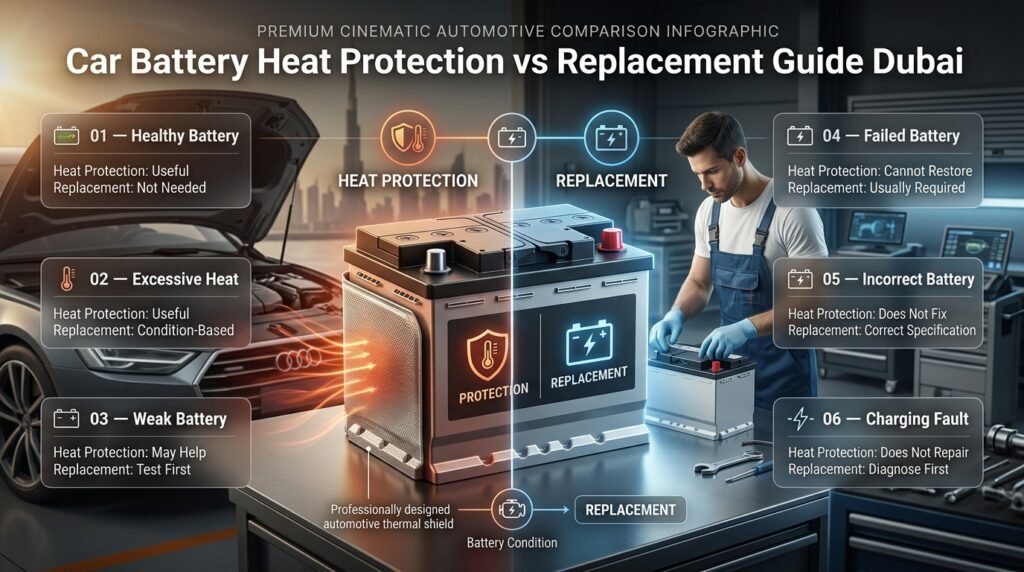
Heat protection can help reduce unnecessary thermal stress, but it cannot restore a battery that has already suffered significant internal deterioration.
| Situation | Heat Protection | Replacement |
| Battery is healthy | Useful | Not needed |
| Battery exposed to excessive heat | Useful | Depends on condition |
| Battery is weak but functional | May help future protection | Testing required |
| Battery has failed | Cannot restore it | Usually required |
| Incorrect battery installed | Does not solve specification issue | Correct battery required |
| Charging-system fault | Does not repair fault | Diagnose system first |
22. Professional Battery Heat Protection Checklist
Before considering the battery protected and healthy, verify the following:
- Correct battery specification
- Correct battery technology
- Secure battery mounting
- Clean and secure terminals
- Proper cable condition
- Good ground connections
- Appropriate heat shielding where required
- Adequate ventilation
- Healthy charging system
- No obvious parasitic electrical drain
- No physical battery damage
- Battery performance tested when necessary
- Vehicle-specific battery procedures completed after replacement when required
23. Choosing the Right Battery for a Hot Climate
Heat protection does not eliminate the importance of battery quality and specification.
Different vehicles require different battery technologies and capacities. Brand selection should come after determining the correct technical specification.
For example, drivers comparing an Amaron battery replacement in Dubai should first confirm that the available battery matches the vehicle’s required size, capacity, starting performance, and technology.
Similarly, a Bosch battery replacement in Dubai can be considered when Bosch specifications match the vehicle’s requirements.
For vehicles using compatible Tuflong products, Tuflong battery replacement in Dubai provides another manufacturer-specific option.
The same principle applies when comparing Exide, Panasonic, FIAMM, or AC Delco batteries: the correct technical specification should always take priority over choosing a brand simply because it is familiar.
24. Understanding Battery Price Differences in Dubai
Battery prices can vary considerably because automotive batteries are not all manufactured to the same specification.
Factors affecting price can include:
- Battery technology
- Capacity
- Starting performance
- Physical size
- Brand
- Vehicle compatibility
- AGM or EFB construction
- Warranty
- Installation requirements
- Electronic registration requirements
- Vehicle-specific application
Drivers comparing replacement costs can use the Car Battery Prices in Dubai 2026 guide to understand the factors that influence battery pricing instead of comparing prices based only on battery size.
25. Additional Battery Brand Options
Some vehicles may require specifications available through manufacturers such as Exide, Panasonic, FIAMM, or AC Delco.
For appropriate vehicle applications, drivers can explore:
- Exide battery replacement in Dubai
- Panasonic battery replacement in Dubai
- FIAMM battery replacement in Dubai
- AC Delco battery replacement in Dubai
These are included here because the relevant battery technology and vehicle application matter more than simply choosing the most popular battery brand.
26. Future of Automotive Battery Thermal Management
Battery thermal management is becoming increasingly important as vehicles become more electronically sophisticated.
Traditional 12-volt batteries remain widely used, but modern vehicles increasingly incorporate advanced electrical architectures, battery monitoring systems, start-stop technology, mild-hybrid systems, and high-voltage battery packs.
Future automotive systems are expected to place greater emphasis on:
- Intelligent battery monitoring
- More accurate state-of-health calculations
- Improved thermal management
- Advanced charging strategies
- Higher-efficiency electrical systems
- Predictive maintenance
- Vehicle-generated battery health warnings
The future of battery replacement is therefore not simply about fitting a new battery. It increasingly involves correct specification, electronic compatibility, system testing, and data-driven maintenance.
27. Expert Recommendations for Dubai Drivers
Professional battery maintenance should focus on preventing failure rather than reacting to it.
Industry Best Practice
1. Reduce unnecessary heat exposure.
Use covered or shaded parking whenever practical.
2. Maintain the vehicle cooling system.
An engine operating correctly helps maintain a more controlled thermal environment.
3. Test batteries showing symptoms.
Slow cranking and repeated discharge should not be ignored.
4. Check the charging system.
A healthy battery depends on proper charging.
5. Use the correct battery technology.
This is especially important for start-stop and electronically advanced vehicles.
6. Inspect connections.
Terminals, grounds, cables, and mounting should remain secure.
7. Consider driving patterns.
Frequent short trips can leave the battery undercharged.
8. Prepare before long journeys.
A battery inspection before extended travel can reduce roadside problems.
9. Use professional diagnosis for recurring failures.
Repeated battery replacement without finding the underlying cause wastes money and may leave the vehicle unreliable.
How Can I Protect My Car Battery From Extreme Heat in Dubai?
Protecting a car battery from Dubai’s heat is not about one single product or trick. The better approach is to reduce unnecessary heat exposure while keeping the battery, charging system, terminals, and surrounding engine compartment in good condition. High temperatures accelerate the chemical processes that contribute to battery aging, so repeated exposure can gradually reduce starting reliability.
For daily driving in Dubai, practical protection includes:
Park in a covered or shaded area whenever possible.
Avoid leaving the vehicle exposed to direct sunlight for unnecessarily long periods.
Keep the battery securely mounted so vibration does not add another source of stress.
Inspect terminals and cables for corrosion or loose connections.
Make sure the vehicle’s charging system is operating correctly.
Use the battery technology specified for the vehicle.
Consider professional battery testing when starting performance begins to change.
A heat shield can also be useful where the vehicle was designed to use one, particularly when the battery is positioned close to major heat sources. However, improvised insulation should not be used because restricting ventilation or creating unsafe clearances can cause other problems.
Does Dubai Heat Really Shorten Car Battery Life?
Yes, and this is one of the most important reasons battery maintenance deserves extra attention in Dubai. High temperatures accelerate electrochemical activity inside lead-acid batteries and can contribute to internal corrosion, water loss in applicable designs, and faster overall aging. The battery’s actual temperature can also become considerably higher than the outdoor temperature when it is exposed to engine-bay heat.
The important distinction is that heat-related deterioration is generally permanent aging, rather than simply a temporary reduction in performance.
Factors that can increase the strain include:
Long periods of outdoor parking
Direct sunlight
High engine-bay temperatures
Heavy traffic and prolonged idling
Frequent short journeys
High electrical demand
Poor charging-system performance
An already aging battery
This is why a battery that appears to be working normally can still be approaching the end of its useful service life. Regular testing gives a much better indication of its condition than waiting for the vehicle to stop starting.
Is AGM the Best Battery for Hot Weather and Dubai Driving?
AGM can be an excellent choice for vehicles that are specifically designed or specified for AGM technology, particularly vehicles with start-stop systems and substantial electrical demands. AGM batteries are known for their strong cycling capability and are widely used in modern vehicles. Consumer Reports also notes that many of its higher-performing batteries are AGM designs and suggests considering AGM in areas with extreme temperatures.
However, AGM should not automatically be considered the best battery for every car. The correct battery depends on the vehicle manufacturer’s specification.
Before choosing AGM, consider:
Required battery technology
Battery size and dimensions
Capacity
Starting-current requirements
Start-stop compatibility
Vehicle electrical architecture
Manufacturer specifications
Battery-management requirements
The professional approach is to select the battery based on the vehicle rather than simply choosing the most expensive or most technologically advanced option.
What Are the Warning Signs That Heat Has Damaged My Car Battery?
Heat damage does not always announce itself with a single obvious warning. In many cases, the first indication is a gradual change in how the vehicle starts or how its electrical systems behave.
A particularly important warning sign is slower or weaker engine cranking. Other symptoms can include repeated discharge, the vehicle requiring a jumpstart after sitting, unusual electrical warnings, or start-stop functionality becoming unavailable. Recent UAE automotive guidance also highlights slow cranking, multiple electrical warnings, and repeated jumpstarts as signs worth investigating.
Watch for these signs:
Slower engine cranking
Battery repeatedly going flat
Needing a jumpstart after the vehicle sits
Battery warning messages
Unusual electrical behavior
Corroded terminals
Visible battery deterioration
Start-stop system becoming unavailable
A battery that performs inconsistently after hot parking
The key point is not to assume heat is automatically the cause. An alternator problem, parasitic drain, poor connection, or incorrect battery specification can create similar symptoms. A proper battery and charging-system test can separate these possibilities.
Should I Replace My Car Battery Before It Completely Fails in Dubai Heat?
If testing shows that the battery has significantly deteriorated, replacing it before complete failure can be a sensible preventive decision—especially if the vehicle is used daily, parked outdoors, or regularly driven in heavy traffic.
Waiting until a battery completely fails can turn a manageable maintenance issue into an inconvenient roadside problem. However, replacing a battery simply because of a fixed age is not always the best approach. Battery condition, vehicle requirements, operating environment, and test results should all be considered.
Before deciding on replacement, a professional assessment should look at:
Battery health and starting capability
Battery age and service history
Charging-system performance
Terminal and cable condition
Possible parasitic electrical drain
Correct battery specification
Signs of excessive thermal exposure
Vehicle-specific battery requirements
This approach avoids two common mistakes: replacing a healthy battery unnecessarily and continuing to use a badly deteriorated battery until it leaves you stranded.
For Dubai vehicles, preventive battery testing is particularly valuable because high temperatures can accelerate battery aging even when the vehicle still appears to start normally.
Conclusion
Car battery heat protection is not simply about keeping the battery away from high temperatures. In Dubai, reliable battery performance depends on managing the complete electrical environment around the battery. Extreme heat, engine-bay temperatures, frequent short trips, heavy electrical loads, and an aging charging system can gradually reduce battery performance and increase the possibility of unexpected starting problems.
The most effective approach is preventive rather than reactive. Regular battery testing, correct battery specification, secure terminals, proper mounting, a healthy charging system, suitable thermal protection, and sensible parking habits can all help reduce unnecessary battery stress.
For modern vehicles, especially luxury and start-stop models, battery selection and electrical-system diagnosis are becoming increasingly important. A professional inspection can determine whether a problem is actually caused by heat, battery deterioration, alternator performance, electrical drain, or another vehicle fault.
For Dubai drivers, taking care of battery condition before failure occurs is one of the simplest ways to improve vehicle reliability, starting confidence, and overall maintenance planning throughout the year.

Leave a Reply