
Introduction
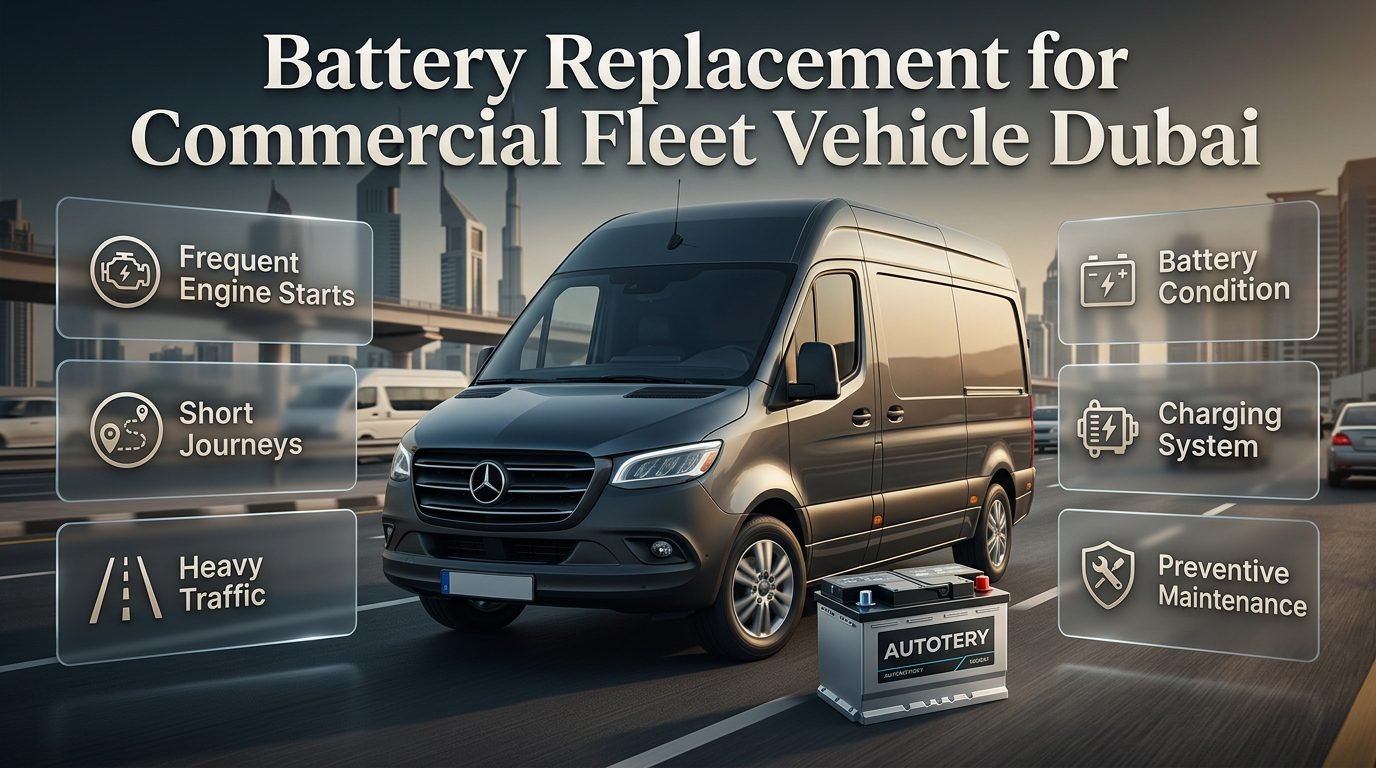
Battery Replacement for Commercial Fleet Vehicle Dubai | Commercial fleet vehicles are expected to remain dependable because business operations often depend on them being available at the right place and at the right time. Delivery vans, company cars, service vehicles, executive vehicles, logistics vehicles, maintenance vans, and other commercial vehicles can spend many hours on Dubai roads every day. They may also experience repeated engine starts, short journeys, heavy traffic, long periods of idling, continuous air-conditioning use, and substantial electrical demand.
For this reason, battery replacement for commercial fleet vehicle Dubai should not be treated simply as an emergency service performed after a vehicle refuses to start. A professional fleet battery strategy considers battery condition, vehicle usage, electrical requirements, charging-system performance, battery technology, replacement history, and preventive maintenance.
Dubai’s operating environment makes this particularly important. High temperatures can accelerate battery aging, while traffic conditions and frequent short journeys can create demanding operating cycles. A fleet vehicle that starts several times every day can experience very different battery wear from a privately owned car that makes one longer journey each morning.
EuroSwift Auto Services can support this wider approach by treating battery replacement as part of professional vehicle maintenance rather than looking at the battery in isolation.
Why Commercial Fleet Vehicles Need a Different Battery Strategy
A commercial fleet is rarely used in the same way as a personal vehicle.
Consider a delivery van operating from morning until evening. It may start at the depot, drive for fifteen minutes, stop at a customer location, switch off, restart, drive another short distance, stop again, and repeat this process dozens of times.
A company vehicle may have a completely different duty cycle. It might travel longer distances between offices, construction sites, warehouses, or customer locations.
An executive vehicle could spend considerable time waiting with climate-control and electronic systems operating.
A service vehicle may carry additional electrical equipment or use tracking and communications systems throughout the day.
All of these factors influence battery demand.
A commercial fleet battery strategy should therefore consider:
- Number of daily engine starts
- Average journey duration
- Daily mileage
- Time spent idling
- Air-conditioning usage
- Electrical accessory consumption
- Vehicle age
- Battery technology
- Charging-system condition
- Parking duration
- Aftermarket electrical equipment
- Driving environment
- Maintenance history
This is why simply asking how many years a battery should last is not enough.
Two identical vehicles can have significantly different battery conditions if one is used for frequent short-distance deliveries and the other travels long highway distances.
Why Battery Reliability Matters for Dubai Fleets
Battery failure creates a different level of inconvenience for commercial operators.
A private driver may experience an inconvenient delay. A commercial operator can experience a chain of operational problems.
A failed fleet vehicle may mean:
- A delivery is delayed
- A service appointment is missed
- A replacement vehicle has to be dispatched
- A driver remains unavailable
- A customer has to wait
- A planned route needs to be changed
- Employees cannot reach their destination
- Business equipment cannot be transported
- Emergency assistance becomes necessary
The actual cost of battery failure can therefore be greater than the price of the battery itself.
For fleet managers, reliability is a business consideration.
A battery that is approaching the end of its useful service life may still start the vehicle today but create a significant risk of failure tomorrow.
That is why preventive inspection can be more valuable than waiting for complete failure.
How Dubai Conditions Can Affect Commercial Vehicle Batteries
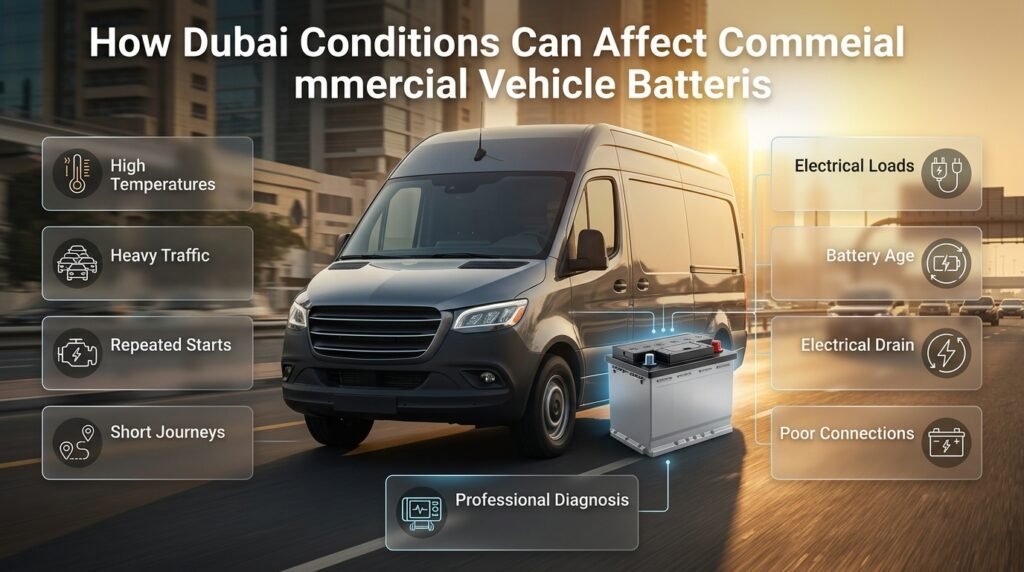
Dubai’s environment creates several conditions that deserve attention during battery management.
High ambient temperatures can accelerate battery aging. Vehicles may also operate their air-conditioning systems heavily for much of the year.
Traffic creates another challenge. A commercial vehicle can spend long periods in congested conditions, often moving slowly or remaining stationary.
When these conditions combine with repeated starting, short-distance travel, and electrical accessory use, the battery and charging system may experience demanding operating conditions.
It is important, however, not to blame every battery failure on temperature alone.
Battery performance depends on multiple factors.
A battery that fails in Dubai may have been deteriorating for a considerable period because of age, internal wear, insufficient charging, electrical drain, poor connections, or an unsuitable operating pattern.
The correct approach is diagnosis.
Signs a Commercial Fleet Vehicle May Need Battery Replacement
Fleet drivers are often the first people who notice early warning signs.
A driver might report that the engine sounds slightly slower during starting or that electrical systems behave differently when the vehicle is started.
These observations should not be ignored.
Common warning signs include:
- Slow engine cranking
- Clicking during startup
- Repeated jumpstart requirements
- Dim interior or dashboard lighting
- Electrical equipment behaving unusually
- Vehicle struggling after overnight parking
- Battery warning indications
- Starting problems after short journeys
- Battery repeatedly losing charge
- Visible battery or terminal problems
These symptoms do not automatically mean the battery needs replacement.
For example, slow cranking could also be caused by a starter motor problem, poor electrical connections, or another issue with the starting system.
Similarly, a repeatedly discharged battery could be caused by an alternator problem or parasitic electrical drain.
That is why a professional inspection is more reliable than replacing components based only on symptoms.
Battery Failure Symptoms and Possible Causes
| Symptom | Possible Cause | Recommended Approach |
|---|---|---|
| Slow cranking | Weak battery, starter issue, poor connection | Test battery and starting system |
| Clicking sound | Low available starting power or connection problem | Inspect battery and terminals |
| Battery repeatedly discharged | Battery deterioration, charging fault, electrical drain | Full electrical diagnosis |
| Vehicle fails after parking | Weak battery or parasitic drain | Battery and current-draw testing |
| Battery warning indicator | Charging-system concern | Inspect alternator and charging system |
| Electrical instability | Voltage problem or electrical fault | Diagnostic inspection |
| New battery becomes weak quickly | Charging fault or excessive drain | Investigate root cause |
| Vehicle needs frequent jumpstarts | Battery or charging problem | Professional testing |
The important fleet-management principle is simple: identify the cause rather than repeatedly treating the symptom.
Battery Testing Before Replacement
A discharged battery is not necessarily a failed battery.
A battery can become discharged because lights were left on, a vehicle remained parked for a long period, electrical equipment consumed power, or the charging system did not restore enough energy.
In such cases, charging and testing may be appropriate.
A battery that has reached the end of its service life may not recover properly even after charging.
Professional battery testing can provide information about its condition and starting capability.
A technician may assess:
- State of charge
- Battery condition
- Starting performance
- Voltage
- Battery terminals
- Cable connections
- Charging-system performance
- Alternator behavior
- Possible electrical drain
This distinction is especially important for fleets because unnecessary replacement across several vehicles can create avoidable maintenance expenses.
At the same time, refusing to replace a genuinely deteriorated battery can create a greater operational cost through unexpected downtime.
The objective is accurate diagnosis.
Battery Replacement or Battery Recharge?
Fleet managers sometimes face a simple question:
Should the battery be charged or replaced?
The answer depends on its condition.
| Situation | Likely Direction |
|---|---|
| Lights accidentally left on | Recharge and test |
| Vehicle parked for extended period | Charge and test |
| Battery is healthy but discharged | Recharge may be sufficient |
| Battery fails performance testing | Replacement likely |
| Battery has significant deterioration | Replacement likely |
| Battery repeatedly discharges | Diagnose underlying cause |
| Charging system is defective | Repair charging problem |
| Battery is physically damaged | Replacement generally required |
This approach avoids the two extremes of replacing every discharged battery and repeatedly charging a battery that has already reached the end of its useful life.
Choosing the Correct Battery for a Commercial Fleet
Battery selection is one of the most important stages of fleet battery replacement.
A battery should not be selected simply because it fits physically inside the battery compartment.
The replacement should be compatible with the vehicle’s requirements.
Important considerations can include:
- Battery voltage
- Physical dimensions
- Terminal configuration
- Capacity
- Starting performance
- Battery technology
- Mounting arrangement
- Vehicle electrical architecture
- Start-stop requirements
- Manufacturer specifications
Commercial fleets often contain several different vehicle models.
That means a fleet manager should avoid assuming that one battery specification can be used across the entire fleet.
A battery suitable for one vehicle may be inappropriate for another.
Conventional, EFB and AGM Batteries
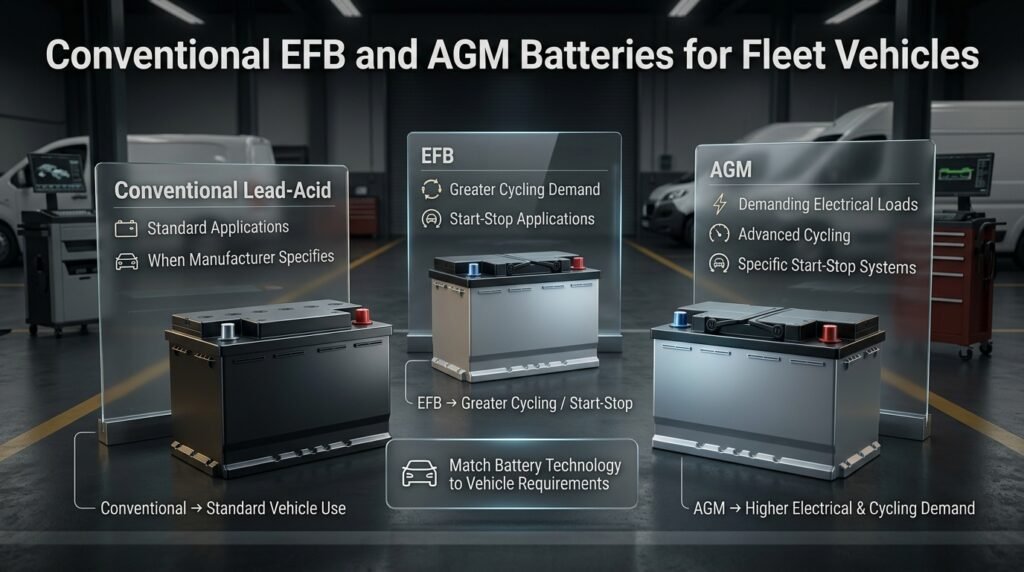
Modern vehicles can use different battery technologies.
Understanding the distinction helps fleet operators make better decisions.
Conventional Lead-Acid Batteries
Conventional batteries remain widely used in vehicles that do not require advanced cycling characteristics.
They can be appropriate where the vehicle manufacturer’s specifications allow them.
EFB Batteries
Enhanced Flooded Battery technology is designed for applications with greater cycling demands than some conventional systems.
EFB batteries may be used in certain vehicles equipped with start-stop technology.
AGM Batteries
Absorbent Glass Mat batteries are designed for demanding electrical and cycling applications.
They are often associated with vehicles that have substantial electrical requirements or specific start-stop systems.
A vehicle designed for AGM should not simply be fitted with an unrelated conventional battery because it is cheaper.
The correct battery technology should follow the vehicle manufacturer’s requirements.
Battery Brands for Commercial Fleet Vehicles
Fleet managers may encounter different battery brands depending on vehicle requirements, availability, specifications, and budget.
EuroSwift Auto Services offers several battery options that can be considered according to individual vehicle requirements.
For example, fleet operators can review:
Amaron Battery replacement in Dubai
Bosch Battery replacement in Dubai
Tuflong Battery replacement in Dubai
AGM Battery replacement in Dubai
Exide Battery replacement in Dubai
Panasonic Battery replacement in Dubai
FIAMM Battery replacement in Dubai
AC Delco Battery replacement in Dubai
The important point is that brand selection should follow vehicle compatibility.
Fleet operators should consider the correct specification first and then compare suitable options.
Why Fleet Vehicles Often Experience More Battery Stress
Commercial vehicles can have significantly higher electrical and operational demands than personal vehicles.
A fleet vehicle may have:
- GPS tracking
- Telematics
- Dash cameras
- Communication equipment
- Additional lighting
- Refrigeration equipment
- Security equipment
- Mobile charging devices
- Fleet-management systems
- Auxiliary electrical accessories
These systems can increase electrical consumption.
When installed and operating correctly, the vehicle should be designed to support its electrical requirements. However, faulty aftermarket equipment or abnormal electrical consumption can contribute to battery discharge.
This becomes particularly important when a vehicle repeatedly loses battery power while parked.
Parasitic Drain in Commercial Fleet Vehicles
Parasitic drain refers to electrical consumption that continues when a vehicle is switched off.
Some electrical consumption is normal.
Modern vehicles may keep certain electronic systems active temporarily after the ignition is turned off.
The concern is excessive or abnormal consumption.
Potential sources can include:
- Faulty accessories
- Incorrectly installed tracking devices
- Interior lights
- Aftermarket electronics
- Faulty control modules
- Security equipment
- Charging accessories
- Electrical wiring problems
If a commercial vehicle repeatedly fails to start after being parked, replacing the battery may not solve the problem.
The electrical system should be investigated.
This is especially important for fleets because a recurring electrical drain can continue affecting every replacement battery installed in the same vehicle.
Alternator Problems Can Be Mistaken for Battery Failure
The battery and alternator work together but perform different functions.
The battery provides electrical energy for starting and supports vehicle electrical requirements under certain conditions.
The alternator produces electrical power while the engine is running and helps restore energy used by the battery.
If the alternator or charging system is not functioning correctly, the battery may remain undercharged.
This can create a cycle:
Battery becomes discharged → vehicle receives jumpstart → vehicle operates temporarily → battery does not recharge correctly → vehicle fails again.
Replacing the battery without checking the charging system can therefore result in another failure.
A professional battery replacement process should consider charging-system diagnosis whenever symptoms indicate a possible problem.
Battery Replacement Process for Commercial Fleet Vehicles
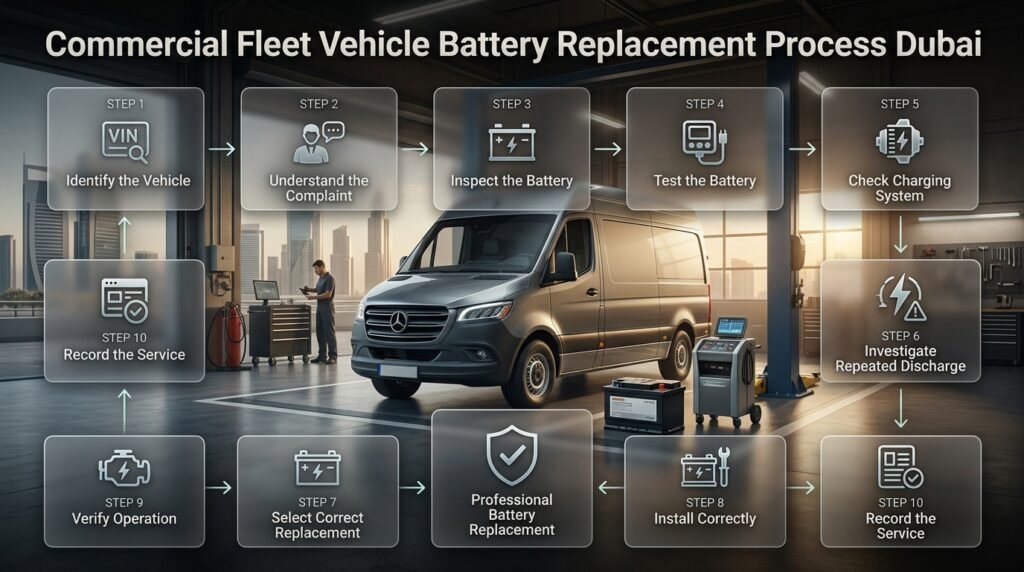
A professional replacement should follow a logical sequence.
1. Identify the vehicle
The technician confirms the vehicle make, model, engine configuration, and relevant battery requirements.
2. Understand the complaint
The driver’s description can provide valuable information.
Was the vehicle completely dead?
Was the engine cranking slowly?
Did the problem happen after parking?
Was a jumpstart previously required?
3. Inspect the battery
The battery and terminals are checked for visible problems.
4. Test the battery
Appropriate equipment is used to determine whether the battery is still capable of performing its required function.
5. Check the charging system
Where necessary, the alternator and charging system are evaluated.
6. Investigate repeated discharge
If the vehicle has a history of battery failures, abnormal electrical consumption should be considered.
7. Select the correct replacement
The battery must match the vehicle requirements.
8. Install the battery correctly
The battery should be secured and connected appropriately.
9. Verify operation
Starting and electrical systems should be checked after installation.
10. Record the service
Fleet records should be updated.
This final stage is often overlooked but is highly valuable for commercial operations.
Why Battery Records Matter for Fleet Managers
A fleet manager should ideally know which battery is installed in each vehicle and when it was installed.
A simple maintenance record can include:
| Fleet Record | Why It Matters |
|---|---|
| Vehicle registration or internal fleet ID | Identifies the vehicle |
| Battery brand | Tracks product history |
| Battery specification | Prevents incorrect replacement |
| Installation date | Measures service history |
| Mileage | Adds usage context |
| Test results | Shows battery condition |
| Charging-system findings | Identifies related faults |
| Failure events | Highlights recurring problems |
| Replacement date | Supports future planning |
Over time, these records can reveal patterns.
For example, if one delivery vehicle repeatedly requires battery replacement while similar vehicles do not, the fleet manager should investigate the vehicle rather than assuming the battery brand is the problem.
Battery Replacement Scheduling for Commercial Fleets
There is no single replacement date that applies to every fleet vehicle.
Calendar-based replacement can be useful for planning, but condition-based maintenance can provide a better understanding of actual battery health.
A vehicle used heavily for short journeys may require more frequent monitoring than a vehicle that travels longer distances.
Similarly, a vehicle with substantial electrical equipment may require different monitoring from a basic company car.
A practical fleet strategy can combine:
- Scheduled inspections
- Battery testing
- Driver feedback
- Mileage records
- Vehicle usage data
- Replacement history
- Charging-system checks
The goal is to identify deterioration before failure.
High-Use Vehicles Need Special Attention
Not every fleet vehicle experiences the same workload.
A vehicle that travels 200 kilometres per day may have fewer starts than a delivery van traveling only 80 kilometres but stopping thirty times.
Therefore, mileage alone is not enough to predict battery stress.
Fleet managers should consider number of starts and operating cycle alongside mileage.
High-use vehicles may include:
- Delivery vans
- Courier vehicles
- Taxi or passenger-service vehicles
- Field-service vehicles
- Maintenance vehicles
- Security vehicles
- Chauffeur vehicles
- Corporate transport vehicles
These vehicles can benefit from more proactive battery monitoring.
Short Journeys and Battery Charging
Repeated short journeys can create a difficult battery operating cycle.
Starting an engine consumes electrical energy.
The charging system then needs time to restore the energy used.
If the vehicle only travels a few minutes before being switched off again, the charging period may be limited.
Repeated throughout the day, this pattern can contribute to an increasingly low state of charge.
This does not mean short trips automatically destroy a battery.
The impact depends on the vehicle, charging system, battery condition, accessory load, and frequency of use.
However, fleet managers should recognize short-trip operation as an important maintenance factor.
Long Idling Periods and Commercial Vehicles
Commercial vehicles can spend significant time idling.
A driver may wait for a customer, load goods, remain at a job site, or operate equipment while stationary.
Idling can create a different electrical environment from normal driving.
Air conditioning, lighting, communication equipment, and other accessories may operate simultaneously.
The alternator is producing power while the engine runs, but the overall electrical balance still depends on the vehicle’s charging system and accessory demand.
Fleet managers should therefore consider idle patterns when investigating battery complaints.
Battery Maintenance Checklist for Fleet Operators
A structured inspection routine can help identify problems early.
Routine battery checks
- Inspect battery condition
- Check terminal connections
- Check battery mounting
- Monitor starting performance
- Test batteries when appropriate
- Review charging-system performance
- Record battery replacement dates
- Monitor repeated discharge
- Review aftermarket electrical equipment
- Investigate unusual electrical behavior
Driver reporting
Drivers should report:
- Slow starting
- Clicking
- Warning lights
- Electrical irregularities
- Repeated jumpstarts
- Problems after overnight parking
- Unusual dashboard behavior
- Battery-related roadside incidents
The earlier these symptoms are reported, the more opportunity the fleet manager has to address them before complete failure.
Common Mistakes Fleet Managers Should Avoid
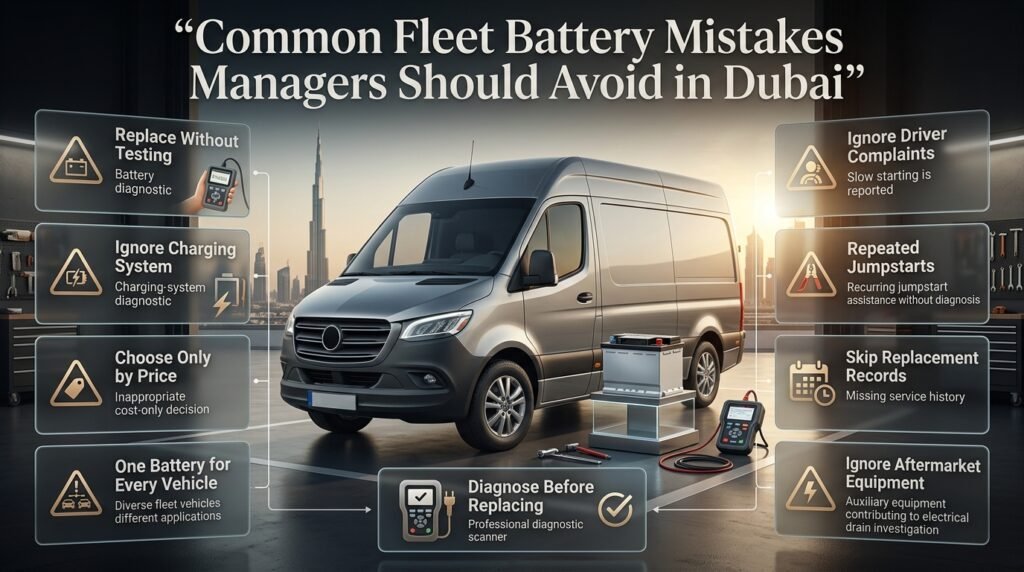
Replacing the battery without testing
A discharged battery may still be serviceable.
Ignoring the charging system
A defective alternator can cause a new battery to become discharged.
Choosing only by price
A cheap battery may not provide the correct specification or long-term value for the application.
Using one battery type across different vehicles
Fleet vehicles can have different electrical requirements.
Ignoring driver complaints
Slow starting can be an early warning.
Repeatedly jumpstarting the same vehicle
Jumpstarting restores starting capability but does not diagnose the cause.
Failing to track replacement dates
Without records, it becomes harder to identify recurring failures.
Ignoring aftermarket equipment
Tracking devices and other accessories can be relevant when investigating electrical drain.
Commercial Fleet Battery Replacement Cost Factors
Fleet operators often want to know the price before scheduling service.
However, there is no universal battery replacement price because different vehicles require different batteries.
The main factors include:
- Vehicle type
- Battery size
- Battery technology
- Battery brand
- Starting requirements
- AGM or EFB requirements
- Installation complexity
- Electronic system requirements
- Diagnostic requirements
- Number of vehicles
- Emergency service requirements
For a broader understanding of battery pricing considerations, fleet managers can review the Car Battery Prices in Dubai 2026 guide.
For commercial fleets, however, price should be evaluated alongside reliability and downtime.
A battery that costs slightly less but fails earlier can become more expensive when lost productivity, emergency assistance, and replacement labor are considered.
Emergency Battery Replacement for Fleet Vehicles
Unexpected failures can still occur even when preventive maintenance is strong.
A vehicle may become immobilized at a customer location, warehouse, roadside, office parking area, or another commercial site.
In such situations, rapid assistance can reduce downtime.
A professional Car Jumpstart may restore temporary starting capability when the battery is discharged, but the vehicle should be evaluated if the problem is recurring.
Similarly, Emergency Car Repair and roadside support can be useful when a battery problem is accompanied by another mechanical or electrical fault.
The key distinction is between getting the vehicle moving and identifying why it stopped.
Fleet management requires both.
Battery Replacement as Part of Complete Vehicle Maintenance
A battery is one component of a larger vehicle.
A fleet vehicle can have excellent battery condition and still experience reliability problems because of neglected maintenance elsewhere.
Commercial fleets should also monitor:
- Engine condition
- Oil level and oil-service intervals
- Braking system
- Tires
- Suspension
- Steering
- Cooling system
- Air conditioning
- Transmission
- Electrical systems
- Wheel alignment
A complete Auto Workshop maintenance strategy can therefore be more effective than treating each breakdown as an isolated event.
For example, a vehicle experiencing starting difficulties may need battery testing, but it may also need broader Engine Repair or mechanical diagnosis depending on the symptoms.
Fleet Battery Management and Preventive Maintenance
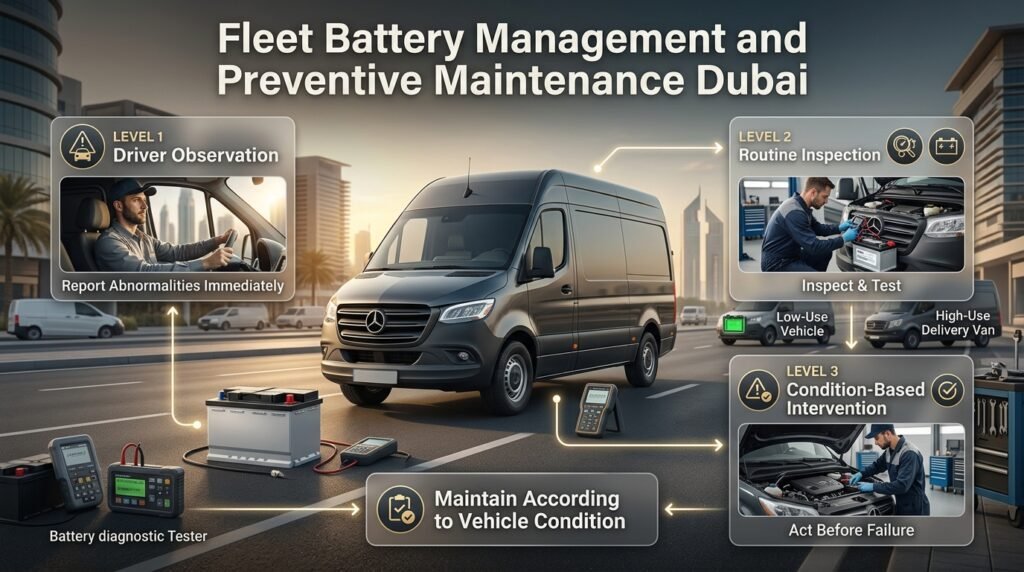
Preventive maintenance should aim to reduce surprises.
A useful strategy is to divide fleet maintenance into three levels.
Level One: Driver Observation
Drivers report abnormalities immediately.
Level Two: Routine Inspection
Technicians inspect and test components during scheduled servicing.
Level Three: Condition-Based Intervention
Vehicles showing deterioration receive targeted maintenance before failure.
This approach is particularly useful for larger fleets because it avoids treating every vehicle identically.
A low-use vehicle with a healthy battery does not necessarily need the same intervention as a high-use delivery van showing early warning signs.
Commercial Fleet Vehicles and Modern Electronics
Modern vehicles contain substantially more electronic equipment than older vehicles.
Even conventional combustion vehicles may include:
- Multiple control modules
- Sensors
- Cameras
- GPS systems
- Security systems
- Infotainment
- Driver-assistance systems
- Battery monitoring systems
- Electronic transmission controls
- Start-stop systems
This makes battery replacement more than a purely mechanical task.
Certain vehicles may require specific electronic procedures after battery replacement.
The exact requirements vary by vehicle.
Professional technicians should therefore follow manufacturer-specific procedures where applicable.
Battery Monitoring Technology in Modern Fleets
Fleet technology is moving toward more proactive vehicle monitoring.
Telematics can provide information about:
- Mileage
- Driving patterns
- Idle time
- Routes
- Vehicle utilization
- Fault information
- Maintenance events
When combined with battery inspection records, this data can help fleet operators identify vehicles that deserve additional attention.
For example, if one vehicle operates predominantly on short routes with many daily starts, the fleet manager can prioritize it for battery monitoring.
This is a more intelligent strategy than waiting for a complete no-start condition.
Predictive Maintenance and Future Fleet Battery Management
The future of fleet maintenance is increasingly focused on prediction.
Instead of asking:
“Which vehicle failed today?”
fleet operators increasingly want to know:
“Which vehicle is showing signs that it may fail soon?”
Battery monitoring, vehicle diagnostics, telematics, and service records can contribute to this approach.
Future systems may increasingly provide automated alerts based on vehicle health, electrical behavior, and operating patterns.
This can allow fleet managers to schedule battery inspections during planned maintenance rather than dealing with unexpected roadside failures.
For commercial operations, predictive maintenance can improve both vehicle availability and planning.
Professional Recommendations for Dubai Fleet Operators
A strong fleet battery program should follow several practical principles.
Test before replacement
Do not automatically replace every battery that has discharged.
Check the charging system
If a battery repeatedly loses power, investigate the alternator and charging system.
Match battery specifications
Use the correct battery technology, capacity, dimensions, and starting characteristics.
Monitor high-use vehicles
Frequent-start and short-trip vehicles may require closer monitoring.
Keep service records
Track replacement dates and battery specifications.
Listen to drivers
Drivers often notice changes before a complete failure.
Investigate repeated failures
Repeated battery replacement is a reason to investigate, not simply replace again.
Consider electrical accessories
Aftermarket equipment should be included in electrical diagnosis.
Plan replacement where possible
Planned service creates less disruption than emergency failure.
Integrate battery management
Battery care should be included in the overall fleet maintenance program.
Battery Replacement Decision-Making Guide
When a commercial fleet vehicle develops a starting problem, a structured process can be followed.
Vehicle fails to start
↓
Check visible electrical symptoms
↓
Inspect battery and connections
↓
Test battery condition
↓
Check charging system when required
↓
Investigate electrical drain if the battery repeatedly discharges
↓
Confirm correct battery specification
↓
Replace battery if testing confirms deterioration
↓
Verify vehicle operation
↓
Record service information
This process is more reliable than replacing the battery immediately without diagnosis.
When Fleet Managers Should Seek Professional Battery Service
Professional assistance is particularly appropriate when:
- The vehicle repeatedly requires jumpstarts
- A replacement battery becomes weak quickly
- Several fleet vehicles experience similar failures
- The battery warning indicator appears
- Starting becomes progressively slower
- The vehicle fails after parking
- Electrical equipment behaves abnormally
- The battery specification is uncertain
- The vehicle uses AGM or EFB technology
- The vehicle has significant aftermarket electrical equipment
- The charging system may be faulty
Professional testing can help separate battery problems from broader electrical or mechanical problems.
How often should a commercial fleet vehicle battery be replaced in Dubai?
There is no reliable one-size-fits-all replacement interval for every commercial fleet vehicle. The better approach is to monitor the battery according to its actual condition, vehicle usage, electrical load, and operating environment. A delivery van making dozens of starts each day may experience very different battery stress from a company vehicle that makes one long journey each morning.
Dubai’s heat is another important factor because elevated temperatures can accelerate battery aging. Frequent short journeys, prolonged idling, heavy air-conditioning use, and additional electrical equipment can further affect the battery’s state of charge and overall performance. Fleet-maintenance guidance similarly recommends judging replacement by battery condition and usage rather than age alone.
Key points fleet managers should monitor:
Battery test results during scheduled maintenance
Slow or increasingly difficult engine cranking
Repeated jumpstart incidents
Battery discharge after normal parking
Vehicle operating hours and number of daily starts
Electrical accessory and telematics usage
Charging-system performance
Battery installation and replacement history
For a Dubai fleet, the most practical strategy is condition-based replacement supported by regular testing. If testing shows that a battery is deteriorating, replacing it during scheduled maintenance is generally more sensible than waiting for the vehicle to become immobilized during a delivery, customer visit, or working shift.
How does Dubai heat affect commercial vehicle batteries?
Dubai’s high temperatures can make battery management more demanding, particularly for vehicles that operate heavily throughout the year. Heat accelerates the chemical processes inside lead-acid batteries and can contribute to faster deterioration. When this is combined with frequent engine starts, electrical loads, traffic, and air-conditioning use, a heavily operated fleet vehicle can experience considerable battery stress.
The important point is that heat is a contributing factor, not an automatic diagnosis. If a commercial vehicle repeatedly develops a weak battery, the technician should still check the battery itself, charging system, electrical connections, and possible abnormal electrical consumption. Local automotive guidance also identifies heat, short trips, outdoor parking, and electrical load as factors that can shorten battery service life in Dubai.
For fleet operators, practical monitoring should include:
Checking battery condition during scheduled servicing
Watching for slow starting after extended parking
Inspecting terminals and connections
Checking charging-system performance
Paying closer attention to high-use vehicles
Recording battery failures by vehicle
Investigating repeated discharge instead of blaming temperature alone
This matters because replacing a battery without understanding why it failed can leave the actual problem unresolved. If an alternator fault or excessive electrical drain exists, the replacement battery may eventually develop the same problem.
Why does the same commercial fleet vehicle keep needing jumpstarts after battery replacement?
When the same vehicle repeatedly needs a jumpstart, the battery should not automatically be blamed every time. A healthy replacement battery that repeatedly becomes discharged is a strong reason to investigate the vehicle’s complete electrical system.
One possibility is a charging-system problem. The alternator may not be restoring sufficient energy while the vehicle is operating. Another possibility is excessive electrical consumption while the vehicle is parked. Modern fleet vehicles can have GPS tracking, telematics, security equipment, cameras, communication devices, and other electrical accessories, so abnormal consumption from one of these systems may contribute to repeated discharge. Fleet-maintenance sources specifically identify parasitic drain from telematics and auxiliary systems as an issue worth accounting for.
When repeated jumpstarts occur, the inspection should consider:
Battery condition and starting performance
Alternator and charging-system operation
Battery terminal connections
Battery cables and mounting
Aftermarket tracking equipment
Auxiliary electrical accessories
Possible parasitic electrical consumption
Vehicle usage and parking patterns
The key fleet-management lesson is that a jumpstart restores mobility, but it does not diagnose the failure. If the same vehicle requires assistance repeatedly, continuing to replace batteries without investigating the underlying cause can increase maintenance costs while doing little to improve reliability.
What is the best battery for a commercial fleet vehicle in Dubai?
There is no single battery that can honestly be called the best choice for every commercial fleet vehicle. The correct battery depends on the vehicle manufacturer’s requirements, electrical architecture, starting demand, cycling requirements, physical dimensions, and the equipment installed on the vehicle.
Commercial vehicles can use different battery technologies, including conventional lead-acid, EFB, and AGM designs. AGM batteries, for example, can be suitable for applications with greater cycling or electrical demands, while a conventional battery may be appropriate for a vehicle designed around that technology. Commercial battery guidance emphasizes determining the vehicle’s power requirements and following the manufacturer’s battery specifications rather than selecting purely on price.
Before selecting a fleet battery, check:
Correct battery size
Voltage requirement
Capacity
Starting-performance requirement
Battery technology
Terminal configuration
Physical mounting
Start-stop requirements
Vehicle electrical load
Manufacturer specification
For a mixed fleet, it is often better to maintain a vehicle-by-vehicle battery specification record rather than assuming every vehicle can use the same battery.
A professional fleet strategy should prioritize compatibility first, quality second, and price as part of the overall value calculation. The cheapest battery is not necessarily the cheapest option if premature failure creates roadside assistance costs and vehicle downtime.
How often should commercial fleet vehicle batteries be tested?
Battery testing should be incorporated into the fleet’s existing maintenance routine rather than being performed only after a vehicle fails to start. Commercial fleet-maintenance guidance recommends regular testing because deterioration can often be identified before it develops into a roadside breakdown. Testing during scheduled service is particularly useful for vehicles with high utilization or demanding duty cycles.
The exact testing frequency should reflect the fleet’s operating conditions. A vehicle that performs frequent short journeys, starts many times per day, carries additional electrical equipment, or operates extensively in Dubai’s heat may deserve closer monitoring than a lightly used company vehicle.
A practical fleet testing program can include:
Testing during scheduled servicing
Additional checks when slow cranking appears
Testing after repeated discharge
Checking batteries after extended vehicle storage
Monitoring high-use vehicles more closely
Recording test results for comparison over time
Checking the charging system when battery performance is abnormal
The real advantage is not simply knowing whether a battery works today. It is building a maintenance history that shows deterioration over time. When test results, mileage, battery age, vehicle usage, and previous failures are recorded together, fleet managers can make better decisions about planned replacement instead of waiting for an unexpected no-start situation.
For commercial operations, that difference is significant: a planned battery replacement can be scheduled around the fleet’s workload, while an unexpected failure can interrupt a route, delay a customer, and require emergency assistance.
Conclusion
For commercial fleet operators in Dubai, battery replacement should be viewed as an important part of vehicle reliability rather than a simple response to a vehicle that will not start. Frequent starts, short-distance routes, heavy traffic, high temperatures, air-conditioning use, and additional electrical equipment can place different demands on fleet batteries, making regular inspection and proper battery selection particularly important.
A professional approach begins with diagnosis. Before replacing a battery, technicians should consider its actual condition, charging-system performance, electrical connections, and any possible abnormal power consumption. When a battery genuinely reaches the end of its service life, the replacement should match the vehicle’s required specifications and battery technology.
For fleet managers, the strongest strategy is preventive rather than reactive. Keeping battery records, monitoring high-use vehicles, responding to early starting symptoms, and testing batteries during scheduled maintenance can help reduce unexpected downtime. It also becomes easier to identify vehicles that repeatedly experience battery problems and investigate the underlying cause.
As commercial vehicles become more electronically sophisticated, battery management is becoming increasingly connected with diagnostics, telematics, and predictive maintenance. Businesses that treat battery health as part of their wider Vehicle Maintenance strategy can make better maintenance decisions and keep their fleet ready for daily operations across Dubai.
Leave a Reply