
Introduction
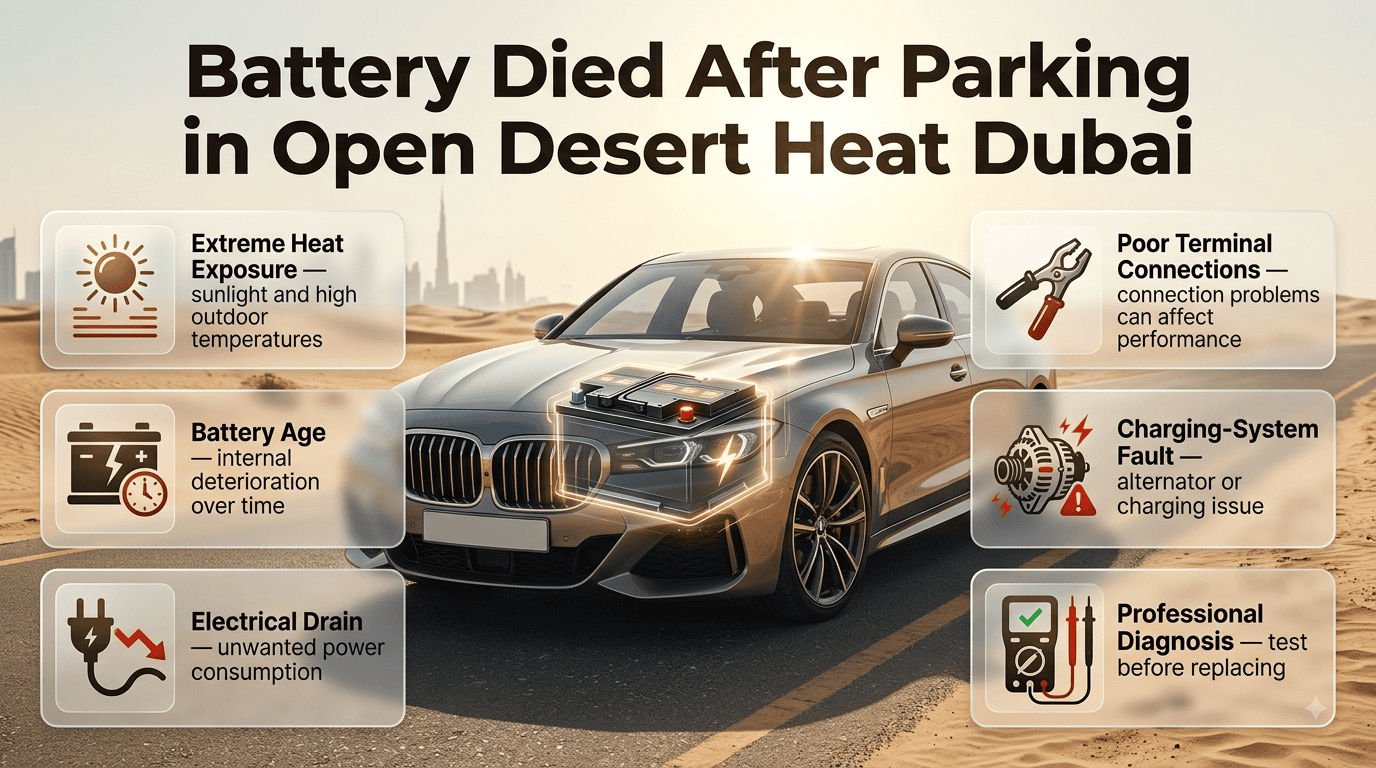
Battery Died After Parking in Open Desert Heat Dubai | A battery died after parking in open desert heat in Dubai is a frustrating situation, especially when the vehicle was working normally before it was parked. Dubai’s extreme summer temperatures can place additional stress on a vehicle battery, particularly when a car is left outside under direct sunlight for several hours or days. However, heat is not always the only reason behind a dead battery. Battery age, internal deterioration, electrical drain, poor terminal connections, and charging-system problems can also contribute to a no-start condition.
For Dubai drivers, understanding why batteries fail after outdoor parking can help prevent unnecessary replacements and unexpected roadside problems. Professional automotive support from EuroSwift Auto Services can help determine whether the battery simply needs charging, requires replacement, or is being affected by another vehicle fault.
The important point is that a dead battery should be diagnosed before assuming that extreme heat is the complete cause.
Why Does a Car Battery Die After Parking in Dubai Desert Heat?
High temperatures can accelerate the chemical processes and aging that occur inside a lead-acid battery. Excessive heat can contribute to faster deterioration of internal components and reduce the battery’s ability to provide reliable starting power over time.
When a vehicle remains parked in direct desert sunlight, temperatures around the engine compartment can become extremely high. An older or already weakened battery may therefore reach its limit while the vehicle is sitting unused.
Several factors can contribute:
- Excessive under-hood temperature
- Battery age
- Internal battery deterioration
- Electrolyte loss in applicable battery designs
- Reduced reserve capacity
- Existing charging-system problems
- Electrical consumption while parked
- Loose or contaminated battery terminals
This means Dubai heat may act as the trigger that exposes an already weakened battery, rather than being the only cause.
How Dubai Heat Affects Battery Performance
The relationship between temperature and battery performance is often misunderstood. Extreme heat does not simply drain a healthy battery in the same way as leaving headlights switched on. Instead, prolonged high temperatures can accelerate battery deterioration and reduce its long-term reliability.
A battery may appear completely normal during everyday driving while gradually losing its ability to maintain adequate starting performance. After the vehicle is parked for an extended period, that reduced capacity may become obvious.
This can create a pattern:
- The vehicle is exposed to high daytime temperatures.
- The engine compartment becomes extremely hot.
- The vehicle is driven and additional heat is generated.
- The vehicle is parked outdoors again.
- The battery repeatedly experiences thermal stress.
- Eventually, an aging battery may no longer provide enough starting power.
This is one reason preventive Vehicle Maintenance is especially valuable in Dubai.
Battery Discharged or Battery Permanently Damaged?
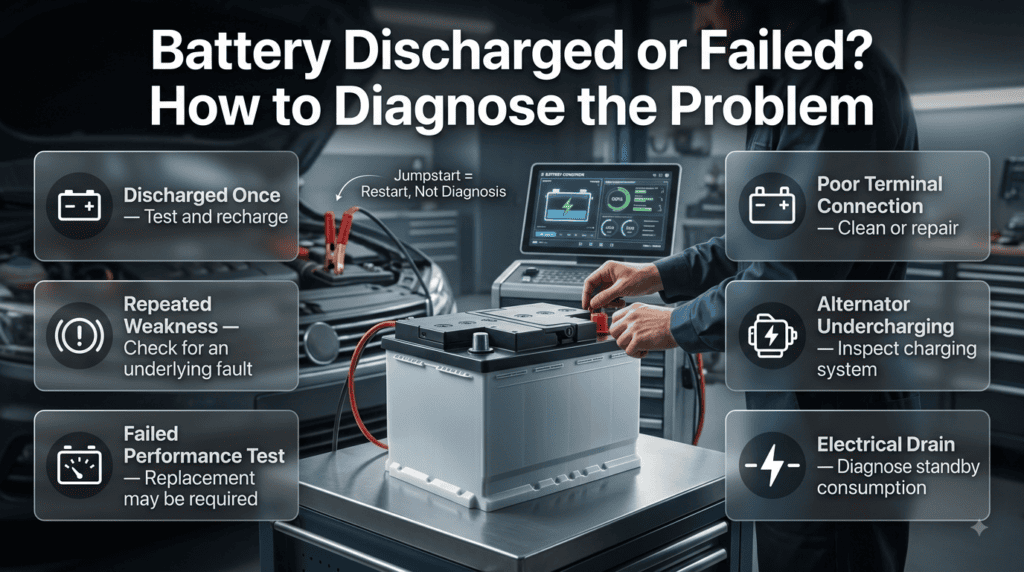
One of the first things to establish is whether the battery is simply discharged or has permanently lost capacity.
A battery can become discharged because of an electrical load, extended parking, or insufficient charging. In other cases, the battery may have deteriorated internally and may no longer be capable of holding an adequate charge.
| Situation | Possible Condition | Appropriate Approach |
|---|---|---|
| Battery discharged once | Temporary loss of charge | Test and recharge |
| Battery repeatedly becomes weak | Possible underlying fault | Full battery/electrical diagnosis |
| Battery fails performance testing | Reduced internal capacity | Replacement may be required |
| Terminal connection is poor | Electrical resistance | Clean or repair connection |
| Alternator undercharges | Battery not replenished | Charging-system inspection |
| Electrical drain while parked | Excessive standby consumption | Electrical diagnosis |
A jumpstart can get the vehicle running, but it does not identify why the battery became discharged.
Signs Your Battery Was Already Weak
Sometimes a battery failure after outdoor parking has warning signs that appeared days or weeks earlier.
Drivers may notice:
- Slower engine cranking
- Clicking during startup
- Repeated jumpstart requirements
- Weak or inconsistent electrical operation
- Battery-related warning messages
- Longer-than-normal starting time
- Start-stop system becoming unavailable
- Battery becoming weak after relatively short parking periods
If these symptoms were already present, the extreme heat may simply have pushed an aging battery beyond its remaining capacity.
Why Direct Sunlight Makes Outdoor Parking More Difficult
Parking under direct sunlight exposes the vehicle to much greater thermal stress than shaded or covered parking.
The vehicle’s body, cabin, engine compartment, and surrounding components absorb heat throughout the day. Even after the engine has been switched off, heat can remain trapped around components in the engine bay.
The situation becomes more significant when the battery is already:
- Old
- Undercharged
- Physically deteriorated
- Poorly connected
- Exposed to repeated thermal cycles
For this reason, drivers who regularly park outdoors should pay closer attention to battery condition rather than waiting for a complete failure.
Can Extended Parking Cause a Battery to Go Flat?
Yes, extended parking can contribute to battery discharge, but the length of parking alone does not prove that the battery is defective.
Modern vehicles continue using a small amount of electrical energy even after the engine is switched off. Security systems, electronic control modules, alarms, keyless-entry systems, memory functions, and other systems may remain active.
A healthy battery normally has sufficient reserve for ordinary standby consumption. A weak battery, however, has much less reserve.
The risk becomes higher when:
- The battery is already aging.
- The vehicle was not fully charged before parking.
- The car has recently required a jumpstart.
- An electrical component is consuming excessive power.
- The vehicle has a charging-system problem.
- The vehicle remains parked for an extended period.
If the battery repeatedly becomes weak while parked, the problem should be investigated instead of simply installing another battery.
Parasitic Drain Can Be the Hidden Cause
A parasitic electrical drain occurs when a vehicle continues consuming more electrical power than expected while switched off.
Possible sources can include:
- Faulty aftermarket accessories
- Interior or luggage-compartment lights
- Alarm systems
- Tracking equipment
- Electronic control modules
- Wiring faults
- Other malfunctioning electrical components
A small abnormal drain can gradually reduce battery charge. The vehicle may still start normally after a short parking period but fail after longer parking.
If a replacement battery develops exactly the same problem, professional Engine Diagnostics and electrical testing become more important than simply replacing the battery again.
Could the Alternator Be Responsible?
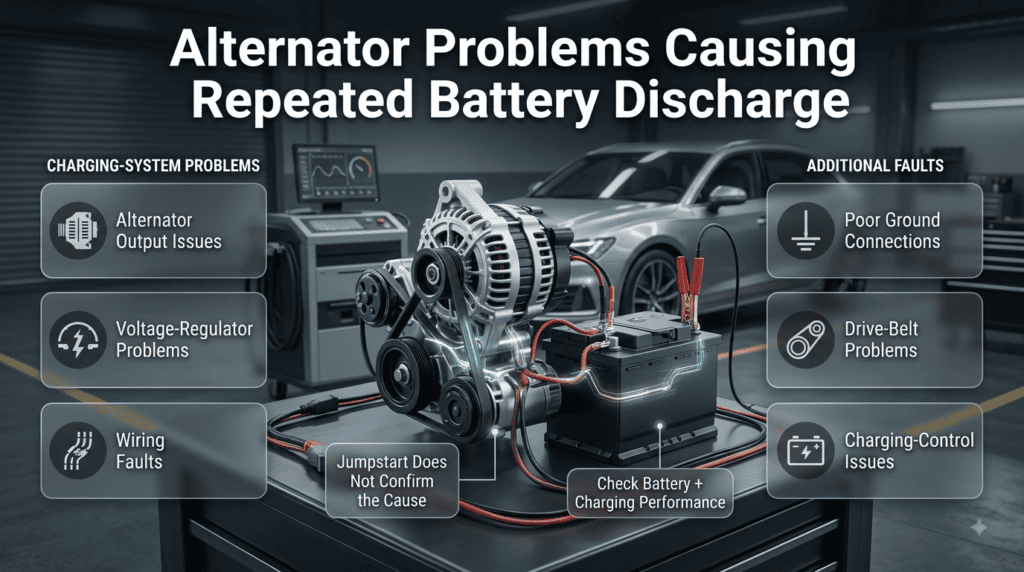
Yes. A battery may be in reasonable condition but repeatedly become discharged if the alternator or charging system is not replenishing it correctly.
The alternator supplies electrical power while the engine is operating and helps restore energy used during starting and vehicle operation.
Possible charging-system problems include:
- Alternator output issues
- Voltage-regulator problems
- Wiring faults
- Poor ground connections
- Drive-belt problems
- Charging-control issues
If a car starts after a jumpstart but later becomes weak again, the battery should not automatically be blamed.
A proper Car Service inspection should consider both battery condition and charging performance.
Battery Terminals Can Also Cause Starting Problems
Not every battery-related problem originates inside the battery.
Loose, contaminated, oxidized, or damaged terminals can create electrical resistance. The battery may contain enough energy, but the vehicle may not receive it efficiently when the starter demands high current.
Common symptoms include:
- Intermittent starting
- Clicking during startup
- Electrical systems switching off unexpectedly
- Unstable electrical operation
- Problems that appear or disappear intermittently
A technician should inspect the battery connections before recommending replacement.
What Should You Do When the Battery Dies in the Desert?
If your vehicle does not start after being parked in an exposed location, avoid repeatedly trying to crank the engine for long periods.
A practical approach is:
- Check whether the dashboard and interior electronics are operating.
- Inspect the battery terminals for obvious problems.
- Switch off unnecessary electrical loads.
- Arrange professional Car Jumpstart assistance if appropriate.
- Test the battery after the vehicle starts.
- Check charging-system performance.
- Investigate repeated battery discharge.
If the battery is genuinely defective, professional Battery Replacement may be necessary.
For Dubai drivers who need on-location assistance, Car Battery Replacement in Dubai can be used as the relevant service page.
Professional Battery Inspection After Heat-Related Failure
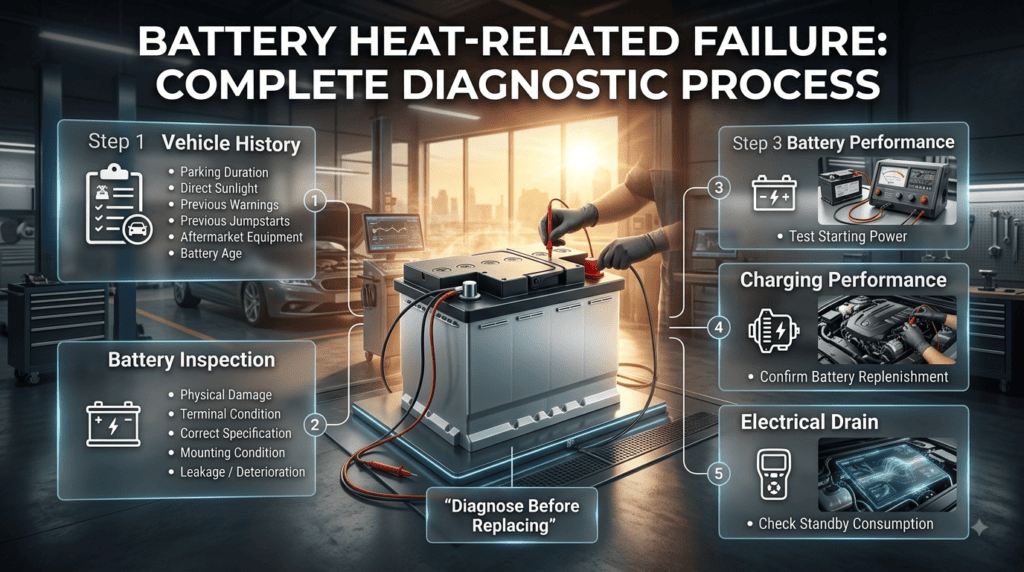
A proper battery inspection should follow a logical diagnostic process rather than immediately replacing components.
Step 1: Review the Vehicle History
The technician should determine:
- How long the vehicle was parked
- Whether it was exposed to direct sunlight
- Whether the battery previously showed warning signs
- Whether the vehicle required previous jumpstarts
- Whether aftermarket electrical equipment is installed
- How old the battery is
Step 2: Inspect the Battery
The battery should be checked for:
- Physical damage
- Age
- Terminal condition
- Correct specification
- Mounting condition
- Signs of leakage or deterioration
Step 3: Test Battery Performance
Voltage alone does not always provide a complete picture of battery health. A proper battery test can provide a better indication of whether the battery can deliver sufficient starting power.
Step 4: Check Charging Performance
If the battery appears serviceable, the charging system should be checked to confirm that the battery is being properly replenished.
Step 5: Check for Electrical Drain
If the battery repeatedly loses power during parking, electrical-system testing may be required to identify abnormal standby consumption.
This process helps separate a genuine battery failure from a wider vehicle electrical problem.
When Is Battery Replacement Actually Necessary?
Battery replacement becomes appropriate when testing shows that the battery has significantly lost its ability to provide reliable starting power or retain charge.
The replacement should match the vehicle’s requirements rather than simply being selected because it is inexpensive or physically fits.
Important considerations include:
- Battery dimensions
- Capacity
- Starting-current requirements
- Terminal layout
- Battery technology
- Vehicle electrical architecture
- Start-stop compatibility where required
Different vehicles may require conventional, EFB, or AGM technology.
Choosing the Right Battery for Dubai Conditions
There is no universal battery that is ideal for every vehicle. The correct selection depends on the vehicle’s manufacturer specifications, electrical system, engine, and battery requirements.
Depending on vehicle compatibility, drivers may consider options such as:
Amaron Battery, Bosch Battery, and Tuflong Battery.
For vehicles that require advanced battery technology, relevant options include AGM Battery and Exide Battery.
Other available options include Panasonic Battery, FIAMM Battery, and AC Delco Battery.
The important principle is to select the battery according to the vehicle’s technical requirements rather than choosing only by brand or price.
How to Reduce Battery Problems When Parking Outdoors in Dubai
Outdoor parking cannot always be avoided, but drivers can reduce unnecessary battery-related problems.
Before Extended Outdoor Parking
- Make sure the battery is in good condition.
- Check for previous slow-starting symptoms.
- Confirm that lights and accessories are switched off.
- Check that the battery terminals are secure.
- Investigate previous jumpstart incidents.
- Test an aging battery before extended parking.
During Regular Vehicle Use
- Do not ignore slow engine cranking.
- Investigate repeated battery discharge.
- Avoid repeatedly relying on jumpstarts.
- Follow the recommended maintenance schedule.
- Check charging performance when battery problems recur.
Preventive maintenance is generally easier than dealing with a vehicle that refuses to start when parked far from assistance.
Common Mistakes After a Heat-Related Battery Failure
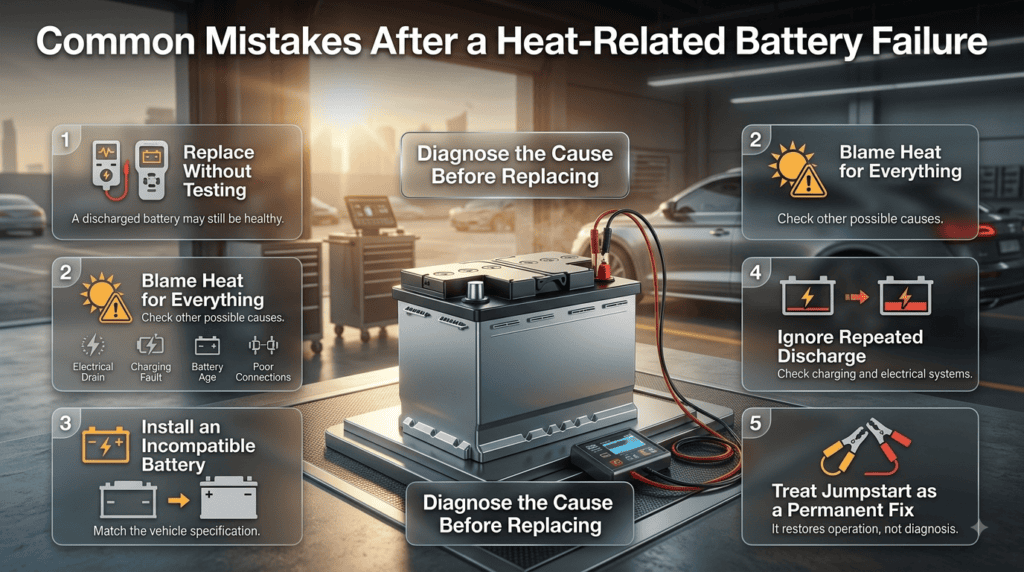
Replacing the Battery Without Testing
A discharged battery may still be healthy. Testing can determine whether replacement is actually required.
Blaming Heat for Every Battery Failure
Dubai’s climate is an important factor, but heat does not explain every no-start problem. Electrical drain, charging faults, battery age, and poor connections can also be responsible.
Installing an Incompatible Battery
A physically larger battery is not automatically better. The replacement must match the vehicle’s specifications.
Ignoring Repeated Discharge
If a new battery repeatedly becomes weak, another problem may exist. The charging system and electrical system should be checked.
Treating a Jumpstart as a Permanent Repair
A jumpstart restores temporary operation. It does not diagnose the cause of the discharge.
When to Consider Roadside Assistance
If the vehicle is stranded in an exposed or isolated location, professional Roadside Assistance can be useful.
This may be particularly important when:
- The vehicle will not crank.
- The battery is completely discharged.
- The car is parked in an isolated area.
- A jumpstart is unsuccessful.
- The battery requires testing.
- A replacement battery is required at the vehicle location.
Professional Emergency Car Repair can help determine whether the issue is limited to the battery or requires further mechanical or electrical attention.
Battery Technology in Modern Vehicles
Modern vehicles increasingly depend on sophisticated electrical systems. Start-stop systems, electronic control modules, advanced driver-assistance systems, connected services, and keyless technologies all make stable electrical performance more important.
This does not mean modern vehicles are necessarily unreliable. Instead, it means the battery is now an important part of a much more complex electrical architecture.
Some vehicles may also require battery registration, coding, or system configuration following replacement. Requirements vary by manufacturer and model.
For premium vehicles, professional Luxury Car Service can be particularly useful when battery replacement involves vehicle-specific electronic procedures.
Battery Replacement vs Battery Recharge
The correct solution depends on the battery’s actual condition.
| Condition | Recharge | Replacement |
|---|---|---|
| Healthy battery accidentally discharged | Often suitable | Usually unnecessary |
| Battery repeatedly becomes weak | Investigate cause | Depends on testing |
| Battery fails performance testing | Not a permanent solution | Usually appropriate |
| Battery physically damaged | Not appropriate | Required |
| Electrical drain exists | Does not fix cause | May not fix cause |
| Alternator problem exists | Does not fix cause | May not fix cause |
The key principle is simple: diagnose first and replace only when testing supports replacement.
Outdoor-Parking Battery Checklist
Before leaving a vehicle parked outdoors for an extended period in Dubai:
- Check whether the battery has recently shown weak-starting symptoms.
- Make sure all lights and accessories are switched off.
- Check that battery terminals are secure.
- Do not ignore previous jumpstart incidents.
- Test an aging battery before extended parking.
- Investigate repeated battery discharge.
- Check the charging system when battery performance has been inconsistent.
- Keep access to reliable roadside assistance if parking in an isolated area.
When a Dead Battery Indicates a Bigger Vehicle Problem
One isolated battery discharge does not necessarily indicate a major mechanical problem. However, repeated failures should not be ignored.
Recurring battery failure may point toward:
- Battery deterioration
- Charging-system weakness
- Parasitic electrical drain
- Poor battery connections
- Incorrect battery specification
- Electronic-system problems
- Insufficient charging
This is where a broader Vehicle Inspection can become useful. Looking only at the battery may fail to identify the reason it repeatedly loses power.
Professional Recommendation for Dubai Drivers
If your battery died after parking in open desert heat in Dubai, do not automatically assume that the battery must be replaced.
The first step should be diagnosis.
A professional inspection should determine whether the battery is:
- Temporarily discharged
- Internally deteriorated
- Unable to hold charge
- Properly connected
- Correctly specified for the vehicle
The charging system and parked-vehicle electrical consumption should also be checked if the problem happens repeatedly.
If replacement is necessary, the new battery should be selected according to the vehicle’s requirements and installed correctly.
For drivers researching the financial side of replacement, the Car Battery Price Guide in Dubai can help explain the different factors that influence battery pricing.
Can extreme Dubai heat cause a car battery to die while the car is parked?
Extreme heat can contribute to battery failure, but it usually does not mean that a healthy battery suddenly loses all its power simply because the car was sitting in the sun. High temperatures accelerate battery degradation, increase internal wear, and can contribute to fluid loss and corrosion. Over time, this reduces the battery’s ability to hold charge and provide reliable starting power.
This is why a battery may appear normal before parking but fail when you return to the vehicle. The heat may have exposed a battery that was already near the end of its useful condition.
Important points:
Extreme heat can shorten battery life.
Older batteries are more vulnerable.
Direct outdoor parking increases thermal stress.
Heat may expose an existing battery weakness rather than being the only cause.
A battery test is more reliable than assuming heat is responsible.
Why does my car battery die after parking outside in Dubai for a few days?
When a car remains parked, the battery can still supply a small amount of electricity to systems such as security functions, electronic modules, alarms, and memory settings. A healthy battery normally has enough reserve for ordinary standby consumption, but an aging or partially discharged battery has considerably less reserve.
Extended parking can therefore reveal a problem that was already developing. AAA notes that batteries naturally deteriorate over time, while vehicles that remain parked for extended periods can also experience self-discharge.
What should be checked:
Battery age and condition
Previous slow-starting symptoms
Charging-system performance
Battery terminal connections
Possible parasitic electrical drain
Whether the battery was fully charged before parking
If the same thing happens after installing a new battery, don’t keep replacing batteries without investigating the vehicle’s electrical system.
How can I tell if my battery needs replacement after it dies in the heat?
A dead battery does not automatically mean you need a new battery. The battery could simply be discharged and still capable of working normally after being properly recharged.
Replacement becomes more likely when testing shows that the battery has lost significant capacity, cannot hold an adequate charge, or cannot provide the starting performance required by the vehicle. Heat can accelerate battery deterioration, so an older battery that repeatedly fails after outdoor parking deserves particular attention.
Look for these warning signs:
Slow engine cranking before the failure
Repeated jumpstarts
Battery warning signs
Battery repeatedly becoming weak
Corrosion around terminals
A battery that fails a proper performance test
For Dubai drivers, professional Battery Replacement should be based on the vehicle’s actual battery condition and specifications, not simply on the fact that the car failed to start.
What should I do if my car battery dies after parking in the desert heat?
The first priority is to determine whether the vehicle has a discharged battery or another no-start problem. A professional jumpstart may restore the vehicle temporarily, but the battery and charging system should still be checked afterward.
If the battery starts the vehicle after assistance but becomes weak again soon afterward, that is an important clue. The problem could involve the battery itself, the alternator, an electrical connection, or excessive electrical consumption while parked.
A professional inspection should normally consider:
Battery condition
Battery terminals
Charging-system performance
Electrical drain
Battery specification
Recent vehicle history
If the vehicle is repeatedly failing to start, Car Battery Replacement in Dubai may be appropriate when testing confirms that the battery has reached the end of its usable condition.
How can I prevent my car battery from dying when parking outside in Dubai heat?
The best prevention is not simply trying to keep the battery cool; it is maintaining the complete starting and charging system before a failure occurs. Heat is a major factor in battery aging, and AAA recommends keeping battery connections clean and secure and having older batteries tested.
If your vehicle is regularly parked outdoors in Dubai, pay attention to changes in starting performance rather than waiting for the battery to fail completely.
Useful preventive steps:
Have an aging battery professionally tested.
Keep battery terminals clean and properly secured.
Investigate slow engine cranking.
Don’t ignore repeated jumpstarts.
Check the charging system when battery problems recur.
Make sure electrical accessories are properly switched off.
Investigate repeated discharge during parking.
The main professional takeaway is simple: Dubai heat can accelerate battery deterioration, but a repeated dead battery should always be diagnosed for the underlying cause rather than blamed on temperature alone.
Conclusion
A battery that dies after parking in open desert heat in Dubai should not automatically be treated as a simple heat-related failure. Extreme temperatures can accelerate battery aging and expose weaknesses that may have been developing for some time. However, battery age, electrical drain, poor terminal connections, charging-system problems, and insufficient battery capacity can also cause the vehicle to fail after parking.
The best solution is to diagnose the complete starting and charging system before replacing parts. A proper battery test can determine whether the battery can still perform reliably, while charging and electrical checks can identify problems that could cause another battery to fail.
For Dubai drivers who regularly park outdoors, preventive Vehicle Maintenance, timely Battery Replacement, professional Car Service, and dependable Roadside Assistance can help reduce unexpected no-start situations.
Most importantly, if your battery repeatedly dies after outdoor parking, do not keep replacing batteries without finding the reason. Identifying the underlying problem is the best way to restore reliable starting performance and protect your vehicle from repeated battery failures in Dubai’s demanding climate.
Leave a Reply