

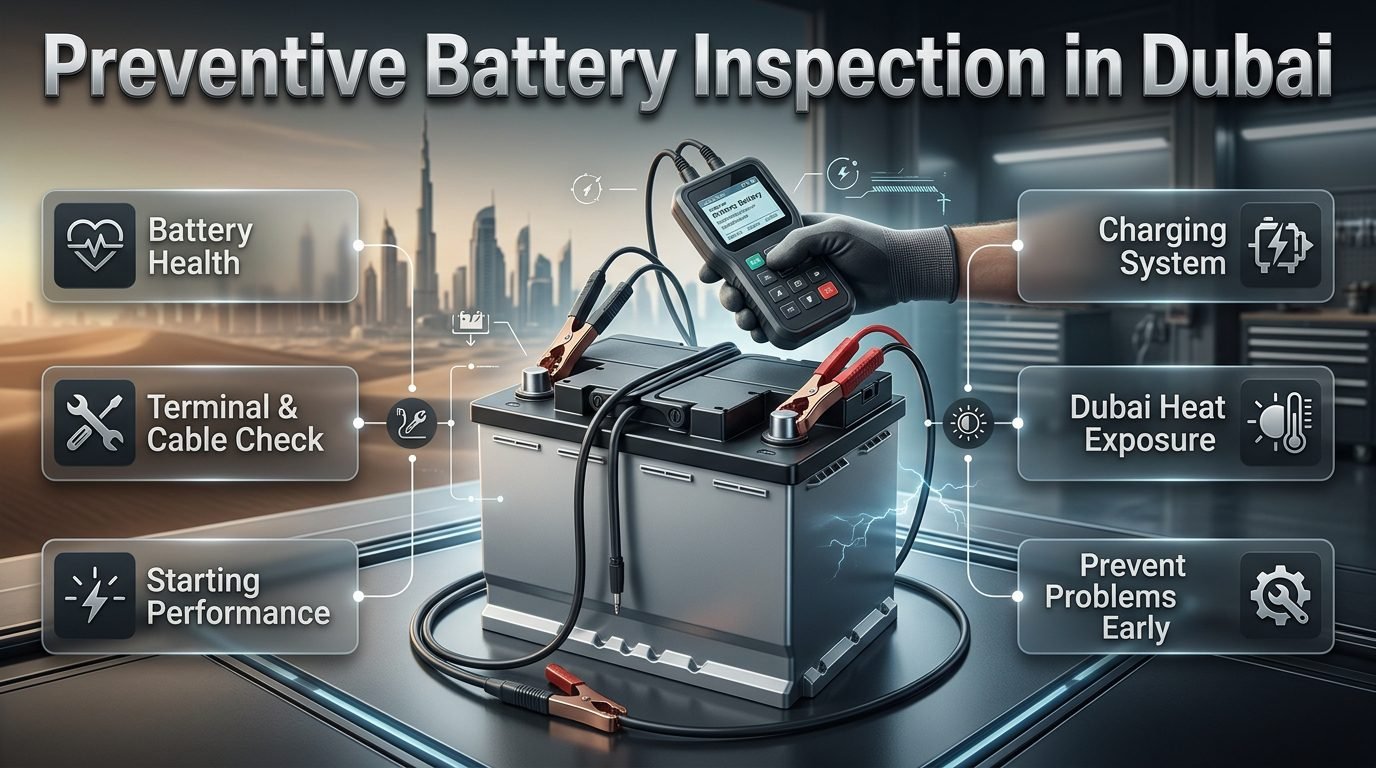
Introduction
Preventive Battery Inspection in Dubai | A car battery can fail without giving the driver much notice. One day the engine starts normally, and the next morning the starter turns slowly or the vehicle does not crank at all. This is why Preventive Battery Inspection is an important part of responsible vehicle maintenance. It helps identify battery weakness, charging problems, poor connections, and other electrical issues before they develop into an unexpected breakdown.
For drivers in Dubai, battery care deserves particular attention. High temperatures, heavy air-conditioning use, traffic congestion, frequent short trips, and long periods of vehicle exposure to heat can place additional demands on the starting and charging system. A professional inspection looks beyond a simple voltage reading and considers the battery, terminals, cables, starting performance, and charging system together.
For drivers looking for professional automotive support, EuroSwift Auto Services can help with battery-related maintenance and broader vehicle care. The purpose of preventive inspection is straightforward: identify problems early, make informed maintenance decisions, and keep the vehicle dependable when you need it most.
What Is Preventive Battery Inspection?
Preventive Battery Inspection is a professional examination of the vehicle’s battery and related electrical components before a complete battery failure occurs.
It is different from checking whether the vehicle starts. A battery can still start an engine while already showing signs of deterioration. Likewise, a vehicle that will not start does not automatically mean that the battery needs replacement.
A proper inspection may include:
- Visual battery inspection
- Battery voltage testing
- Cranking or starting-performance testing
- Charging-system testing
- Terminal and cable inspection
- Corrosion assessment
- Battery mounting inspection
- Battery age and service-history review
- Electrical-system diagnosis when required
The purpose is to establish the actual condition of the battery and determine whether the vehicle has a battery problem, a charging problem, or another electrical fault.
Why Preventive Battery Inspection Matters
Many drivers only think about their battery after the vehicle refuses to start. That approach can turn a relatively simple maintenance issue into a roadside emergency.
Preventive inspection gives you an opportunity to identify deterioration while the vehicle is still usable. If a battery is becoming weak, you can plan a replacement instead of discovering the problem outside your home, workplace, or on a busy road.
Main benefits include:
- Reduced risk of unexpected starting failure
- Early identification of weak battery performance
- Detection of charging-system problems
- Identification of poor electrical connections
- Better battery replacement planning
- Reduced chance of repeated jumpstarts
- Improved vehicle reliability
- More accurate automotive diagnosis
Professional Recommendation
Do not judge battery health solely by whether the engine starts. Starting successfully today does not guarantee that the battery will have enough reserve capacity tomorrow.
How a Professional Battery Inspection Works
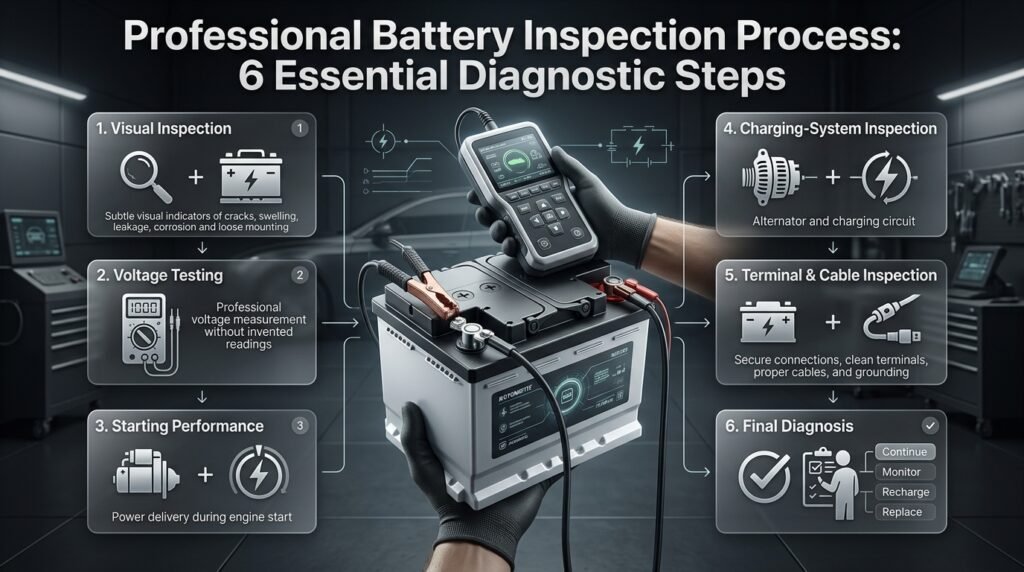
A professional inspection normally follows several diagnostic stages.
1. Visual Inspection
The technician first examines the battery for visible damage. Cracks, swelling, leakage, damaged casing, loose mounting, or excessive corrosion can indicate a condition requiring attention.
The battery should also be securely mounted. Excessive movement or vibration can contribute to physical and connection problems.
2. Voltage Testing
Voltage provides useful information about the battery’s electrical state. However, voltage alone does not provide a complete picture of battery health.
A battery may show reasonable voltage while still having insufficient starting performance.
3. Starting Performance Test
The battery’s ability to support engine starting is assessed using suitable diagnostic equipment. This helps determine whether the battery can provide the required electrical power when the starter demands significant current.
4. Charging-System Inspection
The alternator and charging circuit should be checked when battery problems occur repeatedly.
If the charging system is not replenishing the battery correctly, installing another battery may only provide a temporary solution.
5. Terminal and Cable Inspection
Battery terminals and cables need good electrical contact. Corrosion, looseness, damaged cables, or poor grounding can cause symptoms that resemble battery failure.
6. Final Diagnosis
After considering the test results, physical condition, vehicle symptoms, and charging performance, the technician can recommend whether the battery should remain in service, be monitored, recharged, or replaced.
Signs Your Car Battery Needs Inspection
A battery does not always fail suddenly. In many cases, the vehicle provides clues beforehand.
Slow Engine Cranking
One of the most noticeable signs is a slower-than-normal engine crank. If the starter sounds weaker than usual, the battery and starting system should be checked.
Repeated Jumpstarts
If the vehicle repeatedly needs a jumpstart, do not simply continue carrying jumper cables. The reason for the repeated discharge should be identified.
Dim or Flickering Lights
Headlights or interior lighting that become noticeably dim can indicate an electrical or charging concern. Further diagnosis is necessary because the battery is not always the cause.
Electrical Problems
Unusual behaviour from windows, dashboard electronics, infotainment systems, or other accessories may indicate voltage-related problems.
Battery Warning Light
A battery-shaped warning light can indicate a charging-system problem. It should not automatically be interpreted as proof that the battery itself has failed.
Visible Corrosion
Corrosion around battery terminals can interfere with electrical connections and should be inspected rather than ignored.
Battery Warning Signs and Possible Causes
| Symptom | Possible Cause | Recommended Action |
|---|---|---|
| Slow engine crank | Weak battery or poor connection | Battery and starting-system test |
| Vehicle will not start | Battery, starter, or electrical fault | Complete diagnosis |
| Battery repeatedly goes flat | Charging problem or electrical drain | Battery and charging inspection |
| Battery warning light | Charging-system issue | Check alternator and charging circuit |
| Dim headlights | Electrical or charging issue | System diagnosis |
| Corroded terminals | Poor connection | Clean and inspect terminals |
| New battery repeatedly discharges | Underlying electrical problem | Investigate charging/drain |
These symptoms should be treated as diagnostic clues rather than automatic proof of battery failure.
How Dubai’s Climate Affects Battery Maintenance
Dubai’s climate makes battery maintenance particularly important. High ambient temperatures can accelerate battery deterioration, while vehicles are often exposed to heat for extended periods.
Air conditioning also places a substantial electrical demand on the vehicle. In addition, urban driving frequently involves traffic, stopping, restarting, and short journeys.
These conditions do not mean that every battery will fail early, but they make regular inspection a sensible part of preventive maintenance.
Dubai drivers should pay attention to:
- Extended exposure to high temperatures
- Frequent short-distance journeys
- Heavy air-conditioning usage
- Long periods of parking
- Repeated engine starts in traffic
- Previous battery discharge
- Slow starting after the vehicle has been parked
Expert Insight
Climate should be considered alongside battery age, vehicle usage, charging performance, and electrical condition. Heat is an important factor, but it is rarely the only explanation for battery failure.
Preventive Battery Inspection vs Battery Replacement
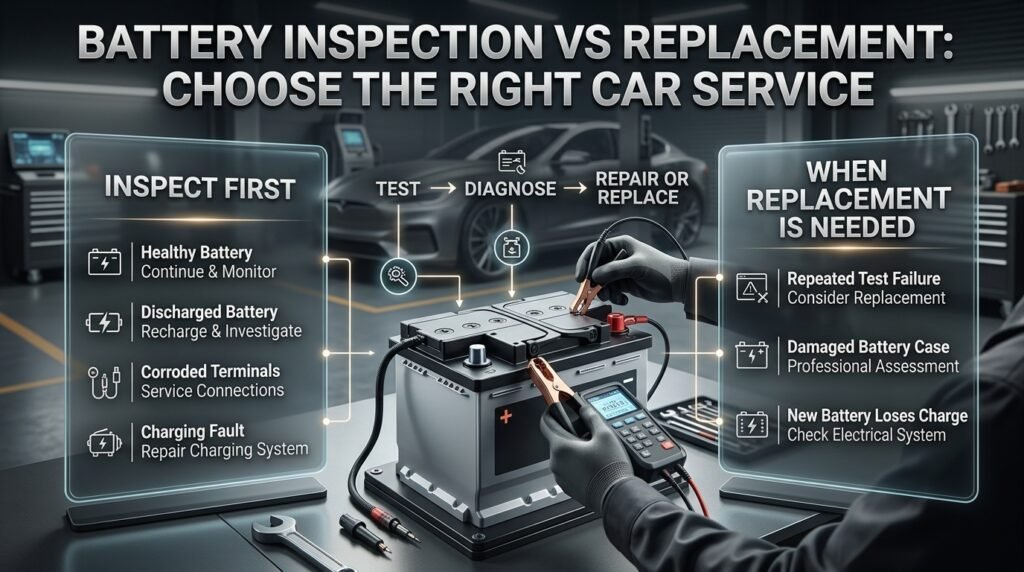
Inspection and replacement serve different purposes.
An inspection determines the current condition of the battery. Replacement becomes necessary when the battery is no longer capable of providing reliable performance or has physical damage that makes continued use unsuitable.
Replacing a battery without diagnosing the vehicle can be an expensive mistake. If the alternator is undercharging or an electrical component is draining power while the vehicle is parked, the replacement battery may eventually develop the same problem.
| Situation | Better Approach |
|---|---|
| Battery tests healthy | Continue using it and monitor |
| Battery is discharged but healthy | Recharge and investigate why |
| Terminals are corroded | Service connections |
| Charging system is faulty | Repair charging system |
| Battery repeatedly fails testing | Consider replacement |
| Battery casing is damaged | Professional assessment |
| New battery loses charge | Investigate electrical system |
This diagnostic approach helps ensure that money is spent on the actual problem.
How Battery Age Influences Preventive Inspection
Battery lifespan varies according to battery technology, climate, vehicle usage, charging conditions, and maintenance.
There is no single replacement date that applies to every car. Instead, drivers should consider battery age together with actual test results.
An older battery that still performs well may remain serviceable, while a relatively newer battery can develop problems because of charging faults, excessive discharge, physical damage, or unsuitable operating conditions.
A battery deserves closer attention when:
- It is approaching the later part of its expected service period.
- The vehicle has experienced repeated starting problems.
- It has been deeply discharged.
- The car has been unused for an extended period.
- The battery has previously required emergency assistance.
- Electrical problems have appeared.
Battery Types and Correct Battery Selection
Modern vehicles use different battery technologies, and the correct replacement must match the vehicle’s requirements.
Conventional Lead-Acid Batteries
These remain widely used across many vehicles and can provide reliable starting performance when correctly specified and maintained.
AGM Batteries
AGM technology is commonly found in vehicles with higher electrical requirements and certain start-stop systems. Correct specification is important because replacing an AGM battery with an unsuitable battery can create compatibility problems.
If inspection confirms that an AGM battery is required, AGM battery replacement in Dubai may be considered.
What Should Be Matched?
Battery selection should consider:
- Physical dimensions
- Terminal position
- Capacity
- Starting capability
- Battery technology
- Vehicle manufacturer requirements
- Electrical load
- Start-stop system requirements
- Battery-management-system requirements where applicable
The cheapest or most powerful battery is not automatically the correct battery.
Battery Brands and Preventive Maintenance
Brand selection can be important, but compatibility should come first.
Depending on the vehicle, drivers may use brands such as Amaron, Bosch, Tuflong, Exide, Panasonic, FIAMM, or AC Delco.
For compatible vehicles, Amaron battery replacement and Bosch battery replacement are examples of brand-specific replacement options.
Other applications may require Tuflong batteries, Exide batteries, Panasonic batteries, FIAMM batteries, or AC Delco batteries, depending on the vehicle specification.
The important point is to select the battery according to the vehicle’s requirements rather than choosing purely on brand recognition.
When Should You Schedule a Battery Inspection?
Battery inspection can be included as part of routine Car Service, but additional testing makes sense when symptoms appear.
Consider an inspection:
- Before a long road trip
- After repeated jumpstarts
- When starting becomes slower
- After a significant battery discharge
- When the vehicle has been parked for a long period
- When electrical symptoms appear
- When a battery warning indicator illuminates
- When the vehicle’s battery is becoming older
- After a charging-system repair
Preventive Maintenance Schedule
| Vehicle Condition | Maintenance Approach |
|---|---|
| Normal daily driving | Check during routine servicing |
| Frequent short trips | Monitor battery condition regularly |
| Heavy traffic use | Include electrical-system checks |
| Long-term parking | Inspect before regular use |
| Repeated starting problems | Test promptly |
| Before long-distance travel | Battery and charging inspection |
| Previous battery failure | Monitor more closely |
The exact maintenance schedule should follow the manufacturer’s recommendations and the vehicle’s actual condition.
Common Battery Maintenance Mistakes
Replacing the Battery Without Diagnosis
A vehicle that will not start may have a faulty starter, charging system, cable, ground connection, or electrical drain.
Ignoring Corrosion
Corroded terminals can restrict electrical flow and create starting difficulties.
Repeatedly Using Jumpstarts
A jumpstart restores temporary mobility but does not fix the reason the battery became discharged.
Installing an Incorrect Battery
A physically compatible battery is not necessarily electrically compatible. Specification matters.
Ignoring the Alternator
If the alternator is not charging correctly, a new battery may eventually become discharged.
Waiting for Complete Failure
Preventive inspection is most useful before the vehicle becomes stranded.
Preventive Battery Inspection as Part of Complete Vehicle Maintenance
Battery health should not be considered separately from the rest of the vehicle.
During a broader Vehicle Inspection, technicians may identify related issues involving:
- Engine performance
- Brakes
- Tires
- Suspension
- Steering
- Cooling system
- Air conditioning
- Transmission
- Charging system
- Electrical components
For example, Engine Diagnostics can help identify starting-related faults, while AC Repair may become relevant when electrical symptoms are associated with the vehicle’s climate-control system.
A complete maintenance approach is more effective than treating each symptom in isolation.
What to Check Before a Long Journey
A battery that is already showing weakness should be addressed before a long trip.
Battery and electrical checks
- Battery condition
- Starting performance
- Terminal security
- Cable condition
- Charging-system performance
- Dashboard warning lights
- Headlight operation
- Electrical accessories
General vehicle checks
- Engine oil
- Coolant
- Tire pressure
- Tire condition
- Brake condition
- Lights
- Wipers
- Air conditioning
- Emergency equipment
A preventive check can provide valuable peace of mind before travelling outside the city or through areas where roadside assistance may be less convenient.
What Happens When a Weak Battery Is Ignored?
A weak battery can continue starting the vehicle for days or weeks, creating a false impression that everything is fine.
Eventually, however, conditions can change. A hot day, extended parking period, additional electrical demand, or repeated starting cycles may expose the battery’s reduced capacity.
Ignoring the problem can lead to:
- Unexpected no-start situations
- Repeated jumpstarts
- Disrupted travel
- Emergency roadside assistance
- Additional electrical diagnosis
- Difficulty identifying the original problem
A Car Jumpstart can get the vehicle moving again, but it should be followed by proper diagnosis if the battery repeatedly loses power.
Preventive Battery Inspection for Modern and Luxury Cars
Modern vehicles contain significantly more electronic systems than older vehicles. Start-stop technology, advanced infotainment, driver-assistance systems, electronic control modules, powered accessories, and sophisticated security systems can increase the importance of correct battery specification.
Some vehicles may also require battery registration or configuration after installation. This is particularly relevant to certain modern European and luxury vehicles.
For such vehicles, Luxury Car Service should follow manufacturer-specific procedures rather than treating battery replacement as a universal process.
A professional technician should verify the required battery technology and ensure that the vehicle’s charging and battery-management systems are functioning correctly.
Latest Battery Inspection Technology
Battery testing has become more sophisticated than simply measuring voltage with a basic meter.
Professional diagnostic equipment can provide information about battery condition and starting capability, while vehicle diagnostic scanners can help identify related electronic or charging faults.
Modern battery diagnosis may involve:
- Digital battery testing
- Starting-system analysis
- Charging-system analysis
- Electronic fault-code scanning
- Battery-management-system checks
- Vehicle-specific diagnostic procedures
Industry Best Practice
The trend in automotive maintenance is moving toward condition-based servicing. Instead of waiting until a component completely fails, technicians increasingly use diagnostic information to identify deterioration earlier.
This approach can make preventive maintenance more efficient and reduce unnecessary component replacement.
Battery Inspection Troubleshooting Guide
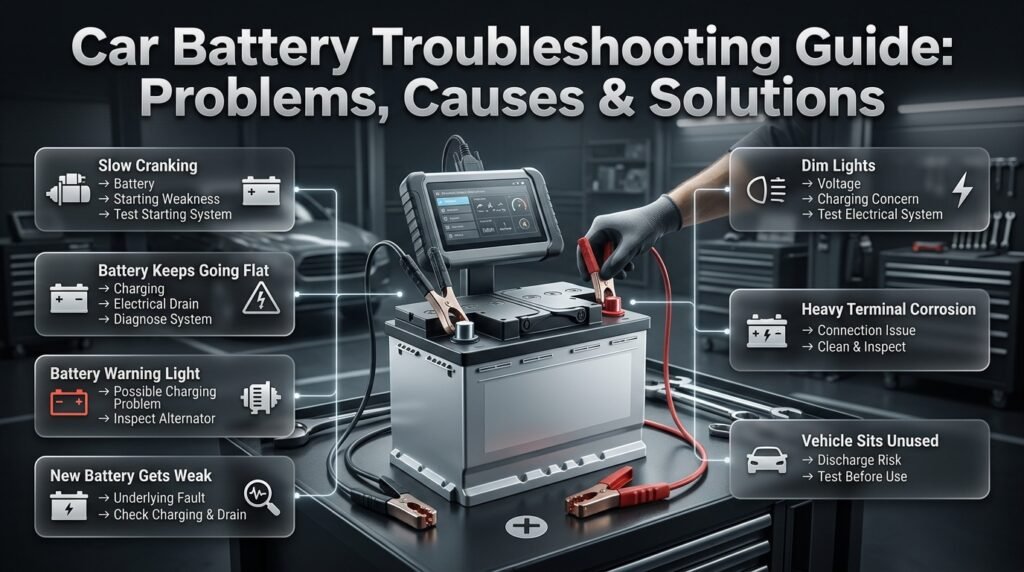
| Problem | What It May Indicate | Professional Action |
|---|---|---|
| Engine cranks slowly | Battery or starting-system weakness | Test battery and starting circuit |
| Battery repeatedly goes flat | Charging issue or electrical drain | Diagnose charging and electrical system |
| Battery warning light appears | Possible alternator/charging problem | Inspect charging system |
| New battery becomes weak | Underlying fault may remain | Check charging and electrical drain |
| Lights become unusually dim | Voltage or charging concern | Test electrical system |
| Battery terminals corrode heavily | Connection or environmental issue | Clean and inspect connections |
| Vehicle sits unused | Battery discharge risk | Test before returning to regular use |
Professional Recommendations for Better Battery Reliability
A few simple practices can make battery maintenance more effective.
1. Pay attention to changes in starting behaviour
A slower crank is useful information. Do not ignore it simply because the engine still starts.
2. Diagnose repeated discharge
If the battery repeatedly goes flat, find the reason instead of repeatedly charging or replacing it.
3. Keep connections clean and secure
Good electrical contact is essential for reliable starting and charging.
4. Choose the correct battery specification
Battery technology, capacity, dimensions, and starting requirements should all be considered.
5. Inspect before demanding situations
Long trips, extreme weather, and periods of heavy vehicle use are good reasons to confirm battery condition.
6. Use professional testing when symptoms appear
Professional equipment can distinguish between battery deterioration and problems elsewhere in the starting or charging system.
Battery Replacement Planning
When testing confirms that replacement is necessary, planning the replacement can be better than waiting for a complete failure.
The replacement decision may depend on:
- Battery condition
- Battery age
- Vehicle specification
- Battery technology
- Starting requirements
- Manufacturer recommendations
- Installation requirements
- Warranty considerations
Drivers who want to understand the factors that affect replacement costs can review the car battery price guide for Dubai before making a purchasing decision.
The most important point is to compare the correct battery specifications rather than choosing solely according to price.
Future of Preventive Battery Maintenance
Automotive maintenance is gradually becoming more predictive. Modern vehicles collect increasing amounts of information through electronic control systems and sensors, while diagnostic equipment continues to become more capable.
In the future, battery monitoring may provide technicians with better information about deterioration before drivers experience obvious starting problems.
Hybrid and electric vehicles will also increase the importance of advanced battery diagnostics. Their high-voltage systems are fundamentally different from conventional 12-volt starting batteries and require specialized equipment, procedures, and safety protocols.
For conventional vehicles, however, the basic principle will remain the same: identify deterioration early rather than waiting for failure.
How often should a car battery be inspected?
There is no single inspection interval that suits every vehicle because battery life depends on climate, driving habits, vehicle electronics, battery type, and age. As a practical approach, battery condition should be checked during routine servicing, with more frequent testing when the battery is older or the vehicle operates in demanding conditions. Some battery specialists recommend testing at least every six months or alongside regular oil-service intervals.
For Dubai drivers, preventive inspection is particularly useful because prolonged heat exposure can accelerate battery deterioration. Frequent short trips can also leave less time for the charging system to replenish the energy used during starting.
Important points:
Inspect an older battery more frequently.
Test the battery if starting becomes slower.
Check it after repeated jumpstarts or unexpected discharge.
Consider an inspection before a long road trip.
Do not rely only on a fixed calendar interval; actual battery condition matters.
What are the warning signs that a car battery needs inspection?
A failing battery does not always stop working suddenly. In many cases, the vehicle gives small clues first. Slow engine cranking, clicking during startup, dim headlights, electrical irregularities, a battery warning light, and visible corrosion are among the common signs that should lead to a battery and charging-system check.
One important point is that these symptoms do not automatically mean the battery itself is defective. For example, repeated battery discharge may be connected to an alternator problem, electrical drain, or poor battery connection. A professional inspection helps separate the symptom from the actual cause.
Watch for:
Slow or hesitant engine cranking
Repeated jumpstart requirements
Dim or flickering lights
Clicking sounds during starting
Battery or charging warning light
Corrosion around terminals
Unusual electrical behaviour
Battery case swelling, cracks, or leakage
If several of these signs appear together, delaying inspection is not a sensible maintenance strategy.
Can a battery test tell me whether I need a new battery?
A professional battery test can provide important information about whether the battery is still capable of delivering reliable starting performance, but the result should be interpreted together with the vehicle’s charging system and battery condition.
For example, a tester may indicate that the battery is healthy but needs recharging. Another result may indicate that the battery should be replaced because its starting capability has deteriorated. A low test result can sometimes require charging and retesting before a final decision is made.
This distinction is important because replacing a battery without finding the underlying problem can lead to another discharge later.
A professional diagnosis may lead to:
Continue using the existing battery
Recharge and retest it
Clean or repair the connections
Investigate the charging system
Check for excessive electrical drain
Replace the battery when testing confirms deterioration
The goal of Preventive Battery Inspection is therefore not simply to sell a replacement. It is to determine what the vehicle actually needs.
Does Dubai’s hot weather affect car battery life?
Yes, high temperatures can contribute to faster battery deterioration, which makes preventive battery inspection particularly relevant in Dubai. Heat is one of several factors that can shorten battery life, alongside driving patterns, vehicle electrical demands, vibration, and maintenance condition.
The important point is not to assume that every battery problem in Dubai is caused by temperature. A battery that repeatedly goes flat could also have a charging fault or an electrical drain. Professional testing can identify whether heat-related deterioration is actually present or whether another issue needs attention.
For better battery care in hot conditions:
Monitor starting performance rather than waiting for failure.
Keep terminals clean and properly secured.
Check battery condition as it gets older.
Inspect the charging system when discharge keeps occurring.
Consider testing before long-distance travel.
Avoid ignoring warning lights or repeated jumpstarts.
In a hot climate, preventive maintenance is much more useful than waiting for a battery to fail at the most inconvenient time.
What is the difference between battery inspection and battery replacement?
Battery inspection is the diagnostic process used to determine the condition of the existing battery and related electrical system. Battery replacement is the corrective service performed when the existing battery is no longer suitable for reliable operation.
A vehicle should not automatically receive a new battery simply because it has experienced one starting problem. The battery may have been discharged because the car was unused, the terminals may have a poor connection, or the charging system may not be replenishing the battery correctly.
Situation
Appropriate Approach
Battery performs within specification
Continue monitoring
Battery is discharged but healthy
Recharge and investigate the cause
Terminals are dirty/corroded
Service the connections
Charging system is faulty
Repair charging system
Battery repeatedly fails testing
Replacement may be appropriate
Battery case is swollen or damaged
Professional assessment/replacement
A good Car Battery Inspection therefore protects the driver from two common mistakes: replacing a battery that is still usable and continuing to rely on a battery that is genuinely near failure.
Conclusion
Preventive Battery Inspection is a simple but valuable part of responsible vehicle maintenance. Instead of waiting until a weak battery leaves you stranded, regular testing can identify declining battery performance, poor connections, charging-system problems, and other electrical issues while there is still time to address them.
For Dubai drivers, this becomes even more important because high temperatures, frequent traffic, air-conditioning use, and short-distance driving can place additional demands on the vehicle’s electrical system. A professional inspection helps determine whether the battery can safely remain in service or whether Battery Replacement is the more sensible option.
The best approach is not to replace a battery based on age or one isolated symptom. A proper inspection should consider battery condition, starting performance, terminals, cables, and the charging system together. This system-based approach can prevent unnecessary replacement while reducing the risk of an unexpected breakdown.
Regular Vehicle Inspection, Car Service, and timely battery testing can make a noticeable difference to everyday reliability. For drivers who want professional assistance with battery diagnosis, replacement, or wider Vehicle Maintenance, choosing an experienced automotive service provider is a practical way to keep the vehicle ready for Dubai’s demanding driving conditions.
Leave a Reply