
Introduction
Preventing Car Battery Discharge in Dubai | A discharged car battery can turn a normal day into an unexpected vehicle problem. The engine may crank slowly, electrical systems may become weak, or the vehicle may fail to start after being parked for several hours or days. Understanding why a battery loses its charge and taking preventive steps can significantly reduce the risk of an inconvenient breakdown.
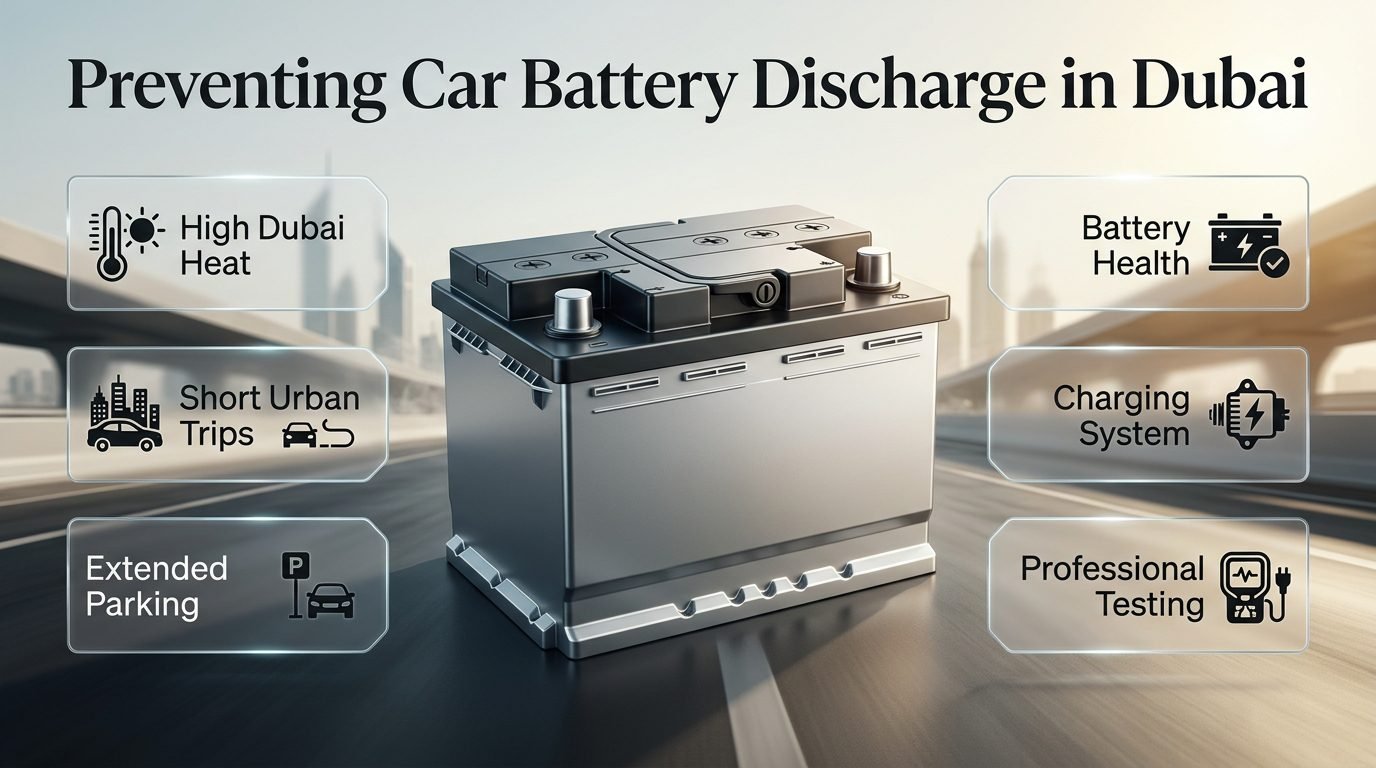
For Dubai drivers, battery care deserves particular attention. High temperatures, frequent air-conditioning use, heavy traffic, short urban journeys, and extended parking can all affect battery performance. EuroSwift Auto Services provides professional automotive support in Dubai, including battery testing, mobile battery replacement, jumpstart assistance, and related vehicle services.
Preventing car battery discharge is not simply about installing a new battery. Reliable starting depends on the condition of the battery, alternator, electrical connections, driving habits, and the vehicle’s wider electrical system. A battery that repeatedly becomes weak may actually be warning you about an underlying charging or electrical problem.
This complete guide explains the main causes of battery discharge, early warning signs, Dubai-specific battery challenges, parking and storage practices, professional diagnostic procedures, battery replacement considerations, and modern developments in battery maintenance.
What Is Car Battery Discharge?
Car battery discharge occurs when the electrical energy being consumed from the battery is greater than the energy being restored to it.
Every time you start your vehicle, the starter motor uses energy from the battery. Once the engine is running, the alternator supplies electrical power to the vehicle and normally helps restore the energy used during starting.
Under normal conditions, this process maintains the battery at an appropriate charge level. Problems occur when the vehicle repeatedly consumes more energy than the charging system can replace.
Battery discharge can happen gradually or suddenly.
For example, leaving the headlights on overnight may cause a noticeable discharge by the next morning. In contrast, a weak battery combined with repeated short journeys may gradually lose its ability to start the vehicle reliably.
The important point is that battery discharge is a condition, not necessarily the underlying fault.
The actual cause could be:
- An aging battery
- Excessive electrical consumption
- Parasitic drain
- Alternator problems
- Poor battery connections
- Repeated short journeys
- Long-term vehicle inactivity
- Extreme temperatures
- Incorrect battery specification
- Faulty aftermarket electrical equipment
Finding the cause is therefore essential when discharge happens repeatedly.
Why Preventing Car Battery Discharge Matters
A vehicle battery is one of the most important components in the starting and electrical system.
Although its primary role is to provide the electrical energy required to start the engine, modern vehicles depend on the battery for considerably more than starting.
Electronic control modules, security systems, lighting, infotainment, sensors, communication systems, and other vehicle electronics all depend on a stable electrical supply.
Preventing unnecessary discharge can help:
- Reduce unexpected starting failures
- Improve starting reliability
- Identify battery deterioration earlier
- Detect charging-system faults
- Reduce repeated jumpstarts
- Avoid unnecessary battery replacement
- Improve vehicle availability
- Reduce roadside emergencies
- Support reliable daily commuting
For someone who relies on a vehicle every day, preventing a battery failure is usually much easier than dealing with one after the vehicle refuses to start.
Main Causes of Car Battery Discharge
Several different conditions can cause a battery to lose its charge.
| Cause | How It Affects the Battery | Recommended Action |
|---|---|---|
| Lights left on | Continuous electrical consumption | Check lights before leaving |
| Short journeys | Limited opportunity to restore starting energy | Monitor battery condition |
| Long parking | Standby systems gradually consume energy | Check battery before storage |
| Aging battery | Reduced ability to hold charge | Perform battery health test |
| Alternator fault | Battery may not receive sufficient charging | Inspect charging system |
| Parasitic drain | Excessive current consumption while parked | Perform electrical diagnosis |
| Corroded terminals | Poor electrical connection | Inspect terminals and cables |
| Incorrect battery | May not meet vehicle requirements | Verify correct specification |
| Aftermarket accessories | May consume power when parked | Check installation and current draw |
A single event does not always indicate a serious battery problem. However, repeated discharge should never be ignored.
How Dubai Heat Affects Car Battery Performance
Dubai’s climate is one of the most important environmental considerations for automotive battery maintenance.
High temperatures can accelerate the aging process inside lead-acid batteries. Heat can contribute to faster deterioration, particularly when a battery is already approaching the end of its useful service period.
Vehicles may also experience significant heat exposure even when parked for relatively short periods.
Air-conditioning creates another demanding operating condition. The vehicle’s electrical and mechanical systems are designed to handle normal AC operation, but a weak battery or charging system may show symptoms more quickly when the vehicle is operating under greater demand.
Dubai conditions can therefore make preventive inspection especially valuable.
Factors that may influence battery performance include:
- Ambient temperature
- Vehicle parking conditions
- Battery age
- Battery construction
- Electrical load
- Driving frequency
- Short-trip usage
- Charging-system condition
Heat does not mean that every battery will fail quickly. However, it can accelerate deterioration, making early testing more useful.
Professional Recommendation: If your vehicle regularly operates in Dubai’s hot climate, do not wait until the battery completely fails before checking its condition.
How Short Trips Can Cause Battery Problems
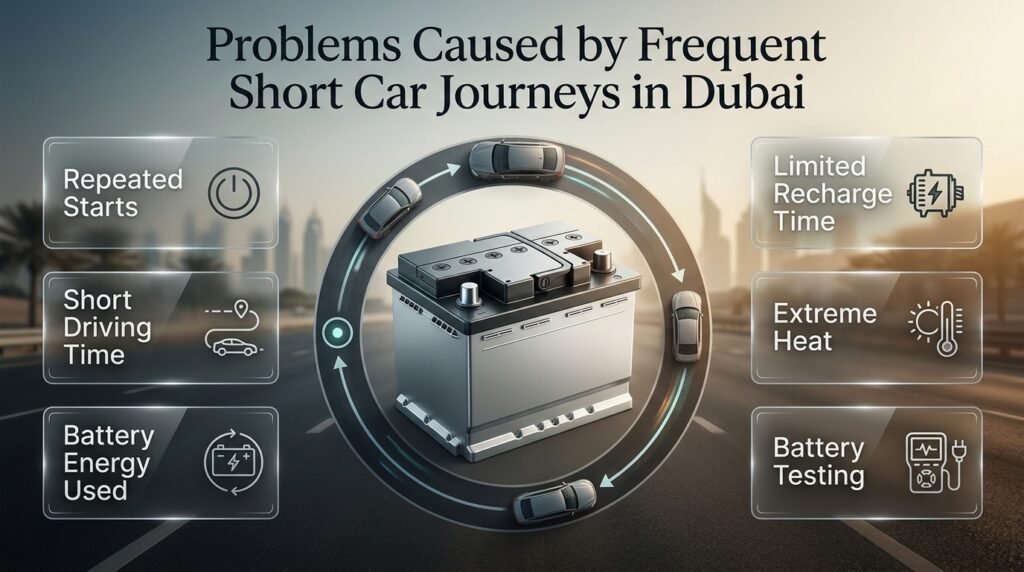
Frequent short journeys are a common but often overlooked battery issue.
Starting the engine requires a substantial burst of electrical energy. The alternator then needs sufficient running time to help replenish the energy used during starting.
Consider a vehicle used mainly for short trips:
- Start the vehicle in the morning.
- Drive a short distance.
- Park.
- Start it again later.
- Make another short trip.
- Repeat the process several times.
Each start places demand on the battery.
If the battery is already weak or the charging system is not operating correctly, repeated short journeys may make the problem increasingly noticeable.
This does not mean that every short journey will discharge a healthy battery. Modern vehicles are designed for normal urban use. The issue becomes more relevant when short-trip driving is combined with battery deterioration, extreme temperatures, heavy electrical loads, or charging-system problems.
Drivers who mainly make short journeys should include battery testing as part of regular Car Service.
Battery Discharge During Extended Parking
A vehicle that is switched off can still consume a small amount of electrical energy.
Modern cars contain electronic systems that remain active after the engine is switched off. Security systems, keyless entry, memory functions, clocks, control modules, and other electronics can continue using a small amount of power.
Normally, this standby consumption is controlled and should not rapidly discharge a healthy battery.
However, when a vehicle remains unused for an extended period, even normal standby consumption can gradually reduce the battery’s available charge.
Before leaving your car unused:
- Turn off all lights.
- Remove unnecessary accessories.
- Make sure the trunk is completely closed.
- Check that all doors are properly shut.
- Inspect aftermarket electrical equipment.
- Check battery condition if the vehicle has previously shown weakness.
- Follow the manufacturer’s storage recommendations.
If a vehicle becomes completely discharged after only a short parking period, investigate the cause rather than assuming that inactivity alone is responsible.
What Is Parasitic Battery Drain?
Parasitic drain occurs when electrical equipment continues consuming an excessive amount of power while the vehicle is switched off.
Some electrical consumption after shutdown is normal. Modern vehicles need a small amount of energy to maintain essential functions.
The problem begins when current consumption is significantly higher than expected.
Potential sources include:
- Aftermarket alarms
- Dash cameras
- GPS equipment
- Audio systems
- Interior lighting faults
- USB accessories
- Faulty control modules
- Incorrect wiring
- Modified electrical systems
- Electronic modules that fail to enter sleep mode
Parasitic drain can be difficult to identify without proper diagnostic equipment.
A technician can measure electrical current while the vehicle is in its normal parked state and investigate circuits if excessive consumption is detected.
Expert Insight: If a relatively new battery repeatedly becomes discharged while the car is parked, another battery may not solve the problem. The vehicle’s electrical system should be checked for abnormal current draw.
Signs Your Car Battery Is Losing Charge
Battery problems often provide warning signs before complete failure.
Drivers should pay attention to changes such as:
- Slower engine cranking
- Clicking during starting attempts
- Dim interior lights
- Weak headlights
- Battery warning light
- Electrical accessories behaving unusually
- Repeated need for jumpstarts
- Difficulty starting after overnight parking
- Difficulty starting after several days of inactivity
- Electronic settings resetting
These symptoms do not automatically prove that the battery itself has failed.
Slow starting can also be related to poor battery connections, starter problems, or charging-system issues.
This is why proper diagnosis is more reliable than replacing parts based only on symptoms.
Battery Discharge vs Battery Failure
A battery can be discharged without being permanently damaged.
For example, if the headlights are accidentally left on overnight, a healthy battery may simply require appropriate recharging.
A deteriorated battery is different. It may no longer have sufficient capacity to reliably retain and deliver the energy required for starting.
| Situation | Likely Condition | Suitable Approach |
|---|---|---|
| Lights left on overnight | Temporary discharge | Recharge and test |
| Car parked for weeks | Low charge possible | Inspect and recharge |
| Battery repeatedly becomes weak | Possible deterioration | Battery health testing |
| Battery goes flat while driving | Charging problem possible | Alternator inspection |
| Battery dies overnight repeatedly | Possible parasitic drain | Electrical diagnosis |
| Battery cannot retain charge | Battery deterioration | Replacement assessment |
Correct diagnosis prevents unnecessary replacement and helps identify hidden problems.
The Role of the Alternator in Battery Charging
The alternator is responsible for producing electrical power while the engine is running and helping maintain battery charge.
If the alternator, voltage regulator, wiring, or another part of the charging system develops a fault, the battery may gradually lose energy even though the vehicle is being driven.
Possible signs include:
- Repeated battery discharge
- Battery warning indicator
- Dim or unstable lights
- Electrical accessories behaving strangely
- Starting difficulties
- Repeated need for jumpstarts
A vehicle that repeatedly develops battery problems should therefore receive both battery and charging-system testing.
This is where professional Engine Diagnostics can become useful, especially if battery symptoms occur alongside other electrical or engine-related problems.
Battery Terminals and Electrical Connections
Battery performance also depends on good electrical connections.
Loose terminals, corrosion, damaged cables, or poor grounding can increase electrical resistance and interfere with starting and charging.
During routine maintenance, a technician can inspect:
- Positive terminal
- Negative terminal
- Battery cables
- Ground connections
- Corrosion
- Physical battery condition
- Battery mounting
A battery can be healthy internally but still produce starting problems when its connections are poor.
Modern vehicles also contain sensitive electronic systems, so battery disconnection and electrical work should be performed using appropriate procedures.
Driving Habits That Help Prevent Battery Discharge
Good driving habits can reduce unnecessary battery stress.
Drivers should avoid leaving electrical accessories running for extended periods while the engine is off.
Useful habits include:
- Switch off lights before leaving the vehicle.
- Turn off unnecessary electrical accessories.
- Avoid repeatedly starting the engine without need.
- Monitor slow engine cranking.
- Do not ignore battery warning indicators.
- Have recurring electrical problems inspected.
- Follow the manufacturer’s maintenance schedule.
Longer journeys can provide more operating time for the charging system than extremely short journeys, but driving for longer should never be considered a replacement for repairing a defective alternator or battery.
How to Prevent Battery Discharge While Parked at Home
A vehicle parked outside a villa, apartment, or residential building can still experience battery problems.
Before locking the car, develop a simple shutdown routine:
- Turn off headlights.
- Check interior lights.
- Switch off accessories.
- Remove unnecessary chargers.
- Check the trunk.
- Make sure all doors are fully closed.
- Check aftermarket electrical equipment.
If the vehicle repeatedly fails to start after being parked overnight, professional testing should be considered.
Overnight discharge is especially important because it can indicate abnormal electrical consumption.
Preventing Battery Discharge During Office Parking
Many Dubai drivers leave their cars parked at work for most of the day.
An aging battery may start the vehicle normally in the morning but fail after several hours of parking.
If you notice progressively slower starting after work, do not wait for complete battery failure.
A battery inspection can determine whether the problem is:
- Battery deterioration
- Low state of charge
- Electrical drain
- Poor connection
- Charging-system issue
Mobile automotive services can be particularly practical in these situations because a technician may be able to test or replace the battery at the vehicle’s location.
Battery Care Before Long-Distance Travel
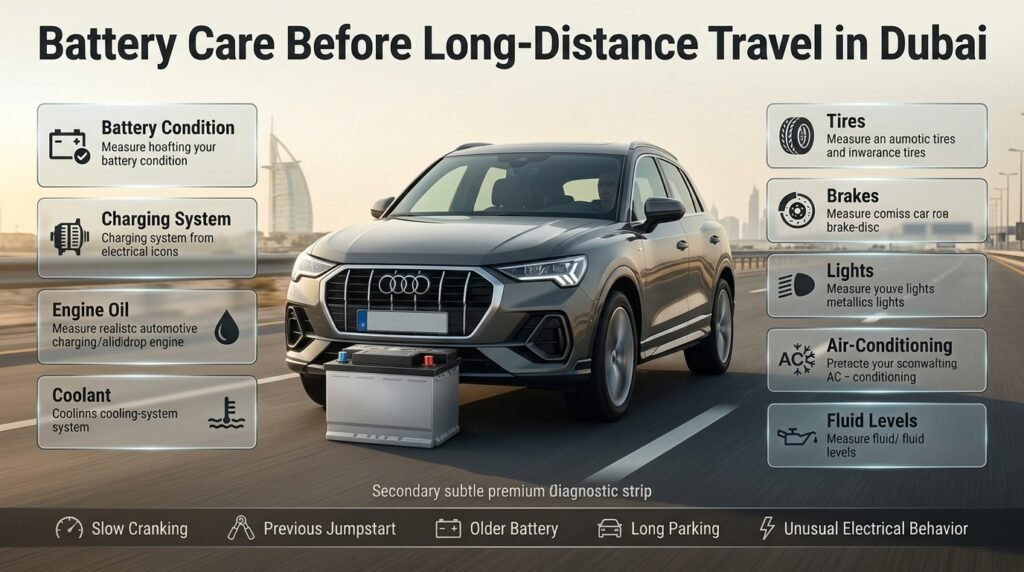
A battery problem is particularly inconvenient before or during a long journey.
Before travelling between Dubai and another emirate, consider a basic vehicle inspection.
Important checks include:
- Battery condition
- Charging system
- Engine oil
- Coolant
- Tires
- Brakes
- Lights
- Air-conditioning
- Fluid levels
A professional Vehicle Inspection can help identify potential problems before the journey begins.
Battery testing becomes especially sensible if:
- The engine has recently cranked slowly.
- The vehicle required a jumpstart.
- The battery is older.
- The car has been parked for a long period.
- Electrical systems have behaved unusually.
How Professional Battery Testing Works
Professional battery testing goes beyond checking whether the engine starts.
Depending on the vehicle and equipment, technicians may evaluate:
- Battery voltage
- Battery health
- Starting performance
- Available starting capacity
- Charging-system operation
- Terminal condition
- Electrical connections
- Parasitic current
- Battery specification
- Vehicle-specific charging requirements
A simple voltage measurement is useful but does not always tell the complete story.
A battery can show acceptable voltage and still have poor starting capability.
Professional testing therefore provides a better basis for deciding whether the battery needs charging, continued monitoring, or replacement.
Why Battery Replacement Alone May Not Solve the Problem
Replacing the battery is not always the correct first step.
Imagine that a vehicle has an electrical component consuming excessive power overnight. Installing a new battery may temporarily restore normal starting, but the same electrical drain can eventually discharge the replacement battery.
The same principle applies to a faulty alternator.
A new battery cannot compensate for a charging system that is not properly restoring electrical energy.
A professional approach is:
Identify the symptom → Test the system → Find the cause → Perform the repair → Verify the result
This approach is more reliable than replacing the battery repeatedly.
When Should a Car Battery Be Replaced?
Battery replacement becomes appropriate when testing confirms that the battery is no longer capable of providing dependable performance.
Possible reasons include:
- Poor battery health
- Inability to retain charge
- Repeated starting problems
- Significant internal deterioration
- Physical damage
- End of useful service life
The replacement battery must also meet the vehicle’s requirements.
Important specifications include:
- Physical dimensions
- Terminal configuration
- Capacity
- Starting capability
- Battery technology
- Vehicle manufacturer requirements
- Start-stop compatibility
Professional Battery Replacement can help ensure correct battery selection and installation.
Choosing the Correct Battery Technology
Modern vehicles use different battery technologies depending on their electrical architecture.
Conventional Maintenance-Free Batteries
These remain common in many conventional vehicles and are suitable where the manufacturer specifies them.
EFB Batteries
Enhanced Flooded Batteries are designed for applications requiring improved cycling capability compared with traditional batteries.
AGM Batteries
Absorbent Glass Mat batteries are designed for vehicles requiring stronger cycling performance and greater electrical capability.
The correct technology depends on the vehicle.
Installing the wrong type can result in unsuitable charging behavior or reduced performance.
AGM Batteries and Battery Discharge Prevention
Vehicles equipped with AGM batteries often have higher electrical demands or start-stop systems.
Drivers should not automatically replace an AGM battery with a conventional battery simply because the physical dimensions are similar.
If your vehicle requires AGM technology, the replacement should meet the appropriate specification.
EuroSwift’s AGM Battery replacement service provides a dedicated option for drivers looking for AGM battery replacement in Dubai.
Battery technology should always be selected according to vehicle requirements rather than simply choosing the most expensive option.
Battery Brands and Replacement Options
Drivers may encounter many battery brands in the Dubai market.
Common examples include:
- Amaron
- Bosch
- Tuflong
- Exide
- Panasonic
- FIAMM
- AC Delco
Brand reputation is important, but compatibility should come first.
Drivers researching specific battery options can explore the relevant EuroSwift pages:
- Amaron Battery
- Bosch Battery
- Tuflong Battery
- Exide Battery
- Panasonic Battery
- FIAMM Battery
- AC Delco Battery
The final selection should always be based on the vehicle’s required specifications.
Understanding Battery Capacity and Starting Performance
Battery specifications can sometimes be confusing for drivers.
Capacity refers broadly to the amount of electrical energy a battery can store, while starting-performance specifications indicate how effectively the battery can provide high current for engine starting.
A suitable battery must match the vehicle’s requirements.
Important considerations include:
| Specification | Why It Matters |
|---|---|
| Battery capacity | Supports electrical energy requirements |
| Starting capability | Supports engine starting |
| Physical size | Ensures correct installation |
| Terminal position | Allows correct cable connection |
| Battery technology | Must match vehicle requirements |
| Start-stop compatibility | Important for equipped vehicles |
Choosing a battery solely because it physically fits is not a professional approach.
Battery Replacement in Modern Vehicles
Modern vehicles can contain numerous control modules and electronic systems.
Battery replacement can therefore involve more than disconnecting the old battery and installing a new one.
Depending on the vehicle, battery replacement may require:
- Correct installation procedure
- Appropriate battery technology
- Electronic battery registration
- System adaptation
- Voltage stabilization
- Post-installation testing
Some vehicles are more sensitive to battery replacement procedures than others.
This becomes particularly relevant with luxury and high-performance vehicles that contain advanced electrical architectures.
What to Do When Your Battery Is Already Discharged
If the vehicle does not start because the battery has discharged, avoid repeatedly attempting to crank the engine.
A professional Car Jumpstart can provide temporary starting assistance.
However, jumpstarting does not repair:
- A failed battery
- An alternator problem
- Parasitic drain
- Poor battery connections
- An electrical-system fault
Once the vehicle is running, the reason for the discharge should be considered.
If the battery becomes weak again soon afterward, further diagnosis is recommended.
Roadside Battery Assistance in Dubai
Battery failure can happen at home, work, shopping areas, parking facilities, or roadside locations.
Mobile assistance can be useful because the technician can potentially inspect the vehicle at its current location instead of requiring an immediate tow.
Professional Roadside Assistance may be suitable when:
- The vehicle will not start.
- The battery is completely discharged.
- A jumpstart is required.
- Battery replacement is necessary.
- The driver cannot safely reach a workshop.
The service location should always be safe and accessible for the technician.
Battery Discharge Troubleshooting Table
| Symptom | Possible Cause | Recommended Action |
|---|---|---|
| Car fails after lights were left on | Battery discharged | Recharge and test |
| Battery dies after several days | Weak battery or inactivity | Battery inspection |
| Battery repeatedly dies while driving | Charging-system fault | Alternator inspection |
| New battery goes flat | Electrical drain or charging fault | Full diagnosis |
| Slow engine cranking | Weak battery or connection | Battery and terminal testing |
| Battery warning light | Charging problem | Professional inspection |
| Electrical settings reset | Low voltage | Electrical-system diagnosis |
| Repeated jumpstarts needed | Underlying battery/system problem | Complete battery assessment |
The pattern of failure is often as important as the symptom itself.
Preventive Battery Maintenance Checklist
- Check for slow engine cranking.
- Turn off headlights before leaving the car.
- Check interior lights.
- Avoid unnecessary accessory use with the engine off.
- Inspect battery terminals during routine servicing.
- Test battery health when symptoms appear.
- Test the alternator if discharge repeatedly occurs.
- Investigate overnight battery drain.
- Check aftermarket electrical accessories.
- Inspect the battery before long-distance travel.
- Follow proper storage recommendations.
- Use the correct battery specification.
- Replace a battery when testing confirms deterioration.
- Verify the charging system after replacement.
Battery Maintenance for Different Driving Patterns
Not every driver puts the same demands on a battery.
Daily Commuters
Drivers who use their vehicles every day should monitor starting performance and include battery testing during regular servicing.
Short-Distance Drivers
Drivers who make many short journeys should pay particular attention to battery condition because of repeated starting cycles.
Long-Term Parkers
Drivers who leave their vehicles unused for weeks should follow suitable storage procedures and check battery condition before extended inactivity.
Luxury Vehicle Owners
Luxury vehicles may contain more sophisticated electronic systems and may require vehicle-specific battery procedures.
High-Mileage Drivers
Drivers who spend significant time on the road should monitor the charging system because consistent alternator operation is essential for maintaining battery charge.
How Battery Maintenance Fits Into Overall Vehicle Maintenance
Battery care should be part of a broader vehicle maintenance strategy.
A vehicle’s reliability depends on many systems working together.
Routine maintenance may include:
- Oil Change
- Brake inspection
- Brake Repair
- Tire maintenance
- Wheel Alignment
- Suspension Repair
- AC Repair
- Cooling-system inspection
- Engine diagnostics
- Transmission servicing
- Electrical-system testing
A battery problem can sometimes be the first sign that another vehicle system needs attention.
For example, repeated battery discharge may eventually reveal a charging-system fault. Similarly, electrical instability can originate from a damaged connection rather than the battery itself.
Comprehensive Vehicle Maintenance helps identify such problems earlier.
When Professional Inspection Is Necessary
Professional inspection is recommended when:
- The battery repeatedly becomes flat.
- The vehicle needs multiple jumpstarts.
- The battery warning light appears.
- Starting becomes noticeably slower.
- A new battery becomes discharged.
- Electrical accessories behave strangely.
- The vehicle contains aftermarket electrical equipment.
- The car has been parked for an extended period.
- You are preparing for a long journey.
- Battery replacement has not solved the problem.
A technician can determine whether the problem is related to battery condition, charging performance, electrical drain, connections, or another component.
Battery Replacement Cost Factors in Dubai
Battery prices vary depending on the vehicle and battery specification.
Factors that can influence replacement cost include:
- Battery brand
- Battery technology
- Battery capacity
- Vehicle requirements
- AGM or EFB technology
- Warranty
- Installation requirements
- Mobile service
- Luxury vehicle specifications
Drivers researching current battery pricing can review the Car Battery Prices in Dubai guide for further information.
The lowest price should not automatically determine the purchase decision. Correct specification, quality, installation, warranty, and compatibility are all important.
Common Mistakes That Cause Battery Discharge
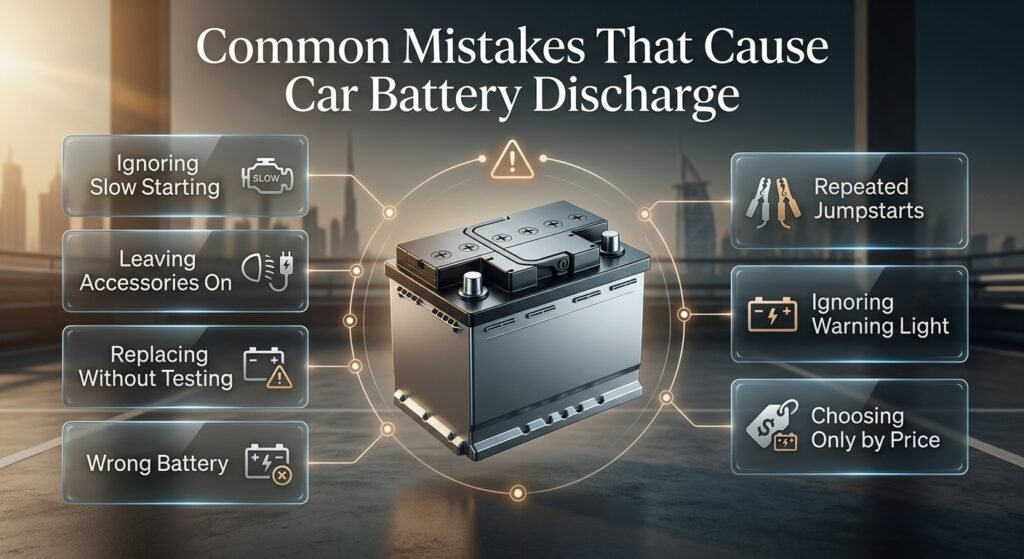
Ignoring Slow Starting
Slow cranking can be an early warning sign. Waiting until the vehicle completely fails can make the problem much more inconvenient.
Leaving Electrical Accessories Running
Lights, chargers, infotainment systems, and other equipment can consume battery power when the engine is off.
Replacing the Battery Without Testing
A new battery cannot fix an alternator problem or excessive electrical drain.
Using the Wrong Battery
A battery that does not match the vehicle’s requirements can create performance and charging problems.
Repeatedly Using Jumpstarts
Jumpstarting restores temporary starting ability but does not identify the underlying cause.
Ignoring the Battery Warning Light
A battery warning indicator can point toward a charging-system problem and should be investigated.
Choosing Only Based on Price
The cheapest battery is not necessarily the most suitable battery for a particular vehicle.
A Professional Strategy for Preventing Battery Discharge
An effective battery maintenance strategy can be divided into four stages.
1. Observe
Notice changes in starting performance, electrical behavior, and dashboard warnings.
2. Test
Perform battery and charging-system testing when symptoms appear.
3. Diagnose
If repeated discharge occurs, investigate parasitic drain, electrical connections, alternator performance, and other possible causes.
4. Maintain
Use the correct battery, follow manufacturer recommendations, and monitor battery condition over time.
This approach helps prevent the common cycle of discharge, jumpstart, temporary recovery, and repeated failure.
Latest Developments in Battery Diagnostics
Automotive battery maintenance is increasingly becoming data-driven.
Modern diagnostic equipment can provide more detailed information about battery health, charging behavior, electrical consumption, and vehicle energy management.
Many modern vehicles also use intelligent battery sensors that communicate with control systems.
These technologies allow technicians to evaluate battery condition more accurately than simply asking whether the vehicle starts.
The direction of the industry is moving toward condition-based maintenance, where components are serviced based on their actual condition rather than relying entirely on fixed replacement schedules.
Future Trends in Car Battery Maintenance
The future of battery maintenance will likely involve increasingly sophisticated monitoring and predictive diagnostics.
Important developments include:
- Predictive battery health monitoring
- Condition-based maintenance
- Intelligent charging systems
- Advanced battery sensors
- Improved battery chemistry
- More accurate battery-life estimation
- Remote diagnostic capabilities
- Integrated vehicle-health platforms
- Automated maintenance recommendations
Hybrid and electric vehicles will add another level of complexity because they contain high-voltage battery systems in addition to conventional low-voltage electrical systems.
For petrol and diesel vehicles, the traditional 12-volt battery will remain an important part of vehicle reliability.
The major shift will be from reactive maintenance toward early detection.
How Can I Prevent My Car Battery From Discharging?
Preventing battery discharge starts with reducing unnecessary electrical consumption and making sure the battery receives enough charging during normal vehicle use. A healthy battery should normally cope with everyday starting and electrical demands, but repeated short trips, long periods of inactivity, accessories left running, extreme heat, and an aging battery can gradually reduce its available charge.
For Dubai drivers, it is particularly important to monitor battery condition because high temperatures can accelerate battery deterioration. Parking in a shaded or covered location when practical, switching off unnecessary electrical equipment before leaving the vehicle, and having the battery checked when starting performance changes are sensible preventive measures.
Practical ways to reduce battery discharge:
Turn off electrical accessories before switching off the vehicle, particularly lights, chargers and infotainment equipment.
Avoid relying only on very short trips if your vehicle is used frequently for short journeys.
Drive the vehicle regularly if it normally remains parked for long periods.
Inspect battery terminals and connections for visible corrosion or looseness.
Test the battery when starting becomes slower than normal.
Check the charging system if the battery repeatedly loses charge.
Investigate aftermarket electrical accessories if the battery becomes weak while parked.
Protect the vehicle from excessive heat by using covered or shaded parking where possible.
One important distinction is that prevention does not mean simply driving the car more. If an alternator is not charging correctly or the vehicle has excessive parasitic drain, normal driving may not solve the problem. In that situation, proper diagnosis is more important than repeatedly charging or replacing the battery.
Why Does My Car Battery Keep Discharging When the Car Is Parked?
A parked vehicle still uses a small amount of electrical energy. Security systems, clocks, control modules, keyless-entry systems and other electronics may remain active after the engine is switched off. This is normally controlled, but a weak battery, extended inactivity or abnormal electrical consumption can eventually cause a starting problem.
If your battery repeatedly goes flat while the vehicle is parked, the first thing to consider is the pattern. A battery that becomes weak after several weeks of inactivity is a different situation from one that repeatedly dies overnight.
Possible causes include:
Aging or deteriorated battery
Excessive parasitic electrical drain
Interior or exterior light remaining active
Dash camera or aftermarket equipment
Faulty alarm or security system
Electronic control module staying active
Poor battery condition
Previous deep discharge
Electrical connection problems
A new battery that becomes flat again shortly after installation deserves particular attention. Replacing it again without checking the vehicle could simply repeat the same problem.
If your battery keeps dying while parked:
Check whether any lights or accessories have been left on.
Consider whether aftermarket electrical equipment has been installed.
Have the battery condition tested.
Have the vehicle checked for abnormal electrical current draw.
Test the charging system if the problem continues.
This is where professional battery diagnostics can save time and unnecessary expense. The goal should be to identify why the battery is losing charge rather than treating every flat battery as a replacement job.
Can Short Trips Cause a Car Battery to Discharge?
Frequent short trips can contribute to battery discharge because starting the engine consumes electrical energy, while a very short drive may provide limited time for the charging system to restore that energy. This becomes more relevant when the battery is already aging or the vehicle operates under demanding conditions.
For example, repeatedly driving only a short distance, parking, and restarting the vehicle several times throughout the day creates multiple starting cycles. The problem is not that short trips automatically damage a healthy battery; rather, repeated short-trip use can make it harder to maintain a strong state of charge.
Better habits for short-trip drivers:
Combine several nearby errands when practical.
Avoid unnecessary repeated engine starts.
Do not leave electrical accessories running after parking.
Monitor slow engine cranking.
Include battery testing in routine maintenance.
Investigate repeated discharge instead of assuming short trips are the only cause.
There is also an important misconception about using a short drive to “fully recharge” a deeply discharged battery. A vehicle’s alternator can maintain a properly functioning battery during normal operation, but a deeply discharged battery may require considerably more charging time and may not be fully restored simply by driving for a short period.
So, if a vehicle has already required a jumpstart, don’t assume that a brief drive has completely solved the battery problem. If the battery repeatedly becomes weak afterward, it should be tested.
How Does Dubai Heat Affect Car Battery Discharge and Battery Life?
Dubai’s high temperatures can place additional stress on automotive batteries. Extreme heat can accelerate chemical processes inside the battery and contribute to faster deterioration, while high under-hood temperatures can further increase the thermal load.
Heat does not mean that every battery will suddenly fail. Battery age, construction, vehicle usage, charging performance, electrical demand and maintenance all influence reliability. However, high temperatures can make an already aging battery more likely to show problems.
This is why a battery that appears acceptable during one period may begin showing slow starting or repeated discharge as it gets older.
Dubai battery-care practices worth following:
Park in a shaded or covered location when possible.
Keep battery terminals clean and properly connected.
Monitor slow or unusual engine cranking.
Have an aging battery professionally tested.
Check the charging system when discharge repeatedly occurs.
Do not ignore battery warning indicators.
Pay closer attention to battery condition before long journeys.
Heat management is particularly important because battery deterioration can occur gradually without an obvious warning. By the time the vehicle refuses to start, the battery may already have been losing capacity for some time.
For Dubai vehicles, preventive Battery Replacement should therefore be based on actual battery condition and vehicle requirements rather than waiting for a complete failure.
How Do I Know Whether I Need a New Battery or There Is Another Problem?
This is one of the most important questions because a discharged battery does not automatically mean the battery needs replacement.
A battery can become flat because of something as simple as lights being left on. On the other hand, repeated discharge can be caused by a failing battery, charging-system fault, poor connection or excessive parasitic drain.
The symptoms can overlap, so proper testing is the best way to separate these possibilities.
Symptom
Possible Explanation
What Should Be Checked
Battery discharged after lights were left on
Temporary discharge
Battery condition and recharge
Slow starting every morning
Weak battery or poor connection
Battery and terminals
Battery repeatedly dies while driving
Charging-system issue possible
Alternator and charging system
Battery dies overnight
Electrical drain possible
Parasitic current
New battery goes flat
Underlying vehicle problem possible
Full electrical diagnosis
Battery cannot hold charge
Battery deterioration
Battery replacement assessment
Battery warning light appears
Charging-system fault possible
Professional inspection
Signs that make battery replacement more likely:
The battery consistently fails health testing.
It cannot retain an adequate charge.
Starting performance remains poor after proper charging.
The battery has significant deterioration.
The vehicle repeatedly requires jumpstarts.
The battery has reached the end of its practical service life.
Signs that suggest another system should be investigated:
A relatively new battery keeps going flat.
The battery dies while the vehicle is parked.
The battery warning light appears.
Electrical accessories behave unusually.
The battery becomes discharged despite regular driving.
There is evidence of aftermarket electrical equipment drawing power.
A professional diagnosis should ideally assess the battery, charging system and electrical drain together when repeated discharge is involved. That approach prevents the common mistake of installing one new battery after another while an alternator fault or parasitic drain remains unresolved. Current automotive guidance similarly recommends testing when batteries struggle to hold charge or require frequent jumpstarts.
Conclusion
Preventing car battery discharge is not just about keeping the battery charged; it is about maintaining the complete starting and electrical system. Regular battery testing, proper driving habits, careful use of electrical accessories, and attention to repeated discharge can help prevent unexpected starting problems.
For Dubai drivers, high temperatures, short journeys, heavy traffic, air-conditioning use, and extended parking can place additional demands on battery performance. A slow engine start, repeated jumpstart, battery warning light, or a battery that keeps going flat should never be ignored. These symptoms can indicate battery deterioration, charging-system problems, poor connections, or parasitic electrical drain.
The right approach is to identify the cause before replacing the battery. Professional battery testing and charging-system inspection can help determine whether the battery needs charging, repair-related attention, or replacement.
With proper preventive maintenance and timely professional inspection, drivers can reduce unnecessary battery failures and keep their vehicles more dependable for everyday driving in Dubai. As modern vehicles become increasingly dependent on sophisticated electrical systems, proactive battery care will continue to play an important role in overall vehicle reliability.
Leave a Reply