
Introduction
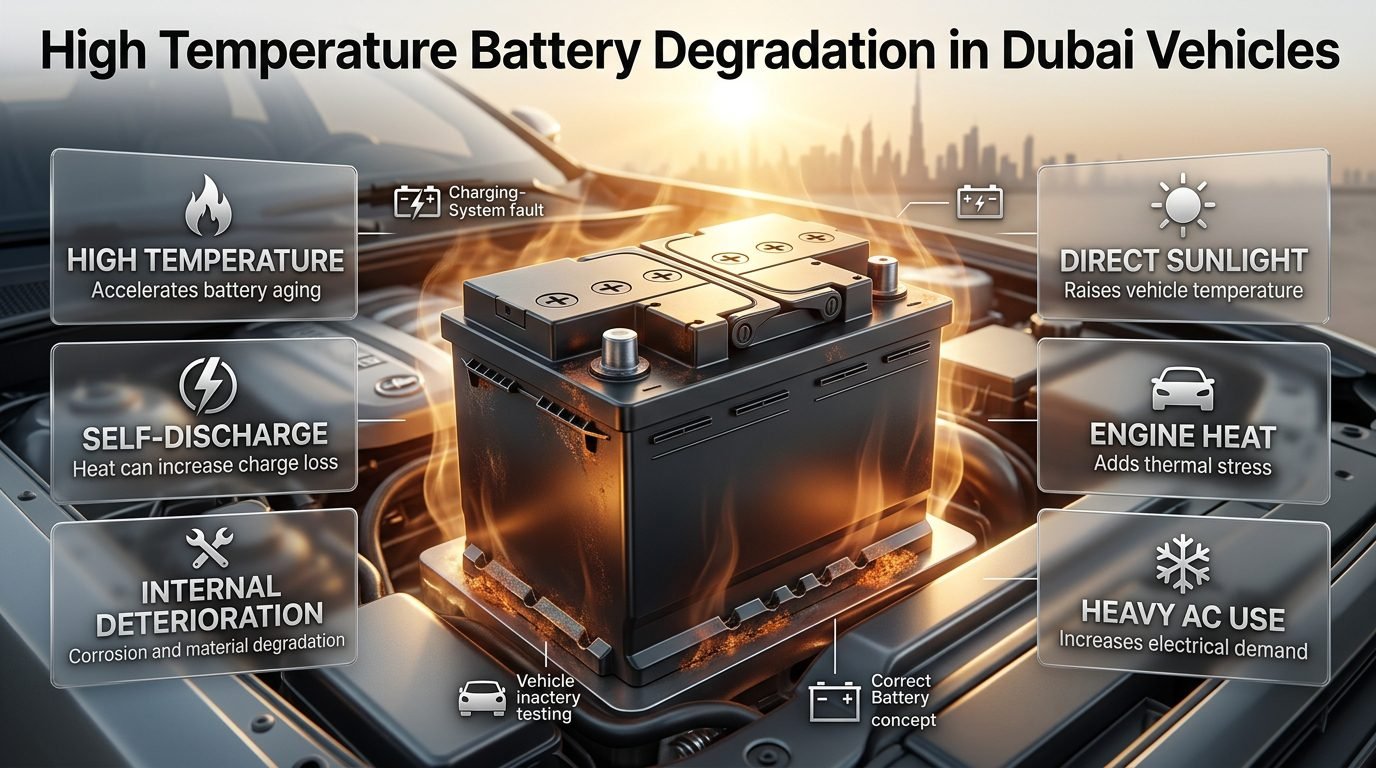
High Temperature Battery Degradation is a major reason car batteries can lose performance earlier than expected, particularly in extremely hot climates such as Dubai. Many drivers associate battery problems with cold weather, but prolonged heat can be equally important because high temperatures accelerate chemical reactions inside the battery and can contribute to corrosion, electrolyte loss, self-discharge, and gradual loss of starting capacity.
Dubai vehicles are exposed to several sources of thermal stress at the same time. High outdoor temperatures, direct sunlight, hot parking areas, engine-compartment heat, traffic congestion, and heavy air-conditioning use can all contribute to demanding operating conditions. A battery may continue starting the vehicle normally while internal deterioration is already progressing.
Drivers looking for professional automotive support can explore EuroSwift Auto Services for vehicle maintenance and battery-related assistance in Dubai.
Understanding how heat affects a battery is important because premature battery failure is not always caused by the battery alone. Charging-system faults, electrical drains, poor connections, incorrect battery specifications, and long periods of inactivity can all contribute to the problem. Professional testing can help determine whether the battery actually needs replacement or whether another part of the vehicle is responsible.
1. What Is High Temperature Battery Degradation?
High temperature battery degradation is the gradual deterioration of battery performance caused or accelerated by prolonged exposure to elevated temperatures.
An automotive battery depends on electrochemical reactions to store and release electrical energy. Temperature influences these reactions. When temperatures rise significantly, chemical activity inside a battery also increases. Although this may sound beneficial, excessive heat can accelerate undesirable reactions and physical deterioration.
Over time, this can reduce the battery’s ability to:
- Store electrical energy effectively
- Maintain charge
- Deliver high starting current
- Support vehicle electronics
- Recover efficiently after engine starting
- Maintain reliable performance under heavy electrical demand
The important point is that heat-related battery deterioration is usually progressive. The battery does not necessarily fail immediately after experiencing a hot day.
Instead, repeated exposure can gradually reduce its remaining reserve.
A vehicle may still start normally in the morning, but the driver may notice slower cranking several months later. Eventually, the battery may no longer provide enough starting power when the vehicle is parked for an extended period or exposed to another demanding condition.
This makes heat management and preventive inspection particularly valuable in Dubai.
2. Why Dubai’s Climate Creates Greater Battery Stress
Dubai presents a challenging environment for automotive batteries because high ambient temperatures are combined with intense sunlight and elevated vehicle temperatures.
The temperature surrounding the vehicle is only part of the issue. A battery installed near the engine can experience considerably higher temperatures than the surrounding outdoor environment.
Several factors contribute to this situation.
Direct Sunlight
A vehicle parked under direct sunlight can become extremely hot. The temperature inside the vehicle and around components can rise significantly during extended parking.
Engine-Compartment Heat
After driving, heat remains around the engine compartment even after the vehicle has been switched off.
The battery may therefore remain exposed to elevated temperatures after every journey.
Traffic Congestion
Slow-moving traffic reduces airflow through the engine compartment compared with normal highway driving.
This can contribute to higher under-bonnet temperatures.
Heavy Air-Conditioning Use
Dubai drivers frequently rely on air conditioning for long periods. While the alternator normally supplies the electrical demand when the engine is running, a weak battery or charging-system problem can make the vehicle more vulnerable.
Frequent Short Journeys
Short trips can also create an unfavorable operating pattern because the battery has less opportunity to recover the electrical energy used during starting.
The combination of these factors makes battery condition particularly important for vehicles operating throughout Dubai’s hotter months.
3. How Heat Changes the Internal Battery Environment
To understand why heat causes battery aging, it helps to look inside the battery.
Traditional lead-acid automotive batteries contain lead-based plates and an electrolyte solution. Electrical energy is produced through controlled chemical reactions between these components.
Temperature affects the speed of these reactions.
At higher temperatures, chemical reactions generally occur more rapidly. Unfortunately, this also means some unwanted processes can accelerate.
Internal Corrosion
Heat can increase the rate at which internal battery components deteriorate.
Corrosion can gradually reduce the effectiveness of the battery’s internal structure and eventually affect its ability to deliver current.
Electrolyte Evaporation
In conventional flooded batteries, high temperatures can contribute to water loss from the electrolyte.
Changes in electrolyte concentration can affect battery operation and accelerate deterioration.
Modern maintenance-free batteries reduce the need for routine fluid maintenance, but they are not immune to heat-related aging.
Active Material Deterioration
Battery plates contain active material that participates in the chemical reaction responsible for producing electrical energy.
Over time, this material can deteriorate.
Heat can accelerate processes that reduce effective battery capacity.
Increased Self-Discharge
Temperature also influences self-discharge.
A battery sitting unused in a hot environment can lose charge faster than one stored under cooler conditions.
This becomes particularly important for Dubai vehicles that remain parked for several days or weeks.
4. Heat Damage Is Different From Normal Battery Aging
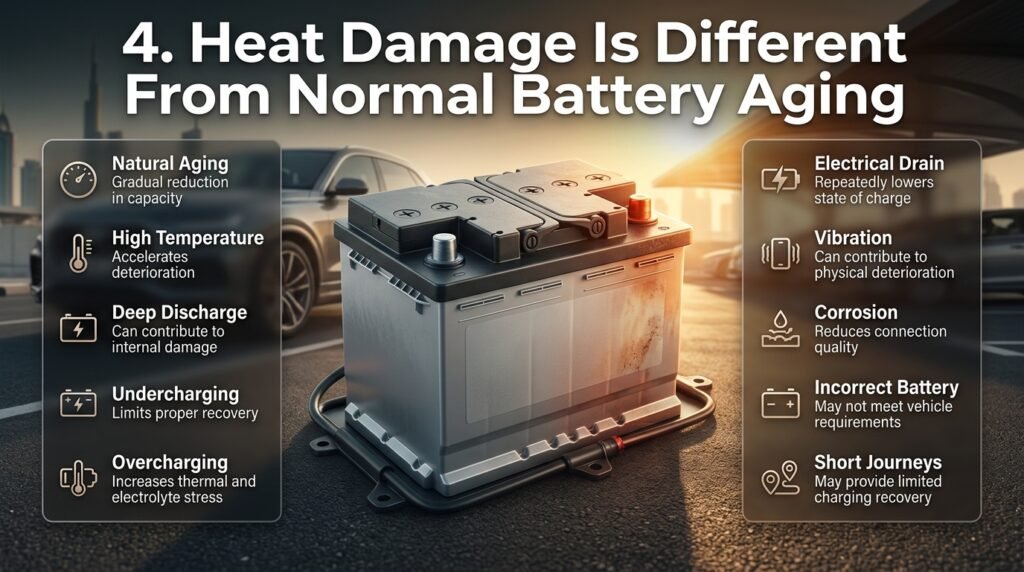
Every automotive battery eventually ages.
However, normal aging and heat-accelerated degradation are not exactly the same thing.
A battery gradually loses performance as it completes charging and discharging cycles, experiences vibration, and undergoes normal chemical changes.
High temperatures can accelerate several of these processes.
| Factor | Effect on battery |
|---|---|
| Natural aging | Gradual reduction in capacity |
| High temperature | Accelerates chemical and physical deterioration |
| Deep discharge | Can contribute to internal damage |
| Undercharging | Prevents proper recovery after use |
| Overcharging | Can increase thermal and electrolyte stress |
| Electrical drain | Repeatedly lowers state of charge |
| Vibration | Can contribute to physical deterioration |
| Corrosion | Reduces electrical connection quality |
| Incorrect battery | May not meet vehicle requirements |
| Short journeys | May provide limited charging recovery |
This is why a professional inspection should not focus on battery age alone.
Two batteries of the same age can have very different conditions depending on how the vehicles were used.
A vehicle parked outdoors every day in extreme heat may place greater thermal stress on its battery than a similar vehicle kept in shaded or covered parking and driven regularly on longer journeys.
5. Why Battery Failure Can Appear Suddenly
One of the most confusing battery problems is sudden failure.
Drivers often say:
“The battery was working perfectly yesterday.”
In reality, the battery may have been deteriorating for months.
A battery can retain enough capacity to start the engine under normal conditions while its reserve capacity is gradually decreasing.
Eventually, a small additional stress can push it beyond its reliable operating limit.
That stress could be:
- Several days of parking
- A particularly hot day
- Repeated short trips
- Heavy electrical demand
- A weak charging system
- A forgotten accessory
- Natural aging
- A long period without proper charging
This is why professional Battery Replacement should ideally be based on testing and symptoms rather than waiting for complete failure.
6. Common Signs of Heat-Related Battery Degradation
Heat-related battery deterioration can produce several warning signs.
Drivers should pay attention when vehicle starting behavior changes.
Slower Engine Cranking
A starter motor that sounds noticeably slower than usual can indicate reduced battery starting capability.
Clicking During Starting
Repeated clicking may occur when the battery cannot provide sufficient current to operate the starter properly.
However, this symptom can also be associated with connection or starter problems.
Repeated Battery Discharge
If the vehicle repeatedly needs charging or jumpstarting, the underlying cause should be investigated.
Electrical Irregularities
A weak battery can sometimes be associated with unusual electrical behavior, particularly in vehicles with sophisticated electronic systems.
Battery Warning Indicator
A battery warning light may indicate a charging-system problem rather than simply a weak battery.
Physical Damage
Swelling, leakage, severe corrosion, or other physical abnormalities require professional attention.
| Warning sign | Possible cause |
| Slow cranking | Weak battery |
| Clicking | Low battery charge or connection issue |
| Repeated discharge | Battery deterioration, drain, or charging fault |
| Warning light | Charging-system problem |
| Corrosion | Connection/environmental issue |
| Swollen casing | Serious battery or charging problem |
| Battery fails after storage | Low state of charge or deterioration |
The important principle is not to assume every symptom automatically means the battery needs replacement.
7. Why Battery Voltage Alone Is Not Enough
One of the most common mistakes during battery diagnosis is relying only on voltage.
A battery can display an apparently normal resting voltage and still have poor starting performance.
Voltage tells you something important about the battery’s electrical state, but it does not necessarily tell you how much usable starting capacity remains.
Consider two batteries with similar resting voltage.
One may still have strong internal condition and excellent starting performance.
The other may have substantial internal deterioration and perform poorly when the starter demands high current.
This is why a proper battery assessment may include:
- Resting voltage
- State of charge
- Starting capability
- Conductance testing
- Battery health
- Physical condition
- Age
- Charging-system performance
For vehicles showing inconsistent starting behavior, professional Engine Diagnostics and electrical testing can help identify whether the battery or another component is responsible.
8. The Relationship Between Heat and Battery Self-Discharge
Self-discharge is the natural loss of battery charge while a battery is not actively being used.
Temperature influences this process.
Higher temperatures can increase the rate of self-discharge, which is particularly important when a vehicle remains parked for an extended period.
For a healthy battery, a short parking period may not create a significant issue.
For an older battery with reduced reserve capacity, however, the same parking period can result in a no-start situation.
This creates a common pattern:
Older battery + high temperature + long parking period = increased risk of low battery condition
The vehicle may have been perfectly operational before being parked.
The problem becomes apparent only when the driver returns and attempts to start it.
9. How Long-Term Vehicle Storage Affects Battery Condition
Long-term storage is especially important in Dubai.
Vehicles may remain unused because their owners travel, use another vehicle, or keep a seasonal car parked for extended periods.
During storage, the battery can gradually lose charge while the vehicle continues consuming small amounts of electricity through systems such as:
- Security systems
- Alarm systems
- Remote-entry electronics
- Control modules
- Memory functions
- Vehicle monitoring systems
High temperatures can make battery self-discharge more significant.
Before Extended Storage
A vehicle owner should consider:
- Checking battery condition
- Confirming adequate charge
- Following manufacturer storage recommendations
- Reducing unnecessary electrical consumption where appropriate
- Arranging periodic vehicle checks
- Inspecting the battery before returning the vehicle to normal use
A professional inspection before a long journey can also be useful if the vehicle has remained parked for an extended period.
This can reduce the chance of needing an unexpected Car Jumpstart.
10. How Driving Habits Affect Heat-Related Battery Aging
Driving patterns can either reduce or increase the stress placed on a battery.
Short-Distance Driving
Repeated short journeys can be demanding because the starter consumes a significant amount of electrical energy during engine starting.
The alternator then needs time to restore that energy.
If journeys are consistently short, the battery may not fully recover.
Long-Distance Driving
Longer journeys generally provide more opportunity for the vehicle’s charging system to restore energy used during starting.
However, long-distance driving does not repair a deteriorated battery.
Heavy Traffic
Stop-and-go traffic creates repeated engine cycles and can reduce airflow through the engine compartment.
Frequent Starting
Repeated starts throughout the day increase the number of times the battery must deliver high current.
A strong battery can handle normal vehicle use, but an aging battery has less reserve.
11. Does Air Conditioning Damage the Battery?
Air conditioning is often blamed when a battery becomes weak during summer.
The relationship is more complicated.
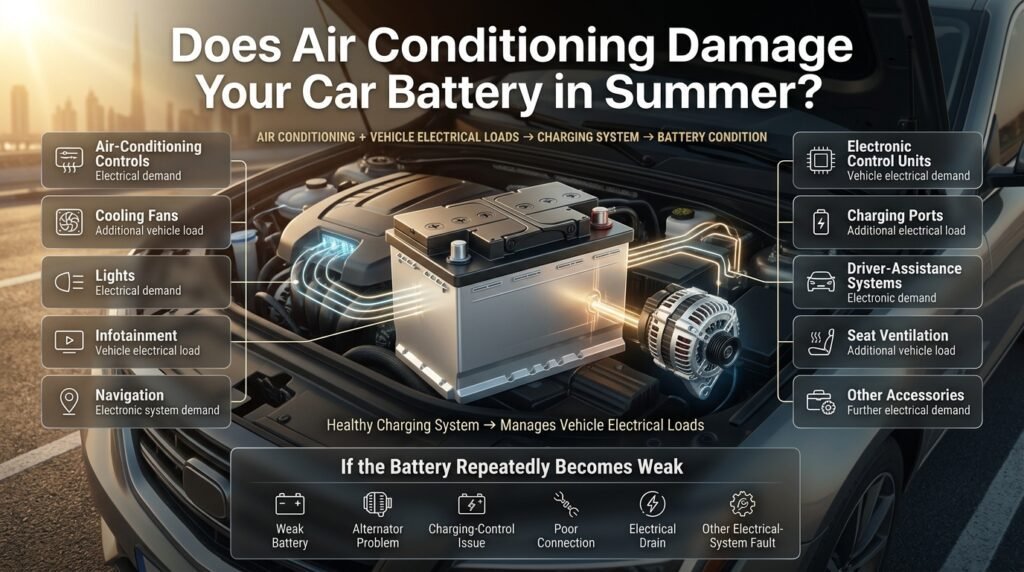
When the engine is running, the alternator normally supplies electrical power to the vehicle’s systems and helps maintain battery charge.
However, modern vehicles can have substantial electrical demand.
The vehicle may simultaneously operate:
- Air-conditioning controls
- Cooling fans
- Lights
- Infotainment
- Navigation
- Electronic control units
- Charging ports
- Driver-assistance systems
- Seat ventilation
- Other accessories
A healthy charging system should manage these loads.
If the battery repeatedly becomes weak when the AC is heavily used, the correct response is to inspect both the battery and charging system.
The problem could involve:
- Weak battery
- Alternator problem
- Charging-control issue
- Poor connection
- Electrical drain
- Another electrical-system fault
Therefore, drivers should not automatically conclude that the air conditioner itself is destroying the battery.
12. How Heat Affects the Charging System
The battery and alternator operate as part of the same electrical system.
The alternator produces electrical energy while the engine is running and supports vehicle electrical loads while helping recharge the battery.
If the charging system is not functioning correctly, the battery may remain undercharged.
Heat can then become an additional stress factor.
Possible Charging-System Problems
- Alternator output problem
- Voltage regulation issue
- Wiring problem
- Ground connection problem
- Drive-belt issue
- Charging-control fault
- Battery sensor issue
A replacement battery installed into a vehicle with an unresolved charging fault may deteriorate prematurely.
That is why professional Vehicle Inspection should consider the entire electrical system when battery failure repeats.
13. Heat Combined With Electrical Drain
A parasitic electrical drain occurs when a vehicle continues consuming more electrical energy than expected while switched off.
Small amounts of standby consumption are normal in modern vehicles.
The problem occurs when an abnormal load remains active.
Possible sources include:
- Faulty modules
- Aftermarket accessories
- Improperly installed electronics
- Interior lighting
- Alarm-system problems
- Faulty wiring
- USB or accessory equipment
- Electronic components that fail to enter sleep mode
Heat can make an already vulnerable battery less tolerant of this continuous discharge.
A strong battery may tolerate a small problem for longer.
An aging battery may become discharged much sooner.
Repeated no-start situations therefore deserve electrical diagnosis rather than repeated battery replacement.
14. Physical Signs of Severe Battery Deterioration
Some battery problems can be identified through visual inspection.
A technician may inspect the battery for:
- Cracks
- Swelling
- Leakage
- Severe corrosion
- Damaged terminals
- Loose mounting
- Damaged cables
- Signs of overheating
Battery Swelling
A swollen battery case should not be treated as a normal aging symptom.
It may indicate severe internal or charging-related problems.
The battery should be professionally assessed rather than continued in normal service.
Terminal Corrosion
Corrosion around terminals can increase electrical resistance.
This can make starting more difficult and can complicate accurate battery diagnosis.
However, terminal corrosion does not necessarily mean the battery itself is defective.
The connection and battery should be assessed together.
15. Battery Mounting Matters More Than Many Drivers Realize
Battery mounting is sometimes overlooked during routine maintenance.
The battery should be securely mounted according to the vehicle manufacturer’s requirements.
Excessive movement can expose the battery to unnecessary mechanical stress.
This becomes more important when the vehicle regularly drives over uneven surfaces.
A professional battery inspection should therefore check:
- Mounting bracket
- Battery position
- Terminal security
- Cable routing
- Physical condition
Battery replacement is not complete simply because a new battery has been installed.
Correct physical installation matters as well.
16. Choosing the Correct Battery for a Hot Climate
There is no single “best battery” for every vehicle.
The correct battery depends on the vehicle’s design and manufacturer specifications.
Important factors include:
- Battery technology
- Capacity
- Starting specification
- Physical dimensions
- Terminal position
- Electrical requirements
- Start-Stop compatibility
- Vehicle charging strategy
- Manufacturer requirements
Modern vehicles may use conventional flooded batteries, EFB batteries, or AGM batteries.
Choosing a battery solely because it has a strong brand reputation can still result in an incorrect application.
The first priority should always be compatibility.
17. AGM, EFB and Conventional Batteries
Understanding battery technology helps drivers make better replacement decisions.
Conventional Flooded Battery
Traditional lead-acid batteries remain widely used in many vehicles.
They can be suitable for applications designed around conventional battery technology.
EFB Battery
Enhanced Flooded Battery technology is designed for applications that require greater cycling performance than a standard conventional battery.
It is commonly associated with certain Start-Stop vehicle applications.
AGM Battery
Absorbent Glass Mat technology is designed for demanding electrical applications and is widely used in vehicles with advanced Start-Stop and energy-management systems.
A vehicle originally designed for AGM should not automatically be fitted with a lower-specification battery.
When replacement is required, the new battery should match the vehicle’s required specification.
For drivers researching battery choices, EuroSwift Auto Services provides dedicated information for options such as AGM Battery.
18. Battery Brand Selection for Dubai Vehicles
Brand selection can be useful when comparing available replacement batteries, but the vehicle’s specification should remain the starting point.
Different manufacturers offer batteries designed for different applications.
Depending on the vehicle, drivers may research:
- Amaron Battery
- Bosch Battery
- Tuflong Battery
- Exide Battery
- Panasonic Battery
- FIAMM Battery
- AC Delco Battery
These pages can help drivers compare brand-specific battery options, but the correct battery still depends on the particular vehicle.
19. Why Battery Management Systems Matter
Modern vehicles are increasingly dependent on electronic energy management.
A Battery Management System, or BMS, may monitor battery-related information and communicate with other vehicle systems.
Depending on the vehicle, the system may account for:
- Battery temperature
- Voltage
- Current
- State of charge
- Energy consumption
- Charging requirements
Some vehicles require battery registration or configuration after replacement.
This means installing the correct battery physically may not be enough.
The vehicle may also need to recognize the replacement battery through the appropriate diagnostic procedure.
This is particularly important for modern Start-Stop vehicles.
20. Heat and Start-Stop Battery Systems
Start-Stop technology places different demands on a vehicle battery.
Instead of starting the engine only once at the beginning of a journey, the system may restart the engine automatically during suitable driving conditions.
This increases the importance of battery cycling capability.
Heat can add another layer of stress.
Therefore, vehicles equipped with Start-Stop systems should use the battery technology specified by the manufacturer.
A professional Car Service should take Start-Stop requirements into account during battery testing and replacement.
21. Professional Battery Inspection in Dubai
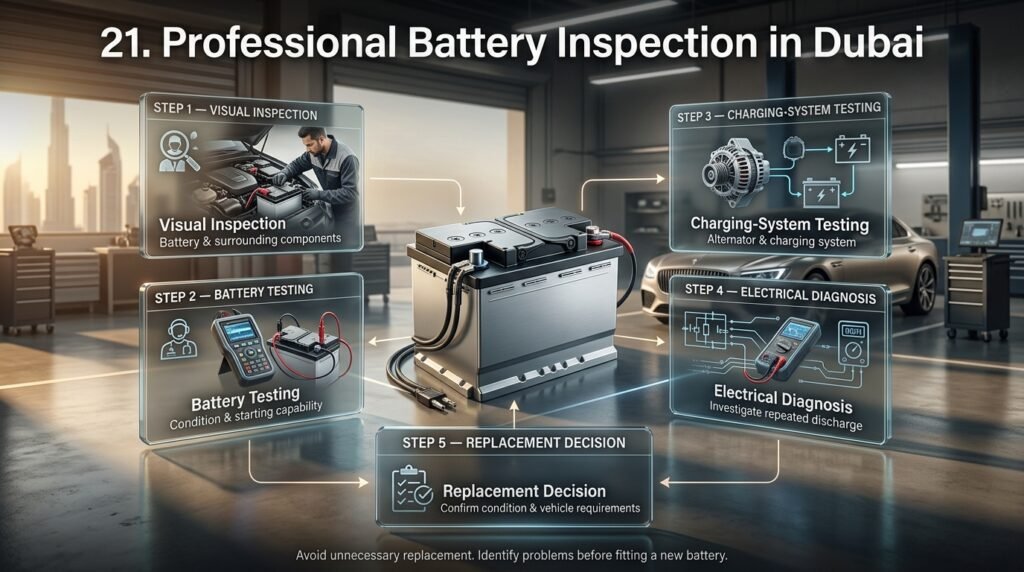
A professional battery inspection should go beyond looking at the battery casing.
Step 1: Visual Inspection
The technician checks the physical battery and surrounding components.
Step 2: Battery Testing
Appropriate equipment is used to assess battery condition and starting capability.
Step 3: Charging-System Testing
The alternator and charging system are checked when necessary.
Step 4: Electrical Diagnosis
If the battery repeatedly discharges, technicians investigate potential electrical drains and other faults.
Step 5: Replacement Decision
Only after the battery’s condition and vehicle requirements are understood should replacement be recommended.
This process helps avoid unnecessary replacement and identifies problems that could damage a new battery.
22. When Battery Replacement Is the Right Solution
Charging a battery and replacing a battery are two different solutions.
Charging May Be Appropriate When:
- The battery is healthy but discharged.
- The vehicle was accidentally left with lights on.
- The car has been parked for an extended period.
- A temporary electrical issue caused discharge.
- Battery testing confirms adequate health.
Replacement May Be Appropriate When:
- The battery has poor starting capability.
- Capacity has significantly declined.
- Internal deterioration is confirmed.
- The battery repeatedly fails.
- Physical damage is present.
- The battery cannot maintain an adequate charge.
- Testing shows it no longer meets vehicle requirements.
Repeated charging cannot reverse permanent internal deterioration.
If the battery has reached the end of its useful service life, replacement is the appropriate long-term solution.
23. Battery Replacement Should Include More Than Installation
A professional battery replacement should consider the entire installation process.
The technician should verify:
- Correct battery specification
- Correct battery dimensions
- Terminal arrangement
- Secure mounting
- Proper cable connections
- Charging-system condition
- Battery-management requirements
- Vehicle configuration requirements
This is particularly important for premium and modern vehicles.
Some vehicles may also require electronic registration after battery installation.
A proper installation reduces the risk of future electrical problems.
24. How Battery Costs Are Determined in Dubai
Battery price varies according to several factors.
| Factor | Impact on cost |
| Battery technology | AGM, EFB and conventional batteries can differ |
| Capacity | Higher-capacity applications may cost more |
| Vehicle type | Premium and advanced vehicles may require specialized specifications |
| Brand | Manufacturing and warranty differences affect price |
| Installation | Service complexity can affect labor |
| Emergency service | Mobile assistance may have additional service costs |
| BMS configuration | Diagnostic procedures may be required |
| Warranty | Coverage can affect overall value |
Drivers comparing Car Battery Prices in Dubai should consider specification, warranty, installation, and suitability rather than selecting purely by the lowest advertised price.
A cheaper battery that does not match the vehicle can become more expensive if it creates repeated problems.
25. Common Mistakes That Accelerate Battery Problems
Ignoring Slow Cranking
A noticeable change in engine cranking should not be ignored.
Replacing Without Diagnosis
A new battery will not fix a faulty alternator or electrical drain.
Choosing by Price Alone
Battery specification matters more than simply choosing the lowest price.
Ignoring Heat Exposure
Repeated extreme heat exposure can accelerate battery deterioration.
Leaving a Weak Battery in Service
A battery with significantly reduced capacity may fail without much warning.
Repeatedly Jumpstarting
Jumpstarting restores temporary mobility but does not necessarily solve the underlying problem.
Ignoring Battery Registration
Some modern vehicles require electronic configuration after battery replacement.
Neglecting Terminals
Poor connections can imitate battery failure and reduce starting performance.
26. How to Prevent Premature Battery Aging in Dubai
Complete prevention of heat-related degradation is not realistic, but good maintenance can reduce unnecessary stress.
Practical Recommendations
- ✔ Test battery health periodically.
- ✔ Pay attention to changes in starting performance.
- ✔ Keep battery connections secure.
- ✔ Inspect terminals for corrosion.
- ✔ Check the charging system when battery discharge repeats.
- ✔ Use the battery technology specified for the vehicle.
- ✔ Keep the battery properly mounted.
- ✔ Consider covered or shaded parking where practical.
- ✔ Check battery condition before long journeys.
- ✔ Inspect older batteries before extended vehicle storage.
- ✔ Investigate repeated jumpstart requirements.
- ✔ Follow manufacturer recommendations for battery replacement.
- ✔ Complete required BMS procedures on compatible vehicles.
Preventive maintenance is generally easier and less disruptive than dealing with an unexpected battery failure.
27. What to Do If the Battery Fails During a Dubai Commute
A sudden no-start situation can happen even when the vehicle appeared normal earlier.
First, avoid assuming that the battery is automatically the only problem.
The issue may involve:
- Battery discharge
- Battery deterioration
- Alternator failure
- Starter problem
- Electrical drain
- Loose terminal
- Wiring fault
If appropriate, professional Car Jumpstart assistance can provide temporary mobility.
However, a jumpstart should not be treated as the final diagnosis.
If the same situation happens repeatedly, the vehicle should be professionally inspected.
This is where Roadside Assistance can be useful for getting the vehicle to a suitable diagnostic or repair location.
28. Heat-Related Battery Troubleshooting Guide
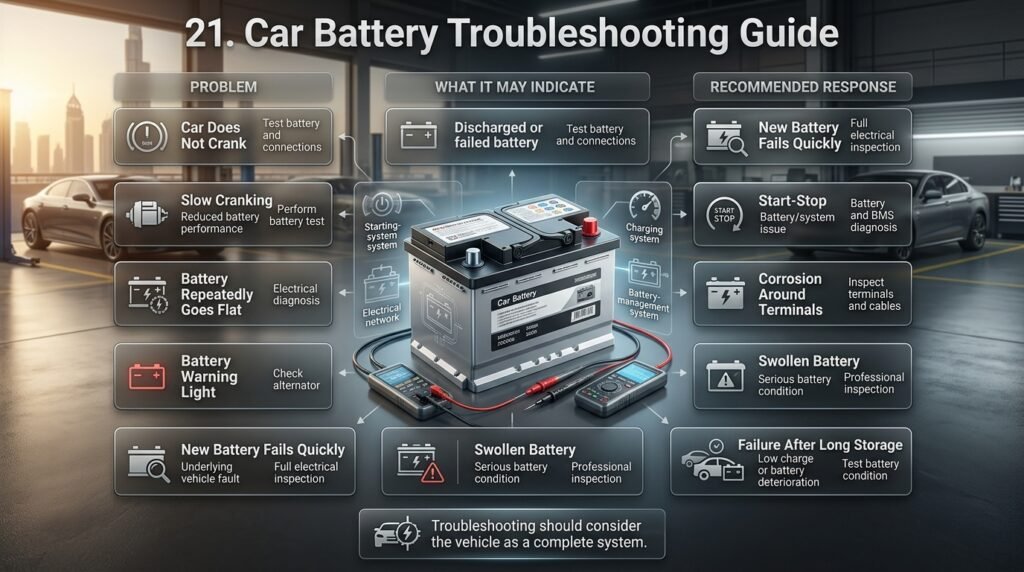
| Problem | What it may indicate | Recommended response |
| Car does not crank | Discharged or failed battery | Test battery and connections |
| Slow cranking | Reduced battery performance | Perform battery test |
| Battery repeatedly goes flat | Drain or charging problem | Electrical diagnosis |
| Battery warning light | Charging-system issue | Check alternator |
| New battery fails quickly | Underlying vehicle fault | Full electrical inspection |
| Start-Stop unavailable | Battery/system issue | Battery and BMS diagnosis |
| Corrosion around terminals | Connection problem | Inspect terminals and cables |
| Swollen battery | Serious battery condition | Professional inspection |
| Failure after long storage | Low charge or battery deterioration | Test battery condition |
Troubleshooting should always consider the vehicle as a complete system.
29. The Importance of Preventive Vehicle Maintenance
Battery health should not be considered separately from general vehicle condition.
A vehicle that receives regular Vehicle Maintenance is more likely to have charging, electrical, engine, and mechanical problems identified before they create secondary issues.
Battery-related maintenance can be integrated with:
- Engine diagnostics
- Oil change
- Brake inspection
- AC servicing
- Tire maintenance
- Wheel alignment
- Suspension inspection
- Vehicle inspection
- Electrical diagnosis
- General mechanical repair
For example, a professional service visit may identify a charging-system issue before it causes complete battery failure.
Similarly, a battery test can identify deterioration before a driver becomes stranded.
30. Why Professional Diagnosis Is Better Than Guesswork
Battery problems can produce symptoms that overlap with other mechanical and electrical faults.
A slow start might be caused by:
- Weak battery
- Poor terminal connection
- Starter problem
- Wiring resistance
- Charging-system issue
Repeated battery discharge might be caused by:
- Battery deterioration
- Parasitic drain
- Alternator fault
- Incorrect charging
- Long periods of inactivity
Professional diagnosis separates these possibilities.
This is particularly valuable when a vehicle has already received a replacement battery but continues experiencing problems.
31. Heat and Luxury Vehicle Batteries
Luxury vehicles often contain extensive electronic equipment.
Depending on the model, the vehicle may have:
- Advanced infotainment
- Multiple control modules
- Electric seats
- Driver-assistance systems
- High-powered audio systems
- Comfort electronics
- Start-Stop technology
- Advanced energy management
This does not mean luxury vehicles automatically suffer more battery failures.
However, battery specification and electronic configuration can be more important.
A Luxury Car Service approach should therefore consider manufacturer-specific battery requirements and diagnostic procedures.
32. Battery Degradation and Long-Distance Travel
A battery that is showing early warning signs should be checked before a long trip.
Long-distance travel can expose a weak battery to additional starting cycles at fuel stations, rest stops, and destinations.
The most important time to discover a weak battery is during a controlled inspection—not after the vehicle has stopped unexpectedly.
Before cross-emirate travel, consider:
- Battery condition
- Charging-system performance
- Tire condition
- Engine oil
- Coolant
- Brake condition
- AC performance
- General vehicle inspection
Battery testing can be a relatively simple part of broader travel preparation.
33. High Temperature Battery Degradation and Future Automotive Technology
Automotive battery technology is continuing to evolve.
Modern vehicles increasingly use electronic monitoring and advanced charging systems.
Future developments are likely to improve:
- Battery-health monitoring
- Charging efficiency
- Thermal management
- Predictive maintenance
- Electronic diagnostics
- Energy management
- Battery-life estimation
As vehicles become more electronically integrated, technicians will increasingly rely on diagnostic information rather than visual inspection alone.
This trend is particularly important for hot-climate markets.
The ability to identify declining battery health before complete failure can improve reliability and reduce unexpected roadside incidents.
34. Professional Battery Maintenance Strategy for Dubai
A practical maintenance strategy can be divided into three stages.
Stage 1: Monitor
Pay attention to:
- Starting behavior
- Battery warning indicators
- Repeated discharge
- Electrical irregularities
Stage 2: Test
When symptoms appear or battery condition becomes uncertain:
- Test battery health
- Check starting capability
- Inspect terminals
- Check charging-system performance
Stage 3: Correct
If the battery is healthy, correct the underlying issue.
If the battery is weak, replace it with the correct specification.
If the charging system is faulty, repair it before relying on a new battery.
This approach avoids unnecessary parts replacement and improves long-term reliability.
How does high temperature cause car battery degradation?
High temperature does more than simply make a battery “hot.” It accelerates the chemical processes taking place inside the battery and can speed up internal aging. In conventional lead-acid batteries, prolonged heat can contribute to grid corrosion, electrolyte loss, increased self-discharge, and deterioration of the materials responsible for storing and delivering electrical energy. VARTA explains that higher temperatures accelerate battery aging and self-discharge, while research also identifies battery temperature as a major factor affecting automotive battery service life.
The important point for drivers is that heat damage usually builds up gradually. A battery can continue starting the vehicle normally while its reserve capacity is declining. After repeated exposure to high temperatures, the battery may have considerably less ability to handle demanding starts, long parking periods, or heavy electrical loads.
Key points:
High temperature accelerates battery aging.
Internal corrosion can progress faster.
Self-discharge can increase.
Electrolyte loss can become a concern in applicable battery designs.
Starting capacity can gradually decline.
A battery may appear normal before its weakness becomes obvious.
This is why a battery should be judged by its condition and performance, not simply by whether the engine still starts every morning.
Why does Dubai heat shorten car battery life?
Dubai creates a particularly demanding environment for automotive batteries because the battery can experience much more than the temperature shown by the weather forecast. Direct sunlight, hot parking areas, high under-bonnet temperatures, traffic congestion, and repeated use of the vehicle in extreme summer conditions all contribute to thermal stress.
VARTA notes that high temperatures increase self-discharge and accelerate aging, while AAA also identifies high temperatures as a major threat to battery longevity.
The situation becomes more noticeable when an older battery is already approaching the end of its useful life. Heat may not be the only cause of failure, but it can push an already weakened battery closer to the point where it can no longer deliver reliable starting power.
Dubai-specific factors include:
Parking for several hours in direct sunlight
High temperatures around the engine compartment
Heavy AC use during daily driving
Stop-and-go traffic
Frequent short journeys
Long periods of vehicle inactivity
Older batteries with reduced reserve capacity
Existing charging-system or electrical problems
For this reason, Dubai drivers should treat battery inspection as part of normal Vehicle Maintenance, particularly when the battery has already shown signs of weakness.
What are the warning signs of high temperature battery degradation?
Heat-damaged or heavily aged batteries do not always fail without warning. In many cases, the first indication is a small change in starting performance that drivers overlook because the vehicle still starts.
The most useful warning sign is often slower or weaker engine cranking compared with the vehicle’s normal behavior. Other symptoms can include repeated low-battery conditions, difficulty starting after the vehicle has been parked, unusual electrical behavior, or a battery that repeatedly needs external charging.
However, these symptoms are not exclusive to the battery. A faulty alternator, poor connection, starter problem, or parasitic electrical drain can produce similar complaints. That is why professional diagnosis matters. Recent automotive guidance also emphasizes that summer heat can weaken a battery before the failure becomes obvious.
Watch for these signs:
Slower engine cranking than usual
Clicking or weak starting attempts
Repeated battery discharge
Needing jumpstart assistance more than once
Battery warning light
Corrosion around terminals
Physical swelling or damage
Starting problems after extended parking
Electrical problems appearing alongside starting issues
One important distinction is that a normal-looking battery is not necessarily a healthy battery. A proper battery-health test can provide information that a basic visual inspection or simple voltage reading may not reveal.
How can I prevent high temperature battery degradation in Dubai?
You cannot remove Dubai’s heat from the equation, but you can reduce unnecessary battery stress and identify deterioration before it becomes a roadside problem. The best strategy is preventive inspection combined with sensible vehicle use, rather than waiting for the battery to stop working.
Covered or shaded parking can reduce unnecessary exposure to direct sunlight. More importantly, drivers should monitor starting behavior and arrange a professional battery test when the vehicle begins showing symptoms. AAA recommends practical heat-protection measures and emphasizes that high temperatures can significantly affect battery longevity.
It is also important to look beyond the battery itself. If a vehicle repeatedly loses charge, the charging system and electrical system should be checked. Otherwise, installing a new battery may only provide a temporary solution.
Useful prevention measures:
Park in covered or shaded areas when practical.
Monitor changes in engine cranking.
Keep battery terminals and connections in good condition.
Test an older battery before long journeys.
Check the charging system if discharge keeps occurring.
Investigate repeated jumpstart requirements.
Use the correct battery specification for the vehicle.
Follow manufacturer requirements for AGM, EFB, or other battery technologies.
Have the battery inspected after extended vehicle storage.
Address electrical faults instead of repeatedly replacing batteries.
The goal is not to make the battery immune to heat. The goal is to manage the factors you can control and catch declining battery performance early.
Should I replace my car battery after heat damage, or can it be recharged?
This depends on the battery’s actual condition. A battery that has simply become discharged is not necessarily a failed battery. For example, a vehicle that has been parked for an extended period or has experienced an electrical drain may need charging and further testing rather than immediate replacement.
On the other hand, charging cannot reverse permanent internal deterioration. If testing shows that the battery has lost significant starting capability or capacity, replacement may be the more appropriate solution.
This distinction is particularly important after a Dubai summer because a battery may still start the vehicle while already having substantially reduced reserve capacity. Current battery guidance recommends testing rather than making a replacement decision based only on age or appearance.
A professional assessment should consider:
Battery state of charge
Battery health
Starting performance
Physical condition
Terminal connections
Charging-system performance
Possible electrical drain
Battery age and usage history
Correct battery specification
If the battery passes testing but is discharged, the underlying reason for the discharge should still be identified.
If it fails testing, Battery Replacement is normally the more reliable long-term solution.
The key is to avoid treating every dead battery as the same problem. Recharge when the battery is serviceable; replace when testing confirms that the battery has reached the end of its useful life; and diagnose the vehicle when another electrical fault is responsible.
Conclusion
High Temperature Battery Degradation is a serious consideration for vehicles operating in Dubai because prolonged heat can accelerate internal battery aging, increase self-discharge, and gradually reduce starting performance. The effects are not always visible immediately. A battery may continue to start the vehicle normally while its internal reserve and overall reliability are steadily declining.
For Dubai drivers, the best approach is to focus on prevention and proper diagnosis rather than waiting for complete battery failure. Regular battery testing, secure connections, charging-system checks, appropriate parking practices, and timely maintenance can help identify problems before they become an unexpected roadside breakdown.
When a battery begins showing slow cranking, repeated discharge, or other warning signs, replacing it immediately is not always the correct answer. The battery, alternator, electrical connections, and possible parasitic drains should be evaluated to determine the actual cause.
A properly selected and professionally installed battery can provide dependable starting performance, but it must also match the vehicle’s electrical requirements. For modern vehicles, AGM or EFB technology, Start-Stop systems, and battery-management requirements may also need to be considered.
Ultimately, managing battery health in Dubai is about understanding how heat, vehicle usage, battery condition, and the charging system work together. With professional Battery Replacement, Vehicle Inspection, Car Service, Engine Diagnostics, and preventive Vehicle Maintenance, drivers can reduce avoidable battery failures and maintain greater confidence in their vehicles throughout the demanding summer months.

Leave a Reply