
Introduction
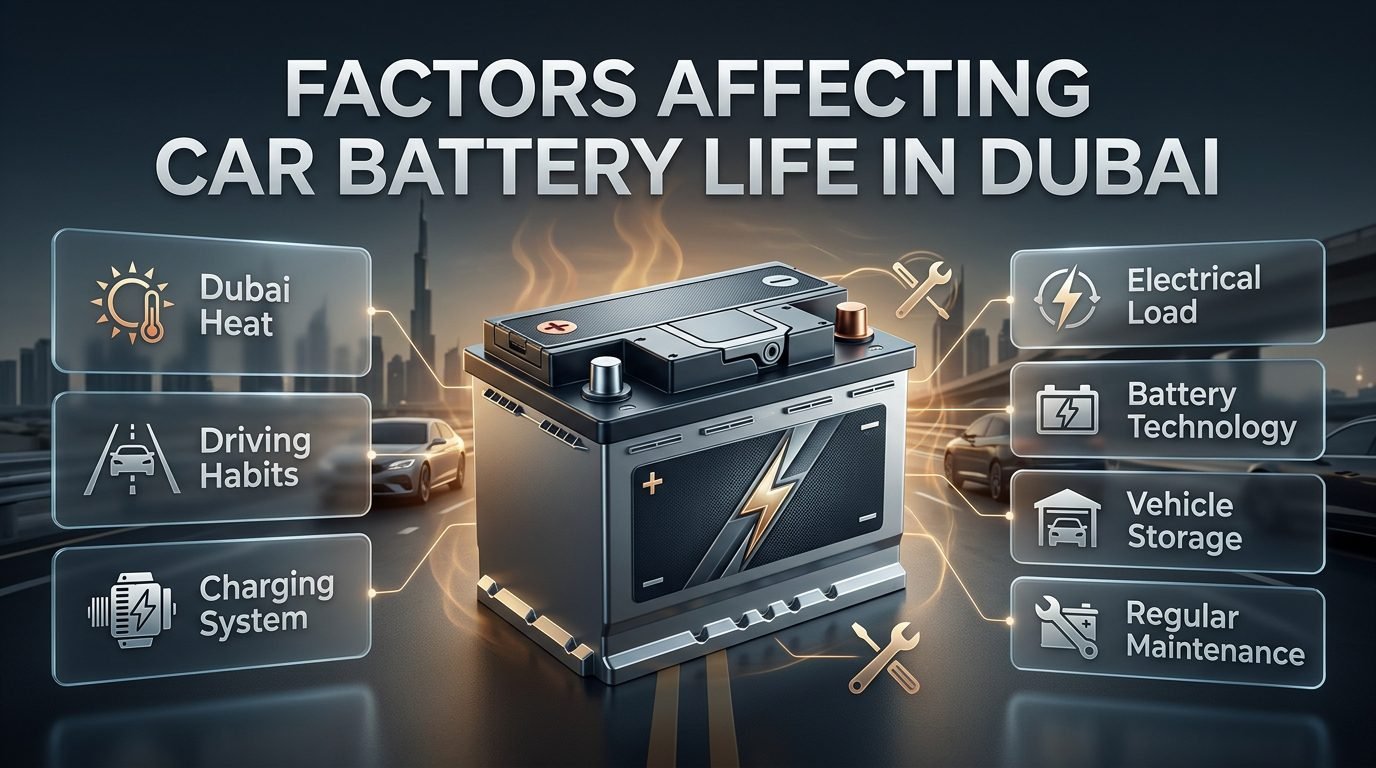
Factors Affecting Car Battery Life in Dubai | A car battery is a critical part of every modern vehicle. It provides the electrical power required to start the engine and supports numerous electronic systems before the alternator takes over once the engine is running. Yet battery life is not controlled by age alone. Temperature, driving habits, charging-system performance, electrical demand, battery technology, vehicle storage, installation quality, and maintenance can all influence how long a battery remains dependable.
Understanding the factors affecting car battery life is particularly important in Dubai. High ambient temperatures, intense under-bonnet heat, heavy traffic, frequent air-conditioning use, and short urban journeys can create demanding operating conditions for a vehicle’s electrical system.
For drivers who need professional automotive support, EuroSwift Auto Services provides automotive maintenance and battery-related services in Dubai. A proper battery inspection can determine whether a vehicle genuinely needs a replacement or whether the underlying problem is actually related to the alternator, starter, electrical connections, or parasitic drain.
A healthy battery is not simply about choosing a good brand. It is about selecting the correct specification, maintaining the complete charging system, recognizing warning signs, and addressing problems before they develop into an unexpected breakdown.
What Determines Car Battery Life?
There is no single factor that determines how long a car battery will last. Battery lifespan is the result of several conditions working together.
For example, two vehicles may use batteries with similar specifications but experience completely different battery life. One vehicle might be driven regularly on longer journeys with a healthy charging system, while the other could be exposed to extreme heat, frequent short trips, long periods of storage, and repeated electrical discharge.
The most important factors include:
- Ambient and under-bonnet temperature
- Battery age
- Driving frequency
- Journey length
- Number of engine starts
- Charging-system condition
- Alternator performance
- Electrical load
- Parasitic drain
- Battery technology
- Battery quality
- Correct battery specification
- Terminal condition
- Cable condition
- Battery mounting
- Vehicle storage
- Start-stop technology
- Vehicle electrical complexity
- Maintenance history
- Installation quality
This is why professional battery diagnosis should consider the complete vehicle rather than focusing only on the battery itself.
Why Car Battery Life Matters
A weak battery can affect much more than the ability to start the engine.
Modern vehicles depend on stable electrical power for numerous systems, including engine management, security systems, infotainment, lighting, sensors, electronic control modules, driver-assistance features, and comfort systems.
When battery voltage becomes unstable, some vehicles may display warning messages or behave differently from normal. In certain cases, a weak battery can create confusing electrical symptoms that initially appear unrelated to the battery.
For everyday drivers, battery reliability is especially important because battery failure often occurs when the vehicle is needed most—before work, during a commute, at a shopping centre, or before a long journey.
Preventive battery testing is therefore an important part of overall Vehicle Maintenance.
1. Dubai Heat Is One of the Biggest Battery-Life Factors
Temperature is one of the most important environmental influences on automotive battery performance.
Dubai’s climate creates prolonged periods of high ambient temperatures, and the temperature surrounding the battery can become even higher when the battery is installed inside or close to the engine compartment.
Heat can accelerate chemical reactions inside conventional lead-acid batteries. Over time, prolonged thermal exposure can contribute to internal degradation and reduced battery capacity.
This does not mean that every battery will fail after a particular number of months or years. Actual lifespan depends on battery technology, vehicle design, driving habits, charging performance, installation location, and maintenance.
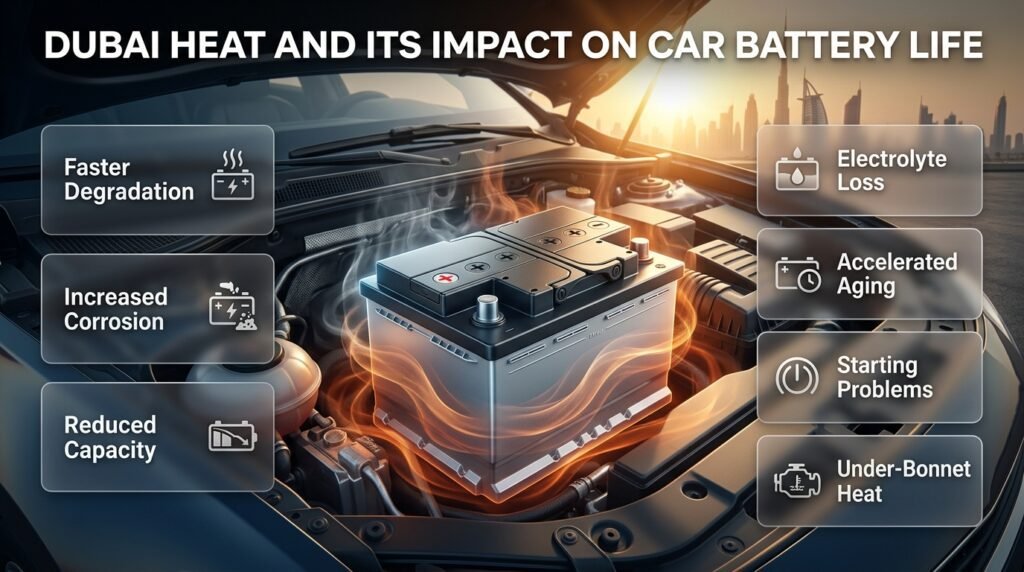
How Excessive Heat Can Affect a Battery
High temperatures may contribute to:
- Faster internal degradation
- Increased corrosion
- Electrolyte loss in applicable battery designs
- Reduced reserve capacity
- Accelerated aging
- Increased risk of unexpected starting problems
- Greater stress on an already weakened battery
The important point is that heat can gradually reduce battery reliability without producing an obvious warning.
A vehicle may start normally for months and then suddenly struggle during an especially demanding period.
Why Under-Bonnet Temperature Matters
The temperature experienced by a battery is not always the same as the outdoor temperature.
A battery positioned near the engine or other heat-producing components can experience significant thermal exposure after the vehicle has been operating. Repeated heat cycles can gradually affect battery condition.
For Dubai drivers, this makes periodic battery testing more useful than relying only on visual inspection.
2. Driving Habits Have a Direct Influence on Battery Condition
The way a vehicle is driven can influence battery charging and discharge patterns.
Every time the engine is started, the battery provides electrical energy to the starter motor and related systems. Once the engine is running, the alternator supplies electrical power and replenishes the energy used during starting.
If the vehicle is repeatedly started and driven only for very short periods, the charging system may have less opportunity to restore the energy consumed during those starts.
This does not mean short trips automatically damage a battery. The effect depends on the number of starts, journey duration, electrical load, battery condition, and charging-system performance.
Short Trips and Battery Charging
Consider a vehicle that is started several times every day but only driven for a few minutes each time.
The battery may repeatedly provide starting energy without receiving enough opportunity to recover from those cycles.
Over time, this can contribute to a progressively lower state of charge, particularly if the battery is already aging.
Longer Journeys
Longer drives generally give the vehicle’s charging system more time to replenish energy, assuming the alternator and charging system are functioning correctly.
However, a longer drive should not be treated as a guaranteed method of fixing a weak battery. If the battery is damaged, severely degraded, or the charging system has a fault, driving alone will not solve the underlying problem.
3. Battery Age Naturally Affects Performance
Automotive batteries gradually lose capacity as they undergo charging and discharging cycles.
As a battery ages, its ability to deliver the current required for engine starting can decline. This may become more noticeable under demanding conditions.
Battery age is therefore an important factor, but it should not be used as the only reason for replacement.
An older battery that still passes appropriate testing may continue to perform adequately, while a relatively new battery may become unreliable because of:
- Excessive heat
- Deep discharge
- Charging-system faults
- Parasitic drain
- Incorrect specification
- Physical damage
- Poor connections
Professional testing provides a better indication of battery condition than age alone.
4. Battery Quality and Construction Matter
Battery quality can influence reliability and service life.
Manufacturing quality, internal construction, materials, design, warranty support, and suitability for the vehicle can all make a difference.
However, the most expensive battery is not automatically the best battery for every vehicle.
A premium battery that does not match the vehicle’s requirements may perform worse than a correctly specified battery designed for that application.
The selection process should therefore consider:
- Battery technology
- Capacity
- Cold-cranking performance
- Physical dimensions
- Terminal arrangement
- Vehicle electrical requirements
- Start-stop compatibility
- Manufacturer specifications
- Operating climate
This is why professional Battery Replacement should begin with vehicle identification and battery specification rather than simply selecting a product based on price.
5. Correct Battery Specification Is Essential
One of the most overlooked factors affecting battery life is using the wrong battery specification.
Modern vehicles may require different battery technologies depending on their electrical architecture.
Common automotive battery categories include conventional flooded lead-acid designs, EFB batteries, and AGM batteries.
Conventional Lead-Acid Batteries
These remain widely used in vehicles designed for conventional battery applications.
Their suitability depends on the vehicle manufacturer’s requirements.
EFB Batteries
Enhanced Flooded Batteries are designed to tolerate greater cycling demands than many conventional batteries and are commonly used in certain vehicles equipped with start-stop technology.
AGM Batteries
Absorbent Glass Mat batteries are designed for vehicles with higher electrical demands and specific charging requirements.
They are frequently found in vehicles with advanced start-stop systems and extensive electrical equipment.
The correct replacement must follow the vehicle manufacturer’s requirements rather than assumptions based on battery appearance.
6. Alternator Performance Directly Affects Battery Health
The battery and alternator work together.
The battery provides electrical energy during engine starting, while the alternator generates electrical power once the engine is running.
If the alternator does not provide appropriate charging support, the battery may gradually become undercharged.
This can create a situation where the driver repeatedly replaces batteries even though the actual problem is the charging system.
Possible Charging-System Warning Signs
- Battery repeatedly becomes discharged
- Battery warning light appears
- Electrical systems behave abnormally
- New battery loses charge unexpectedly
- Vehicle needs repeated jump-starting
- Starting performance deteriorates shortly after battery replacement
A professional Engine Diagnostics assessment can help determine whether the problem originates from the battery, alternator, wiring, voltage regulation, or another component.
7. Electrical Load Can Affect Battery Demands
Modern vehicles have significantly more electrical equipment than older cars.
Depending on the vehicle, electrical systems may include:
- Digital instrument displays
- Infotainment systems
- Cameras
- Parking sensors
- Driver-assistance systems
- Seat ventilation
- Seat heating
- Electric windows
- Electric tailgates
- Security systems
- Navigation
- USB charging
- Interior lighting
- Climate-control electronics
Most of these systems are supported by the alternator while the engine is running. Nevertheless, the battery remains an important part of the vehicle’s electrical architecture.
Vehicles with substantial electrical equipment therefore require an appropriately specified battery and healthy charging system.
8. Air Conditioning and Dubai Driving Conditions
Air conditioning is essential for comfortable driving in Dubai, particularly during the hottest months.
It is sometimes assumed that using the AC directly “drains” the battery. That is an oversimplification.
The vehicle’s AC system places additional mechanical and electrical demands on the vehicle, while components such as blower motors, cooling fans, climate-control electronics, sensors, and control modules contribute to the overall electrical workload.
When combined with high ambient temperatures and slow traffic, the vehicle’s systems can operate under demanding conditions.
If a battery repeatedly becomes weak when the AC is being used, the correct response is not simply to stop using the AC. The battery, alternator, electrical system, and relevant components should be professionally inspected.
9. Stop-and-Go Traffic Can Increase Electrical Demands
Dubai’s busy roads can expose vehicles to frequent stopping, slow movement, and extended periods of idling.
During congested traffic, several systems may operate continuously:
- Air conditioning
- Cooling fans
- Headlights
- Infotainment
- Cabin blower
- Sensors
- Driver-assistance systems
In vehicles equipped with start-stop technology, repeated engine restarts may also increase cycling demands on the battery.
Traffic does not automatically cause premature battery failure. However, when combined with high temperatures, short journeys, heavy electrical loads, and an aging battery, it can contribute to more demanding operating conditions.
10. Parasitic Drain Can Discharge a Healthy Battery
A parasitic drain occurs when a vehicle continues consuming an abnormal amount of electrical power after it has been switched off and should have entered its normal sleep state.
Some standby electrical consumption is normal. Modern vehicles need a small amount of power for security systems, memory functions, control modules, and other systems.
The problem occurs when electrical consumption remains unusually high.
Potential Causes of Excessive Electrical Drain
- Faulty control modules
- Aftermarket accessories
- Incorrectly installed electronics
- Dash cameras
- Tracking systems
- Security equipment
- Interior lights
- Faulty switches
- Infotainment problems
- Wiring faults
A vehicle that repeatedly requires a Car Jumpstart after being parked should be diagnosed rather than repeatedly jump-started.
11. Long-Term Storage Can Discharge the Battery
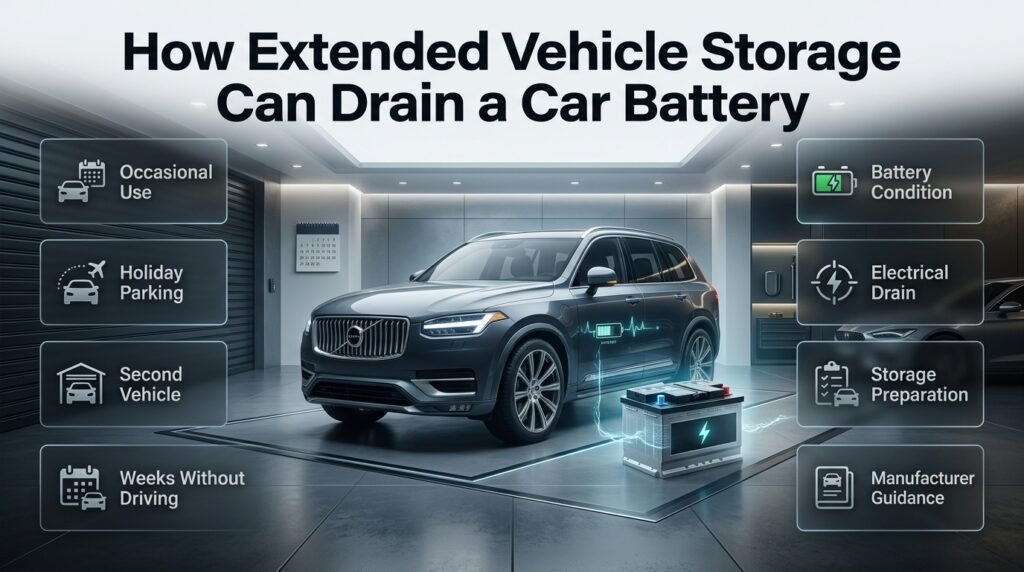
Vehicles consume a small amount of electrical energy even when the engine is switched off.
When a vehicle remains parked for an extended period, this standby consumption can gradually reduce battery charge.
This is especially relevant to vehicles that are:
- Used occasionally
- Parked during holidays
- Stored as second vehicles
- Left unused for several weeks
- Kept in garages for long periods
An older or partially discharged battery may be affected more quickly than a healthy fully charged battery.
Before Extended Vehicle Storage
Owners should consider:
- Checking battery condition
- Following manufacturer storage recommendations
- Checking for existing electrical drain
- Ensuring the vehicle is properly secured
- Arranging appropriate maintenance where required
Modern luxury vehicles may require additional precautions because of their electronic systems.
12. Battery Terminals and Connections Affect Starting Performance
A battery can be internally healthy but still struggle to deliver sufficient starting current if the electrical connections are poor.
Corrosion around terminals can increase resistance. Loose or damaged connections can produce intermittent starting problems.
During a battery inspection, technicians should check:
- Positive terminal
- Negative terminal
- Battery cables
- Ground connections
- Terminal tightness
- Corrosion
- Cable damage
- Battery mounting
A connection problem can sometimes produce symptoms that appear to indicate a weak battery.
This is one reason professional inspection is more reliable than replacing the battery based solely on symptoms.
13. Battery Mounting and Vibration Matter
A battery should be securely mounted.
Excessive movement and vibration can place unnecessary physical stress on the battery and its connections.
A professional replacement should therefore include inspection of:
- Battery tray
- Hold-down bracket
- Mounting hardware
- Terminal position
- Cable routing
A battery that is correctly secured is better protected against unnecessary movement during everyday driving.
Correct installation is particularly important after replacing an old battery.
14. Vehicle Age and Electrical Complexity
Older vehicles and newer vehicles can experience different types of battery-related challenges.
Older vehicles may have simpler electrical architectures but can develop aging wiring, connectors, alternators, starters, or aftermarket electrical modifications.
Modern vehicles may have substantially more electronic systems.
Luxury vehicles can include:
- Multiple electronic control modules
- Advanced infotainment
- Electronic suspension
- Driver-assistance technology
- Electric comfort systems
- Complex security systems
- Sophisticated battery-management systems
Consequently, a modern vehicle may require more advanced diagnostics when battery-related symptoms appear.
This is one reason Luxury Car Service should involve technicians familiar with vehicle-specific electrical systems.
15. Start-Stop Technology Changes Battery Requirements
Start-stop technology automatically switches the engine off under suitable conditions and restarts it when the driver needs to move.
This can reduce unnecessary idling, but it also increases the number of engine-start cycles.
As a result, vehicles equipped with start-stop systems commonly require battery technologies designed for higher cycling demands.
Depending on the vehicle, this may involve EFB or AGM technology.
Replacing the original battery with an unsuitable conventional battery can lead to reduced durability and compatibility problems.
Some vehicles may also require battery registration or adaptation after replacement.
16. Battery Management Systems Are Becoming More Important
Modern vehicles increasingly use electronic battery-management systems to monitor and control battery operation.
Depending on the vehicle, the system may monitor factors such as battery state, charging requirements, current flow, and electrical demand.
This means battery replacement is becoming more sophisticated.
On certain vehicles, simply installing a physically compatible battery may not complete the replacement procedure.
The vehicle may need electronic registration, adaptation, or coding so that its charging strategy correctly recognizes the new battery.
This is particularly important in modern European and luxury vehicles.
17. Battery Discharge and Deep Cycling
A battery can tolerate normal starting and charging cycles, but repeated deep discharge can reduce its useful life.
Examples include:
- Leaving lights on
- Leaving accessories operating
- Long-term parking
- Repeatedly draining the battery until the vehicle cannot start
- Excessive parasitic drain
A battery that has been deeply discharged may require appropriate charging and testing. Depending on its condition, it may or may not recover fully.
Repeated deep discharge is therefore a problem that should be investigated rather than treated as normal battery behavior.
18. How Driving Frequency Influences Battery Condition
Driving frequency creates different battery-management requirements.
A vehicle driven several times every day experiences frequent starting cycles.
A vehicle driven only once every few weeks may experience gradual discharge while parked.
Neither pattern is automatically harmful, but both can create different challenges.
Daily Driver
The main concerns may include:
- Frequent starts
- Short journeys
- Traffic
- High electrical loads
- Heat exposure
Occasional Vehicle
The main concerns may include:
- Long parking periods
- Standby electrical consumption
- Battery self-discharge
- Reduced state of charge
The ideal maintenance approach should therefore consider how the vehicle is actually used.
19. Fuel Economy and Battery Health Are Different Issues
Drivers sometimes assume that any electrical issue will automatically reduce fuel economy significantly.
The relationship is more complicated.
A properly functioning charging system supplies electrical power according to vehicle demand. A charging-system fault can create additional mechanical or electrical problems, but battery condition alone should not be used to explain every fuel-consumption change.
If a vehicle experiences both battery problems and unusual fuel consumption, the appropriate response is a broader vehicle diagnostic assessment.
This can help identify whether the two symptoms are connected or simply occurring at the same time.
20. Battery Problems Can Be Confused With Starter Problems
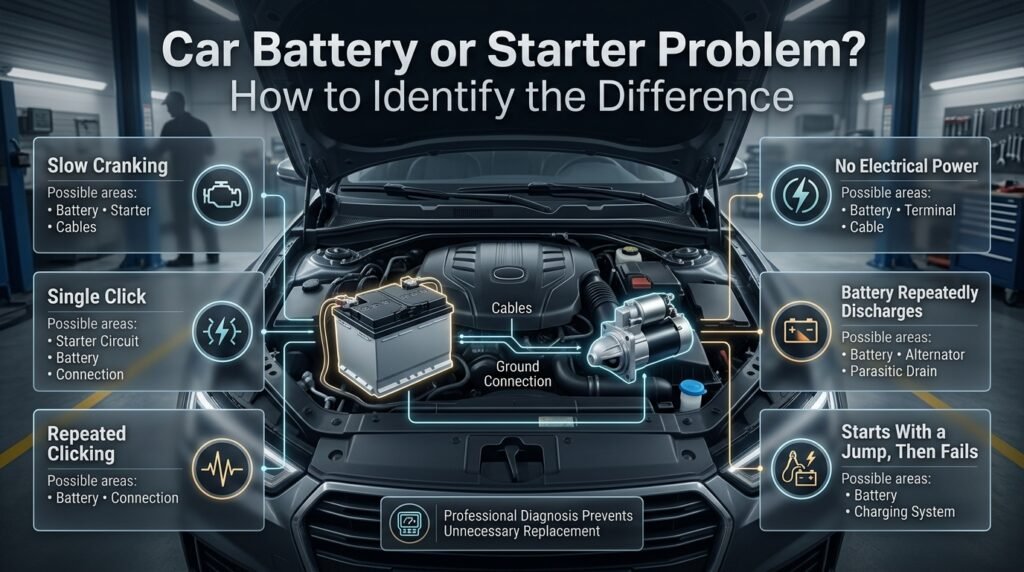
A slow-starting vehicle does not always have a bad battery.
The starter motor requires substantial electrical current. If the battery is weak, starting may become slow.
However, a starter motor, cable, ground connection, or electrical circuit problem can produce similar symptoms.
A professional diagnosis should therefore distinguish between:
| Symptom | Possible Area |
|---|---|
| Slow cranking | Battery, starter, cables |
| Single click | Starter circuit, battery, connection |
| Repeated clicking | Battery or connection |
| No electrical power | Battery, terminal, cable |
| Battery repeatedly discharges | Battery, alternator, parasitic drain |
| Starts with jump but fails later | Battery or charging system |
Correct diagnosis prevents unnecessary component replacement.
21. Signs That Your Battery May Be Nearing the End of Its Useful Life
Battery deterioration can be gradual.
Drivers should pay attention to:
- Slower engine cranking
- Delayed starting
- Repeated jump-start requirements
- Battery warning messages
- Electrical flickering
- Unusual dashboard behavior
- Reduced starting performance
- Visible terminal corrosion
- Battery swelling or physical damage
- Battery repeatedly losing charge
One warning sign does not automatically prove that replacement is necessary.
Testing should determine whether the battery is actually failing.
22. Battery Inspection Should Include the Complete Charging System
A proper battery inspection should not stop after measuring battery voltage.
A professional assessment may include:
Visual Inspection
The technician checks the battery case, terminals, cables, mounting, and surrounding area.
Battery Testing
Appropriate testing equipment evaluates battery condition and starting capability.
Charging-System Testing
The alternator and related components are checked.
Electrical Diagnosis
If repeated discharge is reported, abnormal electrical consumption may need to be investigated.
Vehicle Diagnostics
Modern vehicles may require electronic diagnostic equipment to identify battery-management or control-module issues.
This comprehensive approach helps determine the real reason behind battery problems.
23. Battery Testing Before Long-Distance Travel
A weak battery can become a serious inconvenience during a long trip.
Before travelling, drivers should consider checking the battery and other critical systems.
A basic pre-trip inspection may include:
- Battery
- Alternator
- Engine oil
- Coolant
- Brake system
- Tires
- Lights
- Wipers
- AC operation
- Warning indicators
- Emergency equipment
For drivers planning cross-emirate travel or extended journeys, a professional Vehicle Inspection can provide additional confidence.
Battery condition becomes particularly important when travelling during periods of high temperature.
24. Battery Maintenance for Vehicles Parked at Home
A vehicle parked at a villa, apartment building, or residential parking area may still experience battery discharge even when it is not being driven.
Modern electronic systems remain partially active while the vehicle is locked.
If a vehicle is used infrequently, owners should be aware of:
- Battery age
- Storage duration
- Electrical accessories
- Dash cameras
- Tracking devices
- Alarm systems
- Existing battery condition
If a vehicle repeatedly becomes discharged while parked, professional electrical testing should be considered.
25. Battery Brands: What Should Drivers Consider?
Battery brand is useful when comparing quality, warranty, availability, and product range. However, brand selection should always follow vehicle requirements.
Depending on the vehicle, drivers may consider established battery manufacturers such as Amaron, Bosch, Tuflong, Exide, Panasonic, FIAMM, and AC Delco.
For drivers researching specific options, relevant information can be found through Amaron Car Battery Replacement Dubai, Bosch Car Battery Replacement Dubai, and Tuflong Car Battery Replacement Dubai.
The important consideration is not simply which brand is most popular. The battery must be appropriate for the specific vehicle.
26. AGM Batteries for Modern Vehicles
AGM technology is particularly relevant to modern vehicles with higher electrical demands and certain start-stop systems.
AGM batteries use an absorbed electrolyte design and are engineered for applications requiring specific cycling and performance characteristics.
However, AGM is not automatically the right choice for every car.
Vehicle specifications should determine whether AGM is required or recommended.
For drivers specifically researching this technology, AGM Battery Replacement Dubai provides dedicated information.
The important rule is simple: use the battery technology specified or approved for the vehicle.
27. Other Battery Options in Dubai
Drivers may encounter several battery manufacturers depending on vehicle type and application.
For specific battery research, EuroSwift’s dedicated pages include:
- Exide Battery Replacement Dubai
- Panasonic Battery Replacement Dubai
- FIAMM Battery Replacement Dubai
- AC Delco Battery Replacement Dubai
These pages can provide more focused information when a driver already knows the battery brand or is comparing suitable options.
The main article should remain focused on the broader question of what influences battery life.
28. Does Battery Price Determine Battery Life?
Price can vary significantly depending on battery technology, capacity, vehicle requirements, brand, warranty, installation, and other factors.
A cheaper battery is not necessarily poor quality, while a more expensive battery is not necessarily the best option.
The key is matching the product to the application.
For readers specifically researching cost factors, the Car Battery Prices in Dubai 2026 Guide provides a dedicated resource for battery pricing and related considerations.
Keeping price information separate from the main battery-life discussion also helps maintain a clear search intent for this article.
29. Common Mistakes That Shorten Battery Reliability
Some battery problems are made worse by incorrect maintenance decisions.
Replacing the Battery Without Testing the Alternator
If the charging system is faulty, a new battery may also become discharged.
Ignoring Slow Cranking
A gradual change in starting performance can indicate declining battery performance or another electrical issue.
Repeatedly Jump-Starting the Vehicle
A jump-start provides temporary starting assistance but does not identify why the battery became discharged.
Choosing a Battery Based Only on Price
Battery specification and compatibility are more important than choosing the cheapest available product.
Installing the Wrong Battery Technology
A vehicle requiring AGM or EFB technology may not operate correctly with an unsuitable conventional battery.
Ignoring Parasitic Drain
If a healthy battery repeatedly loses charge while the vehicle is parked, electrical diagnosis may be necessary.
Forgetting Battery Registration
Certain modern vehicles require electronic battery registration or adaptation after replacement.
30. How to Extend Car Battery Life
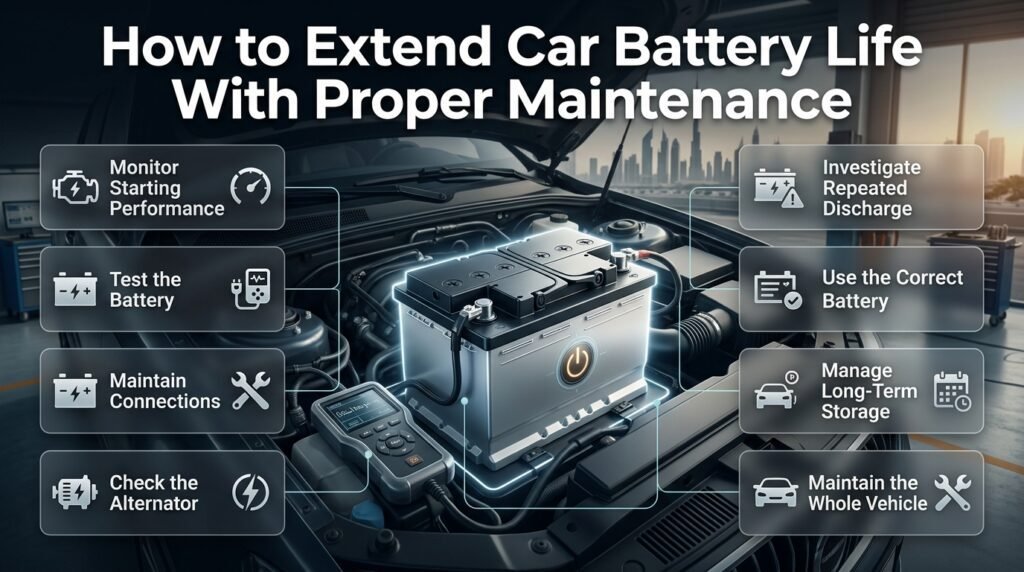
Although no maintenance strategy can guarantee a specific battery lifespan, drivers can reduce avoidable stress.
Monitor Starting Performance
Pay attention to changes in engine cranking speed.
Test the Battery Periodically
Professional testing can identify declining performance before complete failure.
Maintain Battery Connections
Terminals and cables should remain clean, secure, and in good condition.
Check the Alternator
If the battery repeatedly becomes weak, test the charging system.
Investigate Repeated Discharge
Do not treat repeated jump-starting as normal.
Use the Correct Battery
Follow manufacturer specifications for capacity and battery technology.
Manage Long-Term Storage
Follow the vehicle manufacturer’s recommendations when parking the vehicle for extended periods.
Maintain the Whole Vehicle
Battery health is only one part of reliable vehicle operation. Regular Car Service can identify related issues before they become breakdowns.
31. When Should a Battery Be Professionally Tested?
There is no universal testing schedule that works perfectly for every vehicle.
Battery testing is particularly worthwhile when:
- Starting performance changes
- The vehicle requires repeated jump-starts
- The battery has been deeply discharged
- The vehicle has been stored for a long period
- Electrical warning lights appear
- A replacement battery fails unexpectedly
- The charging system has recently been repaired
- The battery is approaching the end of its expected service period
- The vehicle is preparing for a long journey
Testing is especially useful in Dubai because environmental conditions can place additional stress on vehicle batteries.
32. What Happens During a Professional Battery Inspection?
A professional battery inspection should follow a logical process.
Step 1: Vehicle Identification
The technician confirms the vehicle model, engine configuration, and battery requirements.
Step 2: Visual Examination
The battery case, terminals, cables, mounting system, and surrounding components are inspected.
Step 3: Battery Test
The battery is tested using suitable diagnostic equipment.
Step 4: Charging-System Test
The alternator and charging circuit are checked.
Step 5: Electrical Diagnosis
If the battery continues to discharge, the vehicle may require parasitic-drain testing.
Step 6: Replacement or Repair Recommendation
Only after the evidence has been assessed should the technician recommend replacement, charging, repair, or further diagnosis.
This process helps avoid unnecessary parts replacement.
33. Battery Life and Roadside Assistance
Battery failure is one of the common reasons drivers may require roadside support.
A vehicle that suddenly fails to start may need an immediate Car Jumpstart to get moving again.
However, a jump-start should generally be viewed as an immediate assistance measure rather than a permanent repair.
If the battery is failing, or the charging system has a fault, the vehicle should be inspected afterward.
For drivers experiencing a breakdown away from home, Roadside Assistance can provide practical support while the underlying issue is assessed.
34. When Battery Replacement Is Better Than Recharging
A discharged battery is not automatically a failed battery.
Sometimes a healthy battery becomes discharged because the vehicle was left unused, an accessory remained active, or another temporary issue occurred.
In other cases, the battery may have reached the end of its useful service life and no longer hold sufficient capacity.
Testing can help distinguish these situations.
| Situation | Likely Approach |
|---|---|
| Healthy battery accidentally discharged | Recharge and investigate why |
| Weak battery with poor test results | Replacement may be required |
| Repeated discharge | Diagnose charging/drain issue |
| Faulty alternator | Charging-system repair |
| Poor terminal connection | Connection repair |
| Incorrect battery type | Correct specification required |
The correct solution depends on the diagnosis.
35. Battery Life and Preventive Car Service
Battery maintenance should not be isolated from broader automotive maintenance.
A professional Car Service can identify conditions that indirectly affect battery reliability, such as charging-system problems, poor electrical connections, starter issues, warning lights, or unusual vehicle behavior.
Preventive maintenance can also identify other components that could leave the driver stranded.
A complete maintenance approach may include:
- Battery testing
- Alternator inspection
- Engine diagnostics
- Brake inspection
- Oil change
- Cooling-system inspection
- Tire inspection
- AC servicing
- Suspension inspection
- Vehicle electrical diagnosis
This is particularly valuable for vehicles operating in demanding climates.
36. Battery Considerations for Luxury Vehicles
Luxury vehicles often contain more electrical systems than standard vehicles.
Features such as electric seats, advanced climate control, infotainment, cameras, security systems, electronic suspension, and driver-assistance technology can increase electrical complexity.
When battery problems appear, the vehicle may therefore require more than a simple battery replacement.
A technician may need to consider:
- Battery-management systems
- Electronic registration
- Control-module communication
- Vehicle-specific charging strategy
- Auxiliary batteries where applicable
- Electrical sleep modes
This is why specialized Luxury Car Service can be beneficial for technologically complex vehicles.
37. Future Trends in Automotive Battery Technology
Automotive electrical systems are becoming increasingly intelligent.
Future battery-management systems are expected to provide more detailed monitoring of battery condition and electrical consumption.
Vehicle manufacturers are also continuing to improve energy management as cars become more electronically controlled.
Important trends include:
- Smarter battery monitoring
- Improved AGM and EFB technologies
- More sophisticated charging strategies
- Advanced start-stop systems
- Greater electrical integration
- Improved diagnostic systems
- Increased electrification
- More intelligent energy management
Traditional 12-volt batteries will remain important in many vehicles, while hybrid and electric vehicles use increasingly sophisticated high-voltage systems alongside low-voltage electrical networks.
For automotive workshops, this means battery service is becoming increasingly connected with electronic diagnostics.
38. Battery Life in Hybrid and Electric Vehicles
Hybrid and electric vehicles require a different approach to battery terminology.
They may contain a high-voltage traction battery as well as a conventional low-voltage electrical battery.
The high-voltage battery is responsible for propulsion, while the low-voltage system can support control electronics and other vehicle functions.
Therefore, drivers should not assume that the presence of a large high-voltage battery eliminates the possibility of a conventional 12-volt battery problem.
Hybrid and electric vehicles should be serviced according to manufacturer-specific procedures, especially when high-voltage components are involved.
39. A Practical Battery Maintenance Plan for Dubai Drivers
A simple preventive strategy can help reduce the likelihood of unexpected battery failure.
Regularly
Pay attention to changes in starting performance and dashboard warnings.
During Routine Service
Ask for battery and charging-system condition to be assessed when appropriate.
Before Long Trips
Check battery condition, tires, fluids, cooling system, brakes, and other essential components.
Before Extended Storage
Follow manufacturer recommendations and consider the vehicle’s standby electrical consumption.
After a Jump-Start
Determine why the battery discharged rather than assuming the issue has been resolved.
After Battery Replacement
Confirm that the battery specification is correct and that any required registration or adaptation has been completed.
40. Battery Life: Quick Comparison of Major Influences
| Factor | Effect on Battery Reliability | What Drivers Should Do |
|---|---|---|
| High temperature | Can accelerate degradation | Test battery condition regularly |
| Short trips | May limit charging opportunity | Monitor battery state |
| Long storage | Can gradually discharge battery | Follow storage guidance |
| Faulty alternator | Can leave battery undercharged | Test charging system |
| Parasitic drain | Can discharge battery while parked | Diagnose abnormal consumption |
| Poor terminals | Can increase electrical resistance | Inspect connections |
| Wrong battery type | May reduce compatibility and durability | Follow manufacturer specification |
| Heavy electrical load | Increases system demand | Maintain charging system |
| Start-stop operation | Increases cycling requirements | Use appropriate battery technology |
| Excessive vibration | Can affect battery and connections | Ensure secure mounting |
| Deep discharge | Can reduce useful life | Investigate the cause |
| Poor installation | Can create connection problems | Use proper installation procedures |
What factors affect car battery life the most?
Car battery life is influenced by several conditions at the same time, rather than by battery age alone. The biggest factors are heat, driving pattern, charging-system condition, electrical drain, vibration, battery specification, and maintenance. In a hot climate such as Dubai, temperature deserves particular attention because prolonged heat exposure can accelerate battery degradation. AAA also identifies time, heat, and vibration as major influences on battery lifespan.
A battery can therefore fail earlier than expected even when it has not reached the age at which the owner expected replacement. For example, a vehicle used mainly for short journeys in heavy traffic and exposed to high under-bonnet temperatures may experience considerably different battery stress from a vehicle driven regularly on longer journeys with a healthy charging system.
Important factors to watch:
High ambient and under-bonnet temperatures
Frequent short journeys
Long periods without driving
Faulty or weak charging system
Parasitic electrical drain
Corroded or loose terminals
Excessive vibration from poor mounting
Incorrect battery specification
Heavy electrical demands
Repeated deep discharge
The professional approach is to look at the whole electrical system, not simply ask how old the battery is. If a battery repeatedly loses charge, replacing it without checking the alternator, connections, and possible electrical drain can leave the real problem unresolved.
Does Dubai heat shorten car battery life?
Dubai’s high temperatures can significantly increase the stress placed on a car battery. Heat accelerates the chemical processes inside a battery and can speed up internal degradation. AAA notes that batteries in hotter climates generally have shorter service lives than those operating in cooler environments.
The important point is that the battery does not experience only the temperature shown outside the vehicle. Under-bonnet temperatures can become considerably higher, particularly after the engine has been operating. Repeated exposure to this environment can gradually reduce battery performance.
Heat damage is also cumulative. A battery may appear completely normal during one inspection but have substantially less reserve capacity than when it was new. This is one reason a battery can sometimes fail unexpectedly after continuing to start the vehicle normally for a long period.
For Dubai drivers, practical considerations include:
Have the battery condition checked periodically.
Pay attention to slower engine cranking.
Inspect terminals for corrosion.
Make sure the battery is properly secured.
Check the charging system if the battery repeatedly becomes weak.
Consider battery condition before long-distance travel.
Avoid assuming that every starting problem is simply caused by heat.
A professional inspection is particularly useful when a vehicle is approaching the later part of its battery service life. Heat should be treated as an important battery-life factor, not as a reason to replace a battery blindly.
Can short trips and frequent driving reduce car battery life?
Frequent short trips can contribute to battery discharge because starting the engine requires a significant burst of electrical energy, while a very short journey may not give the charging system enough time to replenish what was used. AAA specifically notes that repeated short journeys can be harder on a battery than longer drives for this reason.
This is especially relevant to urban driving. A driver might start the vehicle several times during the day for school, work, shopping, appointments, or other short journeys. Each start draws energy from the battery, while repeated short operating periods may provide limited charging opportunity.
That does not mean every short journey is harmful or that drivers need to make unnecessary long drives. The real concern is a repeated pattern of many short trips combined with other battery stress factors such as high temperatures, heavy electrical loads, an aging battery, or a charging-system problem.
Short-trip battery considerations:
Multiple starts consume battery energy.
Very short journeys provide less charging time.
Heavy electrical use increases the overall demand.
High temperatures can add further battery stress.
An aging battery has less reserve capacity.
A weak alternator can make the situation worse.
If a vehicle is mainly used for short urban journeys and begins showing slow starting or repeated discharge, a professional battery and charging-system test is more useful than simply assuming the driving pattern is the only cause.
Why does a car battery keep going flat even after it has been replaced?
When a relatively new battery repeatedly becomes discharged, the battery itself should not automatically be blamed. An underlying electrical or charging problem may be responsible. A malfunctioning charging system can reduce battery life, while abnormal electrical consumption can drain a battery while the vehicle is parked.
One common situation is an alternator that is not charging the battery correctly. Another possibility is a parasitic electrical drain, where an accessory, control module, light, aftermarket device, or another electrical component continues consuming more power than expected after the vehicle is switched off.
Poor battery connections can also create starting and charging problems. Therefore, repeatedly installing new batteries without diagnosis can become an expensive cycle without solving the underlying fault.
When a new battery keeps going flat, check for:
Alternator or charging-system problems
Abnormal parasitic electrical drain
Loose or corroded battery terminals
Damaged battery cables or ground connections
Incorrect battery specification
Aftermarket electrical accessories
Long periods of vehicle storage
Excessive electrical consumption
Battery-management or vehicle-electronics issues
A proper diagnostic process should establish whether the battery is actually defective and then determine why it became discharged. This distinction is important because replacing a battery and repairing the cause of battery discharge are two different jobs.
How can I extend my car battery life in Dubai?
The best way to extend battery life is not one single trick. It is a combination of correct battery selection, regular inspection, healthy charging performance, sensible driving habits, and prevention of unnecessary discharge.
For Dubai vehicles, temperature management and preventive testing deserve particular attention. Keeping the battery properly secured, maintaining clean connections, avoiding unnecessary electrical use when the engine is off, and addressing repeated discharge can all support better reliability. Recent AAA guidance also recommends regular driving, avoiding excessive short trips, maintaining terminals, protecting the vehicle from extreme temperatures, and using an appropriate battery maintainer for vehicles that remain unused for extended periods.
The most useful approach is to treat the battery as one component of the vehicle’s complete electrical system.
Practical battery-life habits include:
Have the battery professionally tested when its performance begins to change.
Keep terminals and connections clean and secure.
Make sure the battery hold-down is properly fitted.
Check the alternator if the battery repeatedly loses charge.
Avoid leaving electrical accessories running unnecessarily with the engine off.
Investigate repeated jump-start requirements.
Follow the vehicle manufacturer’s battery specification.
Use the correct battery technology for start-stop vehicles.
Pay extra attention to battery condition in extreme heat.
Check the battery before extended journeys.
Follow appropriate procedures when storing a vehicle for a long period.
The key is preventive diagnosis rather than waiting for complete failure. A battery that is showing declining performance can often be identified before it leaves the driver with a no-start situation. That makes battery testing an important part of overall vehicle maintenance, particularly in Dubai’s demanding climate.
Conclusion
Understanding the factors affecting car battery life is essential for maintaining reliable starting performance and avoiding unexpected breakdowns. Battery age is only one part of the equation. Dubai’s extreme heat, frequent short trips, heavy traffic, electrical loads, charging-system condition, parasitic drain, battery specification, terminal condition, and vehicle storage can all influence how quickly a battery loses its performance.
For Dubai drivers, preventive battery care is especially important because high temperatures can place additional stress on the battery and its surrounding electrical components. A battery that repeatedly becomes weak should not simply be replaced without finding the reason behind the problem. Testing the battery, alternator, electrical connections, and charging system provides a much clearer picture of the vehicle’s actual condition.
The best approach is to use the correct battery for the vehicle, maintain proper electrical connections, monitor starting performance, investigate repeated discharge, and arrange professional testing when warning signs appear. Modern vehicles may also require battery registration or electronic adaptation after replacement, making professional installation increasingly important.
With proper Vehicle Maintenance, Battery Replacement, Car Service, Engine Diagnostics, and electrical inspection, drivers can reduce avoidable battery problems and improve overall vehicle reliability. In Dubai’s climate, proactive battery care is not simply about making a battery last longer—it is about ensuring the entire vehicle remains dependable when you need it most.
Leave a Reply