
Introduction
EFB Battery Construction | Understanding EFB battery construction is important for anyone who owns or maintains a modern vehicle equipped with a start-stop system or a relatively high electrical load. EFB stands for Enhanced Flooded Battery, a development of traditional flooded lead-acid battery technology designed to handle more frequent cycling while continuing to provide dependable engine-starting performance.
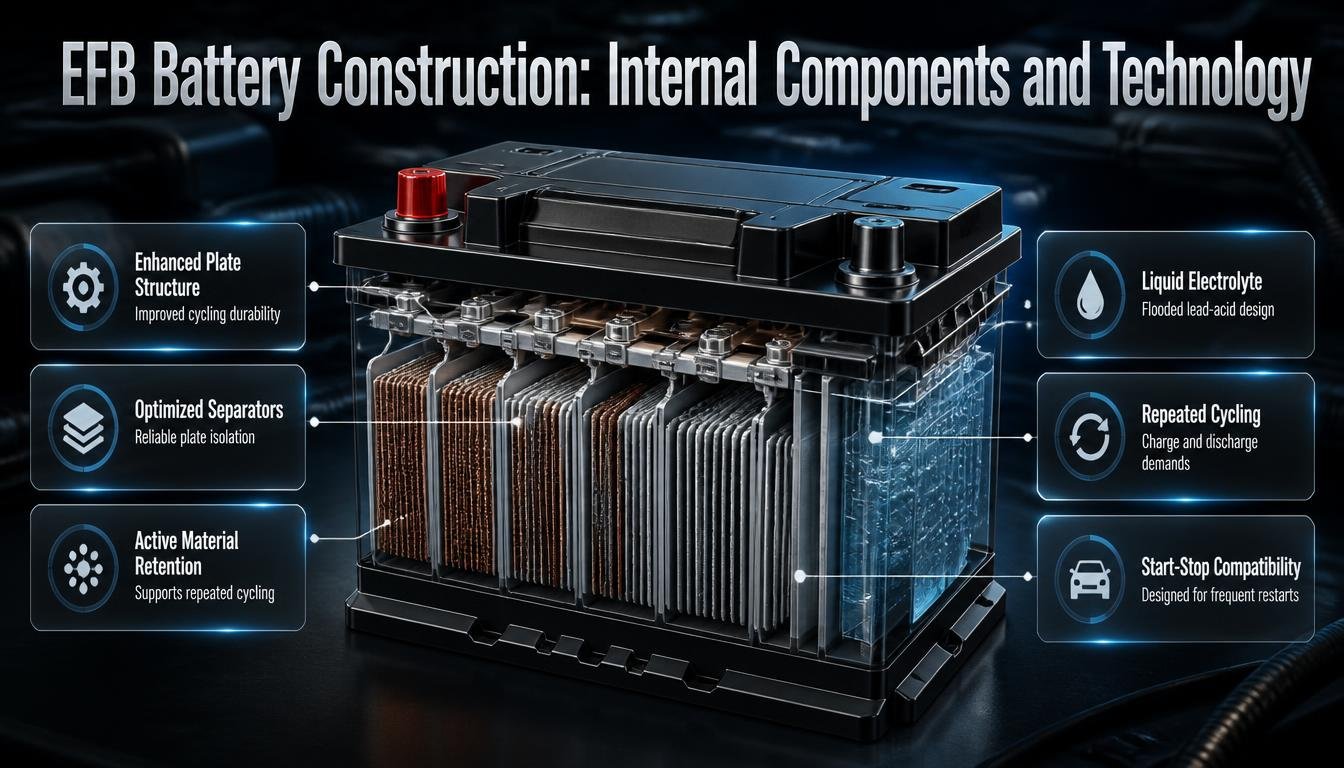
Unlike a conventional flooded battery, an EFB battery is engineered with improvements to its internal construction, including strengthened plate structures, optimized separators, improved active-material retention, and a design intended to tolerate repeated charge and discharge activity. These characteristics make EFB batteries particularly relevant to vehicles that regularly shut the engine off and restart it during urban driving.
For drivers who want to understand how their battery works, EuroSwift Auto Services provides a useful starting point for broader vehicle maintenance and battery-related assistance. Understanding the construction of an EFB battery can also help explain why choosing the correct battery technology matters when replacement becomes necessary.
This guide examines the internal structure of EFB batteries, the purpose of their major components, how their construction differs from conventional flooded and AGM batteries, how they respond to repeated cycling, and what professional technicians consider when diagnosing or replacing them.
What Is an EFB Battery?
An EFB battery is an Enhanced Flooded Battery, meaning it is based on the conventional flooded lead-acid battery design but incorporates engineering improvements intended to increase durability and cycling capability.
The word “flooded” refers to the battery’s liquid electrolyte arrangement. Unlike AGM batteries, where electrolyte is absorbed into glass-mat separators, an EFB battery retains a liquid electrolyte system.
However, EFB should not be viewed simply as an ordinary flooded battery with a different label. Its internal construction is designed around the additional demands created by modern vehicle electrical systems.
A traditional starting battery is primarily expected to provide a high amount of current for engine cranking and then receive charge from the vehicle’s charging system.
An EFB battery has to do more.
It may need to:
- Start the engine repeatedly.
- Support electrical systems while the engine is stopped.
- Recover charge between engine restarts.
- Handle partial-state-of-charge operation.
- Tolerate more frequent cycling.
- Maintain reliable starting performance over repeated use.
This makes the internal construction particularly important.
Why EFB Battery Construction Matters
The construction of a battery determines how effectively it can manage electrical, chemical, mechanical, and thermal stresses.
For EFB technology, the major objective is to improve the battery’s ability to withstand repeated cycling without abandoning the basic advantages of flooded lead-acid technology.
A vehicle equipped with a start-stop system may switch the engine off at traffic lights, during temporary stops, or under other operating conditions. The battery remains responsible for electrical support during these events and must provide energy when the engine starts again.
This creates a different operating pattern from a vehicle that simply starts once at the beginning of a journey and remains running.
The improved construction of an EFB battery is intended to make this repeated operation more manageable.
The key areas include:
- Positive plate construction
- Negative plate design
- Active-material retention
- Separator structure
- Electrolyte arrangement
- Cell construction
- Internal electrical connections
- Battery case durability
- Ventilation
- Terminal design
Each part has a specific role, but the overall performance comes from how these components work together.
Main Components of EFB Battery Construction
An EFB battery contains several fundamental components that work together as an electrochemical and electrical system.
| Component | Main Function | Importance in EFB Design |
|---|---|---|
| Positive plates | Participate in electrochemical reactions | Designed for improved cycling durability |
| Negative plates | Support charge and discharge reactions | Optimized for repeated operation |
| Separators | Prevent plate contact | Maintain electrical isolation and ion movement |
| Electrolyte | Supports chemical reactions | Liquid flooded electrolyte |
| Active material | Stores and releases electrical energy | Designed for improved retention |
| Cell connectors | Join cells electrically | Provide reliable current transfer |
| Battery case | Houses internal components | Provides structural protection |
| Terminals | Connect battery to vehicle | Transfer electrical current |
| Ventilation system | Manages gas release | Supports safe battery operation |
| Plate groups | Increase effective reaction area | Balance starting power and cycling performance |
The battery’s final characteristics depend on the precise engineering choices made by the manufacturer.
EFB Positive Plate Construction
The positive plate is one of the most important components in an EFB battery.
During charging and discharging, the positive plate participates in the electrochemical reactions that allow the battery to store and deliver electrical energy.
Repeated cycling can place considerable stress on the active material associated with the positive plates. If the material gradually loses structural integrity or becomes less effective, battery performance can decline.
EFB construction therefore places particular emphasis on improving the durability of the positive plate system.
The objective is not simply to create a stronger piece of metal. The complete plate assembly must work effectively with the active material, separator, electrolyte, and negative plate.
Positive Plate Functions
The positive plates contribute to:
- Engine-starting current
- Energy storage
- Charge acceptance
- Repeated cycling
- Electrochemical stability
A battery designed for start-stop operation needs to repeatedly move between discharge and recharge conditions. This makes plate durability especially important.
Active Material Retention
One of the challenges in lead-acid battery operation is maintaining the integrity of active material through repeated cycling.
EFB construction is intended to improve resistance to this type of degradation.
Better retention helps the battery maintain useful performance for longer under demanding operating conditions.
Negative Plate Construction
The negative plates complete the electrochemical system inside each battery cell.
Like the positive plates, they must support repeated charge and discharge activity.
The negative plate system contributes to:
- Electrical current production
- Charge acceptance
- Starting performance
- Cycling capability
- Overall battery efficiency
EFB technology optimizes the negative electrode system as part of the complete battery design.
This is important because battery performance cannot be understood by examining only one plate.
The positive plates, negative plates, separators, and electrolyte operate together. A change in one area can influence the behavior of the entire battery.
Role of Battery Separators
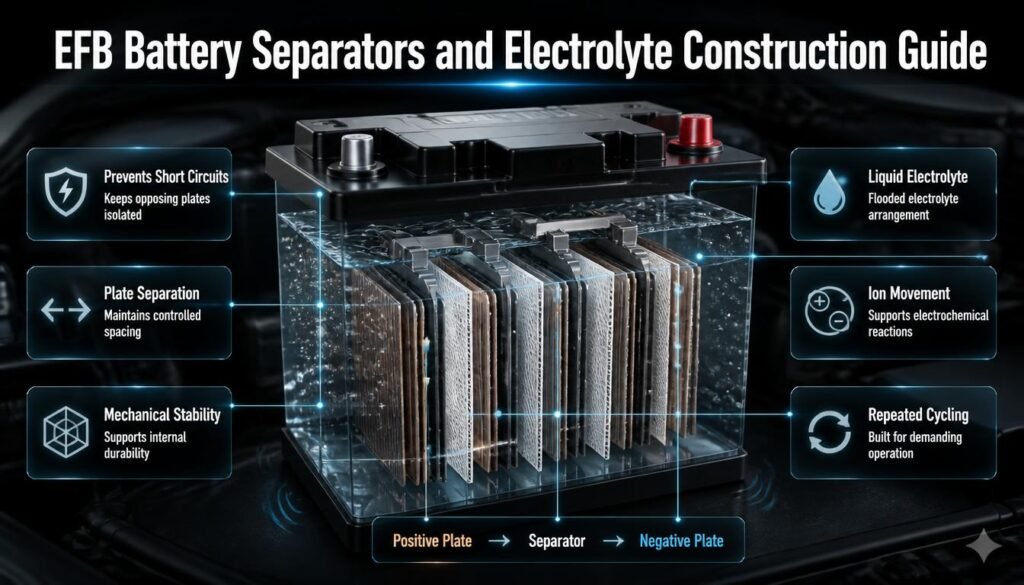
Separators are positioned between positive and negative plates.
Their job is deceptively simple but extremely important.
The separator must prevent direct electrical contact between the opposing plates while allowing ionic movement through the electrolyte.
A properly designed separator contributes to:
- Prevention of internal short circuits
- Reliable plate separation
- Mechanical stability
- Electrolyte movement
- Long-term internal durability
Because the battery operates inside a moving vehicle, internal components are exposed to vibration and mechanical stress.
The separator must therefore remain correctly positioned throughout normal operation.
Separator Design in EFB Technology
EFB separators are part of the battery’s broader effort to improve reliability under repeated cycling.
The separator does not store electrical energy itself. Instead, it creates the controlled internal environment required for the plates to function correctly.
This makes separator construction a critical but often overlooked part of EFB technology.
EFB Electrolyte Construction
The electrolyte is another fundamental part of EFB battery construction.
EFB batteries use a liquid electrolyte rather than the absorbed electrolyte arrangement found in AGM batteries.
The electrolyte provides the medium required for ion movement and supports the chemical reactions taking place between the positive and negative plates.
Its condition can influence battery behavior significantly.
Temperature, state of charge, battery age, and charging conditions can all affect the chemical environment inside the battery.
For this reason, battery performance should not be judged purely by looking at the physical case or measuring one voltage value.
A professional inspection considers the battery’s electrical performance as well as its broader operating environment.
EFB Battery Case Construction
The battery case surrounds and protects the internal components.
It must be strong enough to withstand the conditions found inside a vehicle, including:
- Engine-bay vibration
- Temperature fluctuations
- Mechanical movement
- Normal road shocks
- Electrolyte containment requirements
The case also divides the battery into individual cells.
A typical 12-volt automotive lead-acid battery uses six cells connected in series. Each cell contributes approximately two volts under nominal conditions.
The case therefore serves both a protective and structural function.
EFB Cell Construction
The individual cells are the fundamental electrochemical units of the battery.
Each cell contains a combination of:
- Positive plates
- Negative plates
- Separators
- Electrolyte
- Internal connections
The cells are electrically connected in series to produce the battery’s overall voltage.
A problem affecting one cell can significantly reduce total battery performance.
This is one reason professional battery testing is useful when a vehicle experiences repeated starting difficulties.
A basic voltage measurement can provide useful information, but it does not necessarily reveal every internal problem.
Plate Groups and Surface Area
Inside each cell, several positive and negative plates are assembled into groups.
The number, size, and arrangement of these plates influence the battery’s electrical characteristics.
More effective plate surface area can support high-current engine starting, while the overall plate structure must also withstand repeated cycling.
This creates an important engineering balance.
An EFB battery must provide enough starting current while also surviving repeated discharge and recharge events.
Consequently, EFB construction is not simply about maximizing one specification.
The internal design must balance:
- Starting power
- Cycling durability
- Charge acceptance
- Physical stability
- Service reliability
Active Material and EFB Battery Durability
Active material is the chemically active material associated with the battery plates.
It participates in the electrochemical reactions that allow the battery to charge and discharge.
Every cycle places some degree of stress on this material.
Over time, degradation can reduce the battery’s ability to store energy and provide starting power.
EFB construction is designed to improve the retention and durability of active material compared with conventional flooded battery designs.
This is particularly valuable in vehicles where the battery experiences frequent partial discharge and recharge.
However, enhanced construction does not mean unlimited cycle life.
Poor charging conditions, repeated deep discharge, extreme heat, electrical drain, and natural aging can still cause deterioration.
How EFB Construction Supports Start-Stop Systems
Start-stop technology is one of the most common reasons manufacturers specify EFB batteries.
In a vehicle without automatic start-stop operation, the battery generally provides a strong starting current and then receives charge while the engine runs.
With start-stop technology, the operating pattern changes.
The engine may stop while the vehicle is stationary.
During that time, electrical systems can remain active.
When driving resumes, the engine must restart quickly.
This can happen repeatedly during a single journey.
The battery therefore experiences significantly more frequent cycling.
EFB construction is designed to cope with this pattern more effectively than many conventional flooded batteries.
EFB Battery Charge and Discharge Cycle
Understanding the charge-discharge cycle helps explain why internal construction matters.
During Engine Starting
The battery delivers a high amount of current to the starter system.
During Normal Driving
The vehicle’s charging system replenishes energy consumed during starting and electrical operation.
During Engine Stop
Electrical equipment may continue operating while the engine is temporarily switched off.
During Restart
The battery supplies current again to restart the engine.
During Recovery
The charging system replenishes the battery according to the vehicle’s charging strategy.
This repeated sequence places greater demands on battery durability.
An EFB battery is designed specifically to operate more effectively within this type of environment.
EFB vs Conventional Flooded Battery
EFB technology is an enhanced version of flooded lead-acid construction.
The two share the basic liquid-electrolyte concept, but EFB introduces improvements intended for greater cycling demands.
| Characteristic | Conventional Flooded | EFB |
|---|---|---|
| Liquid electrolyte | Yes | Yes |
| Traditional lead-acid foundation | Yes | Yes |
| Enhanced cycling design | Limited | Yes |
| Start-stop suitability | Vehicle dependent | Common application |
| Charge acceptance | Standard | Improved |
| Plate construction | Conventional | Enhanced |
| Repeated cycling | Lower capability | Higher capability |
This does not mean that an EFB battery should be installed in every vehicle.
Battery selection must follow the vehicle manufacturer’s specifications.
A battery that physically fits the battery tray may still have the wrong technology or electrical characteristics.
EFB vs AGM Battery Construction
AGM and EFB batteries are often discussed together because both are used in modern vehicles, but their construction is different.
AGM stands for Absorbent Glass Mat.
In AGM technology, the electrolyte is held within glass-mat separators.
EFB batteries, by contrast, retain the flooded liquid-electrolyte approach.
| Construction Area | EFB | AGM |
|---|---|---|
| Electrolyte | Liquid flooded | Absorbed in glass mat |
| Basic technology | Enhanced flooded lead-acid | Valve-regulated lead-acid |
| Cycling capability | Enhanced | Generally higher |
| Charge acceptance | Improved | High |
| Common application | Start-stop vehicles | More demanding electrical systems |
| Internal electrolyte arrangement | Flooded | Absorbed |
The correct battery depends on the vehicle’s design.
If a vehicle was designed for AGM, switching to EFB may not provide the required performance. Likewise, upgrading an EFB vehicle to AGM should only be considered when the vehicle’s electrical architecture and manufacturer specifications support it.
EFB Battery Construction and Charge Acceptance
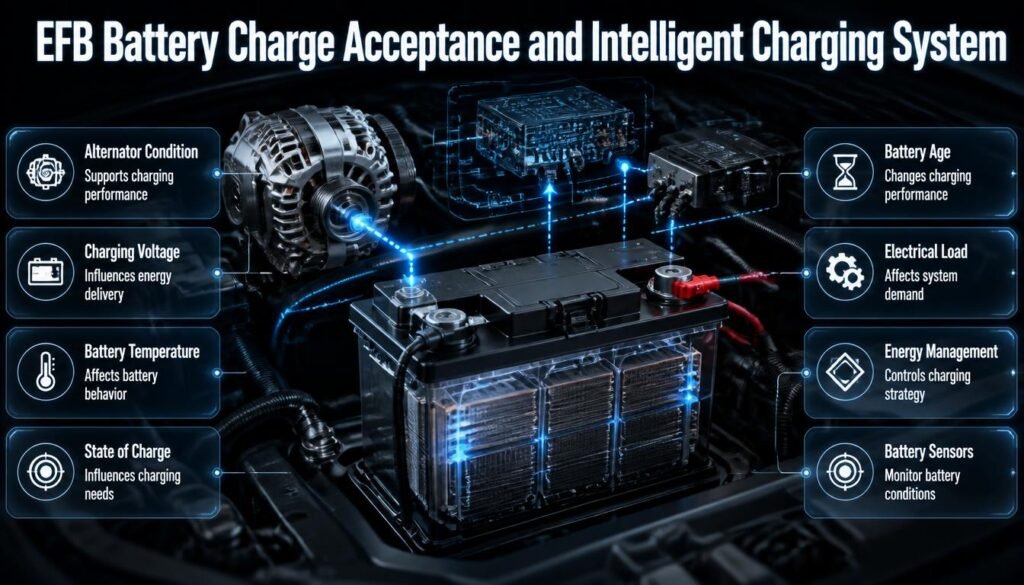
Charge acceptance describes how effectively a battery can accept electrical energy from the charging system.
This characteristic is particularly important in modern vehicles because charging may not operate exactly like a traditional alternator system.
Modern vehicles can use intelligent charging strategies that vary charging behavior according to battery condition, electrical demand, driving conditions, and energy-management requirements.
EFB construction is designed to provide improved charge acceptance compared with conventional flooded batteries.
However, battery charging performance depends on the entire system.
Important factors include:
- Alternator condition
- Charging voltage
- Battery temperature
- State of charge
- Battery age
- Electrical load
- Vehicle energy-management strategy
- Battery-management sensors
A battery should therefore never be diagnosed independently from the charging system when repeated discharge occurs.
EFB Battery Construction and Battery Management Systems
Modern vehicles increasingly use electronic battery-management systems.
Depending on the vehicle, sensors and control modules can monitor battery-related parameters and help manage charging behavior.
This makes battery replacement more than a simple mechanical installation.
Some vehicles may require the replacement battery to be registered or adapted through diagnostic equipment.
The technician may need to confirm:
- Battery technology
- Battery capacity
- Battery specification
- Charging strategy
- Battery-management configuration
- Registration requirements
The precise procedure depends on the vehicle manufacturer and model.
EFB Battery Construction and Vehicle Electrical Loads
Modern vehicles contain far more electrical equipment than older vehicles.
Electrical demand may come from:
- Infotainment systems
- Exterior lighting
- Interior lighting
- Climate-control systems
- Driver-assistance systems
- Security systems
- Electronic control modules
- Heated equipment
- Communication systems
When the engine stops automatically, the battery may need to support several of these systems.
This is one reason start-stop batteries require more advanced construction than basic starting batteries.
A weak battery may cause the vehicle to disable start-stop functionality as a protective strategy.
EFB Battery Construction and Heat
Temperature has a major influence on lead-acid battery operation.
High temperatures can accelerate chemical reactions and contribute to faster aging, while low temperatures can reduce available starting performance.
For vehicles operating in hot environments such as Dubai, thermal stress is an important consideration.
A battery operating in a hot engine compartment may experience conditions that accelerate deterioration.
This does not mean every battery problem is caused by heat.
Instead, climate should be considered alongside:
- Driving pattern
- Battery age
- Charging performance
- Electrical demand
- Vehicle usage
- Maintenance history
Professional Battery Diagnostics can help identify whether battery deterioration is actually present.
EFB Battery Construction and Vibration
Vehicle batteries operate in an environment where vibration is unavoidable.
Road surfaces, engine movement, and vehicle operation all produce mechanical forces.
The battery’s internal plate assemblies, separators, connections, and case must remain stable.
Poor mounting can increase mechanical stress.
Therefore, a proper battery installation should verify that:
✔ The battery is securely mounted.
✔ Terminals are correctly tightened.
✔ Cables are in good condition.
✔ The battery case shows no visible damage.
✔ The battery is positioned according to vehicle requirements.
Physical installation is an important part of battery reliability.
EFB Battery Ventilation and Gas Management
Flooded lead-acid batteries can produce gases during charging and operation.
For this reason, ventilation is incorporated into battery construction.
The ventilation arrangement helps manage gas release under normal operating conditions.
Battery installation should follow manufacturer requirements, particularly when the battery is installed in a compartment or another location where ventilation considerations are important.
A battery should never be modified or installed in a way that compromises its intended safety features.
Common EFB Battery Failure Causes
Although EFB batteries are designed for enhanced cycling, several conditions can still cause premature deterioration.
Common causes include:
Repeated Deep Discharge
Deep discharge places considerable stress on lead-acid battery chemistry.
Insufficient Charging
If the charging system does not replenish the battery properly, the battery may remain undercharged.
Excessive Heat
High temperatures can accelerate aging.
Electrical Parasitic Drain
An electrical component that continues consuming power while the vehicle is parked can gradually discharge the battery.
Frequent Short Trips
Short journeys may not provide enough operating time for the charging system to recover the energy used during starting and electrical operation.
Natural Aging
All batteries gradually lose performance as they accumulate operating cycles and age.
Signs of EFB Battery Deterioration
A failing EFB battery can produce several warning signs.
These may include:
- Slow engine cranking
- Repeated start-stop system deactivation
- Low-battery warnings
- Difficulty starting after parking
- Frequent battery discharge
- Reduced performance in electrical systems
- Poor results on a professional battery test
However, symptoms should not automatically be interpreted as proof that the battery needs replacement.
A vehicle with an alternator problem, poor connection, or parasitic electrical drain can show similar symptoms.
This is why diagnosis should come before replacement.
Professional EFB Battery Diagnostic Process
A professional diagnostic process should evaluate both the battery and the vehicle’s charging system.
Step 1: Visual Inspection
The technician checks:
- Battery case
- Terminals
- Cables
- Mounting
- Corrosion
- Visible damage
Step 2: Battery Voltage Test
Resting voltage can provide useful information about the battery’s state of charge.
However, voltage alone cannot establish complete battery health.
Step 3: Starting Performance Test
A suitable tester can assess the battery’s ability to deliver starting power.
Step 4: Charging-System Test
The charging system should be checked to determine whether the battery is receiving appropriate charging.
Step 5: Electrical Drain Investigation
If the battery repeatedly becomes discharged while parked, technicians may investigate unwanted electrical consumption.
Step 6: Electronic System Check
Modern vehicles may require checking battery-management settings and related electronic systems.
This approach provides a much clearer picture than simply installing another battery.
When Does an EFB Battery Need Replacement?
There is no universal replacement interval for every EFB battery.
Service life can be influenced by:
- Climate
- Driving frequency
- Start-stop usage
- Electrical load
- Charging-system condition
- Battery age
- Discharge depth
- Vehicle storage periods
- Maintenance quality
A battery should be replaced when testing demonstrates that it can no longer reliably perform its intended function or when its condition is clearly deteriorated.
Replacing a battery simply because it has reached an arbitrary age can sometimes be unnecessary, while waiting until complete failure can leave the driver stranded.
Preventive testing offers a better approach.
Choosing the Correct EFB Battery
Battery selection should never be based solely on physical size.
Before installing an EFB battery, the following characteristics should be checked:
| Selection Factor | Why It Matters |
|---|---|
| Battery technology | Must match vehicle requirements |
| Capacity | Determines available stored energy |
| Starting rating | Supports engine starting |
| Physical dimensions | Ensures correct installation |
| Terminal position | Ensures proper cable connection |
| Mounting design | Keeps battery secure |
| Vehicle compatibility | Supports electronic systems |
| Manufacturer specification | Provides correct technical reference |
If the vehicle manufacturer specifies EFB technology, a conventional flooded battery may not provide the required cycling performance.
Can an EFB Battery Be Replaced With a Standard Battery?
A conventional flooded battery should not automatically be treated as an equivalent replacement for an EFB battery.
Although both use liquid electrolyte, their intended operating characteristics differ.
A standard flooded battery may be less capable of handling repeated start-stop cycling.
Installing an unsuitable battery can result in:
- Reduced battery life
- Frequent start-stop deactivation
- Poor energy recovery
- Repeated battery discharge
- Increased electrical-system problems
The correct replacement should therefore follow the vehicle manufacturer’s battery specification.
Can EFB Be Upgraded to AGM?
An AGM upgrade may be possible for certain vehicles, but this should be determined from the vehicle’s specifications rather than assumed.
AGM has different internal construction and different performance characteristics.
Before considering an upgrade, technicians should check:
- Charging strategy
- Battery-management system
- Physical dimensions
- Terminal arrangement
- Battery capacity
- Manufacturer requirements
- Electronic registration procedures
The objective is not simply to choose the battery with the highest specification.
The objective is to install the battery technology that works correctly with the vehicle.
EFB Battery Maintenance Practices
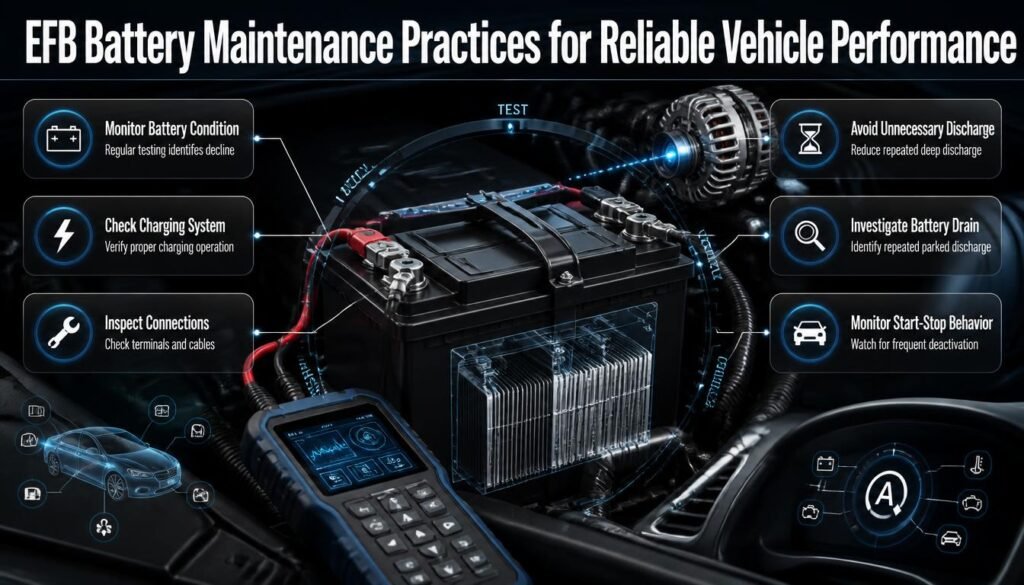
Good maintenance can help an EFB battery perform reliably.
Monitor Battery Condition
Regular testing can identify declining performance before the battery fails completely.
Check the Charging System
An alternator or charging-system problem can repeatedly discharge even a new battery.
Inspect Connections
Loose or corroded terminals can increase electrical resistance.
Avoid Long Periods of Unnecessary Discharge
Repeated deep discharge can accelerate deterioration.
Investigate Repeated Battery Drain
If the vehicle repeatedly loses charge while parked, the underlying electrical problem should be identified.
Pay Attention to Start-Stop Behavior
A start-stop system that frequently becomes unavailable can have several possible causes, including battery state, temperature, electrical demand, and vehicle control strategies.
Common Mistakes When Maintaining EFB Batteries
Mistake 1: Choosing Only by Size
A battery that fits the tray may still have the wrong technology.
Mistake 2: Assuming Voltage Equals Battery Health
Voltage provides information but does not fully describe starting capability or remaining battery performance.
Mistake 3: Replacing the Battery Without Testing the Charging System
If the alternator is not charging correctly, a new battery can suffer the same problem.
Mistake 4: Ignoring Electrical Drain
Repeated battery discharge while parked may indicate a parasitic drain.
Mistake 5: Ignoring Vehicle Electronics
Some modern vehicles require battery registration or adaptation after installation.
Mistake 6: Waiting for Complete Failure
A battery can often show declining performance before it completely fails.
EFB Battery Construction and Short-Trip Driving
Short journeys can create challenging conditions for automotive batteries.
Starting the engine consumes electrical energy.
If the vehicle is then driven only for a short period, the charging system may not fully restore the energy used during starting, depending on vehicle conditions and charging strategy.
Repeated short journeys can therefore contribute to a chronic state of insufficient charge.
This does not mean short trips automatically damage an EFB battery.
Rather, the overall driving pattern should be considered when diagnosing repeated low-charge conditions.
If the vehicle is frequently used for short urban journeys, periodic battery testing can be useful.
EFB Battery Construction and Parasitic Drain
A healthy battery can still become discharged if the vehicle has unwanted electrical consumption while parked.
A parasitic drain may result from an electronic module, accessory, lighting component, aftermarket equipment, or another electrical issue that fails to enter its expected low-power state.
If a vehicle repeatedly starts normally after charging but becomes weak again after sitting overnight or for several days, a professional electrical investigation may be appropriate.
Simply replacing the battery without investigating the drain can lead to repeated battery failures.
This is where broader Vehicle Inspection becomes important.
EFB Battery and the Dubai Driving Environment
Vehicles operating in Dubai can experience a combination of high temperatures, heavy traffic, frequent stop-and-go driving, and substantial use of climate-control systems.
These conditions can place additional demands on the vehicle’s electrical system.
Air-conditioning use, repeated stops, frequent engine restarts, and high ambient temperatures can all influence battery operation.
For this reason, battery condition should be considered as part of wider vehicle maintenance.
Drivers who need assistance with a battery problem may also require services such as Car Jumpstart or Roadside Assistance when a battery becomes too weak to start the vehicle.
A professional assessment can then determine whether the battery requires charging, further diagnosis, or replacement.
Battery Replacement and Professional Installation
Replacing an EFB battery correctly involves more than disconnecting the old unit and connecting a new one.
A professional replacement may involve:
- Identifying the correct battery specification.
- Inspecting the existing battery condition.
- Checking the charging system.
- Confirming terminal and mounting compatibility.
- Removing the old battery safely.
- Installing the replacement securely.
- Checking electrical connections.
- Registering or adapting the battery where required.
- Verifying charging behavior.
- Confirming correct vehicle operation.
For drivers comparing replacement options, a dedicated car battery replacement service in Dubai can be useful when a vehicle requires professional battery assessment and installation.
Understanding EFB Battery Costs
Battery price depends on several factors rather than the battery’s label alone.
Important cost factors can include:
- Battery capacity
- Starting rating
- Battery size
- Manufacturer
- Warranty
- Vehicle compatibility
- Battery technology
- Installation requirements
- Electronic registration requirements
Drivers researching replacement costs can also review the complete car battery price guide for Dubai to understand how battery pricing can vary according to specification and application.
The cheapest physically compatible battery is not necessarily the most appropriate choice.
EFB Battery Brands and Compatibility
Different manufacturers produce batteries using EFB or related technologies, but brand selection should come after confirming vehicle compatibility.
For example, drivers may encounter brands such as Amaron, Bosch, Tuflong, Exide, Panasonic, FIAMM, and AC Delco.
Each battery should still be selected according to the required specifications.
For owners comparing brand-specific options, relevant battery resources can be useful when the chosen battery’s capacity, dimensions, technology, and application are appropriate.
The Amaron car battery replacement option can be considered when an Amaron battery matches the vehicle’s requirements.
Similarly, the Bosch car battery replacement service provides brand-specific information for drivers considering Bosch batteries.
For vehicles requiring a suitable Tuflong battery, the Tuflong car battery replacement resource offers another brand-specific option.
These pages should be used to compare appropriate products rather than assuming that one battery brand fits every vehicle.
EFB and AGM Battery Selection
Drivers sometimes compare EFB with AGM when replacing a battery.
This is especially common when a vehicle uses start-stop technology.
The important consideration is not simply which battery is more advanced.
Instead, the battery should match the vehicle’s electrical architecture.
For vehicles specifically requiring AGM technology, EuroSwift’s AGM battery replacement service in Dubai can provide more relevant information.
The correct technology should always be verified before installation.
Other Battery Technology Options
EFB is only one part of the modern automotive battery market.
Depending on the vehicle, owners may encounter several battery brands and specifications.
For example, drivers looking for Exide batteries can review the Exide car battery replacement service in Dubai when that brand is appropriate for their vehicle.
Panasonic is another established battery option, and the Panasonic car battery replacement resource can help drivers researching Panasonic applications.
FIAMM batteries are also available for suitable applications, with further information provided through the FIAMM car battery replacement service.
AC Delco is another option where vehicle compatibility supports its use. Drivers can review the AC Delco car battery replacement service in Dubai when evaluating that battery brand.
The key principle remains the same: vehicle compatibility should determine the battery choice, not brand popularity alone.
EFB Battery Construction and Vehicle Reliability
The battery is closely connected to overall vehicle reliability.
A weak battery can affect engine starting and may influence the behavior of electronic systems.
At the same time, another vehicle fault can cause battery problems.
For example, an electrical drain may discharge a healthy battery, while a charging-system fault can prevent the battery from recovering properly.
This means battery maintenance should be part of a broader Car Service strategy.
Depending on the vehicle’s symptoms, professional inspection may also involve:
- Engine Diagnostics
- Vehicle Inspection
- Electrical-system testing
- Charging-system testing
- Mechanical Repair
- Emergency Car Repair
A complete diagnostic approach reduces the possibility of treating only the symptom.
Professional EFB Battery Inspection Checklist
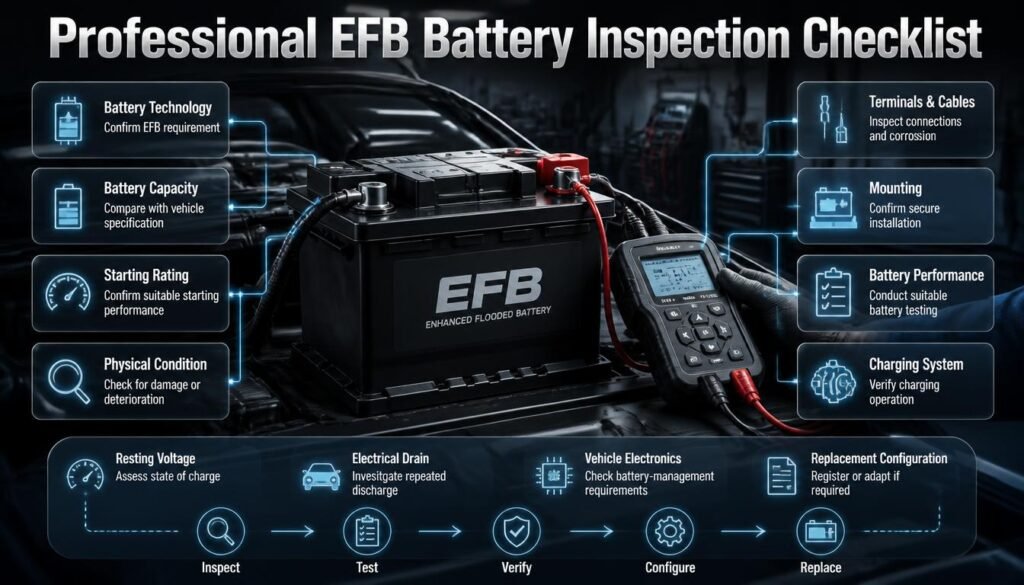
Before replacing an EFB battery, a technician can use the following checklist.
| Inspection Area | Professional Check |
|---|---|
| Battery technology | Confirm EFB requirement |
| Battery capacity | Compare with vehicle specification |
| Starting rating | Confirm suitable starting performance |
| Physical condition | Check for damage or deterioration |
| Terminals | Inspect tightness and corrosion |
| Cables | Check condition and connections |
| Mounting | Confirm secure installation |
| Resting voltage | Assess state of charge |
| Battery performance | Conduct suitable battery test |
| Charging system | Verify charging operation |
| Electrical drain | Investigate repeated discharge |
| Vehicle electronics | Check battery-management requirements |
| Replacement configuration | Register/adapt if required |
This checklist helps ensure that battery replacement is based on diagnosis rather than assumption.
Future Development of EFB Battery Technology
Automotive battery technology continues to evolve as vehicles become increasingly dependent on electrical systems.
Future development is likely to focus on improving:
- Cycle durability
- Charge acceptance
- Temperature resistance
- Manufacturing consistency
- Battery monitoring
- Energy-management integration
At the same time, AGM and other advanced battery technologies will continue to serve applications requiring different performance characteristics.
The broader automotive trend is clear: the 12-volt battery is becoming increasingly integrated with the vehicle’s electronic architecture.
Battery condition therefore matters not only for starting the engine but also for maintaining dependable operation of numerous electronic systems.
EFB Battery Construction: Expert Recommendations
For vehicle owners, several practical principles are worth remembering.
Use the Correct Battery Technology
If the vehicle requires EFB, use an appropriate EFB replacement unless the manufacturer or qualified technician confirms another compatible technology.
Test Before Replacement
A battery test can help determine whether replacement is actually necessary.
Check the Charging System
A battery cannot remain healthy if the charging system is not operating correctly.
Investigate Repeated Discharge
Repeated battery failure should trigger investigation into possible electrical drains or charging problems.
Consider Driving Conditions
Frequent short trips, heavy traffic, and extreme temperatures can influence battery performance.
Follow Manufacturer Requirements
Modern vehicles may require battery registration or other electronic procedures after installation.
Maintain the Whole Vehicle
Battery performance is only one part of vehicle reliability. Engine Diagnostics, Brake Repair, Oil Change, Suspension Repair, AC Repair, Tire Maintenance, Wheel Alignment, and other maintenance services can all contribute to dependable vehicle operation.
What Is EFB Battery Construction and How Is It Different From a Standard Flooded Battery?
An EFB, or Enhanced Flooded Battery, is essentially an improved form of the traditional flooded lead-acid battery. It still uses a liquid electrolyte, but its internal construction is optimized for the repeated charging and discharging that modern Start-Stop vehicles demand. Improvements can include enhanced plate structures, specialized separator arrangements, and materials that help stabilize the active material and improve charge acceptance.
The important difference is therefore not something you can judge simply by looking at the outside of the battery. Much of the engineering improvement is inside the case. A conventional flooded battery is primarily designed around dependable engine starting, while an EFB has to cope with substantially more frequent cycling and partial-state-of-charge operation.
Important construction points:
EFB uses a liquid electrolyte, unlike AGM’s absorbed electrolyte system.
Its internal design is optimized for greater cycling durability.
Enhanced plate and separator construction helps support repeated Start-Stop operation.
Better charge acceptance helps the battery recover energy more effectively between demands.
EFB sits between conventional flooded technology and AGM in terms of its intended application and performance.
That is why replacing an EFB battery simply because a conventional flooded battery has the same physical dimensions can be a poor decision. Battery technology is part of the vehicle’s specification, not just a matter of physical fit.
Why Do Start-Stop Vehicles Need an EFB Battery?
Start-Stop technology changes the job a car battery has to perform. Instead of starting the engine once at the beginning of a journey and then mainly supporting the vehicle while the engine runs, the battery may be involved in repeated engine restarts throughout everyday driving.
When the engine stops at a traffic light or during another temporary stop, the alternator is no longer generating power in the usual way. Meanwhile, electrical equipment can continue operating. When the engine needs to restart, the battery must immediately provide the required starting energy.
That repeated cycle creates considerably more battery stress than conventional vehicle operation. EFB batteries are specifically designed to provide better cycling performance and charge acceptance for these conditions.
For Start-Stop applications, the battery needs to handle:
Frequent engine restarts
Repeated charge and discharge cycles
Electrical loads while the engine is stopped
Partial-state-of-charge operation
Rapid recovery of charge between operating cycles
Consistent starting performance
This is also why a Start-Stop system may stop functioning when the battery condition becomes unsuitable. The vehicle’s energy-management system can restrict or disable Start-Stop operation when battery conditions do not meet the required operating parameters.
So, if a Start-Stop vehicle suddenly stops using its automatic engine-stop function, the battery should be considered as one possible cause, but not automatically assumed to be the only one. Charging-system condition, temperature, electrical demand, and the vehicle’s energy-management strategy can also influence Start-Stop operation.
Is an EFB Battery Better Than an AGM Battery?
There is no universal answer that makes one technology “better” for every vehicle. EFB and AGM are designed for different levels of demand, and the correct choice depends on the vehicle’s original specification and electrical architecture.
EFB remains a flooded battery technology with enhanced cycling capability. AGM uses an absorbent glass-mat construction that holds the electrolyte within the separator material. AGM is generally used where the vehicle requires higher cycling performance, stronger charge acceptance, greater vibration resistance, or more demanding electrical operation.
A useful way to look at the difference is:
Feature
EFB
AGM
Electrolyte
Liquid
Absorbed in glass mat
Construction
Enhanced flooded
Valve-regulated AGM
Cycling capability
High
Generally higher
Charge acceptance
Improved
Generally higher
Typical application
Basic/moderate Start-Stop
More demanding Start-Stop systems
Regenerative-braking applications
Vehicle dependent
Commonly suitable
Cost
Generally lower
Generally higher
An EFB-to-AGM upgrade may be possible on some vehicles, but it should be confirmed against the vehicle’s specifications and battery-management system. Conversely, an AGM battery should not simply be downgraded to EFB because the case size happens to match.
Before choosing between EFB and AGM, check:
Original battery technology
Battery capacity
Cold-cranking requirement
Vehicle energy-management system
Charging strategy
Physical dimensions
Battery-management-system requirements
Manufacturer specifications
The professional approach is not to install the most expensive battery available. It is to install the correct battery technology for that specific vehicle.
Can You Replace an EFB Battery With a Standard Flooded Battery?
A standard flooded battery should not be treated as an equivalent replacement for an EFB battery in a vehicle designed around EFB technology. Although both use liquid electrolyte, the internal construction and intended cycling capability are different. EFB batteries are specifically designed to tolerate the additional demands created by Start-Stop operation.
Installing a conventional battery may initially appear successful because the vehicle can still start. The problem can develop afterward. The replacement battery may experience substantially more cycling stress than it was designed to handle, potentially shortening its service life and affecting Start-Stop operation.
Before replacing an EFB battery, a technician should confirm:
The replacement is also suitable for Start-Stop operation.
The battery capacity matches the vehicle requirement.
The starting specification is appropriate.
The physical dimensions and terminal layout are correct.
The vehicle’s charging system is operating correctly.
Battery-management-system procedures are followed where applicable.
This distinction is particularly important because physical compatibility does not equal electrical compatibility.
If the vehicle originally uses EFB, the safest starting point is normally another correctly specified EFB battery. In some applications, an AGM upgrade may also be supported, but that decision should be based on the vehicle manufacturer’s requirements rather than made simply because AGM is considered a higher-performance technology.
How Do You Properly Test an EFB Battery Before Replacing It?
Testing an EFB battery properly is important because a weak starting symptom does not always mean that the battery itself has failed. The charging system, electrical connections, or an unwanted electrical drain can create similar symptoms.
EFB batteries should be tested using equipment and settings that correctly identify the EFB battery type. Industry diagnostic guidance emphasizes that using the wrong battery-type setting can produce misleading test results. Conductance-based testing is commonly used for evaluating modern battery condition.
A professional assessment should consider more than one measurement.
A proper diagnostic check can include:
Visual inspection: Check the case, terminals, mounting, cables, and visible damage.
State-of-charge assessment: Determine whether the battery is adequately charged before interpreting test results.
Battery health testing: Evaluate whether the battery can still provide the required starting performance.
Charging-system inspection: Confirm that the alternator and charging system are replenishing the battery correctly.
Electrical-drain investigation: If the battery repeatedly loses charge while parked, check for unwanted electrical consumption.
Vehicle-system verification: On modern vehicles, confirm any relevant battery-management or registration requirements.
This matters because replacing the battery without identifying the underlying problem can simply repeat the same failure.
For example, if an alternator is undercharging the battery, installing a brand-new EFB may temporarily improve starting performance but will not correct the charging fault. Likewise, if the vehicle has an abnormal electrical drain while parked, the new battery may eventually become discharged as well.
The professional approach is therefore simple: diagnose the battery, diagnose the charging system, understand the vehicle’s battery-management requirements, and only then decide whether replacement is necessary.
Conclusion
EFB battery construction is an important advancement in flooded lead-acid battery technology, developed to meet the higher cycling and electrical demands of many modern vehicles. By improving the design of the positive and negative plates, separators, active-material retention, internal connections, and overall battery structure, EFB technology provides greater durability and charge acceptance than a conventional flooded starting battery.
Understanding these internal components also explains why EFB batteries are commonly used in vehicles equipped with start-stop systems. Frequent engine restarts, electrical loads while the engine is stopped, and repeated charging and discharging cycles place additional demands on the battery. EFB construction is specifically designed to handle these conditions more effectively while maintaining dependable starting performance.
However, EFB does not mean that every battery will perform the same way under every condition. Extreme temperatures, repeated deep discharge, short-trip driving, charging-system faults, parasitic electrical drains, poor connections, and natural aging can all affect battery performance. This is why proper Battery Diagnostics should be carried out before assuming that a weak battery simply needs replacement.
When replacement is necessary, the correct battery should be selected according to the vehicle’s required technology, capacity, starting rating, dimensions, terminal arrangement, and electronic requirements. An EFB battery should not automatically be replaced with a conventional flooded battery, while an AGM upgrade should only be considered when it is compatible with the vehicle’s charging and battery-management system.
For vehicles operating in demanding conditions such as Dubai, regular battery testing and proper charging-system inspection can be especially valuable. Professional installation should also include checking the battery connections, mounting, charging behavior, and any required battery registration or adaptation.
Ultimately, EFB battery construction is about more than the battery case or its label. Its internal engineering determines how effectively the battery can deliver starting power, accept charge, withstand repeated cycling, and support the vehicle’s electrical system. Understanding this technology helps vehicle owners make better replacement decisions, recognize potential battery problems earlier, and maintain greater confidence in their vehicle’s overall electrical reliability.

Leave a Reply