
Introduction
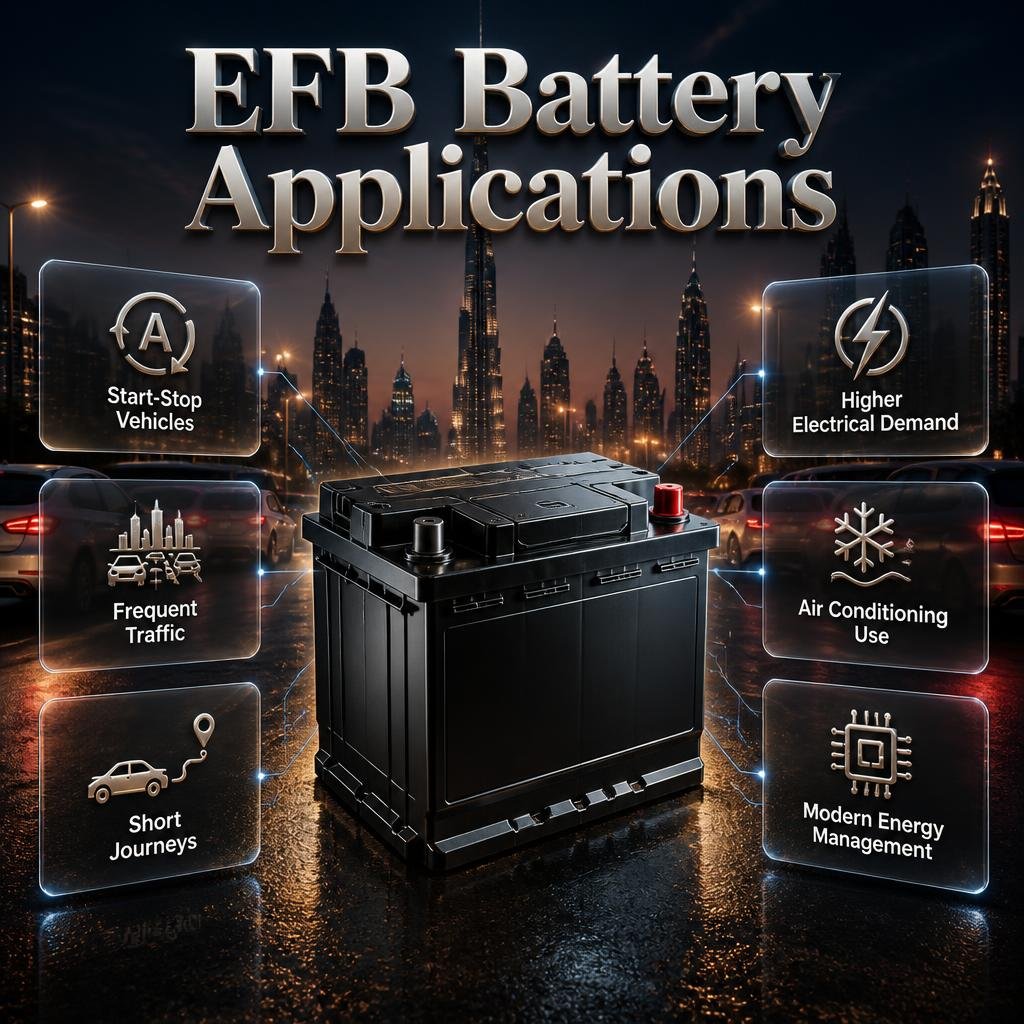
EFB Battery Applications | Modern vehicles depend on their batteries for much more than starting the engine. As manufacturers add start-stop technology, advanced electrical systems, driver-assistance features, comfort equipment, and increasingly sophisticated energy-management systems, the demands placed on the battery have changed significantly. This is where EFB Battery Applications become especially important.
An EFB, or Enhanced Flooded Battery, is an improved version of the conventional flooded lead-acid battery. It is designed to tolerate more frequent cycling and provide stronger performance in applications where a standard starter battery may experience greater stress. EFB technology is commonly associated with vehicles using simpler automatic start-stop systems, but it can also be used in certain vehicles without start-stop technology when the vehicle has demanding electrical or driving requirements.
For Dubai drivers, battery selection deserves particular attention. Frequent traffic, repeated short journeys, extensive use of air conditioning, and high ambient temperatures can all make reliable battery performance more important.
If you are researching battery replacement or vehicle battery compatibility in Dubai, EuroSwift Auto Services provides automotive support with battery inspection and replacement considerations based on the vehicle rather than simply installing a battery that physically fits.
Understanding where EFB batteries are used, how they differ from conventional and AGM batteries, and what should be checked before replacement can help vehicle owners make better maintenance decisions.
What Is an EFB Battery?
EFB stands for Enhanced Flooded Battery. It is a development of traditional flooded lead-acid battery technology designed to provide improved cycling capability and charge acceptance.
A conventional starter battery is primarily designed to deliver a strong burst of energy for engine starting and then recharge while the vehicle is driven. EFB technology is intended for situations where the battery may experience more frequent charge and discharge cycles.
Manufacturers use different construction techniques to improve EFB performance. For example, VARTA describes EFB as a further development of conventional lead-acid technology, with construction features intended to stabilize the active material and improve charging behavior. Exide similarly describes its EFB technology as being designed for vehicles with high cycling requirements, both with and without start-stop systems.
The practical difference is important because a vehicle that repeatedly starts, stops, powers electrical equipment, and operates under partial states of charge can place considerably more stress on a conventional starter battery.
Key characteristics of EFB technology
EFB batteries are generally associated with:
- Improved cycling capability
- Better charge acceptance than conventional starter batteries
- Reliable engine-starting performance
- Greater suitability for repeated engine restarts
- Better tolerance of demanding urban driving
- Compatibility with selected start-stop systems
- Higher suitability for certain vehicles with increased electrical demand
The exact specification still depends on the vehicle. Battery technology should never be selected based solely on the fact that an EFB battery offers enhanced performance.
Why Were EFB Batteries Developed?
The development of EFB technology is closely connected with the changing demands of modern vehicles.
Traditional vehicles generally start once, remain running for most of the journey, and allow the alternator to recharge the battery during normal driving. Start-stop vehicles operate differently. The engine may shut down while the vehicle is stopped and then restart automatically when driving is about to resume.
During these periods, electrical equipment can continue operating even though the engine is temporarily switched off. VARTA notes that start-stop vehicles place greater demands on the battery because of repeated engine starting and the need to continue supplying electrical consumers during stop phases.
This creates a different operating pattern:
Start → Drive → Stop → Electrical consumption → Restart → Recharge → Repeat
If this sequence happens repeatedly in heavy traffic, the battery needs stronger cycling capability than a basic starter battery.
EFB technology was developed to address this type of operating environment.
Main EFB Battery Applications
The most important EFB applications are associated with vehicles where the battery experiences repeated cycling but does not require the full performance characteristics of an AGM battery.
1. Entry-Level Start-Stop Vehicles
One of the best-known applications for EFB batteries is vehicles equipped with simpler automatic start-stop systems.
The system switches the engine off when certain conditions are met, such as stopping at traffic lights, and restarts it when the driver is ready to move.
This can increase the number of engine starts during a normal journey.
VARTA identifies EFB batteries as suitable for cars with simple automatic start-stop systems, while AGM technology is generally associated with more demanding start-stop applications and regenerative braking.
Why EFB works well in this application
An EFB battery is designed to tolerate repeated cycling more effectively than a conventional starter battery.
This makes it suitable for vehicles where:
- The engine starts and stops frequently
- Electrical loads remain active during stop phases
- The battery operates at varying states of charge
- The vehicle has moderate electrical requirements
- The manufacturer specifies EFB technology
2. Urban Driving Applications
EFB batteries can also be useful in vehicles that do not necessarily have start-stop technology but experience demanding urban driving conditions.
City driving often means:
- Frequent traffic lights
- Congestion
- Repeated low-speed operation
- Numerous engine starts
- Short journeys
- Heavy electrical accessory use
- Limited opportunities for full battery recovery
VARTA specifically identifies demanding urban traffic as one application for EFB batteries in vehicles without start-stop systems.
This is particularly relevant for drivers who spend much of their time in busy metropolitan areas.
However, an EFB battery should not be selected simply because someone drives in a city. The vehicle manufacturer’s specification remains the primary factor.
3. Vehicles With Higher Electrical Demand
Some vehicles do not use automatic start-stop but still have extensive electrical equipment.
Examples can include:
- Advanced infotainment
- Heated seats
- Electric steering systems
- Safety electronics
- Driver-assistance systems
- Navigation
- Multiple control modules
- Climate-control electronics
- Security systems
- Connected vehicle features
A vehicle with more electrical equipment can place greater demand on the battery, particularly when electrical consumers operate while the engine is off.
EFB technology can be appropriate for certain such vehicles where the manufacturer specifies it. VARTA lists vehicles without start-stop but with extensive equipment among possible EFB applications.
The important distinction is that electrical equipment alone does not determine battery technology. The vehicle’s original specification and energy-management system must be considered.
4. Short-Trip Vehicles
Short-distance driving can be demanding for automotive batteries.
When a vehicle is driven for only a few minutes, the charging system may have limited time to replace the energy consumed during starting and electrical operation.
Repeated short trips can therefore contribute to a battery operating at a lower state of charge.
For a vehicle designed around EFB technology, its enhanced cycling capability can make it more appropriate for this type of operating pattern than a conventional starter battery.
However, EFB does not eliminate the need for proper vehicle maintenance.
Drivers who regularly make short journeys should still pay attention to:
- Battery condition
- Charging-system performance
- Electrical drain
- Terminal condition
- Start-stop system warnings
- Changes in starting performance
5. Fleet and Commercial Applications
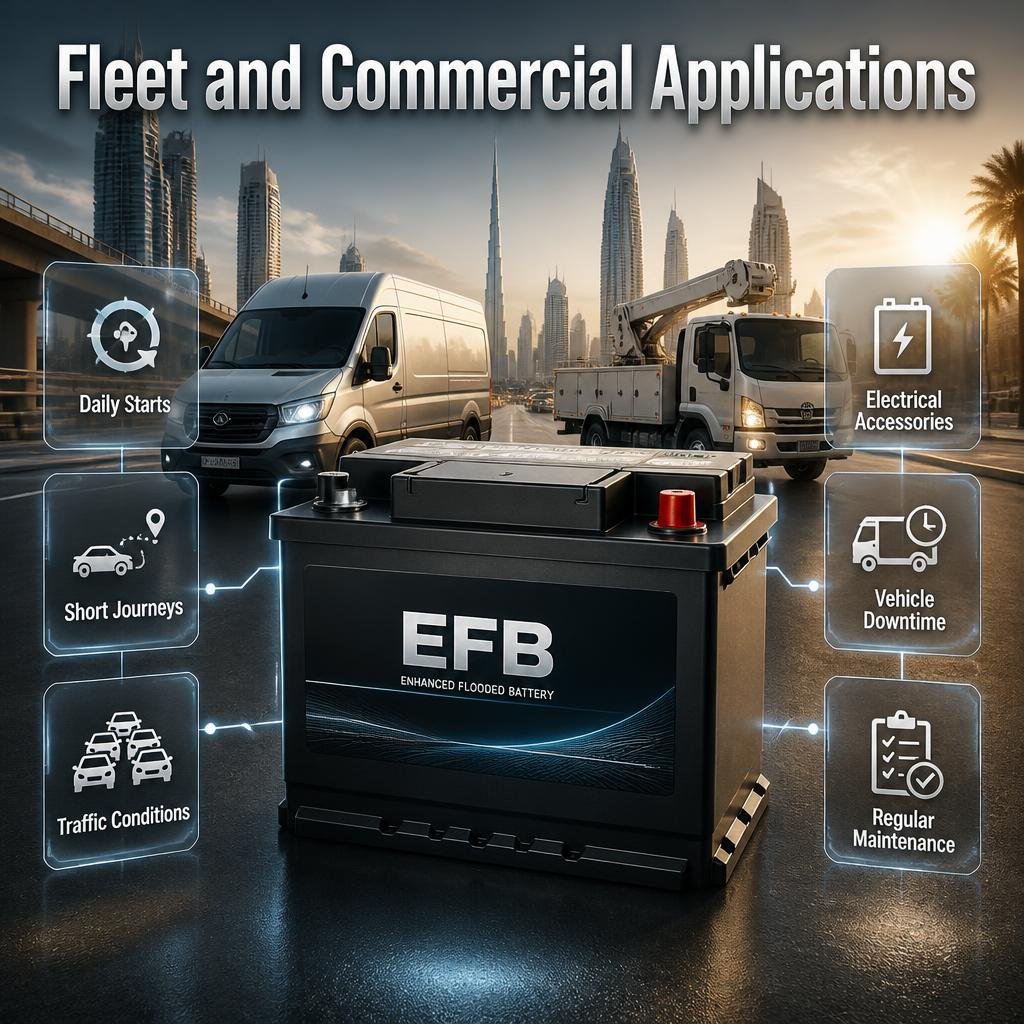
Some fleet vehicles can experience intensive daily operating cycles.
A delivery vehicle, service vehicle, or business car may start and stop considerably more often than a privately used vehicle. If the vehicle manufacturer specifies EFB technology, its cycling capability can make it suitable for these conditions.
Fleet operators should consider the complete operating pattern rather than simply looking at battery capacity.
Important factors include:
| Fleet factor | Why it matters |
|---|---|
| Daily starts | More starts increase cycling demand |
| Journey length | Short journeys may provide less recharge time |
| Traffic conditions | Stop-and-go driving increases battery activity |
| Electrical accessories | Additional loads increase energy consumption |
| Vehicle downtime | Long parking periods can affect battery state |
| Climate | Extreme temperatures influence battery performance |
| Maintenance schedule | Regular testing can identify deterioration earlier |
A professional battery inspection can be especially useful for vehicles that operate intensively.
EFB Battery Applications in Dubai
Dubai presents several operating conditions that make battery condition important.
Heavy traffic can create frequent stopping and restarting. Drivers may also rely heavily on air conditioning and other electrical equipment, particularly during hot weather.
These conditions do not automatically mean that every vehicle needs an EFB battery. Instead, they make correct battery selection and regular inspection more important.
For drivers looking specifically for car battery replacement near me in Dubai, the correct approach is to verify the existing battery technology, capacity, starting specification, physical fit, and vehicle requirements before installation.
Why climate matters
High temperatures can accelerate battery aging. Under-hood temperatures can also become significantly higher than the surrounding outdoor temperature.
A battery that is already approaching the end of its service life may therefore show problems sooner under demanding operating conditions.
Regular testing can help identify declining battery performance before the vehicle refuses to start.
How Start-Stop Systems Change Battery Requirements
Start-stop systems are designed to reduce unnecessary engine idling.
When the vehicle stops and the operating conditions allow it, the engine can shut down automatically. When the driver is ready to move, the system restarts the engine.
From the battery’s perspective, this creates repeated cycles.
A simplified sequence looks like this:
Engine running → Battery charging → Vehicle stops → Engine switches off → Electrical equipment remains active → Engine restarts → Battery recharges
A conventional starter battery may not be designed to handle this pattern repeatedly.
EFB batteries provide improved cycling capability for appropriate applications, while AGM batteries are generally used where the demands are higher.
This is one reason why installing the wrong battery technology can create problems even when the replacement battery physically fits.
EFB vs Conventional Battery
Understanding the difference between EFB and conventional flooded batteries is important when selecting a replacement.
| Feature | Conventional Flooded | EFB |
|---|---|---|
| Basic engine starting | Yes | Yes |
| Repeated cycling | More limited | Improved |
| Entry-level start-stop | Generally unsuitable | Common application |
| Urban demanding use | Standard capability | Better suited where specified |
| Charge acceptance | Standard | Improved |
| Electrical demand | Basic/moderate | Moderate/higher depending on application |
| Technology | Traditional flooded | Enhanced flooded |
| Replacement choice | Vehicle dependent | Vehicle dependent |
EFB is not simply a larger conventional battery. Its construction and intended operating profile are different.
EFB vs AGM: Understanding the Application Difference
EFB and AGM are both used in modern vehicles, but they are designed for different levels of demand.
VARTA describes EFB as suitable for simpler start-stop systems and certain demanding non-start-stop applications, while AGM is intended for more demanding systems, including vehicles with regenerative braking and extensive electrical equipment.
| Application | EFB | AGM |
|---|---|---|
| Simple start-stop | Common | Yes |
| Urban driving without start-stop | Possible | Possible, depending on specification |
| Moderate electrical demand | Suitable where specified | Suitable |
| Advanced start-stop | Vehicle dependent | Common |
| Regenerative braking | More limited | Designed for demanding applications |
| Premium electrical equipment | Vehicle dependent | Common |
| AGM-original vehicle | Not appropriate as downgrade | Required |
| EFB-original vehicle | Standard replacement option | Possible upgrade in some applications |
The most important point is that battery technology should follow vehicle requirements.
If a vehicle originally uses AGM, replacing it with EFB is not generally recommended because the vehicle’s energy-management system may be designed around AGM performance.
Can an EFB Battery Replace a Conventional Battery?
In some vehicles, an EFB battery can be appropriate where the vehicle specification allows it.
However, upgrading to EFB should not be treated as a universal rule.
Before making the change, a technician should consider:
- Battery dimensions
- Ah capacity
- Cold-cranking performance
- Terminal configuration
- Charging-system requirements
- Battery-management system
- Vehicle programming requirements
- Original battery technology
- Electrical load
If the vehicle manufacturer specifies a conventional battery, an EFB may or may not be an approved alternative.
The safest approach is to verify compatibility using the vehicle’s exact make, model, engine, model year, and original battery specification.
Can an EFB Battery Replace an AGM Battery?
This is a much more important distinction.
If the vehicle originally uses AGM technology, moving down to EFB can compromise the battery’s ability to meet the demands of the vehicle’s energy-management system.
VARTA specifically states that downgrading from AGM to EFB is not recommended because the vehicle’s energy-management system is designed around the required battery performance.
Therefore:
AGM → AGM: Normally required where AGM is specified.
EFB → EFB: Standard replacement approach.
EFB → AGM: May be possible as an upgrade in compatible applications.
AGM → EFB: Generally not recommended.
The exact procedure should always be checked against the vehicle manufacturer’s requirements.
EFB Battery Construction and Performance
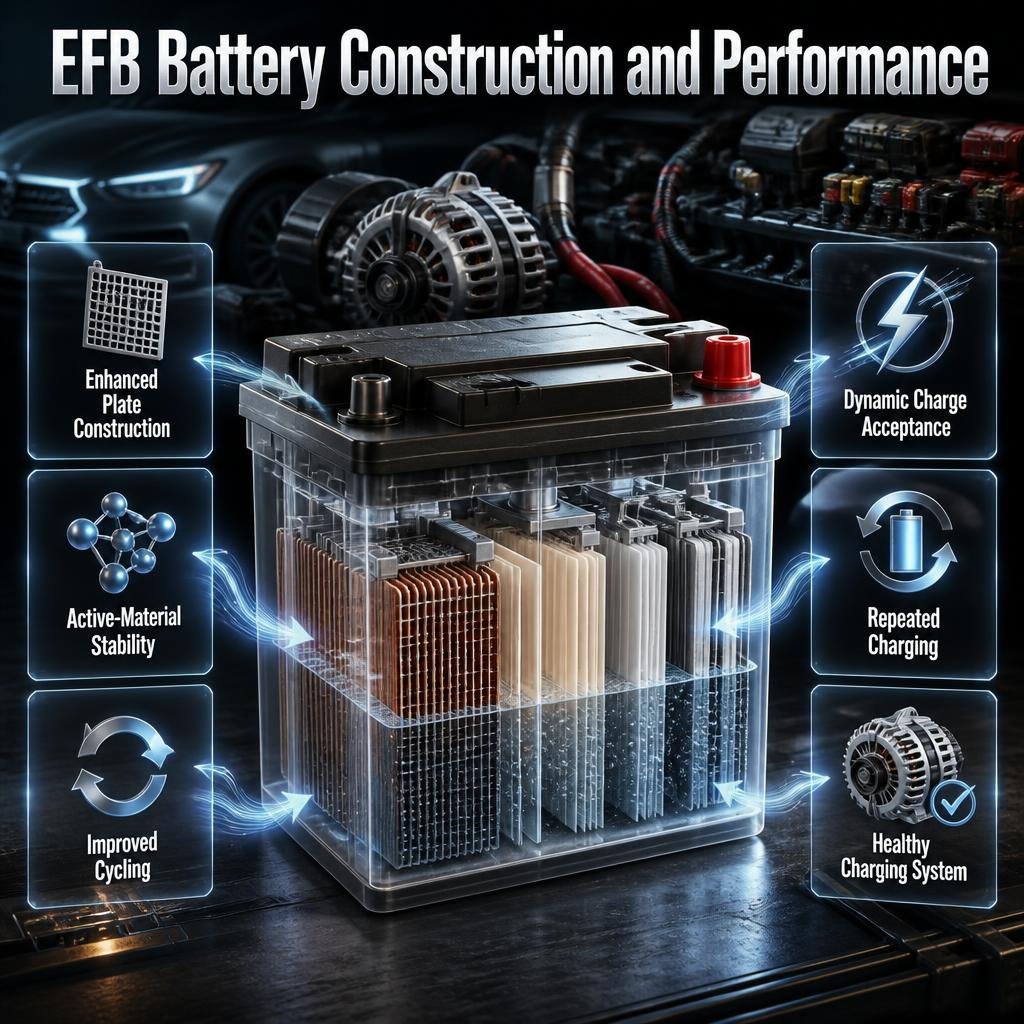
EFB batteries retain the basic flooded lead-acid architecture but incorporate design improvements intended to increase cycling performance.
VARTA describes the use of a polyvlies material on the positive plate to help stabilize active material and separators designed to support charging performance.
Exide describes its EFB technology as using enhanced plate construction and active-material design to improve cyclability and dynamic charge acceptance.
These engineering changes are important because battery performance is influenced by how well the internal components withstand repeated charging and discharging.
The goal is not simply to produce more starting power. It is to create a battery better suited to a particular operating cycle.
EFB Battery Charge Acceptance
Charge acceptance is especially important in modern vehicles.
A battery may need to accept energy quickly during periods when the charging system has an opportunity to replenish it.
This becomes increasingly relevant in vehicles where the battery operates through repeated cycles.
Exide identifies high dynamic charge acceptance as one of the characteristics of its EFB technology.
However, good charge acceptance cannot compensate for a defective charging system.
If the alternator, voltage regulation, wiring, terminals, or battery-management system has a problem, simply installing a new battery may not solve the underlying issue.
EFB Battery Applications and Regenerative Braking
Regenerative braking changes how energy is managed in certain modern vehicles.
During braking or deceleration, the vehicle can recover some energy and direct it into the electrical system.
This creates a more complex charging environment than the traditional model of simply running the alternator continuously.
AGM batteries are commonly used for more demanding start-stop systems involving regenerative braking, while EFB applications depend on the specific vehicle architecture.
This is why battery selection should not be based solely on whether the vehicle has start-stop.
A vehicle with advanced energy recovery may have substantially different battery requirements from a basic start-stop vehicle.
How to Identify Whether Your Vehicle Uses EFB
The first step is to inspect the battery currently installed.
Look for:
- EFB designation
- Battery part number
- Manufacturer specifications
- Ah rating
- CCA rating
- Voltage
- Dimensions
- Technology marking
Then compare the information with the vehicle’s owner’s manual or manufacturer specification.
A professional battery service should also consider the vehicle’s electronic system.
Modern vehicles may use a battery sensor and battery-management system. VARTA notes that incorrect battery technology or incorrect registration can contribute to reduced service life and problems with vehicle functions.
EFB Battery Replacement: What Should Be Checked?
A professional replacement should involve more than removing the old battery and installing a new one.
1. Battery Technology
Confirm whether the vehicle requires EFB, AGM, or conventional flooded technology.
2. Capacity
Check the specified Ah capacity.
3. Cold-Cranking Rating
Confirm that the replacement provides appropriate starting performance.
4. Physical Dimensions
The battery must fit correctly into the original mounting position.
5. Terminal Layout
The terminal arrangement must match the vehicle’s wiring.
6. Charging System
Test the charging system before declaring the old battery responsible for the problem.
7. Battery Management
Some vehicles require battery registration or adaptation following replacement.
8. Start-Stop Function
Where applicable, verify that the start-stop system operates correctly after installation.
Why Battery Registration Can Matter
Modern vehicles increasingly integrate the battery into the vehicle’s electronic management system.
A battery sensor can monitor information related to battery condition and electrical consumption. The vehicle’s energy-management system can then adjust charging behavior accordingly.
If the vehicle requires battery registration and the procedure is skipped, the system may not properly recognize the new battery.
VARTA specifically notes that many modern vehicles require new batteries to be registered so that the Battery Management System knows what type of battery has been installed.
This is one reason professional battery replacement is more involved than simply changing a battery.
Signs That an EFB Battery May Need Attention
An EFB battery approaching the end of its useful service life may show warning signs.
These can include:
Slow Engine Cranking
The starter may turn the engine more slowly than normal.
Start-Stop System Deactivation
The start-stop function may stop operating because the vehicle determines that battery condition or charge level is insufficient.
Repeated Starting Problems
The vehicle may require assistance after sitting for an extended period.
Battery Warning Messages
Modern vehicles can display battery or charging-system warnings.
Electrical Irregularities
Some electrical functions may behave differently when the battery is weak.
Poor Test Results
A professional battery test may reveal reduced starting performance or declining battery health.
These symptoms should not automatically be interpreted as battery failure. A charging-system problem, parasitic drain, poor connection, or another electrical fault can create similar symptoms.
EFB Battery Diagnostic Process
Before replacing an EFB battery, a structured inspection is useful.
| Diagnostic step | What it checks |
|---|---|
| Visual inspection | Damage, leakage, corrosion |
| Terminal inspection | Connection quality |
| Battery voltage test | Electrical state |
| Battery health test | Starting and internal condition |
| Charging-system test | Alternator/charging performance |
| Electrical-load assessment | Abnormal consumption |
| Vehicle scan | Relevant electronic faults |
| Battery specification check | Correct replacement |
| BMS assessment | Battery-management requirements |
This approach reduces the chance of replacing a battery when the real problem lies elsewhere.
For broader electrical or mechanical concerns, professional car service can help identify related maintenance requirements rather than treating the battery as an isolated component.
Common Mistakes When Choosing an EFB Battery
Choosing Only by Physical Size
Two batteries may look similar but have completely different performance specifications.
Selecting the Cheapest Battery
Price should not be the only consideration. A battery must match the vehicle’s requirements.
Ignoring Battery Technology
Installing a conventional battery where EFB is required can result in poor cycling performance.
Downgrading AGM to EFB
This can be inappropriate for vehicles designed around AGM technology.
Ignoring the Charging System
A defective alternator can damage or repeatedly discharge a new battery.
Forgetting Battery Registration
Where the vehicle requires registration, skipping this procedure can interfere with proper energy management.
Waiting for Complete Failure
Testing the battery before complete failure can help reduce the risk of an unexpected breakdown.
EFB Battery Brands and Vehicle Compatibility
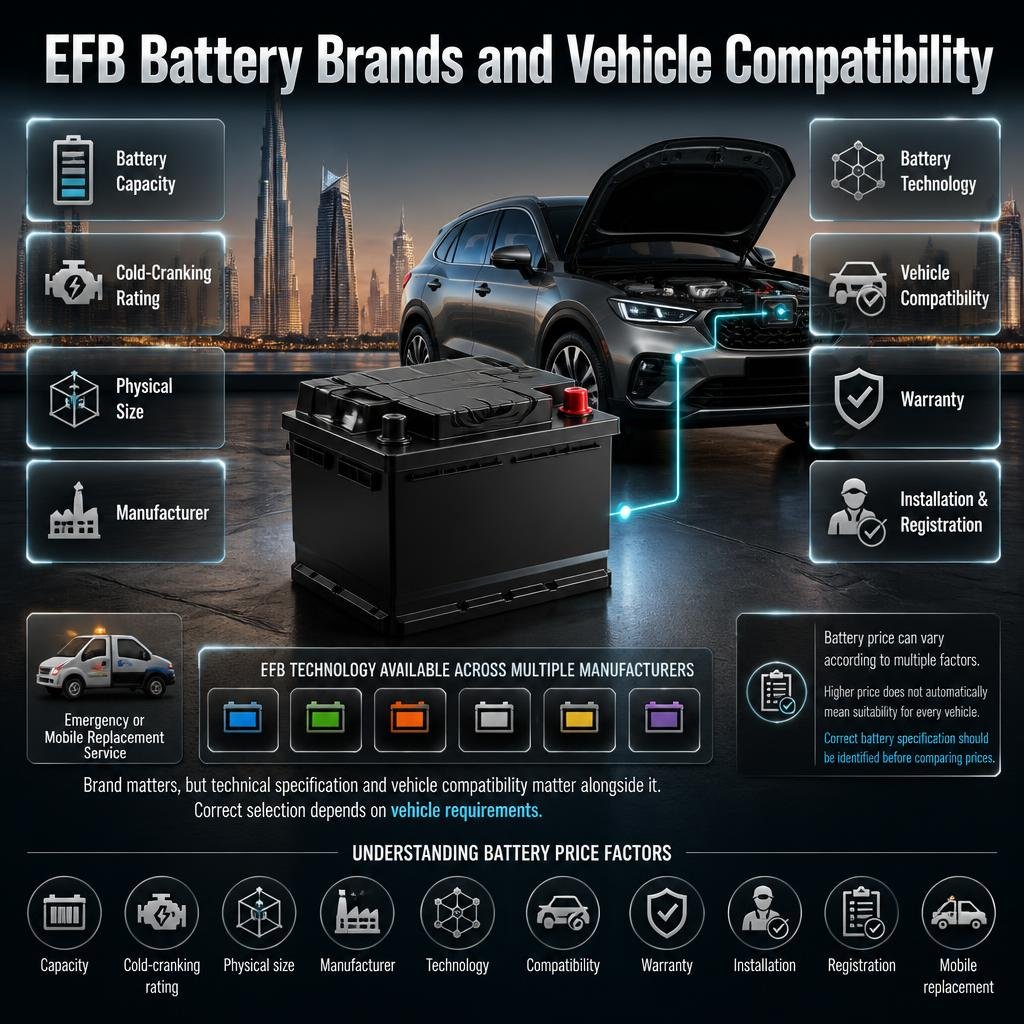
EFB technology is available across multiple automotive battery manufacturers.
When selecting a replacement, the brand should be considered alongside the actual technical specification.
For example, drivers researching different battery manufacturers can review:
- Amaron car battery replacement in Dubai
- Bosch car battery replacement in Dubai
- Tuflong car battery replacement in Dubai
- Exide genuine car battery replacement in Dubai
- Panasonic car battery replacement in Dubai
- FIAMM car battery replacement in Dubai
- ACDelco car battery replacement in Dubai
These resources can be useful when researching brand-specific availability, but the correct battery should still be determined by the vehicle’s required specifications.
Understanding Battery Price Factors
The price of an EFB battery can vary depending on several factors.
These include:
- Battery capacity
- Cold-cranking rating
- Physical size
- Manufacturer
- Battery technology
- Vehicle compatibility
- Warranty
- Installation requirements
- Battery registration
- Emergency or mobile replacement service
A higher price does not automatically mean a battery is appropriate for every vehicle.
Before comparing prices, it is better to identify the correct battery specification.
For a broader overview of market factors, the complete guide to car battery prices in Dubai can help put battery pricing into context.
EFB Battery Maintenance Tips
Although EFB batteries are designed for demanding applications, they still benefit from proper maintenance.
Monitor Starting Performance
Notice changes in engine cranking speed.
Test Before Problems Become Severe
Periodic testing can reveal declining performance.
Inspect Battery Connections
Loose or corroded terminals can create starting and charging problems.
Check the Charging System
A healthy battery cannot compensate for a charging-system fault.
Pay Attention to Start-Stop Warnings
If the system repeatedly disables itself, investigate the reason rather than ignoring the warning.
Avoid Unnecessary Electrical Loads
Leaving electrical accessories active while the engine is off can consume stored battery energy.
Consider Driving Patterns
Frequent short journeys may place more stress on the battery than longer trips.
EFB Applications for Heavy Urban Traffic
Urban traffic is one of the clearest real-world examples of demanding battery operation.
Consider a typical journey:
Start at home → Drive through traffic → Stop at signals → Engine shuts down → Electrical systems remain active → Engine restarts → Repeat
This process can happen numerous times.
In a vehicle designed for EFB use, the battery is engineered to handle this type of cycling better than a conventional starter battery.
However, if the vehicle uses a more advanced start-stop system, AGM may be the specified technology.
The battery must therefore be matched to the vehicle’s architecture rather than selected solely because the driving environment is demanding.
EFB Applications in Vehicles With Comfort Features
Modern comfort features can increase electrical demand.
Examples include:
- Heated seats
- Electric windows
- Infotainment
- Navigation
- Cabin lighting
- Air-conditioning controls
- Electronic steering
- Security systems
- Driver-assistance systems
During normal driving, the charging system supplies electrical power while also replenishing the battery.
During engine-off periods, however, the battery becomes more important because electrical consumers may continue operating.
This is another reason why modern start-stop systems require battery technology designed for the application.
EFB Battery Applications and Vehicle Safety Systems
Modern vehicles increasingly depend on electronic safety systems.
Driver-assistance features can include:
- Parking assistance
- Lane-related systems
- Collision-warning functions
- Cameras
- Radar-based systems
- Electronic stability functions
- Sensors and control modules
Battery condition does not determine whether a particular safety system exists, but stable electrical supply is important to the operation of modern vehicle electronics.
Exide also highlights the role of its EFB products in supporting auxiliary systems and driver-assistance-related electrical requirements.
For this reason, battery maintenance has become part of broader electronic vehicle maintenance rather than simply a starting-system concern.
When Professional Battery Replacement Makes Sense
Professional battery replacement is particularly useful when:
- The vehicle has start-stop technology
- The battery technology is unclear
- The vehicle uses a battery-management system
- The battery is located in a difficult position
- The vehicle has extensive electrical equipment
- Battery registration may be required
- The vehicle has experienced repeated battery failures
- Charging-system problems are suspected
A professional technician can inspect the battery, confirm the specification, check the charging system, and determine whether additional diagnostic work is needed.
If a vehicle has already stopped starting, car jumpstart and roadside assistance may be required before a permanent battery solution can be arranged.
EFB Battery Applications: Professional Selection Checklist
Before installing an EFB battery, confirm:
✔ The vehicle manufacturer allows EFB technology
✔ The original battery is EFB or an approved compatible technology
✔ Battery dimensions are correct
✔ Ah rating is appropriate
✔ CCA rating is suitable
✔ Terminal position is correct
✔ Mounting arrangement is secure
✔ Charging system is functioning correctly
✔ Battery-management requirements are understood
✔ Registration/adaptation is completed if required
✔ Start-stop functionality is checked after installation
This checklist helps prevent the common mistake of choosing a battery based solely on physical compatibility.
Future of EFB Battery Applications
Automotive electrical systems continue to evolve.
Manufacturers are increasingly focused on:
- Better energy efficiency
- Reduced unnecessary idling
- More sophisticated energy management
- Greater electrical equipment
- Driver-assistance technology
- Hybridized vehicle systems
- More efficient charging strategies
EFB technology remains relevant for applications that require enhanced cycling without the full requirements of more demanding AGM systems.
At the same time, AGM and other battery technologies continue to serve vehicles with higher electrical and energy-management demands.
The future is therefore unlikely to be about one battery technology replacing every other type. Instead, vehicle manufacturers will continue matching battery technology to the architecture and energy requirements of each vehicle.
EFB Battery Applications: Quick Comparison Guide
| Application | EFB suitability |
|---|---|
| Conventional vehicle with low electrical demand | Usually unnecessary unless specified |
| Vehicle with simple start-stop | Common |
| Urban vehicle with demanding cycling | Can be suitable |
| Vehicle with extensive electrical equipment | Possible where specified |
| Short-trip vehicle | Can be suitable where specified |
| Advanced start-stop with regenerative braking | AGM often specified |
| Premium high-electrical-demand vehicle | AGM often used |
| Vehicle originally equipped with AGM | Do not downgrade without manufacturer approval |
| Vehicle originally equipped with EFB | EFB is the normal replacement technology |
What are EFB batteries mainly used for?
EFB batteries are mainly designed for vehicles that experience more frequent battery cycling than a conventional flooded starter battery can comfortably handle. Their most common application is in vehicles equipped with automatic start-stop systems, where the engine can switch off and restart repeatedly during normal driving. EFB technology is also used in some vehicles without start-stop when they experience demanding urban driving, frequent short journeys, or relatively high electrical loads.
The important point is that an EFB battery is selected according to the vehicle’s electrical architecture and manufacturer’s specification. It should not be chosen simply because the vehicle is used in traffic or because an EFB is marketed as a more advanced battery.
Key application factors include:
Factory-installed start-stop technology
Frequent engine starting and stopping
Regular urban or stop-and-go driving
Higher cycling requirements
Moderate electrical loads
Vehicle manufacturer approval for EFB technology
For a replacement, the original battery type, capacity, cold-cranking rating, dimensions, and charging requirements should all be checked before installation.
Can an EFB battery be used in a car without a start-stop system?
Yes, an EFB battery can be appropriate for certain vehicles without start-stop technology, particularly where the vehicle experiences demanding cycling or has greater electrical requirements. EFB applications are not limited exclusively to start-stop vehicles; manufacturers also identify certain non-start-stop vehicles with demanding urban use or extensive electrical equipment as suitable applications.
However, this does not mean an EFB battery should automatically replace every conventional battery. Battery selection needs to follow the vehicle’s specifications rather than the assumption that a higher-performance battery is always necessary.
Before choosing an EFB for a non-start-stop vehicle, check:
Original battery technology
Required Ah capacity
Cold-cranking performance
Battery dimensions
Terminal configuration
Charging-system compatibility
Manufacturer’s recommended battery type
If the vehicle already operates correctly with a conventional battery and has relatively low electrical and cycling demands, an EFB upgrade may provide little practical benefit. The correct battery is the one that properly matches the vehicle’s design and operating requirements.
What is the difference between an EFB and AGM battery?
EFB and AGM batteries are both designed for applications that can place greater demands on a battery than a basic conventional starter battery, but they are intended for different levels and types of vehicle requirements. EFB is commonly associated with simpler start-stop systems and certain demanding non-start-stop applications, while AGM is generally used for more demanding start-stop systems, higher electrical loads, and applications involving regenerative braking.
AGM batteries use an absorbent glass mat construction that keeps the electrolyte held within the separator material. This design supports high cycling performance and makes AGM suitable for vehicles with more intensive energy-management requirements.
A practical comparison is:
EFB: Enhanced flooded technology for moderate-to-high cycling applications
AGM: More advanced cycling technology for demanding electrical applications
EFB: Common in simpler start-stop systems
AGM: Common in advanced start-stop systems
EFB: Can suit selected non-start-stop vehicles
AGM: Often specified for vehicles with extensive electrical demands
The important issue is compatibility rather than simply deciding that AGM is “better.” If a vehicle was engineered around EFB, EFB may be the appropriate replacement. If it was designed around AGM, downgrading to EFB can be unsuitable because the vehicle’s energy-management system may depend on AGM-level performance.
Can I replace my EFB battery with an AGM battery?
An EFB-to-AGM upgrade can be possible in some vehicles, but it should only be considered after confirming compatibility with the vehicle’s electrical system and battery-management strategy. AGM technology can provide higher cycling capability, but installing a different battery technology does not automatically improve every vehicle.
The vehicle’s battery-management system, charging strategy, physical battery dimensions, capacity, cold-cranking requirements, and manufacturer recommendations all need to be considered. In some applications, the vehicle may also require battery registration or adaptation after replacement.
Before upgrading from EFB to AGM, verify:
AGM is approved for the specific vehicle
Physical dimensions and mounting are correct
Capacity is appropriate
Starting specification is suitable
Charging system supports the application
Battery-management system is compatible
Registration or coding requirements are completed where applicable
An upgrade should therefore be treated as a vehicle-specific technical decision, not simply a purchase decision. If the existing EFB battery is correctly specified and performing normally, there may be no reason to change technology simply for the sake of upgrading.
Does an EFB battery need to be registered after replacement?
Battery registration depends on the vehicle. Many modern vehicles use a battery-management system that monitors battery condition, charging behavior, electrical consumption, and other parameters. Where the vehicle requires registration, the new battery should be registered or adapted after installation so the system can correctly manage the replacement battery.
This is particularly important in vehicles with start-stop technology and sophisticated energy-management systems. Simply installing the battery without completing a required electronic procedure can prevent the vehicle from properly recognizing the new battery.
A professional replacement may include:
Confirming the correct EFB specification
Installing the replacement battery
Checking battery connections
Testing the charging system
Registering or adapting the battery where required
Checking relevant battery-management information
Verifying start-stop operation
Not every vehicle requires the same procedure, so registration should never be assumed to be necessary—or unnecessary—without checking the specific vehicle. A technician should determine the correct procedure from the vehicle’s system and manufacturer requirements.
Conclusion
EFB batteries have become an important battery technology for vehicles that require stronger cycling performance, better charge acceptance, and dependable support for modern electrical systems. They are particularly well suited to start-stop vehicles, frequent urban driving, short-trip use, and applications where a conventional battery may not provide the required level of durability.
Choosing the right EFB battery is not simply about selecting a battery with the correct physical size. Vehicle compatibility, electrical requirements, battery capacity, starting performance, charging system condition, and the vehicle’s battery-management system should all be considered before replacement. Correct installation and, where required, battery registration help ensure that the new battery works properly with the vehicle’s charging strategy.
For drivers in Dubai, demanding traffic conditions, frequent short journeys, high electrical loads, and the local climate can make reliable battery performance especially important. Regular testing can help identify declining battery performance before a starting problem leaves the vehicle stranded. When replacement becomes necessary, professional inspection and correct battery matching provide a more dependable solution.
As vehicle electrical systems and start-stop technologies continue to develop, EFB batteries remain a practical option for many applications. Understanding where EFB technology fits, how it differs from conventional and AGM batteries, and what your vehicle actually requires allows you to make a more informed battery replacement decision and maintain dependable everyday vehicle performance.
Leave a Reply