
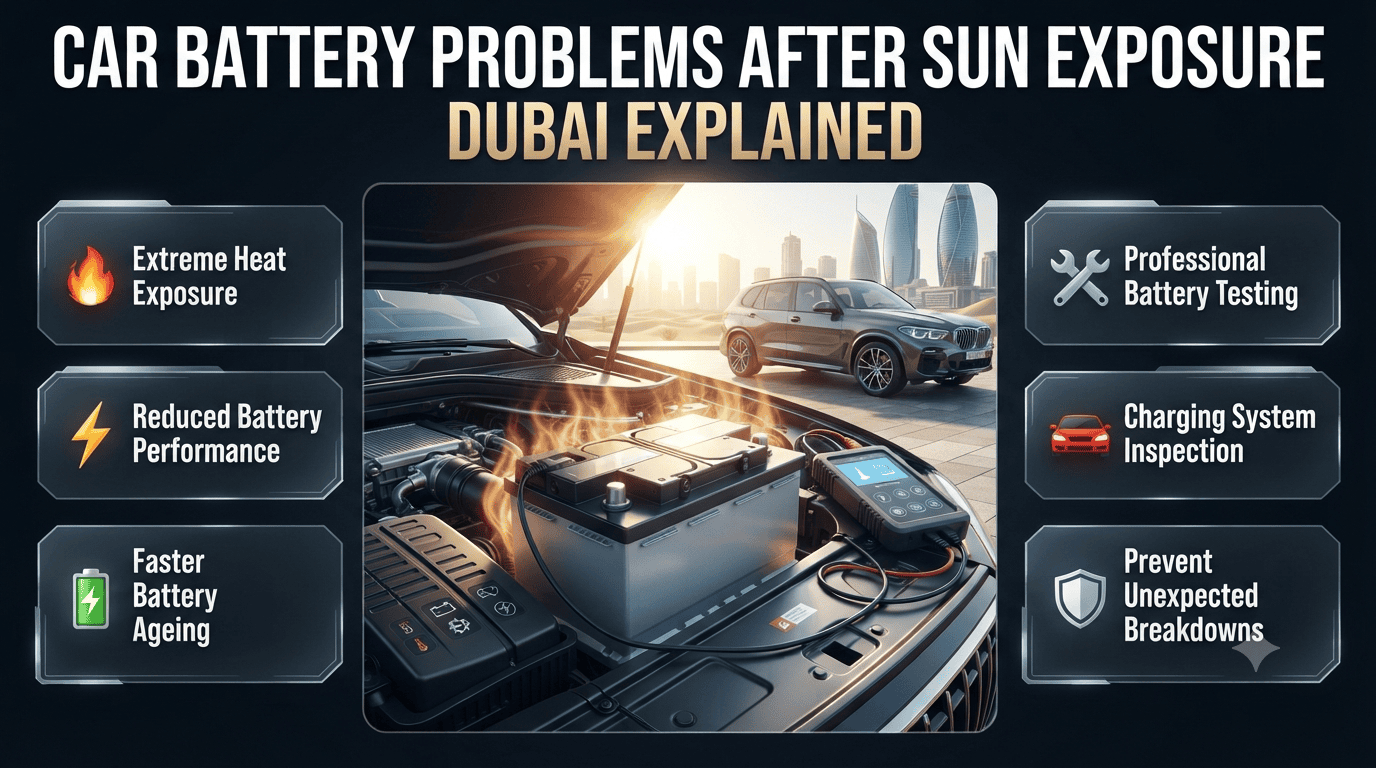
A car battery problem after sun exposure Dubai can occur without warning. Your vehicle may start perfectly in the morning but refuse to crank after spending the afternoon in an uncovered parking area. Modern vehicles are even more vulnerable because advanced electronics, start-stop systems, digital displays, GPS modules, and multiple control units continue drawing power even after the engine is switched off.
Professional diagnosis is essential because not every starting issue is caused by a failed battery. Charging system faults, alternator problems, excessive parasitic drain, or damaged battery terminals may produce similar symptoms. That’s why experienced technicians at EuroSwift Auto Services perform a complete electrical system inspection before recommending a repair or replacement.
Understanding how Dubai’s climate affects battery performance helps drivers avoid unexpected roadside breakdowns, extend battery lifespan, and maintain dependable vehicle reliability throughout the year.
Why Sun Exposure Damages Car Batteries Faster in Dubai
Dubai’s climate is among the harshest operating environments for automotive batteries. During summer, ambient temperatures frequently exceed 45°C, while engine bay temperatures after parking under direct sunlight can become significantly higher.
Unlike cold weather, which temporarily reduces battery efficiency, prolonged heat causes permanent internal damage. Excessive temperatures accelerate chemical reactions inside the battery, increasing corrosion, reducing electrolyte levels, and weakening the lead plates responsible for storing electrical energy.
Once this deterioration begins, battery performance gradually declines until the vehicle eventually struggles to start.
Several environmental conditions contribute to faster battery wear.
✔ Direct sunlight for several hours
✔ High ambient temperatures
✔ Heat trapped beneath the bonnet
✔ Heavy traffic with constant air-conditioning use
✔ Daily stop-and-go commuting
✔ High electrical demand from modern electronics
✔ Long periods of outdoor parking
Professional Battery Replacement becomes necessary once these combined conditions permanently reduce the battery’s ability to hold a full charge.
How Extreme Heat Changes Battery Chemistry
Every automotive battery relies on controlled chemical reactions between lead plates and electrolyte solution.
Heat speeds up these reactions beyond their ideal operating range. Initially, this may allow the battery to produce strong cranking power, but over time it significantly shortens battery life.
Continuous overheating may lead to:
- Increased internal corrosion
- Faster electrolyte evaporation
- Plate sulphation
- Reduced reserve capacity
- Higher internal resistance
- Declining Cold Cranking Amps (CCA)
Unlike normal ageing, heat-related deterioration cannot be reversed through charging alone.
Why Modern Cars Are More Vulnerable
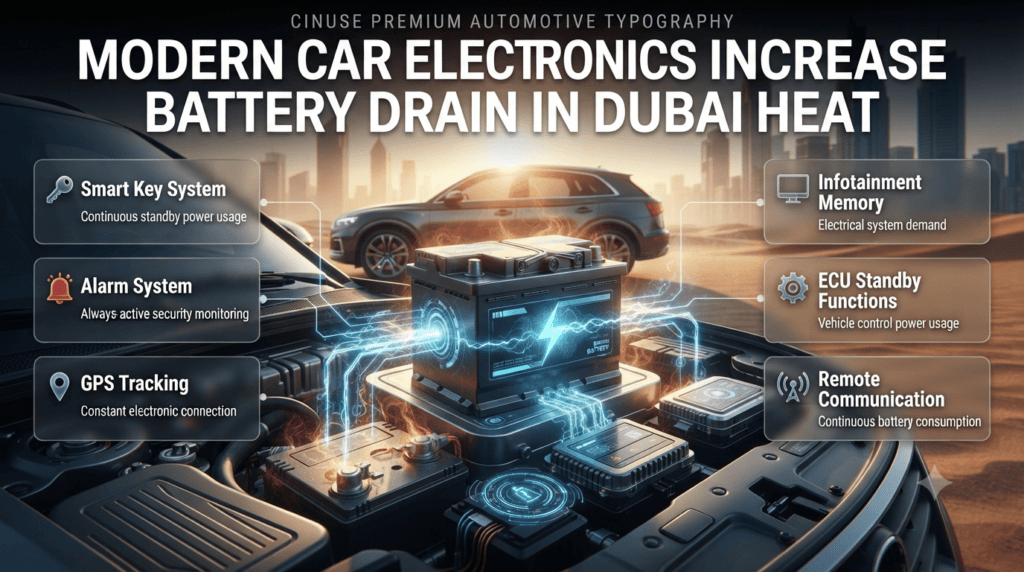
Today’s vehicles depend on dozens of electronic control modules that remain active even after the ignition is switched off.
These systems may include:
- Smart key receivers
- Alarm systems
- GPS tracking
- Infotainment memory
- ECU standby functions
- Remote communication modules
As these components continue consuming small amounts of electricity, a weakened battery exposed to Dubai’s heat loses its remaining reserve much faster than older vehicle designs.
Heat Exposure and Its Effect on Battery Performance
| Environmental Condition | Effect on Battery | Long-Term Result |
|---|---|---|
| Direct sunlight | Increased battery temperature | Accelerated ageing |
| High engine bay heat | Plate corrosion | Reduced battery capacity |
| Long outdoor parking | Electrolyte evaporation | Shorter battery lifespan |
| Heavy city traffic | Frequent charging cycles | Increased wear |
| Continuous electronic load | Faster discharge | Hard starting |
Common Situations That Cause Battery Problems After Sun Exposure
Battery failures usually develop gradually rather than occurring instantly. In many cases, a battery has already been weakened by months of heat exposure before finally failing during one particularly hot afternoon.
Several everyday situations increase the likelihood of heat-related battery problems.
Office Parking
Vehicles parked outside office buildings from morning until evening remain under continuous solar radiation for several hours.
When drivers attempt to leave work, the battery may no longer produce sufficient starting power, particularly if it is more than two years old.
Airport Long-Term Parking
Leaving a vehicle parked at the airport for several days combines continuous electrical drain with prolonged heat exposure.
Security systems, keyless entry modules, and onboard computers continue operating while the battery receives no charging from the alternator.
If the battery was already weakened, professional Car Jumpstart services may restore temporary operation, although complete testing is recommended before continuing regular use.
Shopping Centres and Outdoor Parking Areas
Frequent short trips followed by parking in open areas prevent the alternator from fully recharging the battery.
Repeated heating and cooling cycles gradually reduce battery efficiency until noticeable starting problems begin appearing.
Outdoor Residential Parking
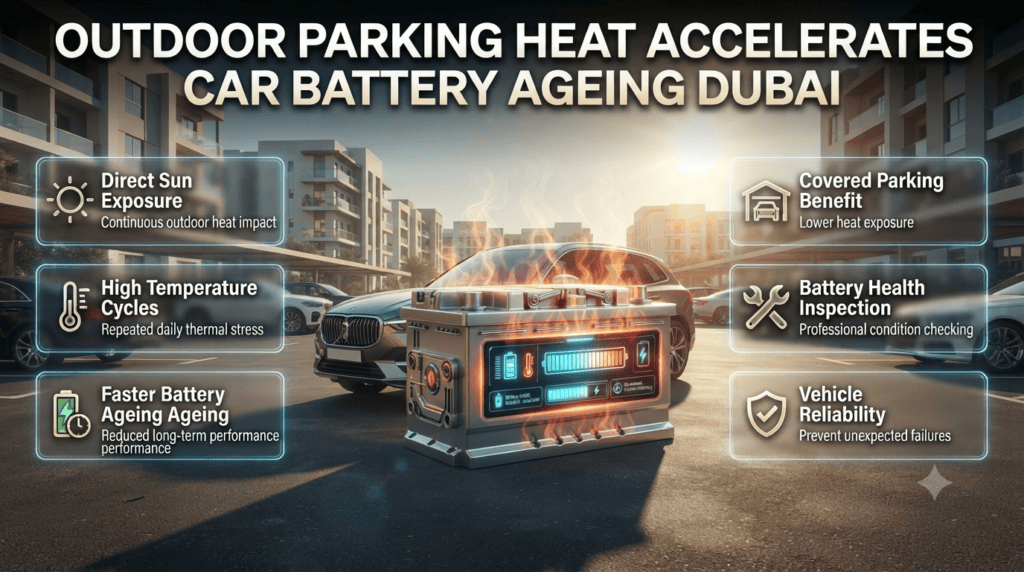
Many residential communities rely primarily on outdoor parking.
Vehicles left in direct sunlight every day experience continuous heat exposure that accelerates internal battery ageing compared to those parked inside covered structures.
High-Risk Parking Locations
| Parking Area | Battery Stress Level | Common Risk |
|---|---|---|
| Covered parking | Low | Normal ageing |
| Basement parking | Low | Better temperature control |
| Office outdoor parking | High | Heat damage |
| Airport parking | Very High | Deep discharge |
| Beach parking | High | Heat and humidity |
| Roadside parking | High | Continuous sunlight |
Early Warning Signs of a Heat-Damaged Battery
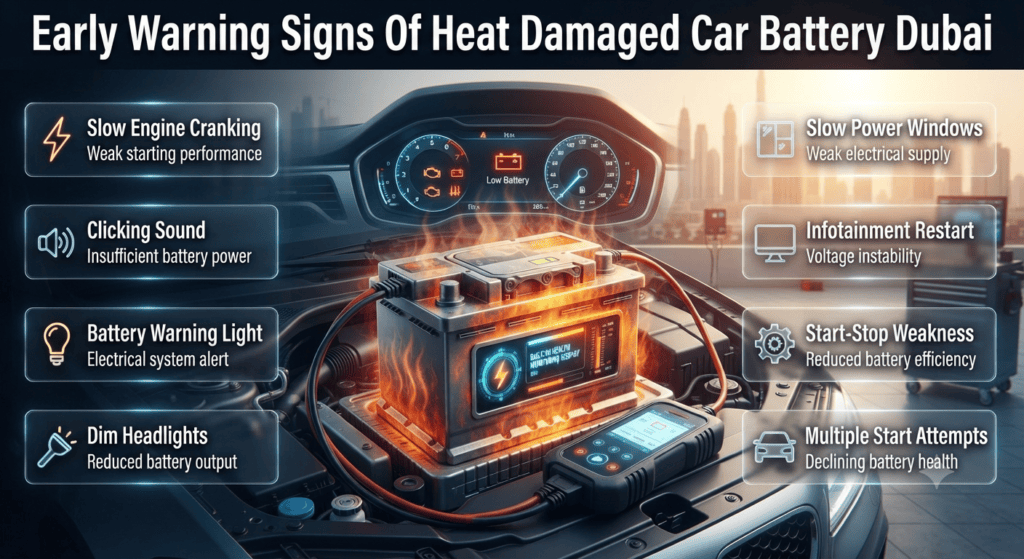
A battery rarely fails without giving warning signs first. Recognising these symptoms early allows professional technicians to diagnose the issue before the vehicle becomes completely immobilised.
Drivers should never ignore changes in starting performance, especially during Dubai’s hotter months.
Common warning signs include:
✔ Slow engine cranking
✔ Clicking noise when turning the key
✔ Battery warning light on the dashboard
✔ Dim headlights before starting
✔ Power windows operating slowly
✔ Infotainment system restarting unexpectedly
✔ Weak automatic start-stop performance
✔ Electronic warning messages appearing intermittently
✔ Engine requiring multiple attempts to start
These symptoms often indicate declining battery health rather than a complete electrical failure.
Slow Cranking After Afternoon Parking
One of the earliest signs of heat-related battery deterioration is noticeably slower engine cranking after the vehicle has remained parked outside during the hottest part of the day.
Although the engine may eventually start, increased cranking time usually indicates that the battery can no longer maintain sufficient voltage under heavy electrical demand.
Professional technicians perform battery load testing instead of relying solely on voltage readings to determine the battery’s true condition.
Unstable Vehicle Electronics
Modern vehicles require stable battery voltage to operate correctly.
When battery performance declines, electronic modules may temporarily malfunction, producing random warning lights, infotainment resets, delayed power seat operation, or intermittent dashboard alerts.
Before replacing expensive electronic components, technicians should first inspect the battery, charging system, and alternator using professional diagnostic equipment. If replacement is necessary, choosing a genuine Bosch Battery or Amaron Battery that matches the vehicle manufacturer’s specifications helps ensure reliable long-term performance.
Professional Recommendation
Drivers should not wait until the battery fails completely. Scheduling periodic Vehicle Inspection, charging system checks, and battery health testing before the peak summer season can prevent inconvenient roadside breakdowns and reduce the risk of unexpected starting failures. For vehicles equipped with start-stop technology or high electrical loads, installing a genuine AGM Battery may provide better heat resistance and improved durability in Dubai’s demanding climate.
Professional Battery Diagnosis Process After Sun Exposure in Dubai
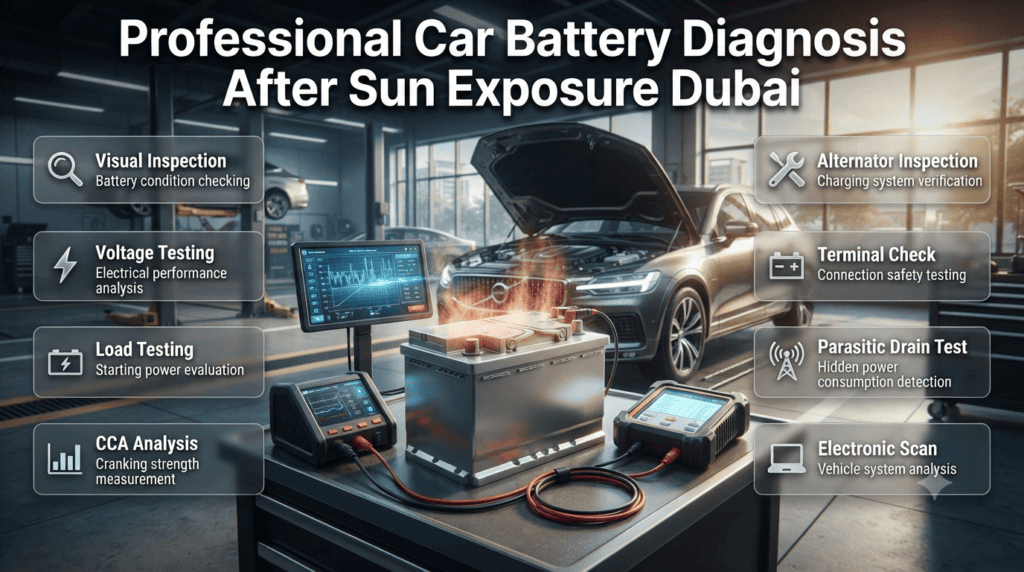
A battery problem caused by sun exposure should never be diagnosed only by checking whether the vehicle starts or not. Many drivers replace batteries immediately after a failed start, but the actual issue may involve alternator performance, electrical leakage, damaged connections, or incorrect battery specifications.
A professional inspection follows a systematic process to identify the exact reason behind the failure. Experienced technicians evaluate the complete starting and charging system instead of focusing on one component.
At EuroSwift Auto Services, battery specialists use modern diagnostic equipment to determine whether the battery can be recovered, requires replacement, or if another electrical issue is responsible for the problem.
A complete battery diagnosis normally includes:
✔ Visual battery inspection
✔ Voltage measurement
✔ Battery load testing
✔ Cold Cranking Amps (CCA) analysis
✔ Internal resistance testing
✔ Alternator output inspection
✔ Terminal and cable examination
✔ Parasitic drain testing
✔ Electronic system scanning
This detailed approach prevents unnecessary replacement and protects sensitive vehicle electronics.
Initial Visual Inspection Before Battery Testing
The first stage of professional battery diagnosis involves a physical inspection of the battery and surrounding components.
Heat exposure often creates visible warning signs that indicate internal damage or poor maintenance.
Technicians check:
| Inspection Area | Possible Issue | Effect on Vehicle |
|---|---|---|
| Battery casing | Swelling or cracks | Risk of battery failure |
| Terminals | Corrosion buildup | Poor electrical connection |
| Battery cables | Damage or looseness | Starting problems |
| Electrolyte condition | Low levels | Reduced performance |
| Mounting bracket | Loose battery position | Vibration damage |
A swollen battery case is especially concerning because it indicates excessive internal pressure caused by extreme heat or charging problems. Such batteries should not continue operating because they may fail suddenly.
Checking Battery Voltage Correctly
Many vehicle owners use a simple voltage reading to judge battery health. However, voltage alone does not provide a complete picture.
A healthy fully charged battery usually shows approximately 12.6 volts when the engine is switched off. However, a damaged battery may still display acceptable voltage while failing under real starting conditions.
Professional technicians measure:
- Resting voltage
- Starting voltage drop
- Charging voltage
- Recovery voltage after starting
This provides a more accurate understanding of battery condition.
Battery Load Testing: The Most Reliable Health Check
A load test simulates the electrical demand placed on the battery during engine starting.
Unlike a basic voltage check, load testing evaluates whether the battery can maintain stable power when the starter motor requires high current.
During the test, professional equipment measures:
✔ Voltage stability
✔ Internal resistance
✔ Available starting power
✔ Battery capacity
✔ Cold Cranking Amps performance
A battery that fails load testing usually requires replacement even if it appears fully charged.
Cold Cranking Amps (CCA) Testing Explained
Cold Cranking Amps represent the battery’s ability to deliver high current during engine starting.
Although CCA ratings are especially important in cold climates, they remain valuable in Dubai because modern engines require strong and stable electrical output.
Heat-damaged batteries often experience declining CCA performance because internal plates lose their efficiency over time.
CCA Performance Comparison
| Battery Condition | CCA Performance | Starting Ability |
|---|---|---|
| New battery | 100% capacity | Strong starting |
| Slightly aged battery | 75–90% capacity | Usually reliable |
| Heat-damaged battery | 50–70% capacity | Slow starting |
| Failed battery | Below required level | No reliable start |
Alternator Inspection After Battery Failure
Replacing a battery without checking the alternator can result in repeated failures.
The alternator is responsible for charging the battery while the engine runs. If the alternator produces incorrect voltage, even a brand-new battery may become damaged quickly.
Professional technicians inspect:
✔ Alternator charging output
✔ Voltage regulator operation
✔ Charging stability
✔ Belt condition
✔ Electrical connections
A properly functioning charging system ensures the replacement battery receives the correct amount of power.
Common Alternator Problems That Affect Battery Life
| Alternator Issue | Battery Impact |
|---|---|
| Low charging voltage | Battery remains undercharged |
| Excessive charging voltage | Battery overheating |
| Damaged regulator | Unstable electrical supply |
| Weak alternator output | Frequent starting problems |
| Loose connections | Charging interruptions |
Parasitic Drain Testing for Hidden Battery Problems
Sometimes a battery appears weak after sun exposure, but the real cause is excessive electrical consumption while the vehicle is parked.
Parasitic drain occurs when electrical components continue drawing power after the vehicle enters sleep mode.
Common causes include:
✔ Faulty alarm systems
✔ Aftermarket accessories
✔ Dash cameras
✔ GPS tracking devices
✔ Malfunctioning control modules
✔ Interior lights remaining active
Professional Engine Diagnostics and electrical testing help identify abnormal power consumption before installing a replacement battery.
Choosing the Correct Battery for Dubai Climate
Selecting the correct battery is just as important as replacing the failed unit. A battery that does not match the vehicle’s electrical requirements may perform poorly even if it is brand new.
Technicians consider:
✔ Vehicle model and engine size
✔ Battery group size
✔ Amp-hour rating
✔ Cold Cranking Amps
✔ Start-stop system compatibility
✔ Manufacturer recommendations
✔ Driving conditions
Luxury vehicles and advanced European models often require premium battery technology because of their higher electrical demands.
AGM Batteries for High-Performance and Luxury Vehicles
Vehicles equipped with start-stop technology, regenerative braking systems, and advanced electronics frequently require Absorbent Glass Mat technology.
An AGM Battery provides advantages such as:
✔ Better vibration resistance
✔ Improved charging efficiency
✔ Higher cycling capability
✔ Strong performance under heavy electrical loads
✔ Reduced leakage risk
However, AGM batteries should only be installed when they match the vehicle’s original specification.
Genuine Battery Brands Recommended for Dubai Conditions
Dubai drivers have access to many battery options, but quality differences can significantly affect reliability.
Professional installation using genuine products helps ensure proper performance, warranty protection, and compatibility.
Popular battery options include:
| Battery Brand | Suitable For | Main Advantage |
|---|---|---|
| Amaron Battery | Daily drivers and SUVs | Heat-resistant performance |
| Bosch Battery | European and premium vehicles | Reliable engineering |
| Exide Battery | Multiple vehicle categories | Balanced durability |
| Tuflong Battery | Economy and commercial vehicles | Cost-effective reliability |
| Panasonic Battery | Japanese vehicles | Stable performance |
| FIAMM Battery | European applications | Premium quality |
| AC Delco Battery | American vehicles | OEM-style compatibility |
Battery Replacement Process After Sun Damage
A professional battery replacement involves more than removing the old battery and installing a new one.
Modern vehicles may require memory protection, battery registration, or ECU adaptation after replacement.
A professional replacement process includes:
Step 1: Vehicle Assessment
Technicians confirm battery specifications and identify the reason behind failure.
Step 2: Safe Battery Removal
Old batteries are removed carefully to prevent damage to terminals, wiring, and electronic systems.
Step 3: Correct Battery Installation
The replacement battery is secured properly with correct terminal connections.
Step 4: Electronic Reset and Testing
Advanced vehicles may require battery registration or ECU reset procedures.
Step 5: Final System Verification
The charging system, starting performance, and electrical stability are tested before completing the service.
Does the sun affect your car battery?
Yes, direct sunlight and extreme heat can significantly affect your car battery, especially in Dubai’s climate. High temperatures increase the chemical activity inside the battery, which accelerates internal corrosion, electrolyte evaporation, and deterioration of the battery plates.
When a vehicle remains parked under direct sunlight for several hours, the battery temperature rises continuously. This heat exposure reduces the battery’s ability to store and deliver electrical power efficiently. Over time, the battery loses reserve capacity and may struggle to start the engine after long parking periods.
Heat damage is different from temporary low voltage. A battery affected by excessive heat may still show normal voltage readings but fail during actual starting conditions because it cannot provide sufficient current.
Sun Exposure Effect
Impact on Battery
Increased internal temperature
Faster ageing
Electrolyte evaporation
Reduced capacity
Plate corrosion
Lower performance
Higher internal resistance
Weak starting power
Long outdoor parking
Increased failure risk
To protect the battery from sun-related damage:
✔ Park in shaded or covered areas whenever possible
✔ Keep battery terminals clean and corrosion-free
✔ Perform regular battery health checks
✔ Avoid ignoring slow starting symptoms
✔ Use a battery designed for high-temperature environments
What is the main cause of battery failure?
The main cause of car battery failure is usually a combination of age, extreme temperature exposure, charging problems, and electrical stress rather than one single factor.
In Dubai, excessive heat is one of the biggest contributors because it speeds up natural battery degradation. However, other mechanical and electrical problems can also shorten battery life.
Common causes include:
Cause
How It Damages the Battery
Extreme heat
Accelerates internal corrosion
Old battery age
Reduces storage capacity
Faulty alternator
Causes overcharging or undercharging
Short trips
Prevents full battery recovery
Parasitic electrical drain
Slowly discharges battery
Poor terminal connections
Restricts electrical flow
Incorrect battery type
Reduces performance
A professional inspection should always check the complete electrical system before replacing the battery. Sometimes a weak alternator, damaged wiring, or hidden electrical drain is the actual reason behind repeated battery failures.
Why does my battery drain so fast in my summer car?
A car battery may drain faster during summer because high temperatures increase electrical stress while modern vehicles continue consuming power even when parked.
Dubai summers create additional challenges because vehicles often operate with:
✔ Maximum air-conditioning usage
✔ Heavy traffic conditions
✔ Longer engine idle periods
✔ High electronic system demand
✔ Extended outdoor parking
A battery that is already weakened by heat may lose its remaining capacity quickly. When combined with small electrical drains from security systems, smart keys, dash cameras, or aftermarket accessories, the battery may become completely discharged.
Common reasons for fast summer battery drain include:
Problem
Explanation
Weak battery cells
Battery cannot hold charge
Alternator issue
Battery is not recharging properly
Old battery
Reduced reserve capacity
Excessive electronics
Higher power consumption
Short driving cycles
Insufficient charging time
Hidden electrical drain
Continuous power loss
If your vehicle frequently needs a jump start after hot days, professional Car Jumpstart assistance may solve the immediate issue, but a complete battery and charging system inspection is recommended to prevent repeated breakdowns.
How long does a premium car battery last?
A premium car battery typically lasts around 2 to 4 years, depending on the vehicle type, driving habits, climate conditions, and maintenance quality.
In Dubai’s extreme heat, even high-quality batteries usually experience shorter service periods compared with cooler regions. A premium battery with proper installation and correct vehicle compatibility can still provide excellent reliability when maintained correctly.
Factors affecting premium battery lifespan include:
✔ Climate exposure
✔ Driving frequency
✔ Vehicle electrical demand
✔ Battery technology
✔ Charging system condition
✔ Maintenance practices
Battery Type
Typical Lifespan in Dubai Conditions
Standard Lead-Acid Battery
Around 18–30 months
Premium Maintenance-Free Battery
Around 2–3 years
AGM Battery
Around 3–5 years depending on usage
High-performance OEM Battery
Around 3–5 years with proper care
Luxury vehicles, SUVs, and cars with advanced electronics often require premium solutions such as AGM technology because these batteries handle repeated electrical cycles more effectively.
Regular Vehicle Inspection, alternator testing, and timely Battery Replacement help maximise battery performance and reduce unexpected roadside failures.
Conclusion: Protecting Your Car Battery From Sun Exposure Problems in Dubai
Extreme sunlight and high temperatures make battery maintenance more important than ever for Dubai drivers. A car battery problem after sun exposure Dubai is not just a temporary inconvenience; it can indicate deeper issues such as internal battery deterioration, charging system faults, or excessive electrical stress. Understanding how heat affects battery performance allows vehicle owners to take preventive action before facing an unexpected breakdown.
Regular battery inspections, professional load testing, alternator checks, and correct battery selection play a major role in maintaining reliable vehicle operation. Whether your vehicle requires a standard battery, premium maintenance-free unit, or an advanced AGM Battery, choosing the right specification ensures better performance under Dubai’s demanding climate conditions.
Preventive Vehicle Maintenance, timely Battery Replacement, and professional electrical diagnostics help protect modern vehicles equipped with advanced electronics, start-stop systems, and high power requirements. Ignoring early warning signs such as slow cranking, dashboard alerts, or repeated jump starts can lead to more serious reliability issues.
For drivers who need dependable support, EuroSwift Auto Services provides professional battery inspection, mobile replacement, diagnostic testing, and emergency automotive assistance designed for Dubai’s unique driving environment.
As automotive technology continues to evolve, future vehicles will depend even more on advanced battery systems, intelligent charging management, and efficient electrical solutions. Maintaining battery health today ensures safer, smoother, and more reliable driving tomorrow.

Leave a Reply