
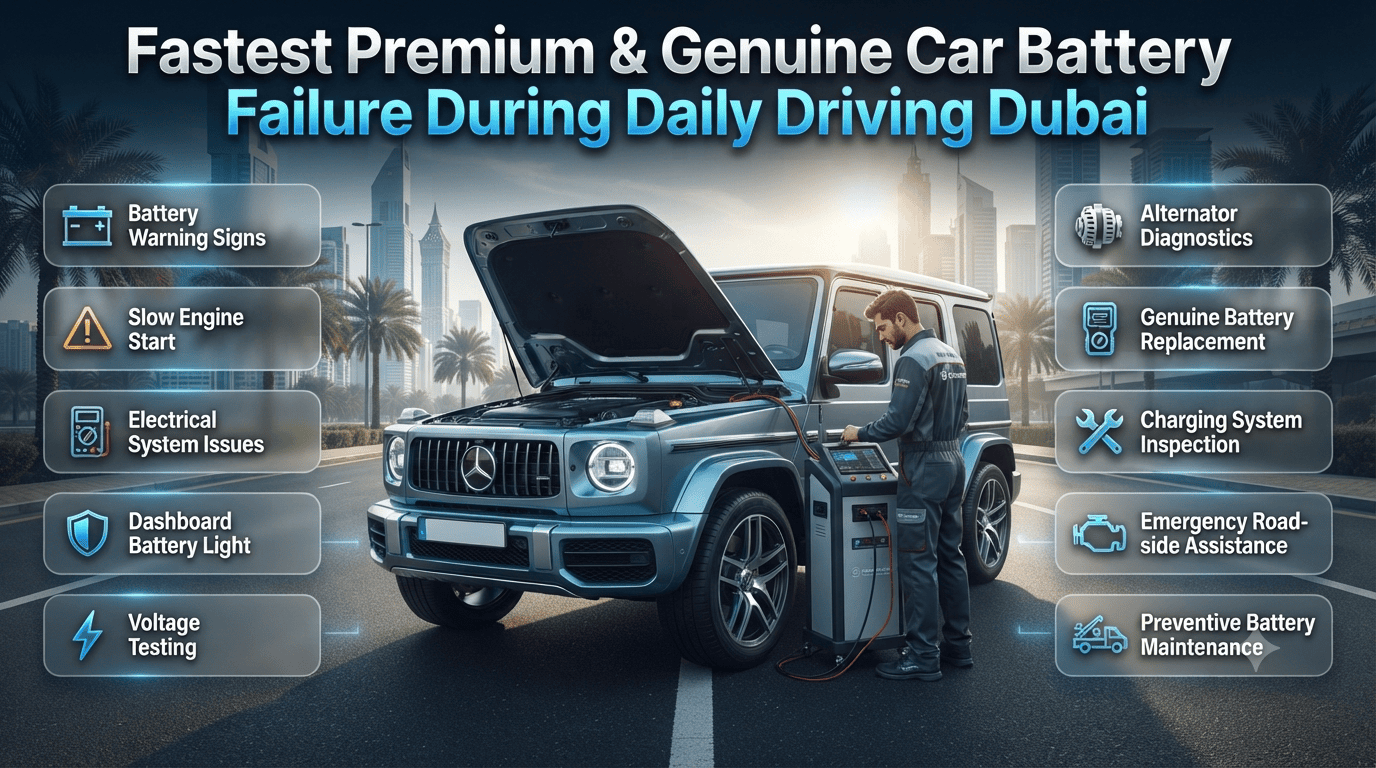
Introduction
A car battery failure during daily driving is one of the most frustrating situations any driver can experience, especially in a busy city like Dubai where traffic congestion, high temperatures, and long commuting hours place constant demands on every vehicle’s electrical system. While many people assume that a battery only fails when a vehicle is parked overnight, batteries can also deteriorate while driving if they have reached the end of their service life or if another component within the charging system develops a fault.
Modern vehicles depend on stable battery voltage to power the engine management system, electronic control units, infotainment systems, lighting, sensors, safety features, and driver assistance technologies. Even if the engine is running, a weak battery combined with charging system issues can lead to unexpected breakdowns, warning lights, reduced electrical performance, or complete vehicle shutdown.
When drivers notice early symptoms, arranging a professional inspection through EuroSwift Auto Services can help identify the actual cause before a minor electrical issue turns into an expensive roadside emergency. Professional technicians perform battery testing, alternator diagnostics, charging system inspections, and battery replacement using genuine batteries suitable for Dubai’s demanding climate.
Why Car Battery Failure Happens During Daily Driving
Many motorists believe that once the engine starts, the battery no longer plays an important role. In reality, the battery continues supporting the electrical system while the alternator recharges it. If either component begins to fail, electrical stability quickly declines.
Daily driving in Dubai exposes vehicles to several challenging conditions:
- Heavy stop-and-go traffic
- Extreme summer temperatures
- Continuous air conditioning use
- High electrical demand
- Frequent short-distance trips
- Long idle periods
Each of these conditions accelerates battery wear and increases the risk of failure during normal driving.
How the Vehicle Battery Works While Driving
Starting the engine is only one of the battery’s responsibilities.
Once the engine is running, the battery works alongside the alternator to stabilize voltage throughout the vehicle. Every electronic component relies on this steady electrical supply.
The battery helps power:
- Engine Control Module (ECM)
- Fuel injection system
- Ignition system
- Digital dashboard
- Power steering electronics
- Parking sensors
- Infotainment display
- Navigation systems
- Climate control
- Security systems
- Lighting systems
- Driver assistance technologies
If battery voltage drops unexpectedly, several vehicle systems may begin malfunctioning simultaneously.
Battery vs Alternator Responsibilities
| Vehicle Component | Primary Function |
|---|---|
| Battery | Starts engine and stabilizes electrical voltage |
| Alternator | Recharges battery while driving |
| Voltage Regulator | Controls charging voltage |
| Starter Motor | Cranks engine during ignition |
| Battery Terminals | Deliver electrical current safely |
Understanding this relationship allows technicians to diagnose the real cause instead of replacing parts unnecessarily.
Why Dubai’s Climate Increases Battery Failures
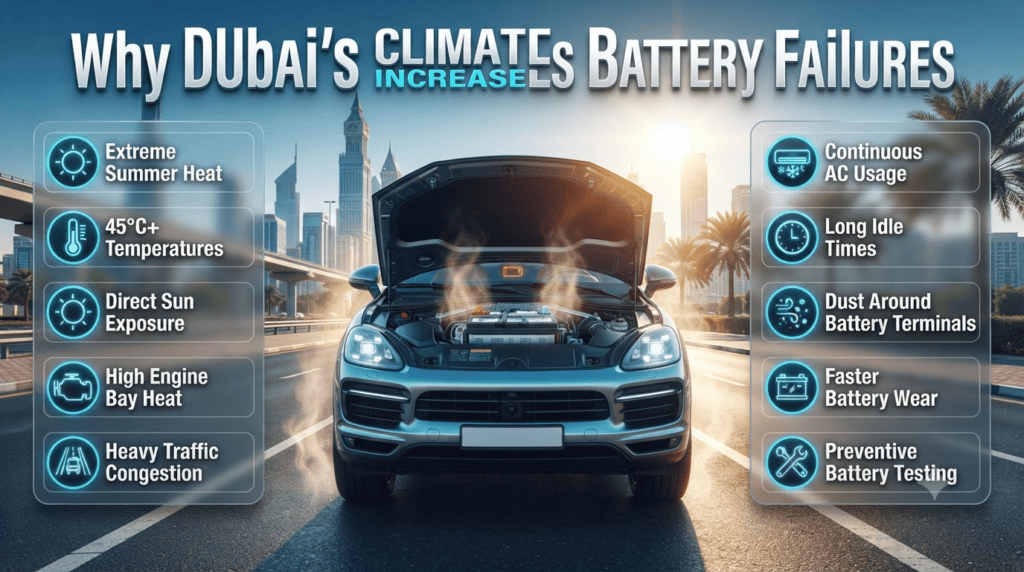
Dubai’s environment is particularly demanding on automotive batteries.
Temperatures frequently exceed 45°C during summer months. Heat accelerates chemical reactions inside the battery, increasing water loss and gradually damaging internal lead plates.
Unlike colder regions where batteries fail due to reduced chemical activity, Dubai’s extreme heat shortens battery life by causing internal deterioration.
Common environmental factors include:
✔ Continuous exposure to direct sunlight
✔ High engine bay temperatures
✔ Heavy traffic congestion
✔ Long idle times
✔ Constant air conditioning usage
✔ Dust accumulation around battery terminals
These conditions make preventive battery testing an essential part of regular Vehicle Maintenance.
Early Warning Signs Before Battery Failure
Most batteries do not fail without warning.
Recognizing early symptoms allows drivers to schedule professional diagnostics before the vehicle becomes immobilized.
Slow Engine Cranking
The starter motor rotates more slowly than usual because the battery cannot supply sufficient current.
This symptom often appears several weeks before complete battery failure.
Flickering Interior Lights
Voltage fluctuations may cause cabin lights and dashboard illumination to dim unexpectedly.
Although this sometimes indicates an alternator issue, battery deterioration is equally common.
Dashboard Battery Warning Light
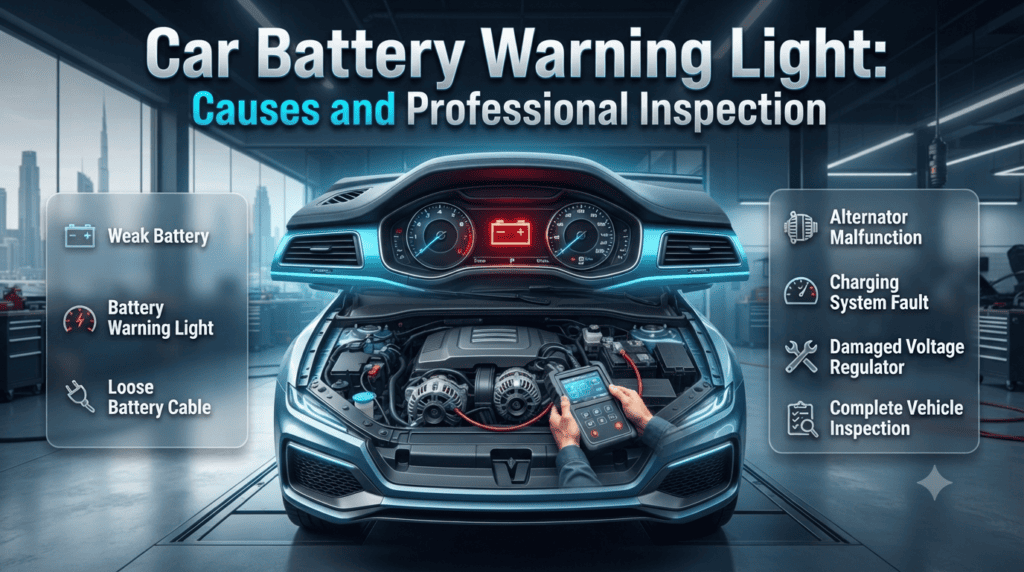
The battery warning indicator should never be ignored.
It may indicate:
- Weak battery
- Alternator malfunction
- Charging system fault
- Loose battery cable
- Damaged voltage regulator
A complete Vehicle Inspection helps identify the exact cause.
Electronic System Malfunctions
Modern vehicles contain dozens of electronic control modules.
Low voltage may cause:
- Navigation resets
- Radio interruptions
- Parking sensor faults
- Warning messages
- Camera system errors
- Keyless entry issues
These symptoms often appear before the battery completely fails.
Common Causes of Car Battery Failure During Daily Driving
Every battery eventually reaches the end of its service life, but several additional factors accelerate failure.
1. Aging Battery
Most batteries operating in Dubai last approximately 18–30 months due to prolonged exposure to high temperatures.
Older batteries gradually lose their ability to maintain stable voltage under load.
Professional load testing determines whether replacement is necessary.
2. Alternator Charging Problems
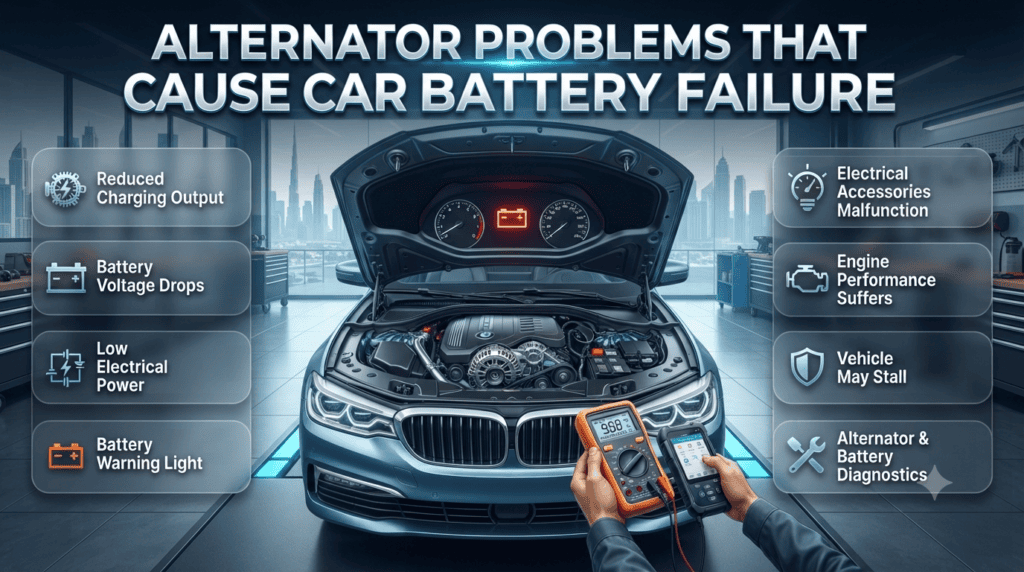
The alternator continuously recharges the battery while driving.
If charging output decreases:
- Battery voltage drops
- Electrical accessories begin malfunctioning
- Engine performance may suffer
- Vehicle eventually stalls
Alternator testing should always accompany battery diagnostics.
3. Loose Battery Connections
Battery terminals naturally loosen over time because of vibration.
Poor electrical contact creates resistance, reducing charging efficiency.
Professional technicians inspect:
- Terminal tightness
- Cable condition
- Corrosion
- Ground connections
4. Corroded Battery Terminals
Corrosion restricts electrical flow between the battery and vehicle.
Typical signs include:
✔ White residue
✔ Blue-green deposits
✔ Slow engine cranking
✔ Intermittent starting
Cleaning alone may solve the issue if battery health remains good.
5. Excessive Electrical Load
Modern luxury vehicles contain numerous electrical systems operating simultaneously.
Examples include:
- Heated seats
- Digital displays
- Multiple cameras
- Driver assistance systems
- Premium sound systems
- Adaptive suspension controls
The greater the electrical demand, the more important battery health becomes.
Professional Diagnostic Process
Experienced technicians avoid guessing.
Instead, they perform a structured diagnostic procedure that identifies the root cause before recommending a Battery Replacement.
Step 1 — Visual Inspection
Technicians inspect:
- Battery age
- Physical damage
- Swelling
- Leakage
- Loose terminals
- Corrosion
Step 2 — Battery Voltage Test
Using a professional digital tester, technicians measure:
- Resting voltage
- Charging voltage
- Load voltage
- Cold cranking capability
Step 3 — Alternator Output Test
Charging system performance is verified under different engine speeds.
This confirms whether the alternator supplies sufficient charging current.
Step 4 — Electrical System Scan
Modern diagnostic equipment scans all electronic modules for stored fault codes related to charging and battery performance.
Step 5 — Final Recommendation
Only after testing is completed will technicians recommend:
- Battery charging
- Terminal cleaning
- Alternator repair
- Electrical repair
- Genuine battery replacement
Diagnostic Inspection Checklist
| Inspection Item | Purpose | Possible Outcome |
|---|---|---|
| Battery Voltage Test | Measure battery condition | Healthy or weak battery |
| Load Test | Verify cranking performance | Battery replacement required |
| Alternator Test | Confirm charging output | Charging system fault |
| Terminal Inspection | Detect corrosion or loose cables | Cleaning or tightening |
| Belt Inspection | Check alternator drive belt | Belt replacement if worn |
| ECU Diagnostic Scan | Identify electrical faults | Accurate system diagnosis |
Choosing the Right Replacement Battery
When replacement becomes necessary, selecting a battery designed for Dubai’s climate is essential. Genuine products provide better heat resistance, reliable cranking performance, and longer service life than many low-cost alternatives.
Depending on the vehicle’s requirements, technicians may recommend:
- Amaron Battery for dependable everyday performance: https://euroswiftautoservices.ae/%F0%9F%94%8B-amaron-car-battery-replacement-dubai/
- Bosch Battery for advanced European vehicle compatibility: https://euroswiftautoservices.ae/bosch-car-battery-replacement-dubai/
- Exide Battery for a balance of durability and value: https://euroswiftautoservices.ae/dubai-fastest-15-min-exide-genuine-free-installation-car-battery-replacement-2026/
- Panasonic Battery for reliable performance in demanding conditions: https://euroswiftautoservices.ae/dubai-fastest-15-min-panasonic-genuine-free-installation-car-battery-replacement/
- FIAMM Battery for many European makes and models: https://euroswiftautoservices.ae/dubai-fastest-15-min-fiamm-genuine-free-installation-car-battery-replacement/
- AC Delco Battery for many American and GM vehicles: https://euroswiftautoservices.ae/%F0%9F%9A%97-dubai-fastest-15-min-ac-delco-genuine-free-installation-car-battery-replacement/
The correct battery should always match the manufacturer’s specifications for battery size, capacity, Cold Cranking Amps (CCA), and reserve capacity.
Professional Recommendation
Ignoring early battery warning signs can result in sudden roadside breakdowns, towing expenses, and unnecessary delays. Routine battery health checks, charging system inspections, and preventive Car Service are particularly valuable for vehicles that operate daily in Dubai’s hot climate.
Scheduling periodic diagnostics with experienced technicians allows minor electrical issues to be corrected before they develop into complete battery or charging system failures.
What to Do If Your Car Battery Fails While Driving
A battery-related problem while driving can quickly become a safety concern, particularly on Dubai’s busy highways and major roads. Although the alternator normally powers the electrical system once the engine is running, a severely discharged battery or a charging system fault can cause multiple warning lights, reduced engine performance, or even engine shutdown.
Instead of continuing to drive and risking additional damage, drivers should respond methodically and prioritize safety.
Immediate Safety Steps
If you notice electrical problems while driving:
✔ Stay calm and avoid sudden braking.
✔ Turn off unnecessary electrical accessories such as seat heaters or high-power entertainment systems.
✔ Safely move toward the nearest shoulder or parking area.
✔ Switch on your hazard lights.
✔ Avoid repeatedly restarting the engine if it stalls.
✔ Contact a professional Roadside Assistance service for inspection.
Prompt assistance can prevent further damage to the charging system or other electrical components.
Symptoms That Require Immediate Professional Attention
Some warning signs indicate that the vehicle should not continue operating until it has been inspected.
Multiple Dashboard Warning Lights
When several warning lights illuminate simultaneously, the problem may extend beyond the battery.
Possible causes include:
- Charging system failure
- Voltage regulator malfunction
- Alternator failure
- Electrical control module communication errors
Professional Engine Diagnostics help identify the exact fault instead of replacing parts unnecessarily.
Loss of Electrical Power
If the headlights become noticeably dim or the infotainment screen repeatedly switches off while driving, the electrical system may no longer be receiving adequate voltage.
Drivers should arrange an inspection as soon as possible.
Burning Smell Around the Engine Bay
An overheated alternator, slipping drive belt, or damaged electrical wiring can generate excessive heat.
Never ignore:
- Burning rubber odor
- Electrical burning smell
- Smoke from the engine compartment
Stop driving immediately if these symptoms appear.
Difficulty Accelerating
Many modern vehicles depend heavily on electronic engine management.
Low system voltage can affect:
- Fuel injection timing
- Ignition performance
- Electronic throttle control
- Transmission communication
Reduced acceleration may therefore be linked to an underlying charging issue.
Professional Roadside Battery Inspection Process
When a technician arrives, the goal is not simply to replace the battery. A professional inspection verifies whether the battery is truly responsible for the breakdown.
A typical inspection includes:
| Inspection Stage | Purpose |
|---|---|
| Visual Battery Check | Detect swelling, cracks, leaks, or corrosion |
| Terminal Inspection | Confirm secure electrical connections |
| Digital Voltage Test | Measure current battery condition |
| Charging System Test | Verify alternator performance |
| Starter System Check | Confirm proper cranking operation |
| Final System Verification | Ensure reliable vehicle operation |
This structured process reduces the likelihood of unnecessary component replacement.
Repair or Battery Replacement?
Not every battery-related issue requires installing a new battery.
Technicians evaluate several factors before making a recommendation.
| Condition | Repair May Be Suitable | Replacement Recommended |
|---|---|---|
| Loose battery terminals | ✔ | |
| Minor corrosion | ✔ | |
| Low charge after accidental drain | ✔ | |
| Internal battery damage | ✔ | |
| Swollen battery case | ✔ | |
| Repeated voltage failure | ✔ | |
| End of service life | ✔ |
Replacing a battery that is still serviceable increases costs unnecessarily, while delaying replacement of a failing battery increases the risk of unexpected breakdowns.
How Genuine Batteries Improve Reliability
Battery quality has a significant impact on long-term performance, particularly in Dubai’s demanding climate.
Premium batteries are designed with improved internal construction, higher-quality materials, and better resistance to heat-related deterioration.
Benefits include:
✔ Stable voltage output
✔ Improved starting performance
✔ Better resistance to vibration
✔ Longer service life
✔ Reliable performance during high electrical demand
✔ Compatibility with advanced vehicle electronics
For vehicles equipped with start-stop systems or high electrical loads, technicians may recommend an AGM Battery specifically engineered for these applications:
Why Correct Battery Matching Matters
A battery should never be selected based only on its physical size.
Professional technicians consider several technical specifications before installation.
Battery Selection Factors
- Vehicle manufacturer specifications
- Battery capacity (Ah)
- Cold Cranking Amps (CCA)
- Reserve Capacity
- Terminal orientation
- Battery dimensions
- Engine size
- Electrical equipment level
- Climate suitability
Installing an incorrectly matched battery may reduce reliability and affect charging performance.
Battery Failure vs Alternator Failure
Although both problems produce similar symptoms, they have different causes and solutions.
| Battery Failure | Alternator Failure |
|---|---|
| Slow engine cranking | Battery warning light while driving |
| Battery cannot hold charge | Battery repeatedly discharges |
| Engine starts after jump start | Vehicle may stall while driving |
| Battery voltage remains low | Charging voltage outside specification |
| Replacement often solves issue | Charging system repair required |
Accurate diagnosis helps prevent replacing the wrong component.
Common Driver Mistakes That Shorten Battery Life
Everyday driving habits influence battery longevity.
The following practices gradually reduce battery performance.
Frequent Short Trips
Short journeys often prevent the alternator from fully recharging the battery.
Over time, repeated partial charging reduces available capacity.
Leaving Electrical Accessories Running
Common examples include:
- Interior lighting
- Dash cameras
- Phone chargers
- Parking cameras
- Audio systems
Even modest electrical loads can discharge a battery if the engine is not running.
Delaying Routine Maintenance
Ignoring scheduled Car Service appointments allows small charging system issues to progress unnoticed.
Routine inspections help identify developing problems before they become roadside emergencies.
Ignoring Dashboard Warning Lights
Warning indicators rarely disappear without reason.
Prompt investigation often prevents more extensive electrical repairs.
Preventive Maintenance Schedule
Routine inspection is the most effective way to reduce the risk of unexpected battery failure.
| Maintenance Task | Recommended Interval |
|---|---|
| Battery voltage check | Every 6 months |
| Terminal inspection | Every service visit |
| Charging system inspection | Annually |
| Battery load test | Before summer |
| Alternator performance test | During major service |
| Complete Vehicle Inspection | Once per year |
Vehicles driven daily in heavy traffic may benefit from more frequent battery evaluations.
Expert Insight: Summer Heat Requires Extra Attention
Dubai’s summer climate places exceptional stress on automotive batteries. Continuous exposure to high ambient temperatures accelerates electrolyte evaporation and internal plate degradation, even when the battery appears to function normally.
Automotive professionals often recommend scheduling a battery health assessment before the hottest months begin, especially if the battery is more than two years old or the vehicle is used for daily commuting.
Preventive testing is generally more convenient and less expensive than dealing with an unexpected roadside breakdown.
Understanding Battery Replacement Costs
The total cost of battery replacement depends on several factors rather than the battery alone.
These include:
- Vehicle make and model
- Battery technology (Standard, EFB, AGM)
- Battery capacity
- Installation requirements
- Battery registration or ECU programming
- Warranty coverage
Drivers looking for an overview of battery options and pricing can compare available choices here:
https://euroswiftautoservices.ae/complete-guide-to-car-battery-prices-in-dubai-2026-updated-list
Reviewing battery specifications alongside pricing helps ensure the selected battery is appropriate for both the vehicle and local driving conditions.
Professional Recommendation
Battery problems rarely develop overnight. Most vehicles provide early warning signs through slower engine starts, electrical irregularities, or dashboard alerts. Responding to these symptoms promptly with professional diagnostics, regular Vehicle Maintenance, and correctly matched genuine batteries helps reduce the likelihood of unexpected failures during daily driving.
What is the main cause of battery failure?
The main cause of car battery failure is battery aging combined with extreme heat, particularly in Dubai and throughout the UAE. High temperatures accelerate the chemical reactions inside the battery, causing the electrolyte to evaporate and the internal lead plates to deteriorate faster. As a result, the battery gradually loses its ability to hold a charge and deliver consistent power.
Other common causes include a faulty alternator, loose or corroded battery terminals, frequent short trips that prevent proper recharging, excessive use of electrical accessories, and poor vehicle maintenance. A professional battery and charging system inspection can identify the actual problem before replacing the battery.
How long will a car battery last in the UAE?
Most car batteries in the UAE last 18 to 30 months because of the country’s extreme climate. However, the actual lifespan depends on the battery’s quality, driving habits, maintenance, and the condition of the charging system.
Drivers can extend battery life by having regular battery health checks, keeping the terminals clean, ensuring the alternator is working properly, avoiding unnecessary electrical loads while the engine is off, and parking in shaded areas whenever possible. Replacing an aging battery before it completely fails helps prevent unexpected roadside breakdowns.
Which type of car battery is the best?
The best car battery is one that matches your vehicle’s manufacturer specifications and driving requirements. For luxury vehicles, SUVs, and cars equipped with start-stop technology, AGM (Absorbent Glass Mat) batteries are generally considered the best choice because they offer superior durability, faster charging, and excellent performance under heavy electrical loads.
For standard passenger vehicles, high-quality conventional lead-acid or Enhanced Flooded Batteries (EFB) also provide reliable performance when correctly matched to the vehicle. Trusted brands such as Amaron, Bosch, Exide, Panasonic, FIAMM, AC Delco, and Tuflong are well suited to Dubai’s demanding weather conditions.
How long does a premium car battery last?
A premium car battery typically lasts 2 to 4 years, depending on driving conditions, maintenance, vehicle type, and climate. In Dubai, where temperatures regularly exceed 40°C, even premium batteries may have a slightly shorter lifespan due to continuous exposure to extreme heat.
Regular battery testing, scheduled vehicle servicing, alternator inspections, and timely replacement when the battery begins to weaken can significantly improve reliability. Choosing a genuine premium battery and having it professionally installed helps ensure dependable performance and reduces the risk of unexpected battery failure during daily driving.
Conclusion
Car battery failure during daily driving is rarely a sudden event. In most cases, your vehicle provides early warning signs such as slow engine cranking, dim lights, dashboard battery warnings, or intermittent electrical issues. Recognizing these symptoms early and arranging a professional inspection can prevent unexpected breakdowns, costly repairs, and unnecessary inconvenience.
Dubai’s extreme temperatures, heavy traffic, and high electrical demands place additional stress on automotive batteries, making regular battery testing and preventive Vehicle Maintenance more important than ever. Whether the issue is a weak battery, a faulty alternator, or a charging system problem, an accurate diagnosis ensures the correct solution and helps avoid replacing components unnecessarily.
Choosing a genuine, vehicle-specific battery and following the manufacturer’s maintenance recommendations can significantly improve reliability, starting performance, and battery lifespan. Regular inspections of the charging system, battery terminals, and electrical components also contribute to safer and more dependable daily driving.
When your vehicle shows signs of battery trouble, relying on experienced technicians for professional diagnostics, genuine battery replacement, and emergency roadside assistance helps keep your car operating safely in Dubai’s demanding conditions. Proactive maintenance is always more cost-effective than dealing with an unexpected roadside battery failure, ensuring peace of mind every time you get behind the wheel.

Leave a Reply