
Introduction
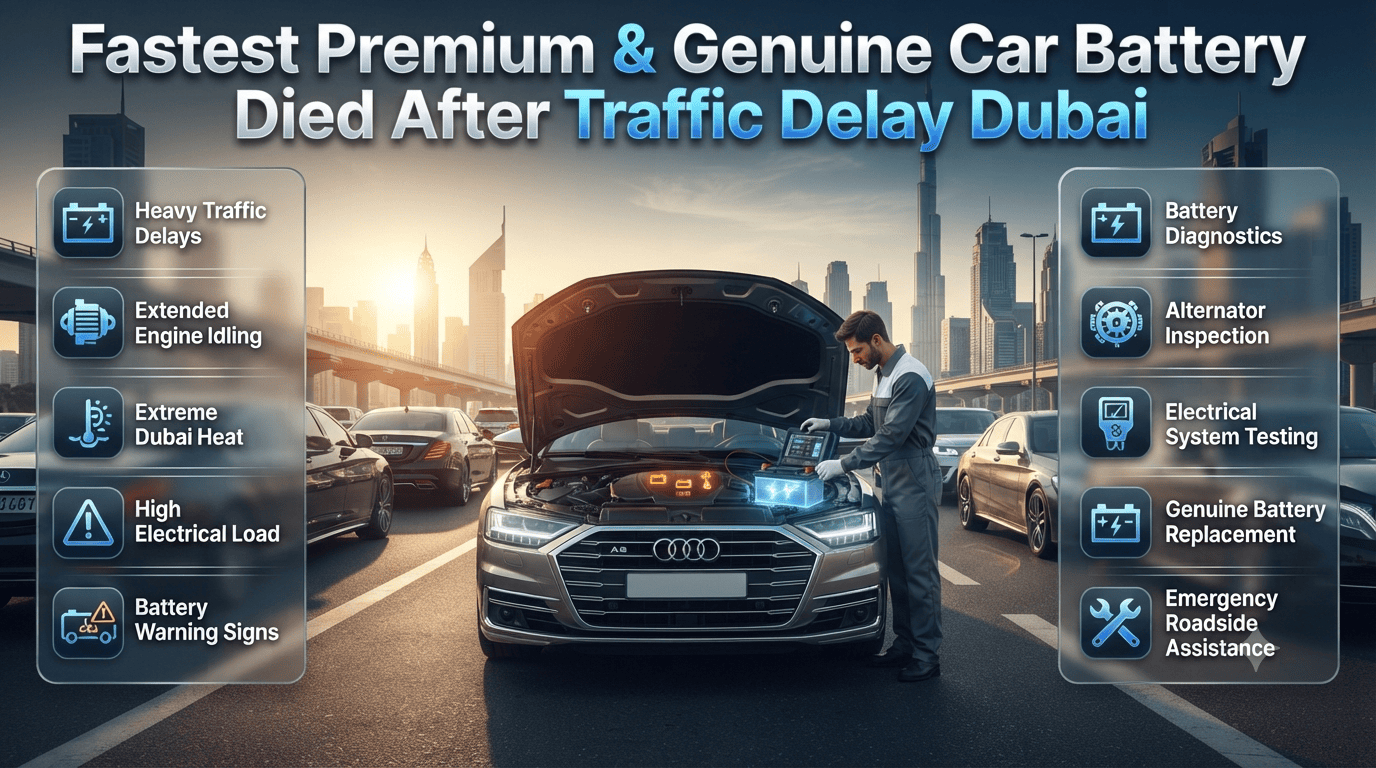
Experiencing a car battery died after traffic delay Dubai is more common than many drivers realize. A vehicle that has been moving slowly through heavy congestion, idling for extended periods, or operating continuously with high electrical demand may suddenly struggle to restart once the engine is switched off. While many motorists assume the battery has reached the end of its lifespan, the underlying cause can involve several interconnected systems, including the alternator, charging circuit, battery condition, and overall electrical health.
Dubai’s driving environment creates unique challenges for modern vehicles. Long traffic queues, extreme summer temperatures, constant air-conditioning usage, and advanced onboard electronics place continuous stress on automotive batteries. Luxury vehicles, hybrid systems, SUVs, and cars equipped with start-stop technology are especially sensitive to voltage fluctuations caused by prolonged stop-and-go driving.
When a battery failure occurs unexpectedly, timely diagnosis is just as important as replacing the battery itself. Professional technicians evaluate charging performance, battery capacity, terminal condition, and electrical system integrity before recommending the most suitable solution. Services such as EuroSwift Auto Services combine emergency roadside assistance, advanced diagnostics, and genuine battery installation to help drivers return to the road safely and efficiently.
This guide explains why batteries often fail after traffic delays, the warning signs to watch for, how Dubai’s climate contributes to battery deterioration, and the professional inspection process used to determine whether a battery requires charging, repair, or complete replacement.
Why Can a Car Battery Die After a Traffic Delay in Dubai?
Many drivers assume that a moving vehicle continuously charges its battery. In reality, prolonged traffic congestion places the electrical system under conditions that differ significantly from normal highway driving.
During heavy traffic, engines often remain at low RPM while powering numerous electrical accessories. The alternator may not consistently generate enough charging current to replenish the battery at the same rate electrical components consume energy. Over time, this imbalance gradually reduces the battery’s available reserve capacity.
Dubai’s climate further intensifies this issue. High ambient temperatures accelerate internal battery degradation, while continuous air-conditioning operation increases electrical demand. When an aging battery is already operating below optimal capacity, a lengthy traffic delay may expose weaknesses that were previously unnoticed.
Rather than causing immediate battery failure, traffic congestion often reveals an existing problem that has developed over months of daily use.
How Stop-and-Go Traffic Affects Battery Performance
Urban driving creates a completely different operating environment compared to steady motorway travel. Vehicles repeatedly accelerate, idle, and stop, placing alternating loads on both the charging system and the battery.
Several electrical components remain active throughout traffic delays:
- ✔ Climate control compressors and blower motors
- ✔ Headlights and daytime running lights
- ✔ Infotainment and navigation systems
- ✔ Cooling fans
- ✔ Electronic steering systems
- ✔ Safety sensors and cameras
- ✔ Mobile device charging ports
- ✔ Automatic transmission control modules
Each system consumes electrical power continuously. If alternator output cannot fully meet these demands during extended idling, the battery supplies the difference, gradually losing charge until restarting becomes difficult.
Why Dubai’s Climate Makes Battery Problems Worse
Unlike colder climates where batteries primarily struggle during winter, Dubai exposes automotive batteries to prolonged high temperatures throughout much of the year.
Heat accelerates chemical reactions inside lead-acid, AGM, and EFB batteries. Although this initially improves conductivity, sustained exposure eventually increases electrolyte evaporation, accelerates plate corrosion, and weakens internal battery components.
Additional environmental factors include:
- ✔ Vehicles parked under direct sunlight
- ✔ Cabin temperatures exceeding normal operating ranges
- ✔ Heavy daily commuting
- ✔ Frequent engine restarts
- ✔ High humidity in coastal districts
- ✔ Continuous use of climate control systems
- ✔ Increased electrical loads from modern vehicle technology
These combined conditions shorten battery lifespan compared with vehicles operating in milder climates.
Common Reasons a Car Battery Dies After Traffic Congestion
| Possible Cause | How It Affects the Battery | Professional Solution |
|---|---|---|
| Aging battery | Reduced reserve capacity | Battery load testing |
| Low alternator output | Insufficient charging | Charging system inspection |
| Loose battery terminals | Poor electrical connection | Terminal cleaning and tightening |
| Excessive electrical load | Battery discharges faster | Electrical diagnostics |
| Internal battery damage | Voltage drops rapidly | Battery replacement |
| Corroded terminals | Increased resistance | Corrosion removal and inspection |
| Weak charging cables | Charging losses | Cable integrity testing |
| Parasitic battery drain | Continuous power consumption | Electrical drain diagnosis |
Every one of these conditions requires accurate testing before replacing the battery. Installing a new battery without identifying the root cause may result in repeated failures.
Early Warning Signs Before the Battery Completely Fails
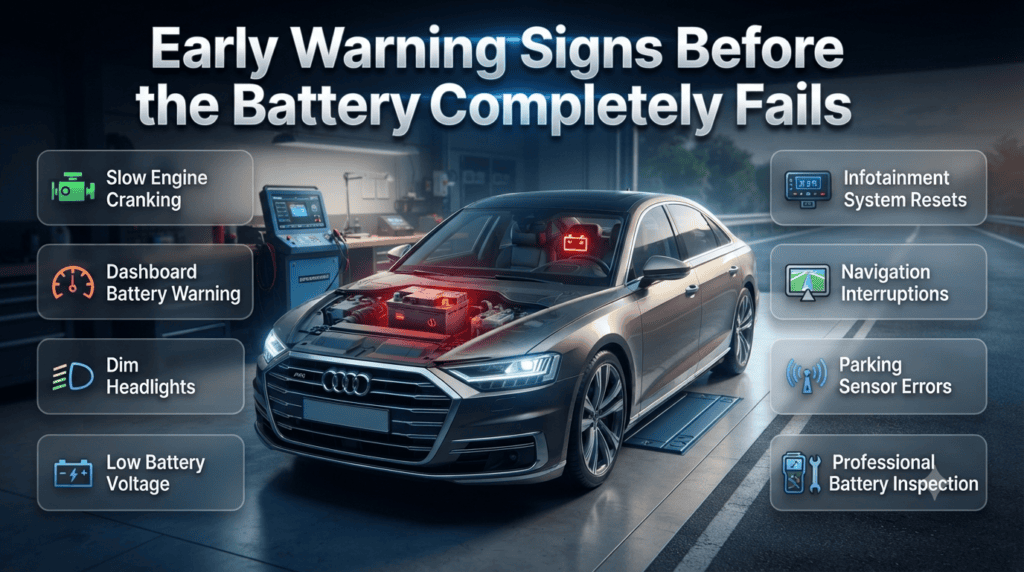
Battery failure rarely occurs without warning. Most vehicles exhibit subtle symptoms well before they refuse to start.
Recognizing these indicators allows drivers to arrange professional Battery Replacement, Car Service, or Vehicle Inspection before becoming stranded.
Slow Engine Cranking
A noticeable delay when turning the ignition key is often the earliest sign of declining battery capacity. As available voltage decreases, the starter motor rotates more slowly, making the engine take longer to start.
Dashboard Battery Warning Light
The battery warning indicator does not always mean the battery itself has failed. It frequently points to charging system issues involving the alternator, voltage regulator, or electrical connections.
Dim Exterior and Interior Lights
Lights that become noticeably dim while idling but brighten when engine speed increases may indicate insufficient charging output during low RPM operation.
Electronic System Irregularities
Modern vehicles rely on stable voltage for dozens of electronic control modules. Weak batteries may trigger:
- Random warning messages
- Infotainment system resets
- Clock resets
- Navigation interruptions
- Parking sensor errors
- Temporary camera malfunctions
These symptoms often appear before complete battery failure.
Symptoms That Should Never Be Ignored
| Symptom | Possible Underlying Issue | Recommended Action |
|---|---|---|
| Vehicle starts inconsistently | Weak battery | Professional battery test |
| Clicking sound during start | Low battery voltage | Charging system inspection |
| Frequent jump starts | Battery nearing failure | Battery replacement evaluation |
| Burning smell near battery | Electrical fault | Immediate inspection |
| Corroded battery terminals | Poor conductivity | Terminal cleaning |
| Swollen battery case | Heat damage | Replace immediately |
| Battery older than two years in harsh conditions | Reduced reliability | Preventive testing |
Ignoring these warning signs increases the likelihood of roadside breakdowns during busy commuting hours.
Vehicles Most Likely to Experience Battery Failure After Traffic Delays
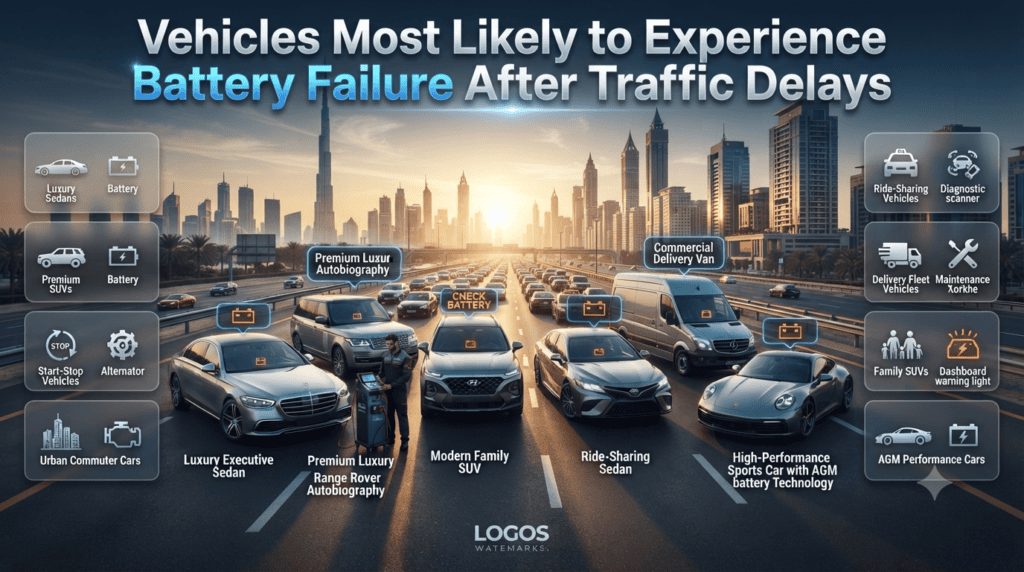
Although any vehicle can develop battery issues, certain categories operate with higher electrical demands.
These include:
- ✔ Luxury sedans with multiple electronic comfort systems
- ✔ Premium SUVs equipped with advanced driver assistance technologies
- ✔ Vehicles featuring automatic start-stop systems
- ✔ Cars used primarily for short urban journeys
- ✔ Ride-sharing and commercial fleet vehicles
- ✔ Delivery vehicles operating continuously throughout the day
- ✔ Family SUVs with extensive multimedia equipment
- ✔ Performance vehicles using AGM batteries
These vehicles benefit from regular Engine Diagnostics, Vehicle Maintenance, and charging system inspections to ensure reliable operation in Dubai’s demanding environment.
Expert Insight: Traffic Delays Reveal Existing Battery Weaknesses
Professional technicians frequently observe that traffic congestion is not the direct cause of battery failure. Instead, prolonged idling and heavy electrical loads expose batteries that have already lost a significant portion of their original capacity.
A healthy battery supported by a properly functioning alternator should withstand routine urban traffic without difficulty. When repeated breakdowns occur after traffic delays, technicians typically perform a comprehensive inspection that includes battery load testing, alternator output measurement, starter motor evaluation, and checks for hidden electrical drains. This diagnostic approach helps determine whether the issue lies with the battery itself or another component within the vehicle’s charging system.
For drivers requiring dependable roadside support, combining emergency Car Jumpstart, detailed Vehicle Inspection, and, where necessary, installation of a genuine replacement battery such as Bosch Battery, Amaron Battery, or AGM Battery ensures the electrical system is restored to manufacturer-recommended performance rather than simply masking the symptom.
Professional Recommendations Before Replacing Any Battery
Before authorizing a replacement, experienced technicians generally recommend:
- ✔ Performing a battery load and capacity test
- ✔ Measuring alternator charging voltage under different engine speeds
- ✔ Inspecting battery terminals and ground connections
- ✔ Checking for parasitic electrical drains after engine shutdown
- ✔ Evaluating starter motor current draw
- ✔ Confirming battery specifications match manufacturer requirements
- ✔ Verifying charging-system health before installing a new battery
- ✔ Selecting a genuine battery designed for Dubai’s high-temperature operating conditions
Following these steps helps ensure that a replacement battery delivers reliable performance and avoids premature failure.
Professional Diagnosis, Charging System Inspection & Battery Technologies
Why Professional Diagnosis Matters Before Battery Replacement
When a vehicle experiences a car battery died after traffic delay Dubai situation, replacing the battery immediately may seem like the quickest solution. However, professional technicians understand that the battery is only one component of a much larger electrical system. A weak alternator, excessive electrical drain, damaged wiring, or faulty voltage regulation can produce symptoms nearly identical to battery failure.
A comprehensive diagnosis prevents unnecessary expenses while ensuring the actual problem is identified. This approach is especially important for modern vehicles equipped with intelligent charging systems, start-stop technology, adaptive cruise control, digital instrument clusters, and numerous electronic control modules. Simply installing a new battery without investigating the charging system may result in another unexpected breakdown within weeks.
At EuroSwift Auto Services, technicians combine roadside diagnostics with workshop-level testing to determine whether the battery, alternator, starter motor, or another electrical component is responsible for the failure.
Step-by-Step Professional Battery Diagnostic Process
Experienced technicians follow a structured inspection rather than relying on visual observations alone. Each stage provides valuable information about the vehicle’s electrical condition.
Step 1 – Customer History Assessment
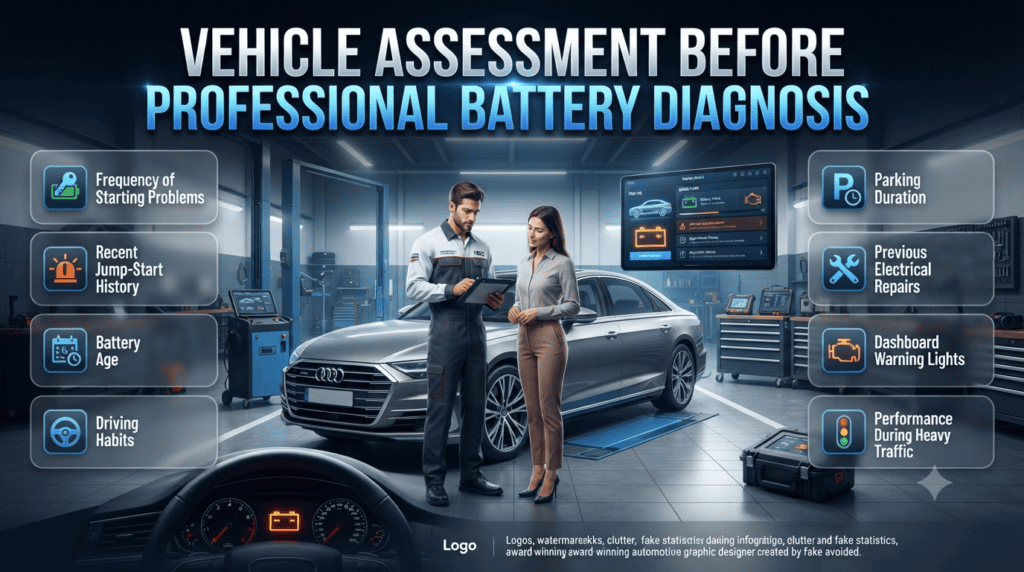
The inspection begins by gathering information about recent vehicle behavior, including:
- Frequency of starting problems
- Recent jump-start incidents
- Battery age
- Driving habits
- Parking duration
- Previous electrical repairs
- Dashboard warning lights
- Performance during heavy traffic
Understanding these details helps narrow down potential causes before testing begins.
Step 2 – Visual Battery Inspection
Although modern diagnostic equipment is essential, visual inspection remains an important first step.
Technicians examine:
✔ Battery housing for swelling
✔ Electrolyte leakage
✔ Corrosion around terminals
✔ Loose battery clamps
✔ Damaged cables
✔ Burn marks
✔ Broken insulation
✔ Improper battery installation
Heat damage is particularly common in Dubai due to prolonged exposure to high ambient temperatures.
Step 3 – Battery Voltage Testing
Static battery voltage provides an initial indication of battery condition.
| Battery Voltage | Condition | Interpretation |
|---|---|---|
| 12.7V or higher | Fully charged | Healthy battery |
| 12.5V–12.6V | Good condition | Normal operation |
| 12.3V–12.4V | Partially discharged | Further testing recommended |
| 12.0V–12.2V | Weak battery | Recharge or diagnose |
| Below 12.0V | Severely discharged | Immediate inspection required |
Voltage alone does not confirm battery health. A battery may display acceptable voltage while having significantly reduced reserve capacity.
Battery Load Testing
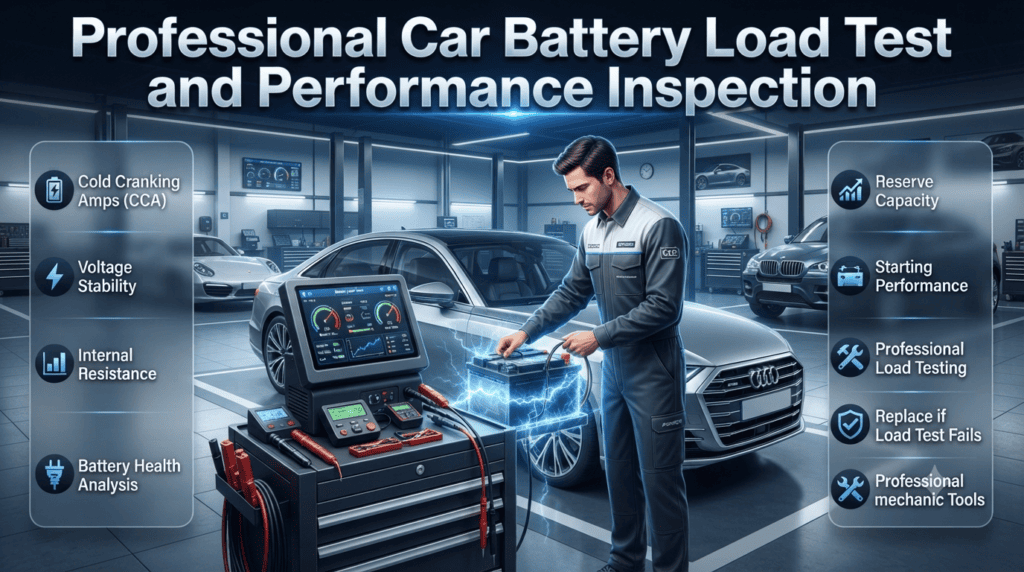
A load test simulates the electrical demand placed on the battery during engine starting.
Unlike a simple voltage reading, load testing evaluates how effectively the battery maintains voltage under high current demand.
Professional equipment measures:
- Cold Cranking Amps (CCA)
- Internal resistance
- Voltage stability
- Reserve capacity
- Starting performance
A battery that fails the load test generally requires replacement, regardless of its resting voltage.
Alternator Performance Inspection
Many drivers replace batteries when the alternator is actually responsible for the problem.
The alternator supplies electrical power while simultaneously recharging the battery during normal driving.
Technicians inspect:
✔ Charging voltage
✔ Charging current
✔ Voltage regulator operation
✔ Drive belt condition
✔ Pulley alignment
✔ Bearing noise
✔ Output consistency
A healthy charging system normally maintains stable voltage throughout varying engine speeds.
Alternator Failure vs Battery Failure
Understanding the difference helps explain why professional diagnosis is essential.
| Battery Failure | Alternator Failure |
|---|---|
| Slow engine cranking | Battery warning light while driving |
| Frequent jump starts | Electrical accessories malfunction |
| Battery older than expected lifespan | Headlights brighten or dim with RPM |
| Vehicle starts after charging | Battery repeatedly loses charge |
| Load test fails | Charging output below specification |
| Swollen battery housing | Charging voltage fluctuates |
Although symptoms often overlap, the repair solutions are completely different.
Starter Motor Inspection
The starter motor places one of the highest electrical demands on the battery.
If the starter develops excessive internal resistance or mechanical wear, it may consume more current than normal, creating the impression of battery failure.
Technicians evaluate:
- Starter current draw
- Solenoid engagement
- Cranking speed
- Internal resistance
- Wiring integrity
This inspection prevents unnecessary battery replacement when the starter motor is actually responsible.
Checking for Parasitic Battery Drain
Some vehicles continue consuming electricity long after the engine has been switched off.
Small electrical loads are normal because security systems, clocks, and memory functions remain active.
However, abnormal power consumption gradually discharges even a healthy battery.
Common sources include:
✔ Faulty interior lighting
✔ Malfunctioning infotainment systems
✔ Dash cameras
✔ GPS trackers
✔ Alarm systems
✔ Damaged control modules
✔ Aftermarket accessories
✔ Faulty relays
Professional electrical testing identifies these hidden drains before they create repeated battery failures.
Common Sources of Electrical Drain
| Component | Potential Effect |
|---|---|
| Dash camera | Continuous battery discharge |
| Interior lighting | Overnight battery drain |
| GPS tracker | Constant power consumption |
| Faulty relay | Electrical circuit remains active |
| Damplified audio system | Increased standby load |
| Security module fault | Unexpected battery depletion |
| ECU communication fault | Sleep mode interruption |
Finding these hidden problems requires specialized diagnostic equipment rather than visual inspection alone.
Electronic Control Unit (ECU) Diagnostics
Modern vehicles rely on dozens of interconnected control modules.
When battery voltage becomes unstable, these modules may generate fault codes unrelated to mechanical problems.
Professional Engine Diagnostics often include:
- ECU scanning
- Charging system communication
- Voltage history analysis
- CAN Bus inspection
- Battery monitoring system evaluation
- Intelligent charging diagnostics
This process prevents unnecessary replacement of electronic components.
Intelligent Battery Monitoring Systems
Many premium vehicles continuously monitor battery condition.
These systems evaluate:
✔ State of Charge (SOC)
✔ State of Health (SOH)
✔ Charging efficiency
✔ Battery temperature
✔ Electrical demand
✔ Regenerative charging performance
Vehicles equipped with these systems often require battery registration after installation to ensure accurate charging behavior.
Ignoring this step may reduce battery life and trigger warning messages.
Understanding Different Battery Technologies
Selecting the correct battery is just as important as diagnosing the original problem.
Different vehicles require different battery technologies based on electrical demand and manufacturer specifications.
Conventional Lead-Acid Batteries
These remain common in many passenger vehicles.
Advantages include:
- Affordable replacement cost
- Reliable starting performance
- Widely available
- Suitable for standard electrical systems
Best suited for:
- Daily commuting vehicles
- Older sedans
- Light commercial vehicles
AGM Batteries
Absorbent Glass Mat (AGM) batteries are designed for higher electrical loads.
Benefits include:
✔ Improved vibration resistance
✔ Faster charging
✔ Better deep-cycle capability
✔ Enhanced durability
✔ Excellent performance with start-stop systems
Luxury vehicles frequently require genuine AGM Battery replacements that match manufacturer specifications.
EFB Batteries
Enhanced Flooded Batteries bridge the gap between conventional batteries and AGM technology.
They provide:
- Longer service life
- Improved cycling capability
- Better resistance to repeated starts
- Increased charging efficiency
These batteries are commonly installed in vehicles with moderate electrical demands.
Comparison of Battery Technologies
| Feature | Lead-Acid | EFB | AGM |
|---|---|---|---|
| Heat Resistance | Moderate | Good | Excellent |
| Start-Stop Compatibility | Limited | Good | Excellent |
| Charging Speed | Standard | Improved | Fast |
| Deep Cycle Performance | Basic | Better | Excellent |
| Electrical Load Capacity | Moderate | High | Very High |
| Expected Performance in Dubai | Good | Very Good | Excellent |
Choosing the correct battery technology significantly improves long-term reliability under Dubai’s demanding driving conditions.
Genuine Batteries vs Low-Quality Alternatives
Battery quality directly influences starting reliability, charging efficiency, and overall lifespan.
Professionally installed genuine batteries generally provide:
✔ Stable Cold Cranking performance
✔ Consistent reserve capacity
✔ Improved heat resistance
✔ Better internal plate construction
✔ Reliable warranty support
✔ Compatibility with advanced charging systems
Drivers can choose manufacturer-approved options such as Bosch Battery, Amaron Battery, Exide Battery, Panasonic Battery, FIAMM Battery, AC Delco Battery, or Tuflong Battery according to their vehicle’s manufacturer requirements.
Industry Best Practice
Professional workshops rarely recommend replacing a battery based solely on age. Instead, they evaluate battery condition, charging efficiency, electrical demand, and manufacturer specifications before making a recommendation. This evidence-based approach reduces unnecessary replacements and ensures the new battery integrates correctly with the vehicle’s charging system.
Key Takeaways from Professional Diagnostics
Before replacing any battery, technicians should always:
- ✔ Verify battery health with a load test
- ✔ Measure alternator charging performance
- ✔ Inspect starter motor current draw
- ✔ Check battery terminals and grounding points
- ✔ Test for parasitic electrical drain
- ✔ Scan the ECU for charging-related fault codes
- ✔ Confirm the correct battery technology and capacity
- ✔ Register the battery when required by the manufacturer
These steps provide a complete picture of the vehicle’s electrical health and help prevent repeat failures.
Why does my car battery die in traffic?
A car battery can die during or immediately after heavy traffic because prolonged stop-and-go driving places continuous demand on the vehicle’s electrical system. While the engine is idling, the alternator produces less charging power than it does at higher engine speeds. At the same time, components such as the air conditioner, cooling fans, headlights, infotainment system, navigation, and charging ports continue consuming electricity.
In Dubai, this situation is intensified by extreme temperatures, which accelerate battery wear and reduce its ability to hold a full charge. If the battery is already aging or the alternator is not charging efficiently, extended traffic delays can expose these weaknesses and leave the battery unable to restart the engine.
Possible Cause
Effect on the Battery
Recommended Solution
Aging battery
Reduced reserve capacity
Battery load test and replacement if necessary
Low alternator output
Battery does not recharge properly
Charging system inspection
High electrical demand
Faster battery discharge
Electrical system diagnostics
Extreme Dubai heat
Accelerated internal battery deterioration
Install a genuine heat-resistant battery
Corroded battery terminals
Poor electrical connection
Clean and inspect terminals
If your vehicle repeatedly struggles after traffic jams, arranging a professional Battery Replacement, Engine Diagnostics, and Vehicle Inspection through EuroSwift Auto Services can identify the root cause before another breakdown occurs.
Can a completely dead battery be revived?
Sometimes, yes—but it depends on why the battery became completely discharged.
If the battery was accidentally drained by leaving lights on or from a temporary electrical load, a professional jump-start followed by proper charging may restore normal operation. However, if the battery has suffered internal damage, sulfation, heat-related deterioration, or has reached the end of its service life, charging alone will not provide a reliable long-term solution.
Professional technicians typically perform several tests before deciding whether the battery can be recovered or should be replaced:
✔ Battery voltage test
✔ Load capacity test
✔ Cold Cranking Amps (CCA) measurement
✔ Alternator output inspection
✔ Electrical drain diagnosis
✔ Terminal and cable inspection
Battery Condition
Can It Be Revived?
Professional Recommendation
Accidentally discharged
Often yes
Recharge and test battery health
Deeply discharged but healthy
Sometimes
Controlled charging and load testing
Heat-damaged battery
Usually no
Replace with a genuine battery
Swollen or leaking battery
No
Immediate replacement required
Failed load test
No
Install a manufacturer-approved replacement
If replacement is necessary, selecting a genuine Bosch Battery, Amaron Battery, or AGM Battery ensures compatibility with your vehicle’s electrical system and Dubai’s demanding climate.
How long should a car battery last in the UAE?
Under normal driving conditions, most car batteries in the UAE last between 18 and 30 months, although premium batteries that are properly maintained may continue performing reliably for up to three years. The exact lifespan depends on several factors, including battery quality, driving habits, electrical load, parking conditions, and regular maintenance.
Dubai’s extreme heat is one of the biggest factors affecting battery longevity. Continuous exposure to high temperatures accelerates electrolyte evaporation and internal corrosion, shortening battery life compared with cooler regions.
Other factors that influence battery lifespan include:
✔ Daily stop-and-go commuting
✔ Long periods of idling
✔ Frequent short trips
✔ Continuous air-conditioning use
✔ Advanced electronic vehicle systems
✔ Parking in direct sunlight
✔ Poor alternator performance
Driving Condition
Expected Battery Lifespan
Ideal operating conditions
Up to 3 years
Typical UAE daily driving
18–30 months
Heavy urban traffic
Around 18–24 months
Extreme heat with high electrical demand
May be shorter without preventive maintenance
Routine Vehicle Maintenance, charging system inspections, and battery health checks help maximize service life and reduce the risk of unexpected roadside failures.
Is it normal for a car battery to die after sitting for a few days?
A healthy, fully charged battery should generally not become completely discharged after sitting unused for only a few days.
If your vehicle repeatedly fails to start after being parked for a short period, it may indicate an underlying issue rather than normal battery behavior.
Common causes include:
✔ Battery nearing the end of its lifespan
✔ Parasitic electrical drain
✔ Faulty alternator that is not fully recharging the battery
✔ Loose or corroded battery terminals
✔ Aftermarket accessories drawing power while parked
✔ Intelligent control modules failing to enter sleep mode
Vehicles with advanced electronics naturally consume a small amount of standby power, but this should not completely drain a healthy battery within several days.
Parking Duration
Healthy Battery Expectation
1–3 days
Should start normally
4–7 days
Usually starts without difficulty
More than two weeks
Battery voltage may decrease, especially in hot weather
Battery dies after only a few days
Professional inspection recommended
If your vehicle repeatedly requires a Car Jumpstart after short periods of inactivity, a comprehensive Engine Diagnostics, Roadside Assistance, and charging system inspection should be performed to identify hidden electrical drains or battery deterioration before replacing the battery.
Conclusion
A car battery died after traffic delay Dubai is often more than an isolated inconvenience—it is usually a sign that the vehicle’s battery or charging system requires professional attention. Prolonged stop-and-go traffic, continuous air-conditioning use, high electrical loads, and Dubai’s extreme climate can accelerate battery wear and expose underlying issues such as reduced battery capacity, alternator inefficiency, corroded terminals, or parasitic electrical drains. Identifying the exact cause through a comprehensive inspection is essential to prevent repeated breakdowns and unnecessary component replacement.
Professional diagnostics, including battery load testing, alternator performance checks, starter motor evaluation, and electrical system inspections, provide a complete understanding of your vehicle’s condition before any repair decisions are made. Whether your battery only needs recharging or requires replacement with a genuine Bosch Battery, Amaron Battery, Exide Battery, Panasonic Battery, FIAMM Battery, AC Delco Battery, Tuflong Battery, or an AGM Battery, selecting the correct specification helps ensure dependable starting performance, improved durability, and compatibility with modern vehicle electronics.
For drivers who experience unexpected battery failure on Dubai’s busy roads, EuroSwift Auto Services offers professional Battery Replacement, Car Jumpstart, Roadside Assistance, Engine Diagnostics, Vehicle Inspection, and comprehensive Vehicle Maintenance to restore your vehicle safely and efficiently. Regular preventive maintenance, timely battery testing, and prompt attention to early warning signs not only improve reliability but also reduce the risk of future roadside emergencies. As automotive technology continues to advance, combining genuine replacement parts with expert diagnostics remains the most effective way to keep your vehicle performing reliably in the demanding driving conditions of the UAE.

Leave a Reply