
Introduction
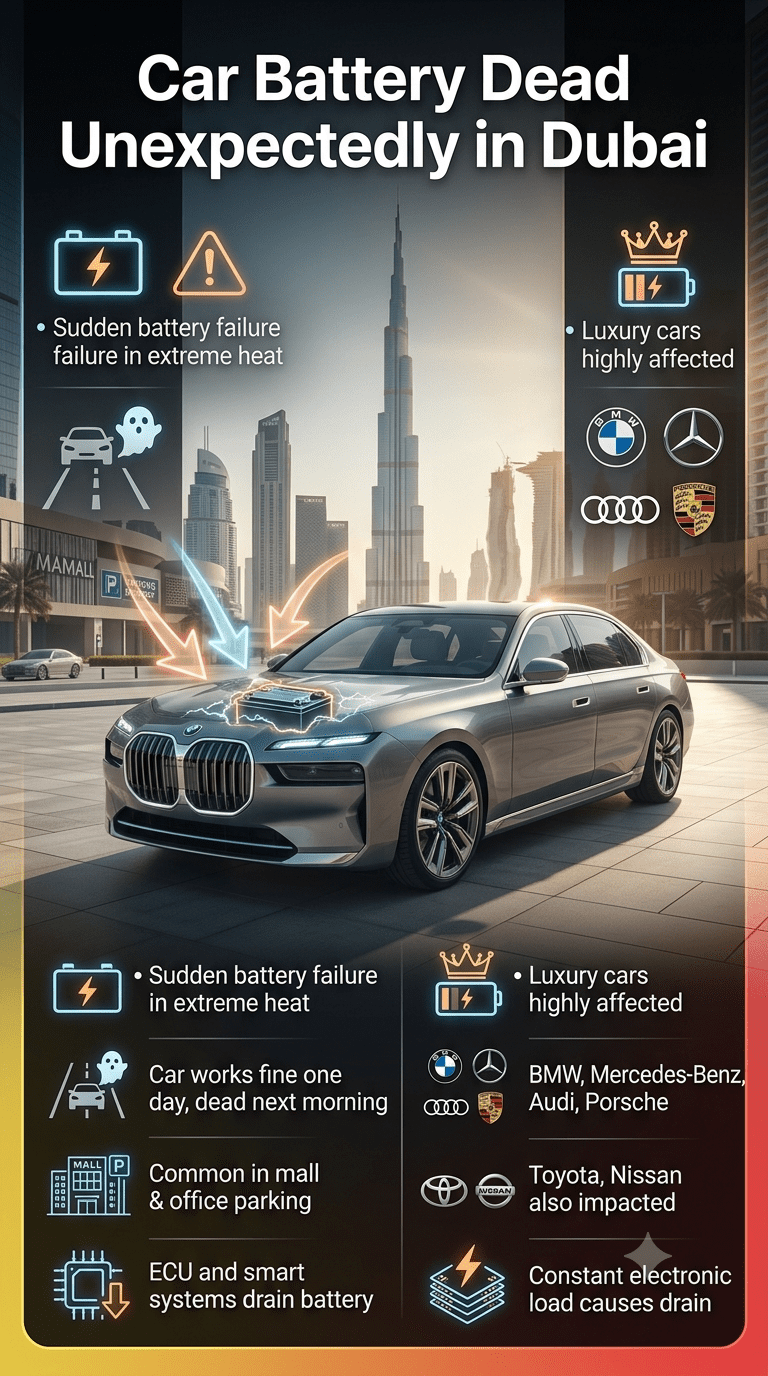
A car battery dead unexpectedly in Dubai is one of the most common and frustrating roadside situations, especially when it happens in extreme heat or during routine parking at malls, offices, or residential towers. In cities like Dubai, Sharjah, and surrounding UAE areas, drivers often experience sudden battery failure even when the vehicle was running perfectly the previous day.
This issue is especially frequent in luxury and high-tech vehicles such as BMW, Mercedes-Benz, Audi, Porsche, Toyota, and Nissan due to constant electronic load and smart battery systems.
Dubai UAE Market Context for Sudden Battery Failure
Dubai driving conditions create a unique environment where batteries rarely fail gradually—they often die suddenly.
Workshop observations from UAE conditions show:
- Vehicles parked in Dubai Marina, Business Bay, and Downtown Dubai often experience rapid battery drain due to long parking durations with active ECU systems.
- Cars in JVC, Al Barsha, and Silicon Oasis frequently show battery failure after overnight parking due to heat retention in basement and open parking cycles.
- Airport parking scenarios lead to deep battery discharge in 3–7 days if the vehicle is not started.
- Rental and fleet vehicles show higher unexpected failure rates due to continuous usage cycles.
Luxury and smart vehicles with advanced ECU modules and keyless entry systems remain in partial standby mode even when parked, slowly draining power.
Problem Overview: Why Battery Dies Unexpectedly in Dubai
In most cases, drivers report:
- Car worked perfectly yesterday
- No warning signs on dashboard
- Sudden no-crank situation in the morning
- Remote key not responding
- Electrical systems completely dead
In Dubai conditions, this is usually not a “slow failure” but a rapid voltage collapse caused by heat stress, parasitic drain, or weak charging systems.
Common Causes of Unexpected Battery Death in Dubai
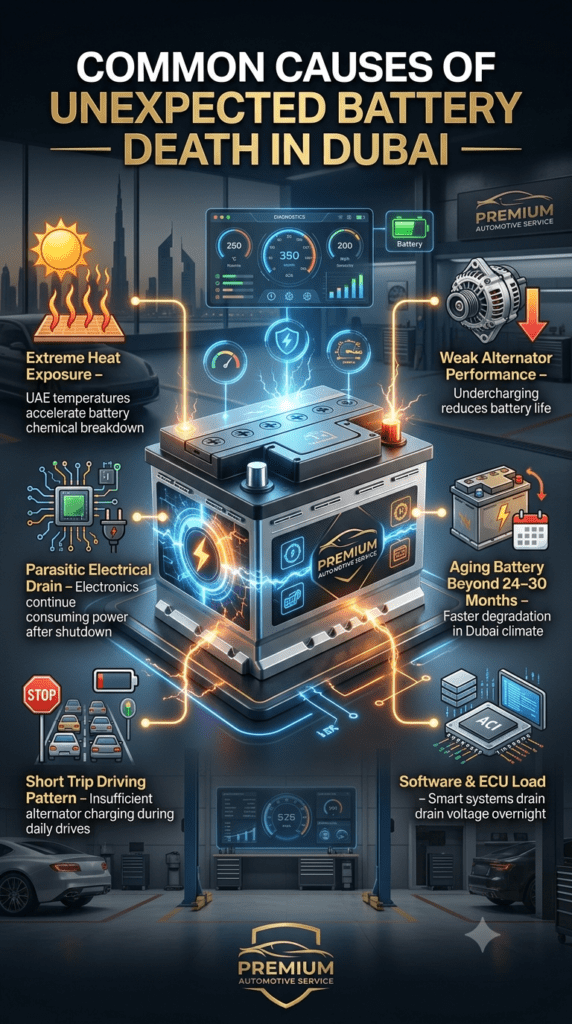
1. Extreme Heat Exposure
UAE temperatures accelerate chemical breakdown inside batteries, reducing electrolyte efficiency and internal plate stability.
2. Parasitic Electrical Drain
Modern vehicles—especially Tesla and premium German cars—keep multiple systems active in sleep mode.
3. Short Trip Driving Pattern
Frequent short trips in traffic-heavy areas like Sheikh Zayed Road prevent full alternator recharge.
4. Weak Alternator Performance
Workshop diagnostics often show undercharging issues that remain unnoticed until full failure.
5. Aging Battery Beyond 24–30 Months
In UAE heat, even premium batteries degrade faster than standard global lifespan expectations.
6. Software & ECU Load
Smart systems in modern vehicles remain active even after ignition off, slowly draining voltage overnight.
Symptoms Before Sudden Failure (Often Missed by Drivers)
Even when failure feels sudden, technicians observe subtle signs:
- Slight delay in engine cranking (often ignored)
- Interior lights dim during startup
- Infotainment system resets randomly
- Keyless entry response becomes inconsistent
- Battery voltage drops after overnight parking
These signs are more noticeable in luxury SUVs like Range Rover and Lexus due to high electronic load systems.
Emergency Response in Dubai (Immediate Actions)
When a car battery dies unexpectedly:
1. Safe Jumpstart Attempt
Technicians in Dubai commonly use professional jump packs instead of donor vehicles to protect ECU systems.
2. Mobile Battery Replacement (Most Reliable Solution)
In UAE conditions, jumpstart is temporary. Mobile replacement is usually recommended immediately.
3. ECU Safety Check
Modern vehicles require voltage stabilization to avoid system errors after restart.
4. Alternator Quick Test
If failure repeats within hours, alternator output must be tested on-site.
Battery Types Common in Dubai Vehicles
| Battery Type | Performance in UAE Heat | Best Use Case | Lifespan |
|---|---|---|---|
| Lead-Acid | Moderate | Economy cars | 1.5–2 years |
| EFB | Good | Start-stop vehicles | 2–3 years |
| AGM | Excellent | Luxury & SUVs | 2–4 years |
| Lithium (EV support systems) | Advanced | EVs & hybrids | 3–5 years |
AGM batteries are widely recommended for UAE luxury vehicles due to heat resistance and deep-cycle capability.
Pricing & Replacement Packages in Dubai
| Battery Type | Price Range (AED) | Vehicle Category | Service Type |
|---|---|---|---|
| Lead-Acid | 250 – 450 | Economy Cars | Standard Replacement |
| EFB | 400 – 650 | Mid-range Vehicles | Mobile Service |
| AGM | 600 – 1200 | Luxury Cars | Premium Installation |
| Premium Brands | 500 – 1300 | All Segments | Full Diagnostic + Install |
For updated market breakdown, drivers often refer to the complete guide on car battery pricing in Dubai.
UAE Parking Environment Impact Comparison
| Parking Type | Battery Stress Level | Risk of Unexpected Failure |
|---|---|---|
| Outdoor Sun Parking | Very High | Severe |
| Basement Parking | Medium | Moderate |
| Airport Long-Term Parking | High | Very High |
| Mall Parking (Short Duration) | Low | Low |
| Residential Parking (Daily Use) | Medium | Moderate |
Heat accumulation in closed environments significantly increases battery degradation speed in Dubai conditions.
Maintenance Tips (ONLY PREVENTION PRACTICES)
- Replace battery every 24–30 months in UAE heat conditions
- Avoid long parking without engine start cycles
- Ensure alternator voltage is checked during service
- Use AGM batteries for high-electronic vehicles
- Keep battery terminals clean and corrosion-free
- Avoid repeated short trips in heavy traffic zones
- Turn off electronics before ignition off
- Schedule periodic battery voltage checks
- Use certified mobile replacement services in emergencies
Workshop-Level Diagnostic Insights in Dubai
Technicians frequently observe:
- Batteries showing full voltage but failing under load
- ECU sleep-mode drain in German vehicles overnight
- Alternator undercharging in stop-and-go traffic vehicles
- Hidden drainage from aftermarket accessories (dash cams, trackers)
- Weak grounding points causing false battery failure symptoms
These issues are common across premium vehicles such as BMW X5, Mercedes GLC, and Range Rover Sport in UAE urban driving conditions.
Service Ecosystem in Dubai for Battery Failure
Modern UAE drivers rely heavily on mobile automotive support due to unpredictable failure patterns.
Trusted service options include:
- Mobile jumpstart assistance
- On-site battery replacement
- ECU-safe installation services
- Emergency roadside diagnostics
- Same-day battery delivery and installation
For direct support, drivers often use EuroSwift Auto Services:
https://euroswiftautoservices.ae/car-battery-replacement-near-me-dubai/
Battery-specific replacements are available for leading brands:
- Amaron Battery: https://euroswiftautoservices.ae/%F0%9F%94%8B-amaron-car-battery-replacement-dubai/
- Bosch Battery: https://euroswiftautoservices.ae/bosch-car-battery-replacement-dubai/
- Tuflong Battery: https://euroswiftautoservices.ae/%f0%9f%94%8b-trusted-tuflong-car-battery-replacement-dubai/
- AGM Battery: https://euroswiftautoservices.ae/dubai-fastest-15-min-agm-batteries-genuine-free-installation-car-battery-replacement/
- Exide Battery: https://euroswiftautoservices.ae/dubai-fastest-15-min-exide-genuine-free-installation-car-battery-replacement-2026/
- Panasonic Battery: https://euroswiftautoservices.ae/dubai-fastest-15-min-panasonic-genuine-free-installation-car-battery-replacement/
- FIAMM Battery: https://euroswiftautoservices.ae/dubai-fastest-15-min-fiamm-genuine-free-installation-car-battery-replacement/
- AC Delco Battery: https://euroswiftautoservices.ae/%F0%9F%9A%97-dubai-fastest-15-min-ac-delco-genuine-free-installation-car-battery-replacement/
Service-Focused Action Section
When a car battery dies unexpectedly in Dubai, delaying action usually leads to deeper electrical stress and repeated failure. The most effective solution is immediate on-site diagnosis followed by correct battery matching based on vehicle electronics and usage pattern.
In UAE driving conditions, especially with high heat and heavy traffic cycles, a weak battery rarely recovers after a full discharge. A proper replacement with heat-resistant technology ensures stable starting performance and protects ECU systems from voltage instability.
Fast mobile battery replacement and diagnostic support is the most reliable way to restore vehicle performance without towing delays or repeated jumpstarts.
Advanced Diagnostic Process (Workshop Workflow in Dubai Conditions)
When a car battery dies unexpectedly in Dubai, experienced technicians never replace the battery blindly. In UAE workshops, the diagnostic flow is structured to quickly identify whether the failure is battery-related, alternator-related, or ECU/parasitic drain-related.
Step-by-step field diagnostic approach:
- Step 1: Static Voltage Check
- A healthy parked battery should show around 12.4V–12.7V.
- In Dubai heat cases, many “dead” batteries still show 12V but collapse under load.
- Step 2: Load Test Under Real Conditions
- Battery is tested using a high-load simulator.
- Common finding: voltage drops instantly below safe threshold → internal plate damage.
- Step 3: Alternator Output Testing
- Running voltage should stay between 13.7V–14.5V.
- In stop-and-go traffic zones like Sheikh Zayed Road, weak alternators often go unnoticed until failure.
- Step 4: Parasitic Drain Measurement
- Modern vehicles like Mercedes-Benz and BMW often show hidden drain from ECU modules, keyless entry systems, and infotainment units.
- Step 5: ECU Sleep Mode Verification
- If the ECU fails to enter deep sleep mode, overnight drain becomes severe—common in luxury SUVs parked in Business Bay or Downtown Dubai.
Repair vs Replacement Decision Logic (UAE Practical Approach)
In Dubai workshop practice, technicians follow a strict decision model:
Battery Replacement Required When:
- Battery is older than 24–30 months
- Load test failure confirmed
- Internal plate damage detected
- Deep discharge below recovery threshold
Repair or System Fix Required When:
- Alternator undercharging is detected
- Parasitic drain identified
- Loose terminals or grounding faults exist
- Aftermarket electronics causing overnight drain
Hybrid Case (Very Common in Dubai):
- Battery weak + alternator borderline performance
- Solution: replace battery + recalibrate charging system
Common Real-World Failure Scenarios in Dubai
1. Mall Parking Scenario (Dubai Mall / Marina Mall / Mall of Emirates)
- Vehicle parked for 6–10 hours
- Smart systems remain active
- Battery drops below ignition threshold
2. Airport Long Parking Scenario
- 3–7 days parking at DXB or DWC
- ECU standby drain + alarm system load
- Complete no-response situation on return
3. Residential Basement Parking (JVC, Al Barsha, Silicon Oasis)
- Heat retention + humidity impact
- Slow overnight voltage drop
- Morning no-crank condition
4. Luxury Vehicle Scenario (Range Rover, Porsche, Lexus)
- Multiple ECU modules stay active
- Soft close doors, sensors, and tracking systems consume power
- Sudden battery collapse without warning
Battery Lifespan Reality in Dubai Heat
Unlike temperate regions, UAE climate significantly reduces battery lifespan.
| Battery Condition | Expected Lifespan in Dubai | Notes |
|---|---|---|
| Standard Lead-Acid | 12–24 months | Fast degradation in summer |
| EFB Battery | 18–30 months | Better for start-stop systems |
| AGM Battery | 24–48 months | Recommended for luxury cars |
| Heavy Usage Vehicles | 12–20 months | Taxis, rentals, fleets |
Technicians consistently report that summer months (May–September) accelerate battery failure by up to 40%.
Emergency Mobile Service Scenario in Dubai
When a battery dies unexpectedly, roadside response is usually structured:
- Technician arrives with AGM/standard battery stock
- On-site voltage diagnosis performed first
- ECU-safe power backup connected during replacement
- Battery installed and coded if required (German vehicles)
- Alternator quick-check performed before departure
This is especially common in areas like Dubai Marina, Business Bay, and Downtown where towing is inconvenient and time-sensitive.
EV & Smart Vehicle Battery Behavior in UAE
Modern EVs and hybrid systems behave differently under UAE heat stress:
- Battery Management System (BMS) constantly balances heat load
- Cabin pre-cooling systems consume standby power
- Tesla and hybrid Toyota systems may enter protective shutdown
- 12V auxiliary battery failure is still common even in EVs
Even in electric platforms, the small auxiliary battery remains critical for startup systems.
Expert-Level Preventive Strategy (UAE Driving Reality)
Technicians working daily on Dubai roads recommend:
- Avoid leaving vehicles unused for more than 4–5 days
- Use trickle charging for long parking periods
- Upgrade to AGM battery for premium vehicles
- Disable unnecessary aftermarket electronics when parked
- Schedule alternator health check every service cycle
- Replace battery proactively before peak summer season
Service-Oriented Action Section
When a car battery dies unexpectedly in Dubai, the fastest and safest resolution is not repeated jumpstarts but a full diagnostic-backed replacement service. In most UAE cases, battery failure is only the visible symptom of heat stress or hidden electrical drain.
A proper on-site inspection ensures the correct issue is identified—whether it is battery degradation, alternator weakness, or ECU drain—before installing a replacement unit.
For immediate roadside assistance or same-day replacement in Dubai conditions, mobile diagnostic and installation service remains the most efficient way to restore vehicle reliability without delay or towing complications.
What is the lifespan of a car battery?
In Dubai and wider UAE driving conditions, a typical car battery lifespan is significantly shorter than in cooler climates due to extreme heat and constant electrical load.
Standard lead-acid batteries: 1 to 2 years
EFB batteries (start-stop vehicles): 2 to 3 years
AGM batteries (premium/luxury vehicles): 2 to 4 years
Heat is the main factor reducing lifespan. In areas like Dubai Marina, Business Bay, and Al Barsha, workshop data consistently shows faster degradation because parked vehicles often experience high cabin heat soak, which accelerates internal plate corrosion and electrolyte evaporation.
Luxury vehicles such as BMW, Mercedes-Benz, Audi, and Range Rover also experience slightly higher failure rates due to continuous ECU and sensor activity even when parked.
What should you do after jumpstarting a dead battery?
After a jumpstart in Dubai conditions, the battery should not be considered “fixed”—it is only temporarily revived.
Immediate actions recommended by technicians:
Keep the engine running for at least 20–30 minutes to allow alternator recharge
Avoid turning off the engine immediately after jumpstart
Drive instead of idling when possible (better charging efficiency)
Turn off heavy electrical loads (AC, infotainment, lights) during recharge
Visit a workshop or mobile technician for load testing within 24 hours
If the battery dies again within a short time, it usually indicates:
Internal battery failure
Weak alternator output
Hidden parasitic drain in ECU or accessories
In Dubai roadside scenarios, repeated jumpstarts are a warning sign that replacement is needed rather than repair.
How do you change a car battery without losing memory?
Modern vehicles—especially German and luxury models—store critical memory in ECUs, infotainment systems, and electronic modules. Disconnecting the battery incorrectly can reset or disrupt these systems.
Safe professional method used in UAE workshops:
Connect an ECU memory saver device through OBD port or cigarette lighter
Ensure stable 12V support before removing old battery
Disconnect negative terminal first, then positive
Replace battery and ensure correct polarity alignment
Reconnect terminals (positive first, then negative)
Perform system reset check (windows, steering calibration, clock, radio presets)
Vehicles like BMW and Mercedes-Benz often require additional battery registration or coding after replacement to ensure proper charging system adaptation.
Skipping memory protection can lead to issues like:
Lost radio presets
Window auto-function reset
ECU fault codes
Start-stop system malfunction
Which car battery is good in the UAE?
In UAE heat conditions, battery quality is defined more by heat resistance and charge stability than just brand name.
Recommended battery types for UAE:
AGM Batteries (Best overall for UAE): High heat resistance
Stable performance under heavy load
Ideal for luxury and SUV vehicles
EFB Batteries (Good for mid-range cars): Better than standard batteries in heat
Suitable for start-stop systems
Premium Lead-Acid Batteries (Economy option): Works for smaller vehicles
Shorter lifespan in extreme heat
Commonly preferred brands in Dubai workshops:
Bosch – strong performance consistency in heat
Exide – widely used in UAE economy and mid-range vehicles
Panasonic – reliable OEM-style performance
AC Delco – balanced durability and price
Amaron – popular for high heat resistance in Gulf region
For Dubai specifically, AGM batteries are the most recommended choice for vehicles with advanced electronics, heavy AC usage, and frequent short-trip driving patterns.
Conclusion
A car battery dead unexpectedly in Dubai is almost never a random event—it is the result of combined stress from extreme heat, modern vehicle electronics, and driving patterns common in the UAE. What makes it more challenging is the sudden nature of failure, where the vehicle often shows no warning and completely stops responding.
In Dubai conditions, a weak battery rarely “slowly fades.” Instead, it collapses abruptly after heat exposure, overnight ECU drain, or repeated short-trip usage without full recharging cycles. This is why vehicles parked in areas like Downtown Dubai, Business Bay, Marina, and Al Barsha often experience sudden no-start situations even when the battery seems fine a day earlier.
Technically, most cases fall into three categories: internal battery degradation, alternator underperformance, or hidden electrical drain. Identifying the correct cause early is essential to avoid repeat breakdowns and unnecessary jumpstarts.
From a practical UAE workshop perspective, the safest long-term approach is preventive replacement before peak failure, especially for batteries older than 24–30 months. In luxury and high-electronic vehicles such as BMW, Mercedes-Benz, Audi, and Range Rover, proactive battery health checks are even more critical due to constant standby power consumption.

Leave a Reply