
Introduction
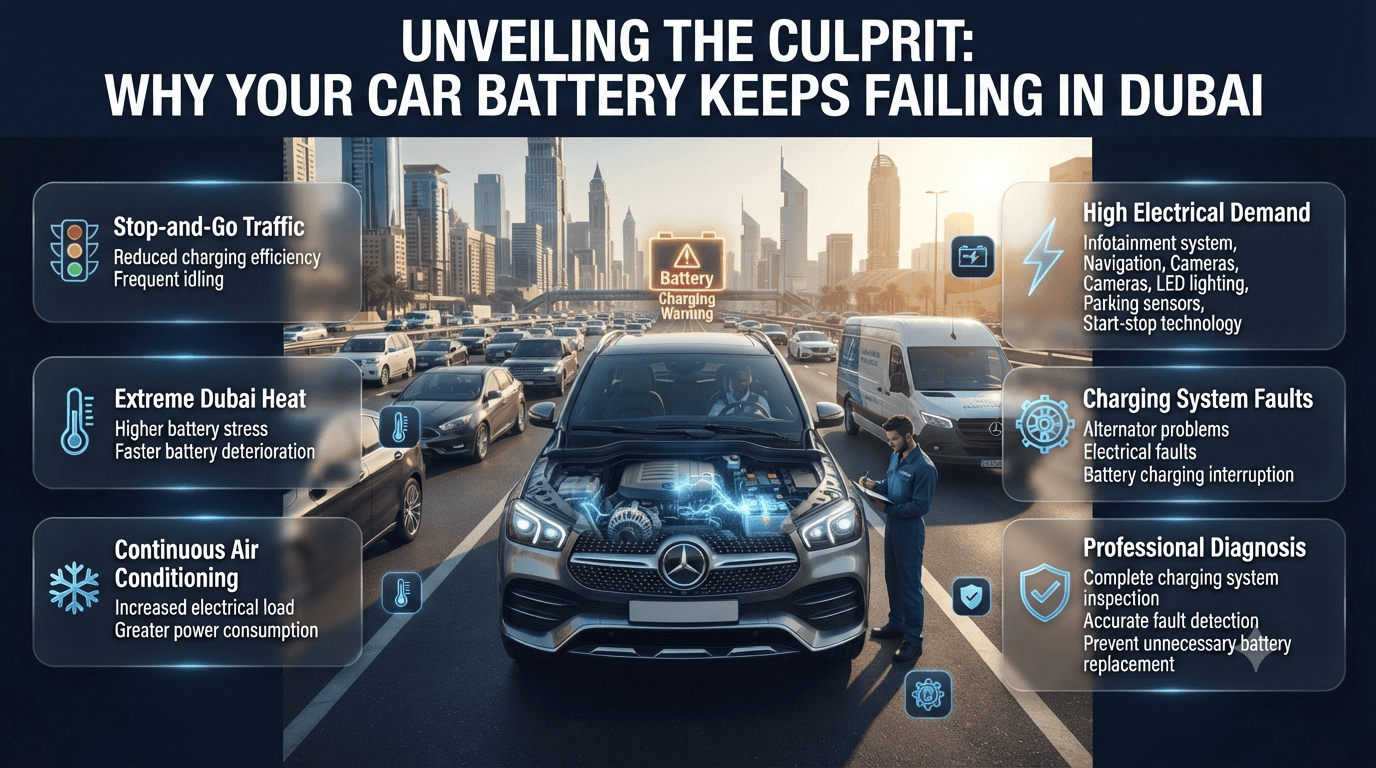
Fastest Premium & Genuine battery stopped charging after city driving Dubai | If your battery stopped charging after city driving in Dubai, the problem may be more serious than a weak battery alone. In many cases, the charging system is unable to restore the battery because of continuous stop-and-go traffic, extreme temperatures, heavy air conditioning usage, or an underlying alternator or electrical fault. These conditions are common in Dubai and can gradually reduce your battery’s performance until the vehicle struggles to start or displays a charging warning on the dashboard.
Modern vehicles rely on advanced electrical systems that consume more power than ever before. Features such as infotainment screens, parking sensors, LED lighting, cameras, navigation systems, and automatic start-stop technology place constant demand on the charging system. If these components consume more energy than the alternator can replace during city driving, the battery eventually becomes discharged.
At EuroSwift Auto Services, experienced technicians diagnose battery and charging system issues for all makes and models, helping drivers avoid unexpected breakdowns and unnecessary battery replacements. This guide explains why your battery may stop charging after city driving, how Dubai’s climate affects battery health, and the professional solutions that keep your vehicle reliable.
Why City Driving in Dubai Is Tough on Your Car Battery
Unlike long highway journeys, city driving places constant stress on your vehicle’s charging system. Every engine start consumes battery power, while frequent stops and low engine speeds reduce the alternator’s ability to recharge the battery efficiently.
Dubai’s traffic conditions make the situation even more challenging.
Common city driving habits that affect battery charging include:
- Frequent stop-and-go traffic
- Long periods of engine idling
- Continuous air conditioner operation
- Multiple short daily trips
- Heavy use of navigation and infotainment systems
- Charging mobile devices through USB ports
- Automatic Start-Stop systems cycling repeatedly
Over time, these conditions prevent the battery from reaching a full charge, reducing its lifespan and increasing the risk of unexpected failure.
How Your Vehicle’s Charging System Works
A healthy charging system consists of several components working together. If one part fails, the battery may stop charging correctly even though the battery itself is still in good condition.
Main Charging System Components
| Component | Function |
|---|---|
| Battery | Stores electrical energy for starting and electronics |
| Alternator | Generates electricity while the engine runs |
| Voltage Regulator | Controls charging voltage |
| Drive Belt | Rotates the alternator |
| Battery Cables | Carry charging current |
| ECU | Monitors charging performance |
| Battery Monitoring Sensor | Measures battery condition in modern vehicles |
Professional Engine Diagnostics are essential for determining which component is responsible for the charging failure instead of replacing parts based on assumptions.
Warning Signs That Your Battery Is No Longer Charging
Most charging problems develop gradually and provide several warning signs before complete failure.
Early Symptoms
✔ Battery warning light stays on
✔ Slow engine cranking
✔ Dim headlights at idle
✔ Flickering dashboard lights
✔ Weak power windows
✔ Touchscreen restarting unexpectedly
✔ Auto Start-Stop system stops working
✔ Electrical accessories behaving inconsistently
✔ Battery voltage warning messages
Ignoring these warning signs often results in roadside breakdowns that could have been prevented with an early Vehicle Inspection.
Common Reasons Your Battery Stopped Charging After City Driving
Many drivers assume the battery has failed, but professional inspections often identify problems elsewhere in the charging system.
1. Weak Alternator Performance
The alternator generates electricity while the engine is running and continuously recharges the battery. If its output becomes weak because of internal wear, damaged bearings, faulty diodes, or a failing voltage regulator, the battery slowly loses charge during everyday driving.
Common symptoms include:
- Battery warning light
- Dim headlights
- Weak starting
- Electrical accessories slowing down
- Low charging voltage
Professional Car Service technicians always test alternator output before recommending a new battery.
2. High Electrical Demand During City Driving
Modern vehicles use significantly more electricity than older models.
Electrical systems include:
- Climate control
- Digital displays
- Reverse cameras
- Blind-spot monitoring
- Parking sensors
- Adaptive cruise control
- LED headlights
- Wireless charging
- USB charging ports
- Advanced safety systems
When all these systems operate simultaneously during slow-moving traffic, the alternator may struggle to maintain sufficient charging voltage.
3. Dubai’s Extreme Climate
Heat remains one of the leading causes of premature battery failure across the UAE.
High temperatures accelerate:
- Internal plate corrosion
- Electrolyte evaporation
- Battery self-discharge
- Reduced charging efficiency
- Overall battery aging
For this reason, many Dubai drivers prefer premium batteries designed for high-temperature environments, including Amaron Battery, Bosch Battery, and Panasonic Battery.
4. Corroded or Loose Battery Connections
Even a healthy battery cannot charge properly if electrical current cannot flow efficiently.
Loose terminals or corrosion may cause:
- Intermittent charging
- Dashboard battery warnings
- Flickering lights
- Random electrical faults
- Poor alternator performance
Regular cleaning and inspection during scheduled Vehicle Maintenance help prevent these issues.
Highway Driving vs Dubai City Driving
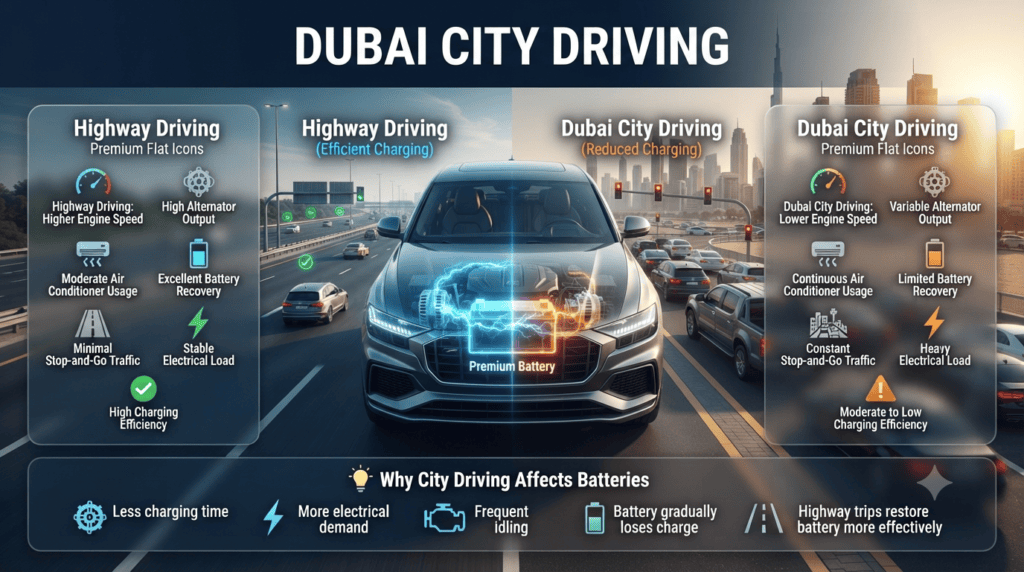
| Driving Condition | Highway Driving | Dubai City Driving |
|---|---|---|
| Engine Speed | Higher | Lower |
| Alternator Output | High | Variable |
| Air Conditioner Usage | Moderate | Continuous |
| Battery Recovery | Excellent | Limited |
| Stop-and-Go Traffic | Minimal | Constant |
| Electrical Load | Stable | Heavy |
| Charging Efficiency | High | Moderate to Low |
This comparison explains why batteries that perform well on long highway trips often struggle after several days of city commuting.
Can Short Trips Prevent the Battery from Charging?
Yes.
Every engine start places a heavy load on the battery. If the journey lasts only a few minutes, the alternator may not have enough time to replace the energy consumed during starting.
Examples include:
- School runs
- Grocery shopping
- Office commutes
- Local deliveries
- Multiple daily errands
Repeated short trips leave the battery partially discharged, gradually reducing its overall lifespan.
Which Vehicles Are Most Affected?
Charging problems are especially common in vehicles with advanced electronics.
These include:
- Luxury sedans
- European vehicles
- SUVs
- Hybrid vehicles
- Performance cars
- Vehicles with Auto Start-Stop systems
- Cars using intelligent charging systems
Many of these vehicles also require specialized battery registration after replacement, particularly those equipped with an AGM Battery.
Professional Charging System Inspection Process
Experienced technicians never replace a battery without first diagnosing the entire charging system.
Standard Inspection Procedure
| Inspection Step | Purpose |
|---|---|
| Battery Voltage Test | Determines battery charge level |
| Battery Load Test | Measures battery health |
| Alternator Output Test | Confirms charging performance |
| Voltage Drop Test | Detects wiring resistance |
| Drive Belt Inspection | Ensures alternator operation |
| Battery Terminal Inspection | Finds corrosion or loose connections |
| ECU System Scan | Identifies charging-related fault codes |
| Electrical System Analysis | Verifies complete charging performance |
Professional inspections like these are routinely performed at EuroSwift Auto Services to accurately identify whether the issue lies with the battery, alternator, wiring, or another electrical component.
Expert Recommendation
Replacing a battery without testing the charging system is one of the most common mistakes drivers make. If the alternator, voltage regulator, or wiring is faulty, even a brand-new battery will eventually become discharged.
If testing confirms that replacement is necessary, choosing the correct battery technology is equally important. Depending on your vehicle’s requirements, specialists may recommend an Exide Battery, Tuflong Battery, FIAMM Battery, or AC Delco Battery to ensure long-term reliability in Dubai’s demanding climate.
Before making a purchase, comparing the latest Car Battery Prices in Dubai can help you select the best battery based on your vehicle, driving habits, and budget.
Advanced Reasons Your Battery Stops Charging After City Driving in Dubai
Many charging problems are not caused by the battery itself. Modern vehicles use intelligent charging systems, battery monitoring sensors, and complex electronic control units that require professional diagnosis. When a battery repeatedly loses charge after city driving, technicians investigate deeper electrical faults rather than simply replacing the battery.
How Professional Technicians Diagnose Charging Problems
An accurate diagnosis follows a systematic process. Skipping any step can lead to unnecessary repairs and recurring battery issues.
Step 1: Battery Health Assessment
The battery is tested using professional equipment that measures:
- State of Charge (SOC)
- State of Health (SOH)
- Cold Cranking Amps (CCA)
- Internal Resistance
- Reserve Capacity
These values reveal whether the battery is still serviceable or has reached the end of its lifespan.
Drivers experiencing repeated charging problems often schedule a complete inspection through EuroSwift Auto Services before investing in a replacement battery.
Step 2: Alternator Output Testing
The alternator should provide sufficient charging voltage while powering all electrical systems.
Technicians test the alternator under different conditions:
| Test Condition | Purpose |
|---|---|
| Engine Idle | Measure minimum charging voltage |
| High RPM | Verify maximum charging performance |
| Air Conditioner ON | Check charging under heavy electrical load |
| Headlights ON | Monitor voltage stability |
| Full Electrical Load | Confirm alternator capacity |
An alternator producing inconsistent voltage often causes batteries to discharge after repeated city driving.
Step 3: Voltage Regulator Inspection
The voltage regulator controls how much electricity reaches the battery.
If it fails, two problems can occur:
Undercharging
The battery never receives enough power.
Possible results include:
- Slow starting
- Low battery voltage
- Frequent jump starts
- Battery warning light
Overcharging
Too much voltage damages the battery internally.
Symptoms include:
- Swollen battery casing
- Strong sulfur smell
- Reduced battery lifespan
- Electrical component damage
Ignoring regulator faults can lead to repeated battery replacements without solving the actual issue.
Understanding Parasitic Battery Drain
One hidden cause of charging problems is parasitic battery drain.
Even after the engine is switched off, certain systems continue consuming small amounts of electricity.
Examples include:
- Alarm systems
- Keyless entry modules
- ECU memory
- GPS trackers
- Dash cameras
- Interior lighting
- Aftermarket accessories
While these systems normally consume very little power, a malfunctioning module can drain the battery overnight.
Common Sources of Excessive Battery Drain
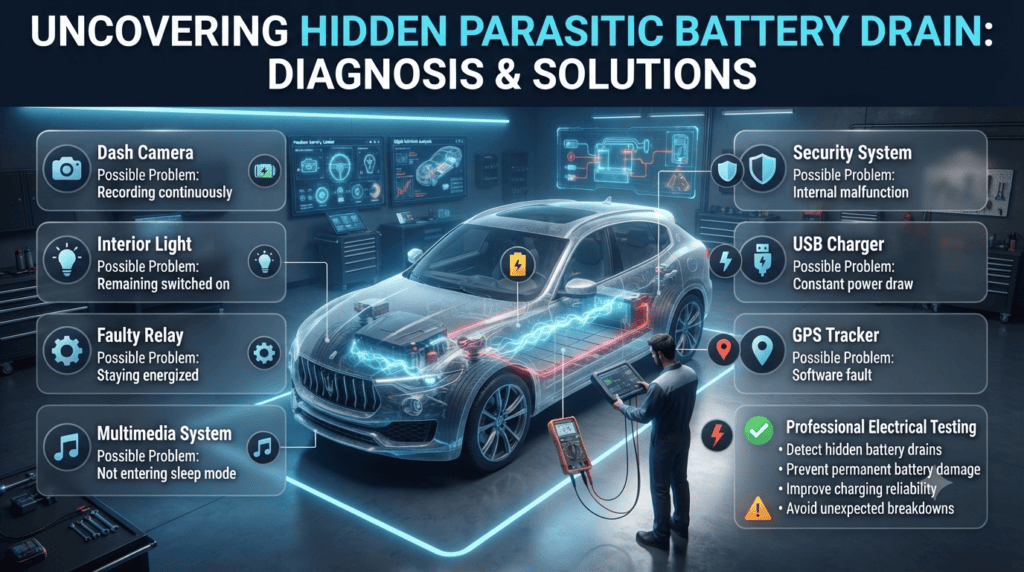
| Electrical Component | Possible Problem |
|---|---|
| Dash Camera | Recording continuously |
| Interior Light | Remaining switched on |
| Faulty Relay | Staying energized |
| Multimedia System | Not entering sleep mode |
| Security System | Internal malfunction |
| USB Charger | Constant power draw |
| GPS Tracker | Software fault |
Professional electrical testing identifies these hidden drains before they damage the battery permanently.
Intelligent Charging Systems in Modern Vehicles
Many newer vehicles no longer charge the battery at a constant voltage.
Instead, they use intelligent charging systems that adjust charging based on:
- Battery temperature
- Driving style
- Engine load
- Fuel economy strategies
- Regenerative braking
- Battery condition
These systems improve efficiency but also make diagnosis more complex.
Battery Monitoring Sensors
Premium vehicles often include battery monitoring sensors attached directly to the battery terminal.
These sensors monitor:
- Voltage
- Current
- Battery temperature
- Charging efficiency
- Battery age
If the sensor fails, the charging system may incorrectly reduce alternator output even when the battery requires additional charging.
Alternator Failure vs Battery Failure
Many symptoms appear identical, making professional testing essential.
| Symptom | Weak Battery | Faulty Alternator |
|---|---|---|
| Slow Starting | ✔ | ✔ |
| Battery Warning Light | Sometimes | Usually |
| Vehicle Stops While Driving | Rare | Common |
| Lights Become Dim | Sometimes | Frequently |
| New Battery Fixes Problem | Yes | No |
| Charging Voltage Low | No | Yes |
Replacing a healthy battery when the alternator is faulty only delays the problem.
Why Battery Registration Matters
Many luxury vehicles require battery registration after installing a new battery.
This process informs the vehicle’s ECU that a new battery has been fitted.
Without registration, the system may:
- Continue charging incorrectly
- Shorten battery life
- Display warning messages
- Reduce charging efficiency
Vehicles fitted with an AGM Battery are particularly dependent on correct battery programming.
Should You Repair the Charging System or Replace the Battery?
The answer depends entirely on the diagnostic results.
Replace the Battery When:
✔ Battery fails load testing
✔ Internal resistance is excessive
✔ Battery casing is damaged
✔ Battery age exceeds recommended service life
✔ Battery cannot hold charge
Drivers looking for reliable replacements often choose premium options such as Bosch Battery or Amaron Battery because of their proven performance in Dubai’s high temperatures.
Repair the Charging System When:
✔ Alternator output is below specification
✔ Voltage regulator has failed
✔ Drive belt is slipping
✔ Wiring connections are damaged
✔ Battery monitoring sensor is defective
✔ Excessive parasitic drain is detected
Replacing the battery without correcting these faults usually results in the same problem returning.
Expert Insight
A surprising number of batteries replaced every year are actually still serviceable. The real fault often lies with the charging system, damaged wiring, or an electrical component that continuously drains power. A complete diagnosis not only saves money but also prevents repeated breakdowns and protects expensive electronic systems from unnecessary stress.
The Impact of Dubai’s Climate on Charging Efficiency
Extreme heat affects every part of the charging system—not just the battery.
High temperatures can:
- Reduce alternator efficiency over time
- Accelerate belt wear
- Increase electrical resistance
- Speed up battery fluid evaporation
- Shorten the lifespan of electronic charging components
For drivers who regularly face heavy traffic and harsh weather, routine inspections and high-quality replacement batteries make a noticeable difference. Options like Panasonic Battery, Exide Battery, FIAMM Battery, Tuflong Battery, and AC Delco Battery are designed to handle demanding operating conditions when matched correctly to the vehicle.
Before choosing a replacement, reviewing the latest Car Battery Prices in Dubai can help you compare suitable battery options for your vehicle and budget.
Preventing Battery Charging Problems After City Driving in Dubai
Once the cause of a charging problem has been identified and repaired, the next step is preventing it from happening again. Preventive maintenance is far less expensive than emergency roadside assistance or repeated battery replacements. In Dubai, where high temperatures and congested roads place continuous stress on the charging system, regular inspections play a vital role in maintaining vehicle reliability.
Drivers who combine routine maintenance with good driving habits often experience significantly fewer battery-related issues, even under demanding urban conditions.
Preventive Maintenance Schedule for Your Charging System
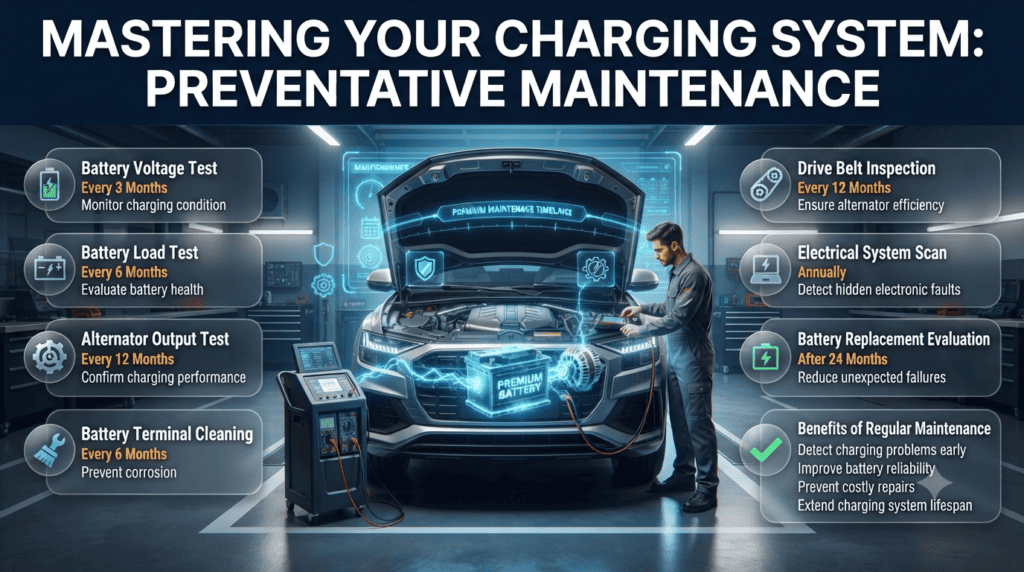
A structured maintenance plan helps detect charging issues before they become serious.
| Maintenance Task | Recommended Interval | Purpose |
|---|---|---|
| Battery Voltage Test | Every 3 Months | Monitor charging condition |
| Battery Load Test | Every 6 Months | Evaluate battery health |
| Alternator Output Test | Every 12 Months | Confirm charging performance |
| Battery Terminal Cleaning | Every 6 Months | Prevent corrosion |
| Drive Belt Inspection | Every 12 Months | Ensure alternator efficiency |
| Electrical System Scan | Annually | Detect hidden electronic faults |
| Battery Replacement Evaluation | After 24 Months | Reduce unexpected failures |
Scheduling these inspections with EuroSwift Auto Services can help identify small charging problems before they develop into expensive repairs.
Daily Habits That Help Your Battery Stay Charged
Small adjustments to your driving routine can significantly improve battery life.
Best Practices
✔ Drive for at least 20–30 minutes whenever possible to allow the alternator enough time to recharge the battery.
✔ Avoid making several short trips in succession if they can be combined into one longer journey.
✔ Turn off unnecessary electrical accessories before switching off the engine.
✔ Keep battery terminals clean and free from corrosion.
✔ Have the charging system inspected before the summer season begins.
✔ Replace worn drive belts before they begin slipping.
These simple habits reduce stress on both the battery and the alternator.
Common Mistakes Drivers Make
Many charging issues become worse because of avoidable mistakes.
Mistake 1: Replacing the Battery Without Testing the Alternator
A new battery cannot solve a faulty charging system.
If the alternator is undercharging, the replacement battery will soon develop the same symptoms.
Mistake 2: Ignoring Dashboard Warning Lights
The battery warning light does not always indicate a failed battery.
It may signal:
- Alternator failure
- Voltage regulator malfunction
- Loose wiring
- Charging circuit problems
Prompt diagnosis prevents additional electrical damage.
Mistake 3: Buying the Wrong Battery
Every vehicle has specific battery requirements.
Choosing the wrong:
- Capacity
- Cold Cranking Amps (CCA)
- Battery technology
- Physical size
can reduce charging efficiency and shorten battery life.
Drivers of premium vehicles often benefit from manufacturer-approved options such as AGM Battery technology, while other vehicles may be better suited to Bosch Battery, Amaron Battery, or Exide Battery depending on the manufacturer’s specifications.
Mistake 4: Depending on Repeated Jump Starts
A jump start gets the vehicle running, but it does not repair the underlying problem.
If your vehicle repeatedly requires jump starts after city driving, the charging system should be professionally inspected rather than relying on temporary solutions.
Emergency Steps When Your Battery Stops Charging
If your battery suddenly stops charging while driving in Dubai, remain calm and follow these steps.
Immediate Actions
- Turn off unnecessary electrical accessories.
- Avoid switching the engine off unless absolutely necessary.
- Watch the dashboard for additional warning lights.
- If headlights begin dimming, reduce electrical load immediately.
- Drive safely to the nearest workshop or arrange roadside assistance.
- Avoid restarting the vehicle multiple times if it struggles to crank.
Taking these precautions may help prevent a complete breakdown before professional assistance arrives.
Latest Technologies Improving Battery Charging
Automotive manufacturers continue developing smarter charging systems that improve efficiency and extend battery life.
Recent Innovations
Intelligent Alternators
Modern alternators adjust charging output according to:
- Driving conditions
- Battery condition
- Engine load
- Fuel economy requirements
Enhanced Battery Monitoring Systems
Advanced battery sensors continuously monitor:
- Voltage
- Current
- Temperature
- Charging efficiency
- Battery aging
These systems help maintain optimum charging performance throughout the battery’s service life.
Improved Battery Materials
Modern batteries use improved internal construction that offers:
- Better resistance to high temperatures
- Faster charging acceptance
- Reduced self-discharge
- Longer service life
Depending on the vehicle, premium products such as Panasonic Battery, FIAMM Battery, Tuflong Battery, and AC Delco Battery provide dependable performance when installed according to manufacturer specifications.
Future Trends in Vehicle Charging Systems
As vehicle technology evolves, charging systems will become increasingly intelligent.
Future developments are expected to include:
- AI-assisted battery health monitoring
- Predictive maintenance alerts
- Cloud-connected vehicle diagnostics
- More efficient regenerative charging systems
- Higher-capacity batteries for advanced electrical systems
These innovations will help drivers detect charging issues earlier, reducing unexpected failures and improving overall vehicle reliability.
Professional Recommendations
If your battery repeatedly loses charge after city driving, focus on diagnosing the complete charging system instead of replacing parts based on guesswork.
Expert Advice
✔ Have the battery tested before replacing it.
✔ Verify alternator output using professional diagnostic equipment.
✔ Check for parasitic battery drain if the battery discharges overnight.
✔ Inspect battery terminals and electrical wiring regularly.
✔ Replace worn drive belts before they affect alternator performance.
✔ Choose a battery that matches your vehicle’s specifications and driving conditions.
✔ Schedule regular charging system inspections, especially before Dubai’s peak summer season.
Before purchasing a replacement battery, reviewing the latest Car Battery Prices in Dubai can help you compare battery technologies, price ranges, and suitable options for your vehicle.
Troubleshooting Guide
| Problem | Possible Cause | Recommended Solution |
|---|---|---|
| Battery loses charge after city driving | Alternator output too low | Perform charging system test |
| Battery warning light stays on | Faulty alternator or regulator | Professional diagnosis |
| Battery drains overnight | Parasitic electrical drain | Electrical system inspection |
| Slow engine cranking | Weak battery or poor charging | Battery load test |
| Headlights dim at idle | Low alternator output | Alternator inspection |
| New battery also goes flat | Charging system fault | Complete diagnostic evaluation |
Why Professional Diagnosis Saves Money
Replacing parts without confirming the actual fault often leads to unnecessary expenses. A structured inspection identifies the exact cause of the problem, whether it involves the battery, alternator, voltage regulator, wiring, battery sensor, or another electrical component. Correct diagnosis minimizes repeat repairs, improves charging efficiency, and helps drivers avoid unexpected roadside breakdowns.
Why did my car battery stop charging after driving in city traffic in Dubai?
Many drivers assume that simply driving the car should recharge the battery, but city driving doesn’t always provide ideal charging conditions. In Dubai, constant stop-and-go traffic, extended idling at traffic signals, and continuous air conditioning use place a heavy load on the electrical system. At low engine speeds, the alternator may not generate enough power to fully recharge the battery while simultaneously supplying electricity to the vehicle’s electronics. If this continues for several days, the battery can gradually lose its charge even though the engine is running normally.
However, city driving is not always the only reason. A weak alternator, failing voltage regulator, worn drive belt, poor battery connections, or a battery nearing the end of its lifespan can produce the same symptoms. Instead of replacing the battery immediately, it’s always better to have the complete charging system inspected by EuroSwift Auto Services to identify the actual cause.
Key Points
✔ Stop-and-go traffic reduces charging efficiency.
✔ Continuous AC use increases electrical demand.
✔ Short trips often don’t allow enough charging time.
✔ Alternator or wiring faults can mimic battery failure.
✔ A professional diagnostic test prevents unnecessary battery replacement.
How can I tell whether the problem is the battery or the alternator?
The battery and alternator work together, which is why they often show similar warning signs. A weak battery usually causes slow engine cranking, especially after the vehicle has been parked overnight. On the other hand, a faulty alternator often causes the battery warning light to stay illuminated while driving, dim headlights, flickering dashboard lights, or electrical accessories that stop working properly.
The most reliable way to identify the faulty component is through professional testing. Technicians measure battery health, charging voltage, alternator output, and electrical load using specialized diagnostic equipment. This approach ensures that the correct component is repaired or replaced instead of relying on guesswork.
Key Points
✔ Slow starting usually indicates a weak battery.
✔ A battery warning light while driving often points to alternator problems.
✔ Low charging voltage requires alternator testing.
✔ Professional diagnostics confirm the actual fault.
✔ Replacing the wrong component wastes both time and money.
Can extreme Dubai heat prevent my battery from charging properly?
Yes. Dubai’s climate is one of the biggest reasons car batteries fail earlier than expected. Prolonged exposure to temperatures above 45°C accelerates internal battery deterioration by increasing electrolyte evaporation and plate corrosion. As the battery ages, it becomes less capable of accepting and holding a proper charge.
Heat also affects other charging system components, including the alternator, voltage regulator, wiring insulation, and battery terminals. For this reason, many vehicle owners choose heat-resistant products such as Bosch Battery, Amaron Battery, or AGM Battery, which are designed to perform more reliably under demanding weather conditions.
Key Points
✔ High temperatures accelerate battery aging.
✔ Heat reduces charging efficiency over time.
✔ Battery fluid evaporates faster in hot climates.
✔ Regular battery inspections are especially important in Dubai.
✔ Premium batteries generally provide better heat resistance.
Is it safe to continue driving if my battery warning light comes on after city driving?
Driving with the battery warning light illuminated is never recommended for long distances. Contrary to popular belief, the warning light does not always mean the battery is faulty—it often indicates that the battery is no longer being charged correctly. If the alternator has stopped supplying power, the vehicle will continue running only until the remaining battery charge is exhausted.
Once the battery is fully discharged, important systems such as power steering, headlights, ignition, and electronic control modules may stop functioning correctly. The safest option is to reduce unnecessary electrical loads and arrange a professional inspection as soon as possible rather than continuing to drive until the vehicle breaks down.
Key Points
✔ The battery warning light often indicates a charging system problem.
✔ Continuing to drive can completely discharge the battery.
✔ Electrical systems may gradually stop functioning.
✔ Early diagnosis helps avoid roadside breakdowns.
✔ Professional testing identifies whether the alternator or battery is responsible.
How can I prevent my battery from losing charge after daily city driving?
Preventing charging problems begins with regular maintenance and smart driving habits. If your daily routine mainly consists of short city trips, consider taking the vehicle on a longer drive occasionally to allow the alternator enough time to fully recharge the battery. Keeping battery terminals clean, checking alternator performance during routine servicing, and replacing worn components before they fail also improves charging reliability.
It’s equally important to install a battery that matches your vehicle’s specifications and Dubai’s demanding climate. Before purchasing a replacement, reviewing the latest Car Battery Prices in Dubai can help you compare battery types and choose the most suitable option. Regular inspections at EuroSwift Auto Services can detect charging issues early, helping you avoid unexpected failures and extend the life of your battery.
Key Points
✔ Combine short trips with occasional longer drives.
✔ Keep battery terminals clean and secure.
✔ Test the alternator during scheduled maintenance.
✔ Replace aging batteries before complete failure.
✔ Use a battery designed for your vehicle and Dubai’s climate.
Conclusion
A battery that stops charging after city driving in Dubai should never be ignored, as it often indicates a problem beyond the battery itself. While frequent stop-and-go traffic, short daily trips, heavy air conditioning use, and extreme temperatures all contribute to reduced charging efficiency, issues such as a weak alternator, faulty voltage regulator, damaged wiring, or excessive electrical drain are equally common. Identifying the exact cause early is essential to avoid unexpected breakdowns, repeated battery failures, and unnecessary repair costs.
Instead of replacing the battery based on assumptions, a complete charging system diagnosis is the most effective solution. Professional testing can accurately determine whether the battery, alternator, or another electrical component is responsible for the issue. At EuroSwift Auto Services, experienced technicians use advanced diagnostic equipment to inspect the entire charging system and recommend the most suitable repair or replacement. Whether your vehicle requires an AGM Battery, Bosch Battery, Amaron Battery, or another premium battery option, choosing the correct product and maintaining it properly will improve reliability in Dubai’s demanding climate.
By following a proactive maintenance schedule, paying attention to early warning signs, and addressing charging system faults before they become major problems, you can significantly extend your battery’s lifespan and keep your vehicle performing at its best. Regular inspections, quality replacement components, and expert automotive care remain the most effective way to ensure dependable performance, safer journeys, and long-term peace of mind on Dubai’s roads.
Leave a Reply