
Introduction
Battery Replacement for Executive Vehicle Dubai | An executive vehicle is expected to deliver more than comfortable transportation. It needs to start reliably for an airport transfer, business meeting, hotel pickup, corporate appointment, or daily commute without unexpected electrical problems. In Dubai, maintaining that reliability can be particularly important because vehicles operate in high temperatures, heavy traffic, frequent stop-and-go conditions, and demanding air-conditioning environments.
Battery replacement for executive vehicle Dubai is therefore not simply a matter of removing an old battery and fitting another one. Modern executive and luxury vehicles use sophisticated electrical systems, battery-management technology, start-stop functions, electronic control modules, advanced infotainment, security systems, cameras, sensors, and other equipment that can depend on stable electrical power.
For this reason, battery replacement should begin with diagnosis and vehicle identification. The technician needs to determine whether the battery has genuinely reached the end of its useful service life or whether the symptoms are being caused by an alternator, starter, electrical connection, parasitic drain, or another component.
For executive vehicle owners looking for professional automotive support in Dubai, EuroSwift Auto Services can be considered as part of a broader vehicle maintenance strategy rather than treating the battery as an isolated component.
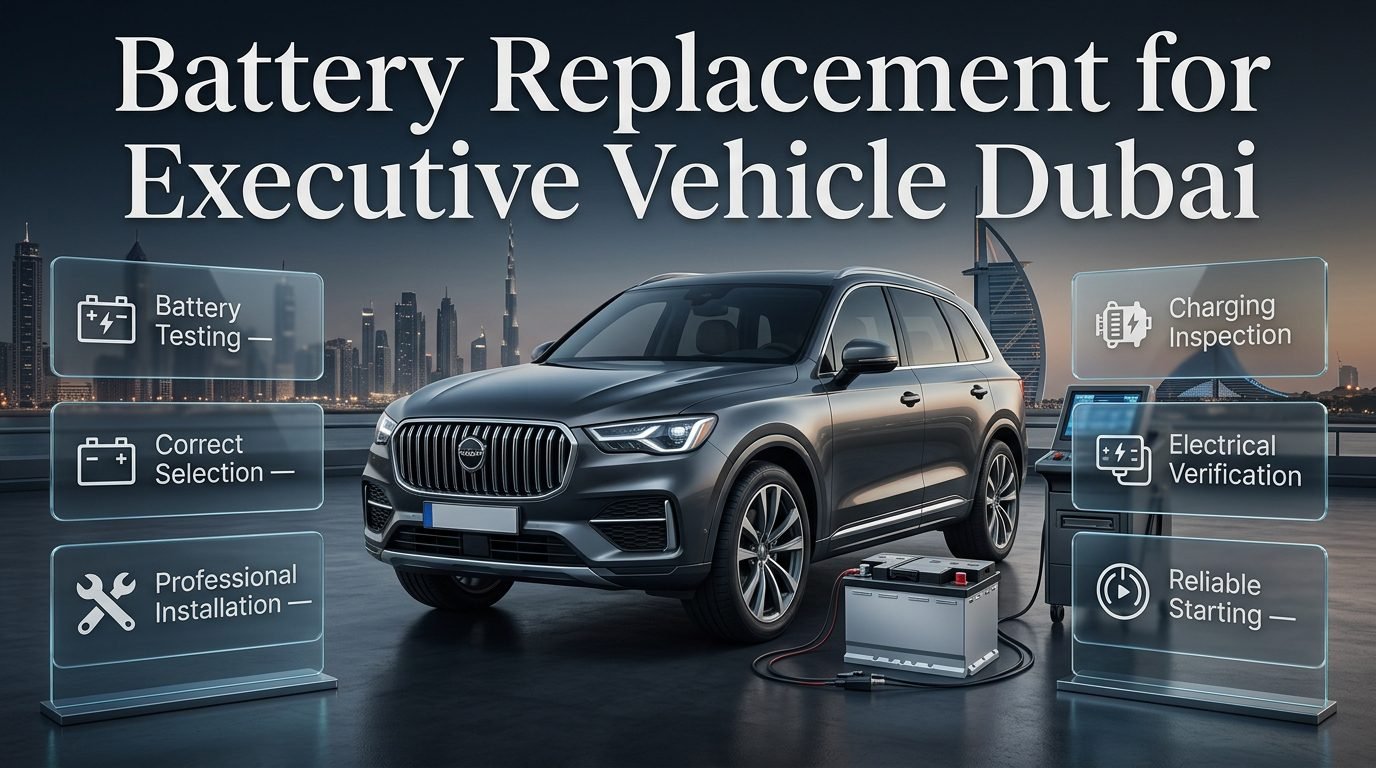
The right replacement process combines battery testing, correct battery selection, professional installation, charging-system inspection, and final electrical verification. This approach is especially valuable for luxury vehicles where reliability, electronic compatibility, and proper maintenance matter as much as the replacement itself.
What Is Battery Replacement for an Executive Vehicle?
Battery replacement is the professional process of determining whether an existing vehicle battery has deteriorated beyond reliable service, selecting a compatible replacement, removing the old unit, installing the new battery, and verifying that the vehicle’s electrical system operates correctly afterward.
For a basic older vehicle, this might appear straightforward. Executive vehicles can be very different.
A premium vehicle may contain:
- Multiple electronic control units
- Keyless entry and push-button starting
- Advanced infotainment
- Electric seats
- Heated and ventilated seats
- Parking cameras
- Parking sensors
- Driver-assistance systems
- Security and alarm systems
- GPS and tracking equipment
- Automatic climate control
- Start-stop technology
- Electronic steering systems
- Intelligent charging systems
- Battery monitoring sensors
All of these systems contribute to the vehicle’s electrical architecture.
That means selecting a replacement battery based only on physical size can be a mistake. A battery may fit into the tray and still be unsuitable because its capacity, technology, terminal arrangement, starting performance, or charging characteristics do not match the vehicle.
A professional Vehicle Inspection can therefore be an important part of the replacement process.
Why Executive Vehicles Need More Careful Battery Replacement
Executive vehicles are designed around comfort, performance, technology, and convenience. Those features also mean that the electrical system can be considerably more sophisticated than the system found in a basic vehicle.
The battery is responsible for supplying electrical energy when the engine is being started and supporting the vehicle’s electrical requirements under different operating conditions.
When battery capacity begins to decline, modern vehicles can sometimes compensate for the weakness for a period of time. This can make the final failure appear sudden even though deterioration has been developing for weeks or months.
Dubai’s environment can make battery maintenance even more important.
High temperatures can accelerate battery ageing. Long periods of parking can allow gradual discharge. Short journeys may not always provide sufficient operating time for the charging system to restore the energy used during starting and accessory operation.
Major factors affecting executive vehicle battery performance
| Factor | Possible effect |
|---|---|
| High temperatures | Can accelerate battery ageing |
| Frequent short journeys | May reduce charging recovery |
| Long parking periods | Can allow gradual discharge |
| Heavy electrical loads | Increase electrical demand |
| Start-stop operation | Increases battery cycling |
| Weak alternator | Prevents proper charging |
| Poor terminal connection | Can restrict current flow |
| Parasitic electrical drain | Can discharge the battery while parked |
| Incorrect battery specification | May affect reliability and system operation |
The important point is that a battery problem does not always originate inside the battery.
If an executive vehicle repeatedly develops a flat battery, replacing it without investigating the underlying reason can simply move the problem into the future.
Signs Your Executive Vehicle May Need Battery Replacement
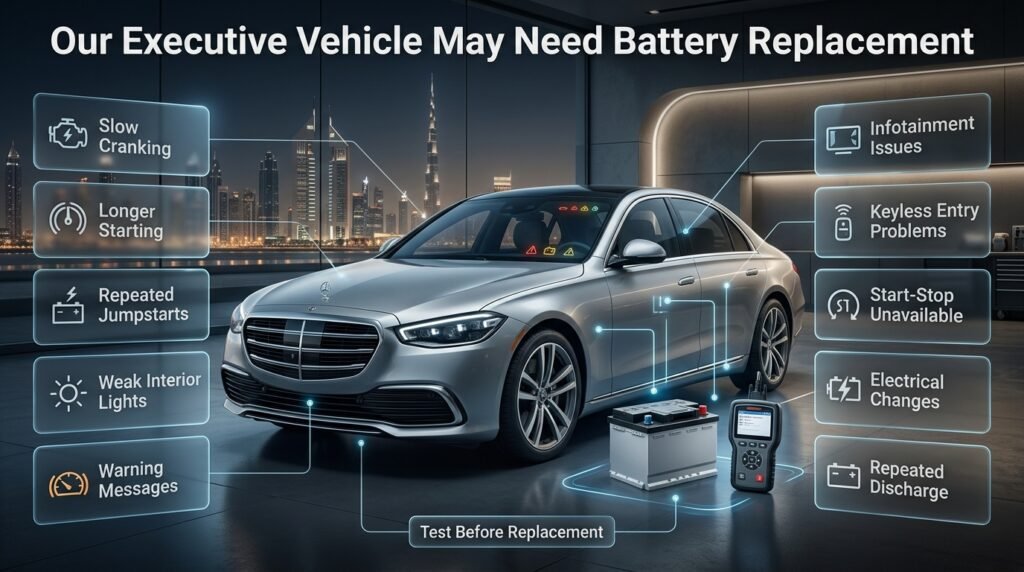
Battery failure usually develops through warning signs rather than appearing completely without symptoms.
Some vehicles provide dashboard messages, while others give the driver more subtle indications.
Common symptoms include:
- Slower engine cranking
- Longer starting time
- Repeated jumpstart requirements
- Weak interior lighting
- Electronic warning messages
- Unusual infotainment behavior
- Intermittent keyless-entry problems
- Start-stop system becoming unavailable
- Battery or charging warning messages
- Electrical accessories behaving differently
- Vehicle struggling to start after parking
- Battery repeatedly becoming discharged
However, symptoms should not automatically be interpreted as proof of battery failure.
For example, slow engine cranking can result from a weak battery, but it can also be associated with a starter problem, poor cable connection, or another electrical fault.
Likewise, a warning related to the battery or charging system does not necessarily mean that the battery itself is defective.
That is why professional Engine Diagnostics and battery testing can provide a more reliable answer than guessing from symptoms.
Battery Symptoms and Possible Causes
| Vehicle symptom | Possible battery issue | Other possible cause |
|---|---|---|
| Slow engine cranking | Reduced battery capacity | Starter or cable problem |
| Complete no-start | Deep discharge or failed battery | Connection or starter fault |
| Battery repeatedly goes flat | Weak battery | Parasitic drain |
| Charging warning | Battery unable to maintain system voltage | Alternator fault |
| Electrical warnings | Low system voltage | Module or wiring issue |
| Start-stop unavailable | Battery condition or state of charge | Vehicle strategy or system fault |
| Dim lights | Low electrical supply | Charging or connection problem |
| New battery quickly becomes weak | Battery problem | Charging-system fault or electrical drain |
This distinction is important because replacing the battery is only the correct solution when diagnosis supports it.
How Dubai Driving Conditions Affect Executive Vehicle Batteries
Dubai creates a distinctive environment for vehicle ownership.
Temperature is one of the most important considerations. Batteries operate within a temperature-sensitive environment, and prolonged exposure to high temperatures can contribute to accelerated ageing.
An executive vehicle parked outdoors for extended periods can experience a very different environment from one kept in shaded or controlled parking.
Driving patterns also matter.
An executive vehicle may spend much of its time in:
- Business districts
- Hotel areas
- Airport routes
- Residential towers
- Shopping destinations
- Heavy traffic
- Short-distance urban journeys
- Repeated pickup and drop-off cycles
A chauffeur-driven vehicle, for example, may start several times during the day and perform numerous short trips. Another executive car might remain parked for several days before being used for an important journey.
Neither pattern is automatically harmful, but both can influence how the battery is used.
Air conditioning and battery performance
Dubai drivers often associate battery problems with heavy AC use. The relationship needs to be understood correctly.
Once the engine is running, the vehicle’s charging system generally supplies electrical energy required by the vehicle. The air-conditioning system can increase the overall operating load, but it is not automatically the root cause of battery failure.
A weak battery may simply become more noticeable when the vehicle’s electrical system is under greater demand.
If the battery is already deteriorating, demanding operating conditions can expose the weakness sooner.
How to Select the Correct Battery for an Executive Vehicle
Battery selection should always begin with vehicle specifications.
The correct battery is not necessarily:
- The cheapest battery
- The largest battery
- The battery with the highest advertised rating
- The battery that physically fits
- The most expensive battery
- The battery most popular with other drivers
The correct battery is the one that meets the requirements of the particular vehicle.
Important factors include:
- Battery technology
- Capacity
- Cold-cranking performance
- Dimensions
- Terminal position
- Electrical requirements
- Start-stop compatibility
- Vehicle manufacturer specifications
- Charging-system characteristics
- Battery-management requirements
Some modern executive vehicles use AGM batteries, while others may require EFB or conventional battery technology.
The vehicle manufacturer’s specifications should determine the appropriate choice.
AGM Batteries for Executive and Luxury Vehicles
AGM, or Absorbent Glass Mat, technology is used in many vehicles requiring greater electrical performance and cycling capability.
AGM batteries can be particularly relevant where vehicles have demanding electrical systems or start-stop technology.
However, it would be incorrect to say that every executive vehicle automatically needs an AGM battery.
The vehicle specification remains the deciding factor.
An AGM battery should be selected when the vehicle requires or supports that technology.
For drivers specifically researching AGM options in Dubai, the dedicated AGM battery replacement service page provides a more focused resource.
The important principle is simple:
Battery technology should follow vehicle requirements, not assumptions about vehicle price or prestige.
Battery Brands for Executive Vehicles in Dubai
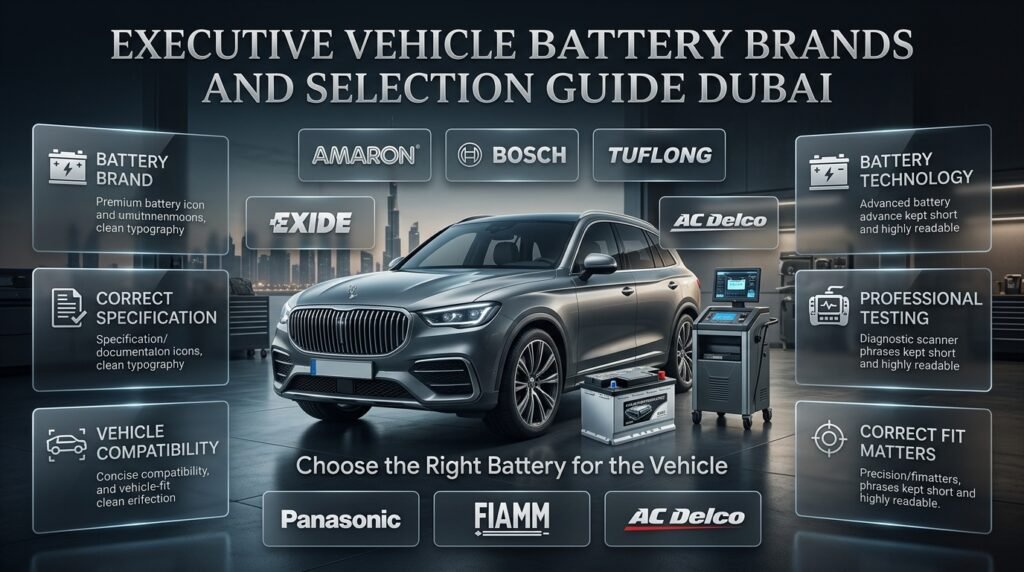
Executive vehicle owners may encounter several established battery brands when searching for replacement options.
Common names can include:
- Amaron
- Bosch
- Tuflong
- Exide
- Panasonic
- FIAMM
- AC Delco
Brand reputation can matter, but it should not replace proper battery matching.
For example, an Amaron battery that is suitable for one vehicle may not be the correct specification for another vehicle. The same principle applies to Bosch, Exide, Panasonic, FIAMM, Tuflong, and AC Delco.
The better question is not:
“Which battery brand is universally best?”
The better question is:
“Which battery specification and technology are appropriate for my vehicle?”
For owners researching individual options, relevant information is available through the following dedicated resources:
Amaron battery replacement in Dubai can be useful when considering Amaron options.
Bosch battery replacement in Dubai provides information for drivers considering Bosch batteries.
Tuflong battery replacement in Dubai covers Tuflong battery options.
Exide battery replacement in Dubai provides information about Exide replacement options.
Panasonic battery replacement in Dubai can help owners researching Panasonic options.
FIAMM battery replacement in Dubai covers FIAMM battery replacement.
AC Delco battery replacement in Dubai is another resource for drivers considering AC Delco.
These resources should be viewed as supporting information rather than reasons to select a brand without checking the vehicle’s exact requirements.
Why Battery Testing Should Come Before Replacement
A professional battery replacement should begin with testing whenever circumstances allow.
The purpose of testing is to answer several questions:
- Is the battery charged?
- Can the battery provide sufficient starting power?
- Is the battery internally deteriorated?
- Is the alternator charging correctly?
- Are the terminals and connections healthy?
- Is there evidence of abnormal electrical consumption?
- Is the battery actually the source of the problem?
A proper diagnostic approach can prevent unnecessary replacement.
For example, suppose an executive vehicle has a new battery installed but continues to lose power after being parked overnight. The battery itself may not be responsible. An abnormal electrical drain could remain active while the vehicle is parked.
Replacing the battery again would not solve the real problem.
Why Battery Voltage Alone Is Not Enough
One of the most common battery-testing mistakes is assuming that a voltage reading automatically proves battery health.
It does not.
A battery can show an apparently acceptable resting voltage and still fail to provide sufficient starting performance under load.
Professional assessment may consider:
- Resting voltage
- State of charge
- Battery condition
- Starting performance
- Load response
- Charging voltage
- Charging behavior
- Battery age
- Electrical consumption
This distinction becomes more important with executive vehicles because modern electronics can be sensitive to voltage stability.
A technician should interpret measurements within the context of the entire electrical system rather than relying on one number.
Professional Battery Replacement Process for Executive Vehicles
A professional replacement should follow a structured process.
1. Vehicle identification
The technician confirms the vehicle make, model, engine configuration, and relevant electrical requirements.
2. Existing battery inspection
The current battery is inspected for:
- Physical damage
- Corrosion
- Leakage
- Terminal condition
- Mounting condition
- Visible deterioration
3. Battery testing
The battery is tested to determine its condition and starting capability.
4. Charging-system testing
The alternator and charging system are evaluated where necessary.
5. Battery selection
A compatible replacement is selected according to the vehicle’s requirements.
6. Safe battery removal
The existing battery is disconnected and removed using an appropriate procedure.
7. New battery installation
The replacement is secured correctly and connected with appropriate terminal positioning.
8. Battery-management procedure
Where required, the new battery may need registration, coding, or adaptation.
9. Vehicle startup
The vehicle is started and its electrical behavior is observed.
10. Final verification
The technician checks for warning messages and confirms that the charging and starting systems are operating appropriately.
This structured process is particularly valuable for executive vehicles because it reduces the risk of treating a sophisticated electrical system like a simple component replacement.
Battery Registration and Electronic Management
Some modern vehicles monitor battery condition through an electronic battery-management system.
Depending on the manufacturer and model, replacing the battery may require the vehicle to recognize the new battery.
This can involve:
- Battery registration
- Battery coding
- Adaptation
- Diagnostic-system confirmation
- Energy-management reset
Not every vehicle requires the same procedure.
It is therefore important not to apply a universal rule.
The correct approach is to identify the vehicle and follow its applicable service requirements.
Failure to account for vehicle-specific battery-management procedures can potentially affect how the charging system manages the replacement battery.
Battery Replacement vs Car Jumpstart
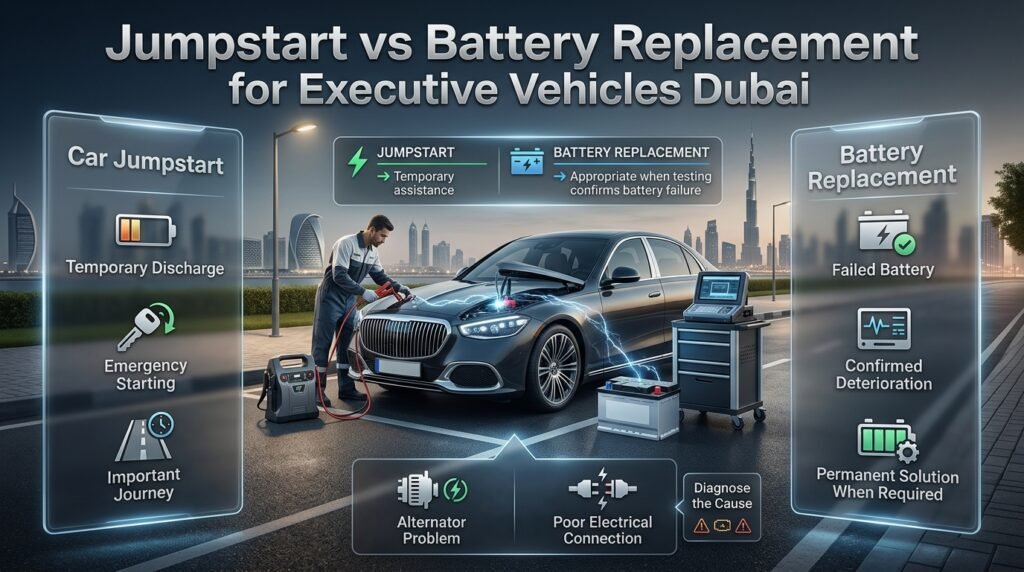
A jumpstart and battery replacement are not interchangeable services.
A Car Jumpstart can help a vehicle start when the battery is temporarily discharged.
Battery replacement is appropriate when testing confirms that the existing battery has deteriorated or failed.
| Situation | Jumpstart | Battery replacement |
|---|---|---|
| Temporary discharge | Useful | May not be necessary |
| Failed battery | Temporary assistance | Appropriate |
| Repeated battery failure | Does not solve cause | Appropriate if battery is defective |
| Alternator problem | Does not repair it | Battery alone does not repair it |
| Poor electrical connection | Does not fix connection | Battery replacement may be unnecessary |
| Important journey and flat battery | Useful emergency measure | Depends on diagnosis |
A jumpstart should therefore be viewed as an emergency starting solution, not automatically as a permanent repair.
If an executive vehicle repeatedly requires jumpstarts, professional diagnosis should follow.
When the Alternator Is Actually the Problem
The battery and alternator perform different functions.
The battery supplies energy for starting and supports electrical requirements when the engine is not operating. The alternator and charging system replenish electrical energy and support vehicle operation while the engine is running.
A charging-system fault can therefore make a healthy battery appear defective.
Potential warning signs include:
- Repeated battery discharge
- Battery warning messages
- Electrical problems while driving
- New battery losing charge quickly
- Weak electrical performance
- Abnormal charging-system test results
This is why a professional battery replacement should consider the charging system whenever the vehicle’s history suggests repeated discharge.
Installing a new battery without checking the alternator can create a false sense of security.
Parasitic Drain and Executive Vehicles
A vehicle continues to use a small amount of electrical energy while parked because certain systems must remain available.
This is normal.
An excessive electrical drain is different.
Possible causes include:
- Faulty electronic modules
- Aftermarket accessories
- Tracking devices
- Security equipment
- Lighting remaining active
- Faulty wiring
- Control modules failing to enter sleep mode
- Incorrectly installed electrical equipment
If an executive vehicle repeatedly develops a flat battery after parking, parasitic drain should be considered.
This is especially important for vehicles that spend long periods parked outside offices, hotels, residential towers, or private parking areas.
The solution is not always another battery.
Sometimes the correct solution is electrical diagnosis.
Battery Problems in Chauffeur-Driven Executive Vehicles
Chauffeur-driven vehicles often have a different duty cycle from privately used cars.
A chauffeur may start the vehicle multiple times during a working day, perform short journeys, wait with the vehicle parked, run climate-control systems, and then complete another trip.
This can produce a demanding usage pattern.
Fleet managers and executive transportation operators should monitor:
- Battery age
- Starting performance
- Number of daily starts
- Short-trip frequency
- Parking duration
- Repeated jumpstarts
- Dashboard warnings
- Electrical-system behavior
- Maintenance history
The objective is not necessarily to replace batteries prematurely.
Instead, condition monitoring can help identify a battery that is approaching the end of its reliable service life before it fails during a critical business journey.
Battery Replacement Before Business Travel
For an executive vehicle, reliability can have professional consequences.
A vehicle failure before an airport transfer or important meeting can result in delays and unnecessary stress.
If a major business journey is scheduled, it is sensible to assess the vehicle beforehand if the battery has shown warning signs.
Useful checks include:
- Battery condition
- Starting performance
- Charging-system operation
- Dashboard warnings
- Tire condition
- Fluid levels
- Recent repair history
- Previous jumpstarts
The objective is simple: do not wait for a complete failure if the vehicle has already provided warning signs.
Preventive Car Service can identify other developing problems at the same time.
Emergency Battery Replacement in Dubai
Battery failure can happen in almost any location.
An executive vehicle might fail at:
- A residential tower
- Hotel parking
- Office parking
- Airport area
- Shopping center
- Business district
- Roadside location
- Private parking facility
When the vehicle cannot be driven to a workshop, mobile assistance can be particularly useful.
However, even emergency service should begin with diagnosis.
The technician may need to determine whether the no-start condition is caused by:
- Discharged battery
- Failed battery
- Starter problem
- Charging fault
- Loose terminal
- Electrical fault
- Immobilizer or key-related issue
This is where professional Roadside Assistance can be more useful than simply sending a replacement battery without checking the vehicle.
How Long Does an Executive Vehicle Battery Last?
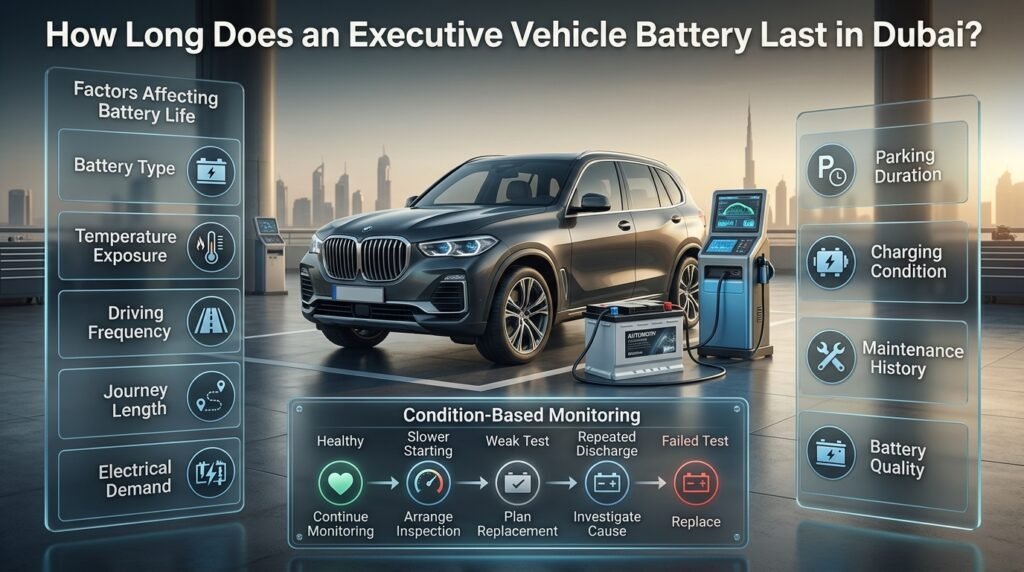
There is no universal battery lifespan that applies to every executive vehicle.
Service life depends on:
- Battery type
- Battery quality
- Temperature exposure
- Driving frequency
- Journey length
- Electrical demand
- Parking duration
- Charging-system condition
- Maintenance history
A vehicle driven regularly and maintained correctly can have a different battery life from one that spends long periods parked.
Rather than depending entirely on a calendar-based replacement schedule, condition-based monitoring is often more informative.
Practical condition guide
| Battery condition | Recommended approach |
|---|---|
| Starts normally and tests healthy | Continue monitoring |
| Slightly slower starting | Arrange inspection |
| Weak test result | Plan replacement |
| Repeated discharge | Investigate cause |
| Failed battery test | Replace |
| Confirmed complete battery failure | Replace promptly |
Common Mistakes Executive Vehicle Owners Make
Choosing only by price
The cheapest battery may not provide the correct specification or long-term value.
Selecting based only on physical fit
A battery can fit the tray while still being electrically inappropriate.
Replacing without diagnosis
Another component may be causing the symptom.
Repeatedly using jumpstarts
Jumpstarting does not repair a failed battery or charging fault.
Ignoring electrical warnings
Modern warning messages can provide useful information about vehicle condition.
Choosing AGM without checking specifications
AGM is not automatically appropriate for every executive vehicle.
Ignoring battery registration
Some vehicles require additional electronic procedures after replacement.
Failing to investigate repeated discharge
A parasitic drain can continue to discharge a new battery.
Neglecting the charging system
A defective alternator can undermine a new battery.
Battery Replacement and Complete Vehicle Maintenance
Battery reliability is only one part of executive vehicle reliability.
A premium vehicle depends on numerous mechanical and electronic systems working together.
Routine Vehicle Maintenance should therefore consider areas such as:
- Engine Diagnostics
- Brake Repair
- Oil Change
- AC Repair
- Transmission Repair
- Suspension Repair
- Wheel Alignment
- Engine Repair
- Tire inspection
- Vehicle Inspection
- Electrical diagnosis
A battery problem can sometimes reveal a broader maintenance issue.
For example, repeated electrical warnings may indicate a charging-system problem. Starting problems may expose an aging starter. Battery discharge may reveal a parasitic drain.
The advantage of comprehensive maintenance is that the technician can consider the vehicle as a complete system rather than treating each symptom independently.
Cost Factors for Executive Vehicle Battery Replacement in Dubai
Battery replacement costs can vary substantially.
There is no single price that accurately represents every executive vehicle.
Several factors influence the final cost.
| Cost factor | Why it affects service |
|---|---|
| Battery technology | AGM and other advanced technologies may cost differently |
| Capacity | Larger batteries may have different pricing |
| Vehicle model | Premium models can have specialized requirements |
| Battery brand | Brand and specification affect price |
| Installation | Professional fitting adds service value |
| Diagnosis | Testing may identify additional faults |
| Registration | Some vehicles require electronic procedures |
| Emergency service | Mobile assistance can affect total cost |
| Warranty | Warranty terms influence overall value |
Owners should therefore compare the complete service rather than comparing battery prices alone.
A low-cost battery that does not match the vehicle can become an expensive mistake.
For drivers researching the wider Dubai market, the complete 2026 car battery price guide can provide additional context about the factors that influence battery pricing.
How to Judge a Professional Battery Replacement Service
A quality replacement should not be judged only by how quickly the vehicle starts after installation.
Look for a process that includes:
- Vehicle identification
- Battery testing
- Charging-system evaluation
- Correct battery selection
- Professional installation
- Proper terminal connection
- Battery-management procedure where applicable
- Final system verification
- Clear explanation of the replacement
- Appropriate warranty information
This approach provides more confidence than simply purchasing a battery and having it installed without diagnosis.
For executive vehicles, proper procedure matters because the battery is connected to a wider electrical network.
Professional Recommendations for Executive Vehicle Owners
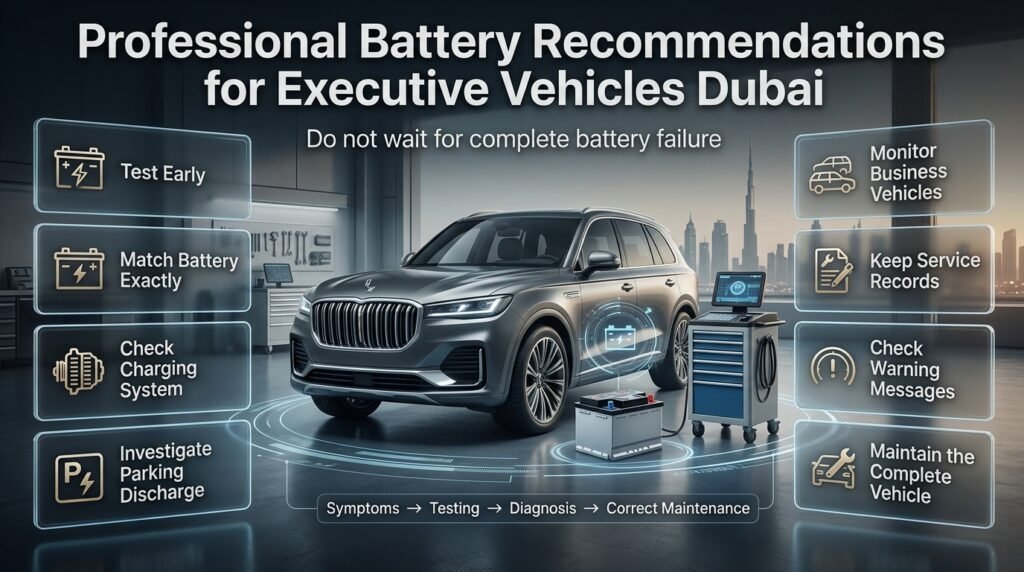
Test when symptoms first appear
Do not wait for complete failure if the vehicle begins cranking more slowly.
Match the battery exactly
Vehicle requirements should determine battery selection.
Check the charging system
Especially when the battery has repeatedly discharged.
Investigate parking-related discharge
A vehicle that repeatedly dies after parking may have an electrical drain.
Monitor business-use vehicles
Chauffeur and corporate vehicles can experience different operating patterns.
Maintain service records
Knowing when a battery was installed helps with future maintenance decisions.
Do not ignore warning messages
Modern electrical warnings should be investigated.
Consider the complete vehicle
Battery replacement should fit into a broader preventive maintenance strategy.
Modern Automotive Battery Technology
The role of the vehicle battery continues to evolve.
Modern vehicles increasingly depend on electrical systems for functions that previously required little or no electronic control.
These include:
- Driver-assistance systems
- Digital dashboards
- Connected services
- Cameras
- Sensors
- Electronic steering
- Intelligent climate control
- Start-stop systems
- Advanced security
- Vehicle tracking
- Energy-management systems
This development means battery diagnosis is increasingly becoming a combination of electrical testing and electronic diagnostics.
The technician of the future will not simply ask whether a battery is “dead.”
The more useful questions will include:
- What is the battery’s condition?
- How is the charging system managing it?
- What electrical loads are present?
- Is the vehicle entering sleep mode correctly?
- Does the vehicle recognize the replacement battery?
- Is the energy-management system functioning correctly?
Future Outlook for Executive Vehicle Battery Service
Automotive technology is moving toward increasingly intelligent energy management.
Connected vehicles, electrified powertrains, advanced electronics, and predictive maintenance are likely to make battery monitoring more sophisticated.
Future vehicle service may increasingly involve:
- Digital battery health monitoring
- Predictive maintenance alerts
- Advanced diagnostic equipment
- Intelligent charging management
- Improved battery chemistry
- More detailed electronic service records
- Automated vehicle health reports
This means professional battery service will become increasingly integrated with overall vehicle diagnostics.
For executive vehicle owners, that development is beneficial because early identification of battery deterioration can potentially prevent unexpected failures.
Why Professional Battery Replacement Matters for Luxury Cars
Luxury vehicles can contain expensive electronics and sophisticated control systems.
The battery supports an electrical architecture that can include numerous modules and systems operating before, during, and after engine operation.
A professional replacement approach helps reduce the risk of:
- Wrong battery selection
- Incorrect terminal installation
- Incomplete diagnosis
- Ignored charging faults
- Repeated battery discharge
- Battery-management issues
- Unnecessary parts replacement
The goal should not simply be to make the vehicle start.
The goal should be to restore reliable electrical operation.
When Battery Replacement Should Become Part of Preventive Maintenance
The strongest battery strategy is proactive rather than reactive.
Instead of waiting until the vehicle completely refuses to start, owners can monitor battery performance during routine service.
A preventive approach may include:
- Battery condition testing
- Charging-system inspection
- Terminal inspection
- Electrical-system diagnosis
- Starting-system evaluation
- Vehicle diagnostics
- Routine engine service
- Brake inspection
- AC servicing
- Tire and suspension checks
This creates a broader reliability program.
For an executive vehicle used for business purposes, preventive maintenance can be particularly valuable because the cost of an unexpected breakdown may involve more than the repair itself.
A missed appointment, delayed airport transfer, or interrupted corporate schedule can create additional inconvenience.
Executive Vehicle Battery Replacement: Practical Decision Guide
| Situation | Best approach |
|---|---|
| Vehicle starts normally | Monitor and test during routine service |
| Starting is becoming slower | Arrange battery testing |
| Battery repeatedly goes flat | Test battery and investigate drain |
| New battery loses charge | Check charging system and electrical consumption |
| Battery warning appears | Diagnose electrical/charging system |
| Battery fails professional test | Replace with correct specification |
| Vehicle requires frequent jumpstarts | Investigate underlying cause |
| Important business trip approaching | Inspect vehicle beforehand |
| Vehicle parked for long periods | Monitor battery condition |
| Modern executive vehicle | Consider vehicle-specific battery-management requirements |
This approach avoids both unnecessary replacement and preventable breakdowns.
How do I know if my executive vehicle needs a battery replacement in Dubai?
Executive vehicles often give several warning signs before the battery completely fails. Slow engine cranking, delayed starting, repeated jumpstart requirements, electrical warning messages, unusual electronic behavior, or difficulty starting after the car has been parked are all reasons to have the battery professionally tested. The important point is that these symptoms do not automatically mean the battery itself has failed. A weak alternator, poor terminal connection, starter problem, or abnormal electrical drain can create very similar symptoms.
For an executive vehicle, replacing the battery based only on a symptom can therefore be an expensive guess. A proper inspection should establish the battery’s condition and, where necessary, check the charging system and starting system at the same time.
Important points:
Slow cranking is one of the earliest signs worth investigating.
Repeated jumpstarts should not become a permanent solution.
Battery voltage alone does not always establish battery health.
The alternator should be considered when the battery repeatedly loses charge.
A battery that fails professional testing is a much stronger reason for replacement than age alone.
The best approach is test first, replace when the diagnosis supports it. This is particularly important for executive vehicles because their electrical systems can be considerably more sophisticated than those of basic cars.
Does Dubai heat make executive vehicle batteries fail faster?
Dubai’s high temperatures can contribute to faster battery ageing, making climate an important consideration for executive vehicle owners. Heat affects the internal chemical and physical processes of a battery and can accelerate deterioration over time. The effect is not identical for every vehicle, however, because battery technology, parking conditions, driving habits, electrical demand, and charging-system condition also influence service life.
This becomes particularly relevant for executive vehicles because they often contain extensive electronic equipment and may spend considerable time parked between business trips, hotel transfers, office visits, or airport journeys.
Dubai-specific factors to watch:
Extended exposure to high temperatures
Outdoor parking during hot periods
Frequent short-distance journeys
Long periods of vehicle inactivity
Heavy electrical demand
Repeated starting cycles
Existing charging-system problems
The practical lesson is not to replace a battery simply because the vehicle operates in Dubai. Instead, monitor its starting behavior and have it tested when warning signs appear. Preventive Vehicle Maintenance is generally more useful than waiting for a complete no-start situation.
Does an executive or luxury vehicle need an AGM battery?
Not every executive vehicle automatically needs AGM, but many modern premium vehicles are designed around advanced battery technologies such as AGM, particularly where start-stop systems and substantial electrical loads are involved. AGM batteries are constructed differently from conventional flooded batteries and are designed for applications requiring particular cycling and starting characteristics.
The important mistake to avoid is choosing AGM simply because the vehicle is expensive. Battery technology should be matched to the vehicle manufacturer’s requirements.
For example, if a vehicle was designed for AGM, replacing it with an inappropriate conventional battery may affect the way the vehicle’s charging and energy-management system operates. On the other hand, upgrading or changing battery technology without confirming compatibility is also not something that should be done simply on assumption.
Before selecting an AGM battery, check:
Original battery technology
Battery capacity
Required starting performance
Physical dimensions
Terminal configuration
Start-stop requirements
Vehicle charging strategy
Battery-management-system requirements
For vehicles that specifically require AGM technology, a correctly specified AGM Battery can be an important part of reliable operation. The priority should always be compatibility rather than choosing a battery based purely on the brand or price.
Does a luxury or executive car need battery registration or coding after replacement?
This depends on the vehicle, but many modern luxury vehicles use battery-management systems that may require the replacement battery to be registered, coded, or adapted after installation. BMW and Mercedes are examples where battery-management procedures can be relevant on applicable models.
The reason is that the vehicle may monitor battery condition and control charging according to information about the battery. Installing a new battery is therefore not necessarily the end of the job on a sophisticated vehicle.
However, it would be inaccurate to say that every executive vehicle requires coding. Requirements vary according to manufacturer, model, year, battery technology, and electrical architecture.
A professional replacement should establish:
Whether the vehicle has a battery-management system
Whether registration is required
Whether battery specifications have changed
Whether adaptation is necessary
Whether diagnostic faults are present after installation
Whether the charging system is functioning correctly
This is one of the main reasons professional Battery Replacement is preferable for modern executive vehicles. The objective is not merely to fit a battery physically; it is to ensure that the vehicle’s electrical-management system is correctly configured for the replacement.
Why does my executive car keep needing a new battery even after replacement?
When a relatively new replacement battery repeatedly becomes weak or discharged, replacing another battery immediately is usually not the best diagnostic approach. The repeated failure may indicate that something else is affecting the electrical system.
Possible causes include a charging-system problem, excessive electrical consumption while parked, poor battery connections, an unsuitable battery specification, or another electrical fault. Modern vehicles can also have multiple electronic systems that remain active or periodically communicate while the vehicle is parked.
When a replacement battery keeps going flat, check:
Battery condition and specification
Alternator and charging performance
Battery terminals and connections
Possible parasitic electrical drain
Aftermarket accessories
Tracking or security equipment
Vehicle electrical warnings
Battery-management-system operation
Vehicle usage and parking patterns
This is particularly important for executive cars that spend long periods parked. A new battery cannot compensate for an unresolved electrical drain or charging fault.
The professional approach is to investigate why the battery is failing, rather than simply replacing the battery repeatedly. That distinction can save money and, more importantly, prevent another unexpected no-start situation.
Professional takeaway
For battery replacement for executive vehicle Dubai, the strongest maintenance strategy is condition-based rather than guess-based: diagnose the battery, verify the charging system, select the correct battery technology, complete any vehicle-specific registration procedure, and investigate repeated discharge instead of repeatedly installing new batteries.
Conclusion
Battery replacement for an executive vehicle in Dubai should never be treated as a simple battery swap. Luxury and executive cars rely on sophisticated electrical systems, advanced battery-management technology, and multiple electronic components that require stable and reliable power. When starting becomes slower, electrical warnings appear, or the battery repeatedly loses charge, professional testing can determine whether the battery itself needs replacement or whether another issue is responsible.
Dubai’s climate and driving conditions also make preventive battery care important. High temperatures, frequent short journeys, long parking periods, and heavy electrical usage can all influence battery performance. Selecting the correct battery technology, whether conventional, EFB, or AGM, should always be based on the vehicle’s specifications rather than price or assumptions about the vehicle.
A professional Battery Replacement should therefore include proper diagnosis, correct battery selection, secure installation, charging-system verification, and battery registration or adaptation where the vehicle requires it. If the battery continues to fail after replacement, the next step should be investigating the alternator, electrical connections, parasitic drain, or other underlying faults.
For executive vehicle owners in Dubai, this proactive approach provides more than a new battery. It supports dependable starting, protects the vehicle’s electrical system, reduces unexpected breakdown risks, and helps maintain the reliability expected from a premium vehicle. Regular Vehicle Inspection, Car Service, Engine Diagnostics, Roadside Assistance, and Vehicle Maintenance can further ensure that the vehicle remains prepared for daily commuting, business travel, airport transfers, and other important journeys.
Leave a Reply