
Introduction
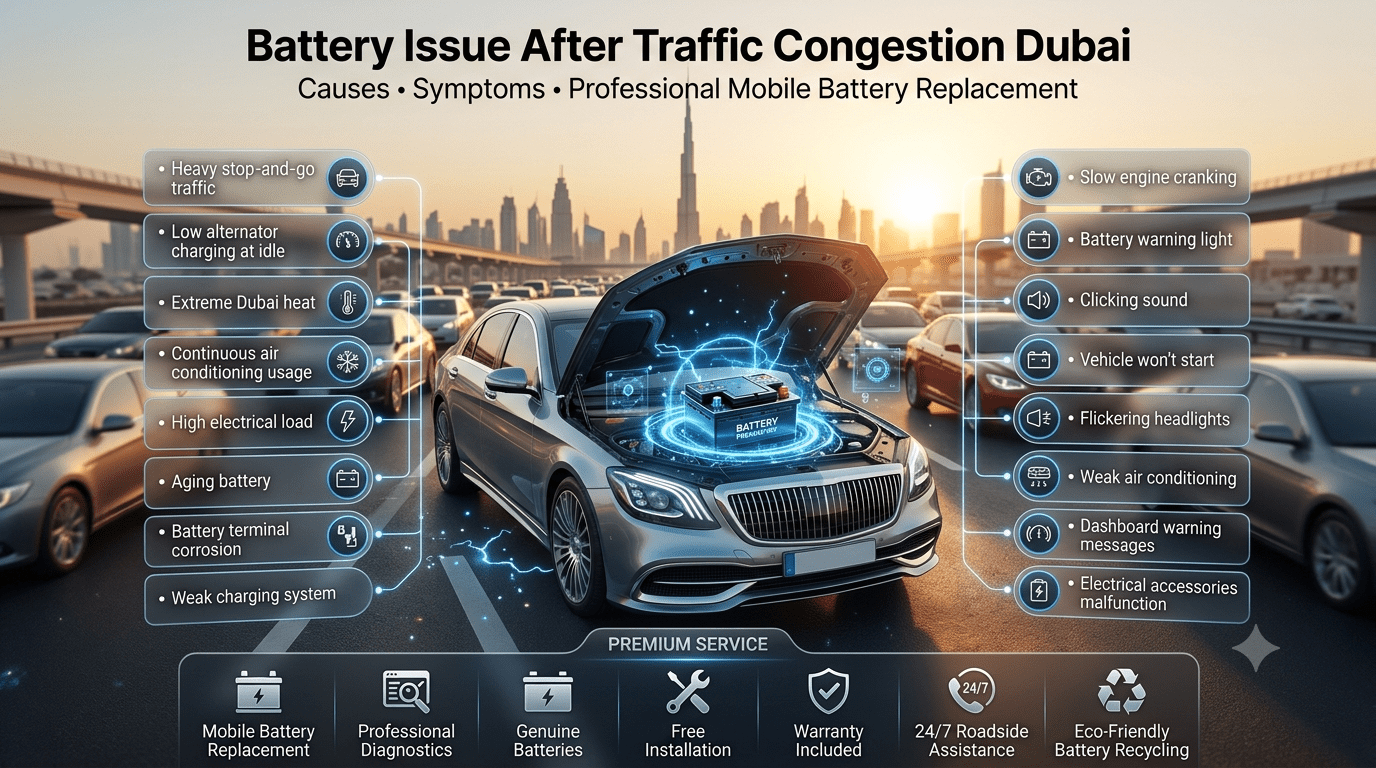
A battery issue after traffic congestion in Dubai is one of the most common roadside emergencies experienced by motorists across the city. Long periods of stop-and-go traffic, combined with Dubai’s extreme temperatures, place significant stress on a vehicle’s battery and charging system. While the engine continues running, low RPMs during congestion reduce the alternator’s charging efficiency, especially when the air conditioner, headlights, infotainment system, and multiple electronic accessories are operating simultaneously.
Many drivers only realize there is a problem after reaching their destination. The engine may crank slowly, dashboard warning lights may appear, or the vehicle may fail to start altogether. These situations are particularly common during peak traffic hours on Sheikh Zayed Road, Al Khail Road, Sheikh Mohammed Bin Zayed Road, and Business Bay, where vehicles often remain in traffic for extended periods.
Professional diagnosis is essential because a weak battery is not always the only cause. Alternator performance, battery age, terminal corrosion, parasitic electrical drain, and excessive heat exposure all contribute to battery-related failures. Choosing a trusted mobile battery replacement service ensures the correct battery is installed according to the manufacturer’s specifications while protecting sensitive vehicle electronics.
If your battery fails unexpectedly, EuroSwift Auto Services provides fast mobile battery replacement, professional diagnostics, genuine batteries, free installation, warranty support, and environmentally responsible battery disposal throughout Dubai. Drivers looking for immediate roadside assistance can visit:
Why Traffic Congestion Causes Battery Issues in Dubai
Traffic congestion creates operating conditions that differ significantly from normal highway driving. During steady highway travel, the alternator spins at higher speeds and efficiently recharges the battery while powering the vehicle’s electrical systems. In heavy traffic, however, engine speed remains low while electrical demand stays high.
Modern vehicles continuously operate numerous electronic components, including automatic climate control, digital instrument clusters, navigation systems, cameras, parking sensors, adaptive cruise control, mobile charging ports, and entertainment systems. These features consume electricity even when the vehicle is barely moving.
Dubai’s extreme summer climate further accelerates battery wear. Under-bonnet temperatures frequently exceed safe operating limits, causing battery fluid to evaporate faster and increasing internal plate corrosion. As batteries age, their ability to hold a full charge decreases, making them far more vulnerable during long traffic jams.
Older batteries are particularly susceptible to failure after congestion because they no longer maintain sufficient reserve capacity. Even if the battery starts the vehicle successfully in the morning, prolonged traffic can leave it unable to restart the engine after parking.
Common Symptoms of a Battery Issue After Traffic Congestion
Several warning signs indicate that the battery may be weakening after extended traffic exposure:
- Slow engine cranking
- Clicking sound when turning the ignition
- Complete no-start condition
- Battery warning light on the dashboard
- Flickering headlights
- Dim interior lighting
- Weak air-conditioning performance
- Infotainment system restarting automatically
- Parking sensor or camera malfunctions
- Auto start-stop system becoming unavailable
- Keyless entry operating inconsistently
- Multiple electronic warning messages
These symptoms should never be ignored, as they often indicate a battery nearing the end of its service life or an underlying charging system problem.
Types of Car Batteries for Battery Issues After Traffic Congestion Dubai
Choosing the correct battery is essential when dealing with a battery issue after traffic congestion in Dubai. Heavy traffic, prolonged idling, and extreme UAE temperatures place additional stress on automotive batteries, making battery type an important factor in performance and lifespan. Professional technicians always recommend installing a battery that matches the vehicle manufacturer’s specifications.
1. Flooded Lead-Acid Battery
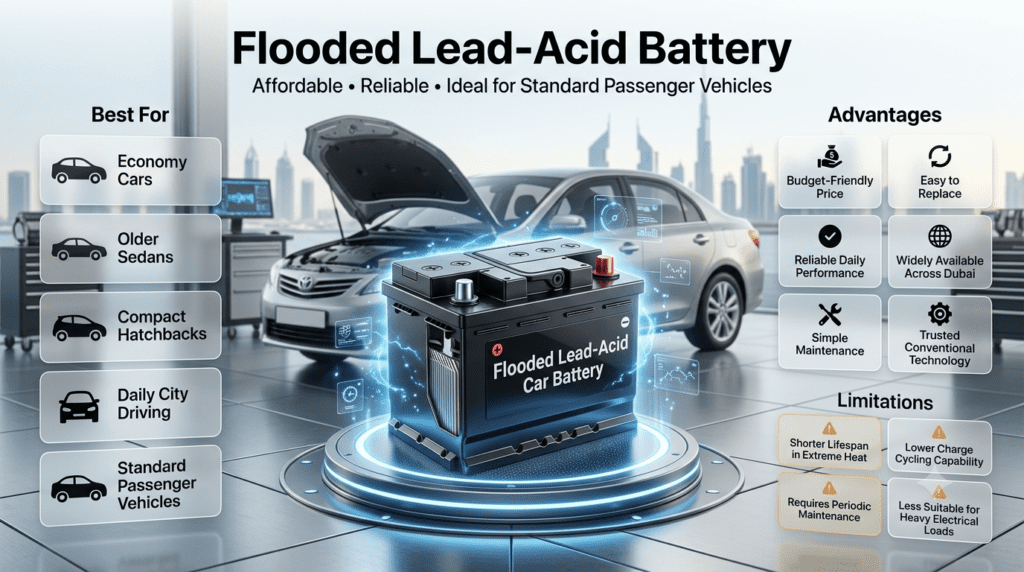
Flooded lead-acid batteries are the most common option for standard passenger vehicles. They are cost-effective, widely available, and suitable for cars with basic electrical systems. However, they are less resistant to frequent stop-and-go traffic and high temperatures than advanced battery technologies.
Best For:
- Economy cars
- Older sedans
- Compact hatchbacks
Advantages:
- Affordable price
- Easy replacement
- Reliable for basic vehicles
- Widely available across Dubai
Limitations:
- Shorter lifespan in extreme heat
- Lower cycling capability
- Requires proper maintenance in some models
2. AGM (Absorbent Glass Mat) Battery
AGM batteries are designed for vehicles equipped with advanced electronics and automatic start-stop systems. They deliver higher starting power, recharge more efficiently, and perform exceptionally well under heavy electrical loads.
Best For:
- BMW
- Mercedes-Benz
- Audi
- Porsche
- Range Rover
- Lexus
- Luxury SUVs
- Start-stop vehicles
Advantages:
- Excellent performance in Dubai traffic
- Faster charging
- Longer service life
- Leak-resistant design
- Handles heavy electrical demand
- Better vibration resistance
Limitations:
- Higher purchase cost
- Requires professional installation and, in many vehicles, battery registration
For premium vehicles, using an AGM battery is often the manufacturer’s recommended choice.
3. Enhanced Flooded Battery (EFB)
EFB batteries are an upgraded version of traditional flooded batteries. They provide improved durability and support moderate start-stop technology while remaining more affordable than AGM batteries.
Best For:
- Mid-range passenger vehicles
- Family sedans
- Vehicles with basic start-stop systems
Advantages:
- Longer lifespan than standard lead-acid batteries
- Better charge acceptance
- Improved cycling performance
- Suitable for frequent city driving
Limitations:
- Lower performance than AGM batteries
- Not ideal for luxury vehicles with extensive electronics
4. Gel Battery
Gel batteries use a gel-based electrolyte instead of liquid acid, making them highly resistant to vibration and leakage. They are commonly found in specialty vehicles rather than everyday passenger cars.
Best For:
- Off-road vehicles
- Recreational vehicles
- Marine applications
- Specialized commercial equipment
Advantages:
- Maintenance-free
- Leak-proof construction
- Excellent deep-cycle performance
- Strong vibration resistance
Limitations:
- Higher price
- Less common for standard passenger cars
- Requires compatible charging systems
5. Lithium Auxiliary Battery
Many modern luxury and electric vehicles use lithium auxiliary batteries to power low-voltage electronic systems. These batteries are lightweight, efficient, and designed to support sophisticated vehicle technologies.
Best For:
- Electric vehicles (EVs)
- Hybrid vehicles
- Premium smart vehicles
Advantages:
- Lightweight
- High energy efficiency
- Long service life
- Fast charging capability
- Supports advanced electronic systems
Limitations:
- Higher replacement cost
- Vehicle-specific compatibility requirements
- Professional installation recommended
Car Battery Type Comparison
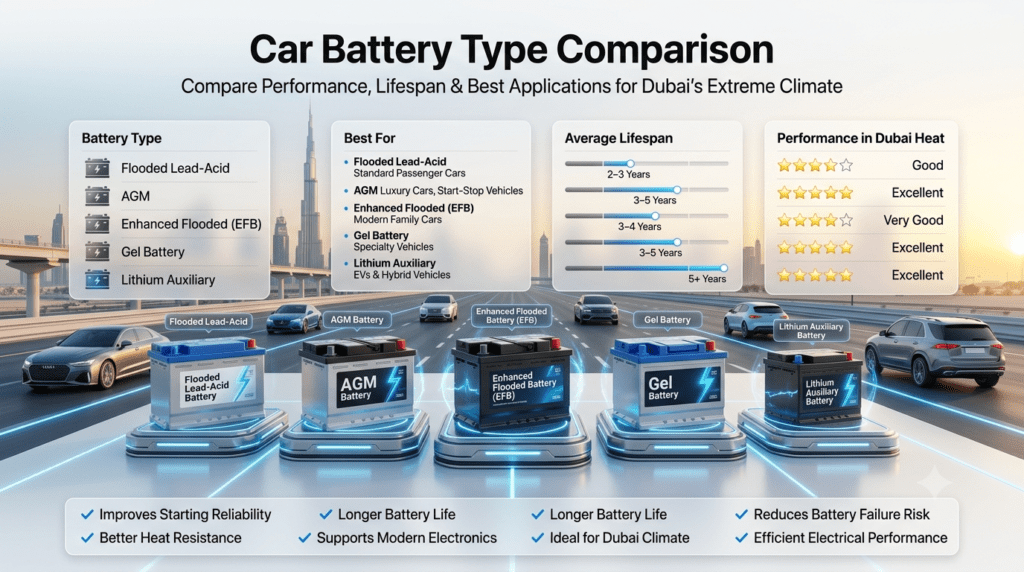
| Battery Type | Best For | Average Lifespan | Performance in Dubai Heat |
|---|---|---|---|
| Flooded Lead-Acid | Standard passenger cars | 2–3 Years | Good |
| AGM | Luxury & Start-Stop Vehicles | 3–5 Years | Excellent |
| Enhanced Flooded (EFB) | Modern Family Cars | 3–4 Years | Very Good |
| Gel Battery | Specialty Vehicles | 3–5 Years | Excellent |
| Lithium Auxiliary | EVs & Hybrid Vehicles | 5+ Years | Excellent |
Selecting the right battery type helps minimize the risk of a battery issue after traffic congestion in Dubai, improves starting reliability, and ensures the vehicle’s electrical system performs efficiently in the UAE’s demanding climate.
Vehicles Most Affected
Battery issues after traffic congestion are particularly common in luxury vehicles due to their higher electrical demands. Brands such as BMW, Mercedes-Benz, Audi, Porsche, Range Rover, Lexus, and Volvo typically require AGM batteries designed to support advanced electronic systems.
Commercial vehicles, delivery vans, taxis, ride-sharing vehicles, and rental cars are also at higher risk because they spend long hours operating in congested urban environments. Hybrid vehicles and electric vehicles may also experience issues with their auxiliary 12-volt batteries, even though their main traction batteries remain fully functional.
Professional Battery Diagnosis Process
A professional inspection is the first step in resolving a battery issue after traffic congestion Dubai. Replacing a battery without proper testing can lead to unnecessary costs if the actual fault lies in the charging system or another electrical component.
Experienced technicians follow a systematic process to identify the exact cause of the problem.
Step 1: Visual Inspection
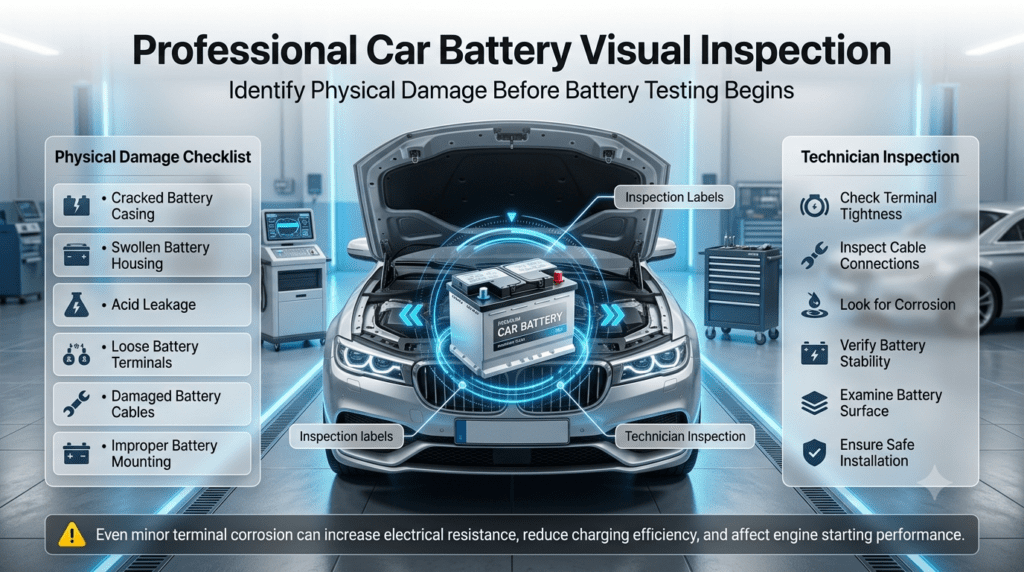
The battery is inspected for physical damage before any testing begins. Technicians check for:
- Cracked or swollen battery casing
- Acid leakage
- Loose battery terminals
- Corrosion around connectors
- Damaged battery cables
- Improper battery mounting
Even minor corrosion can increase electrical resistance and affect starting performance.
Step 2: Battery Voltage Test
A digital battery analyzer measures the resting voltage to determine the battery’s current state of charge.
Generally:
- 12.6V–12.8V: Fully charged
- 12.4V–12.5V: Partially charged
- Below 12.2V: Weak battery
- Below 12.0V: Battery may require replacement
Step 3: Load Testing
A load test determines whether the battery can deliver sufficient current during engine startup. Many batteries appear normal during voltage testing but fail under load due to reduced internal capacity.
Step 4: Alternator Testing
Technicians inspect the charging system to ensure the alternator is supplying adequate power.
A healthy charging system typically produces between 13.8V and 14.7V while the engine is running. Readings outside this range may indicate an alternator or voltage regulator issue.
Step 5: Parasitic Drain Test
Some vehicles experience battery discharge because electrical components continue drawing power after the engine is switched off.
Common causes include:
- Faulty alarm systems
- Dash cameras
- GPS trackers
- Interior lighting faults
- Malfunctioning control modules
- Aftermarket accessories
Step 6: Battery Registration
Many premium vehicles require battery coding or registration after installation. This allows the vehicle’s battery management system to recognize the new battery and optimize charging performance.
Professional Car Battery Replacement Process
Replacing a battery correctly protects the vehicle’s sensitive electronics and ensures reliable performance.
The standard replacement process includes:
- Complete electrical inspection
- Battery health testing
- Verification of charging system performance
- Selection of the correct battery specification
- Safe removal of the old battery
- Cleaning of battery terminals
- Installation of the new battery
- Battery registration (where required)
- Charging system verification
- Final vehicle inspection
Professional installation reduces the risk of electrical faults and helps maximize battery lifespan.
UAE Regulations Related to Car Battery Replacement
Car battery replacement in Dubai should comply with accepted automotive and environmental practices.
Professional service providers ensure:
- The replacement battery matches the vehicle manufacturer’s specifications.
- Installation is carried out safely to protect electronic systems.
- Old batteries are collected for responsible recycling.
- Genuine batteries with valid warranties are supplied.
- Battery terminals and cables are properly secured.
Lead-acid batteries contain hazardous materials such as lead and sulfuric acid. Improper disposal can contaminate the environment and violate waste management regulations. Reputable battery replacement companies send used batteries to authorized recycling facilities instead of disposing of them with general waste.
Common Mistakes That Can Damage a New Battery
Many battery failures occur because of improper maintenance or incorrect installation.
Avoid the following mistakes:
- Installing the wrong battery size
- Using a battery with insufficient cold cranking amps (CCA)
- Ignoring alternator faults
- Driving with loose battery terminals
- Allowing corrosion to build up
- Leaving electrical accessories on after parking
- Delaying replacement of an aging battery
- Choosing low-quality counterfeit batteries
Professional diagnosis helps prevent these issues and ensures the battery operates as intended.
Battery Replacement Packages
Different drivers have different requirements. Professional service providers generally offer several replacement options.
| Package | Includes | Suitable For |
|---|---|---|
| Standard Package | Genuine battery, installation, testing | Daily commuters |
| Premium Package | AGM battery, battery registration, charging system test | Luxury vehicles |
| Fleet Package | Multiple vehicle support, preventive inspections | Business fleets |
| Emergency Package | Mobile roadside replacement, installation, testing | Urgent breakdowns |
Estimated Battery Replacement Pricing in Dubai
Battery prices vary depending on battery capacity, technology, and vehicle type.
| Vehicle Type | Estimated Price (AED) |
|---|---|
| Small Sedan | 300–500 |
| Mid-Size Sedan | 400–700 |
| SUV | 500–900 |
| Luxury Vehicle (AGM) | 700–1,500 |
| Commercial Vehicle | 600–1,200 |
For a more detailed breakdown of battery prices, visit:
https://euroswiftautoservices.ae/complete-guide-to-car-battery-prices-in-dubai-2026-updated-list
Genuine Battery Brands
Using a genuine battery improves reliability and ensures compatibility with your vehicle’s charging system.
EuroSwift Auto Services offers trusted brands, including:
- Amaron Battery
https://euroswiftautoservices.ae/%F0%9F%94%8B-amaron-car-battery-replacement-dubai/ - Bosch Battery
https://euroswiftautoservices.ae/bosch-car-battery-replacement-dubai/ - Tuflong Battery
https://euroswiftautoservices.ae/%f0%9f%94%8b-trusted-tuflong-car-battery-replacement-dubai/ - AGM Battery
https://euroswiftautoservices.ae/dubai-fastest-15-min-agm-batteries-genuine-free-installation-car-battery-replacement/ - Exide Battery
https://euroswiftautoservices.ae/dubai-fastest-15-min-exide-genuine-free-installation-car-battery-replacement-2026/ - Panasonic Battery
https://euroswiftautoservices.ae/dubai-fastest-15-min-panasonic-genuine-free-installation-car-battery-replacement/ - FIAMM Battery
https://euroswiftautoservices.ae/dubai-fastest-15-min-fiamm-genuine-free-installation-car-battery-replacement/ - AC Delco Battery
https://euroswiftautoservices.ae/%F0%9F%9A%97-dubai-fastest-15-min-ac-delco-genuine-free-installation-car-battery-replacement/
Practical Case Study
A driver commuting from Dubai Marina to Downtown Dubai during the evening rush hour spent nearly two hours in heavy traffic with the air conditioner running continuously. After arriving at the destination, the vehicle failed to restart.
A mobile technician performed a complete battery and charging system inspection. Testing showed the battery had lost significant capacity due to age and prolonged exposure to high temperatures. The alternator was functioning correctly, but the battery could no longer hold an adequate charge.
A new manufacturer-approved AGM battery was installed, the vehicle’s battery management system was registered, and the charging system was verified. The vehicle started normally, and no further starting issues were reported during follow-up inspections.
Expert Maintenance Tips
- Test your battery every six months.
- Replace batteries approaching the end of their expected lifespan.
- Keep battery terminals clean and corrosion-free.
- Avoid leaving electronic accessories running after switching off the engine.
- Have the charging system inspected during routine servicing.
- Use the battery type recommended by the vehicle manufacturer.
- Park in shaded or covered areas whenever possible to reduce heat exposure.
- Schedule preventive battery checks before the summer season and before long road trips.
These preventive measures help reduce the likelihood of a battery issue after traffic congestion in Dubai and improve overall vehicle reliability.
Does Sitting in Traffic Drain a Car Battery?
Yes, sitting in heavy traffic can contribute to battery drain, especially in Dubai’s hot climate. During prolonged traffic congestion, the engine often idles at low RPM while high-power electrical components such as the air conditioner, cooling fans, headlights, infotainment system, navigation, and mobile chargers continue consuming electricity. Although the alternator charges the battery while the engine is running, it may not generate enough power at idle speed to meet the vehicle’s electrical demand.
If the battery is already aging or the alternator is underperforming, extended traffic congestion can reduce the battery’s charge and make restarting the vehicle difficult after parking. Professional battery testing can determine whether the issue is caused by the battery itself, the charging system, or another electrical fault.
How Do I Tell If My Car Needs a New Battery?
Several warning signs indicate that your car battery may be nearing the end of its service life. Recognizing these symptoms early can help prevent unexpected breakdowns.
Common signs include:
Slow engine cranking during startup
Clicking sound when turning the ignition key
Battery warning light illuminated on the dashboard
Dim headlights or interior lights
Electrical accessories operating inconsistently
Infotainment system resetting unexpectedly
Difficulty starting after short parking periods
Swollen or leaking battery casing
Corroded battery terminals
Battery older than three years
A professional battery health test is the most reliable way to determine whether replacement is necessary. Technicians can also inspect the alternator and charging system to ensure they are functioning correctly.
What Is the Average Lifespan of a Car Battery?
In the UAE, the average lifespan of a car battery is typically 2 to 4 years, depending on several factors.
Battery life is influenced by:
Extreme summer temperatures
Daily driving habits
Traffic congestion
Frequency of short trips
Vehicle electrical load
Battery quality
Regular maintenance
Charging system condition
Luxury vehicles equipped with advanced electronics often use AGM batteries, which generally last longer than conventional flooded lead-acid batteries when properly maintained. Regular battery inspections every six months can help identify weakening batteries before they fail.
Which Car Battery Is Best in the UAE?
The best car battery depends on your vehicle’s manufacturer specifications, driving habits, and electrical requirements. Genuine batteries from reputable brands provide the best balance of performance, reliability, and warranty support in the UAE’s demanding climate.
Some of the most trusted car battery brands include:
Amaron – Known for excellent heat resistance and long service life.
Bosch – Offers reliable performance for both standard and premium vehicles.
Exide – A popular choice with dependable starting power and durability.
Panasonic – Recognized for consistent performance and advanced technology.
FIAMM – Suitable for many European vehicles and demanding driving conditions.
AC Delco – A reliable option for American, Japanese, and many other vehicle brands.
Tuflong – Designed to deliver dependable performance in high-temperature environments.
AGM Batteries – Recommended for luxury vehicles, start-stop systems, and cars with advanced electronic features such as BMW, Mercedes-Benz, Audi, Porsche, and Range Rover.
The ideal battery should always match your vehicle’s required capacity, Cold Cranking Amps (CCA), reserve capacity, and manufacturer specifications. Choosing the correct battery and having it professionally installed helps ensure reliable starting, longer battery life, and optimal performance in Dubai’s extreme weather conditions.
Conclusion
A battery issue after traffic congestion in Dubai is more than a temporary inconvenience—it is often a warning that your vehicle’s battery or charging system requires immediate attention. Prolonged idling, extreme UAE temperatures, and the high electrical demands of modern vehicles can significantly reduce battery performance, increasing the risk of unexpected breakdowns.
Routine battery inspections, timely replacement, and professional diagnostic testing are the most effective ways to prevent starting problems and maintain reliable vehicle performance. Whether you drive a compact sedan, a luxury SUV, a commercial vehicle, or a hybrid, installing the correct battery that meets the manufacturer’s specifications is essential for long-term reliability.
If your vehicle experiences slow starting, warning lights, or fails to start after heavy traffic, seeking professional assistance can quickly identify the root cause and restore dependable performance. Choosing genuine batteries, expert installation, and regular maintenance helps extend battery life, protect your vehicle’s electrical system, and keep you moving confidently on Dubai’s busy roads.

Leave a Reply