
Introduction
Battery Failure During Morning Office Commute Dubai | A battery failure during the morning office commute can turn a normal working day into an unexpected roadside problem. For Dubai drivers, the issue can be particularly inconvenient because many people rely on their cars for daily commuting, school runs, business meetings, and long urban journeys. A vehicle that started normally the previous evening may suddenly crank slowly, produce clicking sounds, or refuse to start completely the next morning.
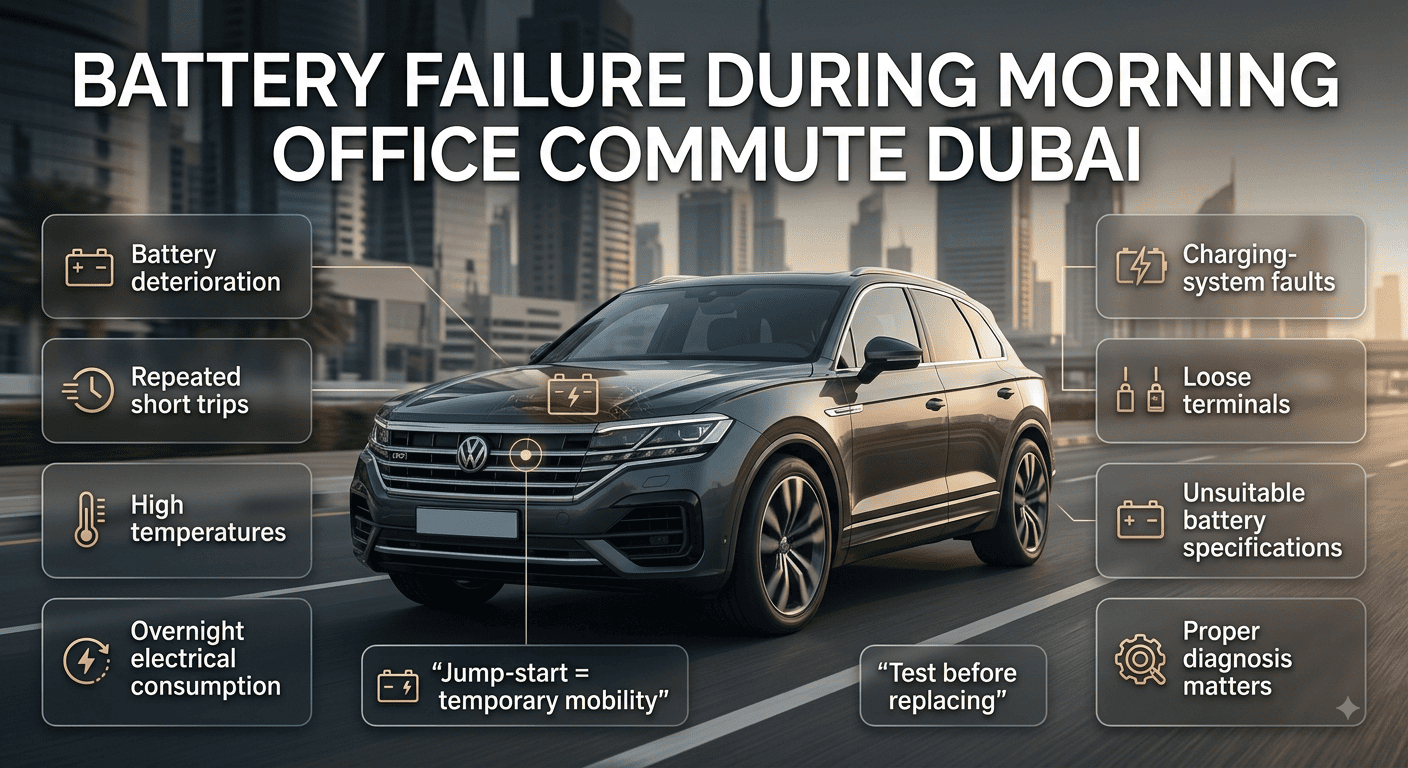
The important thing is that morning battery failure is not always caused by an old battery alone. Battery deterioration, repeated short trips, high temperatures, overnight electrical consumption, charging-system faults, loose terminals, and unsuitable battery specifications can all contribute.
Understanding the reason behind the failure is more useful than simply getting the car started. A jump-start may restore mobility temporarily, but proper diagnosis can determine whether the battery needs charging, testing, replacement, or whether another electrical problem is responsible.
Why Morning Battery Failure Can Happen Without Warning
One of the most frustrating situations for a driver is parking the car after work or in the evening with no obvious problem and then finding that it will not start the following morning.
This happens because battery condition is not simply a matter of whether the battery worked during the previous drive. A battery can still start the vehicle while its available capacity has already declined considerably.
When the engine is switched off, the vehicle continues to consume a small amount of electricity for systems such as security features, electronic memory, keyless-entry functions, alarms, and control modules. A healthy battery can normally handle these demands for an extended period.
A weakened battery, however, may have insufficient reserve capacity after several hours of parking.
The typical pattern may look like this:
- Vehicle starts normally in the evening
- Car is parked overnight
- Dashboard and interior systems appear weaker the next morning
- Starter cranks slowly
- Clicking may be heard when starting
- Engine fails to crank sufficiently
- Driver requires a jump-start or roadside assistance
This is why a battery can appear fine one day and fail the next without the driver noticing a major warning beforehand.
What Causes Battery Failure During a Morning Office Commute?
There are several possible causes, and identifying the correct one is important because replacing the battery does not solve every electrical problem.
1. Battery Age and Internal Deterioration
An aging battery gradually loses its ability to store and deliver electrical energy.
The vehicle may continue starting normally for a while, even though the battery’s reserve capacity is declining. Eventually, the battery may no longer provide enough current for reliable engine cranking.
This deterioration can be accelerated by demanding operating conditions and repeated discharge cycles.
Drivers should therefore pay attention to changes in starting performance rather than waiting until the vehicle completely refuses to start.
2. Repeated Short Office Commutes
Short-distance driving is another factor that deserves attention.
Every time the engine starts, the battery supplies a significant amount of electrical energy to the starter and other systems. The alternator then replenishes that energy while the engine runs.
If the vehicle is repeatedly used for very short journeys, there may be less opportunity for the charging system to restore the energy consumed during starting.
A common weekday pattern can therefore look like:
Home → short office commute → parking → return trip → parking
If the battery is already aging or the charging system is not operating correctly, repeated short journeys can contribute to a gradually declining state of charge.
This does not mean short trips automatically damage a healthy battery. The concern is the combination of short journeys, high electrical demand, battery age, and inadequate charging.
How Dubai’s Climate Can Affect Battery Reliability

Dubai’s climate is an important consideration when discussing long-term battery reliability.
High temperatures can accelerate the deterioration of automotive batteries. Heat can affect the internal chemical processes and materials inside the battery, potentially reducing its long-term performance.
This is particularly relevant for vehicles that spend considerable time parked outdoors or exposed to high ambient temperatures.
Dubai driving can also involve substantial electrical demand from:
- Air-conditioning systems
- Cooling fans
- Infotainment systems
- Lighting
- Electronic control modules
- Navigation systems
- Phone charging
- Dash cameras
- Other accessories
These systems do not automatically cause battery failure. However, when combined with an aging or poorly charged battery, the overall electrical demand can become more significant.
For this reason, regular Vehicle Inspection and battery testing can be useful for drivers who depend heavily on their vehicles.
Overnight Battery Drain: A Common Hidden Cause
Sometimes the battery itself is not the original problem.
An electrical component may continue consuming more power than expected while the vehicle is parked. This is often referred to as a parasitic drain or abnormal electrical draw.
Potential sources include:
- Interior lights
- Boot lights
- Glovebox lights
- Aftermarket dash cameras
- Audio equipment
- Alarm systems
- Incorrectly installed accessories
- Faulty electronic modules
- USB accessories
- Vehicle systems that fail to enter their normal sleep state
A small electrical drain may not completely discharge a healthy battery immediately. However, if the vehicle remains parked for many hours every night, the cumulative effect can eventually prevent a reliable morning start.
If the same battery repeatedly becomes weak after overnight parking, replacing it without investigating the electrical system may only provide a temporary solution.
Why a Battery Can Fail Even When the Alternator Is Working
The alternator and battery have different responsibilities.
The battery provides the initial electrical power required to start the engine. Once the engine is running, the alternator supplies electrical power to the vehicle and helps recharge the battery.
This means a vehicle can continue operating even when the battery is gradually losing its ability to hold a charge.
Likewise, an alternator can have a charging problem while the battery initially appears healthy.
A simplified relationship is:
Battery → starts the vehicle
Alternator → supplies electrical power while running and replenishes the battery
If either component is not functioning correctly, the vehicle can eventually develop starting problems.
That is why professional diagnosis should normally consider both components rather than assuming the battery is automatically responsible.
Loose or Corroded Battery Connections Can Mimic Battery Failure
Another possibility is a poor electrical connection.
Battery terminals and cables carry substantial current during engine starting. If a terminal is loose, contaminated, damaged, or affected by corrosion, electrical resistance can interfere with current flow.
The result may resemble a weak battery.
A driver may notice:
- Slow engine cranking
- Intermittent starting
- Electrical systems switching off during starting
- Clicking sounds
- Unusual electrical behavior
This is one reason visual inspection is an important part of professional Car Service and battery diagnosis.
A technician should not only ask whether the battery has sufficient voltage but also whether the electrical connection between the battery and vehicle is secure and appropriate.
Early Warning Signs Before a Morning Battery Failure
A completely dead battery may seem to fail suddenly, but many vehicles provide warning signs beforehand.
The problem is that drivers often become accustomed to small changes in vehicle behavior.
For example, an engine that takes slightly longer to crank may gradually become normal to the driver. A start-stop system that stops operating may be ignored. Dashboard electronics that reset once may be treated as a random glitch.
These symptoms can provide useful clues.
Common warning signs include:
- Slower engine cranking
- Clicking when starting
- Repeated need for jump-starting
- Dim headlights during engine starting
- Dashboard electronics resetting
- Start-stop system becoming unavailable
- Battery warning indicator
- Unusual electrical behavior
- Remote locking becoming inconsistent
- Vehicle taking longer than usual to start
One symptom alone does not confirm battery failure. Several symptoms occurring together, however, should justify a proper inspection.
Battery Warning Signs: What They May Mean
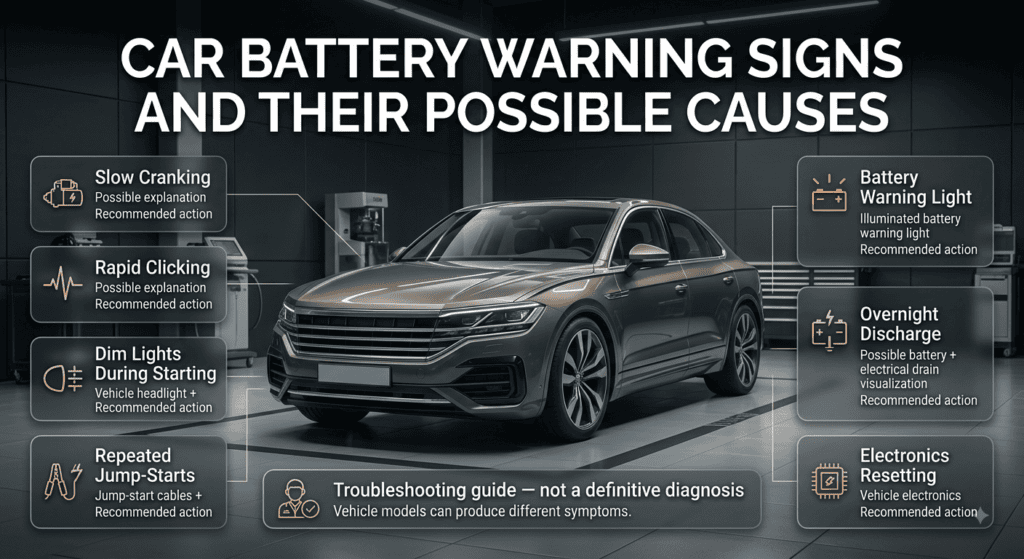
| Warning sign | Possible explanation | Recommended action |
|---|---|---|
| Slow cranking | Weak battery or poor connection | Test battery and terminals |
| Rapid clicking | Insufficient starting power | Battery/electrical inspection |
| Dim lights during starting | Voltage dropping under load | Battery test |
| Repeated jump-starts | Battery, charging or electrical fault | Full diagnosis |
| Battery warning light | Charging-system concern | Charging-system inspection |
| Overnight discharge | Weak battery or abnormal electrical draw | Battery and drain testing |
| Electronics resetting | Low system voltage | Electrical diagnosis |
The table should be treated as a troubleshooting guide rather than a definitive diagnosis. Different vehicle models can produce different symptoms.
Why Repeated Jump-Starts Should Not Be Ignored
A jump-start can be extremely useful when a vehicle needs immediate assistance before work.
However, it does not explain why the battery became unable to start the engine.
If the battery was discharged because a light was accidentally left on, the situation may be relatively straightforward.
But if the vehicle needs a jump-start repeatedly, there may be a deeper issue.
Possible causes include:
- Battery deterioration
- Charging-system problems
- Overnight electrical drain
- Poor battery connections
- Incorrect battery specification
- Excessive electrical consumption
The important question after a jump-start should therefore be:
What caused the battery to lose reliable starting power?
If the answer is not established, the driver may face the same problem again during another morning commute.
For urgent situations, Car Jumpstart and Roadside Assistance can restore mobility, but the vehicle should subsequently receive appropriate testing.
What Happens Inside the Vehicle When Battery Voltage Drops?
Modern vehicles depend heavily on electronic control systems.
When battery voltage becomes excessively low, some systems may not behave normally. A driver may see several warning messages or dashboard indicators at once.
Possible symptoms include:
- Infotainment system restarting
- Dashboard warnings appearing
- Clock or settings resetting
- Power windows operating slowly
- Interior lighting becoming weak
- Central locking behaving unusually
- Multiple electronic warnings appearing together
This can make the situation look more complicated than it actually is.
Low system voltage can affect multiple electronic systems simultaneously. Therefore, a professional technician may first establish whether the vehicle has a stable electrical supply before investigating unrelated mechanical faults.
If unusual electronic symptoms continue after the battery issue has been addressed, Engine Diagnostics or broader electronic vehicle diagnostics may be appropriate.
Battery Failure vs Starter Motor Problem
Not every vehicle that refuses to start has a battery problem.
The starter motor is responsible for physically turning the engine during starting. A starter-related fault can create symptoms that overlap with battery failure.
The difference can sometimes be identified by observing how the engine behaves when the start command is given.
| Symptom | Possible battery issue | Possible starter issue |
|---|---|---|
| Very slow cranking | Common | Possible |
| Rapid clicking | Common | Possible |
| Strong electrical power but no engine cranking | Less likely | Possible |
| Dashboard becomes very weak during starting | More likely | Possible |
| Starts normally with proper jump assistance | Battery-related issue more likely | Starter still possible |
| Repeated failure despite healthy battery | Less likely | Requires starter diagnosis |
A professional inspection is preferable when symptoms are unclear.
Replacing a battery when the starter is actually defective can leave the driver with the same problem.
What Should a Professional Battery Inspection Include?
A proper inspection should not be limited to asking whether the battery has voltage.
1. Visual Inspection
The technician can examine:
- Battery casing
- Terminal condition
- Cable connections
- Mounting
- Signs of physical damage
- Visible contamination
2. Battery Testing
The battery’s electrical condition can be evaluated using appropriate testing equipment.
This helps determine whether the battery is merely discharged or has lost significant starting capability.
3. Starting-System Assessment
The starting process can be evaluated to determine whether excessive voltage drop or abnormal starting behavior is present.
4. Charging-System Testing
The alternator and charging system should be checked when the battery repeatedly loses charge.
5. Electrical Drain Testing
If the vehicle becomes weak after being parked overnight, abnormal electrical consumption may need investigation.
6. Vehicle-Specific Electronic Diagnosis
Newer vehicles may require diagnostic equipment capable of communicating with the vehicle’s electronic control systems.
This comprehensive approach is much more reliable than replacing parts based only on symptoms.
When Should You Consider Professional Battery Replacement?
A battery should not necessarily be replaced after every discharge.
Replacement becomes more appropriate when testing indicates that the battery has significantly lost capacity or can no longer provide dependable starting performance.
Other factors may include:
- Advanced battery age
- Repeated starting failure
- Poor test results
- Physical damage
- Inability to maintain an adequate charge
- Repeated failure despite proper charging
- Manufacturer-specific replacement requirements
When replacement is necessary, the new battery should match the vehicle’s electrical specifications.
For drivers who need assistance, Battery Replacement can be considered when testing confirms that the existing battery is no longer dependable.
Choosing the Correct Battery Instead of Simply Buying the Cheapest One
Battery replacement should be based on compatibility rather than price alone.
The replacement battery should be appropriate for the vehicle’s:
- Battery size
- Capacity
- Starting requirements
- Terminal configuration
- Battery technology
- Electrical demand
- Start-stop system
- Manufacturer specifications
Depending on the vehicle, drivers may consider options such as Amaron Battery, Bosch Battery, Tuflong Battery, or an AGM Battery, depending on the vehicle’s actual requirements.
The correct choice should always be based on vehicle compatibility rather than choosing a brand simply because it is popular.
What Should You Do When Your Car Battery Fails Before Work?
The first priority is to keep the situation safe and avoid repeatedly trying to start the vehicle.
If the car is parked in a safe location, switch off unnecessary electrical accessories and observe what happens when you attempt to start the engine.
Pay attention to whether:
- The dashboard illuminates normally
- The starter turns the engine slowly
- You hear clicking
- Electrical systems become weak
- The engine cranks normally but does not start
- The vehicle has no electrical response at all
These observations can provide useful information for the technician.
If the vehicle is stopped somewhere unsafe or obstructing traffic, professional Roadside Assistance can be a practical option rather than attempting repeated starting attempts.
Can You Drive After a Jump-Start?
A successful jump-start does not automatically mean the vehicle is ready for normal daily use.
If the battery was discharged accidentally and remains healthy, the vehicle may continue operating normally after sufficient charging.
However, if the battery is old, the charging system is faulty, or an electrical drain is present, the problem can return.
The important distinction is:
Jump-starting restores temporary starting ability; diagnosis identifies the reason for the failure.
If the vehicle starts with assistance but repeatedly struggles after being parked, arrange a proper battery and charging-system inspection instead of depending on another jump-start.
Battery vs Alternator: How Professionals Separate the Two
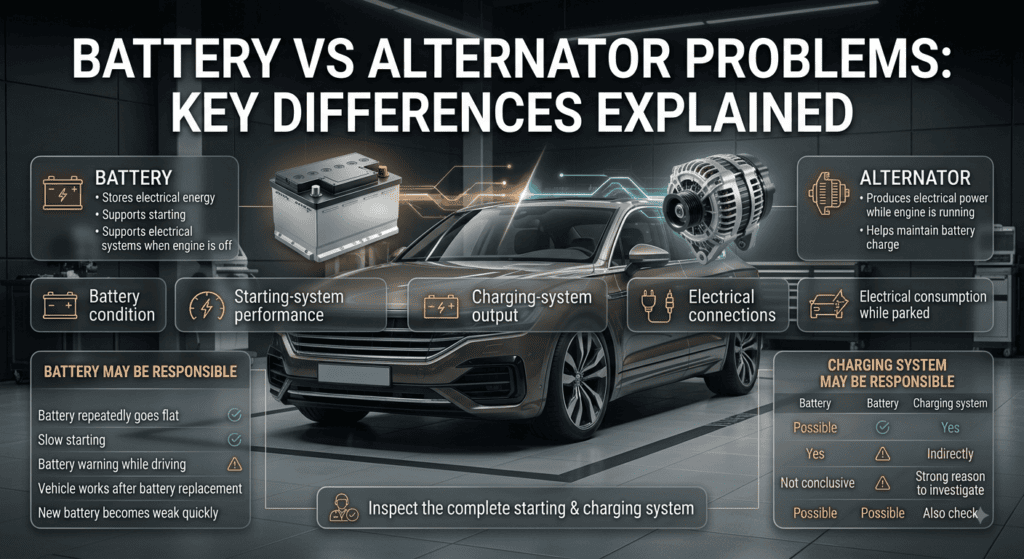
Battery and alternator problems can produce similar symptoms, but they require different solutions.
The battery stores electrical energy for starting and supports electrical systems when the engine is off.
The alternator produces electrical power while the engine is running and helps maintain battery charge.
A technician may therefore evaluate:
- Battery condition
- Starting-system performance
- Charging-system output
- Electrical connections
- Electrical consumption while parked
| Observation | Battery may be responsible | Charging system may be responsible |
|---|---|---|
| Battery repeatedly goes flat | Yes | Yes |
| Slow starting | Yes | Indirectly |
| Battery warning while driving | Possible | More significant |
| Vehicle works after battery replacement | Possible | Not conclusive |
| New battery becomes weak quickly | Possible | Strong reason to investigate |
| Repeated overnight discharge | Possible | Possible, but electrical drain should also be checked |
This is why professional Vehicle Inspection should consider the entire starting and charging system.
What If a New Battery Keeps Going Flat?
This situation should never be dismissed as “bad luck.”
A new battery that repeatedly becomes discharged may indicate that something else is consuming or failing to replenish electrical energy.
Possible causes include:
Electrical drain
An accessory or vehicle module may remain active while the car is parked.
Charging-system problem
The alternator may not be replenishing the battery adequately.
Incorrect battery specification
The installed battery may not be appropriate for the vehicle’s electrical requirements.
Poor connection
A battery terminal, cable, or ground connection may have excessive resistance.
Vehicle usage pattern
Repeated short trips combined with high electrical demand may prevent adequate charging.
The correct response is to diagnose the system rather than repeatedly replacing batteries.
AGM, EFB and Conventional Batteries: Which One Is Right?
Modern vehicles use different battery technologies depending on their electrical architecture.
A conventional lead-acid battery may be appropriate for many standard vehicles. EFB batteries are used in certain vehicles equipped with start-stop systems, while AGM technology is commonly found in vehicles with higher electrical demands and particular energy-management requirements.
Conventional battery
Traditional lead-acid technology remains suitable for many vehicles where specified by the manufacturer.
EFB battery
Enhanced Flooded Battery technology is designed for applications requiring greater cycling capability than many conventional batteries.
AGM battery
Absorbent Glass Mat technology is designed for demanding applications and is used by many manufacturers in vehicles with advanced electrical requirements and start-stop systems.
| Battery technology | Typical use | Main consideration |
|---|---|---|
| Conventional | Standard vehicle applications | Correct specification required |
| EFB | Some start-stop vehicles | Increased cycling capability |
| AGM | Higher electrical demand | Vehicle compatibility is essential |
The correct battery should always be selected according to the vehicle manufacturer’s requirements.
Installing a different battery technology simply because it appears more advanced is not automatically the correct solution.
Does Battery Brand Matter?
Brand reputation can be useful, but compatibility is more important than choosing a brand based solely on popularity.
A professional battery selection should consider the vehicle’s required dimensions, capacity, starting performance, terminal arrangement, technology, and manufacturer specifications.
Depending on the vehicle, drivers may consider established options such as Exide Battery, Panasonic Battery, FIAMM Battery, or AC Delco Battery.
The objective should be to match the battery to the vehicle rather than choosing a product only because it has a familiar name.
How Much Does Car Battery Replacement Cost in Dubai?
Battery replacement prices can vary significantly depending on the vehicle and battery specification.
The final cost may depend on:
- Battery technology
- Battery capacity
- Vehicle type
- Battery brand
- Required starting performance
- Installation requirements
- Battery-management procedures
- Warranty
- Service location
- Emergency or roadside installation
For a more detailed breakdown of the factors affecting pricing, drivers can review the Car Battery Prices in Dubai guide.
A very low price should not automatically be considered the best deal. Battery compatibility, quality, warranty, and correct installation can be more important for long-term reliability.
What Happens During Professional Battery Replacement?
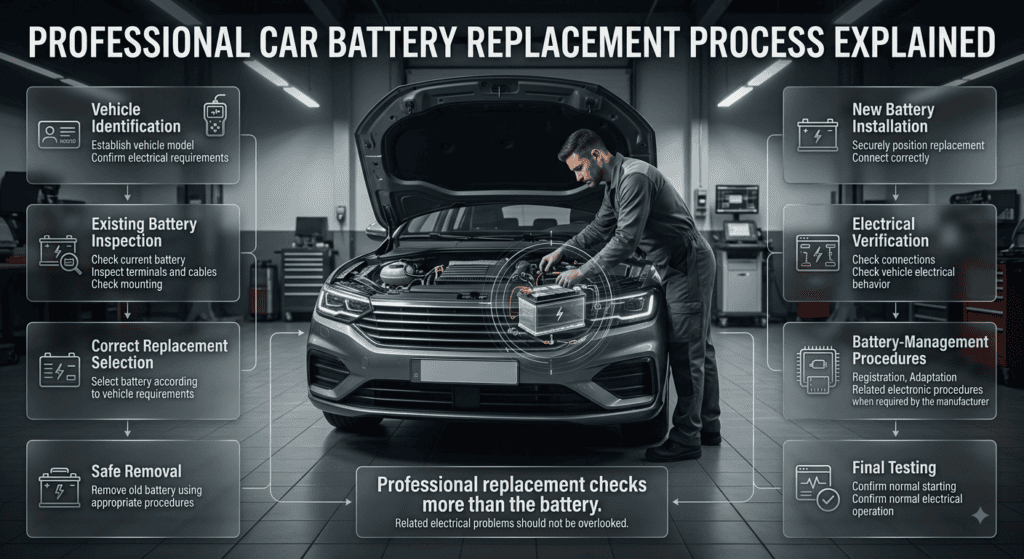
Professional installation should involve more than physically removing the old battery.
A technician may first confirm the required battery specification and inspect the existing electrical connections.
The general process can include:
1. Vehicle identification
The vehicle model and electrical requirements are established.
2. Existing battery inspection
The current battery, terminals, cables, and mounting are checked.
3. Correct replacement selection
The replacement is selected according to the vehicle’s requirements.
4. Safe removal
The old battery is removed using appropriate procedures.
5. New battery installation
The replacement is securely positioned and connected.
6. Electrical verification
Connections and vehicle electrical behavior are checked.
7. Battery-management procedures
Some modern vehicles may require battery registration, adaptation, or related electronic procedures depending on the manufacturer.
8. Final testing
The vehicle is checked to confirm normal starting and electrical operation.
This process reduces the risk of solving only the visible symptom while overlooking a related electrical problem.
Why Battery Registration Can Matter in Modern Cars
Some modern vehicles use intelligent battery-management systems to monitor battery condition and charging behavior.
When a replacement battery is installed, certain vehicles may require the system to recognize the new battery or adapt its charging strategy.
This is not universal across every vehicle.
The requirement depends on the vehicle manufacturer, model, electrical architecture, battery technology, and battery-management system.
For this reason, professional technicians should follow vehicle-specific procedures instead of assuming that every battery replacement is identical.
How Office Commuters Can Prevent Another Morning Failure
The best battery strategy is preventive rather than reactive.
Drivers who depend on their vehicles every weekday should pay attention to gradual changes in starting performance.
Practical habits
✔ Do not ignore slow engine cranking.
✔ Investigate repeated jump-start requirements.
✔ Have an aging battery tested before important journeys.
✔ Check the charging system if the battery repeatedly loses charge.
✔ Avoid leaving lights or accessories operating unnecessarily.
✔ Investigate overnight electrical drain.
✔ Follow the vehicle manufacturer’s maintenance schedule.
✔ Use the correct battery specification.
✔ Keep battery connections properly maintained.
✔ Consider professional inspection when unusual electrical symptoms appear.
These simple habits can reduce the likelihood of an unexpected morning breakdown.
A Preventive Battery Plan for Dubai Office Drivers
A useful approach is to combine daily awareness with periodic professional inspection.
| Maintenance activity | When to consider it | Purpose |
|---|---|---|
| Observe starting behavior | Every day | Detect gradual changes |
| Check dashboard warnings | During normal driving | Identify electrical concerns |
| Inspect battery visually | During maintenance | Identify obvious problems |
| Battery test | When symptoms appear | Assess battery condition |
| Charging-system test | Repeated discharge | Check alternator performance |
| Electrical drain test | Overnight discharge | Identify abnormal consumption |
| Battery replacement | When testing confirms deterioration | Restore dependable starting |
The goal is not to replace the battery unnecessarily. It is to identify deterioration early enough to prevent an inconvenient failure.
What Should You Check Before a Long Workweek?
If your vehicle has recently shown signs of weak starting, do not wait until the next Monday morning to investigate.
Before a particularly busy week, consider checking:
- Battery starting performance
- Battery age and condition
- Terminal security
- Charging-system performance
- Dashboard warning lights
- Tire condition
- Engine oil level
- Coolant condition
- Brake performance
- Air-conditioning operation
A broader Car Service can identify additional maintenance issues before they become disruptive.
For drivers who are already experiencing multiple vehicle problems, professional Car Repair may be more appropriate than addressing only the battery.
Common Mistakes After Morning Battery Failure
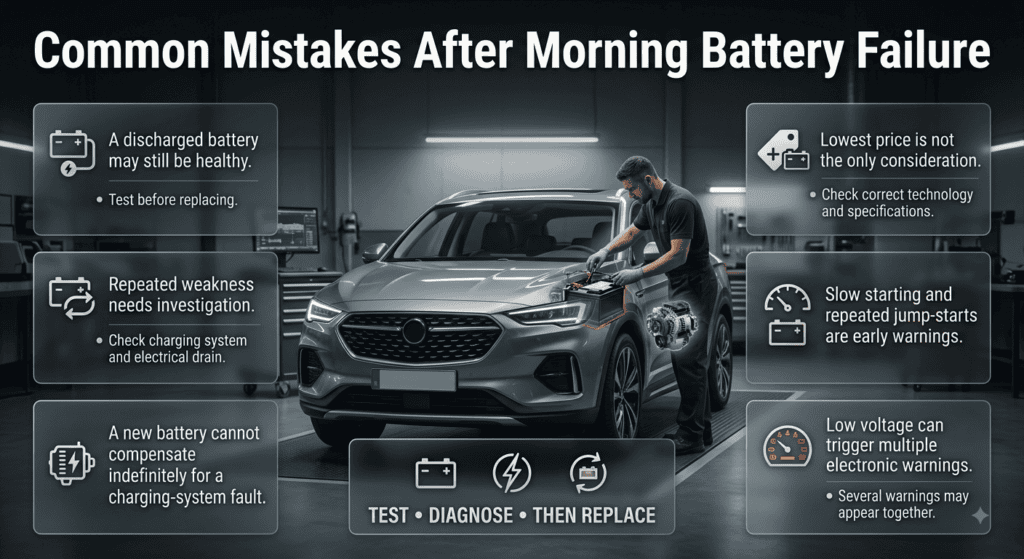
Replacing the battery without testing
A discharged battery may still be healthy. Testing helps distinguish temporary loss of charge from permanent deterioration.
Replacing the battery repeatedly
If a replacement battery repeatedly becomes weak, investigate the charging system and electrical drain.
Ignoring the alternator
A new battery cannot compensate indefinitely for a charging-system fault.
Choosing only by price
The cheapest compatible-looking battery may not provide the correct technology or specifications.
Ignoring warning signs
Slow starting and repeated jump-starts are useful early warnings.
Assuming every dashboard warning means a separate fault
Low voltage can cause multiple electronic systems to generate warnings simultaneously.
When Morning Battery Problems Point to a Larger Vehicle Issue
A battery failure can sometimes be the first visible sign of a broader electrical or mechanical problem.
For example, repeated starting difficulties combined with warning lights may require more extensive Mechanical Repair or electronic diagnosis.
Other systems should also be considered if symptoms indicate a different problem:
- Starter motor
- Alternator
- Engine management
- Ignition system
- Fuel system
- Ground connections
- Electrical control modules
- Keyless-entry system
If the engine cranks strongly but does not start, the problem may not be battery-related at all.
This distinction can save time and prevent unnecessary replacement of healthy components.
Emergency Assistance for a Failed Morning Commute
When a vehicle fails before work, the immediate priority is getting the driver and vehicle into a safe situation.
If the battery is suspected and the vehicle is safely accessible, appropriate Car Jumpstart assistance may restore temporary mobility.
If the vehicle cannot be started or the location makes troubleshooting impractical, Emergency Car Repair or Roadside Assistance may be more appropriate.
However, after the immediate problem is resolved, the vehicle should still be checked if the failure was unexpected or has happened before.
A successful jump-start should be considered the beginning of the diagnosis, not necessarily the end.
Battery Failure Prevention Is Part of Complete Vehicle Maintenance
A reliable daily commute depends on multiple systems working together.
Battery condition is important, but drivers should not overlook:
- Brake condition
- Tire pressure
- Tire wear
- Engine oil
- Cooling system
- Suspension
- Steering
- Transmission
- Air-conditioning
- Electrical systems
Regular Vehicle Maintenance allows developing problems to be identified before they become roadside emergencies.
For vehicles requiring broader attention, services such as Brake Repair, Oil Change, AC Repair, Transmission Repair, Suspension Repair, and Wheel Alignment can form part of a complete maintenance strategy.
Professional Recommendation for Dubai Morning Commuters
If your vehicle has already failed once during the morning commute, the most useful question is not simply:
“Which battery should I buy?”
The better question is:
“Why did the vehicle lose reliable starting capability?”
A professional assessment should establish whether the problem is:
- Battery deterioration
- Temporary discharge
- Charging-system failure
- Electrical drain
- Poor connection
- Incorrect battery specification
- Starting-system fault
- Another vehicle electrical problem
Once the cause is identified, the appropriate repair becomes much clearer.
This approach is particularly valuable for drivers who cannot afford repeated breakdowns during workdays.
Modern Battery Technology and the Future of Vehicle Maintenance
Vehicle electrical systems are becoming increasingly sophisticated.
Modern cars can contain:
- Start-stop systems
- Intelligent charging
- Battery-monitoring sensors
- Advanced driver-assistance systems
- Connected vehicle technology
- Numerous electronic control modules
- Higher electrical accessory loads
As vehicle technology develops, battery maintenance will become increasingly connected with overall electronic vehicle health.
Future diagnostics are likely to rely even more heavily on battery monitoring, electronic data, predictive maintenance, and vehicle-specific diagnostic systems.
For luxury and technologically advanced vehicles, professional Luxury Car Service and specialized electronic diagnostics can therefore become increasingly important.
Morning Battery Failure: Final Prevention Checklist
Before your next important commute, keep these points in mind:
- Pay attention to slow engine cranking.
- Do not ignore repeated clicking during starting.
- Investigate repeated jump-start requirements.
- Check the battery if it is showing signs of deterioration.
- Test the alternator when the battery repeatedly loses charge.
- Investigate overnight electrical drain.
- Check battery terminals and connections.
- Use the correct battery technology and specification.
- Follow the manufacturer’s maintenance requirements.
- Arrange professional assistance if the vehicle becomes unreliable.
A small amount of preventive attention can be far less disruptive than discovering a dead battery when you are already late for work.
Why does my car battery fail during the morning commute in Dubai?
A battery can work normally in the evening and still fail the next morning because its actual starting capacity may already be declining. An aging battery may have enough charge to start the vehicle once but not enough reserve to remain reliable after several hours of parking. Frequent short trips can also leave the battery insufficiently recharged, while high temperatures can accelerate battery deterioration.
For Dubai commuters, the combination of heat, daily short-distance driving, frequent starts, air-conditioning and other electrical demands can make an already weak battery more noticeable. The important point is that the morning failure is often the final symptom of gradual battery deterioration, rather than something that suddenly happened overnight.
Points to consider:
Battery age and previous performance
Repeated short office commutes
High under-hood temperatures
Previous jump-starts
Overnight electrical consumption
Charging-system condition
Battery terminal and cable condition
If the same problem happens repeatedly, a professional battery and charging-system test is more useful than simply replacing the battery without identifying the cause.
Can short daily office commutes drain a car battery?
Yes, repeated short journeys can contribute to battery problems because the vehicle uses substantial electrical energy during starting, while a short drive may provide limited opportunity for the charging system to replenish it. This becomes more important when the battery is already aging or the vehicle has significant electrical demand.
For example, someone who drives only a short distance from home to the office each morning and makes another short journey home may repeatedly operate the vehicle without giving the charging system enough opportunity to restore the battery’s state of charge.
That does not mean every short commute will damage a healthy battery. The real concern is the combination of short journeys with battery age, heat, electrical demand or an existing charging problem.
Professional approach:
Monitor whether starting becomes progressively slower.
Do not ignore repeated weak starts.
Test the battery if it frequently becomes discharged.
Check the charging system if the battery repeatedly loses charge.
Investigate other electrical loads if overnight discharge continues.
How do I know whether the battery or alternator is causing my morning starting problem?
The symptoms can overlap, which is why replacing the battery immediately is not always the correct solution. The battery supplies the power needed to start the vehicle, while the alternator supplies electrical power while the engine is running and helps maintain the battery’s charge. A charging-system fault can therefore leave the battery repeatedly undercharged.
A vehicle that starts with a jump-start but repeatedly becomes weak again deserves further investigation. Likewise, a battery that is relatively new but keeps going flat should not simply be replaced again.
Situation
What it may indicate
Slow cranking
Weak battery or connection problem
Repeated jump-starts
Battery or charging-system issue
Battery repeatedly loses charge
Charging fault, battery deterioration or electrical drain
Battery warning while driving
Charging-system concern
Strong cranking but engine does not start
Problem may be unrelated to the battery
The professional solution is to test the battery, starting system and charging system together. This prevents unnecessary replacement and makes it easier to identify the actual source of the morning breakdown.
Should I replace my car battery after one morning failure?
Not necessarily. One failure does not automatically prove that the battery has reached the end of its life. The battery could have been discharged by an accessory, suffered from an electrical drain, or simply been left in a low state of charge. A proper battery test can determine whether it still has sufficient starting capability.
Replacement becomes much more reasonable when the battery has repeatedly failed, struggles to hold a charge, performs poorly under testing, or has visible physical deterioration. Slow cranking, dim lights, repeated jump-starts, corrosion and an older battery are among the warning signs that should prompt testing or replacement.
Before replacing the battery, check:
Battery condition
Battery age
Charging-system performance
Terminal connections
Possible overnight electrical drain
Correct battery specification
If replacement is confirmed as necessary, choosing the correct battery for the vehicle is more important than simply choosing the cheapest available option.
How can I prevent battery failure during my morning office commute in Dubai?
Prevention starts with recognizing battery weakness before the vehicle becomes completely unable to start. If the engine has recently begun cranking more slowly, the vehicle has required a jump-start, lights have become unusually dim, or electrical systems behave inconsistently, the battery should be checked rather than waiting for another morning failure.
Dubai drivers should also pay attention to the effects of heat and driving patterns. Parking in a covered or shaded location when practical can reduce exposure to extreme heat, while avoiding unnecessary short journeys and switching off accessories when the engine is off can reduce avoidable electrical strain.
A practical prevention routine includes:
Have the battery tested when starting performance changes.
Investigate repeated overnight discharge.
Check the charging system when the battery repeatedly becomes weak.
Keep battery connections properly maintained.
Use the manufacturer’s recommended battery specification.
Do not rely on repeated jump-starts as a permanent solution.
Schedule battery inspection before an important workweek or long journey.
For a Dubai commuter, the real objective is not simply getting the car started this morning. It is identifying the reason the battery became unreliable so the same problem does not leave the driver stranded on another working day.
Conclusion
A battery failure during a morning office commute in Dubai can turn a routine working day into an unexpected roadside problem. Battery deterioration, repeated short-distance driving, Dubai’s high temperatures, overnight electrical drain, poor connections, and charging-system faults can all contribute to starting problems. A jump-start may get the vehicle moving again, but it does not necessarily identify or repair the underlying cause.
When the battery has genuinely reached the end of its useful service life, professional Battery Replacement is the more reliable solution. However, the replacement should be based on proper testing and the vehicle’s required specifications rather than simply choosing the cheapest available battery.
Drivers can also compare suitable options such as Amaron Battery, Bosch Battery, AGM Battery, Exide Battery, Panasonic Battery, FIAMM Battery, and AC Delco Battery when those battery types meet the vehicle manufacturer’s requirements.
For drivers who want to understand the financial side before replacing a battery, the Car Battery Prices in Dubai guide can help explain the factors that influence replacement costs.
Ultimately, dependable commuting requires more than simply installing a new battery. Regular Vehicle Maintenance, proper electrical-system diagnosis, timely Car Service, and attention to early warning signs can significantly reduce the likelihood of being stranded before work. As modern vehicles continue to use more sophisticated electrical and battery-management systems, professional diagnosis and correct battery selection will become increasingly important for reliable everyday driving in Dubai.
Leave a Reply