
Introduction
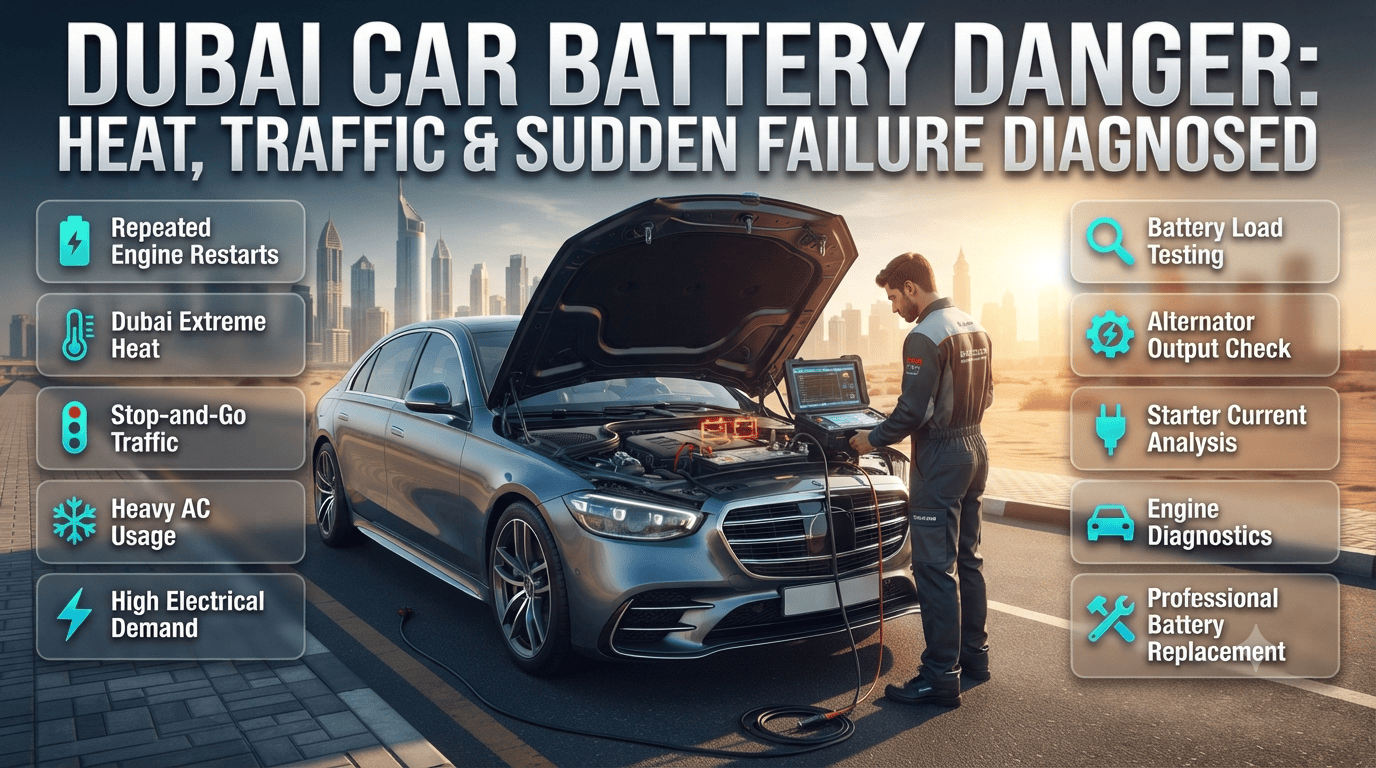
Fastest Premium & Genuine Battery Failed After Multiple Engine Restarts Dubai | A car battery is designed to provide the high burst of electrical power needed to start your engine. While modern batteries can withstand hundreds of start cycles, repeatedly turning the engine on and off within a short period places significant strain on the battery, starter motor, and charging system. In Dubai, this issue becomes even more common because extreme temperatures, heavy traffic, frequent stop-and-go driving, and constant air-conditioning usage accelerate battery wear.
If your battery failed after multiple engine restarts in Dubai, the problem may not be limited to an ageing battery alone. It could indicate insufficient alternator charging, excessive electrical demand, parasitic battery drain, poor battery health, corroded terminals, or even faults within the vehicle’s charging management system. Ignoring these warning signs can leave you stranded unexpectedly, especially during Dubai’s intense summer months when battery performance declines much faster than in cooler climates.
Professional diagnosis is essential to identify the exact cause before replacing any components unnecessarily. Experienced technicians use battery load testing, alternator output analysis, starter current testing, and electronic system diagnostics to determine whether the battery can still be recovered or requires replacement.
Throughout this guide, you’ll learn why repeated engine restarts affect your battery, how Dubai’s climate contributes to premature battery failure, the warning signs to watch for, and the professional repair solutions available through EuroSwift Auto Services, including Battery Replacement, Car Jumpstart, Roadside Assistance, Engine Diagnostics, and preventive Vehicle Maintenance services.
Why Does a Battery Fail After Multiple Engine Restarts?
Every engine start consumes a substantial amount of electrical energy. During each ignition cycle, the starter motor draws several hundred amps from the battery to rotate the engine until combustion begins. Under normal conditions, the alternator replenishes this lost energy while you drive.
However, repeated engine restarts without sufficient driving time prevent the alternator from restoring the battery’s charge. Over time, this repeated discharge leaves the battery operating below its optimal state of charge.
Common situations include:
- Delivery vehicles making constant stops
- Taxi and ride-sharing drivers
- School pick-up and drop-off routines
- Short urban journeys
- Frequent parking with repeated restarts
- Vehicle inspections requiring multiple ignition cycles
- Heavy traffic congestion throughout Dubai
Even a relatively new battery can struggle if this pattern continues every day.
How Multiple Engine Restarts Affect Battery Health
Each ignition event creates a cycle of discharge and recharge. If the recharge phase is shortened, sulphation gradually develops on the battery plates, reducing its ability to hold a full charge.
Repeated incomplete charging eventually causes:
✔ Reduced cranking power
✔ Lower reserve capacity
✔ Increased internal resistance
✔ Slower engine starting
✔ Voltage instability
✔ Shortened battery lifespan
The result is a battery that appears functional one day but suddenly refuses to start the vehicle the next.
Battery Stress During Repeated Engine Starts
| Engine Restart Pattern | Battery Impact | Long-Term Effect |
|---|---|---|
| One or two starts daily | Minimal | Normal lifespan |
| Several short trips | Moderate | Faster wear |
| Continuous delivery driving | High | Reduced battery life |
| Frequent stop-start traffic | High | Lower charging efficiency |
| Repeated failed starting attempts | Severe | Permanent battery damage |
Why Dubai’s Climate Makes the Problem Worse
Unlike colder countries where batteries struggle due to freezing temperatures, Dubai presents the opposite challenge. Continuous exposure to high ambient temperatures accelerates the chemical reactions inside the battery, causing internal water loss, faster electrolyte degradation, and increased plate corrosion.
Vehicles parked outdoors during summer may experience under-bonnet temperatures exceeding 70°C, placing enormous stress on both the battery and surrounding electrical components.
Dubai-specific conditions that increase battery failures include:
- Extreme summer heat
- Continuous air-conditioning use
- High electrical demand
- Long traffic delays
- Short urban journeys
- Dust contamination
- Battery fluid evaporation
- Continuous operation of cooling fans
These factors explain why vehicle batteries in Dubai often have a shorter service life than those in cooler climates.
Expert Insight
Automotive professionals generally recommend monitoring battery health more frequently in hot climates. In Dubai, many vehicle owners schedule routine battery inspections as part of preventive maintenance because prolonged exposure to high temperatures can accelerate internal deterioration even when no obvious symptoms are present. Regular testing helps identify declining performance before it results in an unexpected breakdown.
Common Reasons Your Battery Failed After Multiple Engine Restarts
Battery failure rarely stems from a single cause. Multiple systems work together to start and charge your vehicle.
1. Battery Near End of Service Life
Most batteries naturally lose capacity over time.
Signs include:
- Slow cranking
- Lower voltage
- Frequent jump starts
- Difficulty starting after parking
2. Insufficient Alternator Charging
The alternator replenishes the battery after every engine start.
If charging output drops, repeated restarts gradually drain the battery.
Possible causes include:
- Worn alternator bearings
- Faulty voltage regulator
- Loose drive belt
- Internal alternator failure
This is why Engine Diagnostics should always accompany battery inspections.
3. Excessive Electrical Load
Modern vehicles consume electricity even before the engine starts.
Electrical loads include:
- Automatic headlights
- Infotainment systems
- Climate control
- Heated seats
- Parking sensors
- Dash cameras
- GPS tracking devices
- Mobile charging ports
When these systems operate continuously alongside repeated engine starts, battery depletion accelerates.
4. Corroded Battery Terminals
Dirty or corroded terminals create electrical resistance.
This reduces the amount of current reaching the starter motor.
Symptoms include:
✔ Clicking noises
✔ Slow engine crank
✔ Flickering dashboard lights
✔ Intermittent starting
Fortunately, terminal cleaning is often a simple maintenance procedure that restores proper electrical contact.
5. Parasitic Battery Drain
Even with the engine switched off, several electronic modules remain active.
Examples include:
- Vehicle alarm
- Keyless entry
- ECU memory
- Clock
- Security systems
- GPS units
- Telematics
If one of these systems develops a fault, it may continue drawing excessive current overnight, leaving the battery partially discharged before the next start.
Early Warning Signs Before Complete Battery Failure
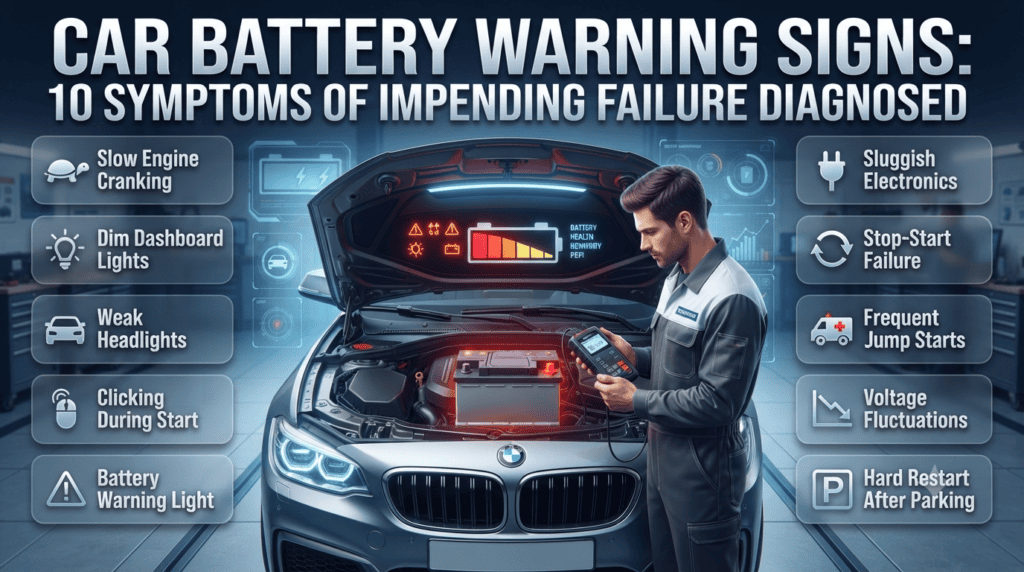
Most batteries provide warning signs long before they stop working completely.
Watch for these symptoms:
✔ Engine cranks more slowly than usual
✔ Dashboard lights dim during startup
✔ Headlights appear weaker
✔ Clicking sound instead of engine starting
✔ Battery warning light remains illuminated
✔ Electrical accessories operate sluggishly
✔ Stop-start system stops functioning
✔ Repeated need for jump starts
✔ Voltage fluctuations
✔ Difficulty starting after short parking periods
Recognising these early symptoms allows you to arrange Vehicle Inspection and Battery Replacement before experiencing a roadside breakdown.
Symptom-to-Cause Reference
| Symptom | Possible Cause | Professional Check |
|---|---|---|
| Slow engine crank | Weak battery | Battery load test |
| Clicking noise | Low battery voltage | Battery and starter inspection |
| Dashboard lights dim | Voltage drop | Charging system analysis |
| Battery warning light | Alternator issue | Alternator output test |
| Frequent jump starts | Battery deterioration | Capacity and CCA test |
| Intermittent starting | Loose terminals | Terminal and cable inspection |
How Professionals Diagnose Battery Failure
Replacing a battery without proper testing may solve the immediate problem—or it may simply mask an underlying fault. A professional inspection identifies the root cause before any parts are replaced.
A comprehensive diagnostic process typically includes:
- Visual Inspection
- Battery casing
- Terminal condition
- Cable integrity
- Signs of leakage or swelling
- Battery Voltage Test
- Resting voltage
- Cranking voltage
- Charging voltage
- Battery Load Test
- Cold Cranking Amps (CCA)
- Reserve capacity
- Internal resistance
- Charging System Check
- Alternator output
- Voltage regulator performance
- Belt condition
- Starter Motor Assessment
- Current draw
- Cranking speed
- Electrical connections
- Parasitic Drain Test
- Current draw with ignition off
- Faulty electronic modules
- Aftermarket accessory checks
This systematic approach helps determine whether the issue requires Battery Replacement, Car Repair, Mechanical Repair, or more advanced Engine Diagnostics, ensuring the correct solution is applied the first time.
Professional Maintenance Checklist
To reduce the likelihood of battery failure after repeated engine restarts:
- ✔ Drive long enough for the alternator to recharge the battery after starting.
- ✔ Keep battery terminals clean and securely fastened.
- ✔ Avoid repeated ignition cycles when diagnosing engine issues.
- ✔ Switch off unnecessary electrical accessories before starting the engine.
- ✔ Park in shaded or covered areas whenever possible to minimise heat exposure.
- ✔ Schedule routine battery and charging system inspections, particularly before Dubai’s summer season.
- ✔ Replace ageing batteries proactively instead of waiting for complete failure.
Professional Battery Testing After Multiple Engine Restarts
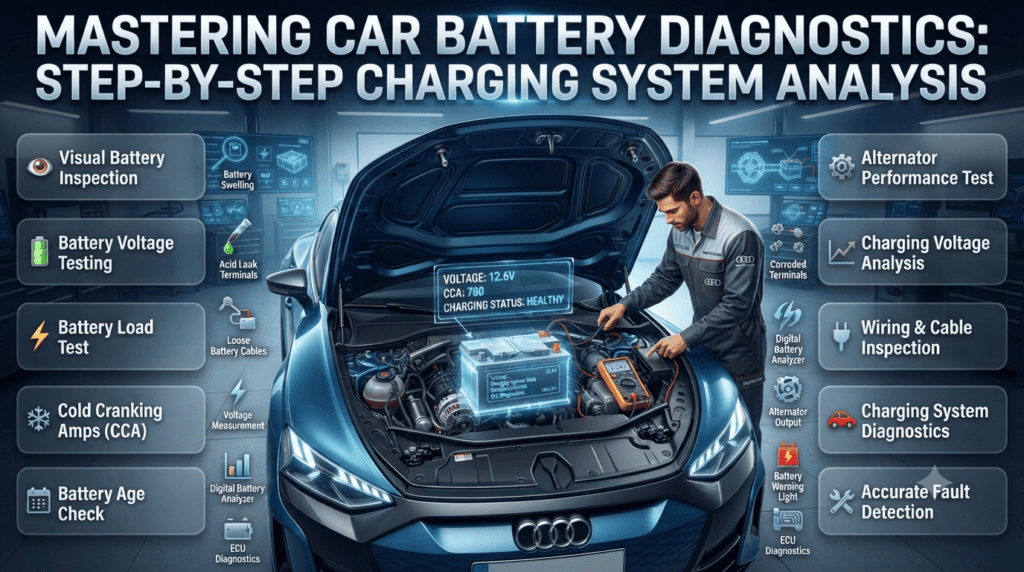
A battery that fails after repeated engine restarts should never be replaced without a complete charging system inspection. Modern vehicles rely on multiple interconnected electrical components, and a weak battery may simply be the first symptom of another underlying fault.
Professional technicians begin with a structured diagnostic process to determine whether the battery, alternator, starter motor, wiring, or electronic control systems are responsible for the problem. This approach prevents unnecessary part replacements while restoring long-term vehicle reliability.
Step 1: Visual Battery Inspection
Every diagnosis starts with a thorough visual examination. Physical damage often reveals problems that electronic testing alone cannot detect.
Technicians inspect:
- Battery casing for swelling
- Acid leakage
- Loose mounting brackets
- Corroded terminals
- Damaged battery cables
- Broken insulation
- Loose earth connections
- Battery manufacture date
Dubai’s high temperatures can accelerate battery case expansion and electrolyte evaporation, making physical inspection especially important before performing electrical tests.
Visual Inspection Checklist
| Inspection Item | Why It Matters | Possible Outcome |
|---|---|---|
| Battery swelling | Indicates heat damage | Battery replacement |
| Acid leakage | Internal failure | Immediate replacement |
| Terminal corrosion | High electrical resistance | Terminal cleaning |
| Loose battery clamp | Excessive vibration | Secure mounting |
| Damaged cables | Voltage loss | Cable replacement |
| Burn marks | Electrical overheating | Further diagnostics |
Step 2: Battery Voltage Testing
Voltage testing provides the first indication of battery health.
Technicians measure voltage in several conditions rather than relying on a single reading.
These include:
- Resting voltage
- Voltage during engine cranking
- Charging voltage
- Voltage after switching off the engine
- Recovery voltage
Each measurement provides different information about battery performance.
Typical Battery Voltage Readings
| Battery Condition | Approximate Voltage |
|---|---|
| Fully charged | 12.6–12.8 V |
| Good condition | 12.4–12.6 V |
| Partially discharged | 12.2–12.4 V |
| Low charge | 12.0–12.2 V |
| Severely discharged | Below 12.0 V |
Voltage alone does not confirm battery condition, which is why additional testing is always recommended.
Step 3: Battery Load Testing
One of the most important diagnostic procedures is the battery load test.
Unlike a simple voltage check, a load test simulates the heavy electrical demand created when starting the engine.
The tester measures how well the battery maintains voltage while delivering high current.
A battery may display normal resting voltage but still fail under load because its internal capacity has deteriorated.
Professional load testing evaluates:
- Cold Cranking Amps (CCA)
- Reserve capacity
- Internal resistance
- Voltage stability
- Recovery performance
This test often reveals hidden battery failures before complete breakdown occurs.
Why Cold Cranking Amps (CCA) Matter in Dubai
Many drivers assume CCA ratings are only important in cold climates. While cold weather places greater demands on starting power, CCA remains a valuable indicator of a battery’s overall condition in hot environments like Dubai.
A battery that has lost a significant portion of its CCA may struggle during repeated engine restarts, particularly when the engine bay is hot and electrical loads are high.
Lower CCA often results in:
- Slower cranking
- Extended starting time
- Higher starter motor stress
- Increased battery temperature
- Faster battery deterioration
Step 4: Alternator Performance Testing
Many batteries are replaced unnecessarily when the real problem is insufficient alternator output.
The alternator supplies electrical power while the engine is running and recharges the battery after every start.
If charging output is too low, the battery gradually loses charge regardless of its age.
Common Alternator Problems
Technicians inspect for:
- Worn bearings
- Faulty voltage regulator
- Slipping drive belt
- Internal diode failure
- Rotor damage
- Stator winding faults
- Poor electrical connections
Even minor charging deficiencies become significant for vehicles that experience frequent stop-and-start driving throughout Dubai.
Battery vs Alternator Problems
| Symptom | Weak Battery | Faulty Alternator |
|---|---|---|
| Engine starts after jump start | ✔ | Sometimes |
| Vehicle stalls while driving | Rare | ✔ |
| Battery warning light | Sometimes | Common |
| Battery repeatedly goes flat | ✔ | ✔ |
| Electrical systems fluctuate | Occasionally | Frequently |
| New battery quickly discharges | Rare | ✔ |
Charging Voltage Analysis
Professional technicians measure alternator output under several operating conditions.
Tests include:
- Idle speed
- Increased engine speed
- Air conditioning switched on
- Headlights activated
- Full electrical load
- Cooling fan operation
These tests reveal whether the alternator can maintain sufficient charging voltage under real-world driving conditions.
Expert Insight
A charging system that performs adequately at idle may struggle when several electrical accessories operate simultaneously. Measuring alternator output under different loads provides a more accurate assessment than checking voltage with no accessories switched on.
Step 5: Starter Motor Evaluation
The starter motor is one of the largest electrical consumers in any vehicle.
Repeated engine restarts significantly increase starter wear.
If the starter begins drawing excessive current, the battery drains much faster during every ignition cycle.
Signs of Starter Motor Problems
- Grinding noises
- Single clicking sound
- Slow engine rotation
- Intermittent starting
- Smoke from starter area
- Excessive current draw
- Burning electrical smell
Professional Engine Diagnostics help distinguish starter faults from battery-related issues, avoiding unnecessary Battery Replacement.
Starter Motor Inspection
| Test | Purpose |
|---|---|
| Current draw | Measures starter efficiency |
| Voltage drop | Identifies cable resistance |
| Cranking speed | Assesses motor performance |
| Solenoid operation | Checks engagement |
| Wiring inspection | Detects damaged cables |
ECU-Controlled Charging Systems in Modern Vehicles
Many newer vehicles no longer charge the battery continuously.
Instead, the Engine Control Unit (ECU) adjusts charging output according to:
- Engine load
- Fuel economy strategy
- Battery temperature
- Battery state of charge
- Regenerative charging systems
This intelligent charging improves efficiency but makes diagnosis considerably more complex.
Technicians often use manufacturer-specific diagnostic equipment to verify that the charging strategy is operating correctly.
Battery Monitoring Sensors
Modern vehicles may include Intelligent Battery Sensors (IBS) attached to the negative battery terminal.
These sensors monitor:
- Battery current
- Voltage
- Temperature
- Charge level
- Battery ageing
If the sensor fails or reports inaccurate data, charging performance may be affected even when the battery itself is in good condition.
Parasitic Battery Drain Testing
One of the most overlooked causes of battery failure after multiple engine restarts is excessive current draw while the vehicle is parked.
Although modern cars continue powering systems such as alarms, clocks, and keyless entry modules after the engine is switched off, abnormal electrical consumption can gradually discharge the battery.
Technicians perform a parasitic drain test after allowing the vehicle’s electronic modules to enter sleep mode.
Common Sources of Excessive Battery Drain
- Dash cameras
- GPS tracking devices
- Faulty interior lights
- Infotainment software faults
- Security systems
- Aftermarket accessories
- USB chargers
- Defective control modules
Finding the exact source often requires advanced Vehicle Inspection equipment and electrical circuit testing.
Typical Electrical Drain Sources
| Component | Normal Draw | Fault Condition |
|---|---|---|
| Vehicle alarm | Low | Excessive battery drain |
| Clock memory | Low | Rare failure |
| Dash camera | Moderate | Continuous discharge |
| GPS tracker | Low | High drain if faulty |
| Interior lighting | None when off | Battery depletion |
| Infotainment system | Minimal | Software-related drain |
The Impact of Dubai’s Driving Conditions on Charging Efficiency
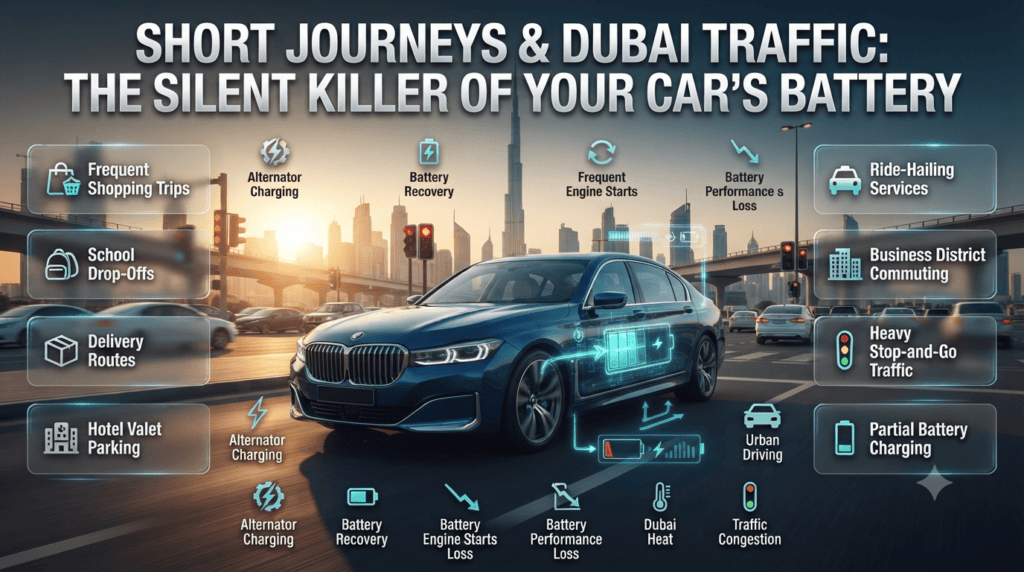
Driving patterns have a major influence on battery recovery.
Vehicles used primarily for short urban journeys often do not operate long enough for the alternator to replace the energy consumed during starting.
Common examples include:
- Frequent shopping trips
- School drop-offs
- Delivery routes
- Hotel valet parking
- Ride-hailing services
- Business district commuting
- Heavy stop-and-go traffic
Over weeks or months, this repeated partial charging reduces battery performance and shortens service life.
Professional Recommendation
Drivers who frequently make short journeys should include periodic charging system inspections as part of their routine Vehicle Maintenance. Combining battery health checks with Car Service, Engine Diagnostics, and preventive Vehicle Inspection helps identify declining performance before it results in an unexpected roadside breakdown.
Advanced Diagnostic Equipment Used by Professionals
Modern automotive workshops rely on specialised equipment rather than guesswork.
Common diagnostic tools include:
- ✔ Digital battery analysers
- ✔ Computerised load testers
- ✔ Battery conductance testers
- ✔ Alternator output analysers
- ✔ Oscilloscopes
- ✔ Digital multimeters
- ✔ Clamp ammeters
- ✔ ECU diagnostic scanners
- ✔ Intelligent battery registration tools
- ✔ Thermal inspection equipment
Using advanced diagnostic technology enables technicians to distinguish between battery deterioration, charging faults, starter motor issues, and electronic system failures with greater accuracy.
Diagnostic Workflow Summary
| Diagnostic Stage | Primary Objective | Typical Outcome |
|---|---|---|
| Visual inspection | Identify physical damage | Repair or replacement recommendation |
| Voltage testing | Assess battery charge | Charging status confirmed |
| Load testing | Measure battery capacity | Battery health evaluation |
| Alternator testing | Verify charging performance | Charging system diagnosis |
| Starter testing | Measure cranking efficiency | Starter condition confirmed |
| Parasitic drain testing | Detect excessive current draw | Electrical fault identification |
| ECU scan | Identify stored fault codes | Electronic system diagnosis |
Repair or Replace? Making the Right Decision After Battery Failure
When a battery fails after multiple engine restarts in Dubai, replacing it immediately is not always the correct solution. A professional diagnosis determines whether the battery has simply discharged, suffered permanent internal damage, or whether another component in the starting and charging system is responsible.
Replacing a healthy battery without identifying the root cause may lead to the same problem recurring within days or weeks. This is why experienced technicians combine Battery Replacement, Engine Diagnostics, and Vehicle Inspection before recommending any repair.
Can a Discharged Battery Be Recharged?
Not every flat battery has reached the end of its service life. If the battery has been discharged because of repeated engine restarts, it may recover with controlled charging, provided there is no internal damage.
Recharge is often possible when:
- The battery is relatively new.
- The casing is not swollen or leaking.
- Internal resistance remains within specification.
- The battery passes a professional load test.
- The alternator and charging system operate correctly.
However, repeated deep discharges reduce battery capacity over time, making future failures more likely.
Recharge vs Replace
| Battery Condition | Recharge | Replacement |
|---|---|---|
| Recently discharged | ✔ Recommended | ✖ Usually unnecessary |
| Low voltage but healthy | ✔ Yes | ✖ |
| Sulphated battery | Sometimes | Often recommended |
| Swollen battery case | ✖ No | ✔ Immediate |
| Acid leakage | ✖ No | ✔ Immediate |
| Failed load test | ✖ No | ✔ Recommended |
| Internal short circuit | ✖ No | ✔ Essential |
When Battery Replacement Is the Best Option
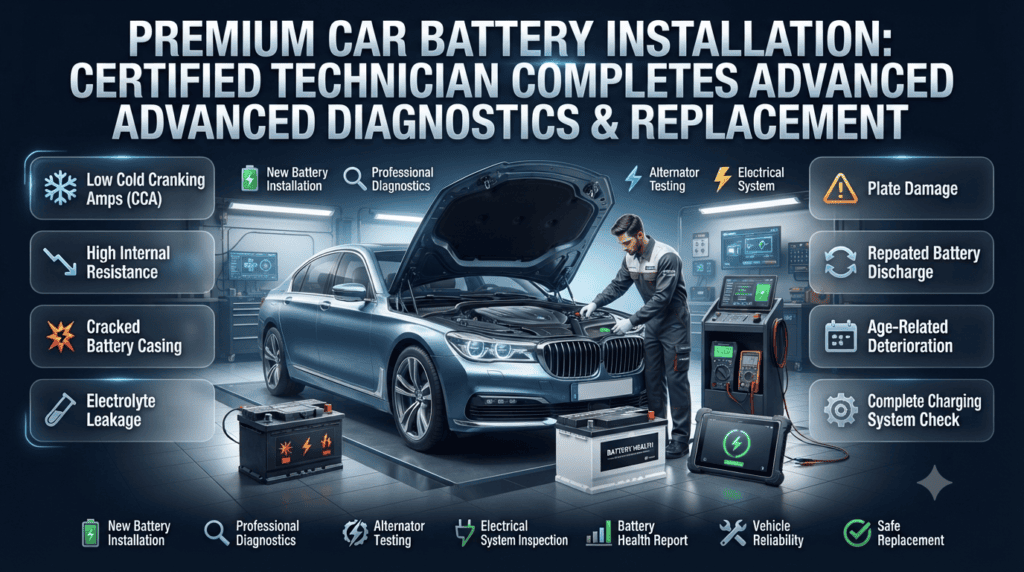
Some batteries cannot be restored safely or reliably.
Professional Battery Replacement is generally recommended if testing identifies:
- Severely reduced Cold Cranking Amps (CCA)
- Excessive internal resistance
- Cracked casing
- Electrolyte leakage
- Plate damage
- Repeated discharge history
- Age-related deterioration
Installing a new battery without addressing charging faults or electrical drain can shorten the lifespan of the replacement battery.
For genuine battery installation and professional diagnostics, many Dubai drivers use EuroSwift Auto Services, where technicians inspect the complete charging system before fitting a replacement.
Choosing the Right Battery for Your Vehicle
Selecting the correct battery involves more than matching its physical size.
Professional technicians consider:
- Manufacturer specifications
- Battery technology
- Cold Cranking Amps (CCA)
- Reserve capacity
- Amp-hour rating
- Vehicle electronics
- Start-stop compatibility
- Dubai climate suitability
Choosing an undersized battery can lead to difficult starting and reduced service life, while an oversized battery may not always charge efficiently if it falls outside the manufacturer’s recommendations.
Understanding Different Battery Technologies
Modern vehicles use several battery types, each designed for specific applications.
Conventional Flooded Lead-Acid Batteries
These remain common in many passenger vehicles.
Advantages include:
- Lower purchase cost
- Reliable starting performance
- Widely available
- Easy replacement
Best suited for:
- Standard family vehicles
- Older models
- Light daily commuting
AGM (Absorbent Glass Mat) Batteries
AGM batteries are engineered for higher electrical demands and improved durability.
Benefits include:
- Faster charging
- Better vibration resistance
- Improved deep-cycle performance
- Ideal for start-stop systems
- Excellent for luxury vehicles
Drivers seeking AGM technology can learn more through EuroSwift’s dedicated AGM Battery Replacement Dubai service.
Enhanced Flooded Batteries (EFB)
EFB batteries bridge the gap between conventional and AGM designs.
Suitable for:
- Mild start-stop vehicles
- Frequent urban driving
- Improved cycling performance
- Moderate electrical loads
Battery Technology Comparison
| Feature | Flooded | EFB | AGM |
|---|---|---|---|
| Standard vehicles | ✔ | ✔ | ✔ |
| Start-stop systems | Limited | ✔ | ✔ Excellent |
| Heat resistance | Good | Better | Excellent |
| Charging efficiency | Standard | Improved | High |
| Electrical accessories | Moderate | High | Very High |
| Service life | Good | Better | Longest |
Choosing the Right Battery Brand
Quality varies significantly between battery manufacturers. Selecting a recognised brand improves reliability, warranty support, and long-term performance, particularly under Dubai’s demanding operating conditions.
Depending on the vehicle and manufacturer specifications, technicians may recommend:
- Amaron Battery Replacement for dependable daily driving.
- Bosch Battery Replacement for premium European vehicles.
- Exide Battery Replacement for reliable all-round performance.
- Panasonic Battery Replacement for advanced electrical systems.
- FIAMM Battery Replacement for selected European applications.
- AC Delco Battery Replacement for American and GM vehicles.
- Tuflong Battery Replacement for dependable everyday performance.
Professional battery selection should always follow the vehicle manufacturer’s specifications rather than choosing solely on price.
Battery Registration and Coding in Modern Vehicles
Many late-model vehicles require electronic battery registration after installation.
This process updates the Battery Management System (BMS), allowing the vehicle to recognise:
- Battery age
- Capacity
- Charging profile
- Battery technology
- State of charge
Failure to register a new battery may result in:
- Incorrect charging
- Reduced battery life
- Dashboard warning lights
- Stop-start malfunction
- Charging system errors
Luxury brands such as BMW, Mercedes-Benz, Audi, Land Rover, Porsche, and many newer vehicles often require battery coding after replacement.
Expert Insight
Modern charging systems continuously adapt to battery condition. Installing a new battery without updating the Battery Management System may cause the alternator to charge the battery incorrectly, reducing both performance and lifespan. Professional battery registration ensures the charging strategy matches the new battery’s specifications.
Factors That Influence Battery Replacement Costs
Battery prices vary depending on several technical and vehicle-specific factors rather than brand alone.
Typical considerations include:
- Battery capacity
- CCA rating
- AGM or conventional technology
- Vehicle make and model
- Installation complexity
- Battery registration requirements
- Warranty coverage
- Mobile installation services
For a detailed breakdown of current options, battery types, and pricing guidance, see EuroSwift’s Complete Guide to Car Battery Prices in Dubai.
Cost Factors Overview
| Factor | Effect on Cost |
|---|---|
| Higher CCA rating | Higher |
| AGM technology | Higher |
| Luxury vehicle | Higher |
| Battery coding | Additional labour |
| Mobile installation | Depends on service |
| Warranty length | May increase initial cost |
| Premium brand | Higher purchase price |
Mobile Battery Replacement vs Workshop Installation
Dubai’s fast-paced lifestyle has increased demand for mobile automotive services.
Instead of arranging towing, many drivers now choose mobile Roadside Assistance and Battery Replacement, allowing qualified technicians to diagnose and replace batteries at homes, offices, shopping centres, or roadside locations.
Mobile Battery Replacement Benefits
✔ Faster response during emergencies
✔ On-site battery testing
✔ Alternator inspection
✔ Battery installation
✔ Battery registration (where applicable)
✔ Immediate vehicle restart
✔ Reduced downtime
This approach is particularly valuable when a battery fails after repeated engine restarts and the vehicle cannot be moved safely.
How Professional Car Jumpstart Services Protect Your Vehicle
Repeatedly attempting to restart a vehicle with a weak battery can place additional strain on the starter motor and electrical system.
Professional Car Jumpstart services use heavy-duty equipment and correct procedures to restore power safely before performing further diagnostics.
Advantages include:
- Correct polarity protection
- High-capacity jump equipment
- Reduced electrical risk
- Immediate voltage assessment
- Follow-up charging system inspection
When jump-starting alone is insufficient, technicians can recommend the appropriate Car Repair, Battery Replacement, or Mechanical Repair based on diagnostic results.
Preventing Repeat Battery Failure
Once the immediate issue has been resolved, preventive maintenance helps maximise battery life and reduce the likelihood of future breakdowns.
Recommended Practices
- ✔ Minimise unnecessary engine restarts.
- ✔ Allow sufficient driving time after each start for the alternator to recharge the battery.
- ✔ Schedule regular Car Service and charging system inspections.
- ✔ Keep battery terminals clean and corrosion-free.
- ✔ Replace ageing batteries before peak summer temperatures.
- ✔ Park in shaded areas whenever possible.
- ✔ Have electrical accessories inspected if battery drain is suspected.
- ✔ Include routine Vehicle Maintenance as part of your annual servicing schedule.
Professional Recommendation
Battery replacement should never be viewed as an isolated repair. Combining Engine Diagnostics, Vehicle Inspection, Car Service, and charging system analysis ensures every component involved in starting and charging operates efficiently. This comprehensive approach reduces unexpected breakdowns and improves long-term vehicle reliability, especially for drivers navigating Dubai’s demanding climate and traffic conditions.
Why does my car battery fail after multiple engine restarts in Dubai even though it’s fairly new?
A relatively new battery can still fail after repeated engine restarts if it isn’t given enough time to recharge. Every time you start your engine, the battery delivers a large burst of electrical current to the starter motor. The alternator then needs sufficient driving time to restore that lost energy. In Dubai, frequent stop-and-go traffic, short journeys, prolonged idling with the air conditioning running, and extreme heat all reduce charging efficiency. If this cycle repeats daily, even a healthy battery can remain in a partially discharged state, accelerating internal wear and reducing its ability to hold a charge.
It’s also worth remembering that a battery is only one part of the vehicle’s electrical system. Problems with the alternator, starter motor, battery terminals, or excessive parasitic drain from electronic accessories may create symptoms that appear to be a battery failure when the real issue lies elsewhere. A professional diagnostic inspection is therefore far more reliable than replacing the battery based on age alone.
Key points to remember:
✔ Multiple short trips prevent the battery from fully recharging.
✔ Dubai’s high temperatures accelerate battery deterioration.
✔ A healthy battery can fail if the charging system has faults.
✔ Modern vehicles place greater electrical demands on the battery than older models.
✔ Professional testing identifies the actual cause before replacing parts.
How can I tell whether the problem is the battery, alternator, or starter motor?
The battery, alternator, and starter motor work together, which means similar symptoms can originate from different components. A weak battery may cause slow engine cranking, but the same symptom can also result from excessive starter motor current draw or insufficient alternator charging. Simply replacing the battery without proper testing may temporarily restore starting performance while leaving the original fault unresolved.
Professional workshops use battery load testing, charging voltage analysis, starter current measurement, and electronic diagnostics to isolate the defective component. This systematic approach avoids unnecessary expenses and ensures the correct repair is carried out the first time.
Quick comparison
Symptom
Most Likely Cause
Slow cranking after parking
Weak battery
Battery repeatedly goes flat
Alternator or parasitic drain
Clicking noise when starting
Low battery voltage or starter fault
Battery warning light while driving
Charging system issue
Vehicle stalls after jump start
Alternator failure
Professional advice:
✔ Never assume the battery is the only problem.
✔ Test the charging system before installing a replacement battery.
✔ Check battery cables and terminals for excessive voltage drop.
✔ Scan the vehicle for stored charging system fault codes.
✔ Confirm alternator output under electrical load.
Does Dubai’s extreme heat really shorten car battery life?
Yes, but not because heat makes the battery weaker overnight. Instead, continuous exposure to high temperatures speeds up the chemical reactions inside the battery, increasing electrolyte evaporation and accelerating corrosion of the internal lead plates. This gradual deterioration reduces the battery’s ability to store electrical energy, meaning it reaches the end of its service life much sooner than it would in a cooler climate.
Vehicles parked outdoors for long periods are particularly vulnerable because engine bay temperatures can rise significantly above the surrounding air temperature. Combined with frequent engine restarts and heavy use of air conditioning, these conditions place continuous stress on the battery throughout the year.
To maximise battery life in Dubai:
✔ Park in shaded or covered parking whenever possible.
✔ Have the battery tested before the summer season.
✔ Keep battery terminals clean and secure.
✔ Avoid leaving electrical accessories running unnecessarily.
✔ Replace ageing batteries proactively instead of waiting for complete failure.
Is it safe to keep jump-starting my car if the battery keeps going flat?
Repeated jump-starting should only be viewed as a temporary emergency solution rather than a permanent fix. If the battery repeatedly loses charge, there is almost always an underlying issue that requires investigation. Continuing to rely on jump starts places additional strain on the starter motor, alternator, and battery itself, while also increasing the risk of damaging sensitive electronic systems if the procedure is performed incorrectly.
Professional roadside technicians not only restore power safely but also perform immediate diagnostic checks to determine whether the battery can still be recovered or requires replacement. Addressing the root cause early is both safer and more cost-effective than repeatedly jump-starting the vehicle.
Best practice after a jump start:
✔ Arrange a battery and charging system inspection as soon as possible.
✔ Avoid repeated ignition attempts if the engine will not start.
✔ Do not ignore recurring flat battery problems.
✔ Use professional jump-start equipment to protect vehicle electronics.
✔ Replace the battery if testing confirms permanent capacity loss.
How often should I replace my car battery in Dubai to avoid unexpected breakdowns?
There is no fixed replacement interval because battery lifespan depends on driving habits, vehicle type, electrical demand, and maintenance history. However, in Dubai’s climate, many batteries experience faster ageing due to prolonged heat exposure and frequent urban driving. Rather than replacing the battery based solely on time, the better approach is to monitor its condition through regular professional testing.
Routine inspections can identify declining Cold Cranking Amps (CCA), reduced reserve capacity, and charging issues long before the battery fails completely. This allows replacement to be planned at a convenient time instead of during an unexpected roadside emergency.
Preventive maintenance checklist:
✔ Test the battery during every major vehicle service.
✔ Inspect the charging system at least once a year.
✔ Replace batteries showing significant capacity loss.
✔ Check battery performance before long journeys.
✔ Include battery health checks as part of your overall preventive vehicle maintenance programme.
These proactive measures significantly reduce the risk of sudden battery failure and help ensure reliable starting performance throughout Dubai’s demanding driving conditions.
Conclusion
Experiencing a battery failed after multiple engine restarts in Dubai is more than an inconvenience—it is often a warning that your vehicle’s electrical system requires professional attention. While repeated engine starts naturally place extra demand on the battery, Dubai’s extreme heat, heavy traffic, short urban journeys, and increasing reliance on electronic vehicle systems can accelerate battery wear and expose hidden charging problems. Simply replacing the battery without identifying the root cause may only provide a temporary solution.
A thorough inspection that includes Battery Replacement, Engine Diagnostics, Vehicle Inspection, Car Service, and charging system analysis helps determine whether the issue stems from the battery itself, the alternator, the starter motor, or excessive electrical drain. Early diagnosis not only prevents unexpected roadside breakdowns but also protects other expensive electrical components and improves your vehicle’s long-term reliability.
Regular preventive Vehicle Maintenance, timely battery testing, and professional servicing are the most effective ways to avoid repeat battery failures, particularly in Dubai’s demanding climate. Whether your vehicle requires a simple recharge, a genuine battery replacement, or a complete electrical system diagnosis, addressing the problem promptly will minimise downtime, reduce repair costs, and ensure dependable performance every time you start your engine.
If your car battery has failed after multiple engine restarts, don’t rely on guesswork. Trust experienced technicians to perform a complete diagnosis, recommend the correct repair, and restore your vehicle’s starting and charging system to peak condition—keeping you safely on the road with confidence throughout every season.
Leave a Reply