
Introduction
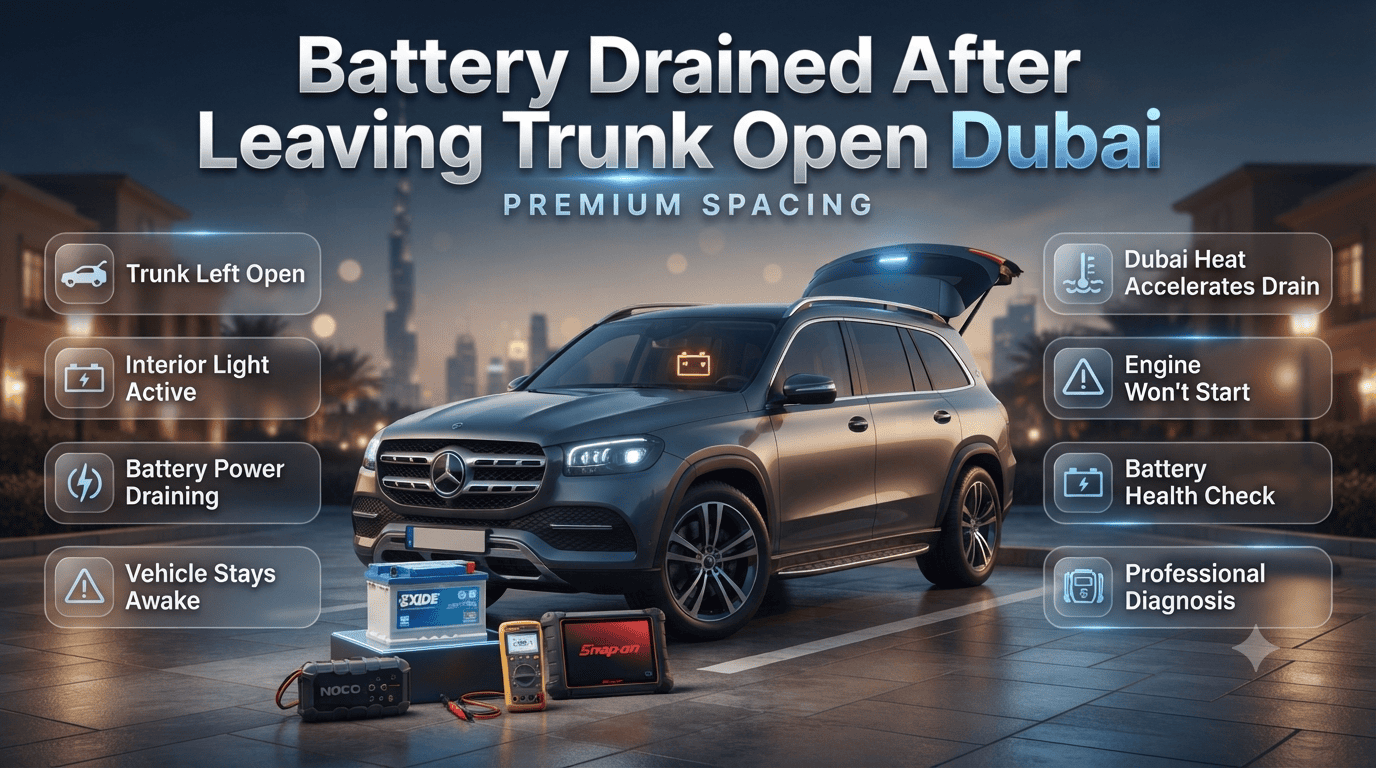
Discovering that your battery drained after leaving trunk open Dubai is a frustrating experience, especially when you’re ready to drive home after shopping, airport pickup, or a day at the beach. Many drivers assume the battery has suddenly failed, but in reality, an open trunk can keep the luggage compartment light, electronic modules, and other systems active for hours. In Dubai’s high temperatures, an already stressed battery can lose enough charge overnight to prevent the engine from starting.
Modern vehicles are equipped with numerous electronic components that continue communicating even after the engine is switched off. If the trunk remains open or does not latch properly, the vehicle may never enter its low-power sleep mode. This continuous electrical draw gradually depletes the battery until there is insufficient power to crank the engine.
Whether you drive a compact sedan, family SUV, luxury vehicle, or high-performance sports car, understanding why this happens can help you avoid unnecessary battery replacement costs. Professional diagnosis is equally important because a discharged battery may not be the only issue—its overall health and the charging system should also be evaluated.
If your vehicle refuses to start after the trunk has been left open, experienced technicians at EuroSwift Auto Services can perform a complete Battery Replacement, Car Jumpstart, and charging system inspection to determine the exact cause before recommending a repair.
Why Leaving the Trunk Open Can Drain Your Car Battery
Many drivers believe the trunk light is the only electrical component operating when the trunk is open. In modern vehicles, the reality is much more complex. Depending on the make and model, an open trunk can prevent multiple electronic systems from shutting down completely.
Instead of entering sleep mode, the vehicle continues supplying power to several modules that remain awake until the trunk is closed and securely latched.
Electrical Components That May Stay Active
Depending on the vehicle, these systems may continue consuming battery power:
- Interior trunk lighting
- Electronic trunk latch motor
- Keyless entry receiver
- Body Control Module (BCM)
- Alarm monitoring system
- Smart access sensors
- Power tailgate controller
- Cargo compartment lighting
- Security monitoring electronics
- CAN Bus communication network
Although each system consumes relatively little power individually, the combined electrical load over several hours can significantly discharge the battery.
How Long Can an Open Trunk Drain a Battery?
There is no single answer because battery discharge depends on several variables, including battery age, capacity, vehicle electronics, and Dubai’s environmental conditions.
| Situation | Approximate Risk Level |
|---|---|
| Trunk left open for 30–60 minutes | Usually low |
| Trunk open for several hours | Moderate battery discharge |
| Overnight with trunk light on | High risk of no-start condition |
| Battery already over 2 years old | Very high risk |
| Vehicle with numerous electronic features | Battery drains faster |
Luxury vehicles often experience quicker battery depletion because more electronic modules remain active while the trunk is open.
Why Dubai’s Climate Makes Battery Drain Worse
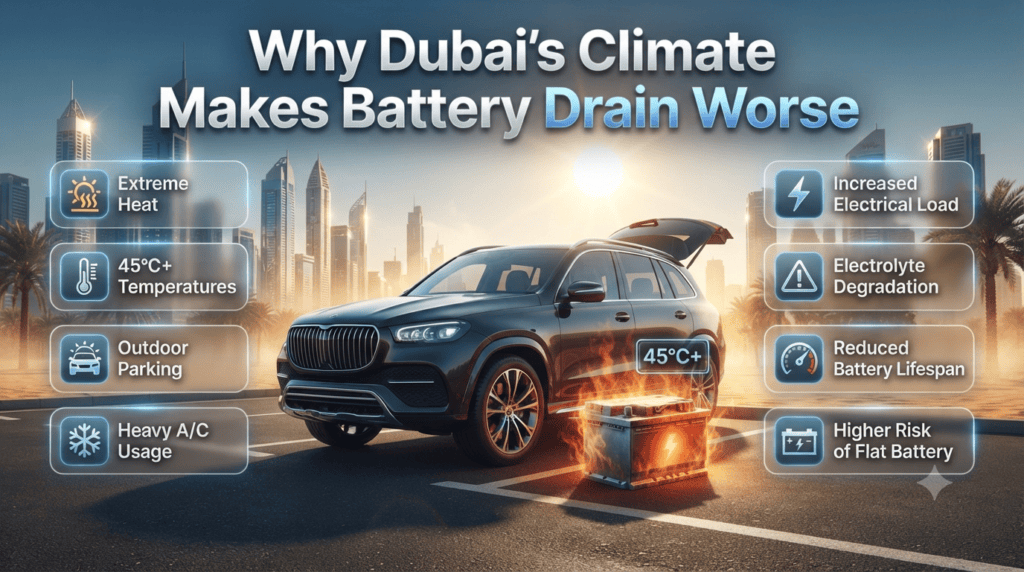
Dubai’s climate is one of the harshest operating environments for automotive batteries. Ambient temperatures exceeding 45°C accelerate chemical aging inside the battery, reducing its reserve capacity even when the battery appears to function normally.
A battery that performs adequately during cooler months may struggle to recover after a prolonged electrical drain in summer.
Additional environmental factors include:
✔ Constant exposure to extreme heat
✔ Long outdoor parking sessions
✔ Heavy air-conditioning usage
✔ Increased electrical demand
✔ Faster electrolyte degradation
✔ Reduced battery lifespan
When combined with an accidentally open trunk, these conditions greatly increase the likelihood of a flat battery.
Understanding Battery Reserve Capacity
Many vehicle owners focus only on Cold Cranking Amps (CCA), but reserve capacity is equally important.
Reserve capacity measures how long a fully charged battery can continue supplying electrical power before its voltage drops below a usable level.
A battery with reduced reserve capacity may:
- Lose voltage much faster
- Recover poorly after deep discharge
- Require repeated jump starts
- Become permanently damaged after several complete discharges
This is one reason professional Vehicle Inspection is recommended after a severe battery drain.
How Modern Vehicles Enter Sleep Mode
After the engine is switched off, today’s vehicles do not immediately power down.
Instead, electronic control units remain active for several minutes while they complete background tasks such as:
- Saving system information
- Monitoring security systems
- Communicating between control modules
- Checking key proximity
- Preparing anti-theft systems
- Managing battery energy
Once these processes finish, the vehicle enters sleep mode and electrical consumption drops dramatically.
However, if the trunk remains open or the latch sensor believes it is still open, the sleep cycle may never begin, causing continuous battery discharge.
Vehicles Most Likely to Experience Battery Drain
Some vehicles are more susceptible than others because they rely heavily on electronic control systems.
| Vehicle Type | Battery Drain Risk |
|---|---|
| Economy hatchbacks | Moderate |
| Family sedans | Moderate |
| SUVs | Moderate to High |
| Luxury vehicles | High |
| Premium German cars | Very High |
| Hybrid vehicles | Moderate |
| Performance cars | High |
Vehicles equipped with powered tailgates, digital security systems, and advanced comfort features typically consume more standby power.
Expert Insight: One Deep Discharge Can Shorten Battery Life
Automotive professionals frequently encounter batteries that appear to recover after a jump start but fail days or weeks later.
A deep discharge can cause internal stress that reduces the battery’s ability to hold a full charge. This is particularly true for batteries that are already approaching the end of their service life.
Instead of replacing the battery immediately, technicians should perform:
- Battery health testing
- Voltage analysis
- Load testing
- Charging system inspection
- Alternator output verification
If testing shows the battery has suffered irreversible damage, replacing it with a quality unit such as an Amaron Battery ensures dependable performance in Dubai’s demanding climate.
Signs Your Battery Was Drained by an Open Trunk
A discharged battery caused by leaving the trunk open often produces several warning signs before the vehicle completely refuses to start.
Watch for these symptoms:
- Slow engine cranking
- Clicking sound when turning the key
- Dashboard lights becoming dim
- Flickering interior lighting
- Power tailgate operating slowly
- Weak horn sound
- Infotainment system resetting
- Multiple warning lights appearing during startup
- Engine failing to crank despite accessories working
- Complete loss of electrical power in severe cases
Recognizing these symptoms early can help prevent further battery damage and reduce the likelihood of becoming stranded.
Common Causes of Battery Drain After Leaving the Trunk Open
Leaving the trunk open is often the event that triggers a discharged battery, but it is not always the only reason. In many cases, the battery was already weakened by age, frequent short trips, or an underlying charging problem. A professional diagnosis helps determine whether the battery simply needs recharging or if another fault contributed to the no-start condition.
Technicians begin by evaluating the battery’s condition before assuming it has reached the end of its service life. This approach prevents unnecessary replacement and ensures the actual cause is resolved.
Factors That Can Make Battery Drain Worse
| Contributing Factor | Effect on the Battery |
|---|---|
| Aging battery | Reduced reserve capacity |
| Extreme Dubai heat | Accelerates battery wear |
| Frequent short journeys | Battery never fully recharges |
| Dirty or loose terminals | Restricts charging efficiency |
| Weak alternator | Cannot restore lost charge |
| High electrical accessory use | Increases battery load |
| Faulty trunk latch switch | Keeps electronic modules awake |
| Aftermarket electronics | May create additional power draw |
When several of these factors occur together, even a few hours with the trunk open can leave the vehicle unable to start.
How Technicians Diagnose a Battery Drained by an Open Trunk
Professional diagnosis involves much more than measuring battery voltage. A healthy battery can temporarily show acceptable voltage while still lacking sufficient cranking power.
An experienced Vehicle Inspection follows a systematic process to identify the exact cause of the discharge.
Step 1: Visual Inspection
The technician first checks for obvious issues, including:
- Battery age and condition
- Corroded battery terminals
- Loose cable connections
- Damaged battery casing
- Swollen battery housing caused by heat
- Moisture or acid leakage
- Secure battery mounting
This initial inspection often reveals problems that affect charging performance.
Step 2: Battery Voltage Test
The battery voltage is measured before any charging begins.
Typical voltage readings are:
| Battery Voltage | Battery Condition |
|---|---|
| 12.6V–12.8V | Fully charged |
| 12.4V | Approximately 75% charged |
| 12.2V | Approximately 50% charged |
| 12.0V | Significantly discharged |
| Below 11.9V | Deeply discharged |
Voltage alone is not enough to confirm battery health, so additional testing is required.
Step 3: Battery Load Test
A load test evaluates whether the battery can deliver sufficient current while the starter motor demands high power.
During this test, technicians examine:
- Cranking performance
- Voltage stability
- Internal battery resistance
- Available Cold Cranking Amps (CCA)
- Overall battery capacity
A battery may recover enough voltage after charging yet still fail a load test because its internal components have deteriorated.
Checking the Alternator After a Battery Drain
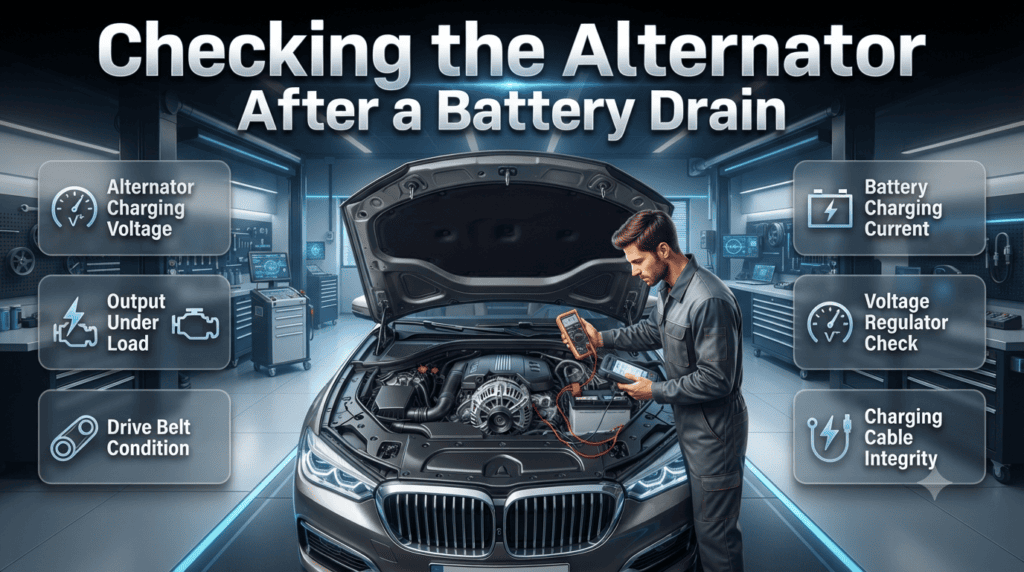
Many drivers replace the battery only to experience the same problem again a few days later. A weak alternator may be the real cause because it cannot fully recharge the battery after each journey.
Once the engine starts, the charging system should be tested to confirm proper operation.
Technicians inspect:
- Alternator charging voltage
- Output under electrical load
- Drive belt condition
- Battery charging current
- Voltage regulator performance
- Charging cable integrity
If the alternator is underperforming, even a brand-new battery will eventually become discharged.
Professional Recommendation
After a no-start incident, avoid assuming the battery is the only faulty component.
A complete Engine Diagnostics and charging system inspection helps identify hidden electrical faults before they develop into recurring breakdowns.
Can a Deeply Discharged Battery Be Saved?
The answer depends on the battery’s age, condition, and how long it remained discharged.
Some batteries recover completely after being professionally recharged, while others suffer permanent internal damage.
Recovery Is More Likely When:
✔ The battery is less than two years old.
✔ The trunk was left open for only a few hours.
✔ The battery has not experienced repeated deep discharges.
✔ Charging begins soon after the battery becomes flat.
Replacement Is Often the Better Option When:
✔ The battery repeatedly loses charge.
✔ The battery fails a professional load test.
✔ The casing is swollen due to excessive heat.
✔ Internal resistance is too high.
✔ The battery is near the end of its expected lifespan.
If replacement is required, selecting a high-quality battery designed for Dubai’s climate is essential. Depending on your vehicle’s specifications, options such as a Bosch Battery or AGM Battery can provide improved durability and reliable starting performance.
Difference Between Battery Drain and Battery Failure
Many vehicle owners use these terms interchangeably, but they describe different conditions.
| Battery Drain | Battery Failure |
|---|---|
| Battery has lost charge | Battery cannot hold charge |
| Usually recoverable | Often requires replacement |
| Caused by electrical load | Caused by internal deterioration |
| May only need recharging | Requires battery testing and replacement |
| Often temporary | Usually permanent |
Understanding this distinction helps avoid replacing a battery that only needed proper charging.
Advanced Diagnostic Equipment Used by Professional Workshops
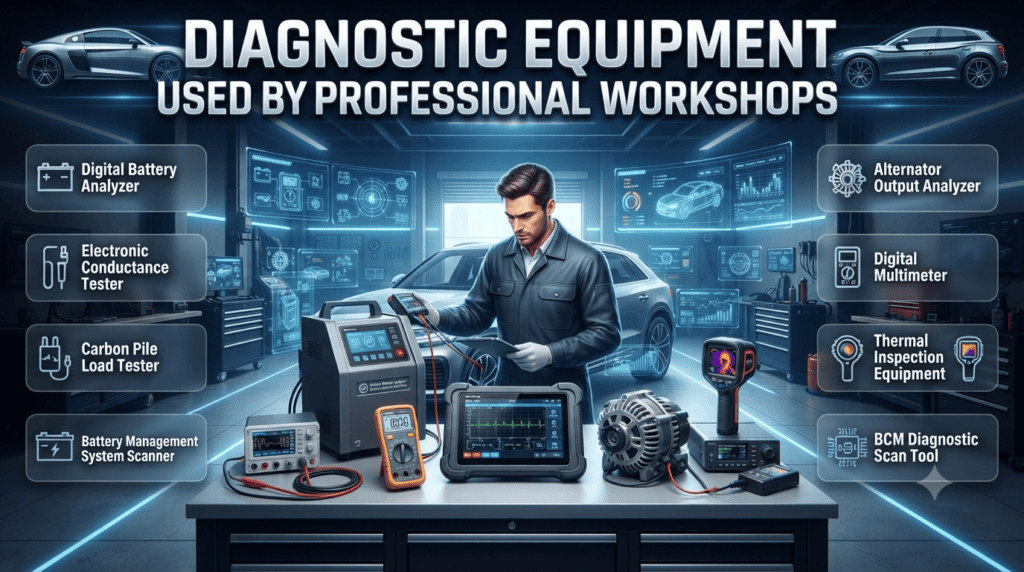
Modern vehicles require more than a basic multimeter for accurate diagnosis. Professional workshops use specialized equipment to evaluate both the battery and the vehicle’s electrical system.
Common diagnostic tools include:
- Digital battery analyzers
- Electronic conductance testers
- Carbon pile load testers
- Battery management system scanners
- Alternator output analyzers
- Digital multimeters
- Thermal inspection equipment
- Diagnostic scan tools for Body Control Module (BCM) faults
These tools provide precise data, allowing technicians to recommend the most appropriate repair instead of relying on guesswork.
When Should You Request Roadside Assistance?
If your vehicle refuses to start after the trunk has been left open, attempting repeated starts can further discharge the battery and place unnecessary strain on the starter motor.
Consider requesting Roadside Assistance if:
- The engine only clicks when you turn the key.
- Dashboard lights are extremely dim or completely off.
- A jump start does not keep the vehicle running.
- The battery is leaking or swollen.
- Warning lights remain illuminated after the engine starts.
- You suspect the alternator is not charging correctly.
Professional roadside technicians can safely perform a Car Jumpstart, test the charging system, and determine whether the battery can be recovered or if a replacement is the safer long-term solution.
Expert Insight: Don’t Ignore a Faulty Trunk Latch Sensor
In some vehicles, the trunk appears closed but a faulty latch switch continues sending an “open” signal to the Body Control Module. As a result, interior lights, security systems, and communication modules remain active, causing a slow battery drain even when the trunk looks fully shut.
If your battery repeatedly goes flat without an obvious reason, the trunk latch sensor should be included in the diagnostic process along with parasitic drain testing and electrical system inspection.
Safe Ways to Restart a Vehicle After the Battery Has Been Drained
Once the battery has been discharged after leaving the trunk open, the next priority is restoring enough power to start the engine safely. However, the recovery method depends on how deeply the battery has been discharged and whether it has suffered permanent damage.
Attempting random jump-start methods or using incorrect equipment can damage sensitive vehicle electronics, particularly in modern luxury and hybrid vehicles. A careful approach protects both the battery and the electrical system.
Professional Recovery Options
The most suitable solution depends on the battery’s condition.
| Recovery Method | Best Used When | Professional Recommendation |
|---|---|---|
| Battery Recharge | Battery is healthy but discharged | Recommended after testing |
| Car Jumpstart | Immediate engine start is required | Follow with charging system inspection |
| Battery Replacement | Battery fails health or load test | Install the correct battery specification |
| Workshop Charging | Deeply discharged battery | Monitor charging and battery performance |
| Mobile Battery Service | Vehicle cannot be moved | Convenient roadside solution |
A qualified technician will always test the battery before recommending replacement.
How a Professional Car Jumpstart Is Performed
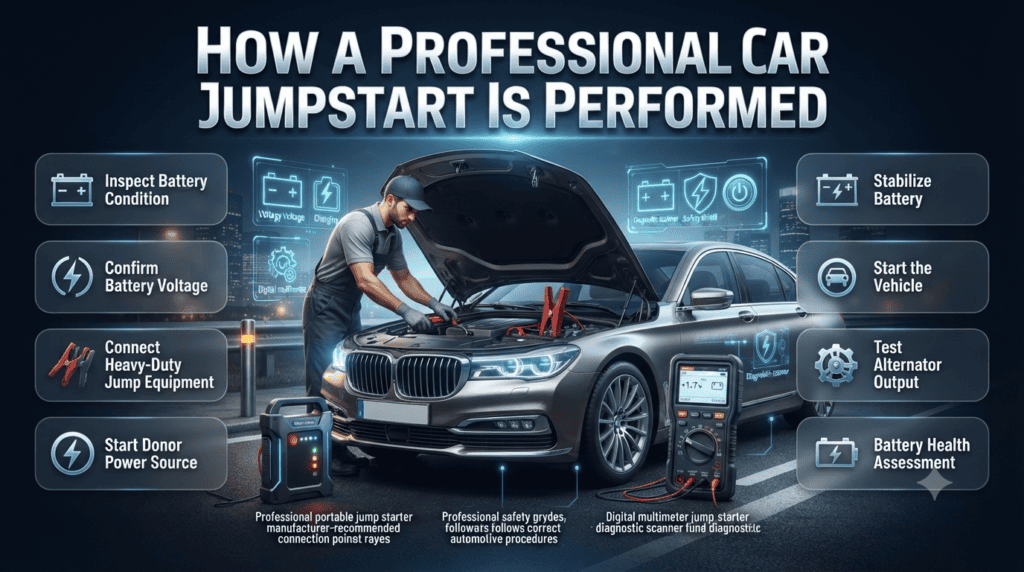
A Car Jumpstart is intended to restore enough power for the engine to start, but it should never be considered a permanent repair if the battery has underlying issues.
Professional technicians typically follow this process:
- Inspect the battery for leaks, swelling, or physical damage.
- Confirm the correct battery voltage.
- Connect heavy-duty jump equipment using the manufacturer’s recommended connection points.
- Start the donor power source before attempting to crank the engine.
- Allow the discharged battery to stabilize for a short period.
- Start the vehicle.
- Test alternator charging output immediately after startup.
- Perform a battery health assessment before completing the service.
This method minimizes the risk of voltage spikes that can affect electronic control units.
Why Repeated Jump Starts Are Not a Long-Term Solution
Some drivers continue using jump starts every few days without investigating the underlying cause. While this may temporarily get the vehicle running, it often masks a larger problem.
Repeated jump starts can indicate:
- A battery nearing the end of its service life
- Charging system deficiencies
- Excessive parasitic electrical draw
- Corroded battery terminals
- Loose ground connections
- Faulty trunk or door latch sensors
If the vehicle repeatedly requires assistance, a full Engine Diagnostics and electrical inspection is far more cost-effective than waiting for another breakdown.
Choosing the Right Replacement Battery
If testing confirms that the battery cannot recover, selecting the correct replacement is critical. Installing the wrong battery size, capacity, or technology may affect vehicle reliability and charging performance.
Important selection criteria include:
✔ Correct battery dimensions
✔ Manufacturer-approved capacity
✔ Appropriate Cold Cranking Amps (CCA)
✔ Suitable reserve capacity
✔ Proper terminal configuration
✔ Compatibility with Start-Stop systems
✔ Heat resistance for Dubai’s climate
For vehicles equipped with advanced electrical systems, an AGM Battery is often recommended due to its superior cycling performance and durability. For conventional vehicles, trusted options such as an Exide Battery or Panasonic Battery provide dependable performance in demanding UAE conditions.
Battery Registration in Modern Vehicles
Many premium vehicles require battery registration after a replacement. This process updates the Battery Management System (BMS) with information about the new battery.
Without registration, the vehicle may:
- Overcharge the new battery
- Undercharge the battery
- Display warning lights
- Reduce battery lifespan
- Generate charging system fault codes
Battery registration is commonly required for many European luxury vehicles equipped with intelligent charging systems.
Post-Replacement Inspection Checklist
Replacing the battery is only one part of the repair. A complete inspection ensures the charging system and electrical components are functioning correctly.
| Inspection Item | Purpose |
|---|---|
| Battery terminal torque | Prevent loose connections |
| Charging voltage test | Verify alternator operation |
| Starter performance | Confirm reliable engine cranking |
| Electrical system scan | Detect stored fault codes |
| Battery mounting | Prevent vibration damage |
| Trunk latch operation | Ensure proper sleep mode activation |
| Interior light inspection | Confirm automatic shut-off |
Completing these checks significantly reduces the risk of future battery-related issues.
How Dubai Driving Habits Affect Battery Recovery
After a jump start, many drivers assume a short drive will completely recharge the battery. In reality, battery recovery depends on driving conditions and the charging system’s efficiency.
Short urban trips with frequent stops, heavy traffic, and prolonged idling may not provide enough time for the alternator to restore a deeply discharged battery.
Common local driving conditions that slow battery recovery include:
- Congested city traffic
- Frequent stop-and-go driving
- Short daily commutes
- Extended idling while using air conditioning
- High electrical loads from infotainment and charging devices
A technician may recommend controlled charging with professional equipment instead of relying solely on driving.
Preventing Damage to Sensitive Electronics
Modern vehicles contain dozens of electronic control units that rely on stable voltage. Incorrect battery handling can lead to expensive electrical repairs.
Professional technicians protect vehicle electronics by:
- Using memory-saving equipment during battery replacement
- Following manufacturer-approved connection procedures
- Preventing reverse polarity connections
- Monitoring charging voltage throughout testing
- Resetting vehicle systems when required
- Verifying all electrical accessories operate normally after installation
These precautions are particularly important for luxury cars with advanced driver assistance systems, digital dashboards, and powered tailgates.
Expert Insight: A Healthy Alternator Cannot Repair a Damaged Battery
A common misconception is that driving the vehicle for a long distance will “fix” a weak battery. While the alternator replenishes lost charge, it cannot reverse internal battery deterioration caused by repeated deep discharges or heat damage.
If the battery has lost its ability to store energy, charging will only provide temporary improvement. Professional battery analysis remains the most reliable way to determine whether continued use is safe or replacement is necessary.
When Mobile Battery Replacement Is the Best Option
If the battery has completely failed and the vehicle cannot be driven, a mobile Battery Replacement service offers a practical solution. Instead of arranging towing, qualified technicians can replace the battery at your home, office, hotel, shopping mall, airport parking area, or roadside location.
A professional mobile service typically includes:
- Battery health assessment
- Safe removal of the old battery
- Installation of the correct replacement battery
- Terminal cleaning and protection
- Charging system verification
- Final starting and electrical system tests
Experienced technicians from EuroSwift Auto Services provide on-site diagnostics, Emergency Car Repair, and battery replacement services across Dubai, helping drivers return to the road quickly while ensuring the charging system is operating correctly.
Preventing Battery Drain After Leaving the Trunk Open
The easiest way to deal with a discharged battery is to prevent it from happening in the first place. While anyone can accidentally leave the trunk open, a few simple habits can significantly reduce the risk of returning to a vehicle that won’t start.
Preventive maintenance is especially valuable in Dubai, where extreme temperatures already place additional stress on automotive batteries. Combining good driving habits with regular Car Service helps maximize battery life and improve overall vehicle reliability.
Daily Habits That Protect Your Battery
Small changes in your routine can prevent unnecessary battery discharge and reduce the likelihood of roadside breakdowns.
Best Practices
✔ Confirm the trunk is fully latched before leaving the vehicle.
✔ Check that interior and cargo lights switch off properly.
✔ Avoid leaving the key fob inside the vehicle.
✔ Park in shaded or covered areas whenever possible.
✔ Drive long enough for the alternator to recharge the battery.
✔ Schedule periodic battery inspections, especially before summer.
✔ Keep battery terminals clean and securely tightened.
✔ Address warning lights immediately instead of delaying repairs.
These simple habits reduce strain on the battery and improve long-term reliability.
Maintenance Schedule for Batteries in Dubai
Regular inspections help identify early signs of battery deterioration before a complete failure occurs.
| Maintenance Task | Recommended Interval |
|---|---|
| Visual battery inspection | Every month |
| Terminal cleaning | Every 6 months |
| Battery voltage check | Every service visit |
| Load testing | Every 12 months |
| Alternator charging test | Annually or after a no-start incident |
| Battery replacement assessment | After 24–30 months, depending on condition |
Following a structured Vehicle Maintenance schedule reduces unexpected breakdowns and extends battery performance.
Common Mistakes Drivers Make After a Dead Battery
Many battery-related problems become more expensive because of incorrect decisions made immediately after the breakdown.
Avoid these common mistakes:
- Replacing the battery without testing the alternator.
- Ignoring repeated battery discharge incidents.
- Purchasing a battery based only on price.
- Installing the wrong battery size or specifications.
- Continuing to drive with a charging system fault.
- Using low-quality jumper cables.
- Disconnecting the battery without following proper procedures.
- Delaying inspection after warning signs appear.
Professional diagnosis is almost always less expensive than repeatedly replacing batteries that are not the root cause of the problem.
How to Tell if the Trunk Latch Is the Real Problem
Sometimes the battery is not drained because the trunk was intentionally left open. Instead, a faulty latch or position sensor continues reporting that the trunk is open even after it has been closed.
Signs of a faulty trunk latch sensor include:
| Symptom | Possible Cause |
|---|---|
| Trunk open warning stays on | Faulty latch switch |
| Interior lights remain illuminated | Open-circuit trunk sensor |
| Battery repeatedly drains overnight | Vehicle never enters sleep mode |
| Alarm behaves unexpectedly | Defective trunk position sensor |
| Remote locking issues | Body Control Module receiving incorrect signal |
A technician performing Engine Diagnostics can confirm whether the latch mechanism or Body Control Module is responsible for the excessive electrical draw.
Battery Technologies Designed for Modern Vehicles
Battery technology has evolved considerably to support today’s vehicles, which contain far more electronics than older models.
Modern battery options include:
Conventional Flooded Batteries
Suitable for many standard passenger vehicles with moderate electrical demand.
Enhanced Flooded Batteries (EFB)
Designed for vehicles with increased electrical loads and some Start-Stop systems.
Absorbent Glass Mat (AGM) Batteries
Provide excellent cycling performance, vibration resistance, and improved durability for luxury vehicles and cars equipped with advanced electronic systems.
Lithium Auxiliary Batteries
Some premium vehicles use lightweight lithium batteries for specific electrical functions, although the primary starting battery remains lead-acid or AGM in many models.
Choosing the correct battery technology improves reliability and ensures compatibility with the vehicle’s charging system.
The Importance of Battery Recycling
Automotive batteries contain lead, plastic, and electrolyte that require proper disposal. Throwing an old battery into general waste can harm the environment and may violate local disposal regulations.
Professional Auto Workshop facilities typically:
- Remove batteries safely.
- Store used batteries correctly.
- Send batteries to licensed recycling facilities.
- Recover reusable materials.
- Dispose of hazardous components responsibly.
Responsible recycling supports environmental sustainability while preventing contamination.
Expert Recommendations for Drivers in Dubai
Experienced technicians recommend several additional precautions for drivers operating in Dubai’s demanding climate.
Professional Advice
✔ Test the battery before the peak summer season.
✔ Replace aging batteries before complete failure.
✔ Keep the charging system in good condition.
✔ Inspect the alternator whenever the battery is replaced.
✔ Investigate any recurring electrical issues promptly.
✔ Use batteries designed for high-temperature environments.
✔ Schedule regular Vehicle Inspection appointments even if no warning signs are present.
Preventive maintenance is far more convenient than dealing with an unexpected no-start situation in a parking area or roadside location.
Latest Innovations in Automotive Battery Management
Vehicle manufacturers continue introducing technologies that improve battery efficiency and reduce unnecessary electrical consumption.
Some of the latest developments include:
- Intelligent Battery Management Systems (BMS)
- Smart alternators with variable charging output
- Automatic load-shedding during low-voltage conditions
- Enhanced sleep-mode programming
- Predictive battery health monitoring
- Remote vehicle diagnostics through connected apps
These technologies help extend battery life, but they also make professional diagnosis increasingly important when electrical faults occur.
Future Outlook for Vehicle Battery Systems
The future of automotive electrical systems is focused on efficiency, predictive maintenance, and greater integration with connected vehicle technology.
Emerging trends include:
| Technology | Expected Benefit |
|---|---|
| AI-assisted battery monitoring | Earlier fault detection |
| Cloud-connected diagnostics | Remote health reporting |
| Smarter Battery Management Systems | Improved charging efficiency |
| Advanced AGM and lithium technologies | Longer service life |
| Predictive maintenance software | Reduced unexpected failures |
| Enhanced energy management | Lower standby power consumption |
As vehicles become more electronically advanced, routine Car Service and professional electrical inspections will play an even greater role in preventing battery-related breakdowns.
Why Professional Assistance Saves Time and Money
Although a drained battery may appear to be a simple problem, identifying the underlying cause requires proper testing. A professional technician can determine whether the battery, alternator, charging system, or an electrical component—such as a faulty trunk latch—is responsible.
Rather than relying on guesswork, experienced specialists perform a complete inspection before recommending repairs. If replacement is required, quality options such as FIAMM Battery or AC Delco Battery can be matched to your vehicle’s specifications. For complete diagnostics, Battery Replacement, Car Jumpstart, and Roadside Assistance, EuroSwift Auto Services provides professional mobile support throughout Dubai.
Can leaving the trunk open overnight drain a car battery in Dubai?
Yes. Leaving the trunk open overnight is one of the most common reasons for a discharged battery, especially in modern vehicles. The trunk light, Body Control Module, keyless entry system, and other electronic components may continue consuming power until the trunk is properly closed. Combined with Dubai’s extreme heat, which naturally reduces battery efficiency, an overnight drain can easily leave the battery without enough power to start the engine.
Situation
Likelihood of Battery Drain
Trunk open for 1–2 hours
Low to Moderate
Trunk open overnight
High
Older battery (2+ years)
Very High
Luxury vehicle with many electronics
Very High
How long does it take for an open trunk to drain a battery?
The exact time varies depending on the battery’s condition, vehicle electronics, and environmental temperature. A new battery with high reserve capacity may tolerate several hours of electrical draw, while an older battery could become too weak to start the engine much sooner.
Factors that affect discharge time include:
Battery age
Battery capacity
Trunk light wattage
Number of active electronic modules
Outside temperature
Overall battery health
If the battery is already weakened, even a few hours with the trunk open may be enough to cause a no-start condition.
Will a jump start completely solve the problem?
Not always. A Car Jumpstart restores enough power to start the engine, but it does not identify why the battery became discharged. If the battery has suffered internal damage or the alternator is not charging properly, the same problem may occur again.
Professional testing should include:
Battery voltage analysis
Battery load testing
Alternator output inspection
Charging system evaluation
Electrical system diagnostics
This approach ensures the root cause is repaired rather than temporarily bypassed.
Can a completely drained battery be recharged?
In many cases, yes. If the battery is relatively new and has not experienced repeated deep discharges, professional charging equipment may restore it successfully.
However, replacement is usually recommended if:
The battery fails a load test.
Internal resistance is excessive.
The battery case is swollen.
It no longer holds a charge.
It has reached the end of its expected service life.
A technician can determine whether recharging or replacement is the better option after testing.
Does Dubai’s heat make battery drain worse?
Absolutely. High temperatures accelerate chemical aging inside automotive batteries and reduce their reserve capacity. As batteries age, they become less capable of handling unexpected electrical loads, such as an open trunk or interior light left on.
This is why batteries in Dubai generally require more frequent inspection than those operating in cooler climates.
How do I know if my alternator is also faulty?
If the vehicle starts after a jump start but the battery repeatedly becomes discharged, the alternator should be tested.
Common warning signs include:
Battery warning light on the dashboard
Headlights dimming while driving
Electrical accessories operating inconsistently
Battery repeatedly losing charge
Difficulty starting after short trips
Testing the charging system prevents unnecessary battery replacements.
Conclusion
Experiencing a battery drained after leaving trunk open Dubai is more than an inconvenience—it is often a sign that your vehicle’s battery, charging system, or electrical components deserve closer attention. While an open trunk can easily discharge the battery by keeping lights and control modules active, factors such as battery age, Dubai’s extreme temperatures, and hidden electrical faults can make the problem significantly worse.
Rather than relying on repeated jump starts or replacing the battery without testing, a professional inspection provides the most reliable solution. Comprehensive battery health analysis, alternator testing, charging system evaluation, and electrical diagnostics help identify the true cause and prevent future no-start situations.
Whether your vehicle only requires a recharge or a complete Battery Replacement, choosing the correct battery technology and ensuring proper installation are essential for dependable performance. Regular Vehicle Maintenance, Car Service, and routine electrical inspections also play an important role in extending battery life and reducing unexpected roadside breakdowns.
For drivers across Dubai, EuroSwift Auto Services offers professional Roadside Assistance, Car Jumpstart, advanced diagnostics, and mobile battery replacement services using genuine batteries matched to your vehicle’s specifications. With expert technicians, modern testing equipment, and preventative maintenance recommendations, you can restore your vehicle’s reliability and reduce the risk of future battery failures, even in Dubai’s demanding climate.
Leave a Reply