
Introduction
Battery Discharged During Public Holiday Parking Dubai | A public holiday in Dubai can change a normal driving routine completely. A vehicle that is usually driven every day may remain parked for several days while the owner travels, visits family, stays at a hotel, spends time at a shopping destination, or simply takes a break from driving. In many cases, the car starts normally when it is parked. The problem appears several days later when the owner returns, turns the key or presses the start button, and discovers that the vehicle has little or no electrical power.
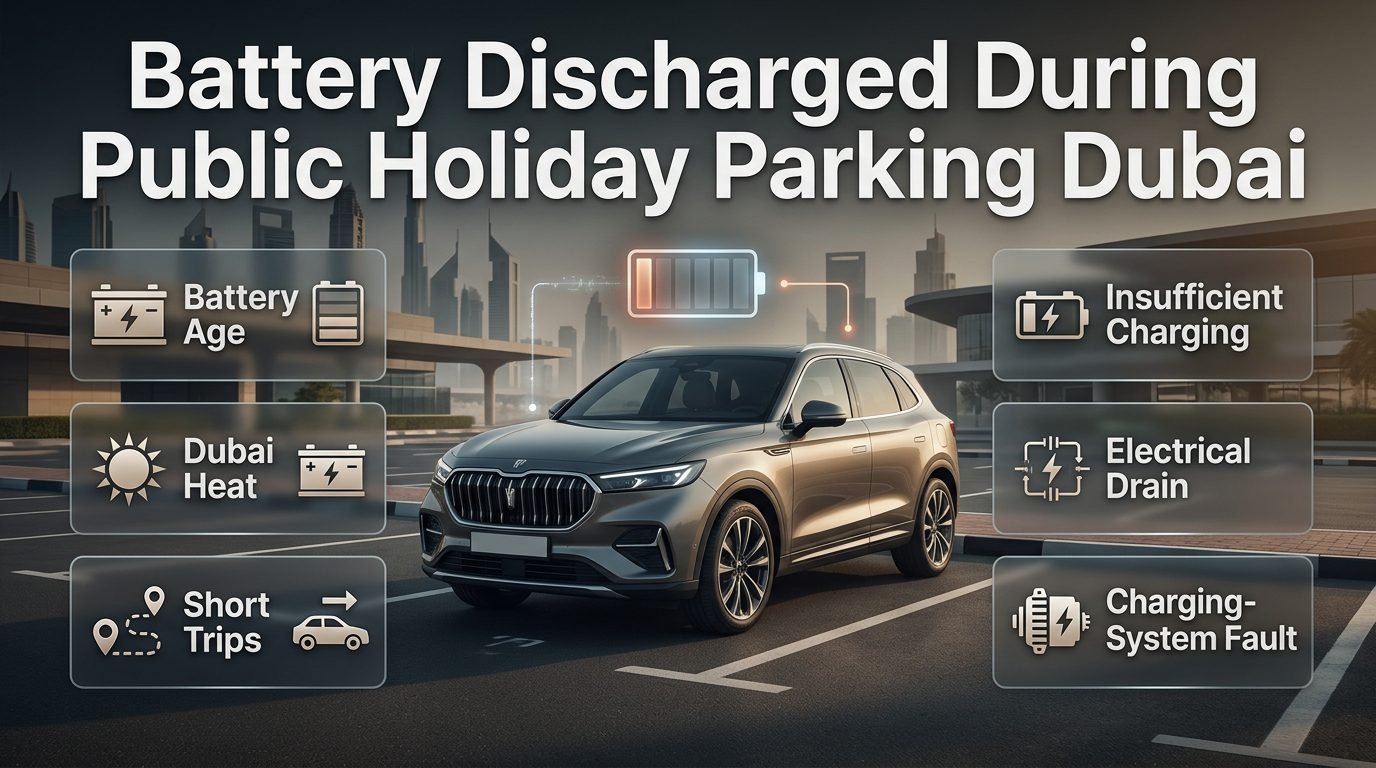
A battery discharged during public holiday parking in Dubai does not necessarily mean the battery suddenly failed because the vehicle was parked. Parking can simply expose a weakness that was already developing. Battery age, Dubai’s high temperatures, repeated short trips, insufficient charging, electrical accessories, parasitic drain, and charging-system faults can all contribute to the problem.
For Dubai motorists, this distinction is important. A battery that becomes discharged after several days of parking may need charging and testing rather than immediate replacement. On the other hand, an older battery that repeatedly loses its charge may have reached the end of its practical service life.
Drivers looking for professional automotive assistance can explore EuroSwift Auto Services for broader vehicle maintenance and repair support in Dubai.
The right approach is to diagnose why the battery discharged, rather than simply jumpstarting the car and assuming the problem has been solved.
Why Public Holiday Parking Can Reveal a Weak Car Battery
A modern vehicle continues to consume a small amount of electrical energy after the engine is switched off.
Security systems, immobilizers, electronic control modules, keyless-entry systems, memory functions, alarms, tracking equipment, and other components may remain active in a low-power state. Under normal circumstances, this standby consumption should not quickly discharge a healthy battery.
The situation changes when the battery has already lost part of its capacity.
During normal weekday driving, the alternator continuously replenishes electrical energy while the engine is running. A driver may therefore not notice that the battery has become weaker. The vehicle continues starting every morning because there is still enough available energy.
When the car remains parked for several days, however, the battery receives no additional charging from the alternator. It continues supplying the vehicle’s standby systems. If its reserve capacity is already reduced, the remaining charge may eventually fall below the level required to operate the starter.
This is one reason a battery can appear perfectly normal before a public holiday and fail immediately afterward.
Public Holiday Parking Is Often the Trigger, Not the Original Cause
This distinction is useful when diagnosing the problem.
Consider a vehicle that has been driven every day for several months. The battery is aging, but the driver does not experience a starting problem. The car is then parked for four days during a holiday.
On the next driving day, the vehicle does not start.
It would be easy to say that the four-day parking period caused the failure. In reality, the extended parking period may simply have revealed the battery’s reduced capacity.
This is why professional diagnosis should consider the vehicle’s history rather than focusing only on the number of days it remained parked.
How Dubai’s Climate Affects Battery Reliability
Dubai presents a particularly demanding environment for automotive batteries because of its high ambient temperatures.
Battery chemistry is sensitive to temperature. Prolonged exposure to high heat can accelerate aging and contribute to deterioration of internal battery components. A battery may continue working for some time despite this degradation, but its reserve capacity can gradually decline.
This creates an important relationship between climate and parking.
A battery that has spent months operating in high temperatures may have less usable capacity than the driver expects. When the vehicle is parked for several days, there is less reserve available to support standby electrical consumption.
The holiday itself does not necessarily damage the battery. Instead, the longer period without alternator charging can expose the effect of previous battery deterioration.
Factors That Can Increase Risk in Dubai
Several conditions can make battery discharge more likely:
- Long periods of outdoor parking
- High under-hood temperatures
- An aging battery
- Repeated short-distance journeys
- Heavy electrical usage
- Aftermarket accessories
- Previous jumpstarts
- Charging-system problems
- Excessive parasitic electrical consumption
- Long periods of vehicle inactivity
Drivers should therefore consider battery condition as part of overall Vehicle Maintenance, particularly before extended periods of parking.
Common Causes of a Battery Discharged After Holiday Parking
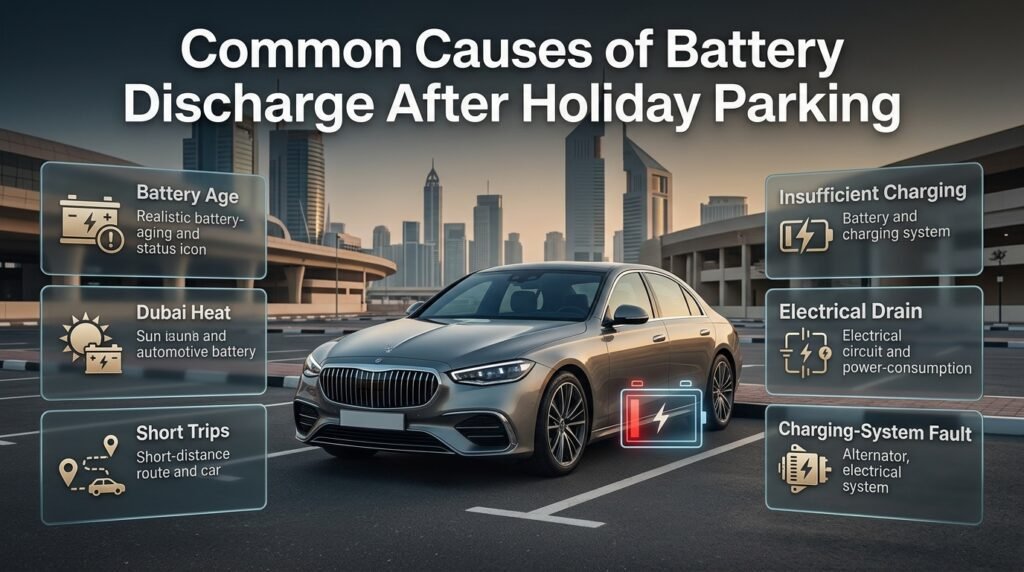
There is no single explanation for every discharged battery.
The most common possibilities include battery degradation, insufficient state of charge, abnormal electrical consumption, charging-system faults, poor connections, or a combination of several factors.
1. Aging Battery
Battery capacity decreases over time.
An aging battery may still start the engine under normal circumstances while having significantly less reserve than when it was new.
This often produces subtle warning signs before complete failure.
The driver may notice slower cranking, occasional hesitation during starting, or electrical systems behaving differently. Because the vehicle eventually starts, these signs are sometimes ignored.
Extended parking can then expose the problem.
2. Repeated Short Trips
Short-distance driving can create an unfavorable charging pattern.
Starting the engine requires electrical energy. During a very short journey, the alternator may not have enough operating time to completely restore the energy consumed during starting and other electrical operations.
One short trip is not necessarily a problem. The concern develops when a vehicle repeatedly performs short journeys while the battery is already aging.
If several short trips occur immediately before a public holiday, the battery may enter the parking period with a lower state of charge than the driver realizes.
3. Parasitic Electrical Drain
A vehicle should reduce electrical consumption after being switched off.
When an electrical component continues drawing more power than expected, the battery can gradually discharge while the vehicle is parked.
Potential sources can include:
- Faulty control modules
- Aftermarket alarms
- Tracking equipment
- Dash cameras
- Interior lighting faults
- Infotainment-related problems
- Incorrect accessory installation
- Electronic modules failing to enter sleep mode
A parasitic drain is particularly important when the same vehicle repeatedly develops a flat battery after parking.
In that situation, replacing the battery without investigating the electrical system may only provide a temporary solution.
4. Charging-System Problems
The alternator is responsible for supplying electrical power while the engine runs and replenishing the battery.
If the charging system is not functioning correctly, the battery may gradually become undercharged.
The driver may not immediately notice the problem because the car can continue operating until the battery reserve becomes too low.
After several days of parking, the remaining charge may not be sufficient for starting.
This is why battery diagnosis should not be separated from charging-system testing.
5. Poor Battery Connections
Loose or contaminated terminals can interfere with electrical flow.
A battery itself may still have adequate capacity, but poor connections can create symptoms that resemble battery failure.
Professional inspection should therefore include the physical condition of the battery installation and terminals.
How to Tell Whether the Battery Was Already Weak
One of the most useful diagnostic clues is what happened before the public holiday.
If the car had been starting increasingly slowly, the battery may already have been deteriorating.
Slow Engine Cranking
The starter motor may sound slower than usual when the battery cannot provide sufficient starting current.
Intermittent Starting Problems
A battery approaching the end of its useful life may start the car normally on one occasion and struggle on another.
Repeated Jumpstarts
If the vehicle has already required jumpstarting several times, the underlying cause should be investigated.
Weak Electrical Performance
Unusual dimming of lights or inconsistent electronic behavior can indicate electrical problems, although other faults can create similar symptoms.
Battery Warning Light
A warning indicator can sometimes point toward a charging-system problem rather than simply a battery that needs replacement.
Drivers should not assume that every battery warning means the battery itself is defective.
Battery Discharge vs Battery Failure
These two conditions are frequently confused.
A discharged battery has insufficient available charge.
A failed battery has a condition that prevents it from reliably holding or delivering the required electrical energy.
A healthy battery can become discharged if lights are left on, the vehicle remains unused for an extended period, or an electrical accessory consumes power.
After appropriate charging and testing, that battery may still be serviceable.
A deteriorated battery, however, may fail testing even after it has been fully charged.
| Condition | What It Means | Typical Approach |
|---|---|---|
| Discharged but healthy battery | Charge is low but battery may still be usable | Recharge and test |
| Aging battery | Capacity has reduced | Test and consider replacement |
| Failed battery | Cannot reliably provide required performance | Replacement may be necessary |
| Charging fault | Battery is not being replenished correctly | Charging-system repair |
| Parasitic drain | Excessive electrical consumption while parked | Electrical diagnosis |
| Poor connection | Electrical flow is restricted | Terminal/connection correction |
This distinction can prevent unnecessary battery replacement.
What Happens Electrically While Your Car Is Parked?
Turning off the engine does not completely shut down every electrical system.
Modern vehicles use a network of electronic control units and security systems. Some systems remain operational in standby mode while others enter sleep states after a period of inactivity.
The battery provides the energy needed for these functions.
A healthy battery has enough reserve to support this normal consumption.
However, several factors can change the outcome:
- Battery capacity has declined.
- The battery was not fully charged before parking.
- An electronic module remains active.
- An accessory continues drawing current.
- The charging system was already underperforming.
- The vehicle has been exposed to prolonged heat.
The important point is that a battery does not have to be completely defective to become discharged during extended parking.
How Long Can a Car Stay Parked During a Dubai Public Holiday?
There is no universal number of days that guarantees a vehicle will start.
Battery condition varies considerably between vehicles.
A relatively healthy battery may tolerate several days of parking without difficulty. Another vehicle with an aging battery may develop a starting problem after a shorter period.
The vehicle’s electrical architecture also matters.
| Parking Period | General Consideration |
|---|---|
| Overnight | Normally low concern for a healthy vehicle |
| Two to three days | Usually manageable for a healthy battery |
| Several days | Weak batteries may begin showing problems |
| Extended inactivity | Battery condition becomes increasingly important |
| Repeated long parking | Consider preventive battery management |
These should not be treated as fixed failure limits.
The condition of the battery is more important than a specific number of days.
Professional Battery Diagnosis After a Public Holiday
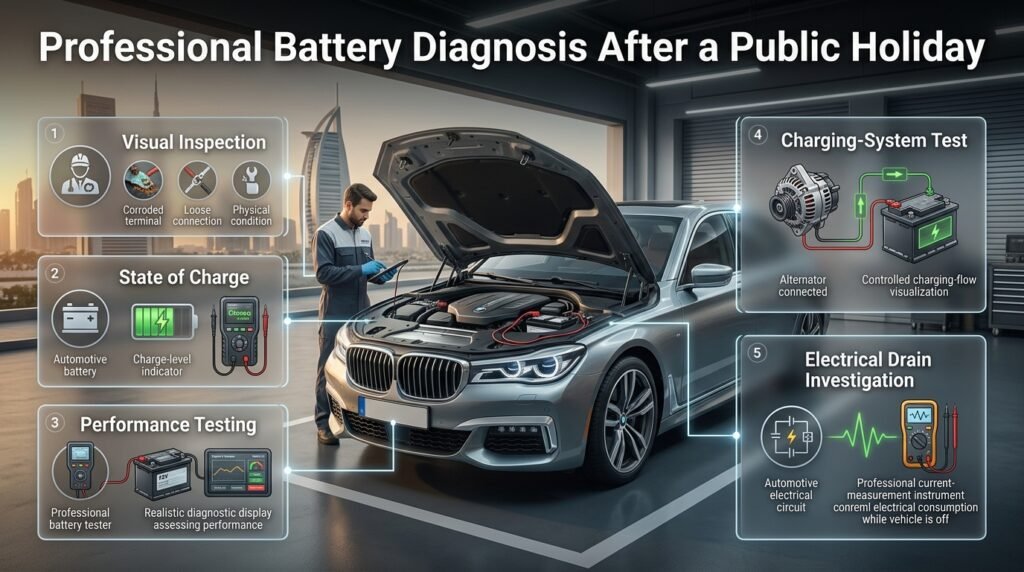
When a vehicle fails to start after extended parking, a proper inspection should follow a logical process.
Visual Inspection
The technician first examines the battery and its installation.
This can reveal:
- Corroded terminals
- Loose connections
- Physical damage
- Leakage
- Incorrect installation
- Abnormal battery-case conditions
Battery State-of-Charge Assessment
The battery’s available charge should be evaluated.
A battery with low state of charge is not automatically defective.
Battery Performance Testing
A professional test can determine whether the battery can still deliver the required starting performance.
This is important because a simple voltage reading does not always tell the complete story.
Charging-System Test
The alternator and related charging system should be assessed.
If the vehicle is not replenishing the battery correctly, installing a new battery without addressing the charging problem can result in another discharge.
Electrical Drain Investigation
If the battery repeatedly becomes flat while parked, technicians may need to investigate excessive electrical consumption.
This step is particularly important when a relatively new battery repeatedly fails after periods of inactivity.
Why Jumpstarting the Vehicle Is Not the Complete Solution
A jumpstart can restore temporary starting ability.
It does not tell you why the battery became discharged.
For example, the underlying problem could be:
- Battery degradation
- Alternator failure
- Parasitic drain
- Poor electrical connection
- Incorrect battery specification
- Accessory-related consumption
If the vehicle starts after a jumpstart and the driver immediately continues using it without investigation, the same problem may return during the next weekend or public holiday.
A professional Car Jumpstart can be useful in an emergency, but recurring battery discharge requires proper diagnosis.
For stranded drivers, Roadside Assistance can provide a practical way to restore mobility while determining what additional inspection may be necessary.
Should You Replace the Battery Immediately?
Not every discharged battery needs replacement.
A professional technician should first determine whether the battery is capable of recovering and delivering reliable performance.
Replacement is more appropriate when testing shows that the battery has substantially deteriorated or cannot meet the vehicle’s requirements.
Charging May Be Appropriate When:
- The battery is relatively healthy.
- The discharge had a temporary cause.
- There is no evidence of continuing electrical drain.
- The charging system is functioning correctly.
- The battery passes performance testing.
Replacement May Be Appropriate When:
- The battery fails a proper performance test.
- Capacity has significantly deteriorated.
- Starting performance remains poor.
- The battery repeatedly becomes discharged.
- The battery is no longer suitable for the vehicle.
- The battery has reached the later stage of its useful service life.
The correct decision should be based on testing rather than guesswork.
Selecting the Correct Replacement Battery in Dubai
When replacement is required, the most important consideration is compatibility.
A battery should be selected according to the vehicle’s requirements, including its physical dimensions, electrical specifications, starting requirements, battery technology, and manufacturer recommendations.
This becomes particularly important with vehicles equipped with start-stop systems and advanced electronic features.
Depending on the vehicle, an AGM or EFB battery may be required rather than a conventional battery.
Amaron Battery
Drivers researching Amaron Battery Replacement in Dubai can use the dedicated page to understand the available service option.
The important point is still vehicle compatibility. A brand should never be selected solely because it is popular.
Bosch Battery
For drivers considering Bosch Battery Replacement in Dubai, the same principle applies: the battery must match the vehicle’s technical requirements.
Tuflong Battery
Another option is Tuflong Battery Replacement in Dubai, which can be considered when the relevant battery specification is suitable for the vehicle.
AGM Battery
Vehicles requiring advanced battery technology may need an AGM solution. Information about AGM Battery Replacement in Dubai can help drivers understand this category.
AGM batteries are commonly associated with vehicles requiring greater cycling capability and advanced electrical performance, but the manufacturer’s specification should always determine whether AGM is appropriate.
Exide Battery
Drivers researching Exide Battery Replacement in Dubai can compare that option according to their vehicle requirements.
Panasonic Battery
For vehicles compatible with this battery range, Panasonic Battery Replacement in Dubai provides another brand-specific reference.
FIAMM Battery
Drivers considering another established battery option can review FIAMM Battery Replacement in Dubai and compare it with the specification required by their vehicle.
AC Delco Battery
AC Delco Battery Replacement in Dubai is another option that can be evaluated where the vehicle’s required battery specification is compatible.
The key lesson across all these choices is simple: correct specification comes before brand preference.
Battery Prices in Dubai: What Actually Determines Cost?
Drivers often search for a fixed battery price, but battery replacement costs can vary considerably.
The price can depend on:
- Battery type
- Battery capacity
- Brand
- Vehicle model
- AGM or EFB technology
- Required starting performance
- Physical battery size
- Availability
- Installation requirements
- Diagnostic requirements
- Vehicle-specific electronic procedures
A small conventional battery and a premium AGM battery should not be expected to have the same market price.
For a broader understanding of pricing considerations, the Car Battery Prices in Dubai 2026 Guide can be useful when comparing replacement options.
Drivers should avoid making the decision based exclusively on the lowest advertised price.
A battery that does not meet the vehicle’s requirements can create reliability problems and may not provide the expected service life.
Public Holiday Parking Situations That Commonly Expose Battery Problems
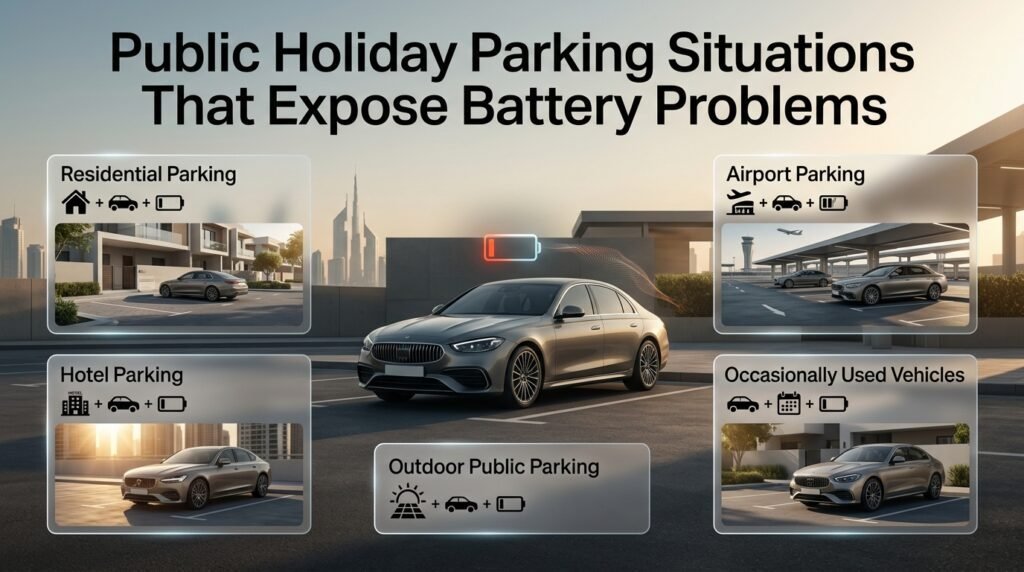
Different parking environments can create different practical challenges.
Residential Parking
A vehicle parked at home for several days may seem completely safe, but inactivity can still reveal an aging battery.
Hotel Parking
A holiday stay can leave the car stationary for several days.
If the battery was already weak, the vehicle may fail when the owner is ready to leave.
Airport Parking
Longer parking periods make battery condition particularly relevant.
Drivers returning from travel may be especially frustrated if the vehicle will not start after several days of inactivity.
Outdoor Public Parking
Outdoor parking can expose the vehicle to high temperatures.
In Dubai, prolonged heat exposure can contribute to battery aging over time.
Second or Occasionally Used Vehicles
Vehicles that are driven infrequently can be more vulnerable to battery discharge because their batteries receive fewer regular charging opportunities.
Battery Problems in Luxury and Modern Vehicles
Modern luxury vehicles can have extensive electronic systems.
Features such as:
- Keyless entry
- Security systems
- Powered seats
- Memory functions
- Infotainment
- Connected services
- Cameras
- Driver-assistance systems
- Multiple control modules
can increase the complexity of electrical diagnosis.
This does not mean these systems should normally drain the battery quickly. They are designed with energy-management strategies.
However, when a module or accessory behaves abnormally, diagnosis can become more complicated.
Owners of premium vehicles should therefore avoid selecting a replacement battery purely by physical size.
A vehicle-specific Luxury Car Service approach can be more appropriate where advanced electrical systems are involved.
How Short Trips Before a Holiday Can Contribute to Discharge
The days immediately before a public holiday can matter.
Suppose a driver normally uses the vehicle for a long commute. The alternator gets significant operating time.
Then, during the days before the holiday, the driver makes only several short trips.
The battery may enter the holiday period with less reserve.
Now the vehicle sits parked for several days.
The combination can create a situation where the car does not start when the holiday ends.
This does not mean short trips are inherently damaging. The issue is the overall charging balance and battery condition.
Professional Recommendations Before Leaving Your Car Parked
A few simple checks can reduce the likelihood of problems.
Check for Early Warning Signs
If the vehicle has been starting more slowly than normal, do not ignore it.
Test an Aging Battery
If you are unsure about battery condition before a long parking period, professional testing can provide useful information.
Check Previous Electrical Problems
A vehicle that has previously suffered unexplained battery discharge deserves more attention before extended parking.
Avoid Ignoring Charging Warnings
A battery warning light may indicate an alternator or charging-system problem.
Review Aftermarket Accessories
Dash cameras, tracking equipment, alarms, and other accessories should be installed correctly and assessed if abnormal battery discharge occurs.
Maintain Service Records
Knowing when the battery was replaced and what battery specification was installed helps technicians diagnose future problems more efficiently.
What to Do When Your Car Will Not Start After a Public Holiday
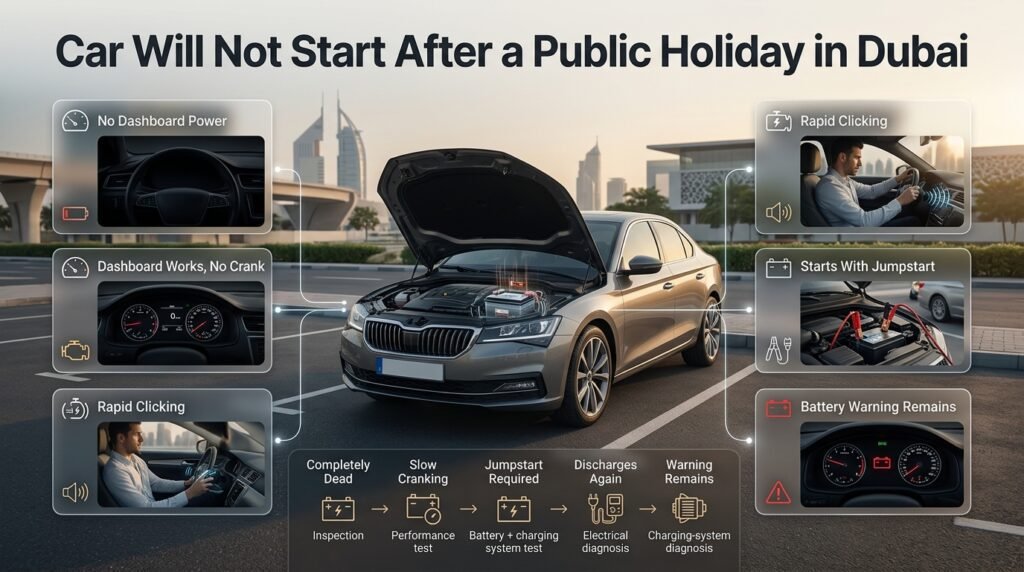
The first step is to identify what the vehicle is doing.
No Dashboard Power
The battery may be severely discharged, although connection problems or other electrical faults are possible.
Dashboard Works but Engine Does Not Crank
The battery may not have sufficient starting power, but the starter system should also be considered.
Rapid Clicking
This can occur when battery power is insufficient for the starting system.
Vehicle Starts With a Jumpstart
The vehicle should still be inspected if the discharge was unexpected or recurrent.
Vehicle Starts but Battery Warning Remains
The charging system should be checked.
| Symptom | Possible Cause | Recommended Approach |
|---|---|---|
| Completely dead vehicle | Severe discharge or electrical connection issue | Battery/connection inspection |
| Slow cranking | Weak battery or starting issue | Battery performance test |
| Starts with jumpstart | Low battery power | Test battery and charging system |
| Dies again after parking | Battery or parasitic drain | Electrical diagnosis |
| New battery repeatedly discharges | Charging or electrical problem | Investigate underlying fault |
| Charging warning remains | Alternator/system issue | Charging-system diagnosis |
Why Battery Replacement Alone Sometimes Fails
One of the most important lessons from recurring battery problems is that the battery may not be the original fault.
Imagine a vehicle with an electrical module that continues consuming excessive power while parked.
The owner replaces the battery.
The new battery works correctly for several days.
The vehicle is parked again.
The same module drains the new battery.
The owner now believes the replacement battery was defective.
In reality, the electrical drain was never corrected.
This is why professional Engine Diagnostics and electrical inspection can be important when battery problems repeat.
The same principle applies to alternator faults.
A replacement battery cannot compensate for a charging system that is not replenishing it correctly.
Preventive Maintenance Beyond the Battery
A public holiday is also a useful opportunity to think about overall vehicle readiness.
Battery reliability is only one part of dependable transportation.
Drivers should also pay attention to:
- Engine condition
- Brake performance
- Oil condition
- Cooling system
- Tire pressure
- Suspension
- Wheel alignment
- Air conditioning
- Warning lights
- Transmission behavior
For example, a vehicle with an overdue Oil Change or unresolved Brake Repair issue may remain parked without showing a problem, but the issue will still be present when driving resumes.
Likewise, AC Repair becomes particularly important in Dubai because cabin cooling is a major part of everyday driving comfort.
A complete Car Service approach considers the vehicle as a system rather than treating each problem separately.
Public Holiday Battery Maintenance Checklist
Before leaving a vehicle parked for several days:
- Check whether starting has become slower.
- Look for unresolved warning lights.
- Confirm battery terminals are secure.
- Consider battery testing if its condition is uncertain.
- Investigate previous unexplained discharge.
- Make sure lights are switched off.
- Check electrical accessories.
- Review upcoming maintenance requirements.
- Check tire condition before extended driving afterward.
- Keep access to professional assistance if the vehicle fails to start.
The purpose of this checklist is not to make drivers perform complicated electrical testing themselves. It is to encourage early recognition of problems.
Common Mistakes Dubai Drivers Should Avoid
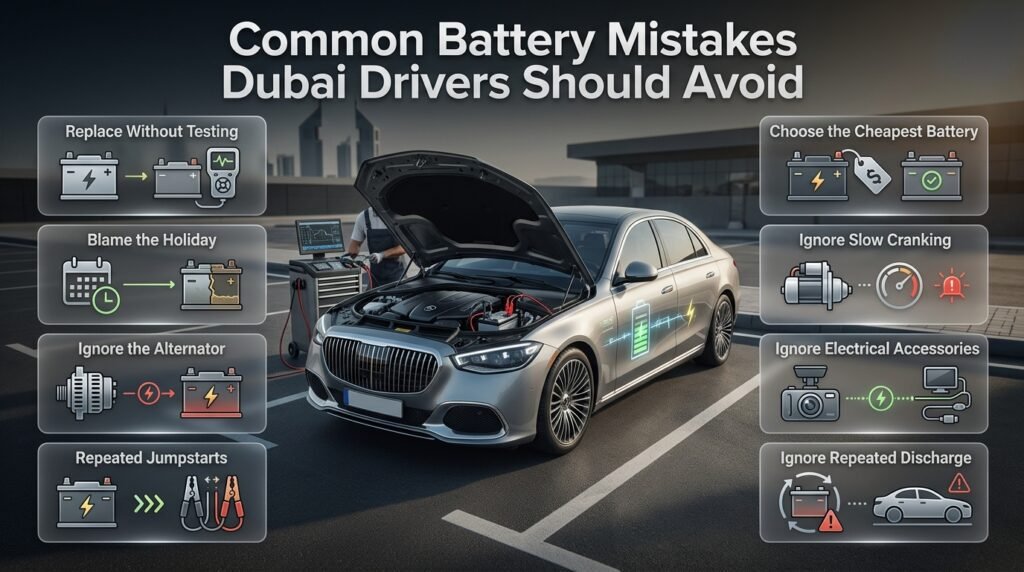
Replacing a Battery Without Testing
A discharged battery may still be usable.
Assuming the Holiday Caused the Failure
The battery may have been deteriorating for months.
Ignoring the Alternator
A charging-system problem can repeatedly discharge even a new battery.
Repeatedly Jumpstarting
Temporary starting assistance does not diagnose the cause.
Choosing the Cheapest Battery
Battery compatibility and quality matter.
Ignoring Slow Cranking
Slow cranking can be an early warning sign.
Forgetting About Electrical Accessories
Aftermarket equipment can contribute to abnormal consumption if installed or functioning incorrectly.
Ignoring Repeated Discharge
If the battery repeatedly becomes flat after parking, the pattern itself is important diagnostic evidence.
When to Contact Professional Roadside Assistance
Professional assistance becomes particularly useful when the vehicle is completely immobile.
This can include situations where:
- The vehicle has no electrical response.
- A jumpstart is unsuccessful.
- The car starts but immediately develops another electrical problem.
- The battery repeatedly becomes discharged.
- The driver is stranded away from home.
- The vehicle requires a specific battery installation.
- The owner is unsure whether the battery or alternator is responsible.
A professional Emergency Car Repair response can restore mobility while also helping determine whether further repair is required.
For recurring issues, however, roadside assistance should be followed by proper workshop-level diagnosis.
Battery Technology and the Future of Vehicle Electrical Systems
Automotive batteries are becoming increasingly integrated with sophisticated energy-management systems.
Modern vehicles may monitor battery condition electronically and adjust charging strategies according to operating conditions.
Start-stop systems have also increased the demands placed on certain batteries.
Hybrid and electrified vehicles are introducing additional layers of battery-management technology.
Even conventional petrol and diesel vehicles are becoming more electronically dependent.
This means battery replacement is becoming less of a simple mechanical task and more of a vehicle-specific electrical service.
Future Auto Workshop operations will increasingly combine conventional mechanical expertise with electronic diagnostics and intelligent battery management.
How a Professional Workshop Approaches Recurring Battery Discharge
A reliable diagnostic process should answer several questions.
Is the Battery Healthy?
Testing determines whether the battery still has adequate capacity.
Is It Fully Charged?
A low state of charge does not automatically mean battery failure.
Is the Alternator Working?
Charging-system testing establishes whether the vehicle replenishes the battery correctly.
Is There Abnormal Current Draw?
Repeated discharge while parked can indicate parasitic consumption.
Are Connections Secure?
Physical connections can affect electrical performance.
Is the Battery Correct for the Vehicle?
The correct specification is essential.
Does the Vehicle Have a History of Electrical Problems?
Previous incidents can help identify recurring faults.
This systematic approach is more effective than replacing parts based solely on symptoms.
Battery Reliability and Long-Term Vehicle Maintenance
A battery should not be considered an isolated component.
Its performance is connected to the charging system, electrical architecture, vehicle usage, climate, parking habits, and maintenance history.
This is why a strong preventive maintenance strategy can reduce unexpected failures.
A complete maintenance program can include:
- Battery testing
- Engine diagnostics
- Charging-system inspection
- Brake inspection
- Oil service
- Tire checks
- Cooling-system checks
- AC maintenance
- Suspension inspection
- Wheel alignment
- General vehicle inspection
Drivers who address developing problems early are less likely to encounter several unrelated failures at the same time.
Expert Insight: The Pattern Matters More Than the Incident
If a battery dies once after an unusual event, the cause may be straightforward.
If the same battery repeatedly becomes discharged whenever the vehicle is parked for several days, that pattern deserves investigation.
Recurring behavior provides valuable diagnostic information.
A technician should ask:
- How old is the battery?
- How frequently is the vehicle driven?
- How long are normal journeys?
- Was the battery recently replaced?
- Has the vehicle been jumpstarted before?
- Does the battery discharge only while parked?
- Are there aftermarket accessories?
- Has the alternator been tested?
- Has the vehicle shown warning lights?
These questions help separate normal battery depletion from a developing electrical problem.
Why does my car battery discharge during public holiday parking in Dubai?
A battery that goes flat while the car is parked for several days is often showing an existing weakness rather than simply being affected by the holiday. Even when the engine is switched off, modern vehicles continue using a small amount of electrical power for security systems, control modules, keyless-entry functions and other electronics. If the battery is already aging or was not fully charged before parking, that small continuous load can eventually leave insufficient power for the next engine start.
Dubai’s heat is another important factor. High temperatures can accelerate battery deterioration over time, so a battery may appear normal during everyday driving while gradually losing its reserve capacity. Extended parking then exposes that deterioration because the alternator is no longer replenishing the battery.
Important points:
A discharged battery is not automatically a failed battery.
Battery age and condition should be checked.
Repeated discharge may indicate an electrical drain.
The charging system should be checked when the problem keeps returning.
Dubai’s heat can contribute to faster battery deterioration.
How long can a car stay parked during a public holiday before the battery dies?
There is no reliable fixed number of days that applies to every vehicle. A healthy battery in a properly functioning vehicle can normally tolerate a reasonable period of inactivity, while an older or partially discharged battery may struggle much sooner. Modern vehicles also continue to consume some electricity while parked, so battery condition is more important than simply counting the days.
The situation becomes more risky when the vehicle was already showing slow cranking, had recently needed a jumpstart, was mainly used for short trips, or had an unresolved electrical problem. In those circumstances, several days of holiday parking can be enough to expose the weakness.
Before extended holiday parking, consider:
Whether the battery has shown slow starting recently.
Whether the vehicle has needed a jumpstart.
Whether the battery is relatively old.
Whether the car is driven mostly on short journeys.
Whether an electrical accessory remains connected while parked.
Whether the charging system has previously shown problems.
The important point is that parking duration alone does not determine battery failure. Battery health, state of charge, electrical consumption and vehicle condition all matter.
Why did my battery die after parking even though the car started normally before the holiday?
This is one of the most common situations because everyday driving can hide a declining battery.
When you drive regularly, the vehicle’s charging system replenishes some of the energy used during starting and normal electrical operation. A battery with reduced capacity may therefore continue starting the car successfully every day. When the vehicle suddenly sits unused for several days, however, there is no alternator activity to replenish the charge. The battery continues supplying its normal standby electrical loads, and its available reserve may eventually become too low for starting.
Repeated short trips before the holiday can make the situation worse because short journeys may not provide enough charging time to restore the energy used during starting.
Warning signs that the battery may already have been weak:
Engine cranking became slower than usual.
The car occasionally took longer to start.
You had already used a jumpstart recently.
Lights appeared weaker than normal.
The battery had been in service for several years.
The vehicle had previously developed unexplained battery discharge.
So, if the car worked perfectly before the holiday but failed afterward, don’t automatically blame the parking period. The holiday may simply have revealed a battery that was already approaching the end of its useful service life.
What should I check if my car battery repeatedly dies while parked in Dubai?
Repeated battery discharge is more significant than a one-time flat battery. If the same vehicle becomes discharged whenever it remains parked for several days, the battery itself should be tested, but the investigation should not stop there.
A technician should consider the battery’s condition and state of charge, charging-system performance, terminal connections and possible parasitic electrical drain. A faulty accessory, control module or aftermarket electronic device can sometimes continue consuming more power than expected after the vehicle is switched off.
This is particularly important when the battery is relatively new. Replacing a battery repeatedly without finding the reason for the discharge can become an expensive cycle.
A professional diagnosis should typically consider:
Battery condition and starting performance.
Battery state of charge.
Alternator and charging-system operation.
Battery terminals and connections.
Aftermarket accessories.
Abnormal electrical consumption while parked.
Previous battery and electrical-system history.
If a new battery also becomes flat after the same parking period, that is a strong reason to investigate the vehicle’s charging or electrical system rather than simply buying another battery.
Should I replace my car battery after it discharges during a public holiday?
Not automatically. A battery can become completely discharged and still be serviceable after appropriate charging and testing. The decision to replace it should depend on its actual condition rather than the fact that it became flat once.
If the battery fails a proper performance test, cannot hold an adequate charge, has significantly deteriorated, or repeatedly struggles to start the vehicle, replacement may be the sensible option. On the other hand, if the battery performs correctly after being recharged and the discharge had a clear temporary cause, immediate replacement may not be necessary.
It is also important to check the charging system when the discharge was unexpected. A faulty alternator or another electrical problem can discharge a replacement battery as well.
Before approving a replacement, check:
Battery health and performance.
State of charge.
Charging-system condition.
Battery terminals and connections.
Possible parasitic drain.
Correct battery specification for the vehicle.
Whether the battery has a history of repeated discharge.
For modern vehicles, battery selection also matters. If the vehicle was designed for a particular battery technology such as AGM, the replacement should meet the manufacturer’s requirements rather than being chosen simply because it is cheaper or physically fits.
Professional takeaway: a public-holiday battery failure should be treated as a diagnostic clue. If it happens repeatedly, find the reason behind the discharge instead of relying on repeated jumpstarts or replacing batteries without testing.
Conclusion
A battery discharged during public holiday parking in Dubai is not always a simple case of leaving the car unused for too long. In many situations, extended parking exposes an existing weakness caused by battery age, reduced capacity, repeated short trips, high-temperature exposure, charging-system problems, or abnormal electrical consumption.
The right response is to diagnose the cause before deciding on replacement. A professional battery test can determine whether the battery can still provide reliable starting performance, while charging-system and electrical checks can identify problems that could otherwise drain even a newly installed battery.
For Dubai drivers, preventive attention is especially valuable before extended holiday parking. If the vehicle has shown slow cranking, required previous jumpstarts, or repeatedly loses charge while parked, these should be treated as warning signs rather than ignored.
A reliable battery is only one part of dependable vehicle operation. Regular Vehicle Inspection, Battery Replacement, Car Service, and electrical diagnosis can help reduce unexpected starting problems and keep the vehicle ready when it is needed most. The goal should not simply be to get the engine started after a holiday, but to make sure the vehicle remains dependable during the next one.
Leave a Reply