
Introduction
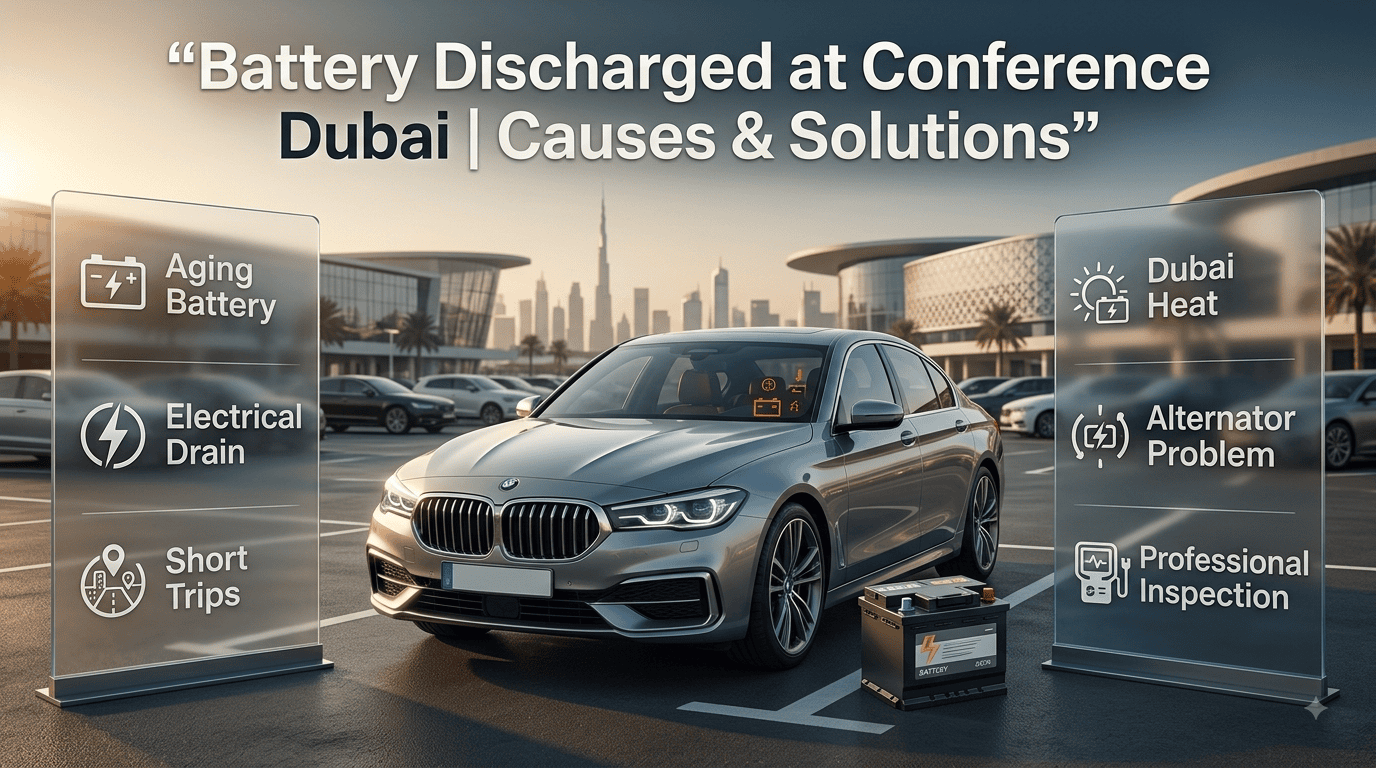
Battery Discharged at Conference Dubai | A battery discharged at conference Dubai situation can be extremely inconvenient. You may park your car before entering a conference, exhibition, business meeting, or corporate event, spend several hours inside, and return to find that the engine will not start. The dashboard may be completely dead, the lights may be very dim, or you may only hear a clicking sound when turning the key or pressing the start button.
The important thing is that a discharged battery does not always mean the battery itself needs replacement. The vehicle may have been parked with an interior light switched on, an accessory may have continued drawing power, the battery may already have been weak, or the alternator may not have been charging it properly before you arrived at the conference.
Dubai’s hot climate and demanding urban driving conditions can also contribute to battery deterioration over time. Frequent short journeys, heavy air-conditioning use, traffic congestion, and extended periods of parking can expose an already weak battery.
If your vehicle has experienced this problem, EuroSwift Auto Services can be considered for professional battery inspection, replacement, jump-start assistance, diagnostics, and related automotive services in Dubai.
The correct solution starts with identifying why the battery discharged, rather than immediately replacing it.
What Does Battery Discharged at Conference Dubai Actually Mean?
When a car battery is described as “discharged,” it means the battery has lost enough usable electrical energy that it cannot provide the required power for starting the engine or operating the vehicle normally.
A discharged battery and a failed battery are different situations.
A battery can become discharged because electrical energy was consumed while the engine was switched off. If the battery remains healthy internally, it may be possible to recharge it and return it to normal service.
A failed battery, however, may no longer be capable of holding or delivering sufficient charge. In that situation, charging may provide only temporary improvement, and replacement may be necessary.
This distinction matters because replacing a battery without investigating the reason for the discharge can leave the real problem unresolved.
A conference parking discharge may involve:
- An interior light remaining on
- Headlights being left active
- Boot or glovebox lighting
- Dash camera operation
- Aftermarket tracking equipment
- Phone accessories
- A weak or aging battery
- Short journeys before the conference
- Alternator charging problems
- Parasitic electrical drain
- Poor battery-terminal connections
The vehicle’s symptoms can provide useful clues, but professional testing is required to confirm the actual cause.
Why Can a Car Battery Discharge While You Attend a Conference?
A modern vehicle does not become completely electrically inactive when the engine is switched off.
Security systems, remote locking, electronic control modules, memory functions, alarms, and other systems may continue consuming a small amount of electrical energy while the vehicle is parked.
This normal electrical consumption is usually designed into the vehicle. Problems can occur when the battery has insufficient reserve capacity or when an abnormal electrical load remains active.
For example, a healthy battery may tolerate normal standby consumption for an ordinary parking period. An aging battery with reduced capacity may struggle much sooner.
The conference itself is therefore not necessarily the cause. The extended parking period may simply expose an existing weakness.
Common scenarios
| Situation | What may happen |
|---|---|
| Healthy battery + normal parking | Usually starts normally |
| Aging battery + several hours parked | Starting may become difficult |
| Light left on | Battery can discharge significantly |
| Dash camera in parking mode | Continuous electrical consumption |
| Faulty electronic module | Abnormal battery drain |
| Weak alternator | Battery may arrive at the conference undercharged |
| Repeated short trips | Battery may not recover enough charge |
This is why the diagnosis should consider what happened before, during, and after the conference.
Dubai Heat and Battery Discharge
Dubai’s climate is an important consideration when discussing automotive battery reliability.
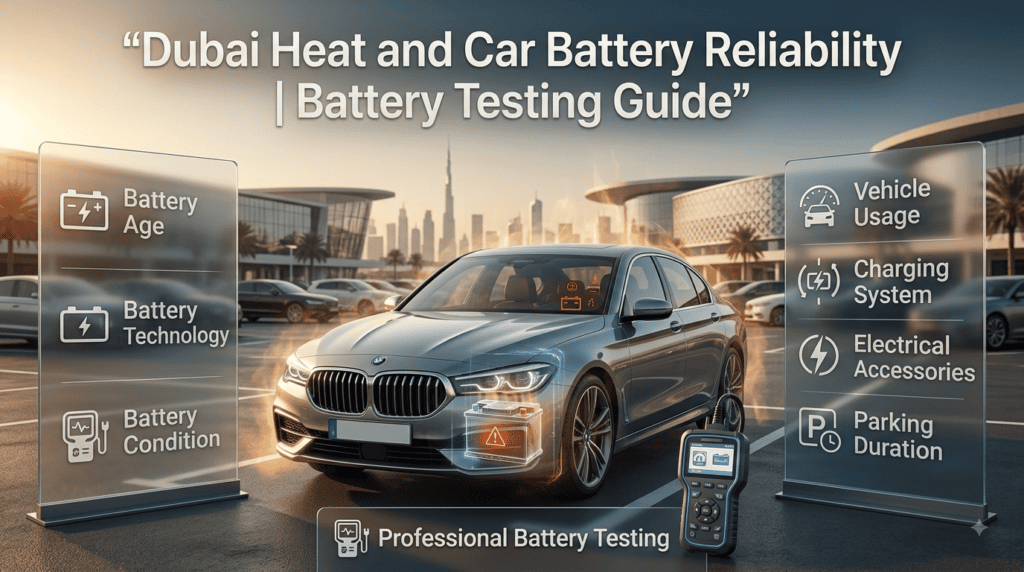
High temperatures can accelerate battery deterioration and increase stress on internal battery components. Heat can affect the rate of chemical reactions inside the battery and contribute to the aging process.
A battery that has already experienced significant deterioration may therefore become noticeably less reliable in demanding conditions.
However, it would be inaccurate to say that every battery failure in Dubai is caused by heat.
A professional technician should consider several factors together:
- Battery age
- Battery technology
- Battery condition
- Vehicle usage
- Charging-system performance
- Electrical accessories
- Parking duration
- Terminal condition
- Previous discharge history
For drivers who regularly park outdoors or use their vehicle heavily in hot conditions, periodic battery testing can identify deterioration before the battery creates an unexpected no-start situation.
How Short Trips Can Leave Your Battery Undercharged
Driving habits can have a major effect on battery condition.
Every engine start requires electrical energy. The alternator replenishes energy while the engine is running, but very short journeys may not provide enough operating time to fully restore what was consumed during starting and vehicle operation.
This can become a problem when a driver repeatedly makes short trips.
For example, a typical day might involve:
- Starting the car for a short morning drive
- Driving through heavy traffic
- Using the air conditioner
- Parking for a short period
- Starting the vehicle again
- Making another short journey
- Repeating the process several times
The battery may gradually remain at a lower state of charge.
When the vehicle finally reaches a conference and remains parked for several hours, there may not be enough reserve capacity for a reliable restart.
Professional recommendation
If your vehicle is primarily used for short-distance urban driving, do not wait until the car refuses to start. Regular battery and charging-system inspections can identify problems before they become inconvenient.
Signs Your Battery Was Already Weak Before the Conference
In many cases, the battery does not suddenly fail while you are inside the conference.
Instead, the battery may have been deteriorating for weeks or months, and the extended parking period simply exposed the weakness.
Drivers often notice subtle symptoms but do not consider them important.
Warning signs include:
- Engine cranking more slowly than usual
- Needing more time before the engine starts
- Repeated jump-start requirements
- Dashboard electronics behaving unusually
- Lights appearing weaker
- Battery warning messages
- Electrical accessories becoming inconsistent
- Vehicle starting normally one day and struggling the next
Slow engine cranking is especially useful information.
If the starter previously turned the engine quickly but has recently become noticeably slower, the battery and starting system should be inspected.
However, slow cranking can also result from poor cable connections or starter-related problems, so it should not automatically be blamed on the battery.
Battery Discharged vs Battery Failed: What Is the Difference?
Understanding the difference between discharge and failure helps prevent unnecessary replacement.
A discharged battery has insufficient available energy at that moment. A healthy battery can potentially recover after proper charging.
A failed battery has a deeper problem involving its ability to store or deliver energy.
| Battery condition | Typical direction |
|---|---|
| Discharged but healthy | Recharge and investigate why |
| Weak battery | Test battery condition |
| Battery fails health test | Replacement may be required |
| Battery repeatedly discharges | Investigate vehicle electrical system |
| Alternator undercharging | Charging-system repair |
| Poor terminal connection | Connection repair |
| Excessive parasitic drain | Electrical diagnosis |
A professional battery tester can provide much more useful information than simply looking at the voltage.
A battery may show a reasonable resting voltage and still fail when subjected to a starting load.
What Should You Do When the Car Will Not Start After the Conference?
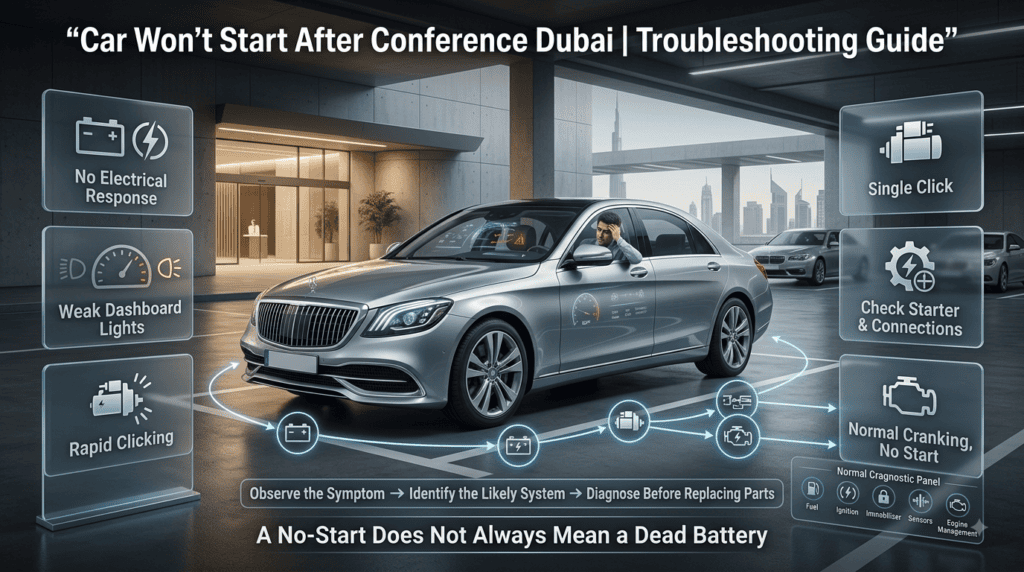
The first step is to observe the vehicle’s behavior.
Do not immediately assume that the battery is completely dead.
If there is no electrical response
If the dashboard, interior lights, and other electronics are completely inactive, a severely discharged battery or electrical connection problem is possible.
If the dashboard lights are weak
Low battery voltage may be preventing the starter from operating correctly.
If you hear rapid clicking
Rapid clicking can occur when available battery voltage drops significantly while attempting to operate the starter.
If you hear one click
The battery is one possibility, but the starter, relay, cable connections, and ground connections may also need inspection.
If the engine cranks normally but does not start
The problem may not be battery-related at all.
Fuel delivery, ignition, immobilizer, sensors, or engine-management systems may need investigation.
This distinction is particularly important because replacing a battery will not repair an unrelated engine-starting problem.
Can a Jump Start Fix a Conference Parking Battery Problem?
A jump start can provide enough electrical assistance to get an engine running when the battery does not have sufficient starting power.
However, a jump start should not be considered a complete repair.
It solves the immediate starting problem but does not explain why the battery became discharged.
If a light was accidentally left on, the battery may simply require proper charging.
If the battery is old and deteriorated, it may fail again.
If the alternator is not charging correctly, the battery may become discharged again even after being replaced.
If an electrical component is consuming excessive power while the car is parked, the problem will continue until that drain is identified.
After a jump start, check:
- Battery health
- Charging-system output
- Battery terminals
- Battery age
- Electrical accessories
- Previous discharge history
- Parasitic electrical drain
Professional Car Jumpstart assistance can therefore be useful for immediate mobility, but the underlying cause should still be investigated.
Professional Battery Inspection Process
A professional battery inspection should be systematic rather than based on a single voltage measurement.
Visual battery inspection
The technician checks the battery case, terminals, cables, mounting, and surrounding components.
Signs of corrosion, physical damage, swelling, leakage, or loose connections can provide important clues.
Resting voltage test
Resting voltage can provide information about the battery’s state of charge.
However, voltage alone does not establish complete battery health.
Starting test
The technician evaluates how the battery behaves when the engine is being cranked.
This helps identify whether the battery can deliver the current required for starting.
Battery health test
A dedicated tester can assess starting capability and provide information about battery condition.
Charging-system test
The alternator and charging circuit should be evaluated once the engine is running.
Electrical-system diagnosis
If the battery and alternator appear healthy but the battery continues discharging while parked, the vehicle may require parasitic-drain testing.
This complete process is more reliable than immediately installing another battery.
Why the Alternator Matters After a Battery Discharge
The alternator plays a critical role in maintaining the vehicle’s electrical system while the engine is running.
It supplies electrical power to vehicle systems and helps replenish energy used from the battery during starting.
If the alternator or charging circuit is malfunctioning, the battery may gradually lose its state of charge.
This can create a confusing situation.
A driver may install a new battery and assume the problem has been solved. The vehicle starts normally for a while, but the battery later becomes weak again because the charging system has not been corrected.
Possible charging-system warning signs
- Battery warning light
- Repeated battery discharge
- Electrical equipment behaving abnormally
- Vehicle becoming difficult to start after driving
- Charging-system test showing insufficient output
A proper diagnosis should distinguish between a battery problem and an alternator problem before recommending replacement.
Parasitic Drain: A Hidden Reason for Battery Discharge
Parasitic drain refers to electrical consumption that continues when the vehicle is switched off beyond what the vehicle normally requires in its parked state.
Some electrical consumption is normal.
The problem occurs when an electrical component continues drawing an excessive amount of current.
Possible sources include:
- Dash cameras
- Aftermarket alarms
- Tracking devices
- Modified audio systems
- Interior lighting
- Boot lighting
- Glovebox lighting
- Faulty switches
- Relays
- Control modules
- Other aftermarket electronics
Some modern vehicles require time for their electronic modules to enter sleep mode before accurate resting-current measurements can be taken.
For this reason, parasitic-drain diagnosis should be performed properly rather than relying on guesswork.
If an abnormal drain is found, replacing the battery without correcting the drain can result in another discharge.
Can a Dash Camera Discharge Your Battery?
A dash camera can contribute to battery drain depending on how it is installed and configured.
Some dash cameras operate only when the ignition is on. Others have parking-mode functionality that allows the camera to continue operating while the vehicle is parked.
Parking mode can be useful for vehicle security, but it means the camera may continue consuming electrical energy.
If the battery is already weak, continuous accessory operation can reduce the available reserve.
Drivers using parking-mode accessories should therefore make sure the installation is appropriate for the vehicle and battery system.
A professional technician can help determine whether an aftermarket device is contributing to an unexpected discharge.
Conference Parking and Battery Age
Battery age is one of the most useful pieces of information during diagnosis, but age alone should not determine whether the battery is replaced.
Two batteries of the same age can have very different conditions depending on:
- Vehicle usage
- Climate exposure
- Charging behavior
- Number of starting cycles
- Parking patterns
- Electrical load
- Battery quality
- Maintenance history
A battery that has been repeatedly discharged deeply may also have suffered deterioration that is not obvious from its appearance.
Therefore, professional battery testing is preferable to relying only on an estimated service-life number.
How to Decide Between Charging and Battery Replacement
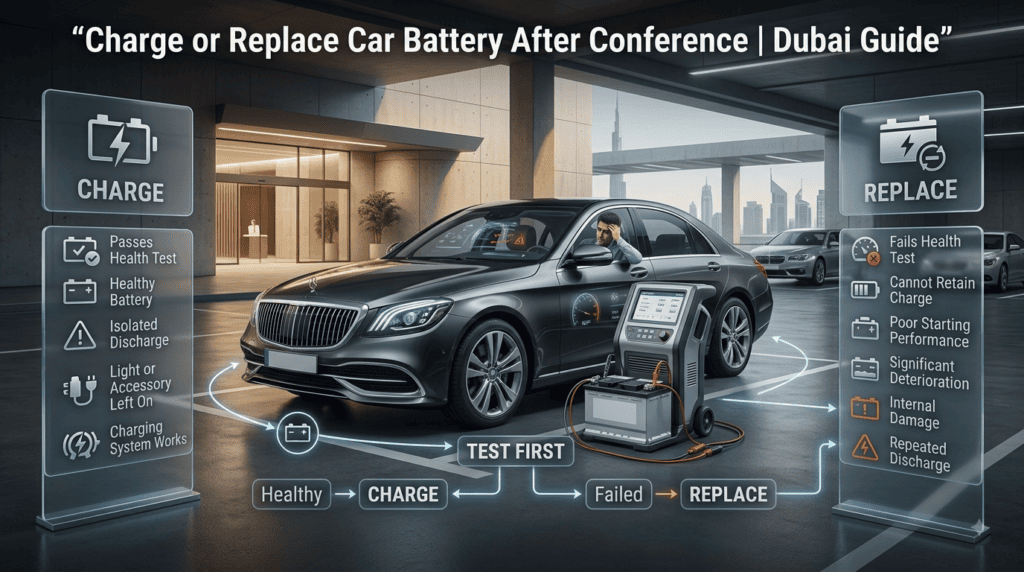
When a conference parking discharge occurs, the next question is often whether the battery should be charged or replaced.
The correct answer depends on testing.
Charging may be appropriate when:
- The battery passes a health test
- The battery is relatively healthy
- A light was accidentally left on
- An accessory was left operating
- The discharge was an isolated event
- The charging system works correctly
Replacement may be appropriate when:
- The battery fails its health test
- It cannot retain sufficient charge
- Starting performance remains poor
- The battery is significantly deteriorated
- Internal damage is present
- Repeated discharge occurs without an external cause
This approach reduces unnecessary replacement and ensures that a genuinely failing battery is not returned to service.
Choosing the Correct Battery for Your Vehicle
Battery replacement should involve more than selecting the cheapest battery that fits physically.
The technician should confirm:
- Battery technology
- Capacity
- Starting capability
- Physical dimensions
- Terminal arrangement
- Vehicle compatibility
- Electrical requirements
- Start-stop requirements
- Manufacturer specifications
Modern vehicles can require specific battery technologies.
For example, a vehicle designed for AGM technology may require an AGM battery because of its electrical architecture and start-stop system.
For drivers researching available options, Amaron Battery can be considered where compatible with the vehicle.
Bosch Battery is another option for vehicles where the required specifications match.
Likewise, Tuflong Battery may be suitable for certain applications.
The correct decision should always begin with the vehicle’s requirements rather than brand preference.
AGM Batteries and Modern Start-Stop Vehicles
Modern vehicles with start-stop systems can place additional demands on the battery.
These vehicles may repeatedly stop and restart the engine during normal driving, while simultaneously powering numerous electrical systems.
AGM technology is designed for applications that require higher cycling capability and specific electrical performance.
However, AGM should not simply be selected because it sounds more advanced.
The vehicle manufacturer determines which battery technology is appropriate.
For vehicles that specifically require this technology, drivers can review AGM Battery replacement options in Dubai.
The key principle is simple: use the battery technology specified or approved for the vehicle.
Battery Brand Options and Vehicle Requirements
Battery brands can differ in construction, specifications, warranty, availability, and application range.
A professional battery selection should therefore match the vehicle first and the brand second.
For example, drivers researching different replacement options can review:
- Exide Battery for compatible vehicle applications.
- Panasonic Battery where specifications are appropriate.
- FIAMM Battery for suitable vehicle requirements.
- AC Delco Battery where the required battery specifications match.
These options should not be treated as universal replacements for every vehicle.
The correct battery depends on the car’s model, engine, electrical architecture, dimensions, capacity requirements, and manufacturer specification.
Battery Replacement Is Not Complete Without System Checks
Installing a new battery is only one part of a professional battery service.
A proper replacement process should consider why the original battery failed.
A professional replacement process may include:
- Confirming the old battery’s condition.
- Inspecting terminals and cables.
- Checking charging-system performance.
- Confirming the correct battery specification.
- Installing the replacement correctly.
- Securing the battery properly.
- Checking electrical connections.
- Performing required battery registration or adaptation where applicable.
- Confirming normal starting performance.
Some modern vehicles use intelligent battery-management systems.
Depending on the vehicle, battery replacement may require electronic registration or adaptation so the vehicle’s energy-management system correctly recognizes the new battery.
Understanding Car Battery Prices in Dubai
Battery pricing can vary considerably depending on the vehicle and battery specification.
A simple conventional battery and an advanced AGM battery may have significantly different pricing because their technologies, construction, capacity, and intended applications differ.
Other factors can include:
- Battery brand
- Battery size
- Battery capacity
- Battery technology
- Vehicle requirements
- Start-stop compatibility
- Installation requirements
- Emergency service requirements
- Warranty
- Availability
Drivers comparing options can use the Car Battery Prices in Dubai 2026 guide to understand the factors that can influence replacement pricing.
The cheapest battery is not necessarily the most economical choice if it is unsuitable for the vehicle or does not provide the required performance.
What If the New Battery Also Becomes Discharged?
This is an important warning sign.
If a newly installed battery becomes discharged again soon afterward, the battery itself may not be the underlying problem.
Possible causes include:
- Alternator undercharging
- Parasitic electrical drain
- Faulty wiring
- Poor battery connection
- Incorrect battery specification
- Electrical accessory
- Control-module issue
- Starting-system problem
Repeated replacement without diagnosis can become expensive and frustrating.
A new battery should therefore be treated as an opportunity to verify that the vehicle’s charging and electrical systems are functioning correctly.
Conference Parking: What Drivers Should Check Before Leaving the Car
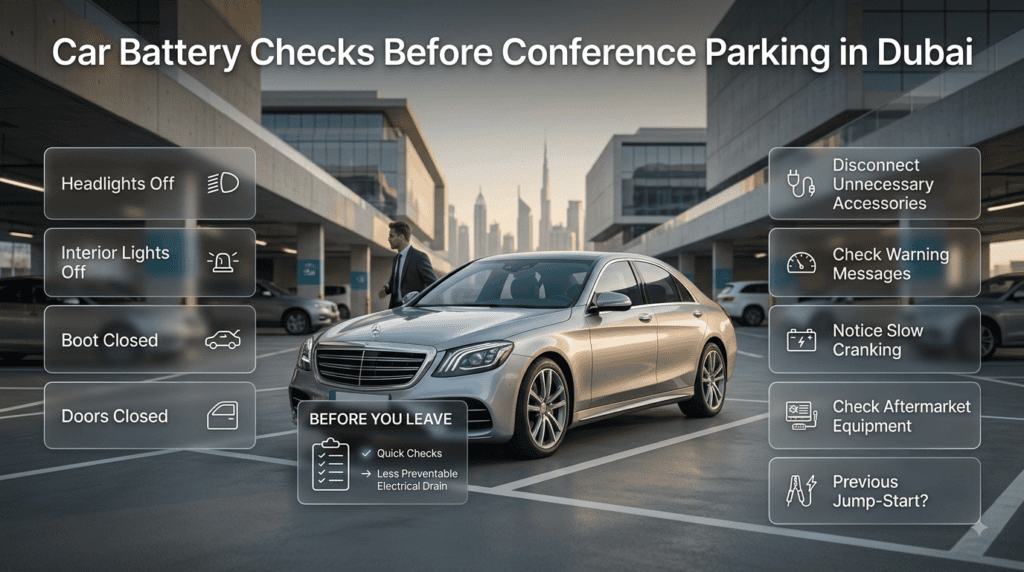
If you are attending a full-day conference, exhibition, meeting, or corporate event, a few simple checks can reduce preventable battery problems.
Before leaving the vehicle:
- Confirm the headlights are switched off.
- Check that interior lights are off.
- Make sure the boot is completely closed.
- Close all doors properly.
- Disconnect unnecessary accessories.
- Check for warning messages.
- Pay attention to slow engine cranking.
- Make sure aftermarket equipment is operating as intended.
- Avoid ignoring a battery that has already needed jump-start assistance.
These checks take very little time but can prevent some common sources of electrical drain.
What to Do If Your Battery Has Discharged Repeatedly
One isolated discharge may have an obvious explanation.
Repeated discharge is different.
If the vehicle repeatedly needs assistance after being parked, professional diagnosis should be considered.
Repeated discharge can indicate:
| Pattern | Possible direction |
|---|---|
| Battery dies after several hours | Weak battery or electrical load |
| Battery dies overnight | Parasitic drain or battery deterioration |
| Battery dies after short trips | Undercharging or battery weakness |
| Battery dies while driving | Charging-system problem |
| New battery becomes weak | Electrical or charging fault |
| Jump start works temporarily | Battery/alternator diagnosis |
Repeated battery failure should not be treated as normal vehicle behavior.
When the Problem Is Actually the Starter
The starter motor is responsible for physically turning the engine during startup.
A vehicle that fails to start does not necessarily have a battery problem.
A weak battery can cause starter symptoms, but a faulty starter can also produce a no-start condition even when the battery has adequate charge.
A technician may therefore inspect:
- Battery voltage
- Battery starting capability
- Starter current demand
- Starter operation
- Cable connections
- Ground connections
- Starter relay
If the battery passes testing but the engine still refuses to crank properly, further starting-system diagnosis may be required.
This is one reason professional Car Repair should focus on diagnosis rather than assumptions.
When the Engine Cranks but Does Not Start
This is another important distinction.
If the starter turns the engine at normal speed but the engine does not actually start running, the battery may have enough power for the starting process.
Possible systems requiring inspection can include:
- Fuel delivery
- Ignition
- Engine sensors
- Immobilizer
- Electronic control systems
- Air and fuel management
A fuel-related problem, for example, will not normally be repaired by replacing the battery.
Similarly, an ignition fault requires diagnosis of the ignition system.
This is why Engine Diagnostics can be valuable when the vehicle shows normal cranking but refuses to start.
Conference Parking and Luxury Vehicles
Luxury vehicles often contain sophisticated electronic systems.
These can include:
- Multiple control modules
- Intelligent battery management
- Advanced security systems
- Start-stop technology
- Connected services
- Electronic comfort systems
- High-powered infotainment
- Advanced driver-assistance features
A low-voltage condition can sometimes cause several warning messages to appear at once.
This does not necessarily mean that every system has failed.
Low voltage can affect electronic communication and cause temporary warnings.
However, professional diagnostic equipment should be used to determine whether the warnings disappear after the electrical system is restored or whether a separate fault remains.
For premium vehicles, proper Luxury Car Service should follow vehicle-specific procedures rather than relying on generic assumptions.
Preventive Battery Maintenance for Dubai Drivers
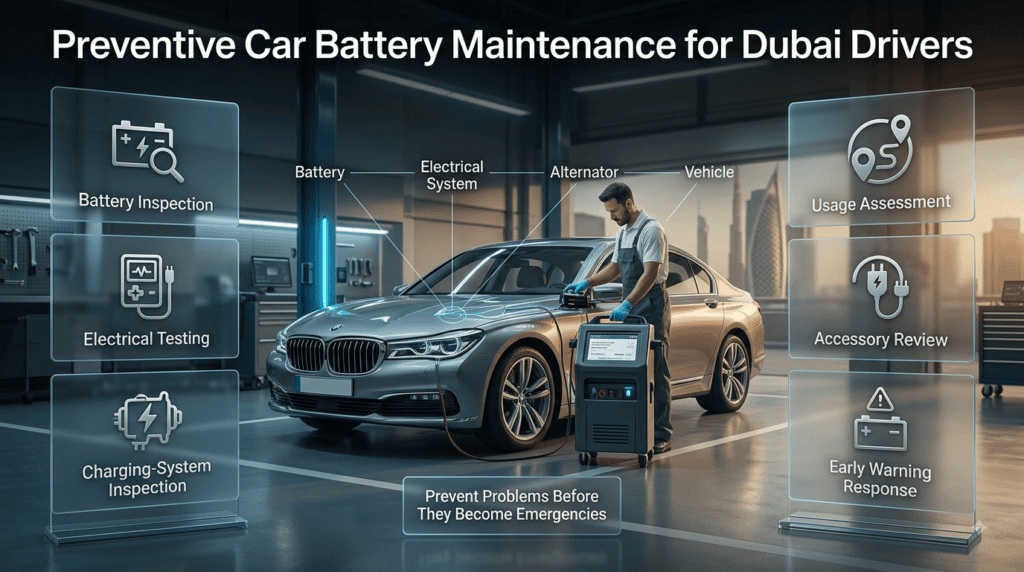
Preventive maintenance can reduce the likelihood of being stranded after an important meeting or conference.
A practical battery maintenance routine includes:
Battery inspection
Check the physical condition of the battery and terminals.
Electrical testing
Test battery health rather than relying only on visual inspection.
Charging-system inspection
Confirm that the alternator is replenishing the battery correctly.
Usage assessment
Consider whether frequent short journeys are preventing adequate charging.
Accessory review
Check whether aftermarket electrical equipment remains active while the vehicle is parked.
Early warning response
Investigate slow starting before the battery completely fails.
Preventive Car Service can identify small problems before they become emergency repairs.
How Conference Parking Differs From Long-Term Storage
A vehicle parked for a normal conference day is not the same as a vehicle stored for several weeks.
Ordinary short-term parking should generally not cause a healthy battery to become completely dead.
If it does, there may be an underlying issue.
Long-term vehicle storage presents different considerations because the battery may remain unused for extended periods while the vehicle continues to consume standby electricity.
This distinction is important.
If a vehicle repeatedly becomes completely discharged after only several hours of ordinary parking, the situation deserves investigation rather than being considered normal battery behavior.
Professional Roadside Assistance for a Discharged Battery
Being stranded in a conference parking area can be particularly inconvenient because the vehicle may be surrounded by other parked cars and the driver may need to leave the location quickly.
Professional Roadside Assistance can provide practical support when the vehicle will not start.
Depending on the situation, assistance may include:
- Battery inspection
- Jump-start service
- Battery replacement
- Electrical diagnosis
- Basic starting-system inspection
- Charging-system testing
- Vehicle recovery when necessary
The immediate goal is to restore safe mobility.
The longer-term goal is to identify why the vehicle lost starting capability.
When Emergency Battery Replacement Makes Sense
Emergency replacement can be appropriate when testing confirms that the battery has reached the end of its serviceable condition.
However, the replacement should still be correctly matched to the vehicle.
A professional technician should verify:
- Battery dimensions
- Capacity
- Starting specification
- Terminal layout
- Battery technology
- Vehicle compatibility
For vehicles with advanced electrical systems, the installation procedure may also involve battery-management procedures.
Emergency service should therefore maintain the same focus on compatibility and correct installation as scheduled workshop service.
Common Mistakes Drivers Make After a Conference Battery Failure
Replacing the battery without testing it
A battery may simply be discharged.
Assuming the alternator is fine
A faulty charging system can discharge even a brand-new battery.
Treating a jump start as a repair
A jump start restores temporary starting ability but does not identify the cause.
Repeatedly attempting to start the vehicle
Repeated attempts can further reduce available battery energy.
Buying the cheapest battery
Price should not be the only consideration.
Ignoring accessories
Aftermarket devices can contribute to battery drain.
Ignoring repeated discharge
A recurring problem should be investigated professionally.
Assuming every no-start problem is a battery
Starter, fuel, ignition, immobilizer, and engine-management problems can produce similar complaints.
Professional Troubleshooting Table
| Vehicle symptom | Possible cause | Recommended action |
|---|---|---|
| Completely dead vehicle | Discharged battery or connection issue | Battery and electrical inspection |
| Dim dashboard | Low battery voltage | Battery testing |
| Rapid clicking | Low available starting voltage | Battery and terminal inspection |
| Single click | Battery, starter, or connection | Starting-system diagnosis |
| Normal cranking, no start | Fuel/ignition/engine system | Engine diagnostics |
| Battery dies overnight | Weak battery or parasitic drain | Electrical diagnosis |
| Battery repeatedly goes flat | Charging or electrical problem | Complete system inspection |
| Battery warning while driving | Charging system | Alternator test |
| New battery fails quickly | Drain or charging fault | Diagnose before replacement |
This type of structured diagnosis helps technicians avoid unnecessary parts replacement.
Battery Discharge Prevention Before Important Events
If you have an important conference, business meeting, airport journey, exhibition, or long-distance drive planned, battery condition should not be ignored.
A vehicle that has recently shown slow starting is not something to leave to chance.
A practical pre-event inspection can include:
- Battery health test
- Charging-system test
- Terminal inspection
- Starting-system assessment
- Accessory review
- Warning-light inspection
If the battery is approaching the end of its useful condition, replacing it before the important event may be more convenient than dealing with an emergency later.
The decision should still be based on battery condition and vehicle requirements.
How Professional Vehicle Inspection Helps
A complete Vehicle Inspection goes beyond checking whether the engine starts.
It can help identify conditions that may contribute to future breakdowns.
Depending on the vehicle and service scope, an inspection may consider:
- Battery
- Alternator
- Starter
- Engine fluids
- Belts
- Cooling system
- Tires
- Brakes
- Suspension
- Electrical components
- Warning lights
This broader approach is useful for drivers who have experienced repeated reliability problems.
A battery discharge may sometimes be an isolated event, but it can also be an early warning that another system requires attention.
Battery Technology Is Becoming More Important
Modern vehicles increasingly depend on sophisticated electrical systems.
Start-stop technology, intelligent charging, electronic energy management, hybrid systems, and advanced vehicle electronics are changing the way battery service is performed.
Technicians increasingly need to understand:
- Battery chemistry
- Charging strategy
- Battery-management systems
- Start-stop requirements
- Electronic adaptation
- Energy consumption
- Vehicle-specific diagnostics
This means battery service is no longer simply a matter of removing an old battery and installing a new one.
Professional Vehicle Maintenance increasingly combines mechanical knowledge with electrical and electronic diagnosis.
Future Trends in Automotive Battery Service
Automotive electrical systems are likely to become even more sophisticated.
Hybrid and electric vehicles already place major importance on electrical energy management, while conventional petrol and diesel vehicles continue adopting advanced electronic systems.
As a result, battery service is moving toward more detailed diagnostics.
Future-focused battery maintenance will increasingly consider:
- Battery condition monitoring
- Intelligent charging
- Electronic energy management
- Vehicle-specific battery adaptation
- More advanced diagnostic equipment
- Improved battery technologies
- Predictive maintenance
The central principle will remain the same: determine the condition of the complete electrical system instead of treating the battery as an isolated component.
Why did my car battery discharge while I was attending a conference in Dubai?
A battery that becomes discharged during a conference is not necessarily failing because the car was parked for several hours. More often, the parking period exposes an existing weakness. An aging battery has less reserve capacity, so normal standby electrical consumption can become enough to prevent the engine from starting later. Other possibilities include an interior light, dash camera, tracking device, aftermarket accessory, or another electrical circuit continuing to draw power while the vehicle is switched off.
Dubai conditions can make the situation more noticeable because high temperatures accelerate battery deterioration, while frequent short journeys can leave the battery insufficiently charged before the vehicle is parked.
Important points:
A single discharge does not automatically mean the battery needs replacement.
Previous slow engine cranking is an important warning sign.
Accessories and aftermarket electronics should be considered.
Battery health and alternator performance should be tested before deciding on replacement.
If the same problem happens repeatedly, electrical diagnosis is more important than simply installing another battery.
Can Dubai heat cause a car battery to die while parked at a conference?
Dubai’s heat can contribute significantly to battery deterioration, but it should not automatically be blamed for every discharge. High temperatures accelerate the chemical processes inside lead-acid batteries and can contribute to internal deterioration, reduced capacity, and shorter service life. When a battery has already become weak, several hours of parking can be enough to expose that weakness.
The important distinction is between heat damaging the battery over time and heat directly causing an immediate discharge. Usually, heat is part of the longer-term deterioration process. The actual no-start event may occur later because the weakened battery can no longer provide sufficient starting power.
What drivers should watch for:
Slower starting after the vehicle has been parked.
Battery performance becoming inconsistent.
A battery that is already relatively old.
Repeated discharge during hot weather.
Battery warning or electrical-system symptoms.
Swelling, leakage, or other visible battery damage.
If heat exposure is combined with short trips, heavy electrical demand, or an existing charging problem, battery reliability can decline more quickly.
How can I tell if the discharged battery needs replacement or just charging?
This is one of the most important questions after a conference parking failure. A discharged battery should be tested before replacement whenever practical. If the battery is still healthy and the discharge happened because a light or accessory was accidentally left operating, proper charging may restore normal operation.
Replacement becomes more appropriate when the battery cannot retain sufficient charge, fails a professional battery-health test, or repeatedly becomes weak despite the vehicle’s charging system operating correctly.
Situation
More appropriate direction
Light accidentally left on
Charge and monitor
Battery passes health test
Recharge and investigate discharge
Battery fails health test
Replacement may be required
Battery repeatedly becomes discharged
Check battery and electrical system
Alternator undercharging
Repair charging system
Excessive parked electrical draw
Diagnose parasitic drain
The biggest mistake is replacing the battery without asking why it discharged. If an alternator problem or parasitic drain remains, the replacement battery can develop the same problem.
Professional approach:
Test battery state of charge.
Test battery starting/health condition.
Check charging-system performance.
Inspect terminals and connections.
Investigate parasitic drain when the pattern suggests it.
This gives a much more reliable answer than judging the battery from voltage or age alone.
Why does my car battery keep dying after I park it in Dubai?
When a battery repeatedly dies while parked, the problem deserves a proper electrical investigation. Modern vehicles continue using a small amount of electrical power after the engine is switched off for security, memory, communication, and other functions. That normal consumption should not ordinarily cause repeated failures over ordinary parking periods. An excessive electrical load, commonly called parasitic drain, can change the situation.
Possible sources include aftermarket dash cameras, tracking systems, alarms, interior or boot lights, faulty wiring, switches, relays, or electronic modules that fail to enter their normal sleep state.
A weak battery can make the problem appear even worse because it has less reserve capacity to tolerate normal parked consumption.
If the battery repeatedly dies, check:
Battery health
Alternator output
Battery terminals and cables
Aftermarket accessories
Parasitic electrical draw
Previous discharge history
Vehicle electronic systems
If a new battery also becomes discharged, that is an especially strong reason to investigate the vehicle’s charging and electrical systems instead of repeatedly replacing batteries.
What should I do if my car won’t start after a conference in Dubai?
Start by identifying what the vehicle is actually doing rather than immediately assuming that the battery is completely dead. If the dashboard is completely inactive or the lights are extremely weak, a discharged battery or poor battery connection is a strong possibility. If you hear clicking but the engine does not crank properly, the battery and starting circuit should be checked.
If the engine cranks normally but does not start, the problem may be elsewhere, such as the fuel, ignition, immobilizer, sensor, or engine-management system. A battery replacement would not correct those faults.
A professional response should include:
Battery condition testing
Battery-terminal inspection
Charging-system testing
Starting-system assessment
Electrical-drain diagnosis when required
Proper battery replacement if testing confirms failure
A Car Jumpstart can restore temporary mobility when the battery is discharged, but it should not be treated as the final diagnosis. If the battery repeatedly needs jump-starting, the underlying cause should be identified before the vehicle is considered reliable again.
Conclusion
A battery discharged at conference Dubai situation is more than an inconvenient no-start problem. It can indicate that the battery has become weak, the charging system is not performing correctly, or an electrical component is consuming excessive power while the vehicle is parked. Dubai’s high temperatures and frequent short-distance driving can also contribute to battery deterioration over time.
The best solution is to identify the actual cause before replacing any component. A professional inspection should check the battery’s health, charging performance, terminals, starting system, and possible parasitic drain. If the battery has genuinely reached the end of its serviceable condition, the replacement should match the vehicle’s required technology, capacity, and specifications.
For drivers attending conferences, exhibitions, meetings, and business events across Dubai, preventive battery testing can help avoid an unexpected breakdown in a parking facility. If the vehicle has already shown slow starting, repeated discharge, or a need for jump-start assistance, addressing the problem early is far more practical than waiting for another failure.
Reliable Battery Replacement, Car Jumpstart, Roadside Assistance, and professional Vehicle Inspection should focus on both the immediate problem and the reason it happened. For professional automotive assistance in Dubai, EuroSwift Auto Services can help with battery-related and broader vehicle maintenance requirements.
The right approach is simple: diagnose the cause, install the correct solution, and address warning signs before the next important journey.
Leave a Reply