

Introduction
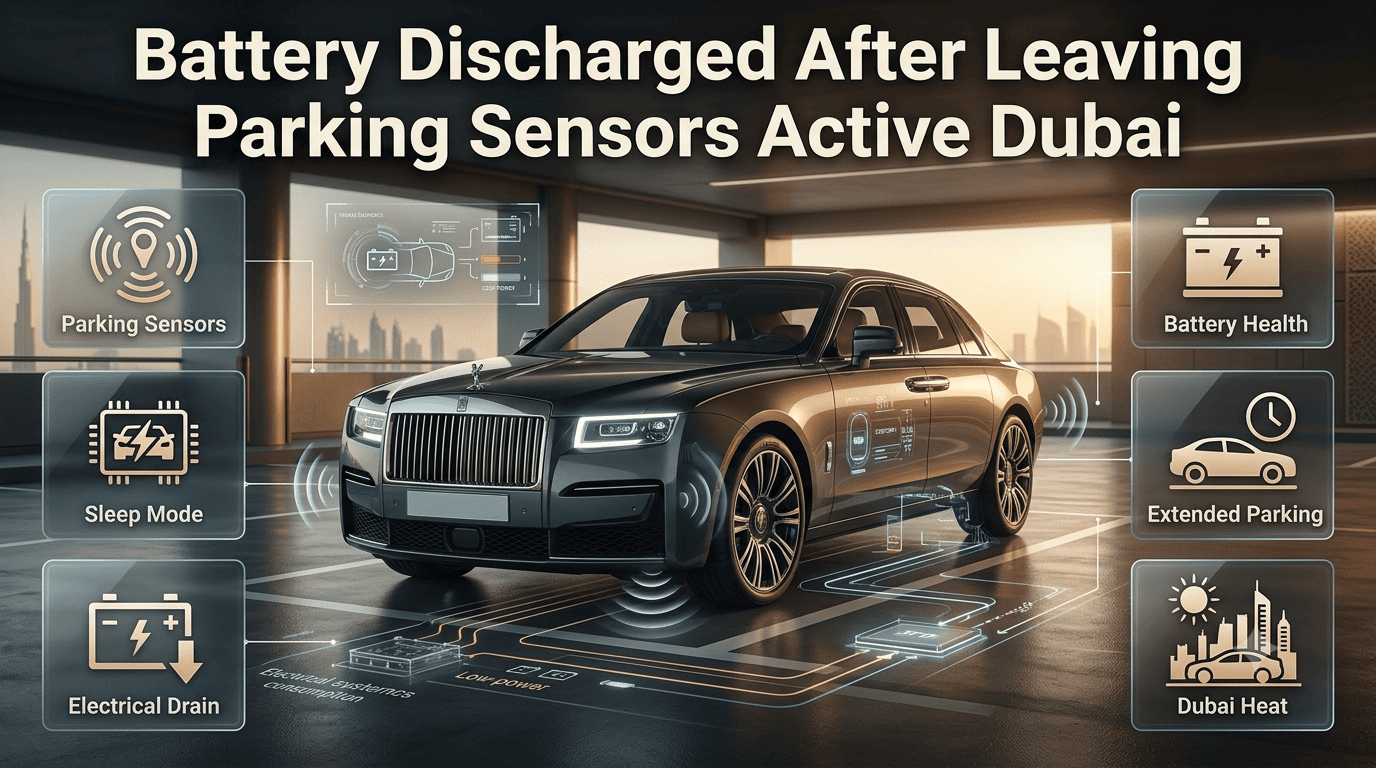
Battery Discharged After Leaving Parking Sensors Active Dubai | Leaving a vehicle parked with parking sensors or related parking-assistance electronics active can raise concerns when the battery is dead or too weak to start the engine later. In Dubai, the situation can become more noticeable because high temperatures, extended parking periods, battery aging, and frequent short journeys can reduce the amount of electrical reserve available.
However, parking sensors should not automatically be blamed whenever a parked vehicle develops a flat battery. Modern vehicles are designed to shut down or place most electronic systems into low-power states after the ignition is switched off and the vehicle is secured. If a parking module, camera, control unit, aftermarket accessory, or another electrical component remains active, the vehicle may consume more power than expected.
The important question is therefore not simply whether the parking sensors were left active. It is whether the vehicle actually entered its normal sleep mode, whether the battery was already weak, and whether another electrical system was contributing to the discharge.
For Dubai drivers, understanding these differences can help determine whether the vehicle needs a battery test, electrical diagnosis, or genuine car battery replacement.
Can Parking Sensors Discharge a Car Battery?
Parking sensors can contribute to battery discharge if the system remains powered or a related control module fails to shut down correctly. However, normal factory-installed parking sensors are generally designed to operate within the vehicle’s electrical-management system and should not continuously consume significant power after the vehicle has properly shut down.
The situation becomes different when a fault prevents the parking-assistance system from entering its expected low-power condition.
Possible causes include:
- Parking sensor control module remaining awake
- Faulty ultrasonic sensor
- Parking camera continuing to operate
- Communication problem between electronic modules
- Damaged wiring
- Faulty body-control module
- Aftermarket parking equipment
- Incorrectly installed accessories
- Software or electronic-control problems
This distinction is important because replacing the battery without identifying an abnormal electrical load may only provide a temporary solution.
If the battery itself has become weak through age or repeated discharge, professional battery replacement may be appropriate. If the battery tests healthy but continues losing charge while parked, the vehicle needs electrical diagnosis instead.
What Happens to the Vehicle After You Switch Off the Engine?
Modern vehicles do not necessarily become electrically inactive the instant the ignition is switched off.
Several electronic systems may remain active temporarily while the vehicle completes its shutdown sequence.
Depending on the vehicle, these systems can include:
- Body control modules
- Security systems
- Keyless-entry systems
- Parking-assistance modules
- Cameras
- Infotainment systems
- Telematics
- Alarm systems
- Electronic memory functions
After a suitable period, most systems should reduce their electrical consumption considerably.
This is commonly referred to as the vehicle entering a sleep state or sleep mode.
The exact shutdown process differs between manufacturers and vehicle models. Therefore, a technician should not diagnose abnormal battery drain simply by observing that some electronic activity continues immediately after the engine is switched off.
The more important issue is whether excessive electrical consumption continues after the vehicle should have gone into its normal low-power state.
Normal Standby Consumption vs Abnormal Battery Drain
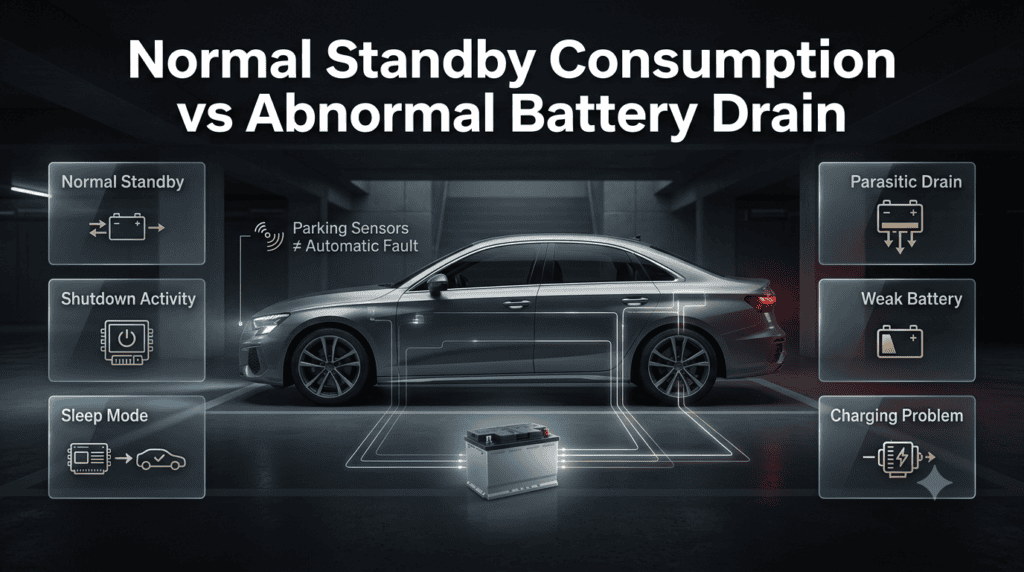
A parked vehicle will normally use a small amount of electricity. The battery must continue supplying power to certain essential electronic functions even when the engine is off.
This is different from a parasitic drain, where the vehicle consumes more electrical current than expected while parked.
| Condition | What it means |
|---|---|
| Normal standby consumption | Vehicle uses a small amount of electricity while parked |
| Temporary shutdown activity | Electronic modules remain active before entering sleep mode |
| Excessive standby consumption | One or more systems may not be shutting down correctly |
| Parasitic drain | Abnormal electrical consumption while the vehicle is supposed to be inactive |
| Weak battery | Battery has reduced capacity and cannot tolerate normal loads for as long |
| Charging problem | Battery is not being adequately replenished while driving |
This is why the statement “the parking sensors drained my battery” does not necessarily identify the actual fault.
The parking system may be involved, but another electronic component could be keeping the vehicle awake.
Why a Weak Battery Makes the Problem Worse
A battery does not have unlimited electrical reserve.
As a battery ages, its ability to store usable energy and deliver sufficient starting power can decline. A battery that was once capable of handling normal overnight parking may eventually struggle after the same parking period.
This creates an important relationship between battery health and electrical consumption.
Imagine two vehicles with similar standby electrical consumption. One has a healthy battery with good reserve capacity, while the other has an aging battery that has already lost a significant amount of its original capability.
The first vehicle may start normally after sitting overnight.
The second vehicle may struggle or fail to start.
The electrical consumption may be similar, but the battery condition changes the outcome.
This is why professional diagnosis should consider both battery health and parked electrical consumption rather than immediately assuming that one component is responsible.
How Dubai Heat Can Affect a Parked Battery
Dubai’s climate is an important part of the battery equation.
High temperatures can accelerate battery aging and increase the stress experienced by batteries installed in the engine compartment. A battery that has already experienced prolonged heat exposure may have less reserve capacity than its age alone would suggest.
The risk becomes more noticeable when several conditions occur together:
- High ambient temperatures
- Long periods of parking
- An aging battery
- Repeated short-distance driving
- Frequent electrical loads
- Insufficient charging time
- Abnormal standby consumption
For this reason, a battery that becomes discharged after parking should be evaluated in the context of the vehicle’s recent driving and operating conditions.
A professional Vehicle Inspection can help determine whether the problem is isolated to the battery or connected to a wider electrical or mechanical issue.
Does Parking Duration Matter?
Yes.
The longer a vehicle remains parked while consuming electricity, the greater the opportunity for the battery’s state of charge to decline.
But there is no universal number of hours that guarantees battery failure.
The result depends on:
- Battery capacity
- Battery age
- Battery state of charge
- Electrical consumption
- Ambient temperature
- Charging-system condition
- Vehicle electronics
- Previous driving pattern
A healthy battery may tolerate normal standby consumption for an extended period.
A weak battery may become incapable of starting the engine after a much shorter period.
| Parking situation | Main consideration |
|---|---|
| Several hours | Battery condition and normal standby load |
| Overnight parking | Battery reserve becomes more relevant |
| One or two days | Battery health and electrical consumption |
| Several days | Parasitic drain becomes increasingly important |
| Long-term parking | Battery condition, charging strategy and electrical isolation |
Therefore, parking duration alone cannot diagnose the cause of battery discharge.
Parking Sensors May Not Be the Only Electrical Load
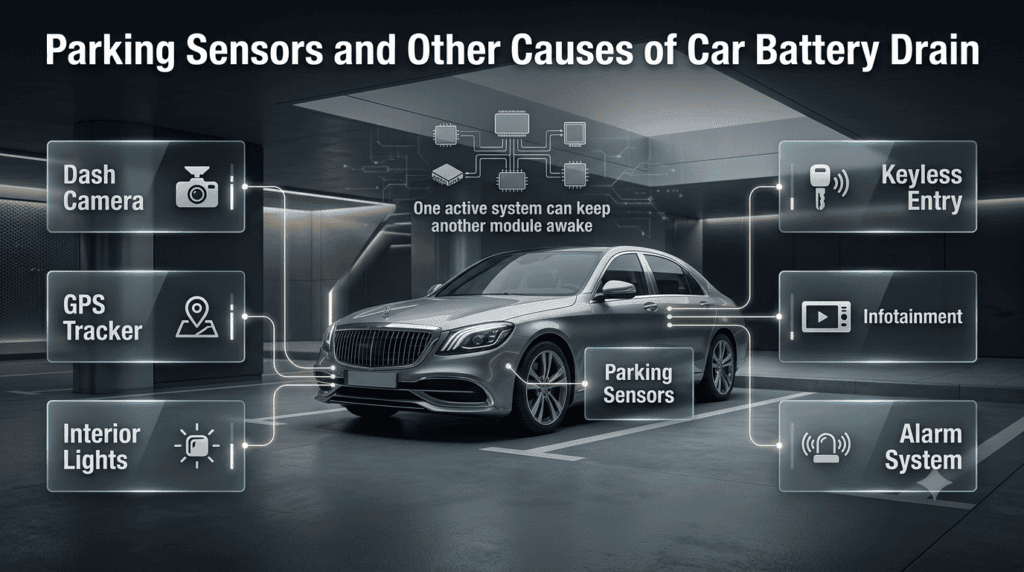
One of the biggest diagnostic mistakes is focusing exclusively on the parking sensors.
Modern vehicles contain many interconnected electronic systems. A fault somewhere else can prevent the vehicle from entering its normal sleep state.
For example, the parking system might communicate with another control module through the vehicle’s electronic network. If that communication remains active, another module could remain awake even though the parking sensors themselves are not continuously operating.
Other potential sources include:
Dash Cameras
A hardwired dash camera configured for parking surveillance can continue consuming electricity after the vehicle is locked.
Aftermarket Trackers
GPS trackers and security devices may consume additional power depending on how they are installed and configured.
Interior or Trunk Lights
A light that remains illuminated because of a faulty switch or latch can gradually reduce battery charge.
Keyless Entry
Modern proximity systems monitor for authorized keys. Their normal consumption is controlled, but abnormal operation can contribute to electrical drain.
Infotainment Equipment
Aftermarket multimedia systems may not always follow the vehicle’s original shutdown strategy.
Alarm Systems
A malfunctioning security system can keep electronic modules active or repeatedly wake them.
This broader perspective is essential when diagnosing a repeated parked-car battery failure.
Signs the Parking System May Not Be Shutting Down Correctly
A driver may notice several clues before the problem becomes severe.
Possible signs include:
- Parking display remains active after shutdown
- Parking camera stays operational
- Parking-related indicators remain illuminated
- Electronic clicking or activity continues unusually long
- Battery repeatedly becomes weak after parking
- Vehicle requires frequent jumpstarts
- Multiple warning lights appear after low voltage
- Central locking behaves differently than usual
- Parking-system faults appear in the vehicle’s diagnostic memory
These symptoms do not prove that the parking system is responsible.
Low battery voltage can itself cause unusual electronic behavior. Modern vehicles contain many interconnected control units, and unstable voltage can cause temporary warnings across systems that are not actually defective.
That is why proper diagnosis is more useful than replacing individual components based only on dashboard warnings.
Parking Sensor Fault vs Parasitic Drain
These terms are related but should not be confused.
A parking sensor fault means there is a problem with the parking-assistance system.
A parasitic drain means the vehicle is consuming excessive electrical current while it is supposed to be parked and in its low-power state.
A parking-system fault can potentially cause parasitic drain, but parasitic drain can originate from many other systems.
| Problem | Possible result |
|---|---|
| Faulty parking sensor | Parking system may malfunction |
| Faulty parking control module | System may remain active |
| Software/network problem | Vehicle may not enter sleep mode correctly |
| Aftermarket accessory | Additional battery consumption |
| Aging battery | Faster loss of starting capability |
| Alternator problem | Battery may not recover charge properly |
| Interior-light fault | Continuous electrical consumption |
This distinction helps a technician decide where testing should begin.
What Should Be Checked Before Replacing the Battery?
If the vehicle has become discharged after being parked with parking sensors active, a complete diagnosis should normally consider several areas.
Battery Condition
The battery should be checked for its current state of charge and starting capability.
Charging System
The alternator should be evaluated to determine whether the battery is being adequately charged while the engine is running.
Battery Connections
Loose, damaged, or heavily contaminated terminals can interfere with electrical performance.
Parking System
The parking sensors, cameras and related control modules should be checked for fault codes and abnormal behavior.
Resting Electrical Consumption
If the battery repeatedly discharges while the vehicle is parked, measuring the vehicle’s resting current can help identify abnormal electrical consumption.
Aftermarket Accessories
Any non-factory equipment should be considered during diagnosis.
This approach is more reliable than simply fitting another battery and hoping the problem disappears.
When Battery Replacement Is Actually Necessary
Battery replacement should be based on the battery’s condition rather than the fact that it became discharged once.
A battery can sometimes be recovered after an accidental discharge if the battery remains healthy. On the other hand, a battery that has significantly deteriorated may not regain reliable starting performance after being discharged.
Professional testing can help determine whether the battery should be replaced.
If replacement is necessary, the correct battery specification matters. Modern vehicles may require specific battery technologies such as AGM or EFB, particularly when equipped with start-stop systems and higher electrical demands.
For drivers researching different options, EuroSwift’s pages for AGM batteries and Exide batteries provide more focused information about those battery categories.
Similarly, battery selection may involve brands such as Bosch, Amaron, Panasonic, FIAMM, or AC Delco, depending on the vehicle’s required specification.
Professional Recommendation
If your battery discharged after leaving parking sensors active, avoid assuming that the battery itself has failed.
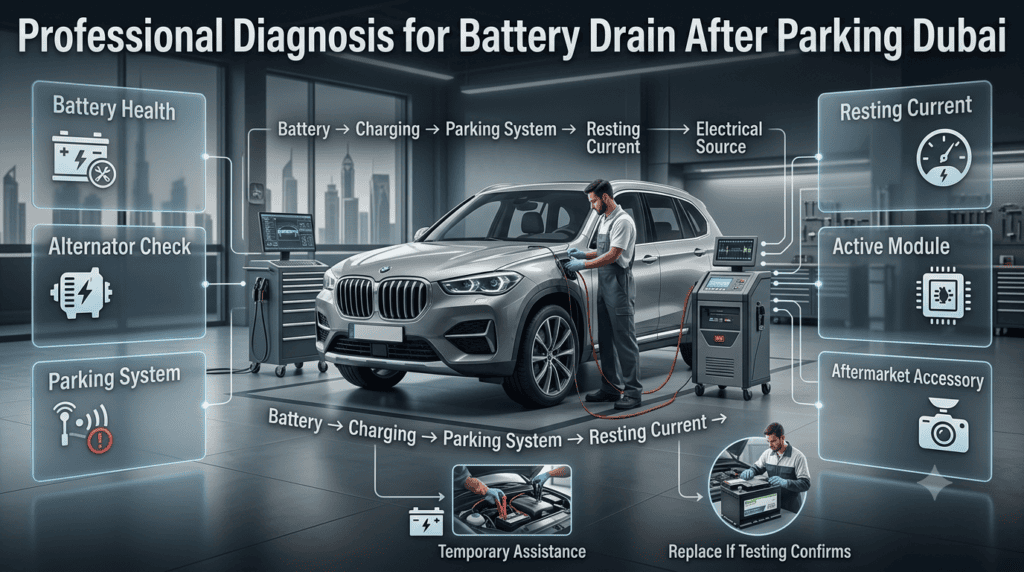
The correct diagnostic sequence is to determine:
- Whether the battery is still healthy
- Whether the alternator is charging correctly
- Whether the parking system is shutting down normally
- Whether another electronic module remains active
- Whether excessive resting current is present
- Whether an aftermarket accessory is contributing to the drain
If the battery has genuinely reached the end of its service life, car battery replacement in Dubai may be the appropriate solution.
If the battery tests healthy but repeatedly becomes discharged while parked, electrical diagnosis should come first.
And if the vehicle is already unable to start, a Car Jumpstart may restore temporary mobility, but repeated jumpstarts should not replace proper fault diagnosis.
How Technicians Determine Whether Parking Sensors Are Draining the Battery
When a vehicle repeatedly loses battery power after parking, the first objective is to establish whether there is actually an abnormal electrical drain.
A technician does not normally start by replacing the battery. The vehicle’s electrical behavior needs to be observed after the engine is switched off and the car has been given enough time for its electronic systems to shut down.
This is particularly important with modern vehicles because several control modules can remain active immediately after the ignition is switched off. Measuring electrical consumption too early can make normal shutdown activity appear to be a fault.
A professional diagnostic process may therefore include:
- Checking battery condition
- Checking charging voltage
- Inspecting battery terminals
- Scanning vehicle control modules
- Checking parking-system fault codes
- Allowing the vehicle to enter sleep mode
- Measuring resting electrical current
- Isolating abnormal circuits
- Inspecting aftermarket accessories
- Confirming the repair with another sleep-cycle test
This approach helps distinguish a genuine parking-system problem from a weak battery or another electrical fault.
What Is Vehicle Sleep Mode?
Vehicle sleep mode is the low-power condition that many electronic systems enter after the vehicle has been switched off and secured.
Modern cars contain numerous electronic control units. Keeping every system fully active while parked would place unnecessary demand on the battery, so manufacturers use power-management strategies to reduce consumption.
Depending on the vehicle, the shutdown process may involve:
- Ignition switched off
- Driver exits the vehicle
- Doors and trunk are closed
- Vehicle is locked
- Electronic modules complete their shutdown procedures
- Communication activity decreases
- Non-essential systems enter low-power operation
The exact sequence and timing vary by manufacturer.
A vehicle that does not reach its expected sleep condition can gradually lose battery charge if the unwanted electrical activity continues for a sufficiently long period.
This is why sleep-mode diagnosis is an important part of professional Vehicle Inspection.
Why Technicians Do Not Immediately Measure Current After Locking the Car
Immediately after switching off a vehicle, several electronic systems may still be active.
For example, the vehicle may:
- Save electronic settings
- Communicate between control modules
- Operate security functions
- Complete system shutdown
- Monitor doors and locks
- Process information from sensors
- Complete delayed electronic functions
Therefore, an immediate current measurement may show significantly more consumption than the vehicle should have after entering its low-power state.
A proper diagnostic procedure allows the vehicle to complete its normal shutdown sequence before evaluating resting electrical consumption.
The exact waiting period is vehicle-specific, so there is no universal number that should be applied to every car.
What Is a Parasitic Battery Drain Test?
A parasitic drain test is used to determine whether a vehicle is consuming excessive electrical current while it is parked.
The purpose is not simply to discover whether electricity is being used. Some standby consumption is normal.
The technician is trying to determine whether the vehicle’s resting electrical consumption is higher than expected for that particular vehicle.
A simplified diagnostic process looks like this:
Battery condition → vehicle shutdown → sleep mode → resting-current measurement → circuit isolation → fault identification
If abnormal consumption is confirmed, the technician can investigate which circuit or control module is responsible.
Possible sources may include:
- Parking assistance system
- Body control module
- Alarm system
- Infotainment equipment
- Interior lighting
- Dash camera
- GPS tracker
- Aftermarket accessories
- Door or trunk control
- Faulty electronic module
This makes parasitic-drain diagnosis considerably more useful than guessing which component caused the battery failure.
How a Parking-Sensor Module Can Become Relevant
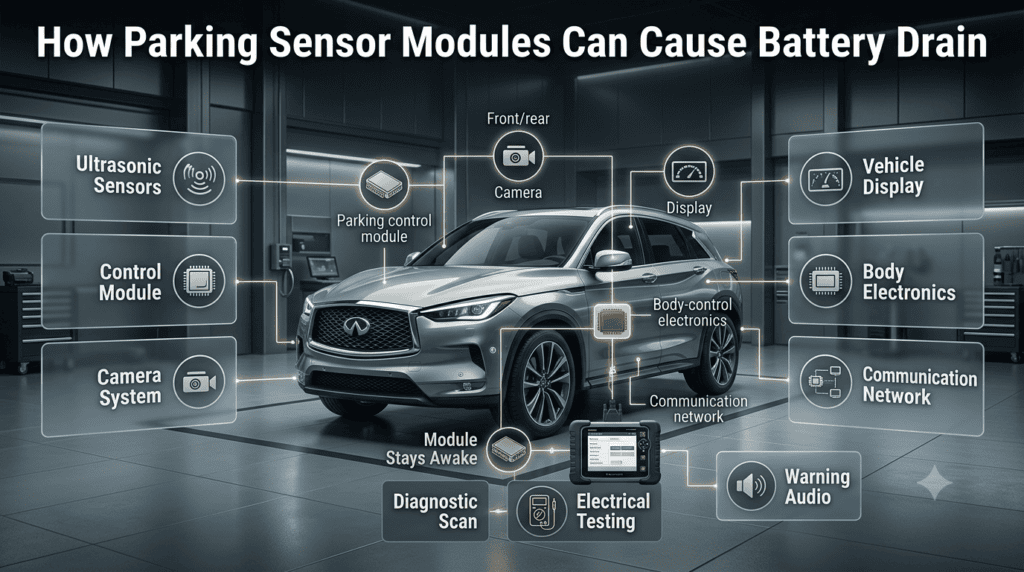
Parking sensors are usually part of a larger electronic system rather than completely independent devices.
Depending on the vehicle, the system may involve:
- Ultrasonic sensors
- Parking control module
- Rear or front camera
- Display
- Body control electronics
- Communication network
- Warning buzzer or audio system
If one part of this system develops an electrical or communication problem, the resulting behavior can extend beyond the sensor itself.
For example, a faulty module may fail to shut down correctly. A communication issue could also cause another control unit to remain awake.
This is why replacing an individual parking sensor without checking the complete system may not solve repeated battery discharge.
A diagnostic scan can help identify stored faults, but a scan alone does not always prove that a particular module is responsible for excessive battery consumption. Electrical measurements and system behavior still matter.
Battery Voltage Does Not Tell the Whole Story
Many drivers check battery voltage and assume that a single reading can determine battery health.
It cannot.
Voltage is useful, but battery condition involves more than voltage alone.
A battery can show an apparently reasonable voltage reading while still having insufficient capacity or starting performance.
Professional battery assessment may consider:
- Resting voltage
- State of charge
- Starting performance
- Conductance or capacity testing
- Battery age
- Previous discharge history
- Terminal condition
- Charging performance
This distinction is particularly important after a battery has been discharged.
A battery that has recently been charged may show an acceptable voltage while still being unable to provide dependable starting performance.
Therefore, if the vehicle repeatedly develops a flat battery after parking, a proper battery test is more useful than relying only on a dashboard voltage display or inexpensive voltmeter.
Why the Alternator Should Also Be Tested
The alternator is responsible for supplying electrical power while the engine is running and helping replenish the battery.
If the charging system is not functioning correctly, a battery may appear to be suffering from a parking-related drain even when the actual problem is inadequate charging.
For example, a vehicle may make several short trips during the week. The battery may lose some charge during starting and normal electrical operation, but the driving pattern may not provide enough opportunity for the charging system to restore the battery fully.
If an electrical drain then occurs while parked, the battery may become too weak to start the vehicle.
This creates a situation where:
Low charging reserve + parked electrical consumption + battery aging = increased starting-failure risk
A charging-system inspection should therefore form part of repeated battery-discharge diagnosis.
Short Trips Can Make a Parking Problem Look Worse
Short-distance driving is common in urban environments.
A vehicle may be started, driven for a short distance, parked, and then started again later. Every engine start requires electrical energy from the battery.
If the vehicle is not driven long enough under appropriate conditions for the charging system to replenish the energy used, the battery can gradually operate with a reduced state of charge.
Now add:
- High ambient temperatures
- An aging battery
- Parking for several hours
- Electrical accessories
- Abnormal standby consumption
The battery may eventually become too weak to start the vehicle.
This means the driver may correctly notice that the battery failed after parking, while the underlying cause developed over several days or weeks.
How to Tell a Weak Battery From a Parasitic Drain
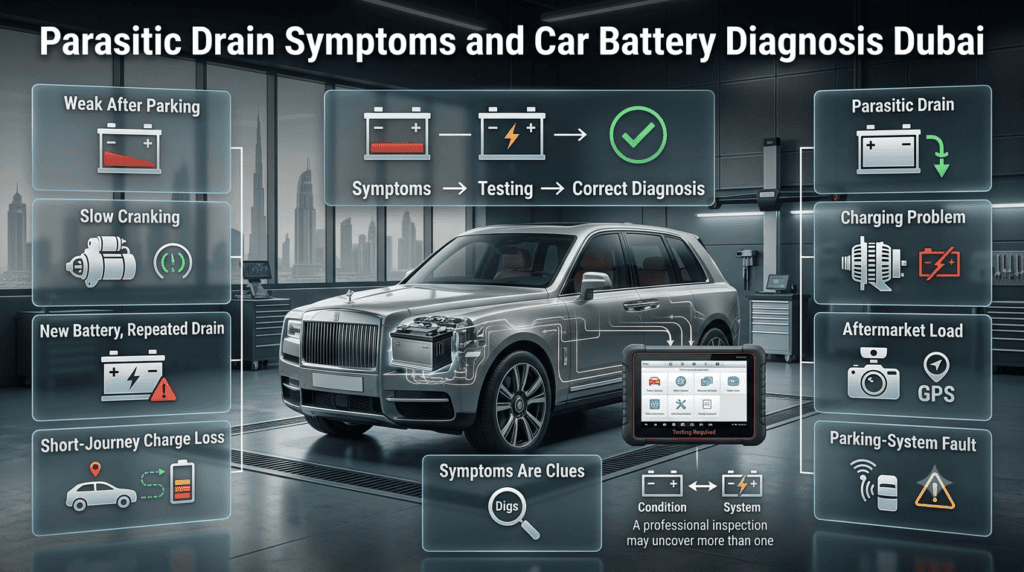
The symptoms can overlap, which is why testing matters.
| Symptom | More likely area to investigate |
|---|---|
| Battery becomes weak after a long parking period but tests poorly | Battery condition |
| Battery repeatedly discharges despite being relatively new | Electrical drain |
| Vehicle starts normally after driving but fails after parking | Battery and resting-current diagnosis |
| Slow cranking before the parked failure | Battery or starting system |
| Battery tests healthy but repeatedly goes flat | Parasitic drain |
| Battery repeatedly loses charge after short journeys | Charging/driving pattern |
| Multiple accessories were recently installed | Aftermarket electrical load |
| Parking system remains active unusually long | Parking-system diagnosis |
These are diagnostic clues rather than absolute rules.
A professional inspection may uncover more than one problem at the same time.
Aftermarket Parking Sensors Require Extra Attention
Factory-installed parking systems are designed around the vehicle’s electrical architecture.
Aftermarket systems can vary significantly in installation quality, wiring method and power-management behavior.
A poorly integrated system may:
- Receive power continuously
- Use an unsuitable power source
- Remain active after the vehicle is locked
- Interfere with another circuit
- Prevent normal shutdown
- Have damaged wiring
- Develop a faulty control module
This is especially relevant when the battery problem started after an accessory was installed.
If the vehicle never had battery problems before a parking sensor, camera, tracker or other accessory was fitted, that installation should be included in the diagnostic investigation.
What About Parking Cameras?
Parking cameras can create a similar diagnostic situation.
A factory camera normally operates according to the vehicle’s electronic control strategy. But an aftermarket camera or recording system may remain active after the vehicle is parked.
Some systems also include parking surveillance functions that intentionally keep the camera operating while the vehicle is unattended.
That is different from a malfunctioning system.
The question becomes:
Is the device operating as designed, or is it consuming more power than the vehicle’s battery can reasonably support during the intended parking period?
If a parking camera is hardwired to the vehicle, its power-management configuration should be checked.
A Practical Overnight Battery-Drain Checklist
If the vehicle is repeatedly dead the following morning, record what happened before assuming the battery needs replacement.
Before Parking
Check whether:
- The vehicle starts normally
- The engine cranks at normal speed
- Any battery warning appeared
- Parking sensors operate normally
- Any new electrical accessories were installed
After Parking
Observe whether:
- Parking displays switch off
- Cameras shut down normally
- Interior lights turn off
- The vehicle locks correctly
- Unusual electrical sounds continue
- Warning indicators remain active
The Next Morning
Record:
- Whether the vehicle starts
- Whether cranking is slow
- Whether electronic systems reset
- Whether warning messages appear
- Whether the battery requires a jumpstart
This information can help a technician reproduce the problem more efficiently.
What Happens During Professional Electrical Diagnosis?
A professional technician may approach the problem in stages rather than replacing parts immediately.
Stage 1: Visual Inspection
The battery, terminals, wiring, fuses and visible electrical accessories are inspected.
Stage 2: Battery Testing
The battery’s state of charge and starting capability are assessed.
Stage 3: Charging-System Testing
The alternator and charging system are checked.
Stage 4: Diagnostic Scan
Vehicle modules are scanned for relevant stored fault codes.
Stage 5: Shutdown Observation
The vehicle is allowed to complete its normal shutdown process.
Stage 6: Resting-Current Testing
Electrical consumption is evaluated after the vehicle reaches the appropriate low-power state.
Stage 7: Circuit Isolation
If abnormal consumption is confirmed, the responsible circuit or system can be investigated.
Stage 8: Repair Verification
The vehicle is tested again to confirm that the abnormal condition has been resolved.
This systematic approach reduces unnecessary parts replacement.
When a Jumpstart Is Enough — and When It Is Not
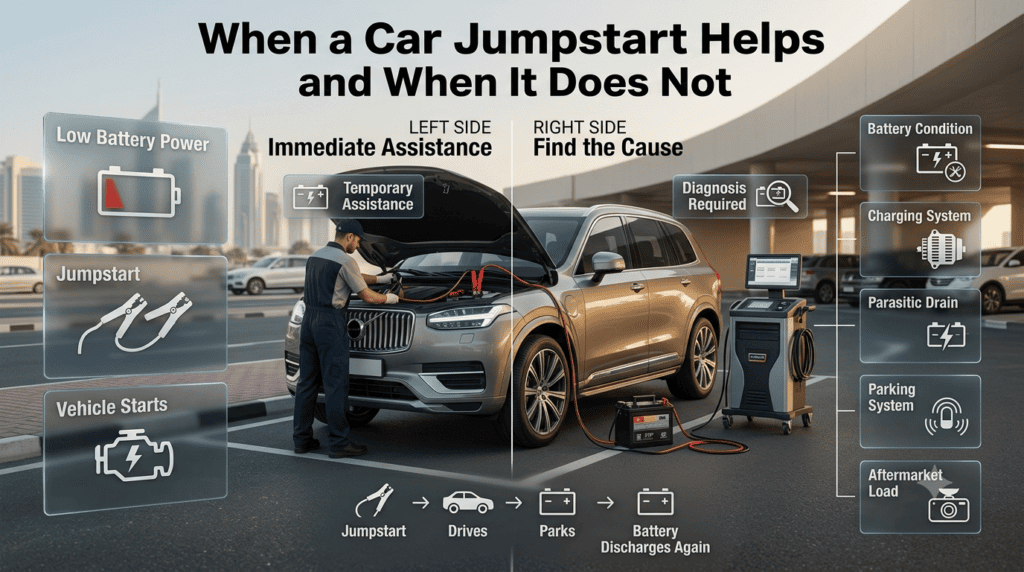
A jumpstart can be useful when the immediate problem is simply that the battery does not have enough power to start the engine.
However, a jumpstart does not diagnose why the battery became discharged.
If the vehicle starts normally after a jump and then develops the same problem again after parking, repeating the jumpstart is not a long-term solution.
In that situation, the vehicle should be checked for:
- Battery deterioration
- Charging-system problems
- Parasitic drain
- Parking-system faults
- Aftermarket electrical consumption
For emergency situations, EuroSwift Auto Services can be relevant when the vehicle requires roadside assistance or battery-related support in Dubai.
When Should You Consider a New Battery?
Battery replacement becomes more likely when testing shows that the battery has lost significant capacity or cannot reliably provide the required starting performance.
The decision should consider:
- Battery test results
- Battery age
- Previous discharge events
- Vehicle requirements
- Charging-system condition
- Frequency of battery failures
- Whether abnormal electrical consumption has been eliminated
If the battery has been repeatedly discharged because of an unresolved electrical fault, installing a new battery before fixing that fault can expose the replacement battery to the same problem.
For drivers comparing costs before making a decision, the car battery prices in Dubai guide can help explain the factors that influence replacement pricing.
How to Prevent Parking-Related Battery Problems
Prevention starts with reducing unnecessary electrical load and identifying battery weakness before a complete failure occurs.
Useful practices include:
- Avoid leaving electrical accessories unnecessarily active
- Check aftermarket equipment installations
- Have repeated battery discharge investigated
- Monitor slow or unusual engine cranking
- Maintain the vehicle’s recommended service schedule
- Check charging performance when battery problems repeat
- Have the electrical system inspected after unexplained overnight discharge
- Replace an unsuitable or deteriorated battery when testing confirms the need
For vehicles with higher electrical demands, correct battery specification is particularly important.
A modern vehicle may require an AGM or EFB battery rather than a basic conventional battery, depending on its original equipment requirements.
Expert Insight: Do Not Diagnose the Cause From One Event
One battery discharge does not necessarily prove that a parking sensor caused the problem.
A vehicle can become difficult to start after parking because the battery was already weak, the vehicle was insufficiently charged, an accessory remained active, or several small factors combined.
The strongest diagnosis comes from looking at the pattern.
If the battery repeatedly becomes discharged after similar parking periods, the pattern provides a reason to investigate resting electrical consumption and battery condition.
If the vehicle had slow cranking for weeks before the incident, battery deterioration becomes more significant.
If the problem began immediately after an electrical accessory was installed, that installation deserves attention.
If the battery is healthy but the vehicle consistently loses charge while parked, parasitic-drain testing becomes increasingly important.
Dubai-Specific Considerations for Long Parking
Dubai drivers may encounter situations where vehicles remain parked for longer periods than expected, particularly when travelling, working remotely, leaving a vehicle at home, or using a second vehicle less frequently.
During extended parking, the battery gradually supplies the vehicle’s standby electronics.
A weak battery may therefore become noticeable only when the vehicle is left unused for longer than its normal routine.
Before extended parking, it is sensible to consider:
| Check | Why it matters |
|---|---|
| Battery condition | Determines available reserve |
| Charging system | Ensures the battery is being replenished correctly |
| Electrical accessories | Identifies unnecessary continuous loads |
| Parking system | Confirms normal shutdown |
| Battery terminals | Reduces risk of poor electrical connection |
| Vehicle condition | Helps identify existing warning signs |
This preventive approach is particularly useful when the vehicle will remain parked for several days in Dubai’s hot climate.
Professional Recommendation for Repeated Battery Discharge
If your vehicle repeatedly becomes discharged after parking, treat the problem as an electrical diagnosis issue rather than simply a battery replacement issue.
Start with the battery and charging system. Then determine whether the vehicle is reaching its expected sleep state. If it is not, investigate the parking system, body electronics, aftermarket accessories and other possible circuits.
If testing confirms that the battery itself has deteriorated, replacement is appropriate. Depending on the vehicle specification, options may include Bosch battery replacement, Amaron battery replacement, Exide battery replacement, Panasonic battery replacement, FIAMM battery replacement, or AC Delco battery replacement, provided the selected battery matches the vehicle’s required specification.
The objective should always be the same: find the reason for the discharge, correct the underlying problem, and ensure the vehicle can reliably start after normal parking.
What We Have Established So Far
A battery that becomes discharged after parking with parking sensors active can result from several different conditions.
The most important diagnostic possibilities are:
- Parking system not entering its expected low-power state
- Faulty parking-control module
- Another vehicle module preventing sleep mode
- Aftermarket parking equipment
- Weak or aging battery
- Poor charging performance
- Repeated short-distance driving
- Another parasitic electrical load
Can leaving parking sensors active drain a car battery in Dubai?
Parking sensors can contribute to battery discharge if the system remains powered when the vehicle should have entered its normal low-power state. However, simply using the parking sensors before switching the engine off does not normally mean they will continuously drain a healthy battery. Modern vehicles are designed to shut down non-essential electronic systems after the car is parked and locked.
If the battery becomes discharged after parking, the more useful question is whether the parking system actually switched off or whether another electronic module remained active. A weak battery can make the situation worse because it has less reserve capacity to tolerate even a relatively small abnormal electrical load.
In Dubai, high temperatures can also accelerate battery aging, so a battery that already has reduced capacity may show the problem sooner than expected.
Important points:
Normal parking-sensor operation should not usually flatten a healthy battery by itself.
A faulty parking module can potentially contribute to parasitic drain.
An aging battery is more vulnerable to prolonged electrical consumption.
Aftermarket parking sensors and cameras deserve additional attention.
Repeated discharge should be diagnosed rather than solved with repeated jumpstarts.
Why does my car battery die overnight after using the parking sensors?
If the battery is dead after the vehicle has been parked overnight, the parking sensors may be involved, but they should not automatically be considered the cause. A modern vehicle can have several electronic systems operating after the engine is switched off, and normally these systems gradually enter a low-power sleep state.
If a parking-control module, camera, body-control unit, alarm, dash camera, tracker, or another accessory remains active, the battery can continue losing charge throughout the night. The condition becomes more noticeable if the battery was already partially discharged or had lost capacity because of age and heat exposure.
A proper diagnosis checks whether the vehicle reaches its expected sleep state and whether excessive resting electrical current continues after shutdown.
What should be checked:
Battery health and state of charge
Alternator charging performance
Parking-sensor control module
Parking cameras and aftermarket equipment
Interior and trunk lights
Alarm and security systems
Resting electrical current after the vehicle enters sleep mode
If the battery repeatedly dies overnight, replacing the battery without checking for abnormal electrical consumption may not solve the problem.
How can I tell if parking sensors are causing a parasitic battery drain?
You generally cannot confirm a parasitic drain simply by looking at the parking sensors or checking battery voltage. The vehicle needs to be assessed after it has completed its normal shutdown process.
A technician can inspect the parking system for stored faults and observe whether the relevant electronics shut down correctly. If the vehicle continues consuming more electrical current than expected after entering its low-power state, the next step is to identify which circuit or module is responsible.
This is particularly important with modern vehicles because several modules communicate with each other. A problem associated with the parking system could sometimes keep another electronic module awake.
Signs that deserve investigation:
Battery repeatedly becomes weak after parking.
Parking display or camera remains active unusually long.
Electronic activity continues after the vehicle is locked.
The problem started after installing aftermarket equipment.
A healthy battery repeatedly loses charge while parked.
The vehicle develops multiple electronic warnings after a low-voltage event.
The strongest diagnosis comes from combining battery testing, charging-system testing, diagnostic scanning and resting-current testing, rather than blaming one component from the beginning.
Should I replace my car battery if it discharged after leaving the parking sensors active?
Not necessarily. A single discharge does not automatically mean the battery has reached the end of its service life.
A healthy battery can sometimes recover after an accidental discharge, depending on how deeply it was discharged and its existing condition. An older battery, however, may have already lost substantial capacity, and a deep discharge can make an existing weakness more noticeable.
The correct decision should be based on battery testing. The charging system and possible electrical drain should also be checked, particularly if the problem happens repeatedly.
For example, installing a new battery will not permanently solve the problem if a faulty parking module or another electrical circuit continues consuming excessive current while the vehicle is parked.
Before replacing the battery, consider:
Battery age and previous performance
Battery capacity or conductance test
Starting performance
Alternator output
Repeated discharge history
Resting electrical consumption
Aftermarket electrical accessories
Correct battery specification for the vehicle
If testing confirms that the battery has deteriorated, professional car battery replacement in Dubai becomes the appropriate solution rather than repeatedly recharging or jumpstarting the same weak battery.
How can I prevent my car battery from draining while parked in Dubai?
The best prevention is not simply switching the parking sensors off manually. The vehicle’s electrical system should be operating correctly so that the parking system and other electronic modules enter their intended low-power state automatically.
For Dubai vehicles, battery condition is particularly important because prolonged exposure to high temperatures can accelerate battery aging. If the car is also used mainly for short journeys or left parked for extended periods, the battery may have less reserve available when an electrical load remains active.
If your vehicle has aftermarket parking sensors, cameras, dash cameras or tracking equipment, their power-management setup should also be checked.
Good preventive practices include:
Have a weak or repeatedly discharged battery tested.
Check the charging system when battery problems recur.
Inspect aftermarket electrical accessories.
Investigate repeated overnight battery discharge.
Do not rely on repeated jumpstarts as a permanent solution.
Check that parking cameras and displays shut down normally.
Have abnormal electrical consumption professionally diagnosed.
Use the correct battery technology and specification for the vehicle.
If replacement is required, battery choice should be based on the vehicle manufacturer’s requirements rather than price alone. Depending on the vehicle, this could mean an AGM, EFB or conventional battery. A properly matched battery combined with a healthy charging and electrical system provides much better reliability during Dubai’s demanding climate.
Conclusion
A battery discharged after leaving parking sensors active in Dubai is not always a straightforward battery failure. In many cases, the parking system may only be one part of a larger electrical issue. A control module that does not enter sleep mode, an aftermarket parking camera, a weak battery, poor charging performance, or another parasitic electrical load can all contribute to the problem.
Dubai’s high temperatures make battery condition even more important. A battery that has already lost capacity may not tolerate extended parking or additional electrical consumption as well as a healthy battery. That is why repeatedly jumpstarting the vehicle or immediately installing a new battery may not address the real cause.
The better approach is to diagnose the complete system: test the battery, verify alternator performance, inspect the parking system, check aftermarket accessories, and measure resting electrical consumption when necessary. If testing confirms that the battery has deteriorated, the correct car battery replacement service should be selected according to the vehicle’s specifications.
For drivers dealing with repeated battery discharge, professional diagnosis from EuroSwift Auto Services can help separate a genuine battery problem from an electrical drain. The objective is not simply to make the car start again—it is to make sure the vehicle remains reliable the next time it is parked.
Leave a Reply