
Introduction
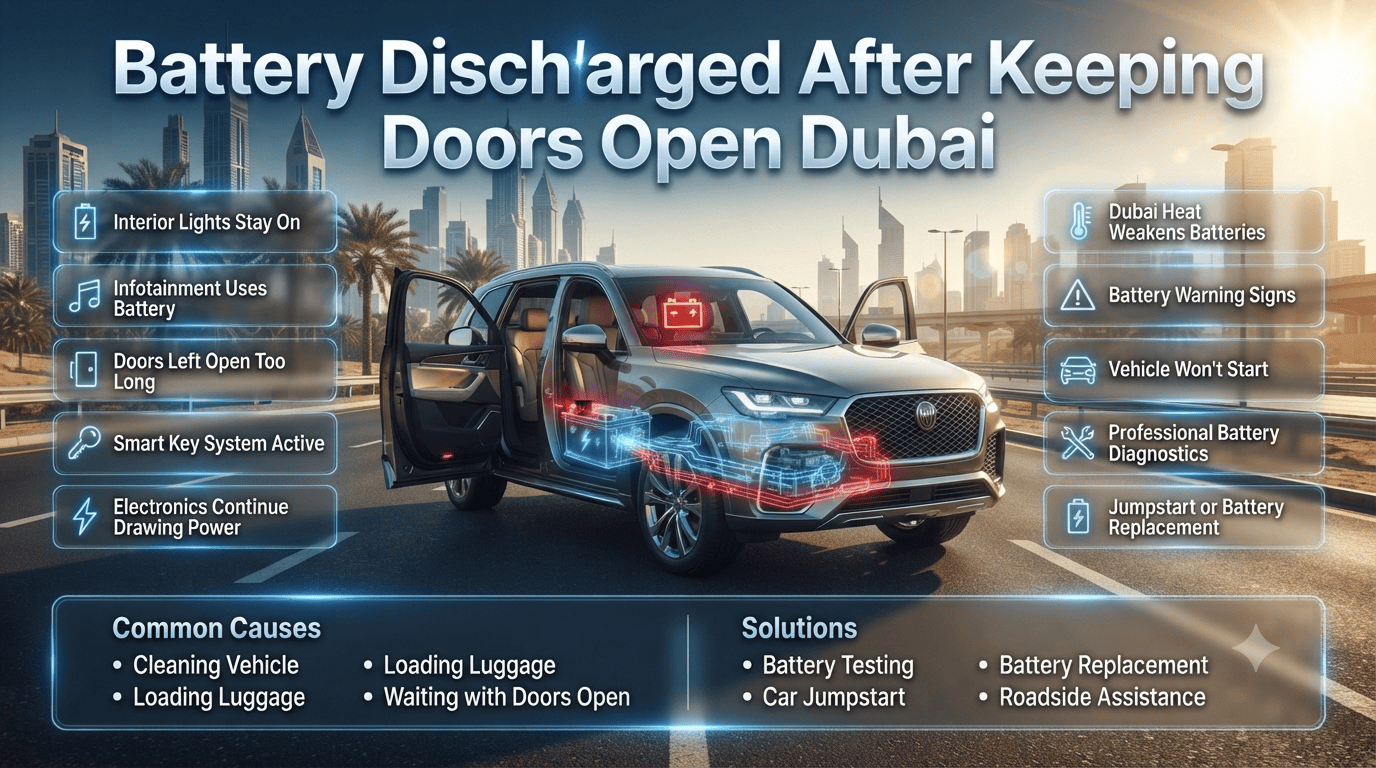
Fastest Premium & Genuine Battery Discharged After Keeping Doors Open Dubai | A battery discharged after keeping doors open Dubai is a common issue that can leave drivers stranded without warning, particularly during the UAE’s extreme summer months. While many people believe the battery only supplies power when the engine is running, modern vehicles continue to consume electricity whenever a door remains open. Interior lights, infotainment systems, body control modules, smart key receivers, and multiple electronic control units stay active, gradually draining the battery.
Dubai’s hot climate further accelerates battery deterioration by reducing its reserve capacity and increasing internal wear. If the battery is already weakened by age or constant exposure to high temperatures, leaving the doors open while cleaning the car, loading luggage, or waiting with passengers can quickly result in a no-start condition.
Understanding why this happens, recognizing the early warning signs, and taking preventive measures can save both time and money. If your vehicle experiences a discharged battery, professional diagnosis is essential to determine whether it simply needs a recharge, a Car Jumpstart, or a complete Battery Replacement. At EuroSwift Auto Services, experienced technicians provide fast on-site diagnostics, battery testing, installation, and roadside assistance across Dubai to help drivers get back on the road safely.
Why Does Keeping Car Doors Open Drain the Battery?
Modern vehicles are packed with sophisticated electronics that continue operating long after the engine has been switched off. Opening a door signals several control modules to remain awake, preventing the vehicle from entering its low-power sleep mode.
Instead of powering only the interior light, today’s vehicles activate numerous electronic components simultaneously, each drawing a small amount of current. While the individual power consumption is minimal, prolonged usage can significantly reduce the battery’s charge.
Vehicle Systems That Continue Using Battery Power
- Interior dome and courtesy lights
- Ambient cabin lighting
- Digital instrument cluster
- Infotainment system standby mode
- Smart key detection system
- Security alarm modules
- Body Control Module (BCM)
- CAN Bus communication network
- Power seat memory functions
- Electric steering lock
- Door control modules
- USB charging ports
- Climate control electronics
The longer these systems remain active, the more battery capacity is consumed.
How Modern Vehicle Electronics Affect Battery Life
Older vehicles relied on basic electrical systems, but modern cars contain dozens of Electronic Control Units (ECUs) that constantly communicate through high-speed networks.
Whenever a door is opened, these ECUs begin exchanging data to monitor door status, security functions, lighting, keyless entry, and comfort features. As long as the vehicle detects activity, many modules stay awake instead of shutting down completely.
Luxury vehicles are especially vulnerable because they include advanced features such as:
- Digital dashboards
- Premium sound systems
- Adaptive ambient lighting
- Automatic seat adjustment
- Wireless phone connectivity
- Remote vehicle monitoring
- Powered tailgates
- Intelligent climate control
This explains why premium European vehicles often experience faster battery discharge than economy models when left with doors open for an extended period.
Why Dubai’s Extreme Heat Makes Battery Discharge Worse
Dubai’s climate is one of the toughest environments for automotive batteries. High temperatures accelerate the chemical reactions inside the battery, leading to faster degradation of internal components and reduced overall capacity.
Even if your battery appears to be functioning normally, prolonged exposure to temperatures above 45°C can shorten its lifespan considerably. A battery with reduced reserve capacity will discharge much faster when electrical accessories continue drawing power.
Common Dubai Conditions That Increase Battery Drain
- Parking under direct sunlight
- Heavy air-conditioner usage
- Stop-and-go city traffic
- Frequent short trips
- Long periods without driving
- High electrical demand from luxury vehicle features
For this reason, many automotive professionals recommend installing high-quality batteries designed for hot climates, such as AGM Battery solutions for vehicles with advanced electrical systems.
Everyday Situations That Can Leave Your Battery Discharged
Battery discharge often happens during normal daily activities rather than because of a mechanical failure.
Cleaning the Vehicle
Leaving every door open while vacuuming or detailing the interior allows multiple electronic systems to remain active for an extended period.
Loading Luggage
Families preparing for airport travel frequently leave the tailgate and doors open while organizing bags, causing unnecessary battery drain.
Waiting Inside the Car
Listening to music, charging mobile devices, or using the infotainment system without the engine running gradually reduces battery voltage.
Installing Child Seats
Repeatedly opening and closing doors while fitting child safety seats can keep the Body Control Module active longer than expected.
Vehicle Inspection or Photography
Insurance inspections, dealership photography, and pre-sale evaluations often require doors to remain open for long periods.
Which Vehicles Are More Likely to Experience Battery Drain?
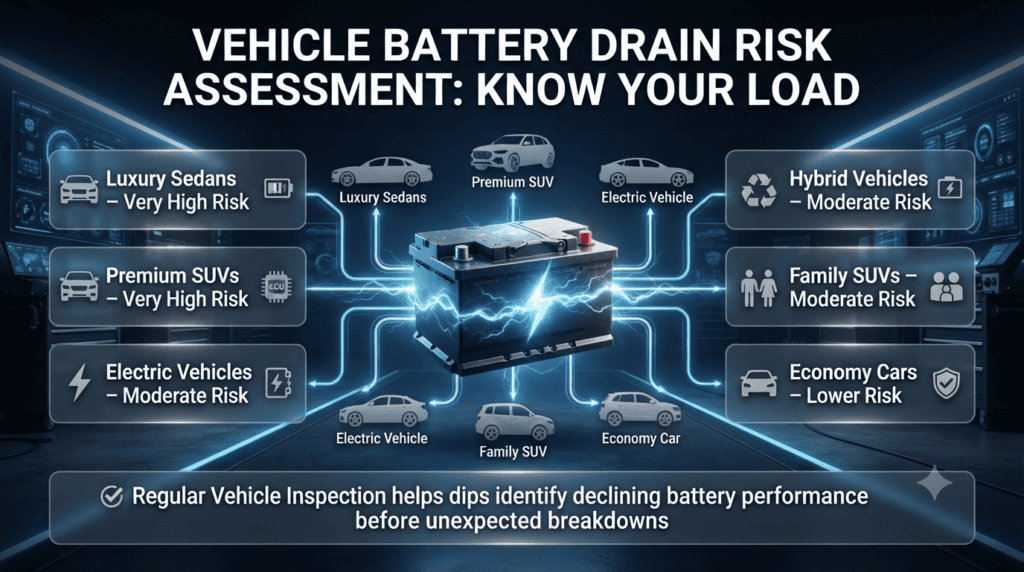
Although every vehicle uses battery power when the doors are open, certain vehicles consume significantly more electricity because of their advanced technology.
| Vehicle Category | Battery Drain Risk | Reason |
|---|---|---|
| Luxury Sedans | Very High | Multiple ECUs and comfort systems |
| Premium SUVs | Very High | Advanced electronics and powered accessories |
| Electric Vehicles | Moderate | Auxiliary 12V battery powers electronics |
| Hybrid Vehicles | Moderate | Numerous electronic control modules |
| Family SUVs | Moderate | Multiple interior lighting circuits |
| Economy Cars | Lower | Simpler electrical systems |
Regular Vehicle Inspection helps identify declining battery performance before it causes an unexpected breakdown.
Early Warning Signs of a Discharged Battery
A battery rarely fails instantly. In most cases, it gives several warning signs before becoming completely discharged.
Watch for These Symptoms
✔ Slow engine cranking
✔ Clicking sound when turning the key
✔ Dim interior lighting
✔ Weak dashboard illumination
✔ Slow-moving power windows
✔ Infotainment system restarting unexpectedly
✔ Battery warning light appearing
✔ Auto start-stop system no longer functioning
✔ Intermittent smart key detection
✔ Vehicle refusing to start after remaining parked
Ignoring these symptoms increases the risk of requiring emergency Roadside Assistance instead of a simple battery inspection.
Warning Signs and Recommended Action
| Warning Sign | Possible Cause | Professional Recommendation |
|---|---|---|
| Slow engine crank | Battery losing charge | Perform battery load testing |
| Clicking during ignition | Low battery voltage | Inspect charging system |
| Dim cabin lights | Reduced battery capacity | Check battery health |
| Dashboard resets | Voltage fluctuations | Complete electrical diagnostics |
| Vehicle will not start | Fully discharged battery | Car Jumpstart followed by battery evaluation |
| Battery warning light | Charging system issue | Inspect alternator and battery together |
Expert Insight: A Discharged Battery Doesn’t Always Mean Replacement
Many drivers assume that a discharged battery automatically needs replacing, but this isn’t always the case. A healthy battery that has been accidentally drained after leaving the doors open may simply require professional recharging and testing.
Experienced technicians first perform a comprehensive diagnostic procedure before recommending a new battery. This includes:
- Battery voltage testing
- Cold Cranking Amps (CCA) testing
- Battery load testing
- Alternator charging output inspection
- Starter motor evaluation
- Terminal corrosion inspection
- Parasitic current draw testing
- Electronic system diagnostics
If the battery no longer meets manufacturer specifications, replacing it with a high-quality option such as Bosch Battery, Amaron Battery, Exide Battery, Panasonic Battery, FIAMM Battery, AC Delco Battery, or Tuflong Battery ensures dependable performance in Dubai’s demanding climate.
Professional Recommendation
If your battery becomes discharged after keeping the doors open, avoid repeatedly attempting to start the engine. Multiple failed start attempts place additional strain on both the battery and the starter motor.
Instead:
- Check whether interior lights were left on.
- Turn off unnecessary electrical accessories.
- Request a professional battery test.
- Verify alternator charging performance.
- Inspect battery terminals for corrosion.
- Replace the battery only after confirming it has reached the end of its service life.
If you’re unsure whether your battery is still healthy or want to compare replacement options and pricing, the Complete Guide to Car Battery Prices in Dubai 2026 provides helpful information on battery types, brands, and cost factors before making a decision.
How Long Can a Car Battery Last If the Doors Are Left Open?
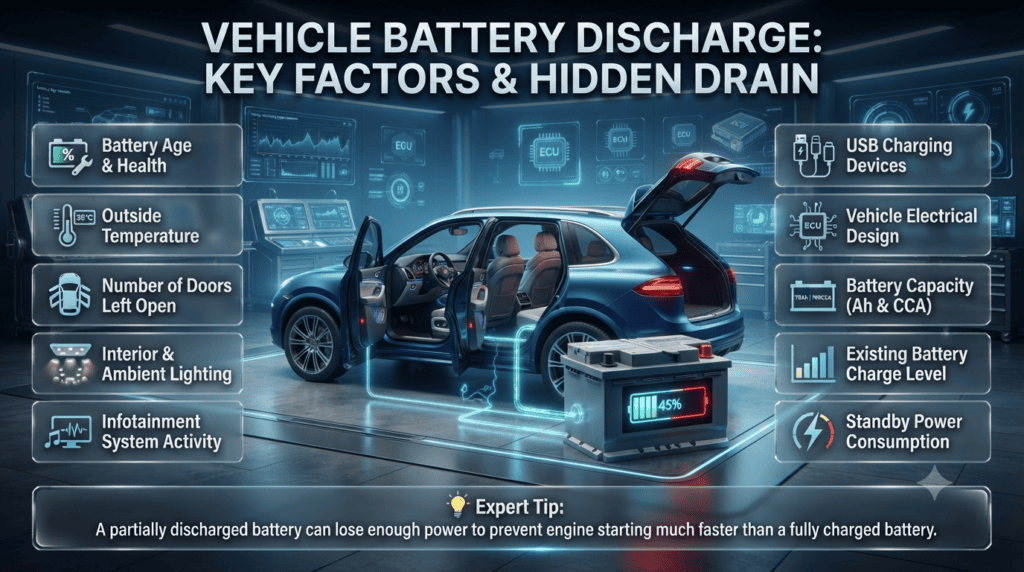
There is no single answer because battery discharge depends on several factors, including the battery’s age, vehicle electronics, outside temperature, and how many electrical accessories remain active. A newer battery with a full charge can tolerate longer periods, while an older battery exposed to Dubai’s heat may struggle after a much shorter time.
Vehicles equipped with keyless entry, premium infotainment systems, ambient lighting, powered tailgates, and numerous Electronic Control Units (ECUs) generally consume more standby power than basic models.
Factors That Affect Battery Discharge Time
- Battery age and overall health
- Outside temperature
- Number of doors left open
- Interior and ambient lighting
- Infotainment system activity
- USB charging devices
- Vehicle electrical design
- Battery capacity (Ah and CCA)
- Existing battery charge level
Expert Tip: A battery that is already partially discharged can lose enough power to prevent engine starting much faster than a fully charged battery.
What Happens Inside the Battery During Discharge?
Every automotive battery stores electrical energy through a chemical reaction between lead plates and electrolyte. As electrical components consume power, the battery converts chemical energy into electricity.
When the discharge continues for an extended period without the alternator recharging the battery, its voltage gradually drops. If the voltage falls too low, the starter motor may no longer receive enough power to crank the engine.
Repeated deep discharges can also accelerate:
- Sulfation of battery plates
- Loss of battery capacity
- Reduced Cold Cranking Amps (CCA)
- Shorter overall battery lifespan
- Internal battery damage
This is one reason automotive professionals recommend testing a deeply discharged battery before placing it back into regular service.
Common Causes of Battery Discharge After Leaving Doors Open
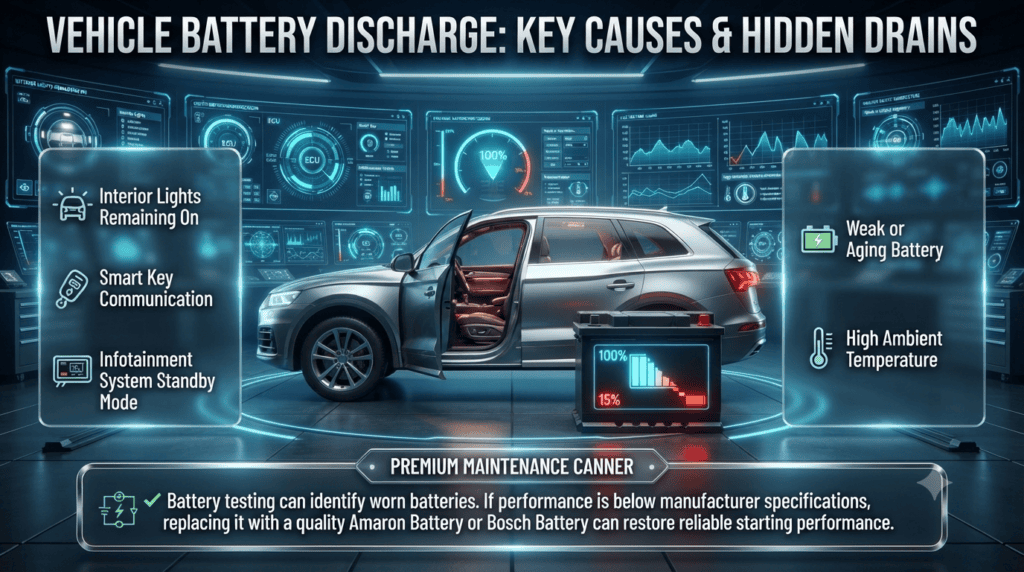
Although open doors trigger battery drain, additional underlying factors often make the problem worse.
1. Interior Lights Remaining On
Many vehicles automatically switch off cabin lights after a certain period. However, this feature varies by manufacturer, and some lights may continue operating much longer than expected.
2. Smart Key Communication
Vehicles equipped with passive keyless entry continuously search for the key fob while doors remain open, creating a constant electrical load.
3. Infotainment System Standby Mode
Large touchscreen displays, navigation systems, Bluetooth modules, and premium audio amplifiers may remain partially powered even after the engine has been switched off.
4. Weak or Aging Battery
A battery nearing the end of its service life has significantly less reserve capacity, making it much easier to discharge.
If testing confirms the battery is no longer performing within manufacturer specifications, replacing it with a quality option such as an Amaron Battery or Bosch Battery can restore reliable starting performance.
5. High Ambient Temperature
Extreme heat increases battery wear throughout the year, reducing its ability to recover after repeated discharge cycles.
Battery Voltage Guide: What the Numbers Mean
Battery voltage provides valuable information about the battery’s condition. However, voltage should always be interpreted alongside professional load testing for an accurate diagnosis.
| Battery Voltage | Battery Condition | Recommended Action |
|---|---|---|
| 12.6V – 12.8V | Fully charged | No action required |
| 12.4V – 12.5V | Good condition | Monitor battery health |
| 12.2V – 12.3V | Partially discharged | Recharge and test |
| 12.0V – 12.1V | Low charge | Professional inspection recommended |
| Below 12.0V | Deeply discharged | Diagnostic testing before reuse |
| Below 11.8V | Severe discharge | Battery may require replacement |
Professional Note: Voltage alone does not determine battery health. A battery may show acceptable voltage while still failing a load test due to reduced capacity.
Professional Battery Inspection Process
A professional technician does far more than simply connect a charger. The goal is to identify the root cause of the discharge and confirm that the entire charging system is operating correctly.
Step 1: Visual Inspection
The technician checks:
- Battery case condition
- Terminal corrosion
- Loose connections
- Cable damage
- Electrolyte leakage
- Battery mounting security
Step 2: Battery Voltage Test
Using a digital tester, the technician measures the battery’s resting voltage to determine its current state of charge.
Step 3: Battery Load Test
A controlled electrical load is applied to evaluate whether the battery can maintain sufficient voltage under starting conditions.
Step 4: Alternator Output Test
The charging system is tested to confirm the alternator is supplying the correct charging voltage after the engine starts.
Step 5: Starter System Evaluation
If the battery passes testing, attention shifts to the starter motor and associated wiring.
Step 6: Electronic Diagnostic Scan
Modern diagnostic equipment checks for stored fault codes that may indicate excessive electrical draw or charging system problems.
This complete inspection helps technicians determine whether the issue requires a Car Jumpstart, battery recharge, repair, or full Battery Replacement.
Weak Battery vs Faulty Alternator
Many drivers confuse battery failure with alternator problems because both can produce similar symptoms.
| Weak Battery | Faulty Alternator |
|---|---|
| Slow engine cranking | Battery warning light while driving |
| Vehicle starts after jumpstart | Vehicle stalls while driving |
| Low resting voltage | Battery repeatedly discharges |
| Old battery age | Charging voltage outside specifications |
| Passes alternator test | Alternator fails output test |
Replacing the battery without checking the alternator can result in the same problem returning within days.
Can Jump Starting Damage the Battery?
A properly performed Car Jumpstart is generally safe for both the battery and vehicle electronics. However, incorrect procedures or poor-quality equipment can create voltage spikes that may damage sensitive electrical components.
Professional roadside technicians use:
- Heavy-duty jump-start equipment
- Voltage-protected booster packs
- Correct polarity connections
- Safe starting procedures
- Post-start charging system verification
After a successful jump start, the battery should still be tested to determine whether it has retained adequate capacity or requires replacement.
Professional Recommendation: Never Ignore Repeated Battery Discharge
If your battery has discharged more than once after leaving the doors open, it should not be dismissed as bad luck. Repeated discharge often indicates reduced battery capacity or an underlying electrical issue.
Rather than relying on repeated jump starts, schedule a comprehensive inspection. If replacement becomes necessary, premium options such as AGM Battery, Exide Battery, Panasonic Battery, FIAMM Battery, AC Delco Battery, or Tuflong Battery are designed to deliver dependable performance in Dubai’s demanding climate.
For fast mobile diagnostics, emergency battery replacement, and roadside assistance, EuroSwift Auto Services offers professional support throughout Dubai.
What Should You Do Immediately After Discovering a Discharged Battery?
Finding your car with a dead battery can be frustrating, especially if you’re parked at home, a shopping mall, the airport, or your workplace. While the first instinct is often to keep trying the ignition, repeated attempts usually make the situation worse by placing additional strain on the battery and starter motor.
Instead, follow a systematic approach that protects your vehicle and helps identify the actual cause of the problem.
Immediate Steps to Take
✔ Turn off all electrical accessories
✔ Remove any USB chargers or unnecessary devices
✔ Ensure all doors, windows, and the tailgate are fully closed
✔ Check whether any interior lights remain on
✔ Look for battery warning messages on the dashboard
✔ Avoid repeated engine cranking
✔ Arrange a professional battery inspection if the vehicle does not start
These simple steps reduce unnecessary electrical load before attempting any recovery procedure.
Can a Discharged Battery Be Recharged?
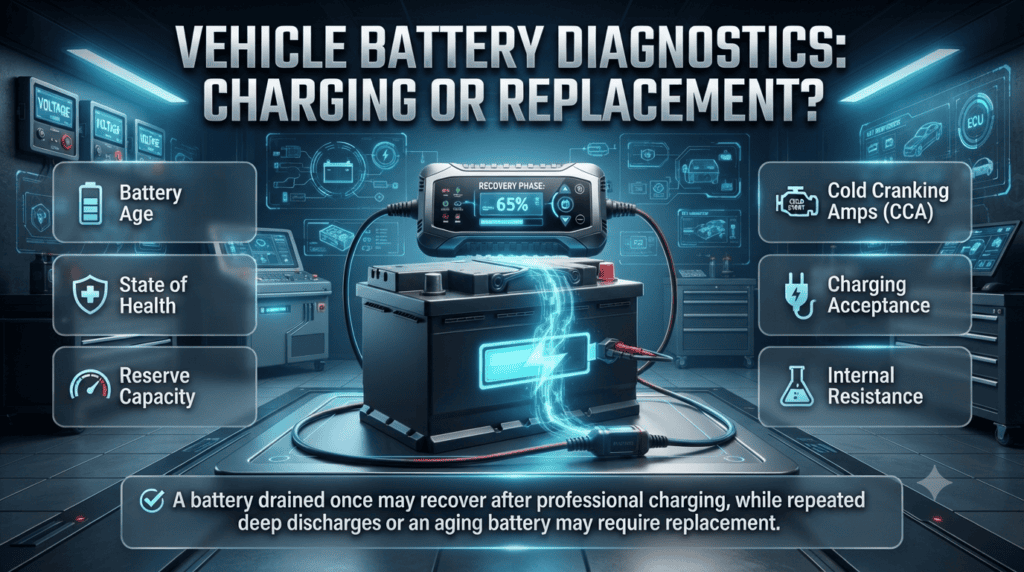
Yes, but not every discharged battery should simply be recharged. Whether charging is the correct solution depends on the battery’s condition, age, and the depth of discharge.
A battery that has been accidentally drained once after leaving the doors open may recover fully after professional charging. However, a battery that has experienced repeated deep discharges or has reached the end of its service life may no longer provide reliable performance.
Professional technicians evaluate several factors before recommending charging or replacement, including:
- Battery age
- State of health
- Reserve capacity
- Cold Cranking Amps (CCA)
- Charging acceptance
- Internal resistance
Only after these tests can an accurate recommendation be made.
When Is Battery Replacement the Better Option?
Sometimes replacing the battery is the safest and most cost-effective solution. Installing a new battery reduces the likelihood of future breakdowns and protects sensitive electronic systems from unstable voltage.
Signs That Replacement Is Recommended
- Battery older than two to three years in Dubai’s climate
- Battery repeatedly loses charge
- Failed professional load test
- Visible swelling or case damage
- Low Cold Cranking Amps (CCA)
- Internal short circuit
- Electrolyte leakage
- Corroded or damaged terminals beyond repair
If replacement is necessary, choosing the correct battery specification is just as important as selecting a reputable brand.
Drivers can compare battery technologies and prices through the Complete Guide to Car Battery Prices in Dubai 2026 before making a decision.
Professional Battery Replacement Process
Replacing a battery in a modern vehicle involves much more than disconnecting one battery and installing another. Today’s cars contain sophisticated electronic systems that often require memory preservation and post-installation diagnostics.
A professional replacement generally follows these steps:
Step 1 – Initial Inspection
The technician confirms the battery is the actual source of the problem rather than the alternator, starter motor, or another electrical fault.
Step 2 – Battery Specification Matching
The replacement battery is selected according to:
- Vehicle manufacturer requirements
- Battery capacity (Ah)
- Cold Cranking Amps (CCA)
- Battery dimensions
- Terminal configuration
- Technology type (Flooded, EFB, AGM)
Step 3 – Safe Battery Removal
The old battery is disconnected using the correct procedure to protect sensitive electronics.
Step 4 – New Battery Installation
The replacement battery is securely installed, terminals are cleaned, and electrical connections are tightened.
Step 5 – System Testing
The technician verifies:
- Starting performance
- Charging voltage
- Battery registration (where required)
- Electronic system operation
Professional installation minimizes the risk of electrical faults after replacement.
Choosing the Right Battery for Dubai’s Climate
Not every battery performs equally well in extreme temperatures. Selecting a battery designed for hot-weather conditions improves reliability and service life.
The best option depends on your vehicle type, electrical requirements, and driving habits.
| Battery Type | Best For | Main Benefit |
|---|---|---|
| Conventional Lead-Acid | Economy vehicles | Affordable and dependable |
| EFB Battery | Start-stop vehicles | Improved cycling performance |
| AGM Battery | Luxury and premium vehicles | Excellent durability and electrical support |
| Premium High-Temperature Battery | Daily Dubai driving | Better heat resistance |
For vehicles with advanced electronics, an AGM Battery is often the preferred choice because it handles repeated charging cycles and higher electrical demands more effectively.
Popular Battery Brands Trusted by Dubai Drivers
Selecting a reputable battery brand helps ensure reliable starting performance and long-term durability.
Some of the commonly chosen options include:
- Amaron Battery – Known for strong heat resistance and dependable performance.
- Bosch Battery – Popular for European vehicles and premium electrical systems.
- Exide Battery – A reliable option for everyday passenger cars.
- Panasonic Battery – Recognized for consistent performance and quality.
- FIAMM Battery – Suitable for a wide range of modern vehicles.
- AC Delco Battery – Frequently used in American and Japanese vehicles.
- Tuflong Battery – Offers dependable value for daily driving.
The ideal choice should always match the vehicle manufacturer’s specifications rather than being selected solely by brand name.
Preventive Maintenance Schedule
Routine battery maintenance significantly reduces the chances of unexpected discharge.
| Maintenance Task | Recommended Frequency | Purpose |
|---|---|---|
| Battery voltage inspection | Every 3 months | Monitor battery condition |
| Terminal cleaning | Every 6 months | Prevent corrosion |
| Charging system inspection | Every 12 months | Verify alternator performance |
| Battery load testing | Before summer | Evaluate starting capacity |
| Battery replacement assessment | After 24–36 months | Prevent unexpected failure |
Following a preventive schedule is especially important for vehicles regularly exposed to Dubai’s high temperatures.
Common Mistakes That Shorten Battery Life
Many premature battery failures result from everyday habits that place unnecessary stress on the electrical system.
Avoid These Common Mistakes
❌ Leaving doors open during cleaning or detailing
❌ Running the infotainment system with the engine off
❌ Ignoring slow engine cranking
❌ Skipping regular battery inspections
❌ Using incorrect battery specifications
❌ Repeatedly jump-starting without identifying the root cause
❌ Allowing corrosion to build up on battery terminals
Correcting these habits can significantly extend battery life and reduce the risk of emergency breakdowns.
Professional Recommendation
If your battery has discharged after keeping the doors open, don’t assume a simple jump start is the complete solution. A professional inspection can reveal whether the battery has retained sufficient capacity or whether another issue—such as a charging system fault or excessive parasitic drain—is contributing to the problem.
For drivers across Dubai, EuroSwift Auto Services provides mobile battery diagnostics, emergency Battery Replacement, Car Jumpstart, and on-site testing using professional equipment. This ensures the correct fault is identified before any parts are replaced, helping you avoid unnecessary expenses and improving long-term vehicle reliability.
Can leaving my car doors open really drain the battery in Dubai?
Yes, leaving your car doors open for an extended period can drain the battery, especially in modern vehicles equipped with advanced electronics. Even when the engine is turned off, opening a door activates several electrical systems, including interior lights, the Body Control Module (BCM), keyless entry sensors, infotainment standby mode, and security systems. These components continue drawing power until the vehicle enters sleep mode, which often doesn’t happen while a door remains open.
In Dubai, the problem becomes more serious because extreme heat naturally reduces battery efficiency and reserve capacity. A battery that has already weakened due to high temperatures may lose enough charge to prevent the engine from starting after the doors have been left open during cleaning, loading luggage, or waiting inside the vehicle.
Key Takeaways
✔ Modern vehicles continue consuming electricity even with the engine off.
✔ Luxury cars usually drain batteries faster due to additional electronic features.
✔ Dubai’s high temperatures reduce battery performance and lifespan.
✔ Keeping doors open for long periods increases the risk of a discharged battery.
✔ Regular battery health checks help prevent unexpected breakdowns.
How long does it take for a car battery to discharge if the doors are left open?
There is no fixed timeframe because every vehicle has different electrical demands and battery capacity. A newer battery in good condition may support open doors for a longer period, while an older battery exposed to Dubai’s harsh climate may discharge much sooner. Factors such as interior lighting, infotainment systems, keyless entry, powered tailgates, and ambient lighting all influence how quickly the battery loses charge.
Instead of focusing on the exact number of hours, it’s better to understand that every minute the doors remain open allows electronic systems to consume stored battery power. The longer this continues, the greater the chance of experiencing a no-start condition.
Factor
Effect on Battery Discharge
Battery age
Older batteries discharge faster
Dubai heat
Reduces reserve capacity
Vehicle electronics
Higher electrical demand
Interior lights
Continuous battery consumption
Existing battery charge
Lower charge means quicker failure
Key Takeaways
✔ Battery age plays a major role in discharge speed.
✔ Advanced electronics increase standby power consumption.
✔ Heat accelerates battery deterioration.
✔ A partially charged battery will discharge much faster.
✔ Preventive inspections reduce the likelihood of sudden failure.
Should I recharge the battery or replace it after it has been discharged?
A discharged battery does not automatically need replacement. If the battery is relatively new and the discharge occurred because the doors were accidentally left open, professional recharging followed by a complete battery health test may be all that’s required. However, if the battery repeatedly loses charge, fails a load test, or has reached the end of its expected service life, replacement is usually the more reliable option.
Professional technicians evaluate battery voltage, Cold Cranking Amps (CCA), charging acceptance, and overall condition before recommending replacement. This approach prevents unnecessary expenses while ensuring long-term reliability.
Key Takeaways
✔ A single discharge doesn’t always mean the battery is faulty.
✔ Professional load testing provides the most accurate diagnosis.
✔ Repeated deep discharges shorten battery lifespan.
✔ Replacing a worn battery improves vehicle reliability.
✔ Always inspect the charging system before replacing the battery.
Can repeatedly jump-starting a discharged battery damage my vehicle?
Occasional jump-starting is generally safe when performed correctly using proper equipment. However, relying on repeated jump starts without identifying the underlying problem is not recommended. If a battery continues to discharge, it may indicate reduced battery capacity, an alternator issue, or excessive parasitic electrical draw.
Modern vehicles contain sensitive electronic modules that can be affected by incorrect jump-start procedures. Using poor-quality jumper cables, reversing battery polarity, or creating voltage spikes can potentially damage electrical components. Having a professional technician perform the jump start and inspect the battery afterward is the safest approach.
Key Takeaways
✔ Occasional jump starts are safe when performed correctly.
✔ Repeated jump starts indicate an unresolved underlying issue.
✔ Incorrect procedures may damage sensitive electronics.
✔ A complete battery and charging system inspection is recommended.
✔ Professional assistance reduces the risk of electrical damage.
How can I prevent my car battery from discharging after keeping the doors open?
The best way to prevent battery discharge is to minimize unnecessary electrical load when the engine is off. If you’re cleaning the vehicle, loading luggage, or carrying out maintenance, keep the doors open only for as long as necessary. For longer tasks, consider starting the engine periodically if it is safe to do so, allowing the alternator to recharge the battery.
Routine battery maintenance is equally important in Dubai’s climate. Regular voltage checks, terminal cleaning, charging system inspections, and replacing aging batteries before they fail all contribute to improved reliability and fewer roadside emergencies.
Key Takeaways
✔ Avoid leaving doors open longer than necessary.
✔ Turn off unnecessary electrical accessories.
✔ Inspect battery health before the summer season.
✔ Keep battery terminals clean and secure.
✔ Replace aging batteries before they become unreliable.
✔ Schedule periodic charging system inspections for long-term performance.
Conclusion
Experiencing a battery discharged after keeping doors open Dubai is more common than many drivers realize, particularly in modern vehicles that rely on advanced electronic systems even when the engine is switched off. While something as simple as leaving the doors open during cleaning, loading luggage, or waiting inside the vehicle may seem harmless, it can gradually drain the battery and leave you with an unexpected no-start situation—especially in Dubai’s extreme heat.
The key to avoiding unnecessary breakdowns is understanding the warning signs early and taking preventive action. Regular battery inspections, charging system checks, and timely replacement of aging batteries can significantly improve vehicle reliability and reduce the risk of roadside emergencies. Choosing the correct battery specification and maintaining it according to the manufacturer’s recommendations also plays an important role in ensuring dependable performance throughout the year.
If your vehicle repeatedly experiences battery discharge, don’t rely solely on jump-starts as a long-term solution. A professional diagnosis can identify whether the issue is caused by battery wear, an alternator fault, or excessive electrical drain. Trusted providers such as EuroSwift Auto Services offer expert Battery Replacement, Car Jumpstart, Vehicle Inspection, and roadside assistance across Dubai, helping drivers restore their vehicles safely and efficiently.
As automotive technology continues to evolve, battery management systems are becoming more advanced, but regular maintenance and timely professional servicing remain the most effective ways to prevent unexpected battery failures. By adopting proactive maintenance habits and responding quickly to early warning signs, you can extend battery life, improve vehicle reliability, and enjoy worry-free driving on Dubai’s roads.
Leave a Reply