
Introduction
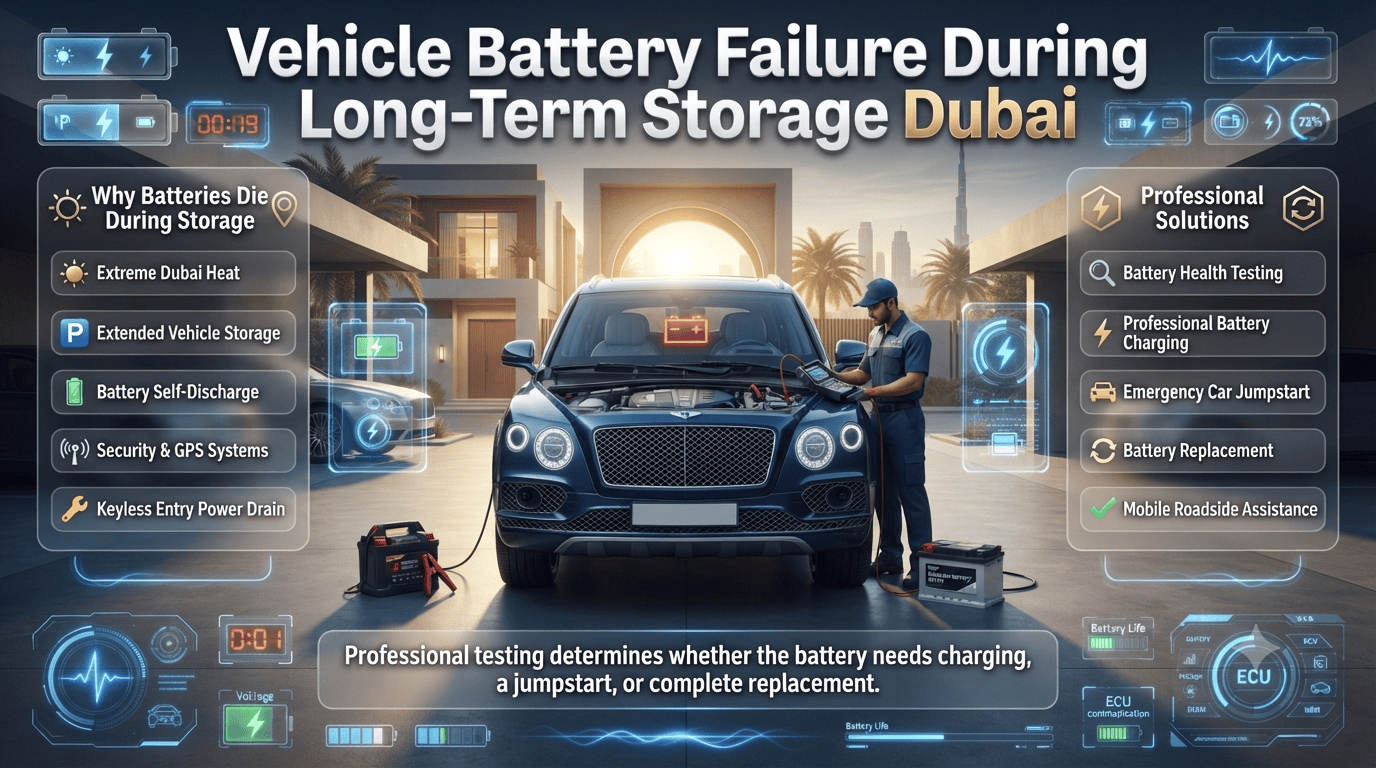
Fastest Premium & Genuine Battery Died After Extended Vehicle Storage Dubai | Leaving a vehicle parked for several weeks may seem harmless, but many drivers in Dubai return to discover a completely dead battery. Whether you were traveling overseas, storing a luxury vehicle for the summer, or simply working remotely, extended vehicle storage can silently drain battery power until the engine refuses to start.
Dubai’s climate creates additional challenges that accelerate battery deterioration. High ambient temperatures, modern electronic systems, security modules, keyless entry functions, GPS trackers, and continuous electrical loads all consume small amounts of energy even when the vehicle is switched off. Combined with prolonged inactivity, these factors significantly reduce battery health.
Fortunately, a dead battery after storage does not always mean permanent failure. Professional testing can determine whether the battery only requires charging, needs a Car Jumpstart, or has reached the end of its service life and requires a complete Battery Replacement.
For vehicle owners seeking reliable roadside assistance, EuroSwift Auto Services provides mobile diagnostics, battery testing, installation, and emergency support across Dubai, helping drivers safely return their vehicles to the road without unnecessary delays.
Why Batteries Die During Extended Vehicle Storage
Many people believe batteries lose power only while driving. In reality, every modern vehicle continues consuming electricity even when parked.
Several electronic systems remain active around the clock, including:
- Security alarm
- Immobilizer
- ECU memory
- Digital clock
- Keyless entry receiver
- GPS tracking systems
- Infotainment memory
- Remote access modules
Although each system uses only a tiny amount of electricity, together they continuously discharge the battery.
When the vehicle remains unused for several weeks, there is no alternator charging the battery, allowing voltage to gradually decline.
How Long Can a Parked Car Battery Last?
The answer depends on several factors.
| Storage Duration | Typical Battery Condition |
|---|---|
| 1–2 weeks | Usually healthy |
| 3–4 weeks | Slight voltage drop |
| 1–2 months | Moderate discharge possible |
| 2–3 months | High likelihood of weak starting |
| Over 3 months | Battery may become deeply discharged |
Luxury vehicles with numerous electronic modules often experience battery drain much sooner than basic vehicles.
Dubai Climate Makes Storage More Challenging
Unlike colder climates where batteries mainly struggle during winter, Dubai presents a completely different challenge.
Extreme heat accelerates:
- Internal chemical degradation
- Electrolyte evaporation
- Plate corrosion
- Reduced battery lifespan
- Higher self-discharge rates
Even vehicles parked inside covered garages remain exposed to elevated temperatures for much of the year.
This explains why batteries stored in Dubai often fail sooner than identical batteries kept in cooler climates.
Expert Insight
Professional Vehicle Inspection after long-term storage is recommended before relying on the battery for regular driving. A voltage reading alone cannot accurately determine remaining battery capacity.
Common Reasons a Battery Dies After Long-Term Parking
Battery discharge is rarely caused by a single issue. Most failures result from several contributing factors occurring simultaneously.
Natural Self-Discharge
Every lead-acid battery naturally loses charge over time.
Even when disconnected from the vehicle, batteries slowly discharge due to internal chemical reactions.
Higher temperatures accelerate this process significantly.
Electronic Parasitic Draw
Modern vehicles constantly consume electricity.
Examples include:
✔ Smart key receivers
✔ Alarm systems
✔ Digital dashboards
✔ Memory seats
✔ Radio presets
✔ Security cameras
✔ Tracking devices
Luxury vehicles generally have much higher standby electrical demand.
Battery Age
A battery nearing the end of its lifespan loses stored energy much faster.
Typical battery life in Dubai ranges between:
| Battery Type | Average Service Life |
|---|---|
| Conventional Lead Acid | 18–24 months |
| Enhanced Flooded Battery (EFB) | 2–3 years |
| AGM Battery | 3–5 years (with proper care) |
Older batteries recover poorly after deep discharge.
Corroded Battery Terminals
Dirty terminals increase electrical resistance.
After weeks of inactivity, corrosion may prevent sufficient current from reaching the starter motor.
Professional cleaning often restores proper electrical flow if the battery itself remains healthy.
Weak Alternator Before Storage
Many batteries blamed for storage failure were already undercharged before parking.
If the alternator was producing insufficient voltage, the battery may never have reached full capacity before storage began.
Once parked, the remaining charge gradually disappeared.
Signs Your Battery Has Been Damaged During Storage
A completely dead battery is obvious, but partial battery deterioration often appears gradually.
Drivers should recognize these warning signs early.
Slow Engine Cranking
The starter motor turns noticeably slower than usual.
This typically indicates reduced battery capacity rather than complete failure.
Clicking Noise Without Starting
Repeated clicking usually means there is enough power to activate the starter relay but not enough current to crank the engine.
Dashboard Flickering
Interior lights may pulse or dim while attempting to start.
This indicates battery voltage collapsing under electrical load.
Electronic System Errors
Low battery voltage can temporarily trigger warning messages such as:
- ABS warning
- Transmission warning
- Steering assist warning
- Stability control alerts
- Parking sensor faults
These messages often disappear after restoring proper battery voltage.
Remote Key Problems
If the vehicle responds inconsistently to remote locking or keyless entry after storage, the main battery may be approaching critical discharge.
Storage-Related Warning Signs Checklist
| Symptom | Possible Cause | Professional Action |
|---|---|---|
| No engine crank | Fully discharged battery | Battery testing |
| Single click | Low voltage | Jumpstart and diagnostics |
| Slow cranking | Weak battery | Capacity test |
| Warning lights | Voltage instability | Charging system inspection |
| Dim headlights | Low battery output | Battery health evaluation |
| Random electronic faults | Deep discharge | Complete electrical diagnosis |
What Happens Inside a Battery During Long-Term Storage?
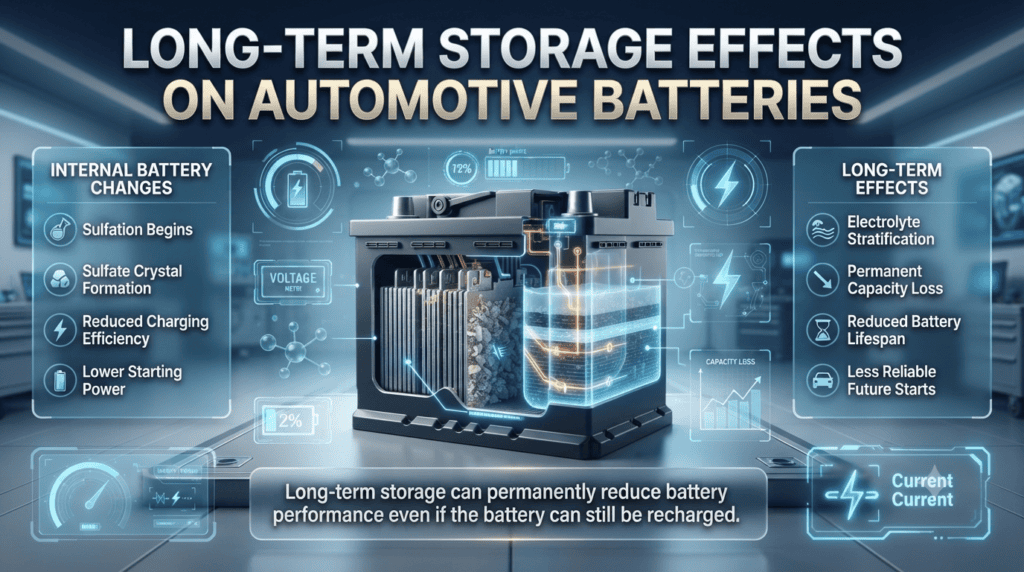
Many owners assume a battery simply “goes flat.” In reality, several chemical and mechanical changes occur during prolonged inactivity.
Sulfation Begins
When a battery remains discharged for an extended period, lead sulfate crystals harden on the battery plates.
These crystals reduce:
- Available capacity
- Charging efficiency
- Starting power
- Overall lifespan
Once sulfation becomes severe, the battery may never regain full performance, even after charging.
Electrolyte Stratification
During long storage periods, the battery’s electrolyte can separate into layers, leaving portions of the plates underprotected. This uneven chemical distribution accelerates internal wear and reduces charging efficiency once the vehicle returns to service.
Permanent Capacity Loss
A battery left deeply discharged for weeks or months may recover enough voltage to start the engine once, but its reserve capacity is often permanently reduced. This means future starts become less reliable, particularly during hot Dubai afternoons when electrical demand is highest.
Professional Inspection Process After a Battery Dies During Vehicle Storage
A battery that fails after weeks or months of vehicle storage should never be replaced based solely on the fact that the engine will not start. Professional technicians follow a structured diagnostic process to determine whether the battery can be recovered or if replacement is the safer and more cost-effective solution.
A comprehensive inspection performed by EuroSwift Auto Services evaluates not only the battery but also the vehicle’s complete charging and electrical system. This prevents unnecessary battery replacements and identifies hidden issues that may have contributed to the discharge.
Step 1: Visual Battery Inspection
The first stage focuses on the battery’s physical condition. Technicians inspect for:
- Cracked or swollen battery casing
- Electrolyte leakage
- Loose battery hold-down brackets
- Corroded terminals
- Damaged battery cables
- Signs of overheating
Even if the battery still holds some charge, visible physical damage usually indicates that replacement is the safest option.
Step 2: Battery Voltage Test
A digital multimeter measures the battery’s resting voltage before any charging begins.
| Battery Voltage | Battery Condition | Recommended Action |
|---|---|---|
| 12.6–12.8V | Fully charged | Further testing |
| 12.4V | Slightly discharged | Recharge and retest |
| 12.2V | Moderately discharged | Load test required |
| Below 12.0V | Deep discharge | Recovery assessment |
| Below 10.5V | Possible cell failure | Likely replacement |
Voltage alone does not determine battery health, but it provides an important starting point for diagnosis.
Step 3: Battery Load Test
The load test is one of the most accurate methods for evaluating a battery after extended storage. It simulates the heavy electrical demand placed on the battery during engine starting.
A battery may display normal voltage yet fail immediately under load because its internal capacity has deteriorated due to sulfation or age.
Professional load testing determines:
- Remaining Cold Cranking Amps (CCA)
- Reserve capacity
- Internal resistance
- Overall battery condition
If the battery fails the load test, installing a quality replacement such as an Bosch Battery or Amaron Battery is usually more reliable than attempting repeated recharges.
Charging vs Jumpstarting vs Battery Replacement
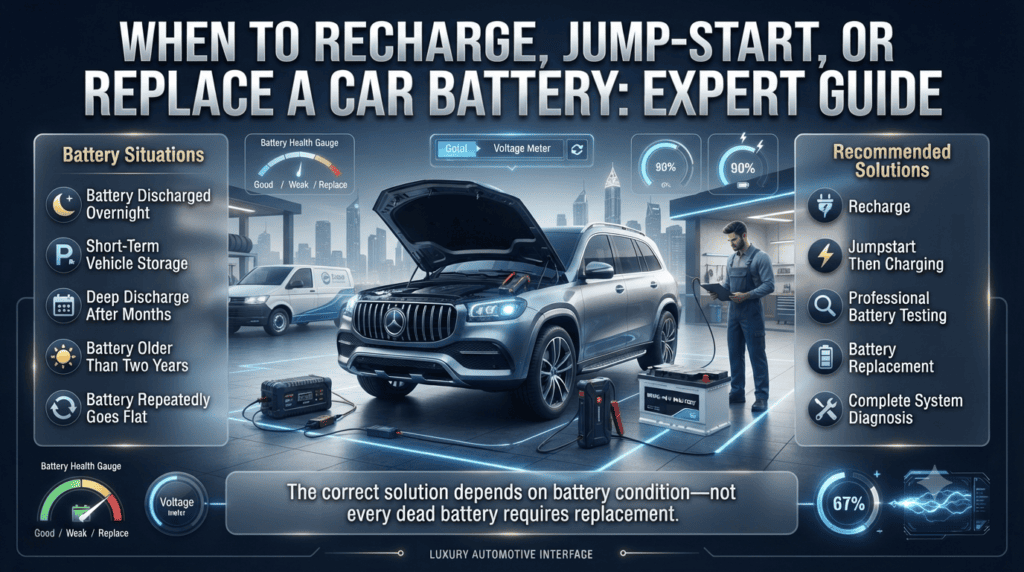
Many drivers assume every dead battery simply needs a jumpstart. In reality, the correct solution depends on the battery’s condition.
| Situation | Best Solution | Why |
|---|---|---|
| Battery accidentally discharged overnight | Recharge | Battery is usually healthy |
| Battery discharged after short storage | Jumpstart then charging | Capacity often remains good |
| Battery deeply discharged for several months | Professional testing | Internal damage possible |
| Battery older than two years in Dubai | Replacement recommended | Heat accelerates aging |
| Battery repeatedly goes flat | Complete diagnosis | Another fault may exist |
When a Jumpstart Is Enough
A professional Car Jumpstart is often sufficient when:
- Battery is relatively new
- Lights were accidentally left on
- Vehicle was parked for only a few weeks
- Load test confirms healthy capacity
- Alternator operates normally
After the jumpstart, the battery should be monitored to ensure it holds charge properly.
When Charging Is the Better Choice
Modern smart chargers restore batteries much more safely than traditional chargers.
Charging may be recommended when:
- Battery voltage is low but stable
- No damaged cells are detected
- Sulfation is minimal
- Vehicle has been stored indoors
- Battery age is relatively low
Charging should always be completed using equipment designed for the specific battery technology.
When Replacement Becomes Necessary
Replacement is generally recommended when technicians discover:
✔ Internal short circuit
✔ Failed battery cell
✔ Severe sulfation
✔ Swollen casing
✔ Excessive voltage drop
✔ Poor reserve capacity
✔ Multiple failed load tests
Drivers of premium European vehicles often benefit from installing an AGM Battery because these batteries are designed to support advanced electronics, start-stop systems, and higher electrical loads.
Recovery Procedure After Long-Term Vehicle Storage
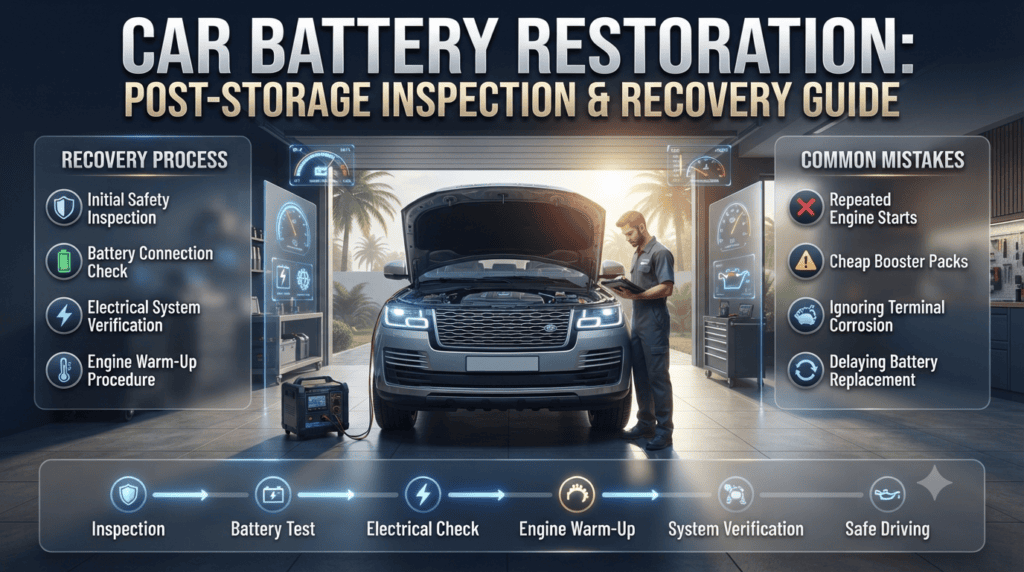
Starting a vehicle after several months of inactivity requires more than simply connecting jumper cables.
A systematic recovery process helps prevent electrical damage and ensures the vehicle returns to service safely.
Initial Safety Inspection
Before attempting to start the engine, technicians inspect:
- Battery connections
- Engine bay wiring
- Coolant level
- Engine oil level
- Brake fluid
- Tire pressure
- Fuel condition
- Visible rodent damage
Vehicles stored in enclosed garages may also require air filter inspection before starting.
Electrical System Verification
After restoring battery power, the following systems are checked:
- Charging voltage
- Starter current draw
- Alternator output
- ECU communication
- Warning lights
- Power steering
- ABS operation
- Air conditioning controls
This step confirms that the dead battery was the primary issue and not the result of another electrical fault.
Engine Warm-Up Procedure
Immediately driving a vehicle after months of storage is not ideal.
Professional technicians recommend allowing the engine to:
- Reach operating temperature
- Stabilize idle speed
- Circulate fresh oil
- Recharge the battery
- Complete system self-checks
This reduces mechanical stress on engine components that have been inactive for an extended period.
Common Mistakes Drivers Make After Storage
Many battery failures become worse because of incorrect recovery methods.
Attempting Repeated Starts
Repeatedly cranking the engine with a weak battery increases starter motor wear and further drains the remaining battery charge.
Using Cheap Booster Packs
Low-quality jump starters often provide unstable voltage, which can affect sensitive vehicle electronics. Professional roadside equipment delivers controlled power that reduces the risk of electrical damage.
Ignoring Corrosion
Even a healthy battery may struggle to deliver sufficient current if corrosion is present on the terminals. Cleaning and securing the connections should always be part of the recovery process.
Delaying Battery Replacement
If testing confirms the battery has reached the end of its life, delaying replacement increases the likelihood of another breakdown.
Reliable options include Exide Battery for dependable everyday use, Panasonic Battery for Japanese vehicles, FIAMM Battery for premium performance, AC Delco Battery for many American models, and Tuflong Battery for dependable daily driving.
Professional Recommendation
If your vehicle has remained parked for several weeks or months and the battery no longer starts the engine, avoid guessing whether it needs a recharge or replacement. A complete diagnostic inspection is the most reliable approach because it identifies battery condition, charging system performance, and any hidden electrical faults before they lead to another unexpected breakdown.
Before purchasing a replacement battery, it’s also worth reviewing the Complete Guide to Car Battery Prices in Dubai 2026 to compare battery technologies, warranty options, and price ranges for different vehicle categories.
Preventive Maintenance Schedule for Vehicles in Long-Term Storage
The best way to avoid returning to a dead battery is to prepare your vehicle before it goes into storage. Whether you’re leaving Dubai for a business trip, an extended vacation, or storing a seasonal or luxury vehicle, a preventive maintenance plan helps preserve battery health and reduces the risk of unexpected breakdowns.
The exact maintenance schedule depends on the battery type, storage duration, parking environment, and the vehicle’s electronic systems.
Recommended Battery Storage Maintenance Schedule
| Storage Period | Recommended Action | Why It Matters |
|---|---|---|
| Up to 2 Weeks | Start and drive the vehicle for 20–30 minutes once a week | Allows the alternator to recharge the battery |
| 2–4 Weeks | Check battery voltage and inspect terminals | Detects early discharge before it becomes severe |
| 1–2 Months | Connect a smart battery maintainer if possible | Prevents deep discharge and sulfation |
| 2–3 Months | Perform a professional battery health inspection before driving | Confirms the battery is still safe and reliable |
| Over 3 Months | Complete electrical system inspection and load test | Identifies hidden battery or charging system issues |
Following this schedule significantly increases the chances of your battery remaining healthy throughout the storage period.
How to Prepare Your Vehicle Before Extended Storage
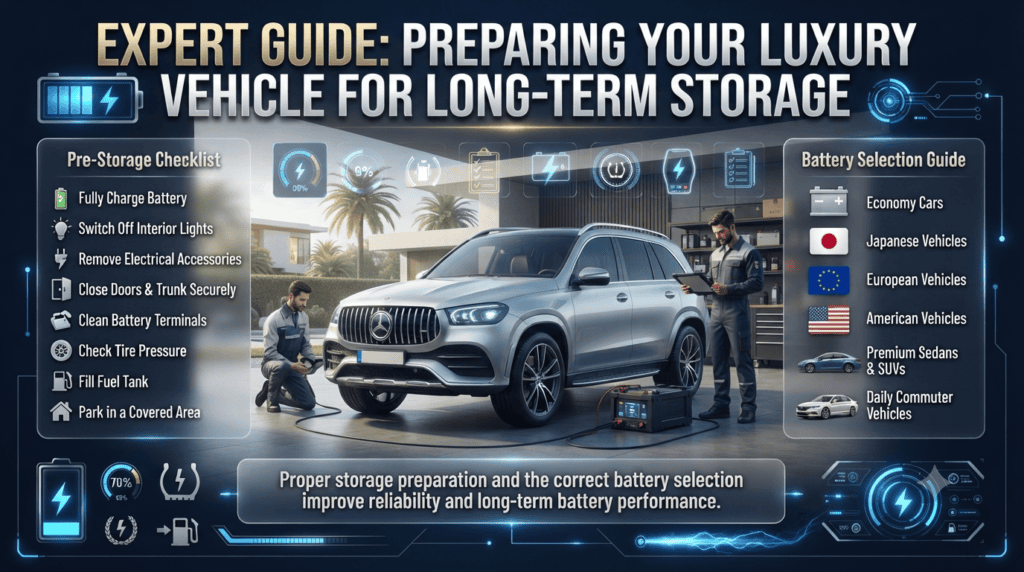
Preparing a vehicle correctly before parking it for several weeks or months is far more effective than trying to recover a deeply discharged battery later.
Pre-Storage Checklist
✔ Fully charge the battery before parking.
✔ Ensure all interior lights are switched off.
✔ Remove unnecessary electrical accessories.
✔ Check that doors, trunk, and hood are fully closed.
✔ Clean battery terminals to prevent corrosion.
✔ Inflate tires to the recommended pressure.
✔ Fill the fuel tank to reduce condensation.
✔ Confirm there are no active warning lights.
✔ Park in a covered or shaded location whenever possible.
If you’re unsure whether your battery is in good condition before storage, scheduling a preventive inspection with EuroSwift Auto Services can help identify weak batteries before they fail.
Choosing the Right Replacement Battery After Storage Failure
Not every vehicle requires the same battery technology. Installing an incompatible battery can reduce performance, shorten service life, or even affect the operation of advanced vehicle electronics.
Battery Selection Guide
| Vehicle Type | Recommended Battery |
|---|---|
| Economy Cars | Exide Battery or Tuflong Battery |
| Japanese Vehicles | Panasonic Battery |
| European Vehicles | Bosch Battery |
| American Vehicles | AC Delco Battery |
| Premium Sedans & SUVs | FIAMM Battery or AGM Battery |
| Daily Commuter Vehicles | Amaron Battery |
Selecting the correct battery ensures reliable starting performance and supports the vehicle’s electrical demands, especially in Dubai’s high-temperature environment.
Dubai Climate and Long-Term Battery Health
Heat is one of the biggest factors affecting battery life in the UAE. Even when a vehicle is not being driven, prolonged exposure to high temperatures accelerates internal chemical reactions inside the battery.
How Heat Impacts Stored Batteries
- Faster self-discharge
- Increased electrolyte evaporation
- Internal plate corrosion
- Reduced reserve capacity
- Shorter overall battery lifespan
Whenever possible, store your vehicle in a covered parking area or temperature-controlled garage. If outdoor parking is unavoidable, regular battery checks become even more important.
Luxury and High-Technology Vehicles Need Extra Attention
Luxury vehicles often have significantly higher standby power consumption than standard passenger cars. Features such as adaptive suspension, digital dashboards, keyless entry, remote monitoring, and advanced security systems continue drawing small amounts of electricity while the vehicle is parked.
Owners of BMW, Mercedes-Benz, Audi, Porsche, Range Rover, Lexus, and similar vehicles should pay particular attention to battery maintenance during long storage periods.
Many of these vehicles are factory-equipped with AGM Battery technology, which requires proper charging procedures and, in some cases, battery registration after replacement.
Future Trends in Vehicle Battery Maintenance
Battery technology continues to evolve as modern vehicles become increasingly dependent on electronics.
Several innovations are changing the way batteries are monitored and maintained.
Smart Battery Monitoring
Many new vehicles now use intelligent battery sensors that continuously monitor:
- Voltage
- Charging efficiency
- Current flow
- Battery temperature
- State of charge
These systems help detect battery deterioration before complete failure occurs.
Predictive Diagnostics
Modern diagnostic equipment can estimate remaining battery life by analyzing internal resistance and charging behavior, allowing technicians to recommend replacement before an unexpected breakdown.
Improved Battery Technologies
Manufacturers continue developing batteries that are:
- More heat resistant
- Longer lasting
- Faster charging
- Better suited to start-stop systems
- More environmentally friendly
These improvements are particularly valuable in regions such as Dubai, where high temperatures place additional stress on conventional lead-acid batteries.
Can a car battery be saved after it dies from extended vehicle storage in Dubai?
In many cases, a battery can be recovered, but the outcome depends on how long it remained discharged and its overall condition before storage. A battery that has only recently gone flat may respond well to a professional recharge using a smart battery charger. However, if the vehicle has been parked for several months—especially during Dubai’s extreme summer heat—the battery may develop sulfation or internal cell damage, which permanently reduces its ability to hold a charge. Simply jump-starting the vehicle may get the engine running temporarily, but it does not confirm that the battery is still reliable for daily use.
Professional technicians usually perform a voltage test, load test, and charging system inspection before recommending whether the battery should be recharged or replaced. This approach prevents unnecessary expenses while reducing the risk of another unexpected breakdown.
Key Points:
✔ Batteries parked for only a few weeks are often recoverable.
✔ Deeply discharged batteries may suffer permanent internal damage.
✔ A load test is more reliable than checking voltage alone.
✔ Dubai’s high temperatures can shorten battery recovery potential.
✔ Professional diagnostics help determine the most cost-effective solution.
How long can a car sit without being driven before the battery dies?
There is no universal answer because battery life during storage depends on the vehicle’s electronics, battery age, weather conditions, and overall battery health. Most modern vehicles can remain parked for two to four weeks without significant problems, but luxury cars equipped with keyless entry, GPS tracking, security systems, and multiple electronic control modules often consume more standby power, causing the battery to discharge faster.
If a vehicle will remain unused for more than a month, it is advisable to periodically start and drive it or use a battery maintainer. This is especially important in Dubai, where prolonged heat accelerates battery self-discharge and internal wear.
Factors That Affect Storage Life:
✔ Battery age and condition.
✔ Number of active electronic systems.
✔ Ambient temperature during storage.
✔ Parking location (covered or exposed).
✔ Frequency of battery maintenance before storage.
Is it safe to jump-start a battery that has been dead for several weeks or months?
Jump-starting a vehicle after extended storage can be safe when performed correctly, but it should not be considered a permanent solution. If the battery has been deeply discharged for a long period, internal damage may already exist. In such cases, the battery might start the engine once after receiving external power but fail again shortly afterward because it can no longer retain sufficient charge.
Professional roadside technicians first inspect the battery, terminals, and charging system before connecting jump-start equipment. This reduces the risk of voltage spikes, electrical damage, and unnecessary strain on sensitive vehicle electronics.
Professional Advice:
✔ Avoid repeated jump-starts without diagnosing the battery.
✔ Inspect battery terminals for corrosion before attempting a jump-start.
✔ Have the alternator tested after the engine starts.
✔ Replace batteries that repeatedly fail after charging.
✔ Use professional-grade jump-start equipment whenever possible.
What is the best battery for a vehicle that spends long periods in storage?
The ideal battery depends on the vehicle’s electrical requirements, manufacturer recommendations, and storage conditions. Vehicles with advanced electronics or automatic start-stop systems often benefit from AGM batteries because they tolerate repeated discharge and recharge cycles better than conventional batteries. Standard passenger vehicles may perform well with premium lead-acid batteries from trusted manufacturers, provided they are correctly matched to the vehicle’s specifications.
Choosing the right battery is about more than price. Capacity, Cold Cranking Amps (CCA), reserve power, warranty coverage, and compatibility all influence long-term reliability. Installing the correct battery also helps protect sensitive electronic systems and reduces the likelihood of premature failure.
When Selecting a Replacement Battery, Consider:
✔ Vehicle manufacturer specifications.
✔ Battery technology (Lead-Acid, EFB, or AGM).
✔ Cold Cranking Amps (CCA) rating.
✔ Reserve capacity for extended parking.
✔ Warranty period and installation quality.
How can I prevent my car battery from dying during long-term vehicle storage in Dubai?
Prevention is always more affordable and convenient than emergency battery replacement. Before leaving a vehicle unused for several weeks, ensure the battery is fully charged, inspect the terminals for corrosion, and confirm there are no electrical faults that could cause excessive battery drain. If possible, use a smart battery maintainer to keep the battery at an optimal charge level throughout the storage period. Parking the vehicle in a shaded or covered area also helps reduce heat-related battery deterioration.
After returning, avoid immediately driving long distances. Instead, perform a quick inspection, verify the battery voltage, and check for warning lights before putting the vehicle back into regular service. These simple steps can significantly extend battery life and reduce the likelihood of unexpected starting problems.
Best Practices Before Long-Term Storage:
✔ Fully charge the battery before parking the vehicle.
✔ Store the vehicle in a covered or shaded location.
✔ Use a smart battery maintainer for extended storage.
✔ Check battery voltage before driving again.
✔ Schedule a professional battery inspection if the vehicle has been parked for several months.
✔ Replace aging batteries proactively rather than waiting for a roadside breakdown.
Conclusion
A battery that dies after extended vehicle storage is more than just an inconvenience—it is often a sign that the battery has lost charge due to prolonged inactivity, continuous electrical drain, aging, or Dubai’s extreme climate. While some batteries can be restored through professional charging, others may suffer permanent internal damage that makes replacement the safer and more reliable option. Identifying the exact cause through proper diagnostics is essential to avoid repeated starting problems and unnecessary repair costs.
Whether your vehicle has been parked for a few weeks or several months, taking preventive measures such as maintaining the battery, storing the vehicle in a shaded location, and scheduling regular inspections can significantly extend battery life. If a replacement is required, selecting the correct battery technology and ensuring professional installation will improve vehicle reliability and protect sensitive electrical systems.
For drivers facing a battery died after extended vehicle storage Dubai situation, EuroSwift Auto Services offers expert mobile battery diagnostics, emergency Battery Replacement, Car Jumpstart, and roadside assistance across Dubai. With high-quality battery brands, experienced technicians, and on-site installation, you can quickly get back on the road with confidence, knowing your vehicle’s electrical system has been tested and restored to reliable working condition.
Leave a Reply