
Introduction
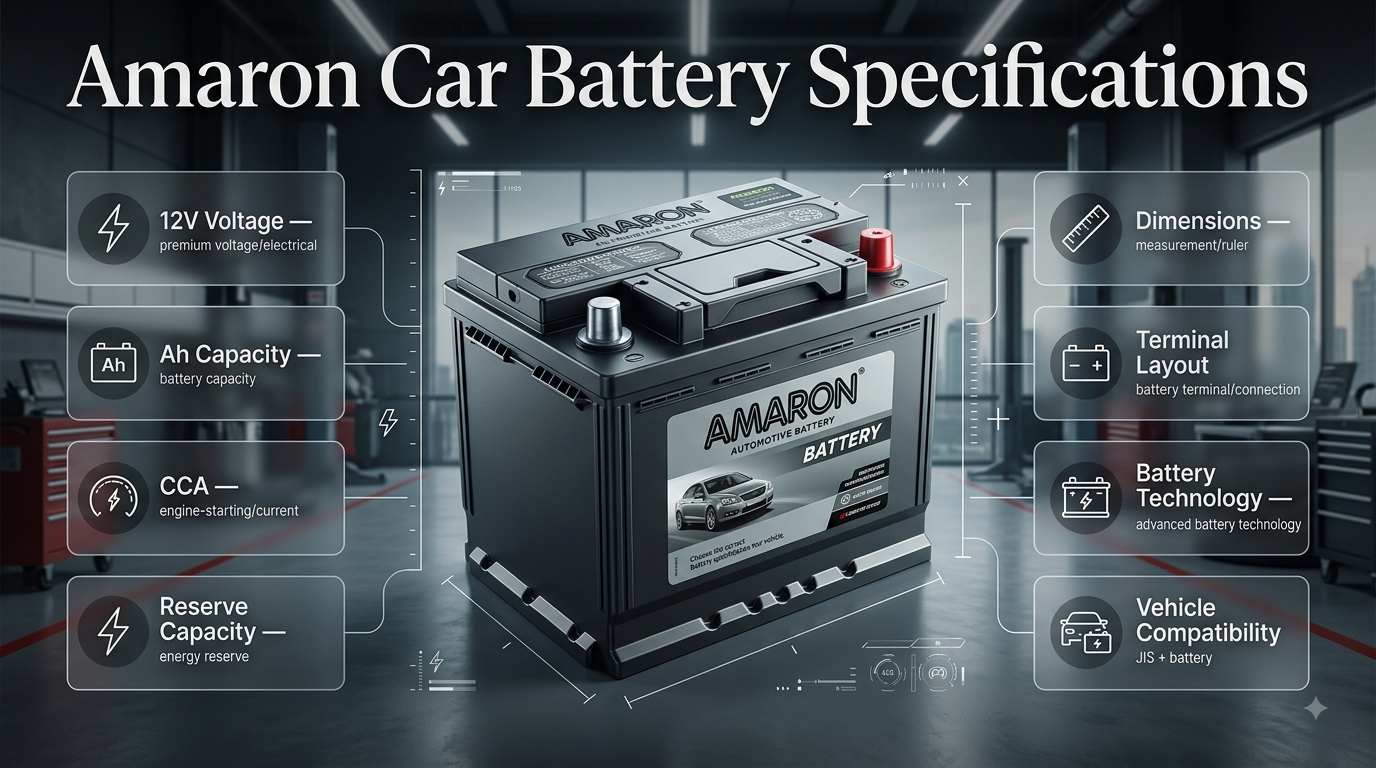
Amaron Car Battery Specifications | When a car battery starts becoming weak, many drivers search for Amaron car battery specifications before deciding which replacement to purchase. The reason is simple: choosing a battery is not just about selecting a well-known brand. The battery must also match the vehicle’s electrical requirements, physical dimensions, terminal arrangement, starting requirements and battery technology.
EuroSwift Auto Services provides automotive support in Dubai where battery inspection, replacement and electrical-system diagnosis can be considered together rather than treating a battery failure as an isolated problem.
Amaron offers automotive batteries in different sizes and specifications, which means there is no single specification that applies to every Amaron battery. Depending on the model, specifications can vary in voltage, Ah capacity, CCA, Reserve Capacity, dimensions and terminal configuration. Some vehicles use JIS-style batteries, while others use DIN-type batteries.
For Dubai drivers, selecting the correct specification is particularly important. High temperatures, extensive air-conditioning use, traffic congestion, short journeys and long parking periods can all influence battery performance.
This guide explains the most important Amaron car battery specifications, how to read them, how to compare different models, when a battery should be recharged instead of replaced, and what professional technicians should check before installing a new battery.
What Are Amaron Car Battery Specifications?
Amaron car battery specifications are the technical details that describe a battery’s electrical capacity, starting performance, physical size and vehicle compatibility.
When you look at an Amaron battery label, you may find several different numbers and codes. These may include:
- 12V voltage rating
- Ah capacity
- CCA rating
- Reserve Capacity
- Battery model number
- Battery group or size
- Length
- Width
- Height
- Terminal arrangement
- Polarity
- Battery technology
Each specification has a different purpose.
Voltage tells you the electrical-system category. Ah gives information about rated capacity. CCA describes starting-current capability under a standardized test. Reserve Capacity provides another measurement of how long the battery can supply a specified load under testing conditions.
Dimensions are equally important because the battery has to physically fit the vehicle.
The terminal arrangement also matters because the positive and negative terminals must be positioned correctly for the vehicle’s battery cables.
This is why a battery should never be selected only because the label says “Amaron.”
The exact model and complete specification are what determine compatibility.
Amaron Battery Voltage: Understanding the 12V Rating
Most conventional passenger cars use a 12-volt electrical system, and many Amaron automotive batteries are designed for this type of application.
However, seeing “12V” on two batteries does not mean they are interchangeable.
For example, two 12V batteries could have completely different:
- Ah capacities
- CCA ratings
- Physical dimensions
- Terminal locations
- Terminal sizes
- Polarity
- Mounting arrangements
- Battery technologies
Voltage should therefore be considered the first compatibility check rather than the complete battery specification.
A compact sedan may require a smaller battery, while a large SUV or diesel vehicle can require considerably greater starting capability and capacity.
Why battery voltage matters
The vehicle’s electrical components are designed around a specific electrical architecture.
Installing an inappropriate battery voltage can cause serious electrical problems.
For a normal 12V vehicle, the replacement battery should be appropriate for that vehicle’s 12V system and should also meet the manufacturer’s other battery requirements.
This is one reason professional Battery Replacement should begin by identifying the vehicle and its original battery specification.
What Does Ah Mean on an Amaron Battery?
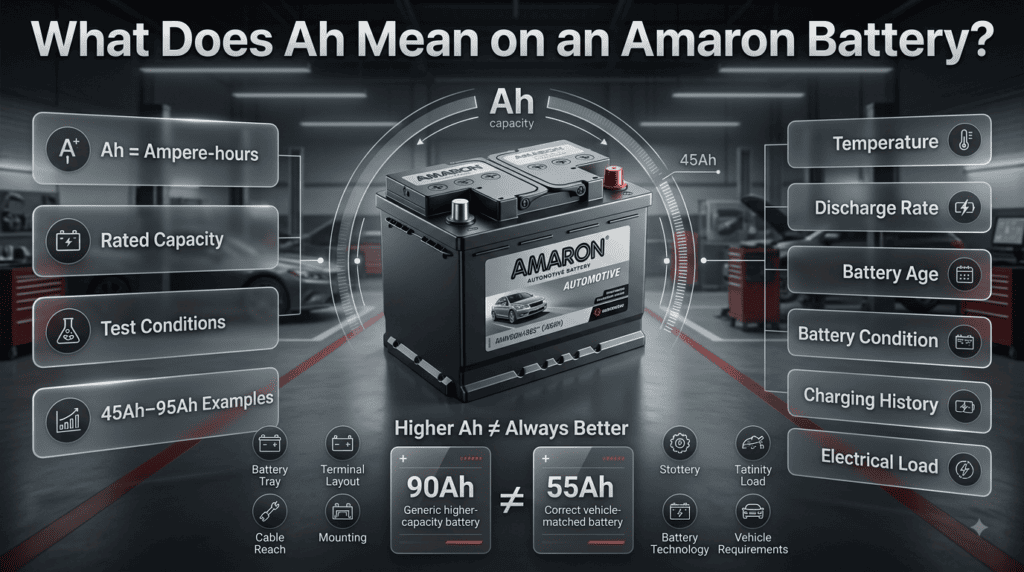
One of the most important Amaron battery specifications is Ah, which means ampere-hours.
Ah is a measurement associated with the battery’s rated capacity under a specified test condition.
It is useful when comparing batteries, but it should not be interpreted as a simple statement that a battery can deliver a certain current for an exact number of hours under every real-world situation.
Battery performance depends on factors such as:
- Testing conditions
- Temperature
- Discharge rate
- Battery age
- Battery condition
- Charging history
- Electrical load
Amaron produces batteries with different capacity ratings.
For example, published Amaron product data for a DIN range includes models around 45Ah, 55Ah, 66Ah, 74Ah, 80Ah, 90Ah and 95Ah.
That variation demonstrates an important point:
There is no single Ah specification for Amaron batteries.
The correct capacity depends on the particular vehicle and battery model.
Does higher Ah mean a better battery?
Not automatically.
A higher-capacity battery may look attractive, but it could still be the wrong choice if:
- It is too large for the battery tray.
- The terminal arrangement is incorrect.
- The battery cables do not reach properly.
- The mounting system does not match.
- The vehicle requires another battery technology.
- The vehicle’s battery-management system expects a different specification.
The correct battery is not necessarily the biggest one.
The correct battery is the one that matches the vehicle.
Amaron CCA Specifications Explained
CCA means Cold Cranking Amps.
CCA measures a battery’s ability to deliver high current for engine starting under a standardized testing procedure.
Although Dubai does not experience the extreme cold conditions associated with CCA testing, CCA remains an important specification because starting the engine requires substantial current.
A battery can sometimes operate basic electrical equipment while still being too weak to provide adequate starting power.
This explains situations where:
- The dashboard turns on.
- Interior lights work.
- The central locking works.
- The radio operates.
- Yet the engine does not crank properly.
The starter motor places a much higher demand on the battery.
Example of Amaron CCA variation
Amaron’s published product information for its US-market DIN range gives different CCA ratings for different models.
| Amaron model | Approx. capacity | Published CCA |
|---|---|---|
| DIN45 PRO | 45Ah | 365A |
| DIN55 PRO | 55Ah | 500A |
| DIN66 PRO | 66Ah | 550A |
| DIN74 PRO | 74Ah | 690A |
| DIN80 PRO | 80Ah | 704A |
| DIN90 PRO | 90Ah | 736A |
| DIN100 PRO | 95Ah | 874A |
These figures are model-specific and should not be treated as universal specifications for every Amaron battery.
Different product families and markets can use different ratings.
Should you choose the highest CCA?
No.
Higher CCA can be useful when it matches the vehicle’s requirements, but CCA is only one part of battery compatibility.
A battery with excellent CCA can still be unsuitable because of:
- Incorrect dimensions
- Wrong terminal position
- Incorrect polarity
- Unsuitable capacity
- Incorrect technology
- Incorrect mounting configuration
Professional battery selection should therefore evaluate the complete specification.
What Is Reserve Capacity in an Amaron Battery?
Reserve Capacity, usually abbreviated as RC, is another battery specification that is often overlooked.
Reserve Capacity provides an indication of how long a fully charged battery can supply a specified electrical load under a standardized testing procedure before reaching a defined voltage level.
It gives technicians and consumers another way of understanding battery capability.
For example, published Amaron data lists different Reserve Capacity figures across its DIN range, with larger batteries generally having greater reserve-capacity ratings.
This measurement is particularly useful when comparing batteries with different electrical characteristics.
However, Reserve Capacity does not mean that drivers should intentionally operate their vehicle’s electrical equipment for long periods with the engine switched off.
It is a technical comparison measurement rather than a recommendation for vehicle operation.
Why Battery Dimensions Are So Important
A battery may have the correct voltage, acceptable Ah capacity and sufficient CCA but still be unsuitable because it does not physically fit the vehicle.
The three basic dimensions are:
- Length
- Width
- Height
But physical fitment also involves:
- Battery tray
- Hold-down mechanism
- Terminal position
- Cable reach
- Hood clearance
- Terminal height
- Battery orientation
For example, published Amaron DIN specifications include batteries with substantially different lengths.
A smaller DIN battery may be approximately 207 mm long, while a larger DIN battery can extend beyond 350 mm.
That difference is significant.
A larger battery should never be forced into a smaller battery compartment.
Why correct mounting matters
The battery should be firmly secured.
A loose battery can experience unnecessary vibration and movement.
That can contribute to:
- Terminal problems
- Cable movement
- Physical battery damage
- Mounting failure
- Electrical connection issues
Correct installation is therefore part of battery reliability.
Amaron JIS Battery Specifications
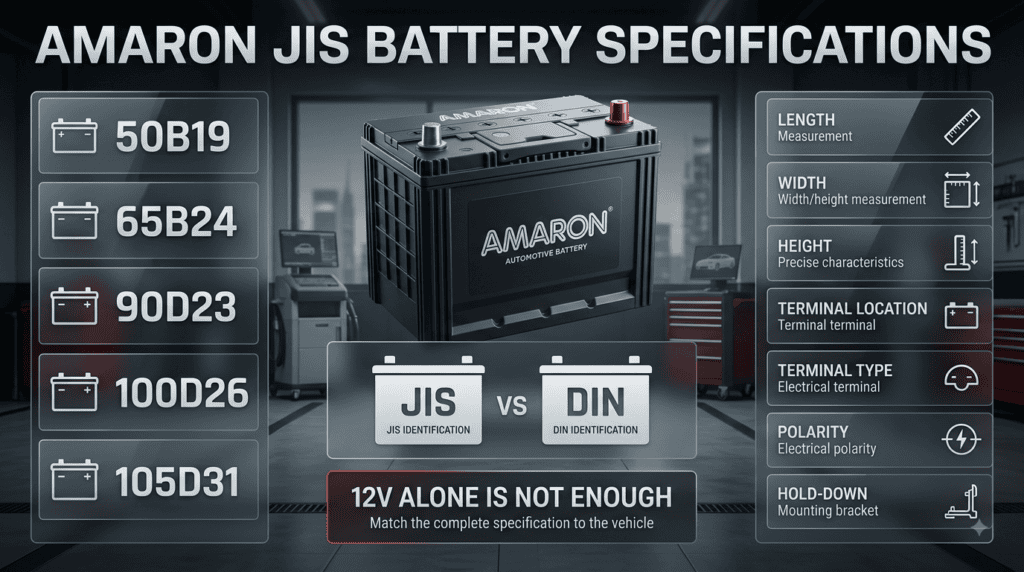
Many Japanese and Asian vehicles use battery sizes based on the JIS battery standard.
JIS battery codes can look different from DIN battery codes.
Examples include:
- 50B19
- 65B24
- 90D23
- 100D26
- 105D31
These battery formats are commonly associated with vehicles from manufacturers such as Toyota, Nissan, Honda, Mitsubishi, Suzuki and Mazda, although the exact application depends on the individual vehicle.
JIS battery identification can involve physical case size, terminal configuration and other characteristics.
That means a JIS battery should be selected according to the complete model and vehicle application.
Why JIS batteries require careful selection
Two batteries can both be 12V and have similar Ah ratings while differing in:
- Length
- Width
- Height
- Terminal location
- Terminal type
- Polarity
- Hold-down configuration
Therefore, matching only the voltage is not enough.
Understanding DIN Amaron Batteries
DIN battery sizing is common across many European vehicle applications.
Amaron’s published DIN product information includes several battery sizes, with significant variation in capacity and physical dimensions.
A simplified example is:
| Battery model | Capacity | CCA | Approx. dimensions |
|---|---|---|---|
| DIN45 | 45Ah | 365A | 207 × 175 × 175 mm |
| DIN55 | 55Ah | 500A | 242 × 175 × 175 mm |
| DIN66 | 66Ah | 550A | 242 × 175 × 190 mm |
| DIN74 | 74Ah | 690A | 278 × 175 × 190 mm |
| DIN80 | 80Ah | 704A | 315 × 175 × 175 mm |
| DIN90 | 90Ah | 736A | 353 × 175 × 190 mm |
These figures illustrate why model identification is so important.
A DIN battery with a similar Ah rating may still have a different physical configuration.
How to Read an Amaron Battery Model Number
Amaron battery model numbers can initially appear confusing.
A code such as 100D26 belongs to a different sizing convention from a DIN battery such as DIN74 or DIN90.
When reading a battery label, do not attempt to determine compatibility from only one number.
Instead, record the complete information.
Check:
- Complete model number
- Voltage
- Ah capacity
- CCA
- Dimensions
- Terminal layout
- Polarity
- Battery technology
- Vehicle application
This approach is particularly useful when the vehicle has already had a replacement battery installed.
Sometimes the existing battery is not the original specification.
If you copy that battery blindly, you can reproduce the same compatibility problem.
Amaron Maintenance-Free Battery Specifications
Many Amaron automotive batteries are marketed as maintenance-free batteries.
This type of battery reduces the need for routine electrolyte-level maintenance associated with older conventional battery designs.
However, maintenance-free does not mean that the battery can be ignored.
The vehicle’s electrical system still needs to be healthy.
A maintenance-free battery can still become discharged or weak because of:
- Alternator problems
- Electrical drain
- Long parking periods
- Repeated short trips
- Heavy electrical loads
- Poor battery connections
- Battery aging
- Charging-system faults
This distinction is important when a driver experiences repeated battery failure.
If a replacement battery is installed without investigating the original cause, the new battery can eventually develop the same problem.
Amaron Battery Performance in Dubai
Dubai presents a challenging environment for automotive batteries.
High ambient temperatures can accelerate battery aging, while temperatures inside an engine compartment can become considerably higher than the outside air.
Air conditioning also plays an important role in everyday driving.
Drivers frequently use the vehicle’s climate-control system for extended periods, increasing the electrical demand on the vehicle.
Traffic congestion adds another operating factor.
A vehicle may spend considerable time in slow-moving traffic, making the overall operating environment different from long-distance highway driving.
Common battery stress factors in Dubai
- High temperatures
- Engine-compartment heat
- Heavy AC usage
- Congested traffic
- Frequent starting
- Short-distance journeys
- Long parking periods
- Electrical accessories
- Battery age
- Charging-system faults
However, it would be incorrect to blame every battery problem on heat.
A professional diagnosis should identify the actual cause.
How to Choose the Correct Amaron Battery for Your Car
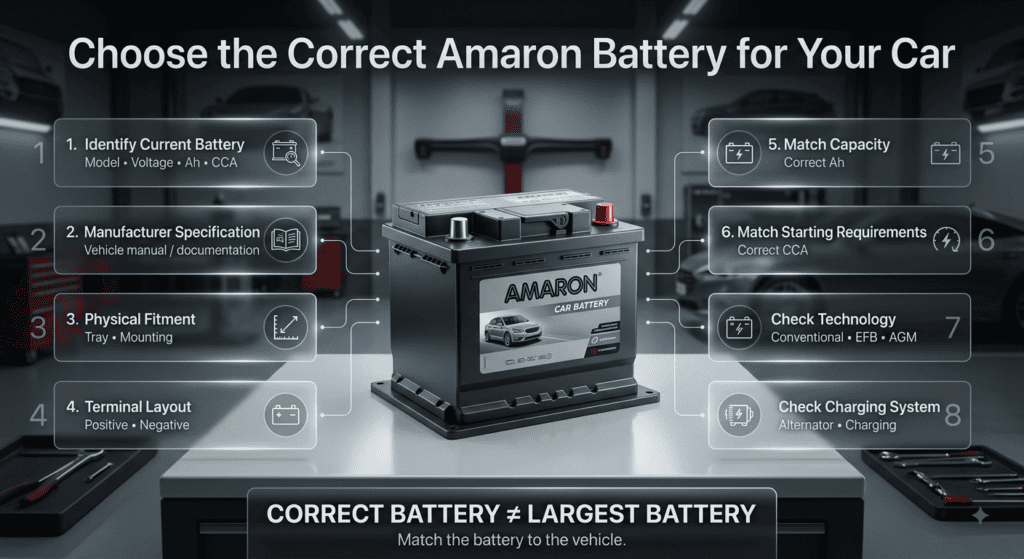
The correct selection process starts with the vehicle.
Step 1: Identify the current battery
Record the complete battery information.
Look for:
- Model number
- Voltage
- Ah
- CCA
- Dimensions
- Terminal configuration
- Battery technology
Step 2: Check the vehicle manufacturer’s specification
The owner’s manual or manufacturer documentation should take priority over assumptions.
Step 3: Confirm physical fitment
Check the battery tray and mounting system.
Step 4: Confirm terminal layout
The positive and negative terminals must be correctly positioned.
Step 5: Match capacity
Choose an Ah rating appropriate for the vehicle.
Step 6: Match starting requirements
CCA should meet the vehicle’s required specification.
Step 7: Check battery technology
Determine whether the vehicle requires conventional, EFB or AGM technology.
Step 8: Check the charging system
If the old battery failed unexpectedly, the alternator and charging system should also be considered.
This process gives a much more reliable result than simply asking for the largest available Amaron battery.
Amaron Battery vs AGM Battery
One of the most important distinctions is between battery brand and battery technology.
Amaron is a battery manufacturer/brand, while AGM describes a specific battery technology.
AGM means Absorbent Glass Mat.
AGM batteries are designed for applications with specific electrical and cycling requirements.
Some modern vehicles use AGM or EFB batteries because of:
- Start-stop systems
- Energy-management systems
- High electrical loads
- Advanced charging strategies
- Frequent engine restarts
If a vehicle was originally equipped with AGM technology, it should not automatically be converted to a conventional battery.
Drivers whose vehicles require AGM can also review the relevant AGM Battery Replacement service when considering battery replacement options.
The important principle is:
Choose the required technology first, then select the appropriate brand and model.
Amaron Batteries for Different Types of Vehicles
Different vehicle categories can require different battery specifications.
| Vehicle type | Main battery consideration |
|---|---|
| Small hatchback | Compact size and appropriate capacity |
| Small sedan | Correct physical fitment |
| Mid-size sedan | Balanced capacity and starting performance |
| Large sedan | Higher electrical requirements |
| SUV | Capacity, CCA and dimensions |
| 4×4 | Starting capability and battery size |
| Diesel vehicle | Strong starting performance |
| Luxury vehicle | Battery technology and registration |
| Start-stop vehicle | AGM/EFB compatibility |
| Performance vehicle | Correct CCA and electrical specification |
These are general categories rather than universal fitment rules.
The actual vehicle model, engine and manufacturer specification should determine the final battery.
Why a Bigger Amaron Battery Is Not Automatically Better
A common mistake is assuming that installing a bigger battery will automatically improve the vehicle.
That is not how battery compatibility works.
A larger battery may have greater capacity, but it may also:
- Be too long
- Be too tall
- Have incorrect terminals
- Have incompatible mounting
- Have the wrong polarity
- Use unsuitable technology
Even if it physically fits, that does not automatically make it the correct battery.
The goal should always be correct specification, not maximum specification.
Why the Highest CCA Battery Is Not Always the Correct Choice
The same principle applies to CCA.
Suppose a driver sees two Amaron batteries and one has a higher CCA rating.
It may appear to be the obvious choice.
But if the higher-CCA battery has incorrect dimensions or terminal configuration, it is not the correct replacement.
CCA should be evaluated alongside:
- Ah
- Dimensions
- Terminal configuration
- Polarity
- Technology
- Vehicle requirements
This is especially important for modern vehicles.
Signs That Your Amaron Battery May Be Weak
A weak battery can show several warning signs before complete failure.
Common symptoms include:
- Slow engine cranking
- Clicking during starting
- Repeated jump-start requirements
- Dim interior lights
- Electronic systems resetting
- Difficulty starting after parking
- Battery warning messages
- Unusual electrical behavior
- Reduced starting performance
However, these symptoms do not prove that the battery itself is defective.
For example, an alternator problem can cause the battery to become discharged.
A parasitic electrical drain can also cause repeated battery failure.
Poor terminal connections can create starting problems even when the battery itself remains healthy.
This is why Engine Diagnostics and electrical testing can be valuable when battery problems continue.
Battery Voltage Test vs Battery Health Test
Many drivers assume that checking battery voltage is enough.
It is not.
A voltage reading can provide useful information about state of charge, but it does not necessarily reveal the battery’s complete starting capability.
A professional inspection may include:
Resting voltage test
This checks the battery’s voltage when the vehicle is not actively starting.
Starting test
The technician observes how the battery behaves when the starter motor operates.
Battery health test
A dedicated battery tester can assess starting capability and estimated battery condition.
Charging-system test
The alternator and charging circuit are checked.
Electrical-drain test
If the battery repeatedly loses charge while parked, the vehicle may require parasitic-drain diagnosis.
This complete approach is much more informative than simply checking whether the battery reads around 12 volts.
Can a Discharged Amaron Battery Be Recharged?
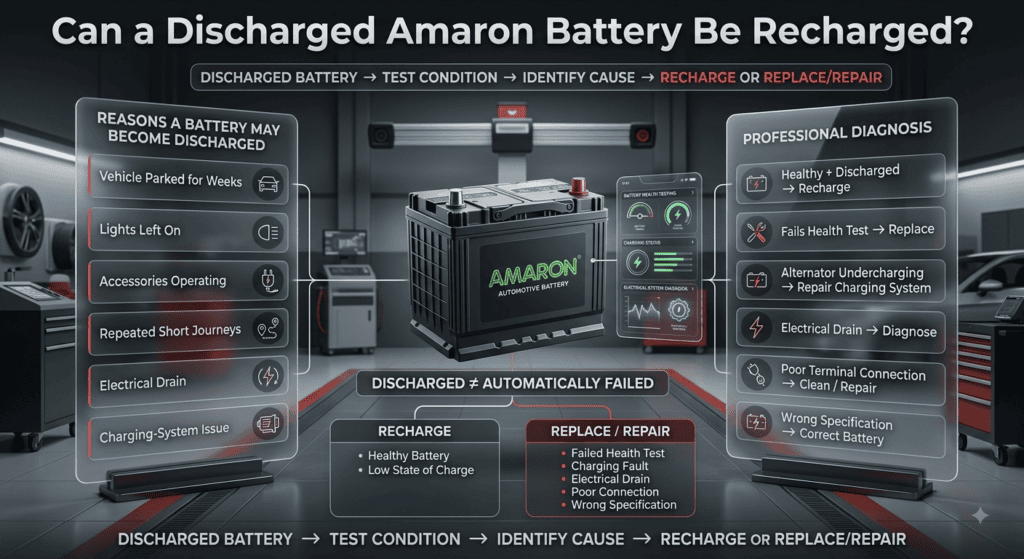
Yes, in some situations.
A battery can become discharged without necessarily being internally defective.
For example:
- Vehicle parked for several weeks
- Lights left on
- Accessories left operating
- Repeated short journeys
- Electrical drain
- Charging-system issue
If the battery remains healthy, proper charging may restore its condition.
Replacement becomes more appropriate when testing indicates that the battery has significantly deteriorated or cannot maintain adequate starting performance.
| Battery condition | Recommended direction |
|---|---|
| Healthy but discharged | Recharge |
| Low state of charge | Recharge and investigate |
| Battery fails health test | Replace |
| Alternator undercharging | Repair charging system |
| Electrical drain detected | Diagnose electrical system |
| Terminal connection poor | Clean/repair |
| Wrong battery specification | Install correct battery |
This is why a dead battery should not automatically be treated as a failed battery.
Why Your New Amaron Battery May Keep Going Flat
If a newly installed battery repeatedly becomes discharged, replacing it again may not solve the problem.
Possible causes include:
Alternator undercharging
The battery may not receive enough charging energy while the engine is running.
Parasitic electrical drain
A component may continue consuming abnormal electrical current while the vehicle is parked.
Poor terminal connection
A loose or contaminated connection can interfere with electrical flow.
Short journeys
The vehicle may not operate long enough to replenish energy used during starting.
Long parking periods
Even normal vehicle electronics consume some electrical energy while parked.
Incorrect battery
The replacement battery may not meet the vehicle’s requirements.
The correct response is diagnosis rather than repeatedly buying another battery.
Amaron Battery Installation: What Professionals Should Check
A proper installation should involve more than removing the old battery and connecting the new one.
The technician should check:
- Correct battery model
- Correct polarity
- Secure mounting
- Clean terminals
- Cable condition
- Terminal tightness
- Battery tray
- Charging-system performance
- Battery-management requirements
If the vehicle is equipped with an advanced battery-management system, the new battery may need to be registered or adapted.
This depends on the specific vehicle.
Battery Registration in Modern Cars
Modern cars increasingly use battery-management systems.
These systems can monitor:
- Battery condition
- Charging
- Electrical consumption
- Battery temperature
- Energy management
Some vehicles require a battery registration or adaptation procedure after replacement.
This does not apply universally.
It depends on the manufacturer and model.
A professional technician should therefore determine whether the vehicle requires such a procedure.
This is particularly important for luxury and modern European vehicles.
Amaron Battery Age and Condition
Battery age is another factor to consider.
Lead-acid batteries naturally undergo internal changes over time.
Dubai’s hot operating environment can increase battery stress and accelerate aging.
However, age alone should not determine replacement.
A battery should ideally be evaluated based on:
- Age
- Health-test result
- Starting performance
- Charging condition
- Vehicle usage
- Physical condition
An older battery that still performs properly may not require immediate replacement, while a newer battery that has experienced repeated discharge may already be compromised.
Amaron Battery Maintenance Tips for Dubai Drivers
Maintenance-free does not mean that drivers should never inspect the battery.
Useful practices include:
Keep terminals clean
Corrosion or contamination can affect electrical connections.
Check battery mounting
The battery should remain securely fixed.
Monitor starting performance
Slow cranking is worth investigating.
Avoid unnecessary electrical loads
Lights and accessories should not be left operating with the engine switched off.
Investigate repeated discharge
A battery that repeatedly goes flat needs diagnosis.
Check the charging system
The alternator should be tested when battery discharge is unexplained.
Test before long journeys
A battery showing warning signs should be checked before extended travel.
A broader Vehicle Inspection can also identify related problems before they become roadside failures.
Amaron Battery and Alternator Problems
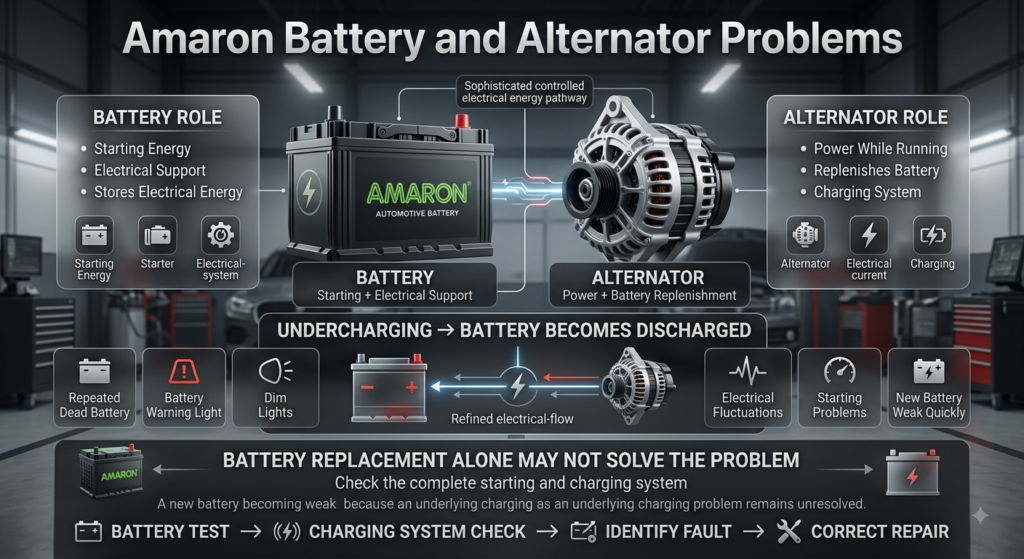
The battery and alternator perform different but connected functions.
The battery provides energy for starting and supports the vehicle’s electrical system.
The alternator produces electrical power while the engine is running and replenishes the battery.
If the alternator is undercharging, the battery can gradually become discharged.
Possible signs include:
- Repeated dead battery
- Battery warning light
- Dim lights
- Electrical fluctuations
- Starting problems
- New battery becoming weak quickly
Replacing the battery without addressing an alternator fault can therefore result in another failure.
Professional Mechanical Repair should consider the complete starting and charging system when battery problems repeat.
Amaron Battery and Parasitic Drain
A parasitic drain occurs when a vehicle consumes more electrical power than expected while it is parked.
Modern vehicles normally continue using a small amount of electricity for systems such as security and memory functions.
The problem occurs when an abnormal electrical load remains active.
Potential causes can include:
- Faulty accessories
- Aftermarket equipment
- Lighting problems
- Electronic modules
- Alarm faults
- Incorrect wiring
A professional electrical diagnosis is required to identify the source.
Repeated battery replacement without fixing the drain does not solve the underlying problem.
Amaron Battery Specifications for Luxury Vehicles
Luxury vehicles often have much more sophisticated electrical systems.
They can include:
- Advanced infotainment
- Electric seats
- Multiple control modules
- Security systems
- Driver-assistance features
- Start-stop technology
- Battery-management systems
Because of this complexity, battery selection should be particularly precise.
The correct battery may need:
- Specific capacity
- Specific CCA
- Specific dimensions
- Specific technology
- Battery registration
For luxury vehicles, professional Luxury Car Service is preferable to choosing a battery based only on a visual comparison with the old one.
Amaron Battery Price in Dubai
Amaron battery prices vary according to specification and application.
Important factors include:
- Ah capacity
- CCA
- Battery dimensions
- Battery technology
- Model series
- Warranty
- Vehicle application
- Availability
- Installation
- Delivery
A small passenger-car battery and a high-capacity SUV battery will naturally have different pricing.
Likewise, an AGM battery can have a different price from a conventional maintenance-free battery.
Drivers researching the wider Dubai battery market can also review the Car Battery Prices in Dubai guide to understand the factors that influence battery replacement costs.
The cheapest battery is not necessarily the most economical option if it does not match the vehicle or fails prematurely.
Comparing Amaron With Other Battery Brands
Amaron should not be compared with other brands simply on reputation.
A useful comparison looks at equivalent specifications.
| Factor | Why it matters |
|---|---|
| Ah | Rated capacity |
| CCA | Starting capability |
| RC | Reserve capability |
| Dimensions | Physical fitment |
| Technology | Vehicle compatibility |
| Terminal layout | Correct connection |
| Warranty | Ownership support |
| Availability | Replacement convenience |
| Installation | Correct setup |
For example, drivers can compare the vehicle’s requirements against a suitable Bosch Battery, Exide Battery, Panasonic Battery, or FIAMM Battery where those products are available in the required specification.
The objective is not to decide that one brand is universally better.
The objective is to find the correct battery for the vehicle.
Amaron vs Tuflong Battery
Tuflong is another battery option that may be considered for certain vehicles.
The same selection process applies.
Check:
- Vehicle compatibility
- Battery dimensions
- Ah
- CCA
- Terminal arrangement
- Battery technology
- Warranty
A Tuflong Battery can be considered when its specification matches the vehicle.
The brand should follow the application requirements.
Amaron vs AC Delco Battery
AC Delco is another battery brand available for various vehicle applications.
Again, brand alone does not determine suitability.
A AC Delco Battery should be evaluated using the same criteria:
- Voltage
- Capacity
- CCA
- Dimensions
- Terminal configuration
- Technology
- Vehicle compatibility
This makes battery comparison much more objective.
Common Mistakes When Buying an Amaron Battery
Choosing only by Ah
A larger capacity does not guarantee compatibility.
Choosing only by CCA
High starting current does not solve physical or electrical incompatibility.
Ignoring dimensions
The battery must fit and be secured correctly.
Ignoring terminal layout
Incorrect terminal positioning can prevent correct cable connection.
Ignoring battery technology
AGM, EFB and conventional batteries are not automatically interchangeable.
Replacing without testing
A discharged battery may not be defective.
Ignoring the alternator
A charging problem can cause another battery to fail.
Ignoring electrical drain
A healthy battery can repeatedly discharge because of a parasitic load.
Assuming all Amaron batteries are identical
Different Amaron models have different specifications.
When Should You Replace an Amaron Battery?
Replacement becomes more likely when testing shows that the battery can no longer provide adequate starting performance or maintain a healthy charge.
Important warning signs include:
- Repeated starting failure
- Battery failing a professional health test
- Severe deterioration in CCA
- Physical damage
- Persistent inability to hold charge
- Battery reaching the end of its service life
- Correct charging system but repeated battery failure
The battery should ideally be tested before replacement whenever circumstances allow.
This is particularly important because battery symptoms can overlap with starter, alternator and electrical-system problems.
Amaron Battery Replacement Checklist
Before installing a new Amaron battery, verify the following:
- Correct voltage
- Correct Ah capacity
- Correct CCA
- Appropriate Reserve Capacity
- Correct dimensions
- Correct terminal configuration
- Correct polarity
- Correct mounting arrangement
- Correct battery technology
- Vehicle compatibility
- Battery condition
- Manufacturing information
- Warranty details
- Charging system
- Electrical drain where necessary
- Battery registration where required
This checklist covers the major specifications that affect real-world battery compatibility.
Professional Battery Inspection Process
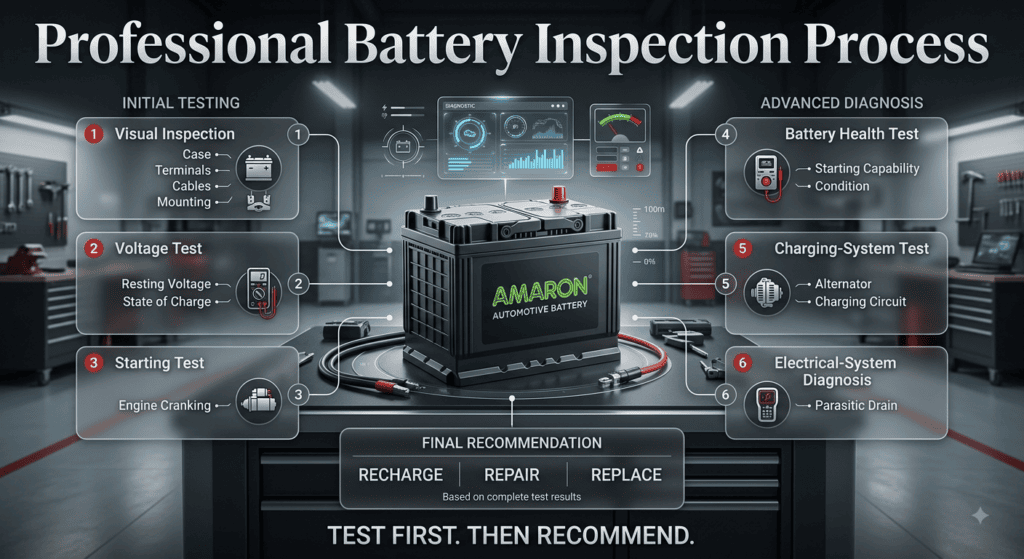
A professional battery inspection should be systematic.
Visual inspection
The technician checks the battery case, terminals, cables and mounting.
Voltage test
Resting voltage provides information about the battery’s state of charge.
Starting test
The battery is assessed during engine cranking.
Battery health test
A dedicated tester can assess starting capability and estimated condition.
Charging-system test
The alternator and charging circuit are checked.
Electrical-system diagnosis
If the battery repeatedly loses charge while parked, the vehicle may require a parasitic-drain test.
Final recommendation
Only after considering the test results should the technician recommend recharge, repair or replacement.
This approach is much more reliable than simply replacing a battery because the car failed to start.
When a Battery Problem Requires Roadside Assistance
A battery problem can become a roadside problem when the vehicle will not start and cannot be safely driven to a workshop.
In such circumstances, a professional Roadside Assistance service can be useful for:
- Battery testing
- Jump-starting
- Battery replacement
- Basic electrical diagnosis
- Vehicle recovery when necessary
A jump-start can get the vehicle running temporarily, but the underlying battery condition should still be checked.
If the battery has repeatedly failed, continuing to rely on jump-starts is not a long-term solution.
Battery Failure Before Work or Daily Commute
A weak battery often becomes noticeable at inconvenient times.
For drivers who use their vehicles for daily commuting, a battery that has started cranking slowly should not be ignored.
The problem can progress from:
slower starting → intermittent starting problem → complete no-start
This is why preventive battery testing can be valuable.
A professional battery inspection can determine whether the battery is healthy enough for continued use or approaching replacement.
Battery Inspection Before Long-Distance Travel
A long-distance journey can place greater importance on battery reliability.
Before traveling, especially in Dubai’s hot conditions, consider checking:
- Battery health
- Battery terminals
- Charging system
- Starting performance
- Battery age
- Dashboard warning lights
The same inspection can be combined with other vehicle checks such as:
- Tire condition
- Engine oil
- Coolant
- Brake condition
- AC performance
- Fluid levels
This makes battery inspection part of preventive vehicle care rather than an emergency response.
Amaron Battery Specifications and Preventive Maintenance
A battery should be treated as part of the vehicle’s wider maintenance system.
Preventive maintenance can include:
- Battery health testing
- Charging-system inspection
- Terminal inspection
- Electrical-system checks
- Starter-system checks
- Vehicle diagnostics
- Regular servicing
This broader approach can help identify developing problems before they become roadside failures.
For vehicles experiencing battery-related symptoms, a complete Car Repair inspection may reveal that the battery is only one part of the problem.
What specifications should I check before buying an Amaron car battery?
Before buying an Amaron car battery, you should check the voltage, Ah capacity, CCA, physical dimensions, terminal position, polarity, battery technology and vehicle compatibility. These specifications work together, so choosing a battery based only on its Ah rating or CCA can lead to an incorrect fit.
For example, two Amaron batteries can both be 12V but have different capacities, dimensions and terminal arrangements. One may be suitable for a particular sedan while another is designed for a larger vehicle. The correct specification should therefore be matched against the vehicle manufacturer’s requirements rather than selected simply because the battery has a higher rating.
The existing battery can provide useful information, but it should not always be copied blindly. If the previous battery was incorrectly fitted, using the same specification could repeat the original problem.
Important points to check:
Voltage and battery capacity
CCA or starting-current requirement
Battery dimensions
Positive and negative terminal positions
Battery technology, such as conventional, EFB or AGM
Correct mounting configuration
Vehicle manufacturer’s recommended specification
A professional Battery Replacement inspection is particularly useful when the original battery specification is unclear or the vehicle has already experienced repeated starting problems.
What do Ah and CCA mean on an Amaron car battery?
Ah and CCA describe different aspects of battery performance. Ah refers to the battery’s rated capacity, while CCA describes its ability to provide high starting current under a standardized test. Neither specification should be treated as a replacement for the other.
A battery with a higher Ah rating generally has greater rated capacity, but that does not automatically make it the correct battery for every vehicle. Similarly, a higher CCA rating can provide stronger starting capability, but the battery still needs to have the correct dimensions, terminals and technology for the vehicle.
This distinction becomes particularly important when comparing different Amaron models. A driver may see one model with a higher number and assume it is automatically better, when the real question is whether that particular specification matches the vehicle.
When comparing Ah and CCA, remember:
Ah: relates to rated battery capacity.
CCA: relates to high-current starting capability.
Higher Ah does not automatically mean better compatibility.
Higher CCA does not automatically mean better compatibility.
Physical size and terminal arrangement still have to match.
The vehicle manufacturer’s specification should remain the reference point.
For Dubai vehicles, battery selection should also consider operating conditions such as high temperatures, frequent air-conditioning use and traffic-heavy driving. These conditions can increase the importance of maintaining a healthy starting and charging system.
Is a higher CCA or higher Ah Amaron battery always better for my car?
A higher rating is not automatically a better choice. The correct battery is the one that meets the vehicle’s required specification and fits the vehicle’s electrical and physical requirements.
It is common for drivers to assume that installing the largest available battery will give them better performance. In practice, battery compatibility is more complicated. A battery can have excellent CCA and capacity but still be unsuitable because its case is too large, its terminals are positioned differently, its polarity does not match, or its technology is inappropriate for the vehicle.
For modern vehicles, battery technology is particularly important. A vehicle designed around an AGM or EFB battery may require the appropriate technology rather than simply a conventional battery with a similar Ah rating.
Before choosing a higher-rated battery, verify:
Correct battery size
Correct Ah range
Required CCA
Terminal arrangement
Polarity
Mounting system
Battery technology
Manufacturer compatibility
The professional approach is therefore not “choose the biggest battery.” It is “choose the correct battery specification.”
This approach can also prevent unnecessary expense because buying a larger battery that cannot be installed correctly does not provide any real benefit.
How do I know which Amaron battery specification is correct for my car in Dubai?
The safest way to identify the correct Amaron battery is to start with your vehicle’s make, model, year, engine specification and original battery requirements. From there, the battery’s complete specifications should be matched rather than relying on the brand name alone.
The existing battery can then be inspected for its model number, capacity, CCA, dimensions and terminal configuration. However, if the vehicle has had previous battery replacements, a professional should confirm that the existing battery is actually the correct specification.
This is particularly relevant in Dubai because vehicles may experience demanding conditions from heat, extended AC operation, frequent stop-and-go traffic and periods of parking. A battery that is marginally suitable may become noticeably weaker under demanding conditions.
A proper battery-selection process should include:
Identify the exact vehicle
Check the manufacturer’s battery requirement
Inspect the current battery
Verify Ah and CCA
Measure physical dimensions if necessary
Confirm terminal layout and polarity
Check whether AGM, EFB or another technology is required
Test the charging system when battery failure is involved
If the battery has gone flat repeatedly, do not assume that installing another battery will solve everything. The alternator, starter system, battery connections and possible parasitic electrical drain should also be considered.
Why does my Amaron battery keep getting discharged even though it is relatively new?
When a relatively new Amaron battery repeatedly becomes discharged, the battery itself may not be the original cause. The vehicle’s charging system, electrical system, connections or driving pattern should be investigated before another battery is purchased.
One common possibility is an alternator that is not replenishing the battery properly while the engine is running. Another is parasitic drain, where an electrical component continues consuming more power than expected while the vehicle is parked.
Short journeys can also contribute to repeated low charge because the vehicle may not run long enough to replace the energy used during starting. Loose or contaminated battery terminals can create additional electrical problems.
Common causes include:
Alternator or charging-system problems
Parasitic electrical drain
Poor battery-terminal connections
Long periods of vehicle inactivity
Frequent short-distance journeys
Excessive electrical accessory use
Incorrect battery specification
Battery-management-system issues on some modern vehicles
A proper battery diagnosis should therefore include more than a simple voltage reading. Battery health, starting performance and charging-system operation should be assessed before deciding whether the battery needs replacement.
This is especially important in Dubai, where a weak battery may become unreliable during demanding operating conditions. If a vehicle requires repeated jump-starts, the underlying cause should be diagnosed rather than treating jump-starting as a permanent solution.
Conclusion
Understanding Amaron car battery specifications is essential before choosing a replacement battery for your vehicle. The right battery is not simply the one with the highest Ah or CCA rating. It must match the vehicle’s required voltage, capacity, starting performance, dimensions, terminal configuration, polarity, mounting arrangement and battery technology.
For Dubai drivers, battery selection deserves extra attention because high temperatures, heavy AC usage, traffic conditions, short journeys and extended parking can place additional demands on the vehicle’s starting and charging system. At the same time, repeated battery discharge should never automatically be blamed on the battery itself. An alternator fault, parasitic drain, poor connection or incorrect battery specification may be responsible.
A professional battery inspection can determine whether an Amaron battery needs charging, replacement or whether another vehicle fault needs to be addressed first. Once the correct specification is identified and properly installed, regular battery checks and preventive Vehicle Maintenance can help reduce unexpected starting problems.
Ultimately, the best Amaron battery is the one correctly matched to your vehicle—not simply the biggest or highest-rated model available. Proper specification, professional installation and a healthy charging system are the foundation of reliable battery performance and dependable driving in Dubai.
Leave a Reply