
Introduction
AGM Battery Advantages and Limitations | Modern vehicles depend on their batteries for far more than simply starting the engine. Today’s cars can contain start-stop systems, advanced infotainment, driver-assistance technology, electronic safety systems, power seats, sensors, cameras, climate-control equipment, and numerous computer modules. Because of this increasing electrical demand, choosing the correct battery technology has become an important part of vehicle maintenance.
One technology that has become particularly important is the Absorbent Glass Mat battery, commonly known as an AGM battery. Understanding the AGM battery advantages and limitations can help vehicle owners make a more informed decision when diagnosing battery problems or planning a replacement.
For drivers looking for professional automotive support, EuroSwift Auto Services provides a broader vehicle-maintenance approach covering battery services, diagnostics, roadside assistance, repairs, and preventive automotive care. When an AGM battery begins showing signs of weakness, understanding whether the problem is the battery itself, the charging system, or another electrical component is essential.
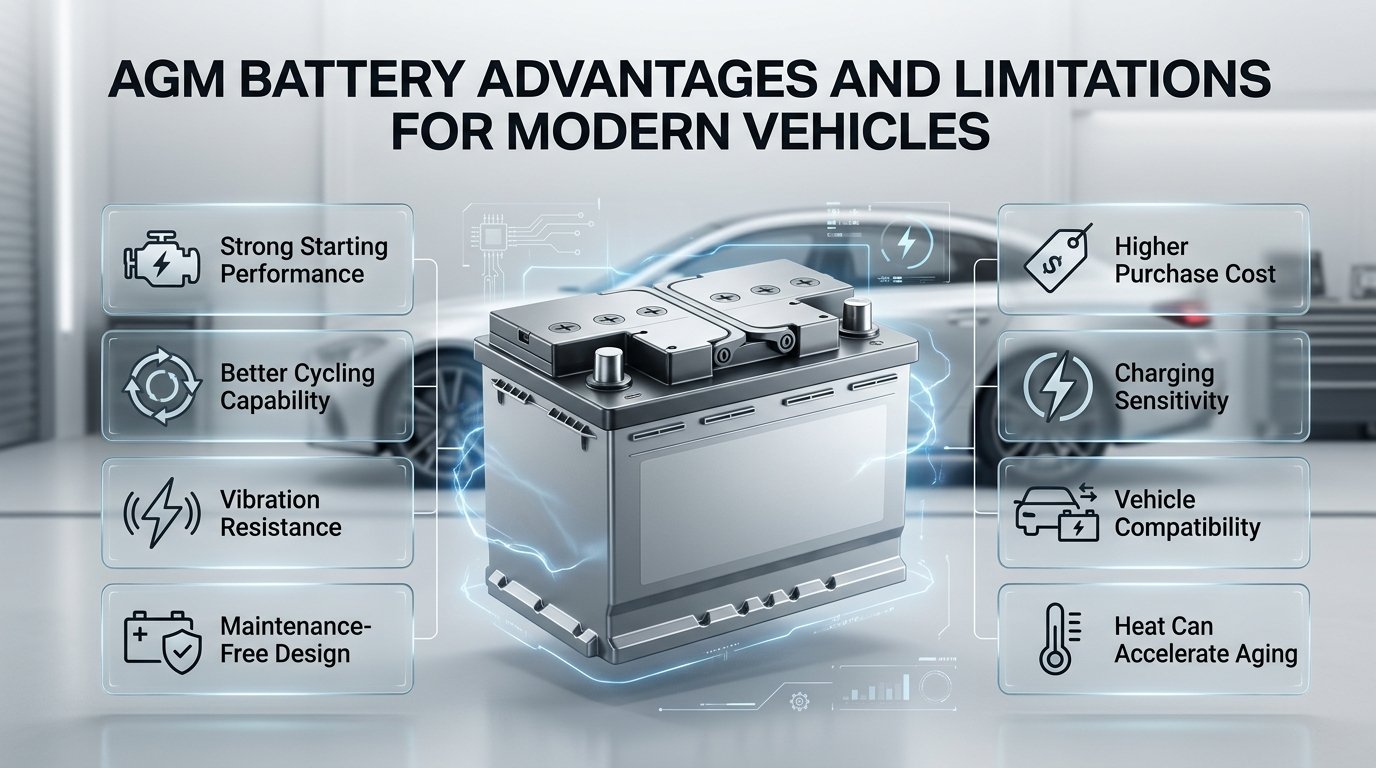
An AGM battery can offer excellent starting performance, strong cycling capability, vibration resistance, and reliable support for many modern electrical systems. However, it also costs more than many conventional batteries and has specific charging and compatibility requirements.
This detailed guide explains how AGM batteries work, their major advantages, limitations, maintenance requirements, replacement considerations, Dubai driving factors, troubleshooting procedures, cost considerations, and the situations where AGM technology makes the most sense.
What Is an AGM Battery?
AGM stands for Absorbent Glass Mat. It is a type of valve-regulated lead-acid battery in which the electrolyte is absorbed and held within specialized fiberglass mats.
In a traditional flooded lead-acid battery, the electrolyte moves more freely around the internal plates. AGM technology uses the glass-mat separator to keep the electrolyte close to the plates.
This construction changes the way the battery handles vibration, charging, cycling, and electrical demand.
AGM batteries are generally sealed and maintenance-free under normal operating conditions. They are commonly used in modern passenger vehicles, premium cars, vehicles with start-stop systems, and applications where dependable electrical performance is important.
The important point is that AGM does not simply mean “a more powerful battery.” It is a different battery technology designed for particular vehicle requirements.
A vehicle originally designed for AGM should normally receive a compatible AGM replacement. Likewise, a vehicle designed around another battery technology should not automatically be converted to AGM without confirming compatibility.
How AGM Battery Technology Works
The internal construction of an AGM battery explains many of its performance characteristics.
The battery contains positive and negative lead plates separated by fiberglass mats. These mats absorb the electrolyte, keeping it distributed throughout the internal structure.
The battery also uses pressure-regulating valves. During normal operation, gases produced inside the battery can recombine within the battery rather than causing significant electrolyte loss.
This design contributes to the battery’s sealed and maintenance-free characteristics.
Main AGM characteristics
| Characteristic | AGM Battery |
|---|---|
| Battery chemistry | Lead-acid |
| Electrolyte design | Absorbed in glass mat |
| Maintenance | Generally maintenance-free |
| Vibration resistance | High |
| Cycling capability | Generally higher than conventional flooded batteries |
| Start-stop compatibility | Common in suitable applications |
| Purchase cost | Usually higher |
| Charging requirements | More specific |
| Spill resistance | High when properly installed |
| Vehicle compatibility | Specification-dependent |
AGM technology is therefore particularly useful when a vehicle requires a battery capable of handling repeated electrical demands without sacrificing starting performance.
AGM Battery Advantages Explained
Understanding the benefits requires looking beyond marketing claims. AGM batteries provide several genuine engineering advantages, but those advantages are most useful when the vehicle’s electrical system was designed to take advantage of them.
1. Strong Starting Performance
One of the biggest AGM battery advantages is strong starting performance.
Starting an engine requires a significant amount of electrical current for a short period. The battery must deliver power to the starter motor while also supporting various vehicle systems.
A properly sized AGM battery can provide strong cranking performance and maintain dependable starting capability when it is healthy and correctly charged.
This can be especially valuable for vehicles with larger engines or sophisticated electrical systems.
However, starting performance depends on more than battery technology. Battery capacity, cold-cranking rating, temperature, battery age, starter condition, cable connections, and engine condition all influence how easily a vehicle starts.
Therefore, an AGM battery should always be selected according to the vehicle manufacturer’s requirements rather than simply choosing the highest-rated model available.
2. Excellent Support for Start-Stop Systems
Start-stop technology is now common in many modern vehicles.
The system automatically switches the engine off under suitable conditions and restarts it when the driver needs to move again. In heavy traffic, this can result in many engine restarts during a single journey.
A conventional battery may not be designed for such repeated cycling.
AGM technology is widely used in start-stop applications because it can tolerate repeated charge and discharge cycles better than many basic flooded batteries.
This does not mean every start-stop vehicle requires AGM. Some vehicles use EFB technology instead.
The correct choice depends on the original vehicle specification.
3. Better Vibration Resistance
A car battery is exposed to constant vibration.
Engine movement, road imperfections, suspension movement, acceleration, braking, and rough surfaces can all transmit vibration into the battery.
The internal construction of AGM batteries helps secure the electrolyte and internal components, giving AGM batteries strong resistance to vibration.
This can be particularly useful in vehicles operating in demanding conditions.
Nevertheless, vibration resistance does not eliminate the need for correct installation. The battery must be firmly secured in its tray, and the terminals and cables must be properly connected.
A loose battery can experience unnecessary movement regardless of its internal technology.
4. Good Cycling Capability
Cycling refers to repeatedly drawing energy from the battery and then replenishing that energy.
Modern vehicles can place significant cycling demands on their batteries because electrical equipment may continue operating while the engine is stopped or during frequent short journeys.
AGM batteries generally handle these conditions better than basic conventional flooded batteries.
This makes AGM particularly useful for vehicles with:
- Start-stop systems
- High electrical loads
- Frequent urban driving
- Multiple electronic accessories
- Advanced climate-control systems
- High-end audio systems
- Extensive onboard electronics
However, even an AGM battery has limits. Continuous deep discharge can reduce battery life.
5. Maintenance-Free Convenience
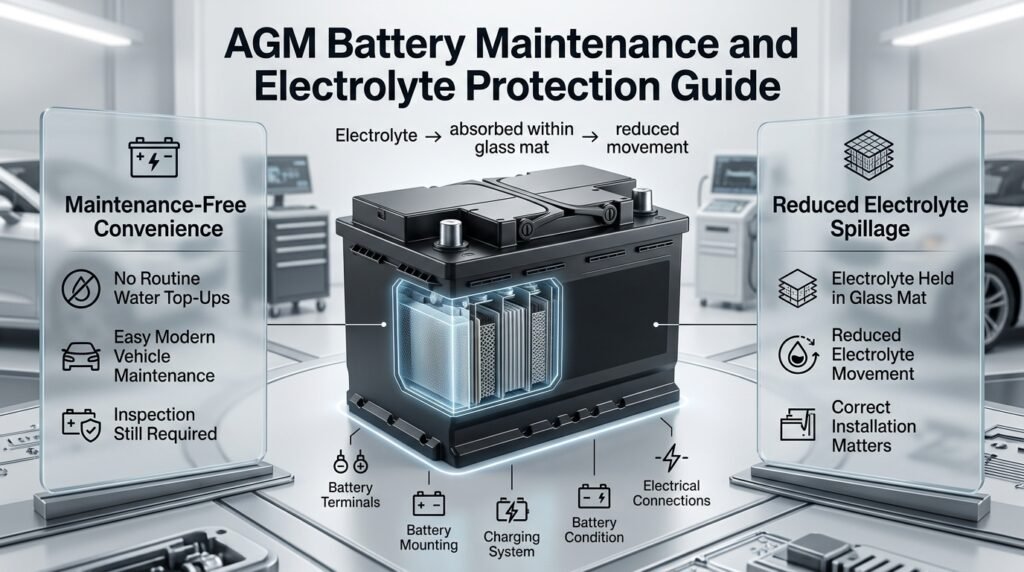
AGM batteries are generally designed as maintenance-free batteries.
Unlike some traditional serviceable flooded batteries, they do not normally require owners to add distilled water as part of routine maintenance.
This is convenient for modern vehicles where battery access may be limited.
However, “maintenance-free” should not be misunderstood as “does not need inspection.”
The battery terminals, mounting, charging system, battery condition, and electrical connections still need attention.
If the vehicle repeatedly experiences starting problems, professional inspection is more appropriate than simply assuming the battery will recover on its own.
6. Reduced Risk of Electrolyte Spillage
The electrolyte in an AGM battery is absorbed into the glass-mat material rather than freely moving around the case.
This helps reduce the risk of electrolyte movement and spillage during normal vehicle operation.
The battery is still not immune to damage. A physically damaged battery should not be used, and installation should always follow the manufacturer’s instructions.
Correct positioning is also important because not every battery should be installed in every orientation simply because it is an AGM design.
7. Suitable for Vehicles With High Electrical Demand
Today’s vehicles have dramatically more electronics than older cars.
A modern vehicle may simultaneously operate:
- Navigation systems
- Digital displays
- Cameras
- Parking sensors
- Driver-assistance systems
- Electronic control units
- Electric seats
- Heated accessories
- Audio systems
- Interior lighting
- Climate-control electronics
AGM batteries can be well suited to many of these vehicles because they are designed to provide strong electrical performance and cycling capability.
This is particularly relevant for luxury vehicles where the electrical system may be significantly more complex.
AGM Battery Limitations You Should Understand
A professional battery guide should explain disadvantages as clearly as advantages.
AGM technology has several limitations that vehicle owners should consider before purchasing or installing one.
1. Higher Purchase Price
The first obvious limitation is cost.
AGM batteries are generally more expensive than many conventional flooded batteries.
The higher price reflects their construction and performance characteristics, but that does not mean every driver should pay more for AGM.
If a vehicle was designed for a conventional battery and does not require AGM characteristics, an AGM upgrade may provide limited practical benefit.
The correct approach is to match the battery technology to the vehicle.
For drivers comparing replacement costs, a detailed Car Battery Prices in Dubai guide can help explain why battery prices vary between specifications, brands, capacities, and technologies.
2. More Sensitive to Incorrect Charging
AGM batteries have specific charging characteristics.
Incorrect charging voltage or inappropriate charger settings can negatively affect battery performance and longevity.
This becomes particularly important when an external charger or battery maintainer is being used.
Drivers should use equipment compatible with AGM technology and follow the vehicle and battery manufacturer’s charging recommendations.
If there is uncertainty about charging requirements, professional inspection is safer than experimenting with different charging settings.
3. Vehicle Compatibility Matters
Not every vehicle should receive an AGM battery.
A vehicle’s electrical system may be designed around a particular battery technology, capacity, charging strategy, and battery-management system.
Before replacement, technicians should verify:
- Original battery technology
- Battery capacity
- Cold-cranking specification
- Physical dimensions
- Terminal position
- Charging requirements
- Battery-management-system requirements
- Manufacturer recommendations
Choosing a battery simply because it is more expensive or has a higher specification can create compatibility problems.
4. AGM Batteries Are Still Affected by Heat
AGM construction offers many advantages, but AGM does not make a battery immune to high temperatures.
Heat remains one of the important factors affecting lead-acid battery aging.
High under-hood temperatures can accelerate chemical reactions and contribute to faster deterioration over time.
This is particularly relevant in hot climates.
For vehicles operating in Dubai, battery condition should be monitored as part of routine Vehicle Maintenance. Long periods of heat exposure, traffic congestion, frequent short journeys, and heavy electrical use can all contribute to demanding operating conditions.
AGM vs Conventional Battery
The difference between AGM and traditional flooded batteries can be summarized as follows.
| Feature | AGM | Conventional Flooded |
|---|---|---|
| Electrolyte | Absorbed in glass mat | Free-flowing |
| Maintenance | Generally maintenance-free | Depends on design |
| Vibration resistance | High | Generally lower |
| Cycling ability | Higher in suitable applications | Generally lower |
| Start-stop use | Common | Limited/application-dependent |
| Cost | Higher | Usually lower |
| Charging sensitivity | Higher | Generally more forgiving |
| High electrical demand | Strong option | Vehicle-dependent |
| Spill resistance | High | Lower |
There is no universal winner.
The best battery is the one that matches the vehicle.
A conventional battery can be perfectly appropriate for a vehicle designed around it, while an AGM battery can be the correct choice for a vehicle specifically engineered to use AGM technology.
AGM vs EFB Battery
EFB stands for Enhanced Flooded Battery.
EFB technology improves upon traditional flooded battery construction and is used in many vehicles with start-stop functionality.
AGM generally provides greater cycling capability, but EFB may be exactly what a particular vehicle requires.
| Characteristic | AGM | EFB |
|---|---|---|
| Basic construction | Absorbed glass mat | Enhanced flooded |
| Cycling performance | High | Improved |
| Start-stop applications | Common | Common |
| Typical cost | Higher | Lower |
| Electrical demand | Suitable for demanding applications | Suitable for moderate-to-demanding applications |
| Replacement decision | Vehicle-specific | Vehicle-specific |
If a vehicle originally uses EFB, replacing it with AGM should only be considered after compatibility has been confirmed.
The same principle applies in reverse.
When Does a Vehicle Need an AGM Battery?
The strongest reason to use AGM is manufacturer specification.
An AGM battery may be appropriate when the vehicle:
- Was originally equipped with AGM
- Uses an advanced start-stop system
- Has significant electrical demand
- Requires high cycling capability
- Uses a battery-management system designed around AGM
- Has a manufacturer-approved AGM configuration
Premium and luxury vehicles may also use AGM batteries because of their extensive electrical systems.
However, the vehicle model and original battery specification should always be checked.
This is particularly important when dealing with European vehicles and other modern cars where battery-management systems can be highly sophisticated.
Signs Your AGM Battery May Be Weak
Battery failure does not always happen suddenly.
Several warning signs can appear before complete failure.
Common warning signs include:
✔ Engine cranking becomes slower.
✔ The vehicle occasionally struggles to start.
✔ Start-stop functionality becomes unavailable.
✔ Battery or charging warnings appear.
✔ Electrical accessories behave unusually.
✔ The battery repeatedly becomes discharged.
✔ The vehicle needs frequent jumpstarts.
✔ Battery testing shows reduced capacity.
✔ The battery is significantly aged.
One symptom does not automatically prove that the AGM battery is defective.
A weak alternator, poor ground connection, starter problem, parasitic drain, or damaged cable can create similar symptoms.
This is why proper Engine Diagnostics and electrical testing are valuable before replacement.
AGM Battery Troubleshooting Guide
When a vehicle has a battery problem, the first question should be:
Is the battery actually the cause?
Consider the following troubleshooting table.
| Problem | Possible Cause | Recommended Action |
|---|---|---|
| Slow starting | Weak battery | Battery health test |
| Battery repeatedly discharges | Parasitic drain | Electrical drain diagnosis |
| Battery warning | Charging issue | Alternator test |
| New battery becomes weak | Charging/drain problem | Full electrical inspection |
| Start-stop unavailable | Battery state/system condition | Battery-management diagnosis |
| Poor connection | Loose/corroded terminal | Terminal inspection |
| Vehicle won’t start after storage | Discharge or aging | Battery + charging test |
Replacing the battery without investigating repeated discharge can result in the same problem happening again.
Professional AGM Battery Inspection Process
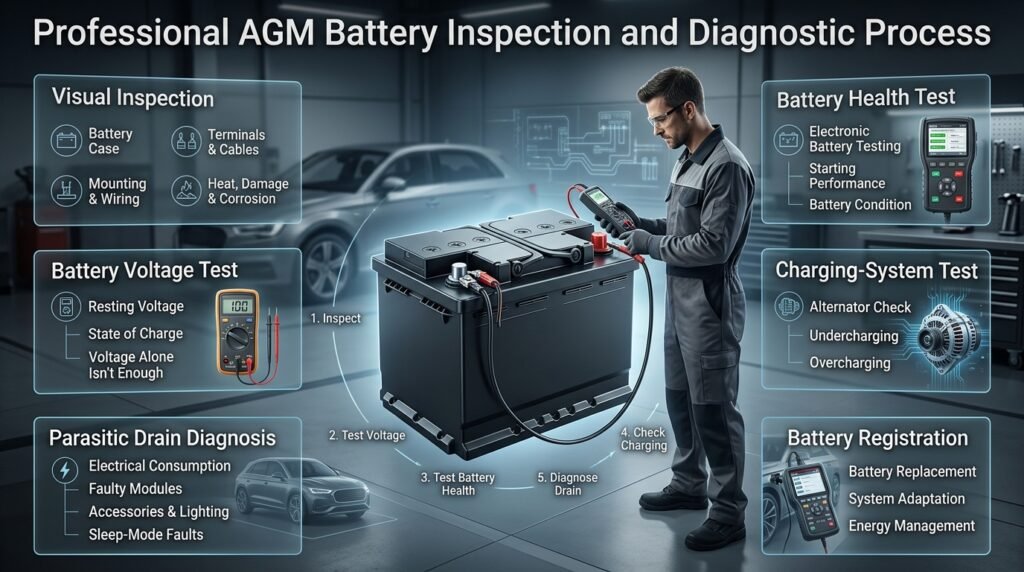
A professional inspection should evaluate the complete electrical system.
Visual Inspection
The technician first checks the battery and surrounding area.
Important items include:
- Battery case condition
- Terminal condition
- Cable connections
- Mounting bracket
- Wiring
- Signs of overheating
- Physical damage
- Corrosion
Battery Voltage Test
Resting voltage can provide useful information about the battery’s state of charge.
However, voltage alone is not enough to determine battery health.
Battery Health Test
Modern battery testers can evaluate battery condition using electronic testing methods.
This helps determine whether the battery can still provide the required starting performance.
Charging-System Test
The alternator should also be checked.
If the charging system is undercharging or overcharging, replacing the battery alone will not solve the underlying issue.
Parasitic Drain Diagnosis
If a vehicle repeatedly loses charge while parked, technicians may test for excessive electrical consumption.
Possible causes include:
- Faulty modules
- Aftermarket electronics
- Lighting faults
- Security systems
- Accessories
- Control modules failing to enter sleep mode
Battery Registration
Some modern vehicles require the new battery to be registered or adapted after installation.
This allows the vehicle’s energy-management system to recognize the replacement.
AGM Battery Replacement Process
AGM Battery Replacement should begin with identification and testing rather than immediately removing the old battery.
A professional replacement process generally includes the following stages:
1. Identify the original specification
The technician confirms the battery technology, capacity, physical dimensions, and starting rating.
2. Check the charging system
A battery should not be replaced blindly if the alternator may be responsible for the problem.
3. Select the correct replacement
The new battery should meet the vehicle’s requirements.
4. Install the battery correctly
Correct terminal placement and secure mounting are essential.
5. Check electrical connections
Loose or contaminated connections can cause starting and charging problems.
6. Register the battery when required
Some vehicles require electronic battery registration.
7. Test the complete system
After installation, the battery and charging system should be checked again.
Why Battery Registration Can Matter
Modern vehicles increasingly use intelligent energy-management systems.
These systems can monitor battery condition and influence charging behavior.
If a battery is replaced without registration where registration is required, the vehicle may continue operating according to the characteristics of the old battery.
This can potentially affect charging strategy and battery management.
Battery registration requirements vary between manufacturers and models.
Therefore, technicians should use appropriate diagnostic equipment when the vehicle requires electronic adaptation.
AGM Battery Maintenance Tips
Even though AGM batteries are maintenance-free in normal use, owners should still follow good maintenance practices.
Recommended practices
✔ Keep battery terminals clean.
✔ Make sure the battery is securely mounted.
✔ Avoid leaving electrical accessories running unnecessarily.
✔ Test the battery if starting performance changes.
✔ Inspect the charging system if the battery repeatedly becomes discharged.
✔ Use an AGM-compatible charger when necessary.
✔ Check battery condition before extended travel.
✔ Investigate repeated jumpstarts.
✔ Inspect the vehicle after long periods of storage.
✔ Follow the manufacturer’s battery specification.
The objective is not simply to make the battery last longer. The bigger goal is to prevent unexpected vehicle downtime.
Dubai Climate and AGM Battery Performance
Dubai presents a demanding environment for automotive batteries.
High ambient temperatures can contribute to faster battery aging, particularly when combined with high under-hood temperatures.
Urban traffic can also affect electrical demand.
Vehicles may spend long periods in slow-moving traffic while the driver uses:
- Air conditioning
- Cooling fans
- Infotainment
- Navigation
- Lighting
- Electronic accessories
Short journeys can create another challenge because the alternator may have limited time to replace the energy consumed during starting and electrical operation.
This is why drivers in Dubai should consider battery health as part of a complete Car Service and preventive maintenance program.
Regular inspection is particularly useful before long-distance journeys or when the vehicle has already shown starting problems.
AGM Battery and Frequent Short Trips
Short journeys are not automatically harmful to every battery, but repeated short trips can create an imbalance between energy consumed and energy restored.
Starting the engine requires electrical energy.
If the vehicle is then driven only a short distance, the charging system may not have sufficient time to replenish all the energy used during starting and other electrical demands.
Over time, this can contribute to a lower state of charge.
Drivers who regularly make short trips should therefore pay attention to:
- Starting performance
- Battery age
- Charging-system condition
- Electrical accessories
- Vehicle storage periods
A professional battery test can provide a clearer picture than guessing based on driving distance alone.
AGM Battery After Extended Vehicle Storage
Vehicles that remain parked for long periods can experience battery discharge.
Even when the engine is off, modern vehicles can continue consuming small amounts of electrical energy for memory systems, security features, monitoring systems, and electronic modules.
If the vehicle remains unused for an extended period, the battery can gradually lose charge.
If the vehicle has already been stored and now struggles to start, a proper battery and charging-system assessment is preferable to repeated jumpstarts.
This is particularly important for luxury vehicles containing numerous electronic systems.
AGM Battery and Car Jumpstart
A Car Jumpstart can restore temporary starting capability when the battery has insufficient charge.
However, a jumpstart does not repair a deteriorated AGM battery.
If the battery is old or internally damaged, it may lose charge again after the vehicle is turned off.
Repeated jumpstarts should therefore trigger further investigation.
Potential causes include:
- Battery deterioration
- Charging-system failure
- Electrical drain
- Long-term vehicle inactivity
- Poor battery connection
- Excessive accessory use
When the vehicle is stranded, Roadside Assistance can provide immediate support while a proper diagnosis determines what caused the no-start condition.
AGM Battery Cost Factors in Dubai
AGM battery prices vary considerably.
Several factors influence the total cost.
| Factor | Why It Affects Cost |
|---|---|
| Battery capacity | Larger capacity can increase price |
| Battery brand | Premium brands may cost more |
| Vehicle type | Specialized applications can require specific batteries |
| AGM technology | Usually costs more than basic flooded batteries |
| Installation | Professional installation may add service cost |
| Registration | Some vehicles require diagnostic programming |
| Emergency service | Mobile replacement can affect total cost |
| Warranty | Coverage can influence overall value |
When comparing prices, it is important to compare batteries with similar specifications.
A cheaper battery with a different technology or lower capacity is not necessarily a better deal.
AGM Battery Brands and Choosing the Right Product
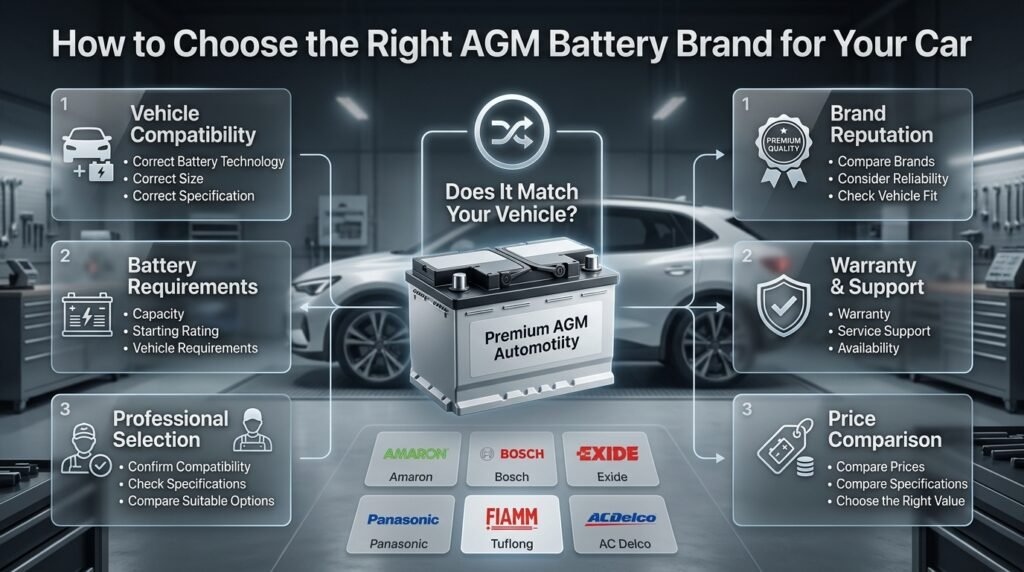
Brand reputation can be useful, but brand name should not be the first selection factor.
The first question should always be:
Does this battery correctly match the vehicle?
Once compatibility is confirmed, drivers can compare brand reputation, warranty, service support, availability, and price.
For example, vehicle owners researching different battery options may encounter products from Amaron, Bosch, Exide, Panasonic, FIAMM, Tuflong, and AC Delco.
For drivers specifically researching brand-specific replacement options, EuroSwift Auto Services also provides dedicated resources for Amaron Battery, Bosch Battery, and Tuflong Battery.
The purpose of using these resources should be comparison and informed selection rather than assuming one brand is automatically suitable for every vehicle.
AGM Battery vs Other Battery Options
Drivers researching AGM technology may also compare several established battery brands and options.
For example, those looking at Exide Battery can evaluate the available specifications against their vehicle requirements.
Similarly, Panasonic Battery may be considered when the vehicle’s required size and specification are available.
Other drivers may investigate FIAMM Battery or AC Delco Battery depending on vehicle compatibility and availability.
The important SEO and customer-service principle is the same: brand pages should support the main battery topic rather than replacing the core information about choosing the correct technology.
Common AGM Battery Replacement Mistakes
Choosing the Most Expensive Battery
More expensive does not automatically mean better for your vehicle.
Selecting the Wrong Technology
AGM, EFB, and conventional batteries have different characteristics.
Ignoring Battery Dimensions
A battery must physically fit the vehicle’s battery tray.
Ignoring Terminal Position
Incorrect terminal placement can create installation and cable-routing problems.
Skipping Charging-System Diagnosis
An alternator problem can destroy the performance of a new battery.
Forgetting Battery Registration
Some modern vehicles require electronic registration.
Replacing a Battery Without Investigating Repeated Discharge
A parasitic drain can cause a replacement battery to become discharged as well.
Choosing Based Only on Cold-Cranking Rating
Starting current is important, but capacity, dimensions, technology, and vehicle compatibility also matter.
AGM Battery Inspection Before Long-Distance Travel
Battery problems can become particularly inconvenient during long-distance driving.
Before cross-emirate travel or an extended journey, drivers should consider checking:
✔ Battery condition
✔ Starting performance
✔ Battery terminals
✔ Charging-system performance
✔ Tire condition
✔ Engine oil level
✔ Coolant condition
✔ Brake condition
✔ Air conditioning performance
✔ Emergency equipment
A pre-trip Vehicle Inspection can identify problems while the vehicle is still at home or at a workshop rather than after a breakdown.
For vehicles already showing slow starting or battery warnings, postponing inspection until the journey begins is not advisable.
AGM Battery and Overall Vehicle Reliability
A battery is only one component of a larger vehicle system.
A reliable car requires coordination between the battery, starter motor, alternator, wiring, control modules, engine, transmission, cooling system, braking system, suspension, tires, and climate-control equipment.
That is why professional automotive service should consider the vehicle as a complete system.
Depending on the problem, a driver may need:
- Engine Diagnostics
- Brake Repair
- Oil Change
- Suspension Repair
- AC Repair
- Wheel Alignment
- Tire Maintenance
- Transmission Repair
- Engine Repair
- Vehicle Inspection
A battery issue can sometimes be the visible symptom of a larger electrical or mechanical problem.
AGM Battery Safety Considerations
AGM batteries are designed to be sealed, but they still contain lead-acid chemistry and should be handled correctly.
When working around an automotive battery:
✔ Avoid accidental short circuits.
✔ Use suitable protective equipment.
✔ Follow charging instructions.
✔ Do not modify the battery.
✔ Secure the battery correctly.
✔ Use suitable charging equipment.
✔ Follow manufacturer installation instructions.
If a battery case is damaged, swollen, leaking, or otherwise abnormal, professional assistance should be sought.
Battery replacement is straightforward on some vehicles but can be considerably more complicated on modern cars with intelligent energy-management systems.
AGM Battery Lifespan: What Determines It?
It is difficult to give one exact lifespan for every AGM battery.
Battery longevity depends on operating conditions.
Important factors include:
Climate
Higher temperatures can accelerate battery aging.
Driving Pattern
Frequent short journeys can leave the battery with insufficient recharge time.
Electrical Load
Vehicles with heavy electrical demands may place greater stress on the battery.
Charging System
Incorrect charging can negatively affect battery condition.
Storage
Long periods of inactivity can gradually discharge the battery.
Installation
Loose connections and poor mounting can cause operational problems.
Battery Quality
Manufacturing quality and correct specification can influence reliability.
For this reason, battery age should be considered together with actual test results and vehicle behavior.
How Professionals Decide Whether to Replace an AGM Battery
A professional does not normally rely on one symptom.
Instead, several pieces of information are considered.
Battery condition
Does testing indicate reduced capacity?
Charging performance
Is the alternator charging correctly?
Electrical drain
Is another component consuming excessive power?
Physical condition
Is the battery damaged or improperly mounted?
Vehicle requirements
Does the replacement battery match the manufacturer’s specification?
Customer driving pattern
Is the vehicle mainly used for short journeys, long-distance driving, or occasional use?
This broader approach helps prevent unnecessary battery replacement.
AGM Battery Preventive Maintenance Strategy
A practical maintenance strategy can be divided into several stages.
Regular observation
Pay attention to changes in starting performance.
Periodic testing
Battery health testing can identify deterioration before complete failure.
Charging-system inspection
Check the alternator when battery performance changes.
Pre-trip testing
Inspect the battery before long journeys if the vehicle has shown warning signs.
Post-storage testing
Check the battery after extended inactivity.
Professional diagnosis
Investigate repeated discharge instead of repeatedly replacing or jumpstarting the battery.
This preventive approach can improve reliability and reduce the chance of unexpected roadside problems.
Latest Automotive Battery Technology Trends
Automotive battery technology continues to evolve alongside vehicle electronics.
Start-stop systems have already increased demand for batteries capable of handling more frequent cycling.
At the same time, intelligent charging systems are becoming more common. Instead of simply charging continuously at one fixed level, modern vehicles can regulate charging based on battery condition, driving conditions, electrical demand, and energy-management requirements.
Vehicle electronics are also becoming more sophisticated.
Advanced driver-assistance systems, connected features, cameras, sensors, and increasingly powerful computing systems all contribute to the importance of stable electrical power.
AGM technology remains relevant in many conventional and auxiliary automotive applications while other battery technologies continue developing.
AGM and the Future of Automotive Energy Systems
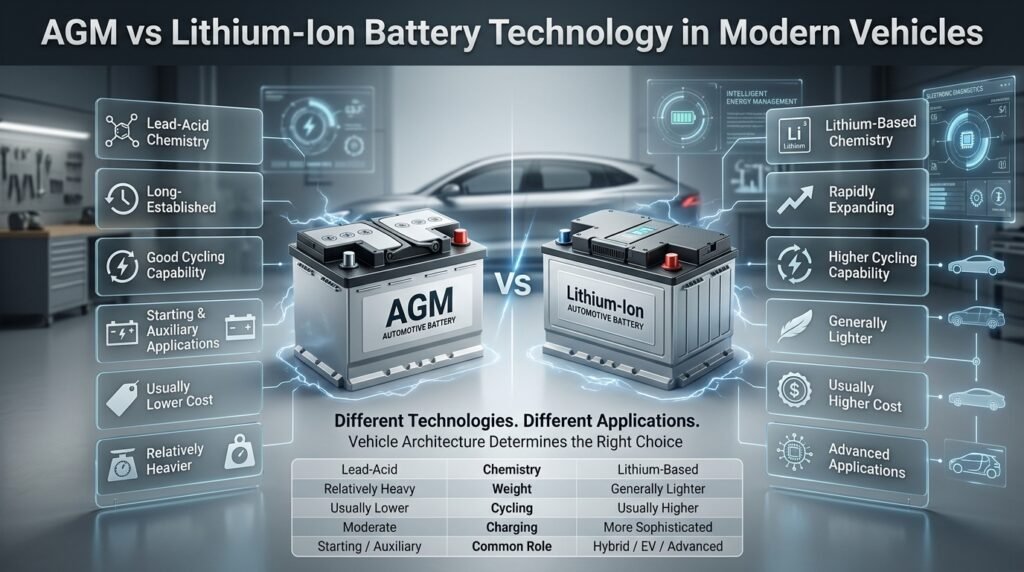
The automotive industry is gradually moving toward more electrified vehicles.
Hybrid vehicles, plug-in hybrids, and electric vehicles use significantly different energy-storage architectures from conventional petrol and diesel vehicles.
Lithium-ion technology is becoming increasingly important in traction applications, while lead-acid technologies such as AGM continue to have roles in conventional starting and auxiliary systems.
Future vehicles are likely to place even greater emphasis on:
- Intelligent energy management
- Battery monitoring
- Electronic diagnostics
- Regenerative charging
- Lightweight electrical systems
- Higher electrical efficiency
- Advanced auxiliary batteries
This means battery diagnosis will increasingly become an electronic and software-related task rather than simply a mechanical replacement job.
AGM Battery vs Lithium-Ion
AGM and lithium-ion technologies serve different purposes.
| Characteristic | AGM | Lithium-Ion |
|---|---|---|
| Chemistry | Lead-acid | Lithium-based |
| Automotive history | Long-established | Rapidly expanding |
| Weight | Relatively heavy | Generally lighter |
| Cost | Usually lower | Usually higher |
| Starting applications | Common | Application-dependent |
| Cycling capability | Good | Generally higher |
| Charging complexity | Moderate | More sophisticated |
| Common role | Starting/auxiliary | Hybrid/EV/advanced applications |
Lithium-ion technology should not simply be viewed as a direct replacement for AGM in every conventional vehicle.
Vehicle architecture determines which technology is appropriate.
When Professional Automotive Assistance Makes Sense
Drivers can often recognize obvious battery symptoms, but diagnosing the underlying cause can require specialized equipment.
Professional assistance is particularly useful when:
- The car repeatedly needs a jumpstart.
- The battery becomes discharged overnight.
- A new battery fails quickly.
- Charging warnings appear.
- Start-stop stops operating unexpectedly.
- The correct replacement battery is unclear.
- The vehicle requires battery registration.
- Multiple electrical systems show warnings.
- The car has been stored for an extended period.
- The vehicle is preparing for a long journey.
EuroSwift Auto Services can serve as part of a broader automotive support strategy, covering Battery Replacement alongside Car Jumpstart, Roadside Assistance, Vehicle Inspection, and other repair and maintenance requirements.
AGM Battery Decision Checklist
Before buying an AGM battery, ask the following questions:
Vehicle compatibility
Does the manufacturer specify AGM?
Battery size
Does the battery physically fit?
Capacity
Does the replacement provide the required capacity?
Starting specification
Does the battery meet the vehicle’s starting requirements?
Charging system
Is the alternator operating correctly?
Battery management
Does the vehicle require battery registration?
Driving conditions
Does the vehicle experience frequent short trips or heavy electrical use?
Climate
Is the vehicle regularly exposed to high temperatures?
Warranty
What warranty and support are available?
Installation
Will the battery be installed and tested correctly?
Answering these questions can prevent many common replacement mistakes.
AGM Battery Advantages and Limitations at a Glance
| AGM Advantages | AGM Limitations |
|---|---|
| Strong starting performance | Higher purchase cost |
| Good vibration resistance | More charging-sensitive |
| Suitable for many start-stop systems | Not suitable for every vehicle |
| Good cycling capability | Heat can still accelerate aging |
| Maintenance-free design | May require registration |
| Good for many high-electrical-demand vehicles | Incorrect charging can reduce performance |
| Reduced electrolyte movement | Replacement requires correct specification |
| Reliable technology for many modern vehicles | Cannot compensate for charging-system faults |
The table highlights an important principle: AGM technology provides meaningful advantages when used in the right vehicle.
Is an AGM Battery Better Than a Regular Car Battery?
An AGM battery can be a better choice than a conventional flooded battery when the vehicle has higher electrical demands, automatic start-stop technology, or was originally designed around AGM technology. The main difference is not simply that AGM is “more powerful”; its internal construction is designed to handle repeated cycling, vibration, and demanding electrical operation more effectively.
For a basic vehicle with a conventional electrical system, however, paying extra for AGM may not always provide enough practical benefit to justify the additional cost. The correct approach is to match the battery technology to the vehicle rather than automatically choosing the most expensive option.
Key points to consider:
Check whether the vehicle originally came with an AGM battery.
Consider whether the car uses automatic start-stop technology.
Compare the required battery capacity and starting specification.
Check the vehicle’s charging and battery-management system.
Consider the vehicle’s electrical load and driving conditions.
Do not choose AGM only because it is marketed as a premium battery.
Professional recommendation: If the manufacturer specifies AGM, staying with AGM is generally the safest approach. If the vehicle originally uses a conventional battery, an AGM upgrade should be considered only after confirming that the vehicle supports it.
What Are the Main Advantages of an AGM Battery?
The biggest advantage of AGM technology is that it is designed for demanding automotive applications where a conventional starter battery may struggle. Its absorbed-electrolyte construction supports strong current delivery, good vibration resistance and better cycling capability, making it particularly useful in many modern vehicles.
AGM batteries are especially relevant to vehicles that repeatedly start and stop the engine or operate numerous electrical systems. This includes cars with automatic start-stop, extensive electronic equipment and other applications where the battery regularly moves between charging and discharging states.
The most important AGM advantages include:
Strong starting performance: Provides substantial current for engine starting when correctly specified.
Better cycling capability: More suitable for repeated charge-discharge activity than many conventional starter batteries.
Vibration resistance: The internal glass-mat construction helps the battery withstand vibration.
Maintenance-free design: Routine electrolyte top-ups are generally not required.
Reduced electrolyte movement: The electrolyte is held within the glass mat rather than freely moving around the battery.
Suitable for demanding electronics: Useful in vehicles with substantial electrical loads.
Good start-stop compatibility: Commonly used where repeated engine restarts place additional demands on the battery.
One important point is that these advantages do not mean every AGM battery will automatically last longer or perform better. Correct sizing, charging, installation, temperature and vehicle compatibility still have a major influence on real-world performance.
What Are the Main Limitations of AGM Batteries?
The biggest limitation is usually cost. AGM batteries generally cost more than conventional flooded batteries, so installing one in a vehicle that does not actually need its additional capabilities can result in unnecessary expense. AAA notes that AGM batteries can cost substantially more than conventional batteries, while also pointing out that the additional capability is most valuable in applications such as start-stop systems.
Another important limitation is charging sensitivity. AGM batteries have tighter charging requirements than conventional flooded batteries, meaning an unsuitable charging method or incorrect voltage can negatively affect battery condition. AGM technology also does not make a battery immune to heat, deep discharge, parasitic drain or charging-system faults.
The main limitations to remember are:
Higher purchase price compared with many conventional batteries.
Charging sensitivity, particularly when using external chargers.
Vehicle compatibility requirements that must be checked before replacement.
Heat sensitivity, especially in demanding engine-bay environments.
Deep discharge can still cause damage despite AGM’s stronger cycling capability.
Battery-management requirements may apply to some modern vehicles.
Wrong installation or specification can reduce the expected benefit.
For a Dubai vehicle, the heat factor deserves particular attention. A premium AGM battery is still exposed to the same basic effects of high ambient and under-hood temperatures. If a battery repeatedly fails, simply installing another AGM battery without checking the charging system or possible electrical drain may not solve the real problem.
Can I Replace an AGM Battery With a Regular Battery?
Replacing an original AGM battery with a conventional flooded battery should not be treated as a simple downgrade. The correct replacement depends on the vehicle’s manufacturer specification and its charging and energy-management system. VARTA specifically advises that an AGM battery should be replaced with AGM in applications where AGM is specified, because the vehicle’s energy-management system may be designed around that technology.
This is particularly important in modern vehicles equipped with start-stop systems and extensive electronic equipment. Installing the wrong battery can reduce battery life, affect energy-management performance, or cause the vehicle’s start-stop function to behave differently.
Before changing battery technology, a professional should verify the vehicle’s requirements rather than relying only on battery dimensions.
Before replacing AGM with another battery type, check:
Original battery technology
Battery capacity
Cold-cranking specification
Physical dimensions
Terminal configuration
Charging strategy
Start-stop system requirements
Battery-management-system requirements
Manufacturer-approved replacement options
If the vehicle was originally equipped with AGM, the safest approach is normally to replace it with a correctly specified AGM battery unless the manufacturer explicitly approves another configuration.
This is also why professional Battery Replacement should involve specification checking and, where necessary, electronic battery registration rather than simply removing the old battery and installing a cheaper alternative.
Do AGM Batteries Need Special Charging and Battery Registration?
AGM batteries require an appropriate charging method, and the charger should support AGM charging requirements. This matters because AGM batteries are more sensitive to incorrect charging conditions than many conventional flooded batteries. Using the wrong charging profile or inappropriate charging equipment can reduce battery performance and potentially shorten its service life.
Battery registration is a separate issue. Some modern vehicles use sophisticated battery-management systems that need to know when a battery has been replaced. Depending on the vehicle, the new battery may need to be registered, adapted, or coded after installation.
This is particularly relevant to modern vehicles with start-stop technology and sophisticated energy-management systems.
During a professional AGM replacement, it is worth checking:
Whether the charger supports AGM.
Whether the vehicle requires battery registration.
Whether the replacement has the correct capacity.
Whether the battery-management system needs adaptation.
Whether the alternator is charging correctly.
Whether a parasitic electrical drain caused the original battery failure.
Whether the replacement battery matches the manufacturer’s specification.
The important distinction is that charging and registration are not the same thing. A charger maintains the battery, while registration or adaptation—where required—allows the vehicle’s electronic energy-management system to recognize the replacement battery correctly.
For modern vehicles, this additional diagnostic step can be just as important as physically installing the new battery.
Conclusion
Understanding the AGM battery advantages and limitations is essential before deciding whether this battery technology is right for a vehicle. AGM batteries offer strong starting performance, better cycling capability, excellent vibration resistance, maintenance-free operation, and dependable support for many modern vehicles with start-stop systems and higher electrical demands. These qualities make AGM technology a practical choice for many newer and electronically advanced vehicles.
At the same time, AGM batteries are not a universal solution. Their higher purchase price, specific charging requirements, vehicle compatibility considerations, and sensitivity to demanding operating conditions mean that the correct battery must be selected according to the manufacturer’s specifications. Simply choosing an AGM battery because it is considered a premium option does not guarantee better performance.
For vehicles operating in Dubai, battery condition deserves additional attention because high temperatures, heavy traffic, frequent short journeys, air-conditioning use, and extended periods of vehicle inactivity can place extra demands on the electrical system. Regular battery testing, charging-system inspection, and preventive Vehicle Maintenance can help identify problems before they result in an unexpected breakdown.
Most importantly, a weak battery should not always be assumed to be the only problem. A faulty alternator, parasitic electrical drain, damaged connection, starter issue, or incorrect battery specification can produce similar symptoms. Professional Engine Diagnostics, Battery Replacement, Car Jumpstart, and Roadside Assistance can help identify the actual cause instead of simply replacing components without proper diagnosis.
As modern vehicles continue becoming more electronically advanced, correct battery selection and intelligent energy management will become increasingly important. Whether a vehicle requires AGM technology or another battery type, the best approach is to combine the correct specification with professional installation, proper charging, and regular inspection. This helps protect vehicle reliability, reduce unexpected starting problems, and keep the entire electrical system working as intended.

Leave a Reply