

Introduction
How to Maximize Battery Lifespan | A car battery does more than simply start the engine. It supplies electrical power during startup, supports the vehicle’s electrical systems, and works with the alternator to maintain reliable electrical performance. Understanding how to maximize battery lifespan can help drivers reduce unexpected starting problems, avoid premature Battery Replacement, and maintain dependable vehicle performance.
Battery lifespan depends on several factors, including driving habits, charging-system condition, electrical load, battery type, vehicle usage, and environmental conditions. In Dubai, high temperatures can place additional stress on automotive batteries, making proper inspection and preventive maintenance particularly important.
For drivers looking for professional automotive maintenance and battery services, EuroSwift Auto Services provides automotive solutions designed to help maintain vehicle reliability. Proper battery care is not about making a battery last forever; it is about reducing avoidable stress, identifying problems early, and replacing the battery when it can no longer provide dependable performance.
In this guide, we explain practical ways to extend battery service life, common mistakes that shorten battery lifespan, warning signs to watch for, and when professional battery testing or replacement may be necessary.
1. What Determines Car Battery Lifespan?
A battery does not have a fixed lifespan that applies to every vehicle. Its condition depends on how the vehicle is driven, where it is operated, how much electrical demand it experiences, and whether the charging system is functioning correctly.
Several factors can influence battery longevity:
| Factor | Impact on Battery Life |
|---|---|
| High temperatures | Can accelerate internal battery deterioration |
| Frequent short trips | May provide insufficient charging time |
| Long periods of inactivity | Can gradually discharge the battery |
| Electrical accessories | Increase electrical demand |
| Weak alternator | Can prevent proper recharging |
| Corroded terminals | Increase electrical resistance |
| Loose connections | Can cause unreliable electrical flow |
| Incorrect battery type | May provide unsuitable performance |
| Parasitic drain | Can discharge the battery while parked |
| Excessive vibration | Can contribute to physical battery damage |
The key to longer battery service life is therefore not one single maintenance action. It is a combination of proper battery selection, charging-system health, sensible vehicle use, and timely inspection.
2. Protect Your Battery From Dubai Heat
Heat is one of the most important environmental considerations for vehicle batteries in Dubai.
High temperatures can accelerate chemical reactions inside a battery and contribute to faster deterioration of internal components. Under-hood temperatures can become even higher than the surrounding outdoor temperature.
Drivers cannot eliminate heat exposure, but they can reduce unnecessary stress.
Practical ways to reduce heat-related battery stress
- Use covered or shaded parking whenever practical.
- Avoid leaving the vehicle exposed to direct sunlight for unnecessarily long periods.
- Keep the battery properly secured.
- Inspect the battery housing for cracks, swelling, or other physical damage.
- Check charging-system performance if the battery repeatedly becomes weak.
- Use the battery specification recommended for the vehicle.
Heat management does not stop normal battery aging, but it can help reduce avoidable deterioration and improve reliability.
3. Avoid Excessive Short Trips
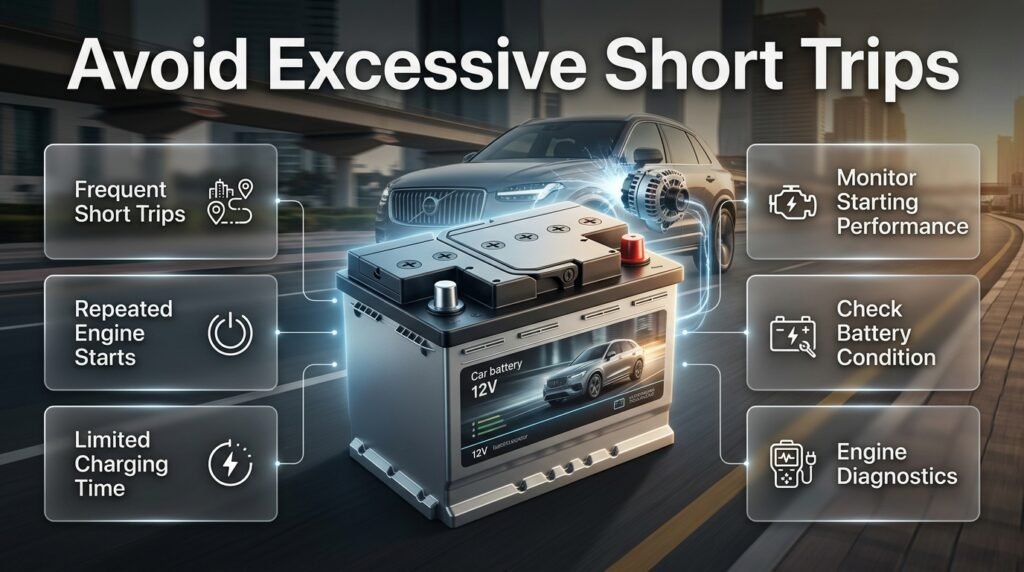
Frequent short journeys can be harder on a battery than many drivers realize.
Starting the engine requires a substantial amount of electrical energy. The alternator then needs operating time to replenish the energy consumed during startup.
When a vehicle is repeatedly driven for very short distances, especially with frequent engine starts, the charging system may have limited time to restore the battery.
If most of your driving is short-distance
Pay closer attention to starting performance and battery condition. If the battery regularly becomes weak, do not assume that driving the vehicle longer will solve the problem.
A weak battery, charging-system fault, or electrical drain may be responsible.
Professional Engine Diagnostics can help determine whether the issue is related to the battery or another part of the vehicle’s electrical system.
4. Keep Battery Terminals and Connections Clean
Battery connections are essential for reliable electrical performance.
Corrosion, contamination, loose terminals, or damaged cables can increase resistance between the battery and vehicle electrical system. This may create starting problems that can sometimes be mistaken for battery failure.
During inspection, pay attention to:
- Terminal corrosion
- Loose connections
- Damaged battery cables
- Cracked battery housing
- Signs of overheating
- Poor battery mounting
- Damaged or deteriorated wiring
If the connections are heavily corroded or damaged, professional inspection is preferable to attempting an uncertain repair.
A healthy battery cannot perform reliably if the electrical connection between the battery and vehicle is poor.
5. Make Sure the Battery Is Properly Secured
Battery vibration is another factor that is often overlooked.
A battery should remain firmly positioned in its mounting location. Excessive movement while driving can place unnecessary stress on the battery casing and connections.
During a professional Car Service, technicians can inspect:
- Battery mounting.
- Retaining hardware.
- Terminal connections.
- Cable condition.
- Battery housing.
- Signs of vibration-related damage.
Proper mounting contributes to both electrical reliability and physical battery protection.
6. Reduce Unnecessary Electrical Load When Parked
Your vehicle can continue consuming electricity even when the engine is switched off.
Interior lights, infotainment systems, USB accessories, aftermarket equipment, and other electrical components can gradually consume battery energy when the alternator is not operating.
Before leaving the vehicle, make a habit of checking:
- Interior lights
- Headlights
- USB devices
- Portable accessories
- Aftermarket electronics
- Doors and trunk closure
If the battery continues losing charge despite these precautions, the vehicle may have an electrical drain that requires professional diagnosis.
7. Monitor Changes in Engine Starting
One of the simplest ways to recognize a developing battery problem is to pay attention to how the engine starts.
A noticeable change from normal starting performance can indicate that the battery or another component of the starting system requires attention.
Common warning signs
- Slower engine cranking
- Repeated starting difficulty
- Frequent need for a jumpstart
- Battery warning indication
- Electrical systems behaving unusually
- Battery becoming weak after sitting
- Headlights appearing abnormal during startup
These symptoms do not automatically mean the battery has failed.
A starter motor, alternator, battery connection, or electrical drain can sometimes produce similar symptoms. Proper diagnosis is therefore more reliable than replacing parts based only on symptoms.
8. Test Battery Health Before Failure
Waiting until a vehicle completely refuses to start is rarely the most convenient approach.
Professional battery testing can help determine whether the battery is still capable of providing dependable starting performance.
A battery inspection may consider:
| Inspection | Purpose |
|---|---|
| Battery condition | Identifies deterioration |
| Voltage | Helps assess electrical state |
| Starting capability | Evaluates starting performance |
| Charging voltage | Checks alternator operation |
| Terminals | Identifies connection problems |
| Battery mounting | Checks physical security |
| Electrical drain | Helps identify unexplained discharge |
Testing becomes especially useful when a vehicle has experienced repeated starting problems, unexplained discharge, or noticeable changes in electrical performance.
9. Check the Alternator and Charging System
The battery and alternator perform different but connected jobs.
The battery supplies the initial electrical power needed to start the vehicle. Once the engine is running, the alternator supplies electrical power and replenishes energy used from the battery.
If the alternator is not functioning correctly, a new battery may also become weak.
Possible charging-system warning signs
- Battery repeatedly loses charge
- Battery warning light appears
- Vehicle needs frequent jumpstarts
- Electrical performance changes while driving
- New battery becomes weak shortly after installation
When a battery repeatedly discharges, the charging system should be checked rather than simply replacing the battery again.
10. Choose the Correct Battery for Your Vehicle
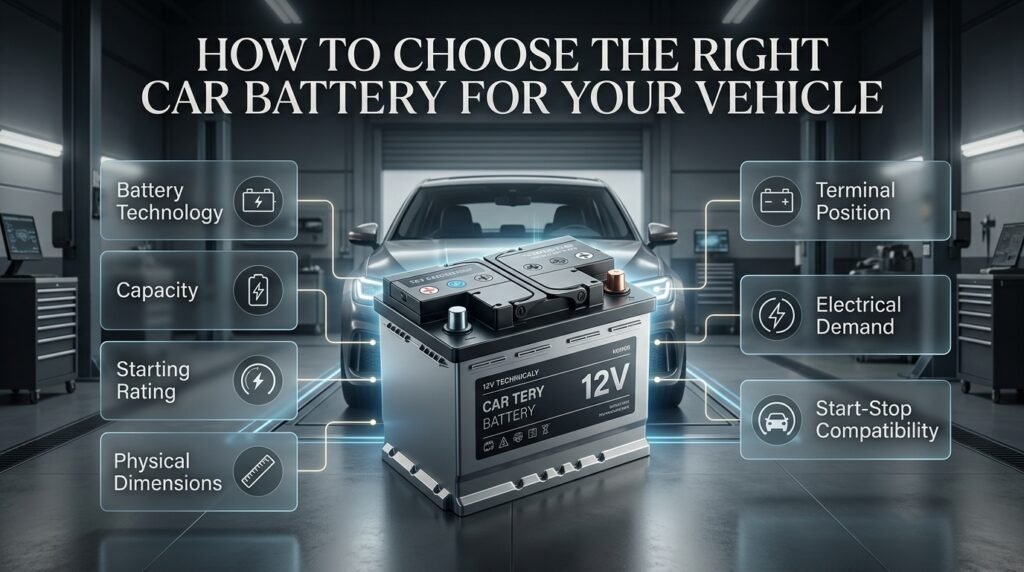
Battery selection is an important part of maximizing service life.
A battery should not be selected simply because it fits physically or has a higher capacity. The replacement should match the vehicle’s specifications, electrical requirements, dimensions, terminal arrangement, and battery technology.
Important factors include:
| Battery Factor | Why It Matters |
|---|---|
| Battery technology | Must suit vehicle requirements |
| Capacity | Determines available electrical storage |
| Starting rating | Affects starting capability |
| Physical dimensions | Must fit the battery tray |
| Terminal position | Must match vehicle connections |
| Electrical demand | Must support vehicle systems |
| Start-stop compatibility | Important for applicable vehicles |
Using the wrong specification can lead to poor performance and potentially reduce reliability.
11. Understand AGM and EFB Battery Technology
Modern vehicles increasingly use advanced battery technologies.
AGM Batteries
Absorbent Glass Mat batteries are designed for applications requiring strong cycling performance and can be found in many vehicles with higher electrical demands and start-stop systems.
EFB Batteries
Enhanced Flooded Batteries are another technology used in certain vehicles, including some start-stop applications.
Neither technology should be considered universally better for every car. The correct choice depends on the vehicle manufacturer’s requirements.
If your vehicle originally uses AGM technology, replacing it with an unsuitable conventional battery can result in poor compatibility and reduced performance.
12. Avoid Extended Periods of Battery Discharge
A parked vehicle can still consume electrical energy.
Modern cars may continue operating security systems, electronic modules, memory functions, and other systems while the engine is off. Over a long period, this can gradually reduce battery charge.
If a vehicle is going to remain unused for an extended period, follow the manufacturer’s recommended storage procedure.
Before long-term storage:
- Check battery condition.
- Confirm the vehicle has no known electrical drain.
- Turn off unnecessary accessories.
- Follow manufacturer storage recommendations.
- Consider professional battery advice for extended inactivity.
Repeated deep discharge can put additional stress on a battery and may reduce its ability to provide dependable starting performance.
13. Do Not Treat Jumpstarting as a Permanent Repair
A Car Jumpstart can restore mobility when a vehicle cannot start because of insufficient battery power.
However, a jumpstart only addresses the immediate starting problem. It does not identify why the battery became discharged.
Repeated jumpstarts may indicate:
- Aging battery
- Charging-system fault
- Electrical drain
- Poor battery connection
- Extended inactivity
- Excessive electrical load
If your vehicle requires repeated jumpstarts, professional diagnosis is more useful than continuing to restart it without identifying the cause.
14. Follow a Practical Battery Maintenance Schedule
Battery care does not require checking the battery every day. A simple maintenance routine can help identify problems before they become inconvenient.
| When | Recommended Action |
|---|---|
| Regularly | Monitor starting performance |
| During Car Service | Inspect battery and connections |
| Before long trips | Check battery condition |
| After repeated discharge | Test battery and charging system |
| Before extended storage | Assess battery condition |
| When warning signs appear | Arrange professional inspection |
| When battery deteriorates | Replace with correct specification |
A vehicle used heavily for short trips, frequent stop-start driving, or extended periods of inactivity may require closer monitoring.
15. Inspect the Battery Before Long-Distance Travel
A battery failure can be particularly inconvenient during a long journey.
Before cross-emirate travel or extended road trips, battery condition should be considered, especially if the vehicle has shown slow starting or other electrical warning signs.
Pre-trip inspection
- Check battery condition.
- Inspect terminal connections.
- Confirm battery mounting.
- Test charging-system performance when necessary.
- Consider battery age and previous performance.
- Investigate any recent starting problems.
Preventive inspection is generally more convenient than dealing with a battery failure during a journey.
For unexpected vehicle problems, Roadside Assistance can provide emergency support, but preventive maintenance remains the better strategy for reducing avoidable breakdowns.
16. Common Mistakes That Reduce Battery Life
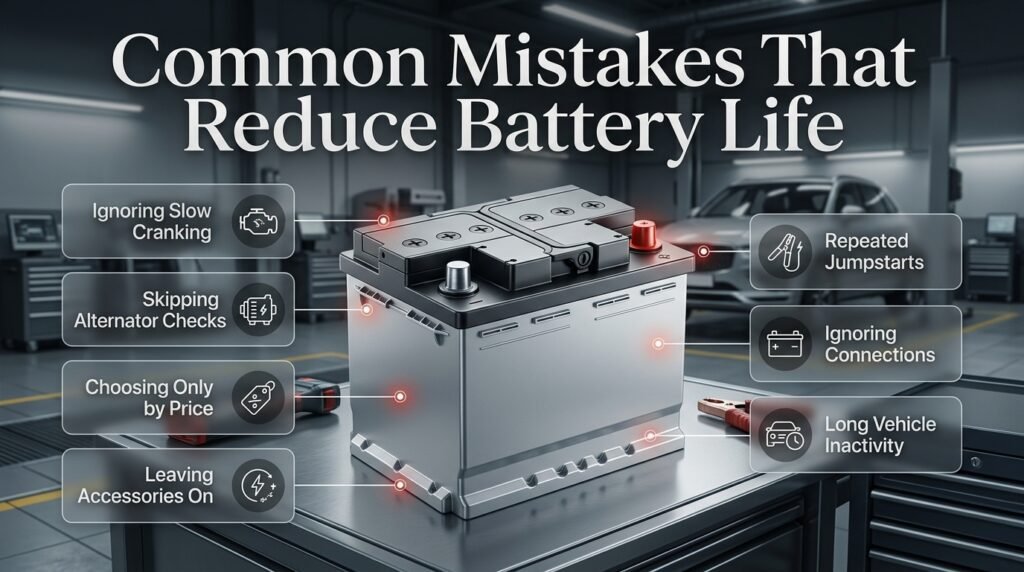
Some battery problems are made worse by simple maintenance mistakes.
Ignoring slow cranking
A noticeable change in engine starting should not be ignored for an extended period.
Replacing the battery without checking the alternator
A charging-system problem can cause another battery to become weak.
Choosing a battery only because it is cheaper
Price alone does not determine battery suitability. Correct specifications matter.
Leaving electrical accessories running
Electrical equipment can gradually discharge the battery when the engine is off.
Repeatedly jumpstarting without diagnosis
Frequent jumpstarts indicate that an underlying problem may remain unresolved.
Ignoring battery connections
Loose or corroded connections can interfere with electrical performance.
Leaving a vehicle unused for long periods
Extended inactivity can gradually reduce battery charge.
17. When Should You Replace the Battery?
Battery maintenance can reduce avoidable stress, but no battery lasts indefinitely.
Replacement becomes appropriate when testing shows that the battery can no longer provide reliable starting performance or has deteriorated significantly.
Before replacing it, identify the actual cause.
| Problem | Likely Direction |
|---|---|
| Battery has deteriorated | Battery replacement |
| Alternator not charging correctly | Charging-system repair |
| Excessive electrical drain | Electrical diagnosis |
| Loose/corroded connection | Connection service |
| Starter-system fault | Starting-system repair |
This diagnostic approach helps prevent unnecessary battery replacement.
18. Professional Battery Inspection Process
A professional inspection should look beyond the battery itself.
At EuroSwift Auto Services, battery-related concerns can be assessed as part of a wider vehicle inspection to help determine whether the problem is actually caused by the battery, charging system, connections, or another vehicle component.
A professional inspection may include:
- Visual battery inspection
- Battery condition testing
- Charging-system assessment
- Terminal inspection
- Cable inspection
- Battery mounting check
- Starting-system assessment
- Electrical-system diagnosis
If replacement is required, the battery should be selected according to the vehicle’s exact requirements.
Depending on compatibility and vehicle requirements, drivers may consider options such as Amaron Battery, Bosch Battery, Tuflong Battery, Exide Battery, Panasonic Battery, FIAMM Battery, AC Delco Battery, or an appropriate AGM Battery.
19. Battery Maintenance as Part of Overall Vehicle Care
Battery reliability should not be viewed as an isolated maintenance issue.
The battery is one component of a larger vehicle system. Regular Vehicle Maintenance provides opportunities to identify electrical and mechanical problems before they become major failures.
A complete maintenance approach can include:
- Oil Change
- Brake Repair
- AC Repair
- Suspension Repair
- Wheel Alignment
- Tire maintenance
- Engine diagnostics
- Transmission Repair
- General Car Repair
- Preventive inspections
The purpose is not to repair components unnecessarily. Instead, routine servicing helps detect developing problems while they are still manageable.
20. Professional Recommendations for Longer Battery Life
There is no single trick that guarantees a long-lasting battery. The most effective approach is consistent preventive care.
Expert Recommendations
✔ Use the correct battery specification.
✔ Keep battery connections secure and in good condition.
✔ Monitor changes in starting performance.
✔ Avoid unnecessary electrical loads when the engine is off.
✔ Investigate repeated battery discharge.
✔ Check the alternator when battery problems recur.
✔ Test battery health before important long-distance journeys.
✔ Pay particular attention to battery condition in hot climates.
✔ Follow appropriate procedures for extended vehicle storage.
✔ Replace a battery when testing shows that it can no longer provide reliable service.
The most important principle is to diagnose the cause of battery problems rather than repeatedly treating the symptom.
21. Modern Battery Management and Future Automotive Technology
Today’s vehicles are increasingly dependent on electronic systems. Start-stop technology, advanced driver assistance systems, connected features, electronic control modules, and sophisticated infotainment systems can all increase the importance of reliable electrical power.
Modern vehicles may also use battery monitoring systems that track electrical conditions and help manage charging strategies.
As vehicle technology continues to develop, battery maintenance is becoming increasingly connected with electronic diagnostics rather than being treated as a simple replacement component.
Future automotive developments are likely to involve:
- More advanced battery monitoring
- Smarter charging management
- Improved energy efficiency
- Greater integration between batteries and vehicle electronics
- More sophisticated diagnostic systems
- Continued development of advanced low-voltage battery technologies
For drivers, this means that professional electrical diagnosis is becoming an increasingly important part of modern Auto Workshop services.
Battery Troubleshooting Guide
| Symptom | Possible Cause | Recommended Action |
|---|---|---|
| Slow engine cranking | Weak battery, connection or starter issue | Professional diagnosis |
| Battery repeatedly goes flat | Battery, charging fault or electrical drain | Test complete system |
| Battery warning light | Charging-system issue | Inspect charging system |
| Frequent jumpstarts | Weak battery or electrical problem | Diagnose underlying cause |
| Battery weak after parking | Battery deterioration or parasitic drain | Electrical and battery test |
| New battery becomes weak | Charging-system or electrical problem | Check alternator and vehicle system |
| Unusual electrical behavior | Battery, alternator or wiring issue | Vehicle inspection |
Battery Lifespan Checklist
Replace the battery when its condition becomes unreliable.
Use the correct battery type and specification.
Keep terminals and connections secure.
Monitor engine starting performance.
Avoid unnecessary electrical loads when parked.
Investigate repeated battery discharge.
Check the charging system when necessary.
Inspect the battery before long-distance travel.
Consider battery condition before extended storage.
Protect the vehicle from unnecessary heat exposure where practical.
How Can I Maximize the Lifespan of My Car Battery?
Maximizing battery lifespan is mainly about keeping the battery properly charged, reducing unnecessary electrical stress, and fixing related vehicle problems before they repeatedly drain or overwork the battery. A battery that is kept in good condition and supported by a healthy charging system has a better chance of reaching its expected service life.
Start with the basics: keep the battery securely mounted, maintain clean and reliable connections, avoid leaving electrical accessories running when the engine is off, and pay attention to changes in starting performance. If your vehicle is used mainly for very short trips or sits unused for long periods, battery maintenance becomes even more important.
Practical ways to extend battery life:
Keep battery terminals and connections clean and secure.
Avoid unnecessary use of lights, infotainment, chargers, and other accessories with the engine off.
Drive the vehicle regularly rather than allowing it to sit unused for extended periods.
Reduce repeated short trips where practical by combining errands.
Have the battery tested when starting performance changes.
Check the alternator if the battery repeatedly loses charge.
Protect the vehicle from excessive heat whenever practical.
Use the battery type and specification recommended for your vehicle.
Have an electrical drain investigated if the battery repeatedly goes flat.
For Dubai vehicles, heat deserves particular attention. High temperatures can accelerate battery deterioration, so preventive inspection is more valuable than waiting for a complete starting failure.
Does Hot Weather Reduce Car Battery Life in Dubai?
Hot weather can significantly affect battery longevity. The battery operates in an already demanding under-hood environment, and high temperatures accelerate the chemical processes that contribute to battery aging. This is one reason battery care is especially important in hot climates such as Dubai.
The important point is that heat damage is gradual. A battery may continue starting the vehicle normally while its internal condition is deteriorating. By the time slow cranking or repeated starting problems appear, the battery may already have lost a meaningful amount of its original performance.
Dubai battery-care practices include:
Prefer shaded or covered parking when practical.
Avoid unnecessary prolonged exposure to direct sunlight.
Pay attention to corrosion and physical battery damage.
Check battery condition during routine vehicle servicing.
Test an older battery before demanding travel.
Investigate repeated discharge rather than repeatedly recharging or jumpstarting it.
Check the charging system if a relatively new battery becomes weak.
There is no maintenance technique that completely prevents heat-related aging. The realistic objective is to reduce avoidable stress and identify deterioration early enough to prevent an inconvenient breakdown.
Do Frequent Short Trips Shorten Car Battery Life?
Frequent short trips can contribute to faster battery deterioration because starting the engine consumes electrical energy, while a very short drive may not provide enough operating time for the charging system to replace all of that energy. When this pattern happens repeatedly, the battery can spend considerable time below a full state of charge.
This does not mean every short journey is harmful or that you need to take unnecessary long drives. The bigger concern is a vehicle that is started frequently but driven only for very short periods, particularly when combined with heavy electrical demand or an aging battery.
If your driving pattern involves many short journeys:
Combine several errands into one trip where practical.
Avoid unnecessary repeated engine starts.
Monitor changes in starting performance.
Have the battery tested if it regularly feels weak.
Check the charging system if the battery does not maintain its charge.
Consider appropriate battery-maintenance procedures if the vehicle is also left unused for long periods.
If a battery repeatedly becomes discharged despite normal use, do not automatically blame short trips. A weak battery, alternator problem, poor connection, or parasitic electrical drain may be the real reason.
How Do I Know When My Car Battery Needs Testing or Replacement?
A battery should be tested when its behavior changes rather than waiting until the vehicle completely refuses to start. Slow engine cranking, repeated jumpstarts, difficulty starting after the vehicle has been parked, dimming electrical systems, or a battery that struggles to hold its charge can all justify further inspection.
Age is also useful context, but it should not be the only replacement criterion. Many conventional automotive batteries commonly fall within a roughly 3–5 year service range, although actual lifespan varies significantly with climate, driving pattern, vehicle design, maintenance, and battery condition.
Consider professional battery testing when:
Engine cranking becomes noticeably slower.
The battery repeatedly loses charge.
You need jumpstarts more often than before.
The vehicle has been sitting unused for an extended period.
A battery warning appears.
Electrical performance becomes inconsistent.
The battery is approaching the end of its expected service period.
You are preparing for a long-distance journey.
A proper inspection should also consider the alternator and charging system. Replacing a battery without addressing an underlying charging fault can simply lead to another weak battery.
Can a Bad Alternator or Electrical Problem Shorten Battery Life?
Yes, and this is one of the most important points to understand when trying to maximize battery lifespan. The battery does not operate independently. The charging system must replenish the energy consumed during starting and normal vehicle operation. If the charging system is undercharging or overcharging, battery deterioration can accelerate.
An electrical drain can create a similar problem. Modern vehicles continue to use some electrical power even when parked, but an abnormal parasitic drain can consume significantly more energy than intended. The result may be a battery that repeatedly goes flat even though the battery itself is not necessarily the original problem.
When a battery keeps becoming weak, check:
Battery health
Alternator performance
Charging-system operation
Battery terminals
Battery cables
Electrical connections
Parasitic electrical drain
Starter-system condition
Aftermarket electrical accessories
This is why professional diagnosis is more useful than simply installing another battery. If the underlying electrical or charging problem remains unresolved, the replacement battery can experience the same stress and eventually develop the same symptoms.
Professional Takeaway
The best battery-maintenance strategy is not simply “replace the battery when it dies.” A better approach is to monitor its condition, protect it from unnecessary stress, and diagnose the entire starting and charging system when problems appear. That approach can improve reliability and help you get the maximum practical service life from your battery.
Conclusion
Maximizing battery lifespan is not about following one single maintenance trick. It requires consistent attention to the battery, charging system, driving habits, electrical load, and the conditions in which the vehicle operates. Simple practices such as keeping connections secure, avoiding unnecessary electrical loads, monitoring starting performance, and addressing repeated battery discharge can help prevent avoidable battery problems.
For Dubai drivers, heat makes proactive battery care even more important. A battery that is regularly exposed to high temperatures, frequent short trips, or repeated discharge can deteriorate faster than expected. Professional battery testing can identify declining performance before a complete starting failure, while checking the alternator and electrical system helps ensure that a replacement battery is not being installed to cover an unresolved problem.
When the battery eventually reaches the end of its useful service life, choosing the correct specification and technology for the vehicle is essential. Combined with regular Vehicle Maintenance, Car Service, and timely Battery Replacement, proper battery care can provide more dependable starting performance and reduce the risk of unexpected roadside problems.
The best approach is simple: maintain the battery, monitor its condition, diagnose problems early, and address the cause rather than repeatedly treating the symptoms. This is the most practical way to maximize battery lifespan and keep your vehicle reliable on Dubai roads.
Leave a Reply