
Introduction
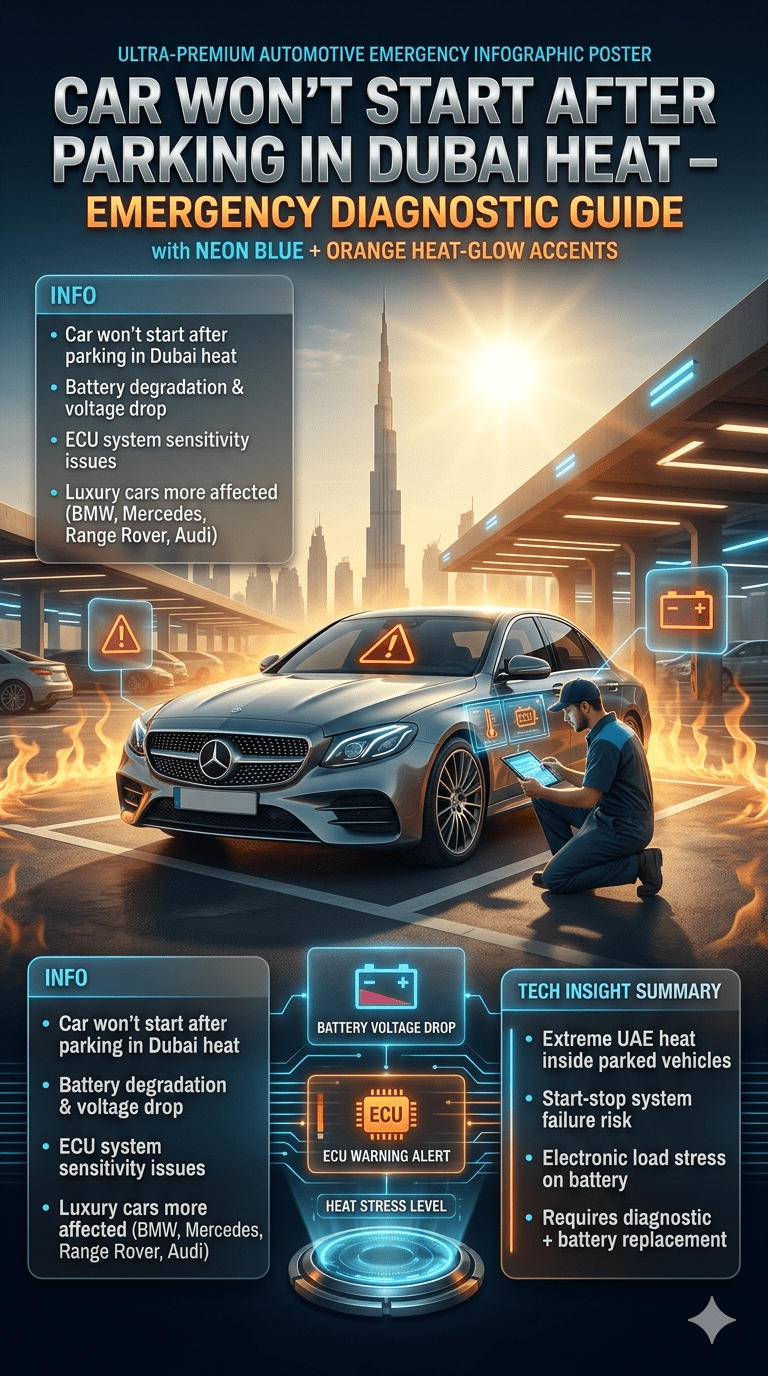
The issue of car won’t start after parking in Dubai heat has become one of the most frequent emergency breakdown scenarios in the UAE, especially in summer months when temperatures inside parked vehicles can exceed extreme thermal limits. In cities like Dubai, Abu Dhabi, and Sharjah, this problem is strongly linked to battery degradation, electronic load stress, and heat-induced electrical failure.
When a vehicle refuses to start after being parked in direct sunlight or even underground parking, the root cause is often not just a weak battery but a combination of thermal expansion damage, voltage drop, and ECU system sensitivity. Luxury cars such as Mercedes-Benz, BMW, Range Rover, and Audi are even more vulnerable due to advanced electronics and start-stop systems.
This guide explains everything about car won’t start after parking in Dubai heat, including causes, diagnostics, battery types, legal considerations, pricing, case studies, and real UAE-based repair solutions.
Market Context: Dubai Heat & Vehicle Starting Failures
Dubai’s climate creates a unique automotive stress environment where parked vehicles are continuously exposed to high thermal pressure. This directly impacts starting performance.
Key environmental factors:
- Ambient temperatures exceeding 45°C in summer
- Interior cabin heat reaching 70°C+
- Battery electrolyte evaporation
- Continuous AC system load before shutdown
- High usage of smart electronics and infotainment systems
Luxury and rental vehicles are most affected due to:
- Constant short-trip usage
- Airport parking long durations
- Tourist vehicle inactivity
- High electrical demand systems
The result is a high demand for car won’t start after parking in Dubai heat emergency solutions.
Service Ecosystem in UAE for Starting Failures
Dubai has a highly developed mobile automotive service ecosystem designed for instant response.
A typical emergency system includes:
- Mobile jump-start units
- On-site battery replacement teams
- ECU diagnostic scanning
- Alternator testing systems
- Roadside assistance fleets
- Luxury vehicle battery coding specialists
Professional service providers such as EuroSwift Auto Services deliver instant on-location solutions:
https://euroswiftautoservices.ae/car-battery-replacement-near-me-dubai/
Types of Battery-Related Failures in Dubai Heat
1. Heat-Dead Battery Failure
Battery loses chemical efficiency due to extreme temperature exposure.
2. Voltage Drop Failure
Battery cannot maintain required voltage for ignition.
3. Parasitic Drain Failure
Electronic systems consume power while parked.
4. Alternator Weak Charging Failure
Battery never fully charges during short trips.
5. ECU Sensitivity Lock Failure
Modern cars block ignition due to voltage instability.
Battery Types Used in UAE Heat Conditions
AGM Batteries
- Best for luxury cars
- Heat resistant and stable
- Supports start-stop systems
EFB Batteries
- Used in mid-range vehicles
- Better than standard batteries
- City driving optimized
Lead-Acid Batteries
- Budget option
- Faster degradation in UAE heat
Car Won’t Start After Parking in Dubai Heat – Process Flow
Step 1: Initial Symptoms Check
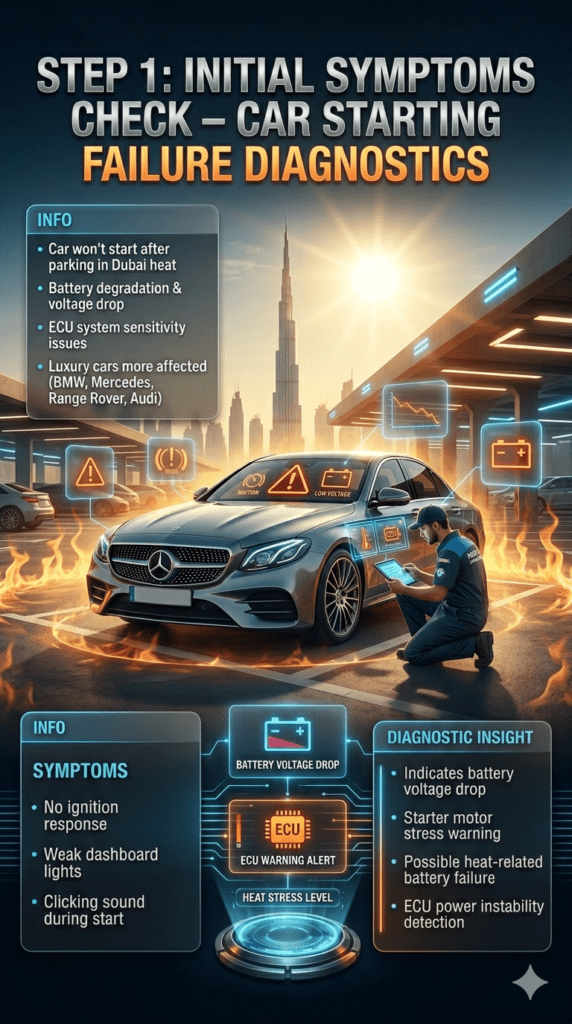
- No ignition response
- Weak dashboard lights
- Clicking sound during start
Step 2: Diagnostic Testing
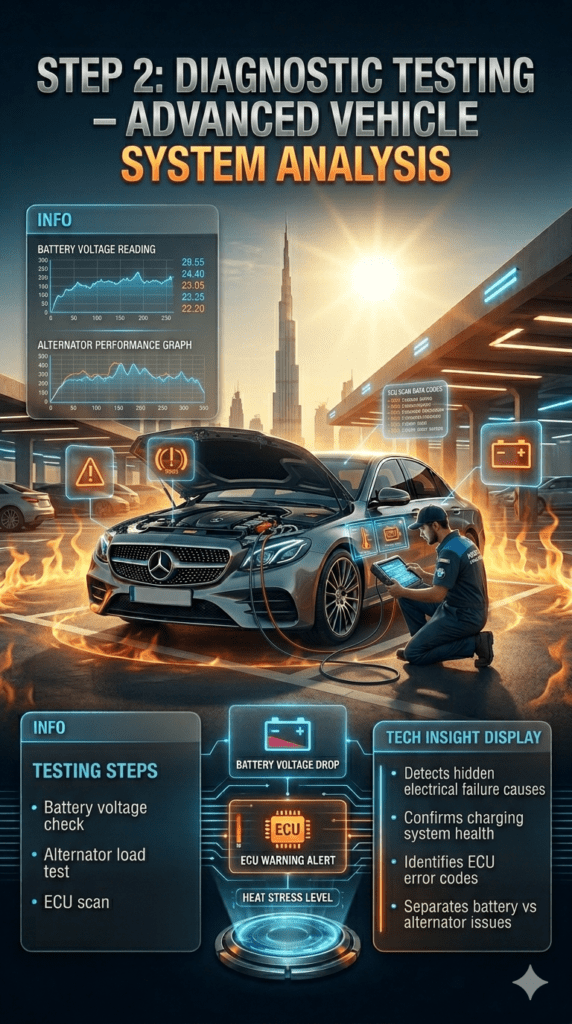
- Battery voltage check
- Alternator load test
- ECU scan
Step 3: Jump Start Decision
- Temporary power restoration
- Used only for emergency movement
Step 4: Battery Replacement Decision
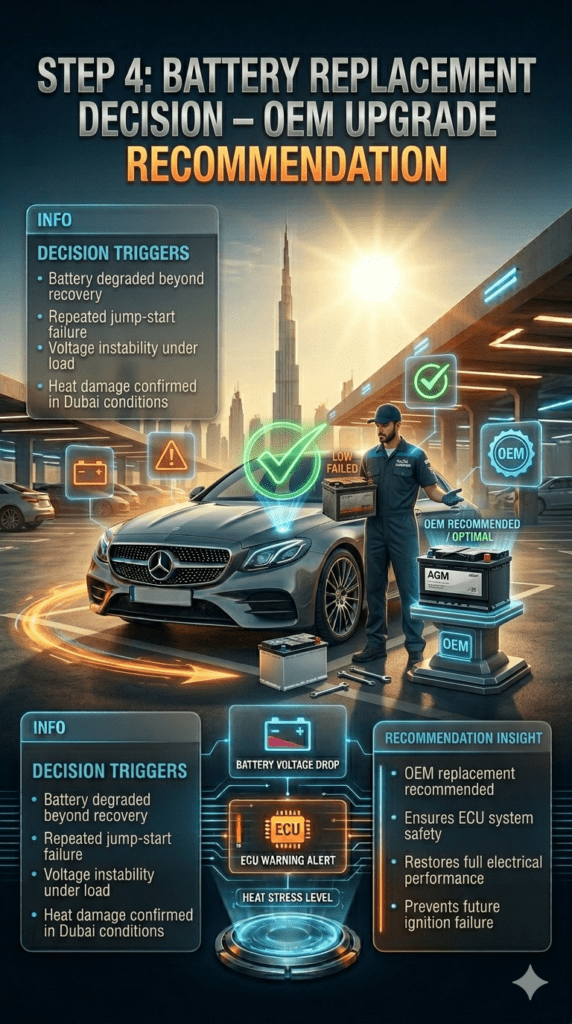
- If battery is degraded beyond recovery
- OEM replacement recommended
Step 5: ECU Reset & Stabilization
- Ensures system compatibility
- Prevents future ignition failure
Legal Requirements & UAE Automotive Compliance
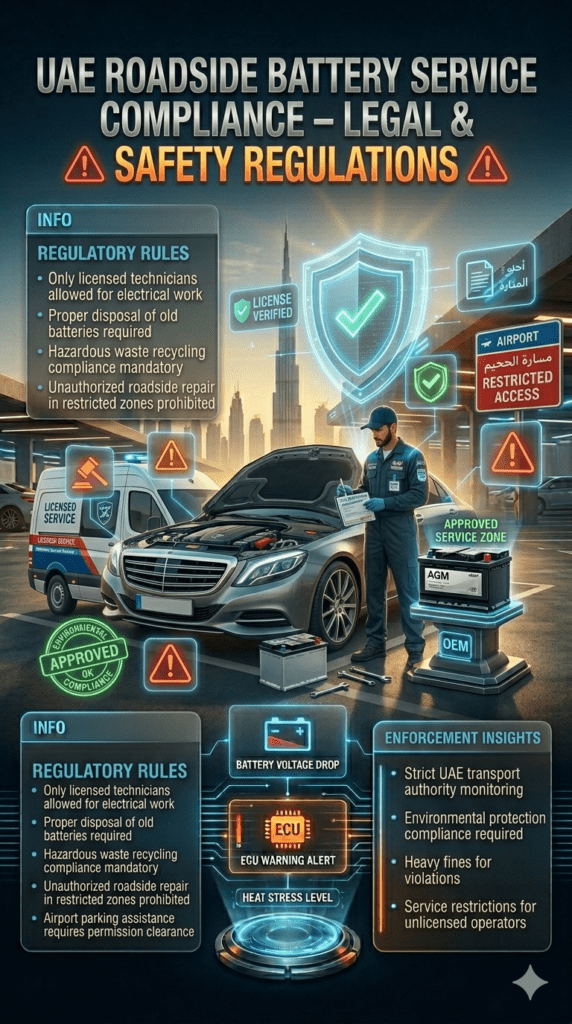
In UAE, roadside battery services must follow strict regulations:
- Only licensed technicians allowed for electrical work
- Proper disposal of old batteries required
- Hazardous waste recycling compliance mandatory
- Unauthorized roadside repair in restricted zones prohibited
- Airport parking assistance requires permission clearance
Failure to comply may lead to fines or service restrictions.
Pricing & Emergency Service Packages in Dubai
Standard Pricing Table
| Service Type | Price (AED) | Description |
|---|---|---|
| Jump Start Service | 80 – 150 | Emergency ignition boost |
| Battery Testing | 50 – 120 | Diagnostic check |
| Economy Battery Replacement | 250 – 450 | Standard vehicles |
| Premium AGM Replacement | 500 – 900 | Luxury vehicles |
| ECU Coding Service | 150 – 300 | Advanced system reset |
Full pricing details:
https://euroswiftautoservices.ae/complete-guide-to-car-battery-prices-in-dubai-2026-updated-list/
Tips for Preventing Car Won’t Start After Parking in Dubai Heat
- Always park in shaded or covered areas
- Avoid long idle parking in direct sunlight
- Drive at least 20–30 minutes daily
- Turn off all electronics before engine shutdown
- Replace battery every 2–3 years in UAE
- Check battery health before summer season
- Avoid repeated short trips only
Maintenance Guide for UAE Drivers
Proper maintenance reduces sudden ignition failure:
- Battery voltage check every 6 months
- Alternator inspection annually
- Terminal cleaning and corrosion removal
- ECU software updates for smart vehicles
- Use AGM upgrade for luxury vehicles
- Avoid deep discharge cycles
Case Study 1: Dubai Marina Parking Failure
A BMW 5 Series failed to start after 4 hours in outdoor parking.
Cause:
- Heat soaked battery degradation
- High infotainment drain
Solution:
- On-site AGM replacement
- ECU reset and diagnostic scan
Outcome:
Vehicle restored in under 40 minutes.
Case Study 2: Airport Rental Car Breakdown
A Toyota Camry rental at Dubai Airport refused to start after 2 days.
Cause:
- Continuous security system drain
- Weak EFB battery
Solution:
- Jump start followed by replacement
- Battery upgrade installed
Outcome:
Vehicle returned to service same day.
Case Study 3: Luxury SUV Heat Failure
A Range Rover experienced ignition failure after desert parking exposure.
Cause:
- Thermal battery expansion damage
- Alternator undercharging
Solution:
- Premium AGM battery installation
- Full electrical system check
Outcome:
Stable restart and restored performance.
Comparison Table: Battery Performance in UAE Heat
| Battery Type | Heat Resistance | Lifespan in Dubai | Best For |
|---|---|---|---|
| AGM | High | 3–5 years | Luxury cars |
| EFB | Medium | 2–4 years | Mid-range cars |
| Lead-Acid | Low | 1.5–3 years | Economy cars |
Trends: AI & Smart Vehicle Starting Systems in UAE
Modern Dubai vehicles are evolving rapidly with advanced systems:
- AI-based battery health monitoring
- Smart ignition lock protection
- Predictive failure alerts
- EV auxiliary battery management
- Cloud-connected diagnostics systems
These technologies reduce sudden car won’t start after parking in Dubai heat incidents but do not eliminate them completely.
Internal Service Ecosystem Links
For emergency mobile support in Dubai:
- https://euroswiftautoservices.ae/car-battery-replacement-near-me-dubai/
- https://euroswiftautoservices.ae/%F0%9F%94%8B-amaron-car-battery-replacement-dubai/
- https://euroswiftautoservices.ae/bosch-car-battery-replacement-dubai/
- https://euroswiftautoservices.ae/dubai-fastest-15-min-agm-batteries-genuine-free-installation-car-battery-replacement/
Final Operational Insight (UAE Reality)
In Dubai heat conditions, a car won’t start after parking is rarely a random failure. It is usually the result of:
- Heat-damaged battery chemistry
- Voltage instability
- Electronic system overload
- Alternator inefficiency
- Aging battery beyond lifecycle
The most reliable solution is always:
👉 Immediate diagnostic + on-site OEM battery replacement with ECU stabilization
Advanced Diagnostic Breakdown: Why Cars Refuse to Start After Parking in Dubai Heat
In most car won’t start after parking in Dubai heat cases, the real issue is not visible until a full electrical system diagnosis is performed. Modern vehicles behave like computers on wheels, so even a slight voltage imbalance can block ignition completely.
1. Battery Voltage Collapse (Hidden Failure)
When a car is parked in extreme heat, internal battery chemistry degrades silently. The voltage may look “normal” on the surface, but under load it collapses instantly.
Key symptoms:
- Dashboard lights flicker or stay dim
- Clicking sound from starter relay
- Central locking becomes weak or unresponsive
2. ECU Lock Protection Mode
Luxury cars such as Mercedes, BMW, and Audi automatically enter protection mode when voltage drops below safe threshold.
What happens:
- Ignition system is blocked
- Fuel injection is disabled
- Start-stop system is deactivated
- Dashboard shows random warnings
3. Alternator Charging Imbalance
Even if the battery is new, a weak alternator cannot recharge it properly during short UAE trips.
4. Heat-Induced Internal Resistance Increase
Extreme temperatures increase resistance inside battery plates, reducing cranking power dramatically.
Electrical Load Stress in Modern UAE Vehicles
Modern cars in Dubai are heavily dependent on electronics, which increases failure probability after parking.
Major power consumers:
- Smart keyless entry systems
- 360-degree camera modules
- Infotainment and navigation systems
- Parking sensors and ADAS systems
- Cabin pre-cooling systems
Even when the engine is OFF, these systems slowly drain battery power, especially in hot climates.
Step-by-Step Professional Recovery Method
When a vehicle refuses to start after parking, experts follow a structured recovery method:
Step 1: Safe Electrical Isolation
Prevent further ECU damage by disconnecting unstable load systems.
Step 2: Real-Time Battery Load Test
A load tester checks whether battery can sustain ignition demand, not just voltage.
Step 3: Alternator Output Verification
Ensures charging system is not the root cause of repeated failures.
Step 4: Controlled Jump Start (If Safe)
Used only if ECU is stable and battery is not fully damaged.
Step 5: Full Battery Replacement Decision
If failure is confirmed, OEM-grade replacement is recommended immediately.
High-Risk Situations in Dubai Parking Areas
Certain locations in Dubai increase failure probability significantly:
- Underground parking (heat trap zones)
- Airport long-term parking
- Mall rooftop parking under direct sun
- Desert-adjacent residential zones
- Tourist rental car parking hubs
These environments accelerate battery degradation faster than normal urban driving.
Real UAE Case Study 4: Dubai Mall Underground Failure
A Lexus RX 350 refused to start after 5 hours in underground parking.
Diagnosis:
- Battery heat soak + partial discharge
- ECU voltage protection triggered
- Alternator tested normal
Solution:
- On-site AGM battery replacement
- ECU reset and system recalibration
Result:
Vehicle restored in 38 minutes without towing.
Real UAE Case Study 5: Airport VIP Parking Breakdown
A Mercedes E-Class failed after 48 hours parked at Dubai International Airport.
Diagnosis:
- Continuous security system drain
- Battery reached deep discharge state
- Start-stop system locked
Solution:
- Emergency mobile jump-start
- Immediate Bosch AGM replacement
- Voltage stabilization reset
Result:
Full recovery and system normalization within 1 hour.
Comparison Table: Causes vs Symptoms in Dubai Heat
| Root Cause | Symptoms | Risk Level |
|---|---|---|
| Battery degradation | No crank, dim lights | High |
| Alternator failure | Battery keeps dying | High |
| ECU voltage lock | No ignition response | Very High |
| Parasitic drain | Slow overnight discharge | Medium |
| Heat damage | Sudden complete failure | Critical |
Expert Emergency Response Strategy (Dubai Standard)
Professional roadside teams follow a fast-response system:
- GPS-based technician dispatch
- Pre-diagnosis via phone symptoms
- Battery type matching (AGM/EFB/Lead-acid)
- On-site ECU-safe installation
- Immediate system validation
This ensures car won’t start after parking in Dubai heat cases are resolved without towing delays.
Hidden Warning Signs Before Complete Failure
Most drivers ignore early signals that appear days before breakdown:
- Slow engine crank in mornings
- Start-stop system disabled message
- Random dashboard warnings
- Weak AC performance at startup
- Delayed infotainment boot-up
Recognizing these signs early can prevent sudden parking failures.
EV & Smart Car Starting Issues in Dubai
Even hybrid and EV vehicles face similar problems, especially in auxiliary systems:
- 12V auxiliary battery failure
- Charging module communication error
- Software-based ignition lock
- Thermal protection shutdown
Tesla, BYD, and Toyota hybrids often require specialized diagnostic tools for recovery.
Advanced Preventive Engineering Insight
Modern battery failure in Dubai is not just chemical—it is system-wide.
Main stress factors:
- Heat acceleration of internal resistance
- Software-based power cutoffs
- High accessory load consumption
- Short-trip incomplete charging cycles
This combination makes prevention more important than repair.
Operational Insight for UAE Drivers
In real-world Dubai conditions:
- Battery failure is often sudden, not gradual
- Heat is the primary accelerating factor
- Luxury cars fail faster due to electronic dependency
- Parking duration directly impacts ignition reliability
The most effective solution remains:
👉 Immediate mobile diagnostics + OEM battery replacement + ECU stabilization
What is the new parking rule in Dubai?
Dubai parking rules are managed mainly by the RTA (Roads and Transport Authority) and updated periodically based on congestion, smart mobility, and payment systems.
Key updated parking rules in Dubai:
Paid parking zones are now fully digital Payment via SMS, apps, or meters only
Peak-hour pricing in busy commercial areas Higher rates in high-demand zones like Downtown & Business Bay
Smart parking enforcement Cameras automatically detect plate violations
Electric vehicle parking incentives Some EV charging zones offer discounted or free parking
Strict illegal parking penalties Blocking exits, fire zones, or disabled spaces leads to heavy fines
Maximum parking duration limits Some zones allow 2–4 hours only during daytime
👉 Dubai is moving toward a fully smart parking ecosystem with AI enforcement and digital payment tracking.
How do cars not overheat in Dubai?
Cars in Dubai survive extreme heat due to engine engineering, cooling systems, and user behavior adjustments.
Main cooling mechanisms:
1. Advanced Radiator Cooling System
Liquid coolant circulates continuously
Prevents engine temperature spikes
2. High-performance engine oil
Designed for extreme heat viscosity stability
3. Strong air conditioning load balancing
Modern cars manage AC + engine load together
4. Heat-resistant battery systems
AGM batteries handle high temperature better
5. Thermal sensors & ECU control
Automatically reduces engine load when overheating risk rises
Driver habits that prevent overheating:
Parking in shaded or underground areas
Avoiding long idle running with AC ON
Regular coolant level checks
Cleaning radiator dust buildup
Driving smoothly in traffic (no aggressive acceleration)
What are the 5 types of parking test in Dubai?
Dubai driving tests (RTA driving license test) include multiple parking skill evaluations.
1. Parallel Parking Test
Parking between two cars on roadside
Requires precise steering control
2. Angle Parking Test
Parking at a 45° or 60° angle
Common in malls and residential areas
3. Garage Parking (Bay Parking)
Reverse or forward parking inside a marked box
Used in residential buildings
4. Slope / Hill Parking Test
Vehicle must stay stable on incline
Handbrake control is tested
5. Emergency Stop & Controlled Parking
Simulates sudden stop and safe repositioning
Tests reaction time and control
👉 These tests ensure drivers can handle real Dubai traffic and parking environments safely.
How to turn in heat in car?
This question usually refers to turning ON heat (heater function) inside a car in hot regions like Dubai, or managing HVAC correctly.
Important clarification:
In Dubai, heating is rarely used, but it is available for defogging and winter nights.
How to activate heat in a car:
Step 1: Start engine
Heater only works when engine is running
Step 2: Set temperature control to HOT
Turn dial or digital control to red zone
Step 3: Switch AC OFF (if needed)
Heating works through engine coolant system
Step 4: Select airflow direction
Windshield (for defogging)
Cabin vents (for warmth)
Step 5: Adjust fan speed
Increase airflow for faster heating
Conclusion
Parking-related vehicle issues in Dubai, especially cars not starting after exposure to extreme heat, are not random failures—they are predictable outcomes of climate stress, electronic load demand, and evolving smart parking systems. From updated RTA parking regulations to advanced vehicle thermal management, everything in Dubai is designed around efficiency, control, and high-temperature resilience.
Modern vehicles rely heavily on electrical systems, which makes battery health, cooling performance, and ECU stability critical in this environment. Even a short parking duration under direct sunlight can trigger ignition failure if the battery or alternator is already weak. That is why preventive maintenance, proper parking habits, and timely diagnostics are essential in UAE driving conditions.
At the same time, Dubai’s infrastructure—smart parking enforcement, digital payment systems, and strict compliance rules—reflects a shift toward fully automated urban mobility. Understanding parking rules, vehicle cooling systems, and driving test standards helps drivers adapt better and avoid unnecessary breakdowns or penalties.
In simple terms, safe driving in Dubai is not just about handling the road—it is about managing heat, electronics, and smart systems together. Drivers who maintain their vehicles properly and follow updated parking guidelines experience far fewer breakdowns and significantly better long-term vehicle performance in UAE conditions.
Leave a Reply