
Introduction
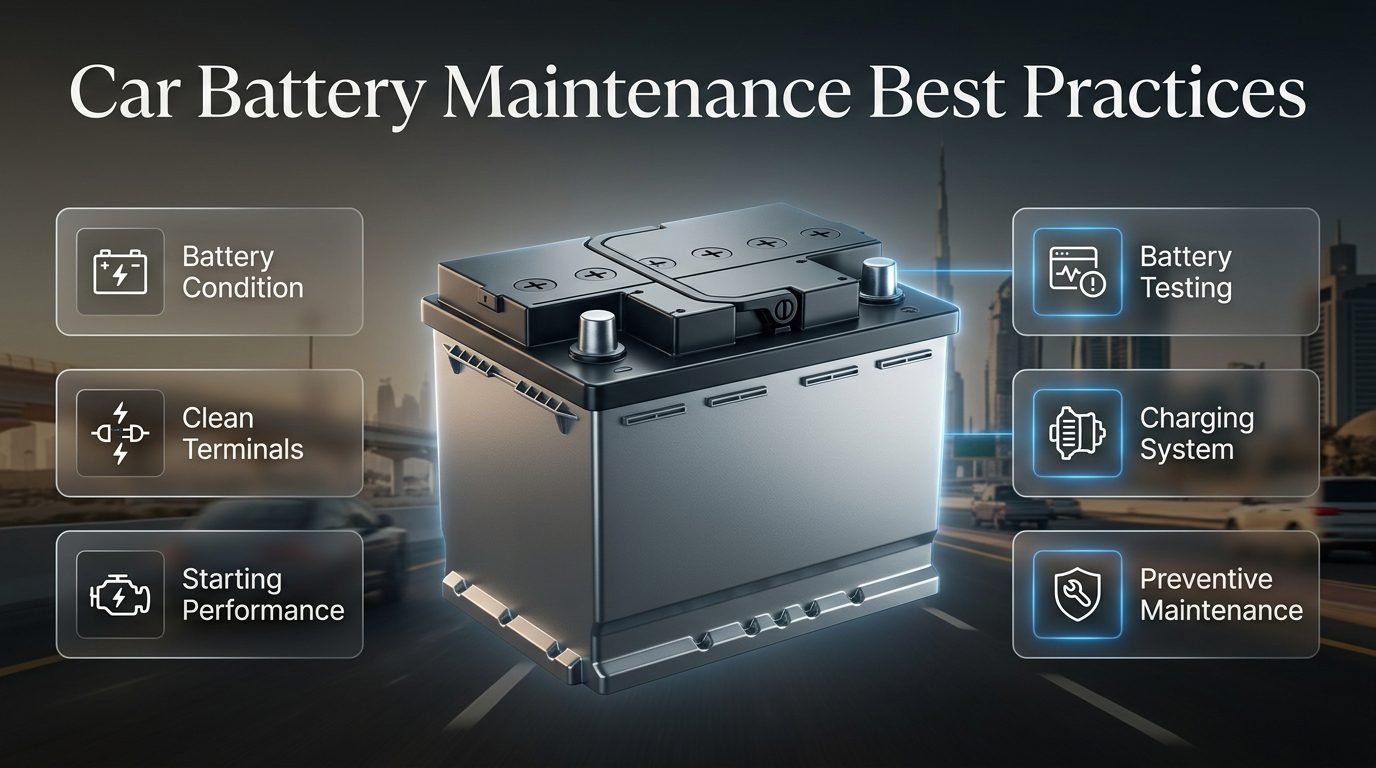
Car Battery Maintenance Best Practices | A car battery is one of those components most drivers notice only when the vehicle refuses to start. In reality, battery condition should be monitored long before a complete failure occurs. The battery supplies the high electrical current required to start the engine and works with the alternator to support the vehicle’s electrical system while driving.
Following proper Car Battery Maintenance Best Practices helps drivers identify deterioration, poor connections, charging problems, and unusual electrical drain before they turn into an unexpected breakdown. This is particularly important in Dubai, where high temperatures, frequent air-conditioning use, traffic congestion, short urban journeys, and extended parking can place additional demands on vehicle electrical systems.
Good battery maintenance is not limited to cleaning corrosion from the terminals. It includes checking the battery’s physical condition, monitoring starting performance, testing the battery when necessary, inspecting the charging system, selecting the correct replacement battery, and responding appropriately when warning signs appear.
For professional automotive support, EuroSwift Auto Services provides battery and broader vehicle maintenance services in Dubai.
1. Why Car Battery Maintenance Is Important
A battery can gradually lose its ability to deliver reliable starting power without failing suddenly. Many batteries continue to start the vehicle normally even after their internal condition has begun to deteriorate.
That makes preventive maintenance more valuable than waiting for a complete failure.
Regular battery maintenance can help with:
- More reliable engine starting
- Early identification of battery deterioration
- Reduced risk of unexpected breakdowns
- Detection of charging-system problems
- Identification of poor electrical connections
- Better battery replacement planning
- Fewer unnecessary jumpstarts
- Improved overall vehicle reliability
The battery should also be considered part of a larger starting and charging system. A weak alternator, damaged cable, poor ground connection, faulty starter, or parasitic electrical drain can produce symptoms that look like battery failure.
Battery maintenance is not just battery cleaning
A proper assessment should consider several connected components.
| Area | What should be checked |
|---|---|
| Battery | Physical condition, age and test results |
| Terminals | Corrosion, tightness and condition |
| Cables | Damage, looseness and resistance |
| Ground connection | Secure and clean connection |
| Starter | Cranking performance |
| Alternator | Charging performance |
| Electrical system | Abnormal power consumption |
| Installation | Correct fitment and secure mounting |
The objective is not simply to ask whether the battery works today. The more useful question is whether it remains capable of providing dependable service.
2. How a Car Battery Works With the Starting System
Understanding the battery’s role makes maintenance easier to understand.
When the driver starts the vehicle, the battery supplies electrical current to the starting system. The starter motor then turns the engine until combustion begins and the engine runs independently.
Once the engine is operating, the alternator generates electrical power and replenishes energy used during starting while supporting the vehicle’s electrical equipment.
The basic sequence is:
- The driver activates the starting system.
- The battery supplies electrical current.
- The starter motor turns the engine.
- The engine starts running.
- The alternator begins supplying electrical power.
- The charging system replenishes the battery.
If one part of this system develops a fault, similar symptoms can appear.
For example, slow cranking may be related to:
- Weak battery condition
- Corroded terminals
- Poor ground connection
- Starter problems
- Wiring resistance
- Charging-system problems
This is why professional Engine Diagnostics or electrical diagnosis can be useful when the cause is unclear.
3. Inspect the Battery Physically
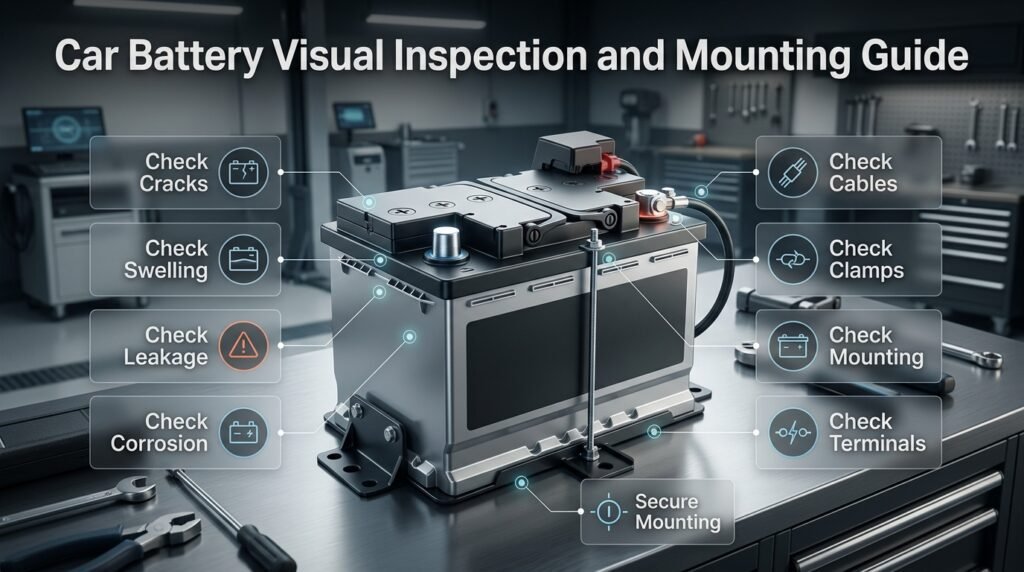
One of the easiest Car Battery Maintenance Best Practices is regular visual inspection.
You do not need sophisticated equipment to notice obvious physical problems. The battery should be checked periodically for signs of damage or deterioration.
Look for:
- Cracks in the battery case
- Unusual swelling
- Visible leakage
- Heavy terminal corrosion
- Loose battery clamps
- Damaged cables
- Broken terminal connections
- Missing protective covers
- Loose battery mounting
A battery that is physically damaged should receive professional attention rather than simply being cleaned and returned to service.
Why battery mounting matters
The battery should remain securely mounted while the vehicle is moving.
Excessive movement can place stress on:
- Battery terminals
- Cable connections
- Mounting brackets
- Internal battery components
A secure installation helps maintain stable electrical connections and reduces unnecessary vibration.
4. Keep Battery Terminals Clean and Secure
Battery terminals create the electrical connection between the battery and the vehicle.
Corrosion around a terminal can interfere with electrical current flow. This may become particularly noticeable when the starter demands substantial current.
Possible symptoms include:
- Slow starting
- Clicking during starting
- Intermittent electrical problems
- Visible corrosion
- Loose connections
- Unexplained starting difficulties
Terminal inspection checklist
During routine inspection:
- Check the positive terminal.
- Check the negative terminal.
- Look for corrosion.
- Confirm that connections are secure.
- Inspect cable ends.
- Check the ground connection.
- Ensure protective covers are correctly positioned.
Cleaning corrosion can improve a poor connection, but it does not repair a damaged cable or defective terminal.
If corrosion repeatedly returns, the connection itself should be investigated.
Professional recommendation
Avoid careless cleaning or handling around the battery. Modern vehicles contain sensitive electronic systems, so battery service should be performed using appropriate procedures.
If a terminal is damaged, loose, or heavily corroded, professional inspection is preferable.
5. Monitor Battery Age
Battery age is an important part of preventive maintenance.
There is no universal battery lifespan that applies to every vehicle. Actual service life depends on battery design, vehicle requirements, climate, driving habits, charging performance, storage conditions, and electrical demand.
Instead of replacing a battery solely because it has reached a particular age, consider its age together with:
- Battery test results
- Starting performance
- Physical condition
- Charging-system condition
- Previous discharge events
- Vehicle usage
An older battery that still performs well may continue to provide reliable service, while a younger battery can develop problems because of charging faults, excessive drain, or repeated deep discharge.
If testing indicates deterioration, planning Battery Replacement before complete failure is generally more convenient.
For drivers looking for professional battery replacement service, Car Battery Replacement Near Me Dubai provides a relevant service option.
6. Test the Battery Instead of Guessing
A visual inspection cannot determine the complete electrical condition of a battery.
Professional battery testing can provide information about its ability to perform under starting conditions.
Depending on the vehicle and battery type, testing may evaluate:
- Battery voltage
- Starting capability
- State of charge
- Battery condition
- Conductance
- Electrical response
- Charging performance
Why voltage alone is not enough
A battery may show an acceptable voltage reading while still having insufficient starting capability.
This is why a simple voltage measurement should not always be treated as proof that the battery is healthy.
A professional battery test provides a better assessment when symptoms appear or when replacement decisions need to be made.
Testing should be interpreted correctly
Battery test results should be considered alongside:
- Battery specifications
- Vehicle requirements
- Battery technology
- Temperature
- Recent driving conditions
- Charging-system performance
- Previous discharge history
Testing is useful when it leads to a better diagnosis rather than an automatic recommendation to replace the battery.
7. Check the Alternator and Charging System
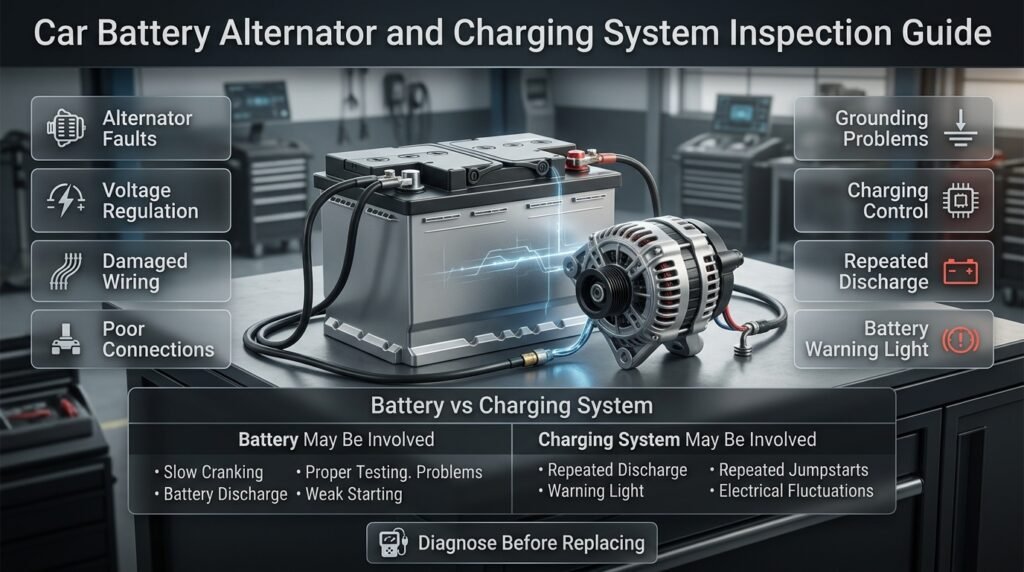
One of the most important battery maintenance principles is to check the charging system when battery problems keep returning.
The alternator normally replenishes energy used from the battery during engine starting and supports the vehicle’s electrical load while the engine is operating.
If the charging system is not functioning correctly, even a recently installed battery can become discharged.
Possible charging-system problems include:
- Alternator faults
- Voltage regulation problems
- Damaged wiring
- Poor electrical connections
- Grounding problems
- Charging-control issues
Battery problems versus charging problems
| Symptom | Battery may be involved | Charging system may be involved |
|---|---|---|
| Slow cranking | Common possibility | Possible |
| Repeated battery discharge | Possible | Important possibility |
| Battery warning light | Less typical | Important warning |
| New battery quickly becomes weak | Possible | Strong possibility |
| Repeated jumpstarts | Possible | Strong possibility |
| Electrical fluctuations | Possible | Possible |
These symptoms are not a definitive diagnosis.
If a vehicle repeatedly needs a jumpstart, replacing the battery without checking the charging system can result in the same problem returning.
8. Pay Attention to Your Driving Pattern
Driving habits can affect battery performance.
Frequent short journeys may provide limited time for the charging system to replenish the energy used during starting. If the vehicle repeatedly starts, drives for a short distance, stops, and starts again, the battery may not receive enough opportunity to recover its charge.
This does not mean short journeys automatically damage a battery. Modern vehicles are designed for urban driving.
The important point is that frequent short-trip use should be considered when diagnosing repeated low-charge conditions.
Drivers who regularly make short journeys should monitor:
- Starting performance
- Battery age
- Battery test results
- Charging-system performance
- Frequency of discharge
- Need for jumpstarts
If short journeys are unavoidable, periodic battery testing becomes more useful.
9. Avoid Unnecessary Electrical Load When Parked
Modern cars contain many electronic systems that can consume electrical power.
These include:
- Security systems
- Interior lighting
- Infotainment systems
- Electronic control modules
- USB accessories
- Dash cameras
- GPS devices
- Aftermarket electronics
Most factory-installed systems are designed to manage their power consumption. However, faulty equipment or incorrectly installed accessories can create abnormal battery drain.
Common causes of unnecessary drain
- Interior lights left on
- Poorly installed aftermarket accessories
- Faulty electronic equipment
- Incorrect dash-camera wiring
- Devices remaining connected
- Electrical modules failing to enter sleep mode
- Wiring faults
If a healthy battery repeatedly loses charge while the vehicle is parked, the electrical system should be investigated.
10. Understand Parasitic Battery Drain
Some electrical consumption while a vehicle is switched off is normal. Modern vehicles need limited electrical power for security, memory, communication, and electronic control functions.
The problem occurs when electrical consumption becomes excessive.
Warning signs of abnormal parasitic drain
- Battery repeatedly goes flat while parked
- Vehicle struggles to start after sitting overnight
- Battery becomes weak despite being relatively new
- Problem began after an accessory installation
- Electrical equipment behaves unexpectedly
Diagnosing parasitic drain can require specialized equipment because modern vehicles contain many interconnected electronic modules.
Replacing the battery without identifying the source of excessive drain may provide only temporary relief.
11. Consider Dubai’s Climate
Climate is an important consideration when discussing Car Battery Maintenance Best Practices in Dubai.
High temperatures can accelerate battery deterioration, while frequent air-conditioning use and heavy traffic create demanding operating conditions.
Dubai drivers may commonly encounter:
- High ambient temperatures
- Heavy air-conditioning usage
- Stop-and-go traffic
- Frequent short journeys
- Extended vehicle parking
- High electrical demand
These conditions do not mean that every battery will fail early. They do mean that battery condition should not be ignored.
Practical battery habits for Dubai drivers
- Inspect the battery periodically.
- Monitor battery age.
- Check for physical swelling or damage.
- Keep connections secure.
- Test the battery when starting performance changes.
- Check the charging system when repeated discharge occurs.
- Inspect the battery before major journeys.
Preventive inspection is generally more convenient than dealing with a starting failure at an inconvenient location.
12. Start-Stop Vehicles Require Additional Attention
Vehicles equipped with automatic start-stop systems can place different demands on the battery because the engine may restart more frequently.
Depending on the vehicle, battery technologies such as AGM or EFB may be required.
This means that replacing a start-stop battery is not simply a matter of finding another battery of similar physical size.
The replacement should match:
- Battery technology
- Capacity
- Starting requirements
- Physical dimensions
- Terminal configuration
- Vehicle specifications
- Start-stop requirements
- Battery-management requirements
For vehicles that require AGM technology, AGM Battery Replacement Dubai is a relevant battery service page.
13. Choose the Correct Battery Specification
Battery selection is one of the most important parts of proper maintenance.
Drivers sometimes focus too heavily on brand or price while overlooking whether the battery actually matches the vehicle.
Important factors include:
| Battery factor | Why it matters |
|---|---|
| Technology | Must suit the vehicle’s electrical system |
| Capacity | Determines stored electrical energy |
| Starting rating | Affects engine-starting capability |
| Dimensions | Battery must physically fit |
| Terminal arrangement | Connections must match |
| Mounting | Battery must be secured correctly |
| Start-stop compatibility | Required for applicable vehicles |
| Vehicle electronics | May require specific battery characteristics |
A more expensive battery is not necessarily better if it is the wrong specification.
Likewise, selecting the cheapest available battery may create reliability problems if its specifications do not meet the vehicle’s requirements.
14. Battery Brands and What Drivers Should Consider
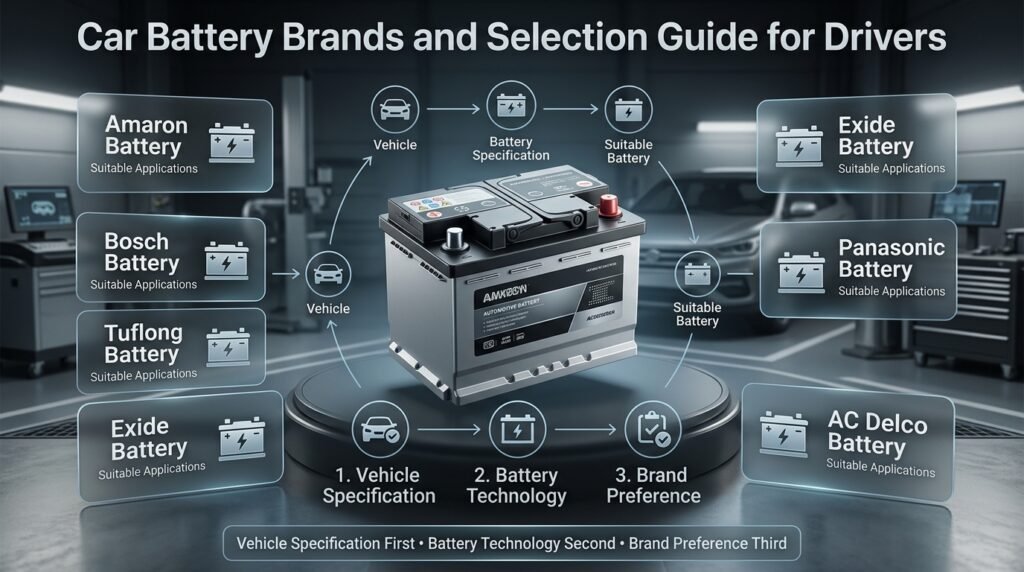
Brand can be one factor in battery selection, but the correct specification should always come first.
Amaron Battery
Amaron provides automotive battery options for different vehicle applications. The correct model should be selected according to the vehicle’s requirements.
Amaron Battery Replacement Dubai
Bosch Battery
Bosch offers automotive batteries for different applications and vehicle requirements.
Bosch Battery Replacement Dubai
Tuflong Battery
Tuflong is another battery option that may be suitable when its specifications match the vehicle.
Tuflong Battery Replacement Dubai
Exide Battery
Exide offers automotive battery solutions covering different vehicle applications.
Exide Battery Replacement Dubai
Panasonic Battery
Panasonic automotive batteries can be considered when the relevant model meets the vehicle’s requirements.
Panasonic Battery Replacement Dubai
FIAMM Battery
FIAMM provides automotive battery options for suitable applications.
FIAMM Battery Replacement Dubai
AC Delco Battery
AC Delco batteries are another option for suitable automotive applications.
AC Delco Battery Replacement Dubai
The key principle is simple:
Vehicle specification first, battery technology second, brand preference third.
15. Follow a Practical Battery Maintenance Schedule
Battery maintenance works best when it becomes part of normal vehicle care.
A practical schedule can be divided into three stages.
Every month
Drivers can observe:
- Starting behavior
- Battery casing
- Terminal condition
- Battery mounting
- Visible cable condition
During scheduled servicing
Ask for:
- Battery condition assessment
- Terminal inspection
- Charging-system inspection where appropriate
- Battery testing when relevant
- Battery-age review
When symptoms appear
Do not wait for complete failure.
Investigate:
- Slow cranking
- Repeated discharge
- Clicking during starting
- Battery warning indicators
- Electrical abnormalities
- Repeated jumpstarts
| Maintenance stage | Main purpose |
|---|---|
| Monthly observation | Detect changes early |
| Scheduled inspection | Identify developing problems |
| Battery testing | Determine electrical condition |
| Symptom-based diagnosis | Find the actual cause |
| Replacement planning | Avoid unexpected failure |
16. Know the Warning Signs of Battery Problems
A battery problem should be investigated when vehicle behavior changes.
Slow engine cranking
If the starter turns the engine more slowly than normal, battery condition should be checked.
Repeated clicking
Repeated clicking can occur when insufficient electrical power reaches the starting system, although starter or connection problems can create similar symptoms.
Frequent jumpstarts
A vehicle should not regularly require external starting assistance.
Battery warning light
A battery warning indicator can point toward a charging-system problem and should not automatically be interpreted as a battery replacement signal.
Visible swelling
Unusual swelling or physical deformation requires professional assessment.
Electrical abnormalities
Unexpected changes in electrical equipment can indicate battery, charging, wiring, or electronic-system problems.
Starting problems after parking
If the vehicle starts normally after driving but struggles after being parked, possible causes include battery deterioration or abnormal electrical drain.
17. Common Car Battery Maintenance Mistakes
Even basic battery maintenance can go wrong when drivers rely on assumptions.
Waiting until the battery completely fails
This creates unnecessary inconvenience and can leave the vehicle stranded.
Better practice: Monitor battery age, starting performance, and test results.
Replacing the battery without diagnosis
A charging fault or parasitic drain can cause a replacement battery to discharge again.
Better practice: Investigate repeated battery failure.
Checking only voltage
Voltage is useful but does not provide the complete picture of battery health.
Better practice: Use an appropriate battery test.
Ignoring cables and grounds
A healthy battery cannot compensate for a poor electrical connection.
Better practice: Include terminals, cables and grounds in the inspection.
Choosing the cheapest battery
The cheapest option may not match the vehicle’s requirements.
Better practice: Prioritize specification and compatibility.
Ignoring driving patterns
Frequent short journeys and extended parking can influence battery charge.
Better practice: Consider actual vehicle usage when evaluating battery condition.
Assuming every starting problem is a battery problem
The starter, alternator, cables and electrical systems can also cause starting difficulties.
Better practice: Diagnose before replacing components.
18. What to Do When the Battery Goes Flat
A flat battery does not automatically mean the battery needs replacement.
Possible reasons include:
- Lights left on
- Extended parking
- Excessive parasitic drain
- Charging-system problems
- Battery deterioration
- Frequent short journeys
- Electrical accessories
A jumpstart may restore temporary starting ability, but it does not identify why the battery became discharged.
If the battery repeatedly goes flat, the vehicle should receive a proper electrical and charging-system assessment.
Professional Car Jumpstart assistance can help get the vehicle running again, but repeated jumpstarts should be treated as a warning that the underlying problem needs diagnosis.
19. Battery Maintenance Before Long-Distance Travel
Battery failure during a long journey can be particularly inconvenient.
Before a major trip, battery inspection is worth considering if:
- The battery is relatively old.
- Starting performance has changed.
- The vehicle has previously required a jumpstart.
- The battery recently discharged.
- The vehicle has experienced electrical problems.
- The vehicle has been parked for an extended period.
Pre-trip battery checklist
- Battery condition checked
- Battery age confirmed
- Terminals inspected
- Battery mounting checked
- Starting performance observed
- Charging system assessed if necessary
- Previous discharge investigated
- Replacement considered if testing indicates deterioration
A preventive inspection is usually easier than dealing with an unexpected breakdown during travel.
20. Battery Care During Extended Vehicle Storage
Extended parking can gradually reduce battery charge.
Modern vehicles continue to consume a small amount of electrical power while switched off. Security systems, memory functions, electronic modules, and other systems may continue operating.
Before storing a vehicle, consider:
- Battery condition
- Expected storage duration
- Manufacturer storage recommendations
- Vehicle electrical requirements
- Parking conditions
- Appropriate battery-maintenance options
When the vehicle returns to regular use, observe its starting performance.
A battery that has been deeply discharged may have suffered deterioration even if it starts the vehicle afterward.
21. What Happens During a Professional Battery Inspection?
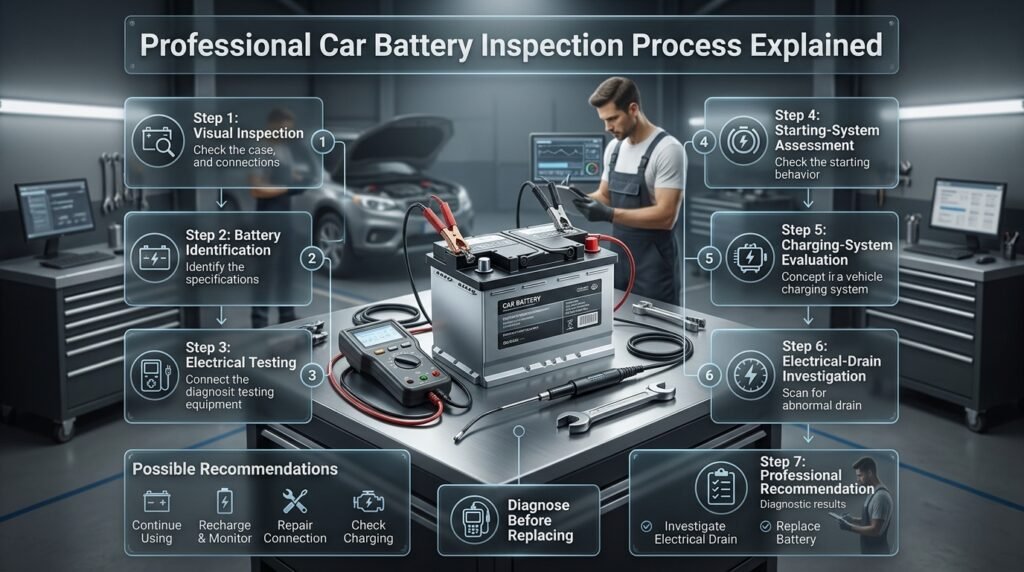
A professional battery assessment should follow a logical process.
Step 1: Visual inspection
The battery case, terminals, cables and mounting are examined.
Step 2: Battery identification
The battery type, specifications and approximate age are confirmed.
Step 3: Electrical testing
Appropriate testing equipment is used to assess battery condition.
Step 4: Starting-system assessment
Starting behavior and relevant connections are evaluated.
Step 5: Charging-system evaluation
If symptoms indicate a possible charging problem, the alternator and charging circuit are checked.
Step 6: Electrical-drain investigation
If the battery repeatedly loses charge while parked, abnormal electrical consumption may be investigated.
Step 7: Recommendation
The final recommendation may be:
- Continue using the battery
- Recharge and monitor
- Repair a connection
- Repair a charging-system issue
- Investigate electrical drain
- Replace the battery
This diagnostic approach is more reliable than automatically installing a new battery whenever a vehicle develops a starting problem.
22. Battery Repair vs Replacement
Not every battery-related issue requires replacement.
| Condition | Appropriate direction |
|---|---|
| Loose terminal | Correct connection |
| Corroded connection | Clean or repair appropriately |
| Charging fault | Diagnose charging system |
| Excessive electrical drain | Find and correct drain |
| Low state of charge | Recharge and reassess |
| Battery deterioration | Replacement may be required |
| Physical battery damage | Professional replacement assessment |
| Incorrect battery specification | Install correct specification |
The distinction is important because replacing a battery cannot repair an alternator problem, electrical drain, damaged cable, or poor ground connection.
A broader Vehicle Inspection may be appropriate when the source of the problem is uncertain.
23. Integrate Battery Maintenance With Complete Car Service
Battery maintenance should form part of a broader vehicle-maintenance strategy.
During routine Car Service, technicians can consider battery condition alongside:
- Engine condition
- Engine oil
- Cooling system
- Brakes
- Tires
- Suspension
- Steering
- Air conditioning
- Charging system
- Electronic diagnostics
This makes it easier to identify problems before they become roadside failures.
For example, a vehicle with slow starting may require battery testing, charging-system inspection, and electrical diagnosis rather than immediate battery replacement.
A good preventive maintenance strategy considers the vehicle as a complete system.
24. The Best Preventive Battery Maintenance Strategy
The most effective approach is condition-based maintenance.
A useful strategy has three levels.
Level 1: Driver observation
The driver notices changes in starting, lighting, or electrical behavior.
Level 2: Routine inspection
Battery condition is assessed during scheduled maintenance.
Level 3: Condition-based intervention
Testing results and symptoms determine whether the vehicle needs:
- Monitoring
- Charging
- Electrical repair
- Charging-system repair
- Battery replacement
This avoids two common extremes:
Replacing a battery too early and waiting until the battery fails completely.
25. Complete Car Battery Maintenance Checklist
Battery condition
- Battery casing inspected
- No visible cracks
- No unusual swelling
- No visible leakage
- Battery securely mounted
- Battery age recorded
Terminals and cables
- Positive terminal inspected
- Negative terminal inspected
- Corrosion checked
- Cable condition checked
- Ground connection considered
- Connections secure
Starting system
- Engine cranks normally
- No repeated clicking
- No unusual starting delay
- No repeated jumpstart requirement
Charging system
- Charging performance assessed when necessary
- Alternator concerns investigated
- Battery warning indicator checked
- Repeated discharge investigated
Usage pattern
- Short-trip driving considered
- Extended parking considered
- Electrical accessories reviewed
- Previous discharge events recorded
Replacement planning
- Correct battery specification confirmed
- Battery technology confirmed
- Vehicle requirements checked
- Replacement planned when testing indicates deterioration
26. Factors That Affect Battery Replacement Cost
Battery prices vary because vehicles do not all use the same battery specifications.
Important cost factors can include:
- Battery technology
- Battery capacity
- Vehicle type
- Brand
- Battery specification
- Availability
- Installation requirements
- Electronic battery-management procedures
- Emergency versus scheduled service
The cheapest battery is not necessarily the best value if it does not meet the vehicle’s requirements.
Similarly, the most expensive battery is not automatically the right choice.
The better approach is to choose a battery that provides the correct specification, technology, compatibility, and expected performance.
For a detailed look at the factors affecting battery costs, see the Complete Guide to Car Battery Prices in Dubai 2026.
27. Modern Trends in Car Battery Maintenance
Modern vehicles are becoming increasingly dependent on sophisticated electrical systems.
Start-stop technology, electronic control modules, advanced driver-assistance systems, infotainment systems, battery-management systems, and energy-management technologies have changed the way vehicle batteries are used.
Battery replacement is therefore becoming more technical.
Depending on the vehicle, professional service may involve:
- Correct battery technology
- Correct capacity
- Appropriate starting rating
- Battery-management procedures
- Electronic battery registration where required
- Charging-system diagnosis
- Vehicle-specific diagnostic equipment
The future of battery maintenance
Automotive maintenance is moving toward condition monitoring and predictive diagnostics.
Future systems are expected to make greater use of:
- Battery health monitoring
- Electronic charging management
- Predictive maintenance
- Vehicle health data
- More advanced diagnostic systems
- Automated fault detection
The fundamental principle remains the same: identify deterioration before it becomes a failure.
How often should a car battery be checked and maintained?
Car battery maintenance should not be limited to the moment when the vehicle refuses to start. A practical approach is to visually inspect the battery and its connections during routine servicing, while a proper battery and charging-system test should be performed when the battery is aging, starting performance changes, or the vehicle has experienced repeated discharge. Current automotive guidance also emphasizes more frequent attention as a battery gets older.
A useful maintenance routine includes:
Check the battery casing for cracks, swelling, or other visible damage.
Inspect terminals and cables for corrosion or looseness.
Monitor whether the engine cranks normally.
Keep track of the battery’s installation date.
Test the battery when starting performance changes.
Check the charging system if the battery repeatedly loses charge.
The important point is consistency. A battery can appear normal externally while its ability to deliver starting power is declining, so professional testing becomes particularly useful when the battery is older or symptoms begin to appear.
What are the warning signs that a car battery needs attention?
The most useful warning signs are changes in the vehicle’s normal behavior. Slow engine cranking, repeated clicking during starting, dim or fluctuating lights, a battery warning indicator, repeated jumpstart requirements, and visible battery damage can all justify further inspection. These symptoms can originate from the battery itself, but they can also indicate charging-system or electrical problems.
Pay particular attention to:
Slow cranking: The starter turns the engine noticeably more slowly than usual.
Repeated starting problems: The vehicle increasingly struggles to start.
Dim or flickering lights: This can indicate battery or charging-system concerns.
Battery warning indicator: This may point toward a charging-system issue rather than simply a weak battery.
Frequent jumpstarts: Repeated jumpstarts mean the underlying problem should be diagnosed.
Swelling or cracking: Physical battery damage requires professional attention.
The key mistake is waiting for complete failure. When one of these symptoms appears, testing the battery and starting/charging system can help determine whether the problem is actually the battery or another component.
Does hot weather and frequent short driving affect car battery life?
Yes, operating conditions can have a significant effect on battery performance. Extreme heat can accelerate battery deterioration, while frequent short journeys may give the charging system limited time to replenish the energy used during engine starting. Modern vehicles also have substantial electrical demands, making battery condition more important than it was in simpler vehicles.
For vehicles operating regularly in Dubai, practical battery care includes:
Monitor battery condition more carefully as it ages.
Inspect terminals for corrosion.
Pay attention to slower-than-normal starting.
Avoid leaving unnecessary electrical accessories operating when the engine is off.
Have the battery tested if it repeatedly becomes discharged.
Consider battery condition before long-distance travel.
Short journeys are not automatically harmful, but a vehicle that is used almost exclusively for short trips should have its battery condition monitored rather than assuming normal driving will always maintain a full charge.
Can a car battery be maintained if the vehicle is rarely driven?
Yes, but extended inactivity requires more attention because a parked vehicle can continue consuming a small amount of electrical power through security systems, memory functions, and other electronic equipment. A vehicle that sits unused for long periods can therefore experience a gradual reduction in battery charge.
For a vehicle that is not driven regularly, the maintenance strategy should include:
Check the battery condition before and after extended storage.
Follow the vehicle manufacturer’s storage recommendations.
Avoid leaving unnecessary accessories connected.
Monitor starting performance when the vehicle returns to regular use.
Consider an appropriate battery maintainer when recommended for the vehicle and storage situation.
One important distinction is between a battery being discharged and a battery being damaged or deteriorated. A discharged battery may recover after proper charging, while a battery that has deteriorated may continue to lose performance even after being recharged.
If a battery repeatedly becomes flat while the vehicle is parked, the issue should be investigated for possible parasitic electrical drain rather than simply charging or replacing the battery repeatedly.
How do I know whether to replace the battery or repair another part of the electrical system?
This is one of the most important battery-maintenance questions because a starting problem does not automatically mean the battery is defective. The battery, alternator, starter, cables, ground connections, and other electrical components work together, so the actual cause should be established before replacement.
A professional assessment should consider:
Situation
What should be investigated
Slow engine cranking
Battery and starting system
Battery repeatedly goes flat
Battery, alternator and electrical drain
Battery warning light
Charging system
New battery quickly loses charge
Charging system or parasitic drain
Corroded terminal
Connection and cable condition
Physically damaged battery
Battery replacement
Incorrect battery specification
Correct battery type and specification
Battery replacement becomes more appropriate when testing shows that the battery can no longer provide dependable performance or when its physical condition has deteriorated.
On the other hand, if the battery tests properly but continues to discharge, replacing it again may simply hide the real problem. A charging-system inspection or electrical diagnosis may be necessary.
Professional recommendation: Treat battery replacement as the result of a diagnosis, not as the first response to every starting problem. This approach can prevent unnecessary expense and helps ensure that the vehicle’s complete electrical system remains reliable.
Conclusion
Following the right Car Battery Maintenance Best Practices is about preventing problems before they become roadside emergencies. Regular inspection, clean and secure terminals, battery testing, correct charging-system checks, and awareness of changes in starting performance can make battery problems much easier to identify and manage.
For Dubai drivers, preventive battery care deserves particular attention because high temperatures, frequent air-conditioning use, heavy traffic, short journeys, and extended parking can place additional demands on the vehicle’s electrical system. However, battery maintenance should never focus on the battery alone. A weak alternator, poor connection, parasitic drain, or starting-system fault can produce similar symptoms.
A professional approach is simple: inspect the battery regularly, test it when necessary, investigate repeated discharge, and choose the correct replacement only when testing and vehicle requirements justify it. This condition-based approach supports better reliability and reduces the risk of unexpected starting problems.
When battery care is combined with regular Car Service, Vehicle Inspection, Engine Diagnostics, and other preventive maintenance, it becomes an important part of keeping the entire vehicle dependable. For professional automotive assistance in Dubai, EuroSwift Auto Services can support drivers with battery services and broader vehicle maintenance needs.

Leave a Reply