
Introduction
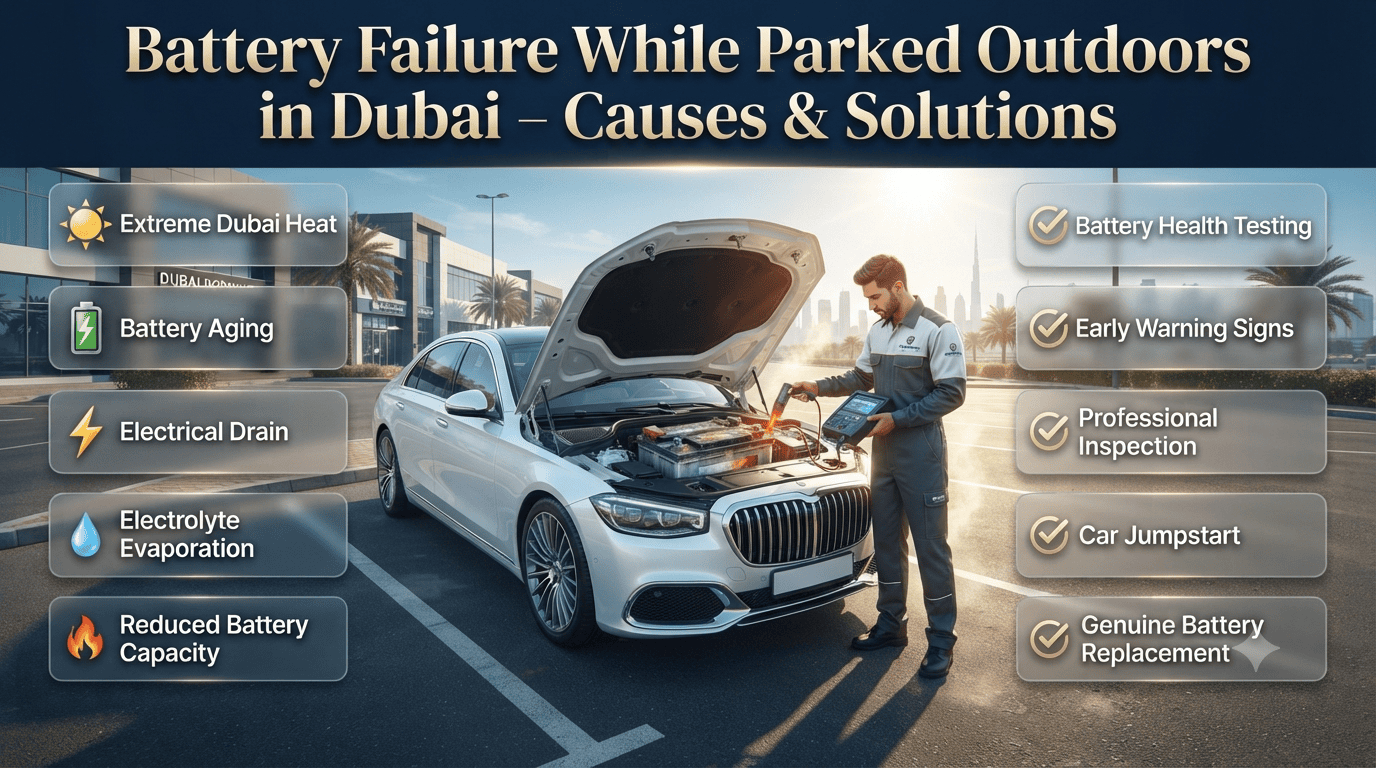
Parking your vehicle outdoors is a daily reality for thousands of drivers across Dubai. Whether your car spends hours under direct sunlight at the office, outside your home, or in an open parking lot, continuous exposure to extreme temperatures can significantly affect your vehicle’s electrical system—especially the battery. One of the most frustrating situations drivers face is discovering a completely discharged or failed battery after the car has been parked for several hours or overnight.
Battery failure while parked outdoors in Dubai is rarely caused by heat alone. Prolonged exposure to high temperatures, natural battery aging, parasitic electrical drain, corrosion, and reduced electrolyte efficiency often combine to shorten battery life. Without regular inspections, these hidden issues can leave drivers stranded without warning.
At EuroSwift Auto Services, experienced technicians diagnose battery-related problems using advanced testing equipment before recommending the most suitable solution. Whether your vehicle requires professional battery testing, a Car Jumpstart, or a complete Battery Replacement, timely intervention helps prevent unexpected breakdowns and protects other electrical components from unnecessary stress.
This guide explains why batteries fail while parked outdoors, the most common warning signs, contributing environmental factors, and how preventive maintenance can improve battery reliability in Dubai’s demanding climate.
Understanding Battery Failure While Parked Outdoors in Dubai
Battery failure occurs when the battery can no longer provide sufficient electrical power to start the engine or support the vehicle’s electronic systems after remaining parked. Outdoor parking exposes the battery to conditions that accelerate internal wear, making it one of the leading causes of unexpected starting problems in hot climates.
Unlike mechanical failures that often develop gradually, battery problems may appear suddenly. A vehicle that started perfectly the previous day can become completely unresponsive after several hours in intense sunlight.
Modern vehicles rely heavily on battery power even when parked. Security systems, keyless entry modules, onboard computers, alarm systems, and memory functions continue drawing small amounts of electricity. Combined with Dubai’s extreme temperatures, this continuous electrical demand gradually weakens aging batteries.
Professional Vehicle Inspection and periodic battery health testing help identify declining performance before complete failure occurs.
Why Outdoor Parking Creates Additional Stress
Several environmental conditions contribute to faster battery deterioration:
- Continuous exposure to extreme summer temperatures
- Increased electrolyte evaporation
- Accelerated internal plate corrosion
- Higher electrical resistance within aging batteries
- Expansion of internal battery components
- Increased self-discharge during prolonged parking
These factors often reduce the service life of automotive batteries compared with vehicles regularly parked in shaded or covered areas.
How Modern Vehicles Increase Battery Demand
Today’s vehicles contain significantly more electronic systems than older models. Even when switched off, many components remain active.
Examples include:
- Smart key detection
- Vehicle security systems
- GPS tracking modules
- Infotainment memory
- Electronic control units (ECUs)
- Remote communication systems
This constant electrical consumption means batteries must remain in excellent condition to maintain reliable performance.
Table: Battery Performance in Different Parking Conditions
| Parking Condition | Battery Stress Level | Likelihood of Failure |
|---|---|---|
| Covered Parking | Low | Low |
| Underground Parking | Very Low | Very Low |
| Outdoor Shade | Moderate | Moderate |
| Direct Sunlight | High | High |
| Extended Outdoor Parking | Very High | Very High |
Why Outdoor Parking Accelerates Battery Failure in Dubai
Dubai’s climate presents one of the most demanding operating environments for automotive batteries. During summer, vehicle cabin temperatures can exceed ambient air temperatures by a significant margin, creating intense heat around the battery compartment.
Heat does not immediately destroy a healthy battery. Instead, it speeds up chemical reactions inside the battery, increasing internal wear over time. As these reactions continue, battery efficiency gradually declines until starting reliability becomes inconsistent.
Vehicles parked outdoors every day generally experience faster battery aging than those stored in shaded or climate-protected environments.
Increased Electrolyte Evaporation
The electrolyte solution inside a lead-acid battery is essential for storing and delivering electrical energy. High temperatures accelerate evaporation, reducing the battery’s ability to maintain a stable electrical charge.
Reduced electrolyte levels may lead to:
- Lower starting power
- Reduced reserve capacity
- Poor charging efficiency
- Increased internal heat generation
Accelerated Plate Corrosion
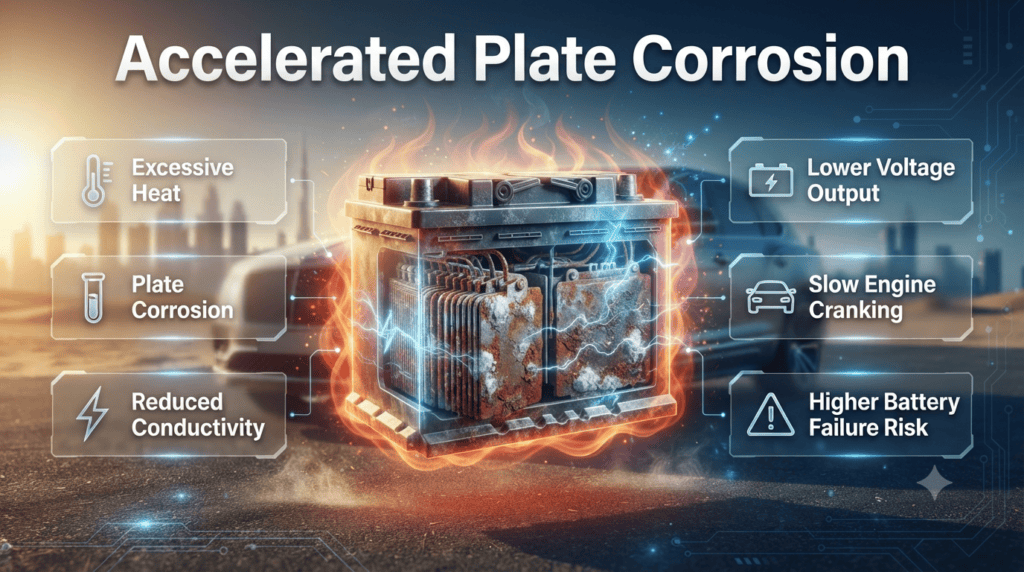
Battery plates naturally corrode over time, but excessive heat speeds up this process considerably.
Consequences include:
- Reduced electrical conductivity
- Lower voltage output
- Slower engine cranking
- Increased likelihood of complete battery failure
Greater Internal Resistance
Heat-related aging increases resistance inside the battery. As resistance rises, more energy is lost during operation, making it harder for the battery to deliver the high current required for engine starting.
Table: Effects of Outdoor Heat on Battery Components
| Battery Component | Effect of Outdoor Heat | Possible Result |
|---|---|---|
| Electrolyte | Faster evaporation | Lower battery capacity |
| Lead Plates | Accelerated corrosion | Reduced lifespan |
| Battery Terminals | Increased oxidation | Poor electrical connection |
| Battery Case | Thermal expansion | Swelling or cracking |
| Internal Separators | Faster degradation | Reduced battery efficiency |
Expert Insight
Professional technicians often find that batteries exposed to daily outdoor parking fail months earlier than identical batteries maintained in covered parking. Regular inspections, terminal cleaning, and charging system evaluations help detect heat-related deterioration before it leads to a roadside breakdown.
Common Causes of Battery Failure While Parked Outdoors
Although extreme heat is a major contributor, battery failure while parked outdoors is usually the result of several interconnected factors rather than a single issue.
Understanding these causes allows drivers to address potential problems before they become emergencies.
1. Aging Battery
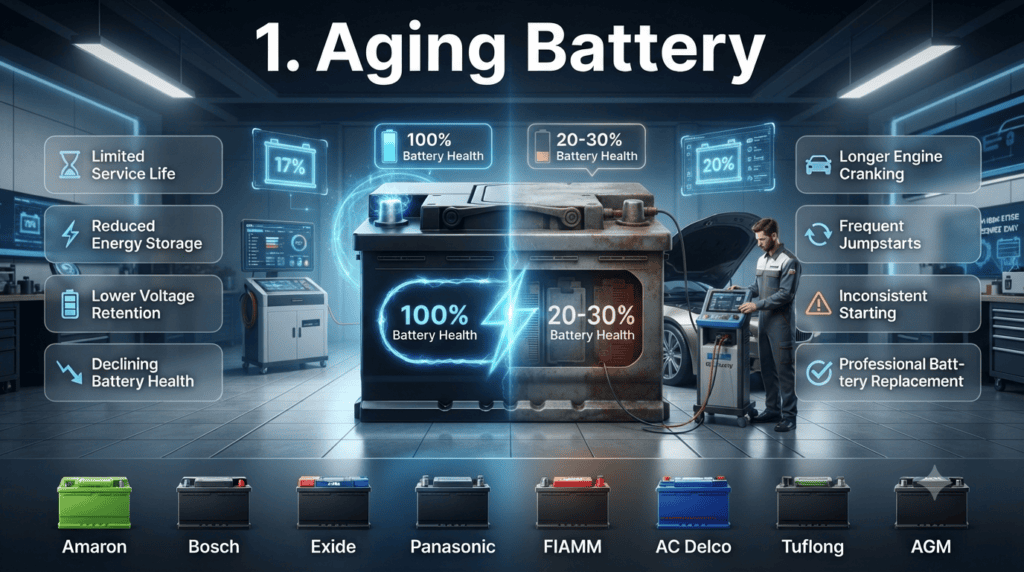
Every automotive battery has a limited service life. As it ages, its ability to store electrical energy decreases naturally.
Signs of battery aging include:
- Longer engine cranking
- Frequent jumpstarts
- Reduced voltage retention
- Inconsistent starting performance
If testing confirms the battery has reached the end of its lifespan, a professional Battery Replacement is generally the most reliable solution. EuroSwift Auto Services offers genuine battery options, including Amaron Battery, Bosch Battery, Exide Battery, Panasonic Battery, FIAMM Battery, AC Delco Battery, Tuflong Battery, and AGM Battery, ensuring compatibility with a wide range of vehicles.
2. Parasitic Electrical Drain
Even when the ignition is off, some electrical components continue consuming small amounts of power.
Excessive parasitic drain may result from:
- Faulty control modules
- Interior lights remaining on
- Dash cameras
- GPS tracking devices
- Aftermarket accessories
- Alarm system malfunctions
Professional Engine Diagnostics and electrical testing can identify abnormal current draw before it completely discharges the battery.
3. Loose or Corroded Battery Terminals
Outdoor humidity, airborne dust, and oxidation gradually corrode battery terminals, increasing electrical resistance and reducing charging efficiency.
Common symptoms include:
- Clicking sound during starting
- Slow engine crank
- Flickering dashboard lights
- Intermittent electrical faults
Routine terminal cleaning during scheduled Car Service helps maintain reliable electrical connections.
Table: Common Causes and Their Impact
| Cause | Effect on Battery | Recommended Solution |
|---|---|---|
| Aging Battery | Reduced capacity | Battery testing and replacement |
| Extreme Heat | Faster internal wear | Regular inspections |
| Parasitic Drain | Battery discharge | Electrical diagnostics |
| Corroded Terminals | Poor conductivity | Terminal cleaning |
| Charging System Issues | Incomplete charging | Alternator inspection |
Early Warning Signs Before Complete Battery Failure
Battery failure rarely occurs without warning. Recognizing early symptoms allows drivers to arrange professional servicing before becoming stranded.
Watch for these warning signs:
✔ Slow engine cranking during startup
✔ Clicking sound when turning the ignition key
✔ Battery warning light on the dashboard
✔ Dim headlights while the engine is off
✔ Intermittent power window or infotainment issues
✔ Unresponsive keyless entry system
✔ Frequent need for jumpstarting
✔ Electrical accessories operating inconsistently
✔ Swollen or leaking battery casing
✔ Corrosion around battery terminals
Professional Recommendation
If any of these symptoms appear—especially during Dubai’s hotter months—schedule a comprehensive battery health inspection rather than waiting for complete failure. Early diagnosis can determine whether the battery can be recharged, whether the charging system requires attention, or whether a genuine replacement is the safest long-term solution.
Price Guide: https://euroswiftautoservices.ae/complete-guide-to-car-battery-prices-in-dubai-2026-updated-list/
Internal Links (naturally placed as requested):
EuroSwift Auto Services: https://euroswiftautoservices.ae/car-battery-replacement-near-me-dubai/
Bosch Battery: https://euroswiftautoservices.ae/bosch-car-battery-replacement-dubai/
Amaron Battery: https://euroswiftautoservices.ae/%F0%9F%94%8B-amaron-car-battery-replacement-dubai/
Professional Battery Inspection Process for Vehicles Parked Outdoors
A battery that repeatedly fails after being parked outdoors should never be replaced without proper testing. Many starting issues are caused by charging system faults, excessive electrical drain, or poor battery connections rather than the battery itself. A systematic inspection helps technicians identify the root cause and recommend the most effective solution.
At EuroSwift Auto Services, technicians perform a multi-step evaluation using professional diagnostic equipment to determine whether the battery can continue operating safely or requires replacement.
Step 1: Visual Battery Inspection
The inspection begins with a careful examination of the battery’s physical condition. Visible damage often provides valuable clues about internal deterioration or environmental stress.
Technicians typically check for:
- Cracked or swollen battery casing
- Acid leakage
- Loose battery mounting
- Corroded terminals
- Damaged battery cables
- Loose terminal clamps
- Signs of overheating
Even minor external issues can reduce electrical performance and lead to unreliable engine starting.
Step 2: Battery Voltage Testing
Voltage testing measures the battery’s resting charge before the engine is started.
A healthy battery should maintain stable voltage after several hours of parking. Lower readings may indicate:
- Reduced charge retention
- Internal sulfation
- Aging battery cells
- Excessive self-discharge
Voltage testing provides an initial assessment but is only one part of a complete battery diagnosis.
Step 3: Cold Cranking Performance Test
Although Dubai rarely experiences cold weather, Cold Cranking Amps (CCA) remain an internationally recognized measure of a battery’s ability to deliver high current during engine startup.
Professional load testing evaluates whether the battery can:
- Supply sufficient starting current
- Maintain stable voltage under load
- Recover after testing
- Meet manufacturer performance specifications
A battery may appear fully charged yet still fail this test due to internal wear.
Step 4: Charging System Inspection
Replacing a battery without checking the charging system may only provide a temporary solution.
Technicians inspect:
- Alternator output
- Voltage regulator operation
- Drive belt condition
- Charging voltage stability
- Wiring integrity
If the alternator is undercharging or overcharging, even a new battery can experience premature failure.
Step 5: Parasitic Current Draw Test
Modern vehicles continue consuming electricity after the engine is switched off. Excessive current draw can discharge a battery overnight.
Common sources include:
- Faulty alarm systems
- Interior lighting
- Dash cameras
- GPS trackers
- Infotainment modules
- Electronic control units
- Aftermarket accessories
Using precision ammeters, technicians measure standby current and isolate any components drawing abnormal power.
Table: Professional Battery Inspection Checklist
| Inspection Item | Purpose | Possible Finding |
|---|---|---|
| Visual Inspection | Identify physical damage | Swelling, cracks, corrosion |
| Voltage Test | Measure state of charge | Low resting voltage |
| Load Test | Verify starting performance | Weak battery capacity |
| Charging Test | Check alternator output | Undercharging or overcharging |
| Current Draw Test | Detect battery drain | Excessive parasitic load |
| Terminal Inspection | Ensure proper conductivity | Loose or oxidized connections |
Repair vs Battery Replacement: Which Is the Better Option?
Not every battery issue requires immediate replacement. Some problems can be corrected through maintenance or repairs, while others indicate the battery has reached the end of its service life.
Making the right decision depends on the battery’s age, condition, and diagnostic results.
When a Battery Can Be Repaired
A battery may continue performing reliably if the issue is external rather than internal.
Repair or maintenance may be appropriate when:
- Battery terminals are corroded
- Terminal clamps are loose
- Charging system faults are corrected
- Battery charge was depleted due to lights being left on
- Minor electrical drain has been resolved
After repairs, technicians should retest the battery to confirm normal performance.
When Replacement Is the Safer Choice
Some batteries cannot be restored because their internal components have deteriorated beyond repair.
Replacement is generally recommended when:
- Internal cells have failed
- Battery repeatedly loses charge
- Battery case is swollen
- Electrolyte leakage is present
- Capacity has fallen below acceptable limits
- Battery exceeds its expected service life
Installing a high-quality genuine battery helps restore reliable starting performance and supports modern vehicle electronics.
Comparison Table: Repair vs Replacement
| Situation | Repair | Replacement |
|---|---|---|
| Dirty terminals | ✔ Recommended | ✘ Not required |
| Loose battery connections | ✔ Recommended | ✘ Not required |
| Battery discharged accidentally | ✔ Recharge and test | ✘ Usually unnecessary |
| Internal cell failure | ✘ Not possible | ✔ Required |
| Swollen battery case | ✘ Unsafe | ✔ Immediate replacement |
| Multiple failed load tests | ✘ Temporary results | ✔ Best solution |
Vehicles Most Commonly Affected by Outdoor Battery Failure
While every vehicle can experience battery failure, certain categories are more susceptible due to higher electrical demands and advanced onboard technology.
Luxury vehicles often contain dozens of electronic control modules that remain active even while parked. These systems continuously draw small amounts of power, making battery health especially important.
Commonly affected vehicles include:
- BMW
- Mercedes-Benz
- Audi
- Porsche
- Land Rover
- Range Rover
- Lexus
- Toyota
- Nissan
- Honda
- Hyundai
- Kia
- Volkswagen
- Ford
- Chevrolet
- GMC
- Jeep
- Volvo
- Tesla (12V auxiliary battery)
- Hybrid vehicles
Regular Vehicle Maintenance and scheduled battery inspections help reduce the risk of unexpected failures, particularly for vehicles parked outdoors for extended periods.
Outdoor Parking Battery Protection Checklist
Drivers who frequently leave their vehicles in open parking areas can significantly reduce battery-related problems through routine preventive care.
Daily Habits
✔ Turn off all interior lights before leaving the vehicle.
✔ Ensure doors, trunk, and hood are fully closed.
✔ Disconnect unnecessary aftermarket accessories if the vehicle will remain parked for several days.
✔ Avoid leaving electronic devices connected to USB charging ports.
Weekly Maintenance
✔ Start the vehicle and allow it to reach normal operating temperature if it has not been driven.
✔ Inspect battery terminals for corrosion.
✔ Check dashboard warning lights after startup.
✔ Listen for slower-than-normal engine cranking.
Monthly Preventive Checks
✔ Schedule professional battery testing.
✔ Inspect the charging system.
✔ Verify alternator output.
✔ Check battery mounting security.
✔ Clean battery terminals if corrosion is present.
✔ Inspect battery cables for wear or looseness.
Routine maintenance is significantly less expensive and more convenient than dealing with an unexpected roadside battery failure.
Expert Recommendation
Battery failures caused by outdoor parking are often preventable with regular inspections and timely maintenance. Rather than waiting for a complete no-start situation, schedule periodic battery health checks—especially during Dubai’s hotter months. Combining professional diagnostics with quality Battery Replacement, Car Service, and Roadside Assistance when needed helps maximize battery life, improve starting reliability, and reduce the risk of inconvenient breakdowns.
What does battery failure mean?
Battery failure means your car battery can no longer store or deliver enough electrical power to start the engine and operate the vehicle’s electrical systems. It may happen gradually due to aging or suddenly because of extreme heat, internal cell damage, or excessive electrical drain.
Common signs of battery failure include:
Slow engine cranking
Clicking sound when turning the key
Dashboard battery warning light
Dim headlights
Electrical accessories malfunctioning
Vehicle not starting after being parked
A professional battery inspection can determine whether the battery needs recharging, repair, or complete Battery Replacement.
Battery Condition
Vehicle Performance
Recommended Action
Fully Charged
Normal starting
Routine maintenance
Weak Battery
Slow cranking
Battery health test
Failed Battery
Engine will not start
Replace with a genuine battery
What is the life of a car battery in the UAE?
The average lifespan of a car battery in the UAE is 2 to 3 years, although this varies depending on driving habits, battery quality, vehicle type, and maintenance. Due to the UAE’s extreme summer temperatures, batteries generally have a shorter lifespan than in cooler climates.
Factors affecting battery life include:
Daily exposure to direct sunlight
Frequent short trips
Heavy traffic conditions
Long periods of outdoor parking
High electrical loads from modern vehicle electronics
Regular maintenance and charging system condition
Routine inspections and timely maintenance help maximize battery performance and reduce the risk of unexpected failure.
Driving Condition
Expected Battery Life
Covered parking with regular driving
3–4 years
Mixed driving conditions
2.5–3 years
Frequent outdoor parking in extreme heat
2–3 years
Poor maintenance and excessive heat exposure
Less than 2 years
Do maintenance-free batteries require you to remove any corrosion?
Yes. Although maintenance-free batteries do not require topping up electrolyte levels, they still require periodic inspection and cleaning of the battery terminals.
Corrosion can develop because of:
Moisture
Oxidation
Heat exposure
Battery vapors
Environmental contaminants
Corroded terminals increase electrical resistance, reducing charging efficiency and making the engine harder to start.
Regular terminal cleaning during scheduled Car Service helps:
Improve electrical conductivity
Enhance charging performance
Reduce starting problems
Extend battery service life
Prevent unnecessary electrical faults
How do I know if my car battery is permanently damaged?
A battery may be permanently damaged when its internal components can no longer hold or deliver sufficient electrical power. While only professional testing can confirm the condition, several warning signs strongly indicate replacement is necessary.
Common signs of permanent battery damage include:
The battery repeatedly goes flat even after a full recharge.
The engine will not start despite jumpstarting attempts.
The battery case is swollen, cracked, or leaking.
A strong sulfur or “rotten egg” smell is present.
Load testing shows the battery has failed.
Voltage drops quickly after charging.
The battery is more than 3 years old and has recurring starting issues in hot weather.
If these symptoms are present, replacing the battery with a genuine, manufacturer-recommended unit is usually the safest and most reliable solution.
Symptom
Likely Cause
Recommendation
Swollen battery case
Heat damage
Replace immediately
Repeated loss of charge
Internal cell failure
Replace battery
Failed load test
Reduced capacity
Replace battery
Heavy terminal corrosion with internal damage
Advanced deterioration
Professional inspection and replacement
Battery will not accept a full charge
Permanent internal damage
Install a new battery
Conclusion
Battery failure while parked outdoors in Dubai is a common issue caused by a combination of extreme heat, natural battery aging, parasitic electrical drain, and prolonged exposure to harsh environmental conditions. While a battery may appear to function normally one day, hidden internal deterioration can quickly lead to unexpected starting problems and leave drivers stranded.
Routine battery inspections, charging system diagnostics, terminal cleaning, and preventive Vehicle Maintenance are the most effective ways to reduce the risk of sudden battery failure. Identifying early warning signs—such as slow engine cranking, dashboard battery warnings, or repeated jumpstarts—allows problems to be addressed before they become costly roadside emergencies.
Whether your vehicle requires professional battery testing, Car Jumpstart, or a genuine Battery Replacement, choosing experienced technicians and high-quality batteries helps ensure reliable performance throughout Dubai’s demanding climate. At EuroSwift Auto Services, every battery is tested, installed, and verified using professional diagnostic equipment to ensure maximum safety, durability, and compatibility with your vehicle.
As automotive technology continues to evolve with advanced electronics, hybrid systems, and intelligent battery management, regular maintenance will become even more important. Investing in proactive battery care today not only improves vehicle reliability but also minimizes unexpected breakdowns, protects your vehicle’s electrical system, and provides greater peace of mind every time you drive.

Leave a Reply