
Introduction
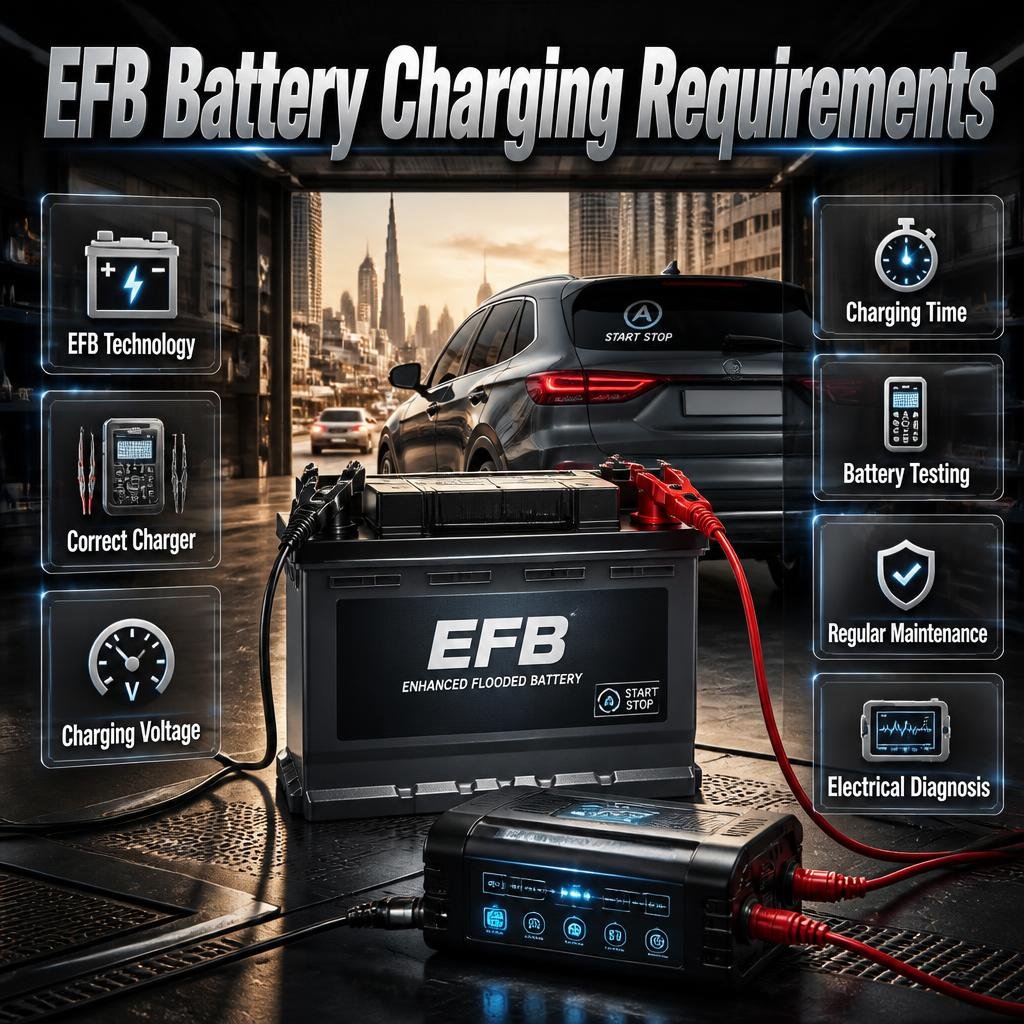
EFB Battery Charging Requirements | Understanding EFB Battery Charging Requirements is important for drivers whose vehicles use Enhanced Flooded Battery technology, particularly cars equipped with start-stop systems and vehicles that experience frequent electrical cycling. An EFB battery is designed to handle more charge and discharge cycles than a conventional flooded starter battery, making it suitable for modern vehicles with greater electrical demands.
For drivers in Dubai, maintaining the correct battery condition can be especially important because high temperatures, traffic congestion, frequent stops, air-conditioning use, and short urban journeys can place additional demands on the vehicle’s electrical system. Correct charging is therefore not simply about connecting a charger and waiting until the battery appears full.
At EuroSwift Auto Services, a professional battery approach should begin by understanding the vehicle, battery technology, charging system, and reason for discharge before recommending a solution. This is particularly important when a vehicle has repeatedly required a jumpstart or when a recently installed battery continues to lose charge.
This comprehensive guide explains EFB charging requirements, charger selection, charging voltage considerations, charging time, charging procedures, start-stop systems, common charging problems, battery testing, maintenance, and the situations where professional Battery Replacement or electrical diagnosis may be more appropriate.
What Is an EFB Battery?
EFB stands for Enhanced Flooded Battery. It is an improved version of the traditional flooded lead-acid starter battery, developed to provide greater cycling ability and better charge acceptance for vehicles with higher electrical demands.
Unlike AGM batteries, EFB batteries retain a flooded electrolyte design, but their internal construction is enhanced to improve durability under repeated charging and discharging. Modern EFB technology is widely used in vehicles with start-stop systems and other applications requiring greater cycling capability.
An EFB battery is designed to cope with situations in which the engine may be stopped and restarted several times during a journey. During these periods, the battery can also continue supplying electrical equipment while the engine is not running.
This makes the battery’s ability to accept charge particularly important.
Why EFB Technology Is Different
A conventional starter battery is primarily designed to provide a strong burst of starting power and then receive energy from the alternator during driving. An EFB battery has to cope with more frequent cycling.
Its advantages can include:
- Improved cycling performance
- Better charge acceptance
- Greater suitability for start-stop operation
- Better resistance to repeated partial discharge
- Support for increased electrical demand
- Improved durability compared with conventional flooded batteries
Exide describes current EFB technology as providing high dynamic charge acceptance and significantly greater cycling capability than conventional batteries.
However, enhanced capability does not mean that EFB batteries are immune to poor charging conditions. Correct charging remains essential.
Why EFB Battery Charging Requirements Matter
A battery can be connected to a charger and appear to charge while still failing to provide reliable performance in everyday driving.
This happens because battery charging involves more than simply increasing voltage. The charging system must deliver energy appropriately while the battery’s condition, temperature, state of charge, and charging stage are taken into account.
Correct charging helps maintain:
- Reliable engine starting
- Stable electrical performance
- Start-stop functionality
- Battery capacity
- Charge acceptance
- Long-term battery reliability
An EFB battery that repeatedly operates in a low state of charge may eventually experience reduced performance.
The problem can become more noticeable when a vehicle is primarily driven for short distances. Starting the engine consumes energy, while the short journey may not provide enough operating time for the charging system to replace all of the energy used.
This is why repeated battery charging without investigating the reason for discharge is not always an effective solution.
EFB Battery Charging Requirements at a Glance
Before charging an EFB battery, several important factors should be considered.
| Charging Factor | What Should Be Checked |
|---|---|
| Battery technology | Confirm that the battery is EFB |
| System voltage | Verify the vehicle and battery voltage |
| Charger compatibility | Use a charger suitable for the battery technology |
| Charging mode | Follow charger and battery manufacturer instructions |
| Battery condition | Check for damage or serious deterioration |
| Temperature | Consider operating and charging temperature |
| Connections | Ensure secure and clean electrical connections |
| Charging time | Allow sufficient time for the battery to recover |
| Vehicle electronics | Follow vehicle-specific charging instructions |
| Final testing | Check battery and charging-system performance |
There is no single charging setting that should automatically be applied to every EFB battery. Battery capacity, manufacturer specifications, charger design, vehicle architecture, and operating conditions can all influence the appropriate charging method.
For this reason, the battery label and manufacturer’s documentation should always take priority over generic charging advice.
Can an EFB Battery Be Charged With a Smart Charger?
Yes, an appropriate smart charger can be used with an EFB battery when the charger is designed for the battery technology and the correct operating mode is selected.
Modern chargers can automatically regulate the charging process instead of simply delivering a constant current. Depending on the charger, the process may involve several stages that progressively restore the battery and then maintain it.
VARTA states that charging an EFB or AGM battery follows the same general principles as other suitable automotive battery charging, but the charger and charging method must be appropriate for the battery technology and the manufacturer’s instructions should be followed.
A smart charger can therefore be useful for maintaining a vehicle that is driven infrequently or for restoring a battery that has become discharged.
However, the term smart charger should not be treated as a guarantee of compatibility.
Before using one, check:
- Battery type
- Battery voltage
- Battery capacity
- Charger specifications
- Available charging modes
- Manufacturer instructions
Choosing the Correct Charger for an EFB Battery
The charger should be selected according to the battery rather than simply according to price or maximum amperage.
Start by checking the battery label.
Important information may include:
- Voltage
- Ah capacity
- Battery technology
- Manufacturer
- Model number
- Charging recommendations
If the charger specifically supports EFB or start-stop batteries, follow its instructions for selecting the correct mode.
A charger designed only for a particular battery type should not automatically be assumed to be suitable for every other lead-acid technology.
Charger Selection Checklist
Before charging:
- Confirm the battery is an EFB unit.
- Confirm the system voltage.
- Check the battery’s Ah rating.
- Verify charger compatibility.
- Read the charger’s operating instructions.
- Inspect the charging cables.
- Ensure clamps and terminals are clean.
- Check the battery for visible physical damage.
- Make sure the charging environment is appropriate.
The objective is controlled and appropriate charging rather than simply delivering the highest possible current.
EFB Battery Charging Voltage
Charging voltage is one of the most important technical aspects of battery charging.
However, it is a mistake to assume that one fixed voltage is suitable for every EFB battery in every situation.
The appropriate charging behavior depends on factors including:
- Battery manufacturer
- Battery construction
- Charging stage
- Battery temperature
- Charger design
- Vehicle charging system
- Battery state of charge
For this reason, the manufacturer’s specifications should be used when determining the correct charging procedure.
The vehicle’s charging system also matters. Modern vehicles may use intelligent energy management that changes alternator behavior according to battery condition and vehicle operating requirements.
A professional technician therefore evaluates the charging system rather than judging battery performance from one voltage reading.
Why Battery Temperature Matters During Charging
Temperature affects lead-acid battery behavior and charging characteristics.
A battery operating in a very hot environment can experience accelerated aging. This is particularly relevant in climates such as Dubai, where vehicles can be exposed to high under-bonnet temperatures.
High temperatures can contribute to faster deterioration of battery materials over time.
At the same time, unsuitable charging conditions can create additional stress.
A professional charging process should therefore take environmental conditions into account rather than treating every battery as though it operates under identical circumstances.
For vehicles regularly exposed to extreme heat, periodic battery testing can help identify declining performance before the vehicle experiences a starting problem.
EFB Battery Charging Current
Charging current affects how quickly energy is delivered to the battery.
A higher-current charger can reduce charging time in suitable circumstances, but more current is not automatically better.
The correct charging current depends on:
- Battery capacity
- Battery condition
- State of charge
- Charger characteristics
- Battery manufacturer’s recommendations
- Charging environment
A deeply discharged battery may need a controlled charging process rather than aggressive charging.
The charging process should also be monitored when the battery is significantly discharged or its condition is uncertain.
How Long Does an EFB Battery Take to Charge?
There is no universal charging time for every EFB battery.
Charging duration depends on battery capacity, starting state of charge, charger output, battery condition, temperature, and charging efficiency.
As a general concept, a larger battery takes longer to replenish using the same charger output than a smaller battery.
VARTA notes that automotive battery charging can commonly take many hours and provides a calculation based on battery capacity and charger rating, while also allowing additional time for the final charging stage.
A simplified calculation is:
Approximate charging time = Battery capacity in Ah ÷ charger output in A
This is only an estimate.
Real charging is not perfectly linear because charging behavior changes as the battery approaches a high state of charge.
Example
A battery with a larger Ah capacity connected to a low-current charger may require considerably longer than a smaller battery using the same charger.
This is why a short charging session may provide enough energy for a temporary start without fully restoring the battery.
How to Charge an EFB Battery Safely
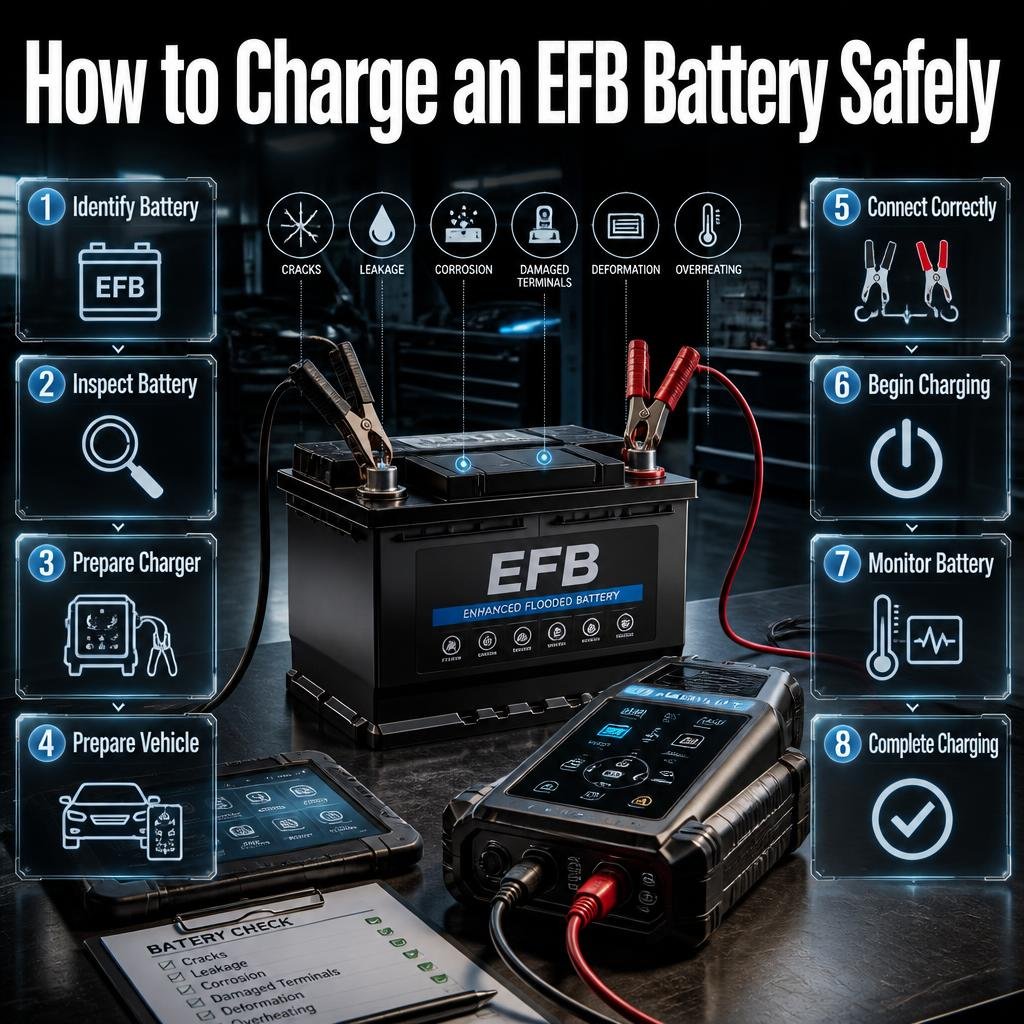
Charging should always follow the charger and battery manufacturer’s instructions.
A general professional approach involves several stages.
1. Identify the Battery
Confirm that the battery is actually EFB.
Do not select a charging mode solely because the battery is physically similar to another lead-acid battery.
2. Inspect the Battery
Look for:
- Cracks
- Leakage
- Severe corrosion
- Damaged terminals
- Deformation
- Signs of overheating
A visibly damaged battery should be professionally evaluated.
3. Prepare the Charger
Confirm:
- Correct voltage
- Correct battery mode
- Compatible charging profile
- Good cable condition
- Secure clamps
4. Prepare the Vehicle
Switch off unnecessary electrical consumers and follow vehicle-specific charging instructions.
Modern vehicles can have sensitive electronic systems and battery-management components.
5. Connect the Charger Correctly
Follow the charger’s instructions for connection order and terminal locations.
VARTA’s general guidance places the positive connection first and the negative connection second, while also emphasizing that the charger should be connected before the mains supply.
6. Begin Charging
Select the correct charging mode and allow the charger to regulate the process.
7. Monitor the Battery
Pay attention to abnormal temperature, warning indicators, unusual smells, or other signs of a problem.
8. Complete the Charging Process
Allow the charger to finish its intended charging cycle where appropriate.
After charging, the battery should be evaluated rather than automatically assumed to be healthy.
Charging an EFB Battery While It Is Installed
Whether an EFB battery should remain connected to the vehicle during charging depends on the vehicle and charging procedure.
Modern vehicles can contain:
- Battery monitoring sensors
- Energy-management systems
- Electronic control units
- Start-stop controllers
- Intelligent alternator systems
Some vehicles have dedicated charging or jump-start connection points.
For this reason, the vehicle manufacturer’s instructions should be followed.
Incorrect procedures can create unnecessary electrical-system complications, particularly in newer vehicles.
Professional battery services can be useful when the vehicle’s battery management system makes the charging or replacement process more complex.
EFB Batteries and Start-Stop Systems
Start-stop technology creates a different operating environment from a conventional vehicle.
Instead of starting the engine once at the beginning of a journey and running continuously, a start-stop vehicle may shut the engine down during traffic stops and restart it repeatedly.
During engine-off periods, electrical consumers continue to operate.
The battery therefore experiences repeated changes in state of charge.
EFB batteries are specifically designed to support vehicles with increased cycling requirements. Exide notes that EFB technology provides higher cycling capability and dynamic charge acceptance for start-stop applications.
This is one reason correct charging and battery condition are important for maintaining start-stop functionality.
Why Start-Stop May Stop Working
Drivers sometimes assume that a start-stop system that stops operating automatically means the battery has failed.
That is not always the case.
The system can restrict start-stop operation when battery conditions are not suitable for repeated restarting.
Possible factors include:
- Low state of charge
- Reduced battery health
- High electrical demand
- Extreme temperature
- Vehicle operating conditions
- Charging-system issues
A diagnostic inspection can determine whether the battery or another part of the vehicle is responsible.
The Alternator’s Role in EFB Battery Charging
The alternator is responsible for replenishing electrical energy while the engine is operating, but modern alternator systems can be much more sophisticated than traditional fixed-output systems.
Depending on the vehicle, charging behavior can be influenced by:
- Battery condition
- Electrical load
- Engine speed
- Temperature
- Energy-management strategy
- Vehicle control systems
- Regenerative braking
This means a battery that repeatedly becomes discharged may have a problem beyond the battery itself.
Potential causes include:
- Alternator performance problems
- Poor electrical connections
- Excessive parasitic drain
- Battery-management faults
- Incorrect battery installation
- Frequent short journeys
This is why a professional Vehicle Inspection can be more valuable than repeatedly charging the battery without identifying the cause.
Short Trips and EFB Battery Charging
Short-distance driving can create challenging conditions for automotive batteries.
Starting the engine consumes electrical energy. If the vehicle is then driven only for a few minutes, the charging system may not have enough opportunity to replace all of the energy consumed during starting and accessory operation.
The situation can become more demanding when the vehicle is used heavily in traffic.
Electrical loads may include:
- Air conditioning
- Headlights
- Infotainment
- Phone charging
- Interior electronics
- Cooling fans
- Other vehicle accessories
If the vehicle is repeatedly used for short trips, the battery may gradually operate at a lower state of charge.
This does not necessarily mean that the battery needs immediate replacement.
Instead, battery health and charging performance should be tested.
Signs of an EFB Battery Charging Problem
Charging problems can appear through several symptoms.
| Symptom | Possible Explanation |
|---|---|
| Slow cranking | Low state of charge or reduced battery performance |
| Repeated discharge | Charging fault, battery deterioration, or electrical drain |
| Start-stop unavailable | Battery condition or vehicle operating conditions |
| Battery warning light | Possible charging-system problem |
| Frequent jumpstarts | Battery or electrical-system issue |
| New battery becomes weak | Possible underlying charging or electrical fault |
| Battery requires frequent charging | Insufficient charging or excessive discharge |
These symptoms are not diagnostic by themselves.
A weak battery, faulty alternator, poor terminal connection, or parasitic electrical load can create similar symptoms.
EFB Battery Charging vs Battery Replacement
One of the most important questions is whether a discharged EFB battery should be charged or replaced.
Charging can be appropriate when the battery is healthy but temporarily discharged.
Replacement may be necessary when the battery has lost significant capacity or has reached the end of its useful service life.
| Situation | Likely Approach |
|---|---|
| Battery temporarily discharged | Test and recharge |
| Healthy battery with low state of charge | Controlled charging |
| Battery repeatedly loses charge | Diagnose underlying cause |
| Battery has poor capacity | Consider replacement |
| Physical damage | Professional assessment/replacement |
| Charging system fault | Repair system before relying on new battery |
A professional Battery Replacement service should therefore be based on testing rather than assumption.
This is also why drivers researching battery brands may look at options such as Amaron car batteries, Bosch batteries, or Tuflong batteries. The important consideration is not simply the brand name but whether the selected battery matches the vehicle’s required technology, size, capacity, starting performance, and electrical-system specifications.
Common EFB Battery Charging Mistakes
Using the Wrong Charging Mode
A charger may have several battery modes. Selecting one without checking compatibility can lead to an unsuitable charging process.
Assuming Every 12V Battery Is the Same
Voltage alone does not define battery technology.
Two 12V batteries can have different construction, charging characteristics, capacity, and intended applications.
Charging Without Checking Battery Condition
A damaged or severely deteriorated battery should not simply be connected to a charger without inspection.
Repeatedly Charging Without Diagnosis
If the battery keeps becoming discharged, repeatedly charging it may only treat the symptom.
Ignoring the Alternator
A new battery cannot compensate for a charging-system problem indefinitely.
Judging Battery Health From Voltage Alone
A battery may show a reasonable voltage reading while still having reduced capacity.
VARTA notes that EFB/AGM testing involves more than simply measuring state of charge because these batteries operate under repeated starting and partial-discharge conditions.
How Professional Battery Testing Works
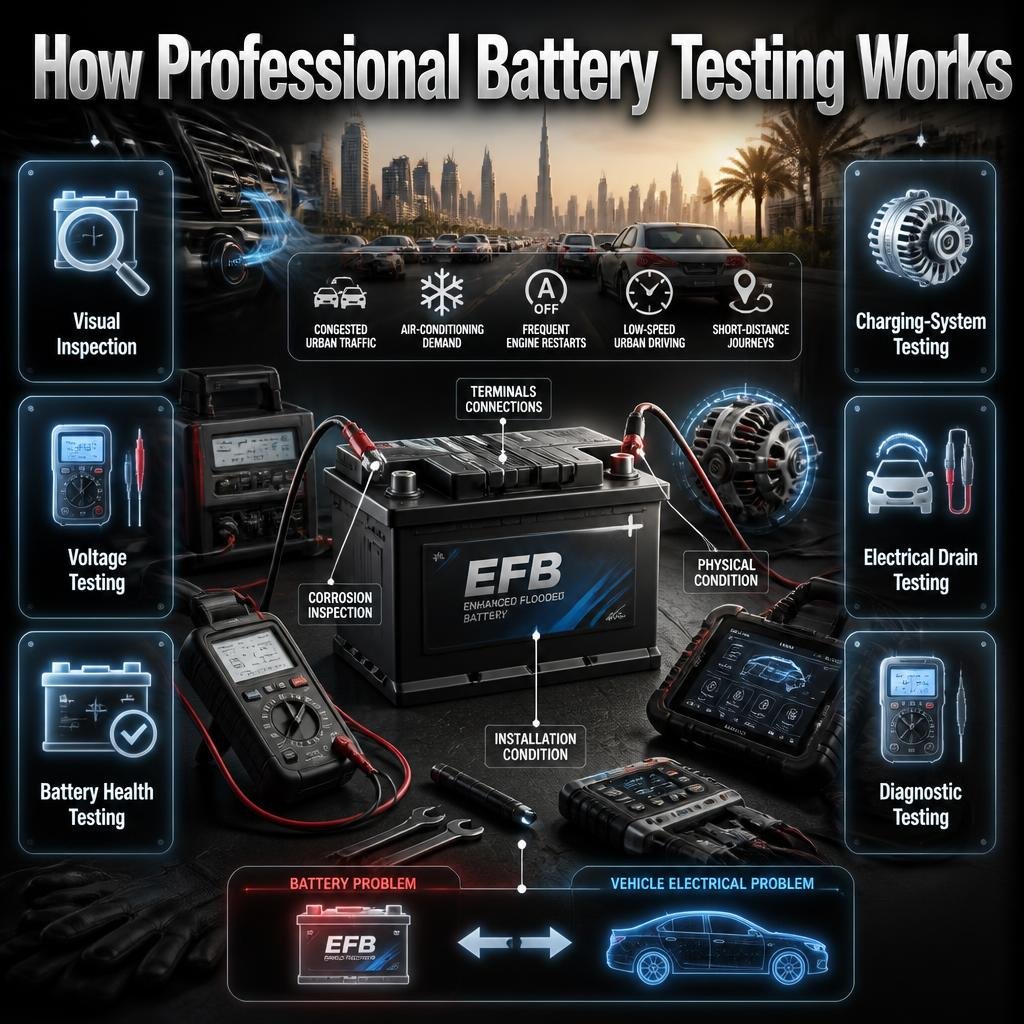
Professional battery testing should consider several areas.
Visual Inspection
The technician checks:
- Battery casing
- Terminals
- Connections
- Corrosion
- Physical damage
- Installation condition
Voltage Testing
Voltage provides useful information about battery state, although it should not be treated as a complete health assessment.
Battery Health Testing
A suitable tester can assess starting capability and other characteristics.
Charging-System Testing
The alternator and vehicle charging system should be evaluated.
Electrical Drain Testing
If the battery repeatedly becomes discharged while the vehicle is parked, excessive electrical consumption may need investigation.
Diagnostic Testing
Modern vehicles can store battery-management or charging-system fault information.
This broader process helps distinguish between a battery problem and a vehicle electrical problem.
EFB Battery Charging in Dubai’s Climate
Dubai’s climate makes battery maintenance particularly relevant.
High temperatures can accelerate battery aging, while traffic conditions and air-conditioning use can increase electrical demand.
A vehicle that spends considerable time in congestion may experience:
- Frequent engine restarts
- Long periods of low-speed driving
- Heavy air-conditioning use
- Increased electrical load
- Short-distance operating patterns
These conditions do not automatically mean an EFB battery will fail early, but they make regular inspection valuable.
Drivers can benefit from checking battery condition before the battery becomes too weak to start the vehicle.
For broader vehicle care, professional Vehicle Maintenance should include attention to the battery, charging system, engine condition, and other components that affect reliability.
EFB vs AGM Battery Charging
EFB and AGM are both advanced battery technologies, but they are not identical.
| Feature | EFB | AGM |
|---|---|---|
| Full name | Enhanced Flooded Battery | Absorbent Glass Mat |
| Electrolyte design | Flooded | Absorbed in glass mat |
| Cycling capability | Higher than conventional flooded batteries | Very high |
| Typical application | Start-stop and higher cycling demands | More demanding start-stop/electrical applications |
| Charging | Technology-appropriate method required | Technology-appropriate method required |
| Replacement | Match vehicle specification | Match vehicle specification |
A driver should not automatically replace an EFB battery with AGM simply because AGM is considered a more advanced technology.
The vehicle manufacturer determines what battery technology is appropriate.
Battery dimensions, capacity, charging strategy, energy-management programming, and electrical requirements all need to be considered.
For vehicles already specified for AGM technology, a suitable AGM battery replacement service should follow the vehicle’s requirements.
Battery Brands and EFB Compatibility
Battery brand selection is important, but compatibility comes first.
Depending on the vehicle and application, drivers may encounter brands such as:
- Amaron
- Bosch
- Tuflong
- Exide
- Panasonic
- FIAMM
- AC Delco
A brand-specific page can provide useful information about available battery options, but the exact battery must still be matched to the vehicle.
For example, drivers researching Exide battery options should check the correct battery technology and specification rather than selecting solely by brand.
Likewise, Panasonic battery replacement or FIAMM battery replacement should be based on vehicle compatibility.
The same principle applies when considering AC Delco battery replacement.
What Happens When an EFB Battery Is Repeatedly Undercharged?
Repeated undercharging can prevent the battery from operating at its best condition.
A battery that spends much of its operating life at a low state of charge may experience declining performance and reduced ability to meet starting and electrical demands.
This can create a cycle:
Short journey → energy consumed → insufficient recovery → lower state of charge → weaker performance → greater starting demand
Breaking this cycle requires more than simply charging the battery once.
A suitable maintenance approach may involve:
- Battery testing
- Charging-system inspection
- Reviewing driving patterns
- Checking electrical loads
- Correct charging
- Monitoring battery performance
What If an EFB Battery Charges but Quickly Goes Flat?
This is one of the most important charging-related problems.
If an EFB battery charges successfully but becomes weak again shortly afterward, possible causes include:
Battery deterioration
The battery may no longer have sufficient usable capacity.
Charging-system problem
The alternator or its control system may not be replenishing the battery correctly.
Electrical drain
An electrical component may continue consuming energy while the vehicle is parked.
Driving pattern
Very short journeys may repeatedly consume more energy than the vehicle replaces.
Poor connections
Loose or corroded connections can interfere with charging and starting.
Repeatedly charging the battery without identifying the cause can result in unnecessary expense and inconvenience.
EFB Charging and Battery Registration
Some modern vehicles use electronic battery-management systems that monitor battery condition and charging behavior.
After installing a new battery, certain vehicles may require battery registration or adaptation through diagnostic equipment.
The exact requirement depends on the vehicle.
This is especially important when changing battery technology or capacity.
The replacement should match the vehicle’s original specification unless the manufacturer specifically permits an alternative configuration.
A professional technician can determine whether registration or system adaptation is required.
EFB Battery Maintenance Checklist
A practical maintenance routine can help identify problems early.
Regular Checks
✔ Inspect battery terminals
✔ Check for corrosion
✔ Observe starting performance
✔ Pay attention to battery warning indicators
✔ Monitor start-stop behavior
✔ Check for repeated discharge
✔ Test the charging system
✔ Test the battery when symptoms appear
✔ Follow manufacturer charging recommendations
✔ Investigate repeated battery weakness
Before Long Trips
It is sensible to check:
- Battery health
- Charging-system operation
- Terminal condition
- Starting performance
- Vehicle electrical warnings
A small amount of preventive attention can be preferable to discovering a battery problem during a journey.
When Should You Call for Professional Battery Assistance?
Professional assistance is particularly useful when:
- The vehicle will not start.
- The battery repeatedly becomes discharged.
- The battery warning light appears.
- Start-stop functionality repeatedly becomes unavailable.
- A new battery does not solve the problem.
- You are uncertain which charger or battery type is correct.
- The battery shows physical damage.
- The charging system appears abnormal.
- The vehicle has sophisticated battery-management electronics.
A professional automotive service can combine battery inspection with broader Car Service and Vehicle Inspection rather than treating the battery as an isolated component.
EFB Battery Charging and Roadside Assistance
A discharged battery can leave a vehicle unusable at home, at work, or on the roadside.
If the battery has enough recoverable condition and the vehicle circumstances permit it, a professional Car Jumpstart may help restore temporary mobility.
However, a jumpstart is not a replacement for diagnosis.
If the battery has failed, the charging system is faulty, or the vehicle has another electrical problem, the vehicle may stop again after the initial start.
In situations where the vehicle cannot safely continue, professional Roadside Assistance can help determine the most suitable next step.
The important principle is simple: starting the vehicle and solving the battery problem are two different tasks.
EFB Battery Charging and Preventive Vehicle Maintenance
Battery reliability is closely connected with overall vehicle maintenance.
A healthy vehicle electrical system depends on more than the battery itself.
Other areas that may affect reliability include:
- Alternator
- Starter motor
- Wiring
- Ground connections
- Electrical accessories
- Engine condition
- Charging control
- Battery-management system
This is why battery maintenance can form part of a broader Car Service strategy.
A vehicle that receives regular preventive maintenance gives technicians an opportunity to identify developing electrical problems before they become roadside failures.
Expert Recommendations for EFB Battery Charging
Recommendation 1: Identify the Battery Correctly
Always confirm whether the battery is EFB, AGM, or conventional flooded before selecting a charging method.
Recommendation 2: Follow Manufacturer Instructions
Generic charging information should never override the battery or charger manufacturer’s specifications.
Recommendation 3: Do Not Use Charging as a Substitute for Diagnosis
If the battery repeatedly becomes weak, investigate why.
Recommendation 4: Check the Vehicle Charging System
A battery can be healthy but remain discharged if the vehicle does not recharge it correctly.
Recommendation 5: Consider Driving Conditions
Frequent short journeys and heavy electrical loads can contribute to a charging deficit.
Recommendation 6: Test Before Replacing
Battery replacement should be based on evidence whenever possible.
Recommendation 7: Match the Replacement Battery
If replacement is required, the battery’s technology, dimensions, capacity, terminal configuration, and starting specification should match the vehicle requirements.
EFB Battery Charging: Practical Troubleshooting Table
| Problem | Possible Cause | Recommended Direction |
|---|---|---|
| Battery will not hold charge | Reduced capacity | Professional battery test |
| Battery repeatedly discharges | Charging fault or electrical drain | Electrical diagnosis |
| Slow starting | Low charge or weak battery | Battery and charging test |
| Start-stop unavailable | Battery condition or system conditions | Diagnostic inspection |
| New battery becomes weak | Vehicle charging issue | Charging-system test |
| Battery charges slowly | Charger, battery, or connection issue | Check charger and battery |
| Battery warning appears | Charging-system fault possible | Professional inspection |
| Battery works after jumpstart but fails later | Underlying battery/system issue | Full diagnosis |
Why Voltage Alone Cannot Tell the Whole Story
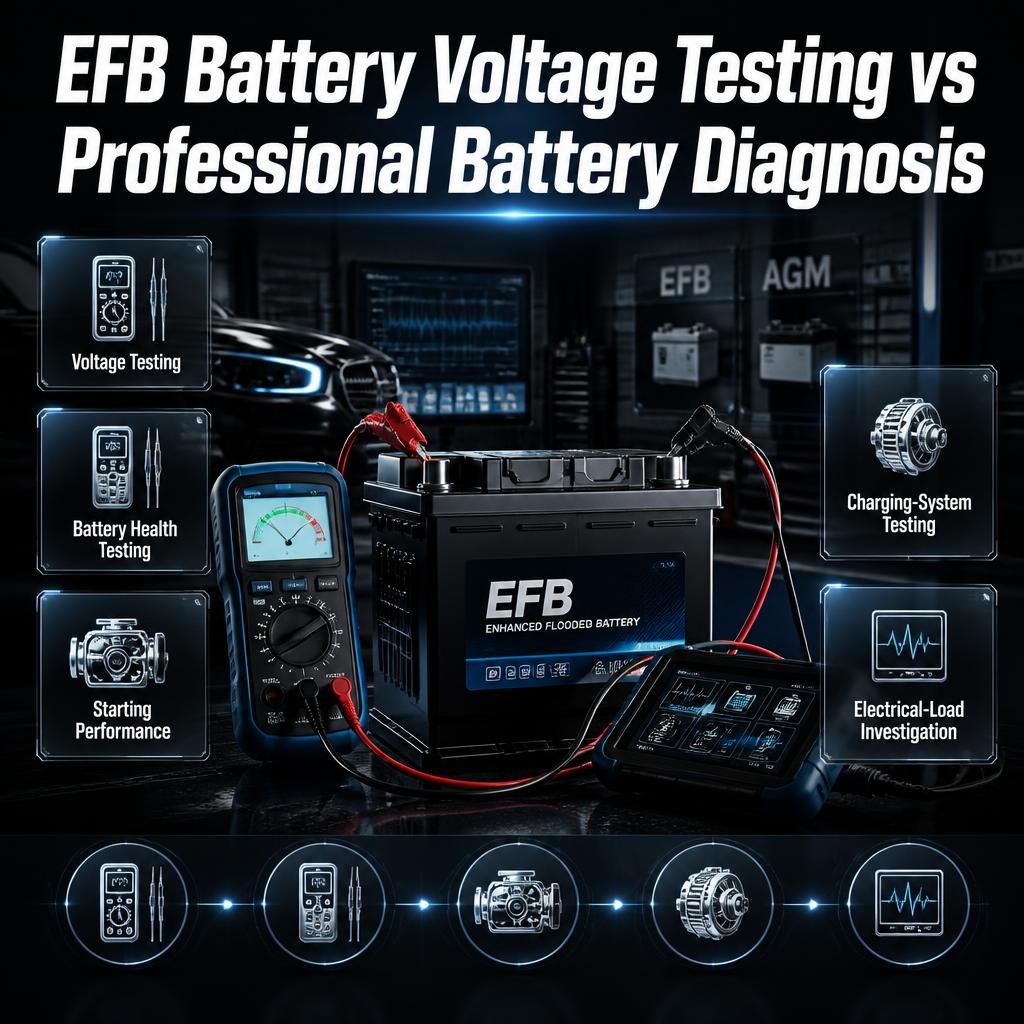
Voltage is useful, but it is only one part of battery diagnosis.
A battery can display a reasonable voltage while having insufficient capacity to perform reliably under load.
This is particularly important for EFB and AGM batteries because their operating environment involves repeated starting events and partial discharges.
VARTA explains that start-stop battery testing involves more than simply determining state of charge; battery capacity and charge acceptance are also relevant considerations.
Therefore, a professional diagnosis may combine:
- Voltage testing
- Conductance or battery health testing
- Starting performance assessment
- Charging-system testing
- Electrical-load investigation
This gives a more useful picture of the battery’s actual condition.
EFB Battery Charging for Vehicles Used Infrequently
A vehicle that sits unused for long periods can gradually lose charge because some electronic systems continue consuming small amounts of electricity.
If the vehicle is parked for extended periods, battery maintenance may become particularly important.
A suitable maintenance charger can sometimes help maintain battery condition, provided it is compatible with the battery and vehicle.
However, the vehicle manufacturer’s storage and charging recommendations should be followed.
If a parked vehicle repeatedly develops a flat battery, the cause should be investigated instead of assuming that inactivity alone is responsible.
EFB Battery Charging Before a Long Journey
Before a long trip, it is sensible to check the battery rather than waiting for a starting problem.
A professional pre-trip inspection can evaluate:
- Battery condition
- Charging system
- Starting performance
- Terminal connections
- Electrical warnings
Drivers who already notice slow cranking, repeated jumpstarts, or start-stop problems should address these symptoms before travelling.
This is particularly useful in hot weather or when travelling through areas where roadside support may be less convenient.
Cost Factors Related to EFB Battery Charging and Replacement
The cost of dealing with an EFB battery problem depends on the actual cause.
Possible cost factors include:
- Battery condition
- Battery capacity
- Battery brand
- Battery technology
- Vehicle model
- Installation complexity
- Diagnostic requirements
- Battery registration
- Charging-system repairs
- Emergency roadside requirements
A driver comparing battery costs can also review a car battery price guide for Dubai to understand the factors that can influence replacement pricing.
However, the cheapest battery is not necessarily the most suitable choice.
Correct fitment and specification should come first.
The Importance of Correct Battery Replacement
If an EFB battery has reached the end of its useful life, replacement should be carried out according to the vehicle’s requirements.
Exide specifically advises replacing an EFB battery with a new EFB battery in its current product guidance.
The replacement process may involve more than physically removing the old battery.
A professional installation may include:
- Confirming battery specification
- Checking the existing battery
- Removing the old battery safely
- Installing the replacement
- Checking terminal connections
- Testing charging performance
- Performing battery registration where required
- Checking vehicle electrical-system operation
This approach reduces the chance of replacing the battery while leaving an underlying electrical problem unresolved.
Latest EFB Battery Technology
Modern EFB development continues to focus on cycling capability, charge acceptance, durability, and compatibility with increasingly sophisticated vehicle electrical systems.
Exide’s current EFB technology highlights high dynamic charge acceptance and improved cycling capability, reflecting the growing importance of batteries that can operate effectively under repeated partial-charge conditions.
As vehicles become more dependent on electrical systems, battery technology is becoming increasingly integrated with energy management.
This means automotive technicians increasingly need to understand:
- Battery chemistry
- Charging behavior
- Vehicle electronics
- Energy management
- Start-stop systems
- Diagnostic procedures
Battery service is therefore moving beyond simple replacement toward complete electrical-system management.
Future of EFB Battery Charging
The automotive industry is continuing to develop more intelligent charging and energy-management strategies.
Future improvements are likely to focus on:
- Better charge acceptance
- More accurate battery monitoring
- Improved energy recovery
- More efficient charging control
- Longer battery service life
- Better integration with vehicle electronics
As electrical demand increases, the battery will remain an important part of the vehicle’s overall energy-management architecture.
For workshops and automotive service providers, this creates a growing need for accurate diagnosis rather than basic component replacement.
What Are the Correct Charging Requirements for an EFB Battery?
Charging an EFB battery correctly means using a charger and charging method that are suitable for EFB/start-stop battery technology. The exact charging settings should be based on the battery manufacturer’s specifications and the charger’s instructions rather than applying one universal voltage or current value to every EFB battery. EFB batteries are designed to handle repeated cycling and have higher charge-acceptance requirements than conventional starter batteries, so appropriate charging equipment is important.
For a professional charging process, the battery’s condition should also be considered. A battery that is simply discharged is different from one that has lost significant capacity or has an internal fault. Charging the latter may provide only a temporary improvement.
Important points:
Confirm the battery is actually EFB before selecting a charging mode.
Use a charger that is suitable for EFB/start-stop batteries.
Follow the battery and charger manufacturer’s instructions.
Consider battery condition and temperature during charging.
Do not assume that a fully charged reading means the battery is healthy.
If the battery repeatedly becomes discharged, inspect the vehicle’s charging system as well.
Can You Charge an EFB Battery With a Smart Charger?
A suitable smart charger can be an effective way to recharge an EFB battery, particularly when the vehicle is used infrequently or the battery has become discharged. The important factor is not simply whether the charger is marketed as “smart,” but whether its charging profile and operating instructions are appropriate for the battery technology. VARTA specifically advises using a device and charging method suitable for EFB or AGM start-stop batteries.
A modern charger can regulate the charging process instead of continuously delivering the same output. This allows charging to progress through different stages as the battery’s condition changes. However, the charger should still be configured according to its manufacturer’s instructions.
Before connecting a smart charger:
Check the charger’s supported battery types.
Confirm the vehicle and battery voltage.
Select the appropriate charging mode.
Inspect the battery for visible damage.
Switch off unnecessary electrical consumers.
Follow the charger’s connection procedure.
Allow the charger to complete its intended charging cycle.
Have a repeatedly discharged battery professionally tested rather than continually recharging it.
How Long Does It Take to Fully Charge an EFB Battery?
There is no single charging time that applies to every EFB battery. The duration depends on the battery’s capacity, its starting state of charge, charger output, battery condition, temperature, and how efficiently the battery accepts charge. As a practical example, VARTA notes that a typical 70Ah battery may require around 15 hours with a 5A charger, while also explaining that the final charging stage adds additional time.
A useful starting estimate is to divide the battery’s Ah rating by the charger’s output in amps, but this should only be treated as an approximation. Real charging slows as the battery approaches a high state of charge, so simply doing the mathematical calculation does not guarantee the battery is fully charged.
Factors that can increase charging time include:
A deeply discharged battery
Larger battery capacity
Low charger output
Reduced battery health
Cold or unsuitable charging conditions
Poor electrical connections
Reduced charge acceptance
A battery approaching the end of its useful life
A short charging session may provide enough energy to restart a vehicle without actually restoring the battery to a healthy state of charge.
Why Does My EFB Battery Keep Going Flat After Charging?
When an EFB battery repeatedly becomes flat after being charged, the most important step is to find out why the battery is losing energy. Repeatedly connecting a charger may temporarily restore the vehicle, but it does not necessarily solve the underlying problem.
The cause could be an aging battery with reduced capacity, an alternator or charging-system fault, excessive electrical consumption while the vehicle is parked, poor terminal connections, or a driving pattern dominated by short journeys. Start-stop batteries operate under frequent partial-discharge conditions, which makes proper assessment of both state of charge and battery condition particularly important.
A professional diagnosis should consider:
Battery state of charge
Battery health and remaining capacity
Charge acceptance
Alternator performance
Battery terminals and connections
Possible parasitic electrical drain
Vehicle driving pattern
Start-stop and battery-management system behavior
If a recently installed EFB battery is repeatedly going flat, replacing it again without checking the vehicle may simply repeat the same problem. The battery and the complete charging system should be assessed together.
Can an EFB Battery Be Replaced With an AGM Battery?
An EFB battery should not automatically be replaced with an AGM battery simply because AGM is a higher-performance battery technology. The correct replacement depends on the vehicle manufacturer’s specification, electrical architecture, battery-management system, and original battery technology.
EFB and AGM batteries are both designed for vehicles with greater cycling demands, but they are engineered differently and are intended for different applications. VARTA notes that EFB batteries are commonly used in vehicles with simpler start-stop systems, while AGM is intended for more demanding applications such as start-stop systems with recuperation and higher electrical loads.
The safest approach is to match the replacement to the vehicle’s requirements rather than making the decision based solely on the battery’s apparent performance level.
Before changing EFB to AGM, check:
Original battery technology
Battery capacity and specification
Physical dimensions
Terminal configuration
Vehicle charging strategy
Battery Management System requirements
Manufacturer-approved replacement options
Whether battery registration or adaptation is required
For modern start-stop vehicles, correct battery installation and, where applicable, battery registration are important because the vehicle’s management system may need to recognize the replacement battery.
Conclusion
Understanding EFB battery charging requirements is essential for maintaining reliable starting performance, stable electrical operation, and dependable Start-Stop functionality. An EFB battery is designed to handle more frequent charging and discharging than a conventional starter battery, but it still depends on the correct charging equipment, suitable charging method, and a healthy vehicle charging system.
A proper charging process should always consider the battery’s technology, condition, state of charge, charger compatibility, and the vehicle manufacturer’s recommendations. Using a charger that is suitable for EFB and Start-Stop batteries helps ensure that charging is controlled correctly rather than relying on a generic charging approach.
It is also important to remember that a fully charged EFB battery is not necessarily a healthy battery. If the battery repeatedly loses charge, Start-Stop performance decreases, or the vehicle requires frequent external charging, the underlying cause should be investigated. Battery health, charge acceptance, charging-system performance, electrical connections, driving patterns, and possible parasitic loads can all influence reliability.
For modern vehicles, correct battery specification is equally important. EFB and AGM batteries are closely connected with the vehicle’s electrical management system, so replacing an EFB battery with an unsuitable conventional battery can create performance and reliability problems. Where appropriate, an EFB-to-AGM upgrade may be possible, but the replacement should always match the vehicle’s requirements and battery-management system.
Ultimately, the best approach is simple: use the correct battery, charge it with suitable equipment, investigate repeated discharge instead of repeatedly recharging it, and test the battery and charging system when performance becomes questionable. With proper attention to these areas, an EFB battery can provide the dependable performance expected from modern Start-Stop vehicles while helping maintain consistent everyday driving reliability.
Leave a Reply