
Introduction
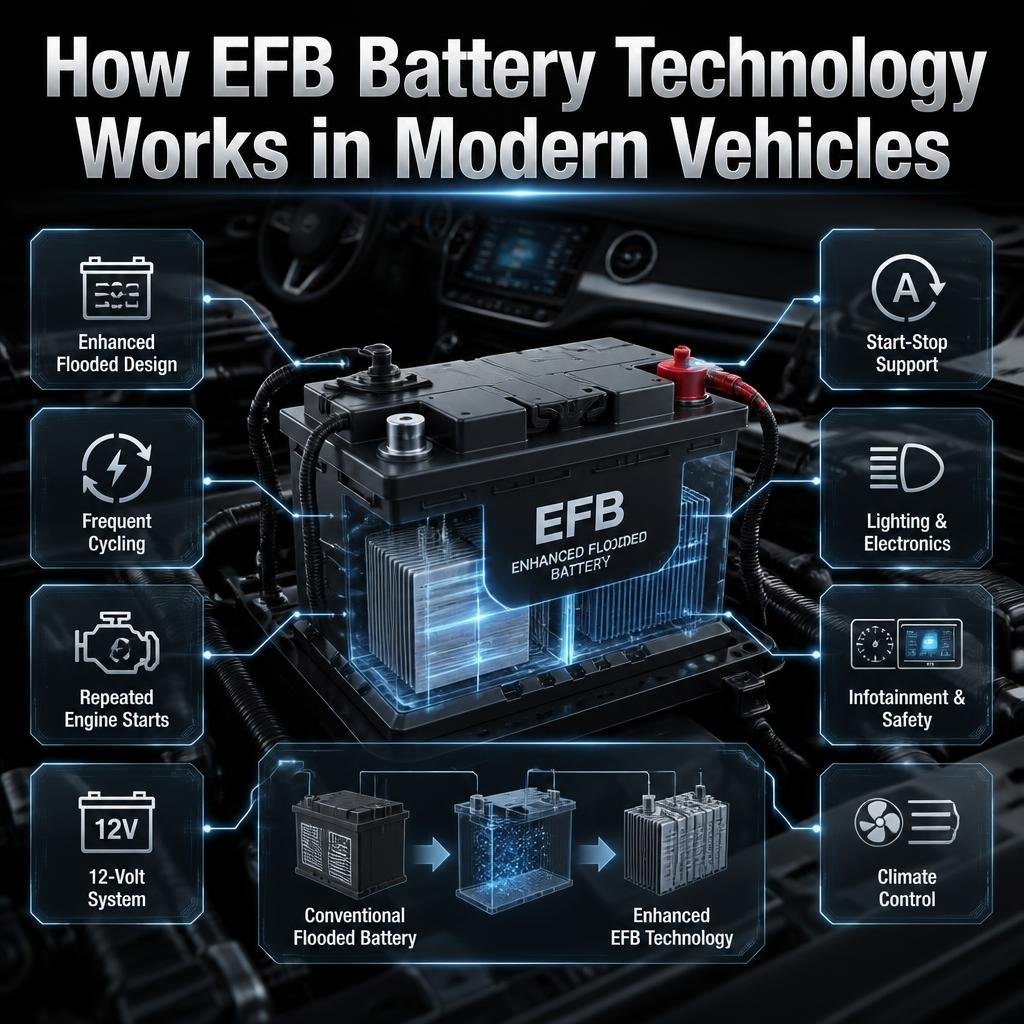
How EFB Battery Technology Works | Understanding how EFB battery technology works is important for drivers whose vehicles use start-stop systems or have higher electrical demands. EFB stands for Enhanced Flooded Battery, a development of conventional flooded lead-acid battery technology designed to handle more frequent charging and discharging cycles.
Modern vehicles can place considerably more demand on a 12-volt battery than older vehicles. Start-stop systems may switch the engine off during traffic stops and restart it repeatedly, while lighting, infotainment, safety systems, climate control and other electronics continue requiring electrical power.
At EuroSwift Auto Services, understanding the vehicle’s battery technology is important before recommending replacement because the correct battery should match the vehicle’s specifications rather than simply fitting into the battery tray. EFB technology is particularly relevant to vehicles that require improved cycling performance while retaining a flooded-battery design.
This guide explains how EFB batteries work, how their internal construction differs from conventional batteries, how they support start-stop systems, how EFB compares with AGM, and what drivers should consider when testing or replacing one.
What Is an EFB Battery?
An EFB battery is an Enhanced Flooded Battery designed to provide improved cycling performance compared with a conventional flooded lead-acid battery.
The fundamental battery principle remains familiar. It uses positive and negative plates, electrolyte, separators and electrical connections to store chemical energy and convert it into electrical energy when the vehicle needs power.
The difference lies mainly in the internal design and materials.
Modern EFB designs can use reinforced plate structures, higher-density active materials and specialized additives to improve durability and charge acceptance. Manufacturers describe EFB technology as particularly suitable for vehicles with repeated start-stop operation and higher cycling requirements.
In simple terms:
Conventional flooded battery → mainly designed around normal starting and charging
EFB battery → enhanced for more frequent cycling
AGM battery → more advanced construction for higher-demand applications
The exact application always depends on the vehicle manufacturer.
How Does EFB Battery Technology Work?
The basic operating process is straightforward.
When the engine starts, the battery delivers a large amount of electrical current to the starter motor. Once the engine is running, the vehicle’s charging system begins restoring energy to the battery.
When the vehicle stops and the start-stop system switches the engine off, the battery may continue supplying electrical power to the vehicle’s systems.
When the engine restarts, the battery again provides starting current.
This can happen repeatedly during a journey.
An EFB battery is designed to tolerate this type of repeated cycling better than a conventional flooded battery. Its improved internal construction helps it manage frequent charge and discharge activity while maintaining dependable starting performance.
The basic cycle is:
Start → discharge → recharge → partial discharge → recharge → restart → repeat.
This repeated operation is one of the main reasons EFB technology has become important in modern vehicles.
What Is Inside an EFB Battery?
Understanding the major internal components makes the technology easier to understand.
Positive Plates
Positive plates participate in the chemical reactions that allow the battery to store and release energy.
EFB designs improve plate durability so that repeated charging and discharging are less demanding on the internal structure.
Negative Plates
Negative plates perform the complementary part of the electrochemical process.
Their construction and active material influence current delivery, charging behavior and cycling performance.
Electrolyte
EFB batteries use a flooded electrolyte arrangement. This distinguishes them from AGM batteries, where electrolyte is absorbed into glass-mat material.
Separators
Separators keep positive and negative plates from directly contacting each other while allowing the necessary ionic movement inside the battery.
Grid Structure and Active Material
Modern EFB manufacturers may use improved grid designs, additives and higher-density active materials to improve current flow, durability and resistance to active-material shedding. Hankook, for example, describes reinforced internal structures, improved grid design and advanced additives as part of its EFB technology.
The overall result is not caused by one component alone. EFB performance comes from the interaction of the plates, grids, active material, electrolyte and separator system.
Why Was EFB Technology Developed?
Vehicle manufacturers increasingly needed batteries capable of supporting start-stop operation.
When a conventional vehicle stops at a traffic light, the engine normally continues running.
A start-stop vehicle may shut the engine down instead.
That creates a different electrical operating pattern.
The battery may need to support vehicle electronics while the engine is stopped and then provide another high-current engine restart moments later.
If this happens repeatedly, a conventional battery may experience more cycling than it was designed to handle.
EFB technology addresses this requirement by providing enhanced cycling performance while retaining the basic flooded battery architecture.
Manufacturers also use EFB technology in vehicles with higher cycling requirements even when the vehicle does not use start-stop operation.
How EFB Supports Start-Stop Systems
Start-stop operation is one of the most common applications for EFB batteries.
Imagine driving through busy Dubai traffic.
You stop at a signal.
The vehicle determines that conditions are suitable and switches the engine off.
During this period, electrical systems may continue operating.
When the vehicle needs to move again, the engine restarts.
The battery therefore needs to handle another starting event.
This cycle can occur many times during urban driving.
EFB technology is designed to handle this type of repetitive operation more effectively than a standard flooded battery.
However, not every start-stop vehicle uses EFB. Some vehicles require AGM technology instead, particularly when their electrical architecture and energy-management demands are more advanced.
EFB Battery Charging and Discharging
Charging and discharging are central to understanding EFB operation.
During Discharge
When the battery supplies electricity, stored chemical energy is converted into electrical energy.
This happens during:
- Engine starting
- Engine-off periods
- Temporary electrical demand
- Certain operating conditions where electrical demand exceeds charging-system output
During Charging
When the engine is running, the vehicle’s charging system supplies electrical energy to restore the battery.
Modern energy-management systems may control charging according to battery condition, electrical demand and driving conditions.
This means the battery may not always remain at maximum charge.
EFB batteries are designed to tolerate this type of demanding operating environment better than conventional batteries.
Manufacturers specifically highlight improved charge acceptance and cycling capability as important EFB characteristics.
Why Charge Acceptance Matters
Charge acceptance describes how effectively a battery can accept electrical energy under appropriate charging conditions.
This is particularly relevant to start-stop vehicles.
The vehicle may have relatively short periods available to restore energy after a starting event. Therefore, the battery needs to recover efficiently during normal operation.
Modern EFB designs can incorporate internal materials and structures intended to improve dynamic charge acceptance.
This does not mean an EFB battery can compensate for a faulty alternator or a severely damaged battery.
If the charging system is not operating correctly, even an advanced battery can eventually become discharged or damaged.
That is why battery testing and charging-system testing should be considered together.
EFB Battery vs Conventional Battery
The simplest distinction is cycling capability.
A conventional flooded battery is suitable for many traditional vehicles, particularly those without demanding start-stop requirements.
An EFB battery is designed for a more demanding duty cycle.
| Feature | Conventional Flooded | EFB |
|---|---|---|
| Flooded electrolyte | Yes | Yes |
| Standard starting use | Yes | Yes |
| Enhanced cycling | Limited | Improved |
| Start-stop suitability | Vehicle dependent | Common |
| Repeated engine restarts | Less suitable | Better suited |
| Higher cycling requirements | Limited | Designed for this |
| Typical application | Conventional vehicles | Start-stop/high-cycle vehicles |
Continental describes its EFB batteries as intended for entry-level start-stop applications and emphasizes their ability to support rapid charging and discharging.
The important point is that EFB should not be viewed simply as a bigger conventional battery. It is a different battery design intended for a different operating pattern.
EFB vs AGM Battery Technology
AGM stands for Absorbent Glass Mat.
While EFB remains a flooded battery technology, AGM uses absorbent glass-mat separators to hold the electrolyte.
AGM is generally used in vehicles with more demanding electrical requirements or more sophisticated start-stop systems.
| Characteristic | EFB | AGM |
|---|---|---|
| Electrolyte design | Flooded | Absorbed in glass mat |
| Cycling capability | Enhanced | Higher |
| Start-stop use | Common | Common |
| High electrical demand | Good where specified | Often suited to higher demand |
| Regenerative braking applications | Vehicle dependent | Common in advanced systems |
| Replacement | Vehicle-specific | Vehicle-specific |
Continental differentiates EFB applications from AGM applications, describing EFB for entry-level start-stop systems and AGM for more sophisticated start-stop systems involving braking-energy recovery.
This is why drivers should not automatically assume that AGM is always a suitable replacement for EFB.
Can You Replace an EFB Battery With AGM?
Sometimes an EFB-to-AGM upgrade can be appropriate, but it depends on the vehicle.
Before changing battery technology, a technician should verify:
- Original battery type
- Vehicle manufacturer specification
- Battery capacity
- Starting-current requirement
- Physical dimensions
- Terminal configuration
- Charging strategy
- Battery-management system
- Registration or coding requirements
The safest principle is simple:
Match the replacement to the vehicle’s electrical architecture.
A battery that physically fits may still be electrically inappropriate.
EFB Battery Performance in Dubai
Dubai driving conditions can make battery condition especially important.
High ambient temperatures, heavy traffic and frequent use of air conditioning can create demanding operating conditions.
Urban traffic can also increase the number of stops and starts during a journey.
For a vehicle using start-stop technology, this may mean repeated battery cycling.
Drivers should therefore pay attention to changes in:
- Engine cranking
- Start-stop behavior
- Battery warning messages
- Electrical performance
- Battery discharge
- Charging behavior
Extreme heat does not mean every EFB battery will fail prematurely, but temperature is one factor that can influence battery aging.
Common Signs of a Weak EFB Battery
A failing EFB battery does not always stop working suddenly.
Several warning signs can appear first.
Slower Cranking
The starter may sound weaker than usual.
Start-Stop Deactivation
The vehicle may stop using its start-stop function when battery conditions are not suitable.
Repeated Jump-Starts
If the vehicle repeatedly requires a Car Jumpstart, the battery and charging system should be properly tested.
Battery Warning
A warning light or message may indicate a battery or charging-system issue.
Electrical Problems
Unusual electrical behavior can sometimes be associated with battery voltage or charging problems.
These symptoms can have multiple causes, so testing is more reliable than assuming the battery is automatically responsible.
How Professionals Test an EFB Battery
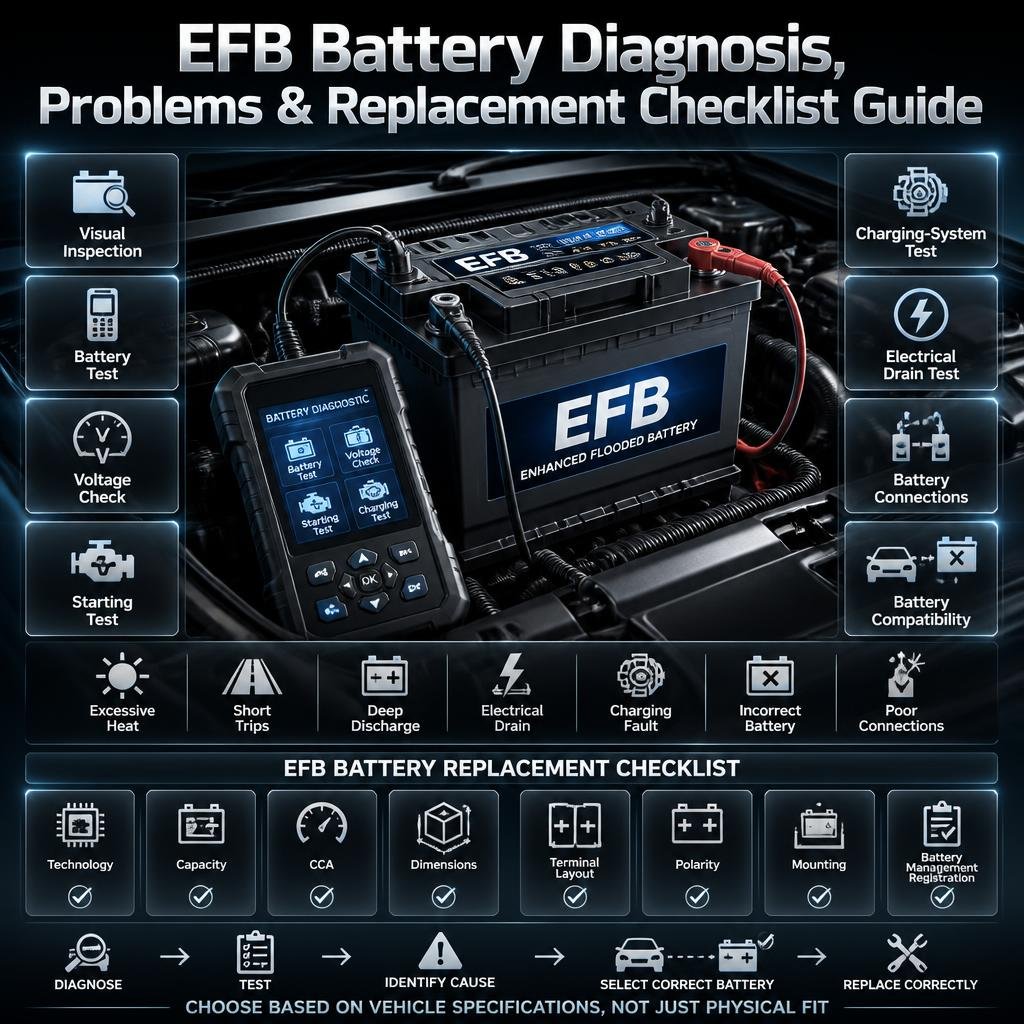
A proper battery diagnosis should go beyond checking whether the engine starts.
A professional inspection can include:
1. Visual Inspection
The technician checks the case, terminals, cables and mounting.
2. Battery Test
Electronic testing can assess battery condition and starting capability.
3. Voltage Check
Resting and operating voltage can provide useful information.
4. Starting Test
Battery behavior during engine cranking is evaluated.
5. Charging-System Test
The alternator and charging system are checked.
6. Electrical Drain Test
If the battery repeatedly becomes discharged, the vehicle may need to be checked for excessive current draw.
A professional Car Battery Replacement service should therefore begin with diagnosis rather than immediately removing the existing battery.
For Dubai drivers needing mobile support, EuroSwift’s car battery replacement near me Dubai service page covers inspection, battery selection and on-site replacement.
What Causes EFB Battery Problems?
Several factors can affect battery performance.
Excessive Heat
High temperatures can accelerate battery aging.
Frequent Short Trips
Short journeys may provide limited opportunity for the charging system to restore energy.
Repeated Deep Discharge
A battery that repeatedly becomes heavily discharged can deteriorate faster.
Electrical Drain
A faulty electrical component can continue consuming energy after the vehicle is parked.
Charging-System Fault
An alternator or related charging problem can prevent proper battery recovery.
Incorrect Battery
Using an unsuitable battery technology can create compatibility problems.
Poor Connections
Loose or contaminated terminals can interfere with starting and charging.
EFB Battery Replacement: What Should You Check?
When replacement becomes necessary, battery selection should be systematic.
| Check | Why It Matters |
|---|---|
| Battery technology | Ensures correct cycling capability |
| Capacity | Matches electrical requirements |
| CCA | Supports engine starting |
| Dimensions | Ensures physical fit |
| Terminal layout | Prevents connection problems |
| Polarity | Ensures correct installation |
| Mounting | Keeps battery secure |
| Battery management | Supports vehicle electronics |
| Registration | Required on some vehicles |
The replacement battery should meet the vehicle’s specifications rather than being selected solely because it fits.
Choosing an EFB Battery Brand
Brand selection comes after confirming the correct battery specification.
Depending on the vehicle, drivers may consider established battery manufacturers such as Amaron, Bosch, Tuflong, Exide, Panasonic, FIAMM or AC Delco.
For example, if an appropriate application requires Amaron, EuroSwift’s Amaron car battery replacement in Dubai page can be reviewed as part of the replacement process.
For Bosch applications, the dedicated Bosch car battery replacement Dubai service page provides another relevant option.
Drivers researching Tuflong can also explore Tuflong car battery replacement Dubai.
The goal should always be compatibility first, followed by battery quality, warranty and installation support.
EFB, AGM and Battery Replacement Options
Some vehicles require EFB, while others use AGM.
If a vehicle specifically requires AGM technology, drivers can review EuroSwift’s AGM battery replacement service in Dubai rather than assuming an EFB battery will provide the same performance.
For vehicles where Exide is an appropriate specification, the Exide battery replacement Dubai service is another relevant option.
Other brand-specific resources include Panasonic battery replacement Dubai and FIAMM battery replacement Dubai.
For vehicles requiring AC Delco, the relevant AC Delco battery replacement Dubai page can be considered.
These pages are most useful after the vehicle’s required technology, capacity and specifications have been confirmed.
How Much Does an EFB Battery Replacement Cost?
EFB replacement cost depends on several factors rather than one universal price.
Important factors include:
- Battery capacity
- Brand
- Vehicle model
- Battery technology
- Warranty
- Installation requirements
- Diagnostic requirements
- Vehicle battery-management system
A premium vehicle may require a more specialized battery and installation procedure than a basic vehicle.
For drivers comparing costs in Dubai, EuroSwift’s complete car battery price guide for Dubai 2026 can provide additional context when comparing battery options.
Price should always be considered together with correct specification and installation quality.
EFB Battery Maintenance Tips
Although EFB batteries are designed for demanding cycling, good maintenance remains important.
Monitor Starting Performance
Do not ignore changes in engine cranking.
Check Battery Connections
Loose or contaminated terminals can affect performance.
Test Before Long Trips
A battery check can identify problems before a journey.
Investigate Repeated Discharge
If the battery repeatedly becomes flat, determine the cause.
Check the Charging System
A new battery cannot solve an alternator or charging-system fault.
Use the Correct Battery Technology
Do not replace EFB with a conventional battery without confirming compatibility.
Follow Manufacturer Requirements
Vehicle-specific battery-management procedures should always be followed.
Professional EFB Battery Inspection Checklist
Before replacing an EFB battery, a technician should ideally confirm:
✔ Correct battery technology
✔ Correct capacity
✔ Correct CCA
✔ Battery physical condition
✔ Terminal condition
✔ Cable condition
✔ Secure mounting
✔ Charging-system performance
✔ Battery-management system
✔ Possible electrical drain
✔ Start-stop operation
✔ Correct replacement specification
This approach reduces unnecessary replacements and helps identify problems elsewhere in the vehicle.
Common EFB Battery Mistakes
Choosing Only by Size
A battery can fit physically while having the wrong electrical specifications.
Ignoring Battery Technology
A conventional flooded battery may not provide the cycling capability required by an EFB-equipped vehicle.
Assuming AGM Is Always Better
AGM can be more advanced, but that does not automatically make it the correct battery for every vehicle.
Replacing Without Testing the Charging System
A charging fault can damage or discharge the replacement battery.
Waiting Until Complete Failure
Testing a battery before complete failure can reduce the risk of an unexpected breakdown.
Treating a Jump-Start as a Repair
A jump-start restores temporary operation. It does not diagnose why the battery became discharged.
EFB Technology and the Future of Automotive Batteries
Automotive electrical systems are becoming increasingly sophisticated.
Start-stop systems, regenerative braking, driver-assistance systems and greater electronic content are creating new demands for 12-volt battery systems.
EFB technology remains useful because it provides enhanced cycling capability without using the same construction as AGM.
Manufacturers continue improving grid structures, active materials and additives to increase durability and charge acceptance. Current manufacturer information confirms that improved cycling and dynamic charge acceptance remain central goals of modern EFB designs.
The future is therefore unlikely to involve one battery technology replacing every other type. Instead, manufacturers will continue selecting battery technology according to each vehicle’s electrical architecture and operating requirements.
What Is an EFB Battery and How Does EFB Battery Technology Work?
An EFB, or Enhanced Flooded Battery, is an improved form of conventional flooded lead-acid battery technology. Its basic operating principle remains the same: chemical energy is converted into electrical energy when the battery supplies power, and electrical energy is used to restore the battery when the vehicle’s charging system recharges it. The important difference is that EFB batteries are engineered to tolerate more frequent charge-discharge cycles.
This makes EFB technology particularly useful in vehicles equipped with start-stop systems. When the engine switches off at a traffic signal, the battery may continue supporting electrical systems. When the engine restarts, the battery must provide another substantial burst of starting current. An EFB battery is designed to handle this repeated workload more effectively than a standard flooded battery.
Important points:
EFB means Enhanced Flooded Battery.
It uses a flooded electrolyte design.
Its internal construction is enhanced for repeated cycling.
It is commonly used in start-stop applications.
Battery specifications must still match the vehicle manufacturer’s requirements.
The key advantage is therefore cycling durability, not simply having a larger battery or more starting power.
Is an EFB Battery Better Than a Normal Car Battery?
An EFB battery can be a better choice when the vehicle is designed to use EFB technology. It is specifically developed for applications where the battery experiences more frequent charging and discharging than a traditional vehicle battery normally encounters.
A conventional flooded battery can work well in vehicles with ordinary starting requirements. However, repeatedly starting and stopping the engine places a different type of workload on the battery. EFB technology is designed to cope with this more demanding operating pattern while retaining a flooded-battery construction.
For this reason, the question should not simply be whether EFB is “better.” The more professional question is whether EFB is the correct technology for the vehicle.
Consider these factors before choosing a replacement:
Original battery technology
Battery capacity
Cold-cranking or starting rating
Vehicle electrical demand
Start-stop system requirements
Physical battery dimensions
Battery-management system requirements
Manufacturer specifications
Installing the correct battery is more important than choosing the most advanced technology available. A battery that is excellent for one vehicle may be inappropriate for another.
Replacing an EFB battery with an AGM battery can be possible on some vehicles, but it should not be treated as a universal upgrade. AGM and EFB use different internal constructions and are designed for different levels of electrical demand.
AGM, or Absorbent Glass Mat, holds electrolyte within specialized glass-mat separators rather than using the same flooded arrangement found in EFB batteries. AGM technology is commonly used in vehicles with higher electrical demands and more sophisticated start-stop or energy-management systems.
If an EFB-equipped vehicle is being considered for an AGM replacement, the complete vehicle specification should be checked first.
A professional compatibility check should include:
Original battery type
Battery capacity
Starting-current requirement
Physical dimensions
Terminal arrangement
Charging strategy
Battery-management system
Vehicle manufacturer’s approved battery specification
Battery registration or coding requirements, where applicable
An AGM battery should therefore be viewed as a vehicle-specific alternative, not an automatic upgrade. The charging and energy-management system must be capable of working correctly with the selected battery.
How Long Does an EFB Battery Last and What Causes It to Fail Early?
There is no single lifespan that applies to every EFB battery. Service life depends heavily on the vehicle’s operating conditions, climate, driving pattern, charging performance and electrical demand.
An EFB battery used mainly for longer journeys with a healthy charging system may experience a very different workload from one used for short urban trips with frequent start-stop events. High temperatures can also accelerate battery aging, while repeated deep discharge or an electrical fault can place additional stress on the battery.
For Dubai drivers, this is particularly relevant because high ambient temperatures, heavy traffic, frequent short journeys and extensive air-conditioning use can create demanding operating conditions.
Factors that can shorten EFB battery life include:
Excessive heat exposure
Frequent short-distance driving
Repeated deep discharge
Chronic undercharging
Faulty charging systems
Excessive parasitic electrical drain
Poor terminal connections
Incorrect battery specification
Heavy start-stop cycling
Rather than replacing an EFB battery simply because it has reached a particular age, professional battery testing provides a much better indication of its current condition and starting capability.
Why Is My Start-Stop System Not Working After Installing an EFB Battery?
A start-stop system can become unavailable for several reasons, and battery condition is only one possibility. Modern vehicles monitor various conditions before allowing the engine to switch off automatically.
If the vehicle determines that battery energy is insufficient, or that another operating condition is unsuitable, it may temporarily prevent start-stop operation. A battery can also appear capable of starting the engine while having reduced available capacity or cycling performance.
After an EFB battery replacement, the vehicle may additionally require a battery-management procedure, registration or configuration depending on its design.
Important areas to check include:
EFB battery condition
State of charge
Charging-system performance
Battery sensor
Battery-management system
Vehicle electrical load
Engine temperature
Cabin climate requirements
Correct battery specification
Required battery registration or coding
If start-stop remains unavailable unusually often, replacing the battery again without diagnosis is not the best approach. A proper battery and charging-system inspection can determine whether the issue is related to the battery, charging system, vehicle electronics or normal system operating conditions.
Conclusion
EFB battery technology was developed to handle the greater electrical demands placed on modern vehicles, particularly those equipped with start-stop systems and more advanced energy management. Its reinforced construction, improved charge acceptance, and greater resistance to repeated cycling make it a practical step above a conventional flooded battery for the applications it is designed to support.
However, choosing an EFB battery should always be based on the vehicle manufacturer’s specifications rather than battery size or price alone. The correct capacity, starting performance, physical dimensions, terminal arrangement, and battery technology all need to match the vehicle. In some applications, an AGM battery may be more appropriate, while in others, an EFB remains the correct and cost-effective choice.
Regular testing also plays an important role in getting reliable service from an EFB battery. If you notice slow starting, repeated battery discharge, warning messages, or start-stop system problems, proper battery and charging-system diagnostics can identify the underlying issue before it develops into an unexpected breakdown.
For drivers in Dubai, professional inspection is particularly valuable because high temperatures and demanding driving conditions can place additional stress on the vehicle’s electrical system. A properly selected, correctly installed, and regularly tested EFB battery can provide dependable starting performance while helping the vehicle’s electrical and start-stop systems operate as intended.
Leave a Reply